Introduction
Maize is a short duration cereal crop. Its wide genetic base and adaptability makes it a good choice for cultivation around globe. Maize is also a model organism for genetic research programmes. Its unique genetic makeup makes it a desirable plant for studying the genetics of outcrossing-species, (Wallace et al., Reference Wallace, Larsson and Buckler2014). Maize breeding was revolutionized in 19th century after the utilization of hybridization and inbreeding methodologies to produce hybrids. That generally exploits the hybrid vigour to improve the traits of economic and agronomic importance, (Hallauer and Carena, Reference Hallauer, Carena and Teng2009). It is a cross pollinated crop and maintains its genetic diversity over generations. Conventional breeding strategies and excessive selection lead towards reduced genetic variability, (Toker et al., Reference Toker, Yadav, Solanki, Yadav, McNeil and Stevenson2007). According to (FAO, 2019) maize was cultivated on almost 197 million-hectares (mha) producing grain yield of 1.1 billion-tonnes. It was predicted that due to climate change yield of maize will decrease by 28% till the middle of this century, (Ahmad et al., Reference Ahmad, Ahmad, Boote and Hoogenboom2020). Other major challenges effecting maize crop like drought stress, salt stress and aflatoxins can be solved by producing stress tolerant and high yielding genotypes through exploitation of plant breeding and molecular breeding techniques, (Ribaut et al., Reference Ribaut, Betran, Monneveux, Setter, Bebberzen and Hake2009; Cairns et al., Reference Cairns, Sonder, Zaidi, Verhulst, Mahuku, Babu, Nair, Das, Govaerts and Vinayan2012; Williams et al., Reference Williams, Krakowsky, Scully, Brown, Menkir, Warburton and Windham2015; AbdElgawad et al., Reference AbdElgawad, Zinta, Hegab, Pandey, Asard and Abuelsoud2016). Recent technological breakthroughs have revolutionized the scope of maize breeding, including genotyping and sequencing techniques, double haploid technology, characterization of diverse germplasms, genome editing and transformation techniques for genetic manipulation, hybrid production and development of inbred lines, respectively, (Andorf et al., Reference Andorf, Beavis, Hufford, Smith, Suza, Wang, Woodhouse, Yu and Lübberstedt2019). Apart from the objective of maximization of yields, now researchers are also focused to improve the nutritional status of maize. For this purpose, marker assisted selection is relatively more time and cost efficient than conventional methods, and can also improve nutritional traits and enhance selection efficiency, (Prasanna et al., Reference Prasanna, Palacios-Rojas, Hossain, Muthusamy, Menkir, Dhliwayo, Ndhlela, San Vicente, Nair and Vivek2020). To address the prevailing challenges, development of new genetic resources is the need of hour.
Mutation breeding
Any sudden and heritable genetic change in living cells is called mutation. It is an efficient technique to alter the genetic makeup, (Pathirana, Reference Pathirana2011). By exploiting mutations, we can improve the traits of crop plants. Varieties produced by using the physical and chemical mutagens played a significant role in facing the contemporary challenges like food security and climate change, (Raina et al., Reference Raina, Laskar, Khursheed, Amin, Tantray, Parveen and Khan2016). Conventional breeding strategies and excessive selection lead towards reduced genetic variability. So induced mutagenesis enables us to break that bottleneck and study novel genetic combinations in result, (Toker et al., Reference Toker, Yadav, Solanki, Yadav, McNeil and Stevenson2007). Now a days, mutation breeding is widely used in functional genomic analysis. DNA fingerprinting and mapping of genes in mutant population help us to identify and isolate trait specific genes, (Ahloowalia and Maluszynski, Reference Ahloowalia and Maluszynski2001). Genetic mutations can be induced by both physical and chemical agents. Physical agents include X-rays, Gamma-rays, UV light, electromagnetic radiations and particle radiations (thermal and fast neutrons, B and A particles). While chemicals are mostly azides and alkylating agents, (Kodym and Afza, Reference Kodym, Afza and Grotewold2003; Leitão, Reference Leitão2012). Ethyl methanesulfonate (EMS) is an alkylating agent capable of inducing high frequency of mutations throughout the genome, (Wani et al., Reference Wani, Khan and Kozgar2011; Khursheed et al., Reference Khursheed, Raina, Laskar and Khan2018). EMS is widely used due to its easy availability and low impact on the biological system of the organism. EMS induces point mutations because of its alkylating mode of action. It can cause G/C to A/T transitions, deletions and rearrangement of base pairs in the genome, (Rafi et al., Reference Rafi, Kamili, Ganai, Mir and Parray2016; Shah et al., Reference Shah, Kamili, Wani, Nazir, Sajad, Khan, Parray and Shah2016). Induced mutagenesis is an efficient tool to induce genetic variation in crops which can easily be exploited in any crop improvement programmes. It helps us to produce variants in very short duration as compared to other hybridization methods.
Single sequence repeats (SSRs)
Molecular markers are widely used to identify the genetic diversity in crop plants. There are two types of markers; dominant and codominant markers among which SSRs are categorized as codominant markers, (Idrees and Irshad, Reference Idrees and Irshad2014). SSRs are small tandem repeats consisting of 1–6 nt motifs. These repeats are found in all genomes, specifically in eukaryotes, (Avvaru et al., Reference Avvaru, Saxena, Sowpati and Mishra2017). SSRs have wide applications in plant research projects. They are used for the identification of genetic diversity and analyse the population structure of the germplasm. By using SSRs we can identify heterotic groups and patters in the population and study the plant evolutionary genomics, (Reif et al., Reference Reif, Melchinger, Xia, Warburton, Hoisington, Vasal, Beck, Bohn and Frisch2003; Van Inghelandt et al., Reference Van Inghelandt, Melchinger, Lebreton and Stich2010; Qin et al., Reference Qin, Wang, Wang, Li, Hou and Zhang2015). UPGMA analysis is very useful in studying the population structure and phylogeny. Based on similarity coefficients UPGMA can be used to construct dendrogram. It is very helpful tool to categorize the population into clusters, its utilization in diversity analysis has been illustrated by (Luo et al., Reference Luo, He, Chen, Ou and Gao2010; Ramakrishnan et al., Reference Ramakrishnan, Ceasar, Duraipandiyan, Al-Dhabi and Ignacimuthu2016; Pathaichindachote et al., Reference Pathaichindachote, Panyawut, Sikaewtung, Patarapuwadol and Muangprom2019).
Objectives of this study are (1) To develop the mutant population of maize using EMS chemical mutagenesis. (2) Assessment of diversity and genomic characterization of mutant population. (3) Phenotypic evaluation of mutant population and phenotypic characterization using Principal component analysis.
Materials and methods
Collection of Germplasm and EMS treatment
Seeds of 2 white maize genotypes 100,003 and 100,004 were obtained from Seed Lab, Department of Plant Breeding and Genetics, University of Agriculture, Faisalabad. EMS treatment and PCR analysis were performed in Plant Genomics lab, CABB, UAF. Protocol for EMS seed treatment was obtained from Manual on Mutation Breeding, FAO (Spencer-Lopes et al., Reference Spencer-Lopes, Forster and Jankuloski2018) and applied with slight modifications. For treatment 120 seeds of each genotype were pre-soaked in distilled water for 24 h. Then three different EMS concentrations 25, 50 and 75 mM were made in 20 ml distilled water in falcon tubes. Dilution of EMS was made in the fume hood with extreme caution. Then 40 of maize seeds of each genotype were treated with each EMS concentration. Treatment was given in falcon tube wrapped in aluminium foil. These wrapped tubes were than double packed in sealed airtight plastic bags. After concealing, bags were placed inside box and placed on orbital shaker at 120 rpm for 4 fours as mentioned in the (Spencer-Lopes et al., Reference Spencer-Lopes, Forster and Jankuloski2018). After treating, EMS was discarded in biohazard waste and seeds were washed again for almost 1 h under running water. After washing, seeds were air dried for 2 h at room temperature.
Sowing of seeds
At first, trays were filled with autoclaved peat moss then seeds were sown in the tray. Then trays were placed in the lab and seeds were allowed to germinate at room temperature. After germination, trays were transferred outside the lab and allowed to grow until 3–4 leaf stage. At this stage plants were transplanted into field.
DNA extraction and quantification
For extraction of DNA, miniprep method was used with slight changes, (Khan et al., Reference Khan, Awan, Ahmad and Khan2004). Leaf samples were taken at 6–7 leaf stage from field. After obtaining the DNA pallet it was dried overnight at room temperature. Dried pallet was dissolved in 50 μl injected water and stored at −20°C. DNA was quantified by using Nano drop (Thermo scientific lite printer). Then DNA was electrophoresed on 2% agarose gel to check the quality. Samples with poor quality were extracted again by the same method. After quantification, DNA working dilutions of 30 ng/1 μl (w/v) were prepared for SSR PCR analysis.
PCR analysis
Polymerase chain reaction (PCR) was carried out for 20 μl reaction volume comprising of 2 μl-DNA Template, 2.2 μl-D3H20, 2 μl-Primer forward, 2 μl-Reverse primer and 9.8-Dream Taq Master Mix by Thermofisher Scientific. Profile for thermal cycler was set for total 35 cycles consisting of lid temperature: 110°C, initial denaturation on 94°C for 4 min, denaturation per cycle on 94°C for 1 min, annealing per cycle on Temperature (Listed primer wise in online Supplementary Table S1) for 30 s, extension per cycle on 72°C for 5 min, final extension: 72°C for 10 min and storage on 4°C. Resultant amplified products along with 50 bp ladder were electrophoresed on 2% agarose gel to check the bands. Gel was electrophoresed at 100 V for 50 min for bands separation. For visualization of gels Biorad chemidoc-gel-documentation system was used.
Molecular data analysis
Gel Scoring was performed by designating ‘0’ for absence and ‘1’ for presence. GenAlex software version 6.5 was used to calculate the allele frequency. Population 1 (P1) category was assigned for the mutants derived from genotype 100,003 and P2 category was assigned for mutants developed from 100,004. Popgen 32 V.1.32 software was utilized to carry out UPGMA cluster analysis based on genetic distance (Nei, Reference Nei1972), homozygosity and heterozygosity content was computed according to Levene (Reference Levene1949) and Nei (Reference Nei1973).
Phenotypic evaluation
Survived mutants at 3–4 leaf stage were transplanted in the research area of CABB, UAF. P × P (Plant to Plant) distance was maintained of 6 inches and R × R (Row to Row) of 27 inches. All agronomic practices were carried out according to the need of plant. Data for following phenotypic traits was recorded on plant maturity. Plant Height (PH), No. of Nodes (NN), Ear Height (EH), Internodal distance (IND), No. of Cobs/plant (No. C/P), No. of Leaves/Plant (No. L/P), Days to Silking (DS), Days to tasseling (DT) and Leaf Area (LA). For phenotypic characterization PCA was performed using XLSTAT software, (Hotelling, Reference Hotelling1933). Mutants which showed normal growth and reproduced seeds were selected for phenotypic data analysis.
Results
Initial observations
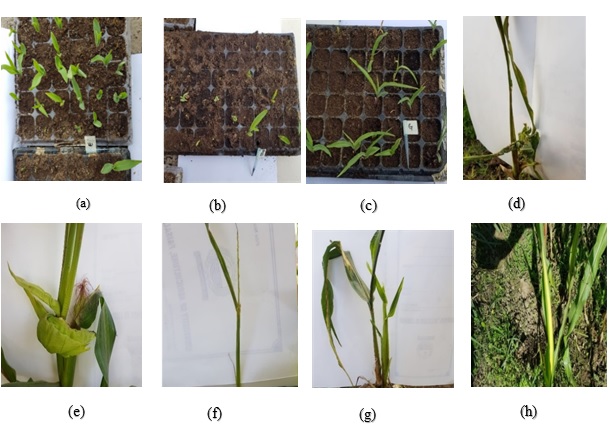
Total of 55 mutants survived from both genotypes. Delayed germination was observed for EMS higher concentrations. Maximum survival rate was observed for 25 mM concentration. However, survival rate decreased with increase in EMS concentration. Abnormal growth patterns were observed on all EMS concentrations like albino leave patterns, retarded plant growth, retarded cobs and tassel morphology and in some cases absence of cobs and tassels. Mutants derived from 25 mM concentration showed less abnormalities as compared to 50 and 75 mM mutants. As illustrated in online Supplementary Fig. S1.
Molecular data analysis
SSR PCR analysis was carried out for total 10 loci for 57 samples (55 mutants + 2 Genotypes). Results showed amplification of total 28 alleles with average alleles of 2.6 and 2.8 for P1 and P2, respectively. Average heterozygosity content was 0.58 for P1 and 0.53 for P2. Umc-1191 and Pumc-1071 were the most heterozygous among other loci showing 0.78 and 0.88 heterozygosity content. Lowest heterozygosity estimates were observed for Nc-030 and Pumc-1013 by 0.39 and 0, respectively as written in Table 1. UPGMA cluster analysis, characterized the population into 2 main and many groups. Highest similarity contents were observed between M24–M23, M30–M20 and M38–M29 by 0.92, 0.91 and 0.87, respectively. All of the above-mentioned mutants were derived from genotype 100,004. Highest estimates of genetic distance were observed between M50–M11, M52–M11 and M43–M11 by 2.49, 2.194 and 2.19, respectively. Among which M11 was derived from 100,003 and the remaining 50, 43 and 52 were from 100,004. Dendrogram is shown in Fig. 1.
Dendrogram based on UPGMA.

Homozygosity and Heterozygosity contents in total and population wise

Ho, Observed heterozygosity; He, Expected heterozygosity; ho, Observed homozygosity; he, Expected homozygosity; Nei Exp. H, Nei exp. Heterozygosity. Whereas, Pumc, Phi, Nc and Umc are the name of the SSR markers used in this study
Phenotypic data analysis
Total 31 mutants which reproduced seeds successfully were selected for PCA analysis. Mean, standard deviation and coefficient of variance were also calculated. Coefficient of variance showed the amount of variation present in the population. Highest estimates of CV were observed for LA, CH, NC, PH and IND by 42.2, 41, 34.7, 28.1 and 27.9, respectively. As shown in Table 2.
Descriptive statistics

Standard deviation (SD), Coefficient of variance (CV%), No. of Nodes (NN), No. of leaves (NL), Leaf area (LA), Days to tassel (DT), Days to silking (DS), Internodal distance (IND), Plant height (PH), Cob height (CH).
Out of 9 principal components (PC), PC 1 and 2 collectively represented 64.3% variation. In PC1 PH, CH and LA contributed majorly. PH contributed for about 15.71%, CH for about 14.5% and LA for about 14.2%. While in PC2, NC, IND and NN contributed about 42.9, 31.4 and 11%, respectively. PC1 and PC2 explained about 52.46 and 64.3% variability with eigenvalues 4.72 and 1.1, respectively. In PC1, PH showed the highest value of eigenvector. While DT showed the lowest. In PC2, IND obtained the lowest value while NC showed the highest eigenvalue as shown in Table 3. Mutants were characterized on phenotypic basis in bi-plot analysis illustrated in Fig. 2.
Principle component analysis.

Principal component analysis

Principal component (PC), Eigenvectors (EV), Factor loadings (FL), Individual contribution of traits (Cont.), No. of nodes (NN), No. of leaves (NL), Leaf area (LA), Days to tassel (DT), Days to silking (DS), Internodal distance (IND), Plant height (PH), Cob height (CH).
Discussion
In present investigation the most appropriate dose for the induction of genetic variation was observed on 25 mM for both genotypes. EMS concentrations of 50 and 75 mM induced the changes with higher abnormalities and less survival rate then 25 mM. (Laskar et al., Reference Laskar, Sheikh, Hajong and Khan2020) found Lethal Dose LD50 of EMS in maize as 117.5 mM for 6-h EMS treatment. In another study mutant population was obtained using EMS seed treatment on various concentrations. LD50 was recorded on 60 mM and increased concentration was responsible for reduced yield, chromosomal abnormalities and reduced physiological attributes, (Aslam et al., Reference Aslam, Saeed, Sattar, Rehan and Sajjad2018). Depending upon different wheat genotypes, optimum dose of EMS varied from 0.4 to 1.8% v/v for 2 h treatment, (Shimelis et al., Reference Shimelis, Olaolorun, Mathew and Laing2019). In rice LD25 and LD50 was observed on 0.25 and 0.5% concentration, (Talebi et al., Reference Talebi, Talebi and Shahrokhifar2012). Which means different genotypes shows different responses to similar EMS concentrations.
SSR analysis was very useful for the detection of genetic variation and characterization of the population. Mean heterozygosity content for genotypes P1 and P2 was 0.58 and 0.53, respectively. Fst was 0.044 with P-value 0.001, indicating presence of significant genetic variation in population. In a study, characterization was preformed based on molecular data. Qin et al. (Reference Qin, Cai, Yang and Wang2008) analysed 48 mutants by using 52 SSRs. Average allele per locus were 3.27 ranged from 2 to 6. 0.32 mean polymorphic content was observed and UPGMA analysis characterized mutants in 6 groups. SSR Analysis of 118 mutants derived from 3 inbreds showed average polymorphic content as 0.5, 0.59 and 0.71, respectively, (Qiao et al., Reference Qiao, Shi, Ke, Yuan and Yu2012). Implications of SSRs in assessment of variation and characterization of maize population helps a lot for selection of potential donors which can be exploited in future breeding programmes (Adeyemo et al., Reference Adeyemo, Menkir, Melaku and Omidiji2012; Li et al., Reference Li, Lu, Lan, Yang, Jin, Qiao, Lu, Meng and Chen2013).
Principal component analysis of mutants assessed the variation in population. PC1 and PC2 both explained cumulative variability of 64.28%. Descriptive statistics showed highest coefficient of variation among LA, CH, PH and IND traits. Biplot analysis characterized the mutants on phenotypic basis. For improvement of LA, M27, M8 and M10 can be further selected as donors due to their superior performance regarding that particular trait. Like that for PH M5 can be selected, M18, M22, M36, M12 for CH and M17 for IND.
Results of UPGMA and biplot analysis were also in line with each other. M11 was categorized in different cluster with respect to rest of the population, both in UPGMA dendrogram and Biplot. However, M11 exhibited superior performance in terms of phenotypic traits from the rest of population. Moreover, M12 was found as a promising line for the improvement of CH shown by Biplot analysis while in SSR results M12 was clustered with M27, superior in terms of LA shown by Biplot analysis. It shows that they are genetically close but differs for these two specific phenotypic traits. M22 was also found to be superior in terms of CH and M8 in terms of LA. As both mutants are derived from different parents categorized into different clusters by UPGMA dendrogram, in future they can be crossed to produce a superior genotype in future and resultant variation can be exploited in future. Hameed et al. (Reference Hameed, Khan, Sadaqat and Awan2019) evaluated rice mutants using PCA. Results showed contribution of both PCs of about 52.6% variation in M1 and 54.4% in M2. In another study for the selection of drought tolerant genotypes PCA was used. Results exhibited contribution of both PCs about 78, 72.5 and 68% variation in treatment 1, 2 and 3, respectively. In result, better performer genotypes were recommended under various treatments, (Aslam, Reference Aslam2014). Assessment of genetic diversity, selection of genotypes for improvement of yield contributing traits, identification of potential parents for future breeding and selection for stress resistant genotypes can be performed using PCA, (Maqbool et al., Reference Maqbool, Aslam, Ali, Shah, Farid and Zaman2015; Al-Naggar et al., Reference Al-Naggar, Shafik and Musa2020).
Conclusions
EMS mutagenesis is an efficient technique for the induction of genetic variation in crop plants especially in indigenous germplasms. It requires less time and cost as compared to other conventional methods. In present study optimal concentration for EMS was found as 25 mM, generating enough variation with maximum survival rate. Combining this technique with molecular markers enables to identify potential mutants and carry out efficient selection in relatively less time. Which can be further used in crop improvement programmes. These techniques collectively can speed up the process of varietal development and holds much of unexplored potential for genetic improvement of crop plants.
Supplementary material
The supplementary material for this article can be found at https://doi.org/10.1017/S1479262123000023.
Acknowledgements
The authors are thankful to Center of Agricultural Biochemistry and Biotechnology, UAF. For providing the Lab facility.