The memory deficits associated with adult aging have been well documented (Kausler, 1994), as have been the attempts to localize the loss, whether in terms of memory stores or processes (Salthouse, 1991; Zacks, Hasher, & Li, 2000). Of interest, less attention has been given historically to those processes that are resistant to aging effects. One of the cases that has been noted in the literature is the dramatic dissociation between older adults' poor ability in recall of unstructured word lists (e.g., Kahana, Howard, Zaromb, & Wingfield, 2002) relative to their generally good recall of meaningful sentences even when the number of words to be recalled are equated (see the review in Wingfield & Stine-Morrow, 2000).
We have two goals in this present paper. The first is to test whether Potter's (1993, 1999) model of conceptual short-term memory (CSTM), first demonstrated using a rapid serial presentation of written words, can be shown to generalize to spoken sentence presentations. In so doing we added several stimulus conditions designed to rule out possible alternative interpretations of Potter's original data. Our second goal was to determine whether the sort of CSTM proposed by Potter is preserved in normal aging and may serve as an account for older adults' well-documented success in recall of meaningful sentences.
Theorists have long postulated the need for a brief verbatim or phonological memory trace for heard speech as a requisite for effective language processing. Such a brief trace would allow for retrospective recognition of an indistinct or poorly articulated word based on the context that follows that word (Connine, Blasko, & Hall, 1991; Grosjean, 1985) as well as allowing for a second pass of the surface form of a sentence to correct any initial parsing errors. A brief verbatim store of the surface features of a sentence would also allow additional time for syntactic processing (Fodor, Bever, & Garrett, 1974) and higher level semantic integration (van Dijk & Kintsch, 1983). This notion of a transient verbal memory store based on an articulatory or phonological code fits well with the two-store memory models of the 1960s (Atkinson & Shiffrin, 1968; Conrad, 1964), and later as one element of a larger working memory system (Baddeley, 1986, 1992).
At issue is not whether such a transient phonological short-term store exists. Evidence for such a store can be seen in individuals' manifest ability to recall nonsense word lists or, on a surprise test of recall for connected speech, to produce apparent verbatim recovery of a preceding full clause or sentence (Glanzer, Fisher, & Dorfman, 1981; Jarvella, 1971). Rather, the question is whether this verbatim phonological memory store is necessary for ordinary language comprehension. An alternative postulate is that incoming speech has direct access to a conceptually based short-term store. Evidence for the existence of an immediate conceptual short-term store that does not rely on an initial gateway phonological or articulatory store has been seen in reports of brain-injured patients with dramatically limited phonological or articulatory memory yet who have surprisingly good sentence comprehension (e.g., Butterworth, Campbell, & Howard, 1986; Caplan & Waters, 1990; Martin, 1993; Martin, Shelton, & Yaffee, 1994; Saffran & Martin, 1999). In a demonstration consistent with the coexistence of phonological and conceptual stores Martin et al. (1994) described two patients: one with a selective impairment in short-term retention of phonological information, and the other with a selective impairment in short-term retention of semantic information. The patient with the phonological deficit was better at sentence comprehension, whereas the patient with the semantic deficit was better at verbatim repetition of sentence materials.
It is the case that some brain-injured patients with verbatim (phonological) memory deficits have difficulty with language comprehension and still others can successfully comprehend short or syntactically simple sentences but have difficulty with longer or syntactically challenging sentences (c.f., Caplan & Waters, 1999; Martin, 1999; McCarthy & Warrington, 1999). When cases of a dissociation between verbatim memory capability and sentence comprehension are observed, however, they are difficult to reconcile with traditional memory models in which a phonologically based STM store is an obligatory gateway for verbal materials to reach long-term memory and higher cognitive processing (Atkinson & Shiffrin, 1968). Rather, they suggest that conceptual encoding of a sentence may involve another pathway that does not rely on an interim phonological store prior to access to syntactic and conceptual information about the sentence (see Caplan & Waters, 1999).
Based on such findings, a number of authors have postulated that a far more complex memory system must be needed to carry online sentence comprehension than the previously described two-store memory models of the 1960s. Martin, for example, has argued persuasively from the neuropsychological literature for the need to maintain phonological, lexical–semantic, and syntactic information during sentence processing (Martin, 1999; Martin & Romani, 1994; Martin et al., 1994). Our particular focus in this paper is on one possible component of such a complex memory system. This is the postulate that as a sentence is being heard multiple memory traces may be formed concurrently, and that such traces may coexist for a brief period rather than one form of trace being replaced by the other.
Potter (1993, 1999) has proposed a system that embodies this principle. This system proposes a CSTM, which is a specialized store that briefly holds a conceptually based representation of information. Even when verbatim recall of a sentence is requested this may be based on a CSTM rather than a phonological trace. Incoming information will enter CSTM where it is briefly maintained and integrated into a coherent structure and used as a conceptual framework to allow regeneration of that material. The model proposes that information that does not fit this requirement is retained only as a phonological trace and will decay rapidly without rehearsal. An important point in Potter's analysis is that accurate, veridical recall need not imply that the recall was necessarily generated from a verbatim phonological store. Knowledge of sentence meaning and whether the phrasing had been canonical for that meaning could be used to reconstruct the probable wording of the stimulus sentence that would make it appear as if one were observing reproduction from a verbatim store rather than a reconstruction from a conceptual representation. This proposition is in accord with demonstrations that individuals may accurately regenerate a sentence based on a stored representation of the sentence meaning plus its syntactic form (Savin & Perchonock, 1965), and the appearance of additions and substitutions in sentence recall that maintain syntactic and semantic coherence (e.g., Wingfield, Tun, & Rosen, 1995).
Potter, Stiefbold, and Moryadas (1998) illustrated the effects of the proposed CSTM store in an experiment in which they presented written sentences using rapid serial visual presentation (RSVP), a technique in which the words of a sentence are presented one by one in a single location for a brief period of time on a computer screen. In their experiment, two words (one above the other) were presented at a specific juncture within each sentence. One of these target words fit with the semantic context of the sentence and the other was unrelated to the meaning of the sentence. After the entire sentence had been presented participants were asked to attempt to recall the sentence with only one of the words from the pair. Following this recall participants were then asked to attempt to recall the second word. Potter et al. found that the word that was congruent with the meaning of the sentence was usually the one recalled with the sentence. In contrast, the incongruent word was rarely recalled, and many of the participants reported no conscious recollection of having seen the incongruent word.
Potter (1993, 1999) argued that this finding, that context strongly biases selection from a double-word array, is more consistent with the proposed characteristics of a CSTM than exclusive reliance on a phonological short-term store in sentence recall. If participants were relying exclusively on a phonological short-term store, for which context is proposed to have no direct effect, one would not expect to see an encoding bias for the congruent word of the double-word array. Although such a finding might result from a response bias, as often occurs in recall from longer term memory (e.g., Alba & Hasher, 1983), the rapid presentation of the words using the RSVP technique and the request for immediate recall favors the argument for an encoding bias for the semantically congruent word based on a conceptual understanding of the sentence that was being formed as the sentence was being presented.
Potter (1993) conceived of the CSTM as co-occurring, and potentially working in conjunction, with a phonological store. The distinction between the two stores centers on the nature of the codes that are maintained. Information is stored as conceptual units in CSTM, whereas information is stored as an acoustic or articulatory trace in the phonological store. The novel aspect of Potter's model is her proposition that the input lays down two traces; a conceptual trace as well as a brief phonological trace, with the two forms of memory code running in parallel (Potter, 1993). This view directly counters early memory and language processing models that postulated an initial verbatim, semantically unanalyzed, phonological, or articulatory store that is necessary for holding speech content to give time for either immediate recall or for semantic analysis and then storage in long-term memory (cf., Atkinson & Shiffrin, 1968; Fodor et al., 1974).
There are some conditions where a transient short-term verbatim store as traditionally envisaged is required as a necessary backup when online analysis fails (see, e.g., the argument by McCarthy & Warrington, 1999). The CSTM postulate sees this verbatim store as a briefly available backup when the verbatim input needs to be readdressed. It does not see this transient veridical storage as an obligatory stage in a processing sequence from sensory input to conceptual encoding.
The purpose of the present study was to test, for both young and older adults, Potter's CSTM model using a modified version of the Potter et al. (1998) double-word selection task. For this purpose we introduced four major changes to their original study: the modality of presentation, the characteristics of the word pairs, an additional test of recognition memory for the nonselected incongruent members of a word pair, and finally, an expansion of the participant groups beyond the university-aged young adult participants used by Potter et al. In the following sections we consider each of these changes and their implications in turn.
PRESENTATION MODALITY
Potter (1993) suggested that the CSTM, although proposed in the context of reading, should work similarly in the auditory modality. Although this may be true, Potter's use of a visual presentation of word pairs in the previous studies adds a layer of interpretive complexity: activation of word meaning may necessitate phonological activation, or there may be a direct mapping from orthography to meaning (for a discussion, see Coltheart, Curtis, Atkins, & Haller, 1993). Given these possibilities it could be argued that the use of visual presentations of sentences and word pairs limited the applicability of the findings, and hence, the proposed model's utility in describing spoken language processing. One test of the generality of the Potter model, along with the additional manipulations to be described, would thus be to change the presentation modality from visual to auditory. A failure to replicate Potter's major findings would suggest that her results were a consequence of presentation modality. A replication would support her postulate of the direct formation of a conceptual store that is independent of the modality of presentation.
In the present study the stimuli consisted of spoken sentences presented binaurally (to both ears). In a manner analogous to Potter et al.'s (1998) RSVP presentation, at a certain point in the sentence a pair of words was presented simultaneously. In this case the simultaneous words were presented dichotically (one word of the pair presented to one ear and the other word to the other ear). As with the RSVP paradigm for printed words, with connected speech the word input arrives rapidly and the participant has no control over this input rate.
Other than the change in input modality the general outline of the double-word selection task was maintained: participants were asked to recall the sentence using one of the two words of the word pair and then to attempt to recall the second word of the pair. According to the Potter model, one would expect that the relevant information (a word congruent with the sentence meaning) would be encoded with the sentence in the CSTM. In contrast, the irrelevant information (a word incongruent with the sentence meaning) might be maintained briefly in a parallel phonologically based store, but it would not qualify for inclusion in CSTM. Any recall of the noncongruent word would be attributed to accessibility of the word from the phonological trace prior to its decay.
WORD-PAIR CHARACTERISTICS
A second major methodological change to the Potter et al. (1998) experiment was to expand the characteristics of the word pairs. The word pairs used by Potter et al. (1998) always pitted words that were highly congruent with the sentence meaning against words that were entirely incongruent with the sentence meaning. Because the highly congruent words were also highly predictable within the sentence contexts, it was difficult to discern whether the participants selected the congruent word for recall because it had been conceptually encoded with the sentence, as argued by Potter et al., or whether at the time of recall of the sentence the participants simply inserted a highly predictable word that happened to be correct. To tease apart an account based on early selection in initial encoding versus reconstruction in recall, in the current experiment we varied the relationship of the words used in the word pair to the meaning of the sentence. The nature of these pairings, we will show, make different predictions as to outcome on sentence recall and the likelihood of a word from a word pair being recalled as part of that sentence.
WORD-PAIR GOODNESS OF FIT
In Potter et al.'s (1998) original experiment word pairs always included one word that was highly congruent with the sentence context and one word that was incongruent. This condition, which we denote as strongly congruent/incongruent, was included in the present experiment. In this case, the participant might binaurally hear the sentence, “She asked for two scoops of ______ on a cone,” with the strongly congruent word chocolate presented to one ear and the incongruent word fabric presented concurrently to the other ear. We can express this schematically as, “She asked for two scoops of chocolate/fabric on a cone.”
Following Potter et al.'s (1998) argument, if the word that is strongly congruent with the sentence content is the one encoded in the CSTM representation of the sentence, participants should produce this word in their recall of the sentence. One would also predict that in these cases the sentence itself would be recalled more accurately. This would be so because the encoding of the strongly congruent word with the overall meaning of the sentence would bring increased coherence to the sentence. Finally, because the incongruent word would not have been encoded within the CSTM representation, one would expect a low probability of recall of this incongruent word when participants are specifically asked for the second member of the word pair following the sentence recall.
In addition to employing strongly congruent/incongruent word pairings as used by Potter et al. (1998), we added a condition in which we combined an incongruent word with a word that would fit with the meaning of the sentence but with a lower probability, namely, weakly incongruent/incongruent. Presumably, if the level of congruency between the sentence and the target words was reduced, the strength of conceptual encoding would also be reduced. This would lead to a lower likelihood that the weakly congruent word would be recalled as part of the sentence relative to a word that was strongly congruent with the sentence. This reduced degree of congruency might also reduce the binding effect of the congruent word, leading to poorer recall of the sentence as a whole, again, relative to a strongly congruent/incongruent word pairing.
Such an outcome would not allow one to directly answer the question of whether the bias for recalling the congruent word in the sentence was due to the fact that it was encoded with the conceptual representation of the sentence, as Potter (1993, 1999) would argue, or whether the production of a highly congruent word in sentence recall reflects a response bias during the act of recall. Either of these effects could lead to a lower probability of recall of a weakly congruent word relative to a highly congruent word. However, if recall of the weakly congruent word in the weakly congruent/incongruent condition does not show a significant drop relative to recall of the strongly congruent word in the strongly congruent/incongruent condition, it would argue against the response bias explanation of the results.
In Potter's (1993, 1999) model, items not conceptually related to the meaning of a sentence will be forgotten at higher rates than those that are congruent with the sentence meaning. It is this feature of the CSTM model that we examined with the above conditions. Not directly answered in the model as thus far presented is what would be the outcome on word and sentence recall if both members of a word pair are, to one degree or another, a conceptual fit with the sentence frame. To answer this question we added three additional word-pair conditions.
In one of these conditions participants would hear a sentence with a dichotic word pair, with one of the words in the pair being highly congruent with the sentence meaning and the other also congruent but with a less probable fit. We refer to this as a strongly congruent/weakly congruent condition. This condition might be represented by a sentence and dichotic word-pair combination such as, “She asked for two scoops of chocolate/coconut on a cone.” In a second additional condition both words of the word pair were strongly congruent with the sentence frame (strongly congruent/strongly congruent), as in the example, “She asked for two scoops of chocolate/vanilla on a cone.” In the final combination condition, participants received a word pair consisting of two words that were congruent with the sentence meaning but of low probability as a fit to the sentence (weakly congruent/weakly congruent). Such a sentence and dichotic word pair might be, “She asked for two scoops of coconut/lemon on a cone.”
The predictions for recall in these cases follow the same logic as above; namely, selection of a word for recall in the sentence and probability for recall of the second word following the sentence is driven by the level of conceptual match or strength of conceptual fit between the words and the sentence. Specifically, when both items from the word pair are strongly congruent with the meaning of the sentence recall of both words should be greatest. As the conceptual fit decreases (strongly congruent/strongly congruent, strongly congruent/weakly congruent, and then weakly congruent/weakly congruent) the level of recall of both words will decrease. The model predicts that when both words fit within the conceptual structure of the sentence both should be encoded in CSTM. These predictions are in contrast to the pairings described above when one of the items from the word pair does not fit within the conceptual structure of the sentence and is then forgotten.
One alternative explanation for the findings reported by Potter et al. (1998), that congruent words are recalled in the sentence and incongruent words are forgotten, is that output interference affects recall performance. If participants adopted a strategy with a goal of increasing the likelihood of correct sentence recall, then it is conceivable that they recalled the congruent word in the sentence not because it was encoded with the sentence but because it created increased coherence in the sentence and allowed for greater ease of sentence recall. In this case recall of the incongruent word would be postponed until after the sentence, leaving the possibility that the act of recalling the sentence resulted in output interference that negatively affected recall of the incongruent word. A direct comparison of the strongly congruent/incongruent and strongly congruent/strongly congruent conditions would allow us to address this issue. These two conditions are identical with the exception of the replacement of a strongly congruent word for an incongruent word. If output interference played a role in the results, we would expect the second strongly congruent word in the strongly congruent/strongly congruent pair to be recalled only as often as the incongruent word in the strongly congruent/incongruent condition. However, if the basis of the CSTM model is correct, we would expect the incongruent word of the strongly congruent/incongruent pair to be recalled much less often than the second strongly congruent word in the strongly congruent/strongly congruent pair. This result would indicate that the lack of semantic fit of the incongruent word, and not output interference, was responsible for participant's forgetting of the incongruent word.
RECOGNITION OF THE INCONGRUENT WORD
The model is clear in its claim that an incongruent word will be maintained briefly only in the phonological store. It is presumed that it is the rapid decay of the phonological trace that yields the lower likelihood that an incongruent word will be available for recall after the sentence has been recalled (Potter et al., 1998). There still remains the possibility, however, that the participant might recognize the incongruent word even though it was not accessible to free recall. To examine this possibility we conducted a recognition test for nonselected incongruent words that were not recalled either as part of a sentence nor recalled as the unselected word after the sentence had been recalled.
GENERALIZABILITY OF THE MODEL TO OLDER ADULTS
Although healthy older adults, as indicated previously, show poorer recall in almost all episodic memory tasks (Kausler, 1994), age differences are small when recall of meaningful sentences is contrasted with equal-length lists of unrelated words (see reviews in Kausler, 1994; Wingfield & Stine-Morrow, 2000). Although Potter and colleagues followed the tradition of testing their model with undergraduate participants, their conclusions would appear to fit well with this difference in the character of recall in older adults.
To the extent that one would observe a similar pattern of results between young and older adults across conditions, one would be able to confirm the robustness of the Potter et al. (1998) findings, not only across presentation modalities, but also across two different populations with well-known differences in general mnemonic ability. Because of these differences, our argument would be based not on whether absolute levels of recall would be the same for young and older adults but on the potential similarity in relative effects on recall of the relationships between the target words and their sentence frames. Such a pattern similarity in condition effects, should it occur, would also support the notion that the good recall of sentences relative to word lists so often observed in older adults (Kausler, 1994) reflects a spared CSTM in older adulthood in contrast with a declining efficiency for verbatim phonological coding and retrieval. This is not the only possible outcome one might observe. One might see differential effects of the various congruency conditions on the young adults' performance that does not replicate for older adults. Should such an outcome be observed, the effect could still support Potter's (1993, 1999) two-store position but it would imply that the efficacy of both forms of memory store decline in adult aging. Were this the case it might imply that the good recall older adults generally show for meaningful speech relative to unstructured word lists so well documented in the literature would be attributable primarily to the effective use of spared top-down linguistic and real-world knowledge to support output recall.
METHODS
Participants
The young adult participants were 30 university students (22 women, 8 men) with ages ranging from 18 to 23 years (M = 19.1 years, SD = 1.4). They had a mean of 12.9 years of formal education at time of testing (SD = 1.3) and a mean Wechsler Adult Intelligence Scale (WAIS; Wechsler, 1997) vocabulary score of 52.9 (SD = 6.7). The older adults were 30 healthy, community-dwelling volunteers (21 women, 9 men) with ages ranging from 63 to 83 years (M = 72.6 years, SD = 4.4). The older adults had a mean of 16.5 years of formal education (SD = 2.6) and a mean WAIS vocabulary score of 57.8 (SD = 5.6).
Both groups were thus well educated and had good verbal ability, with the older group having an average of 3.6 more years of formal education, t (58) = 6.90, p < .001, and, as is common with older adults (Verhaeghen, 2003), a somewhat higher vocabulary score than the young group, t (58) = 3.00, p < .01. All participants were native speakers of English, and none had a history of stroke or illness that might affect cognitive performance. (Two young adults and one older adult whose sentence recall fell below 2 SD of the group means were replaced.)
Although the older adults in this study had good hearing for their ages (Morrell, Gordon-Salant, Pearson, Brant, & Fozard, 1996), significant differences in acuity were present relative to the young adults. In general, the younger participants had better hearing acuity than the older participants, as measured by pure tone averages (PTA) for 500, 1000, and 2000 Hz (young M = 11.9 dB, SD = 4.4; older M = 20.9 dB, SD = 8.4) with approximately symmetrical hearing for both ears. A cutoff of 25 dB is typically taken as clinically normal, placing both groups in the clinically normal range for speech (Hall & Mueller, 1997).
Stimuli
The stimuli were constructed on a base of 105, 8- to 10-word English sentence frames. For each frame sets of word pairs would be heard 2–5 words from the end of the sentence. The stimuli were prepared such that the sentence frame would be heard binaurally (to both ears), with the exception of the paired words, which would be heard dichotically (a different word to each ear). For each sentence five different types of word pairs were constructed representing the five different congruency combinations previously described (strongly congruent/incongruent, weakly congruent/incongruent, strongly congruent/strongly congruent, strongly congruent/weakly congruent, weakly congruent/weakly congruent).
The sentence frames and word pairs were selected from the norms given in Little, Prentice, and Wingfield (2004), in which 303 participants rated the goodness of fit of sets of alternative words to the sentence frames. We took as highly congruent words those that had an average goodness of fit rating of 6.8 (SD = 1.03) on a 1–9 rating scale, and as weakly congruent words that had an average goodness of fit of 3.5 (SD = 1.16). These norms were collected for both young and older adults, with exemplars for use in this experiment chosen only for cases with good age agreement on the goodness of fit ratings.
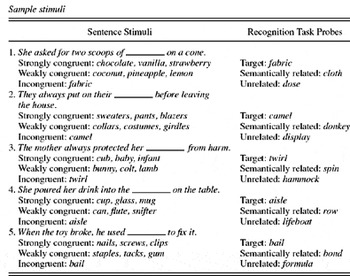
To control for potential salience effects the exemplars chosen for the word pairs were all rated as having high familiarity in the Hoosier Mental Lexicon database (Nusbaum, Pisoni, & Davis, 1984) and the members of each word pair were matched on their Hoosier familiarity ratings. The ease and speed of perception of individual words can vary with factors such as the number of words that share the word's onset (Marslen-Wilson, 1984; Wayland, Wingfield, & Goodglass, 1989), or more generally, the word's neighborhood density (Luce, Pisoni, & Goldinger, 1990). Because of the constraints imposed by the congruency manipulation we were unable, from existing databases, to equate the stimulus words for neighborhood density. Although potential effects of neighborhood density on the speed and/or ease of word identification might be nullified by effects of context, we conducted pretesting to ensure that the words used as stimuli in the various conditions were all easily recognizable when presented in isolation from their sentence contexts. Appendix A shows six sample sentence frames along with three exemplars of highly congruent or weakly congruent words available for presentation with these sentence frames plus an incongruent word for each frame.
Recordings were made of each of the potential word-pair members for each sentence. To ensure natural prosody, each of the words was recorded as part of the sentence in which it might be heard. Once these recordings were made, a sound editing software program (SoundEdit 16; Macromedia, San Francisco, CA) was used to prepare the specific word-pair combinations, which were spliced into a single rendition of the relevant sentence frame at the appropriate point in the sentence. All of the sentences and word pairs were recorded by the same female speaker of American English at an average speech rate of 140 words per minute (wpm). In the preparation of the stimuli the volume of the two members of each word pair was adjusted to the same level and equivalence of duration of the two members was ensured by digitally expanding or compressing the words in a pair as needed. The compression/expansion algorithm was applied equally across the full word rather than operating only on the steady state portions of the words to preserve original word stress often carried by relative steady-state durations (Janse, 2003).
Procedures
Each of the participants was tested individually in a sound-attenuated testing room. Participants were told that they would hear a series of sentences over both ears of the earphones they would be wearing. Participants were told that at a certain point in the sentence they would hear two simultaneous words, one heard in one ear and the other heard in the other ear. They were told that when a sentence had been heard they were to first attempt to recall the full sentence, being sure to include in the sentence one of the two words presented in the dichotic word pair. Following this recall they were then to attempt to recall the other member of the word pair that they had not recalled with the sentence. Participants received a tone accompanied by the recorded instruction to “recall the sentence” 750 ms after the end of each sentence. This tone and instruction introduced a delay of 2.2 s before recall could be initiated.
Each participant heard all 105 sentence frames, with 21 sentences and word-pair combinations for each of the five congruency conditions. Although each participant heard each sentence frame only once, across participants the different possible word-pair combinations for that sentence were heard an equal number of times. Because of potential ear preference effects, the ear in which the strongly, weakly, or incongruent word-pair members were heard was randomized and counterbalanced across participants.
Forty-two of the 105 sentences heard by each participant contained an incongruent word as one of the words in the word pair, which was either combined with a highly congruent word (21 sentences) or a weakly congruent word (21 sentences). For these 42 sentences participants were given a recognition test for the incongruent word. That is, following recall of the sentence and attempted recall of the word not included with the sentence, participants saw a word visually presented on the computer screen with the instruction to press a “yes” or “no” key on a response box as to whether that word had been one of the words heard. Our focus was on testing recognition memory only for the incongruent word of the word pair, a word that we expected to be rarely recalled based on the results of the Potter et al. (1998) study.
Following recall of a sentence, participants were presented with one of three types of recognition probes. For example, for a sentence with a strongly congruent/incongruent word pair (e.g., “She asked for two scoops of vanilla/fabric on a cone,” participants might see either the incongruent target word (fabric), a word semantically related to that word (e.g., cloth), or a word unrelated to either of the target word or to the sentence (e.g., dose). The semantically related words were either direct synonyms for the target words or words with high free association probabilities to those words (Nelson, McEvoy, & Schreiber, 1998). Examples of recognition probes consisting of the unrelated (target) words, words semantically related to the target words, and unrelated words, are shown in Appendix A for each of the eight sample sentences.
To avoid confusion of instructions the 42 sentences heard with an incongruent word-pair member for which recognition testing would be conducted were presented as a block, with the order of presentation of the sentences within this block varied randomly between participants. The remaining 63 sentences (e.g., strongly congruent/strongly congruent, strongly congruent/weakly congruent, and weakly congruent/weakly congruent) were also presented in a block and randomized. The order of presentation of the two blocks was counterbalanced across participants. The experiment was preceded by a brief practice session using sentences and word pairs different from those used in the main experiment. During this practice session participants were instructed to adjust the volume of the speech over the earphones to a comfortable listening level which was maintained for that participant throughout the experiment.
Like Potter et al.'s (1998) RSVP technique with written sentences, we also wished to present our stimuli at a rate that would not produce ceiling effects. Potter et al.'s goal, like ours, was to ensure that presentation rates were sufficiently rapid so as to discourage rehearsal of the sentences as they were being heard. Based on a pilot study conducted with 12 young and 12 older adults who were presented with these sentences time compressed to various speech rates, we found two rates that would produce approximately a verbatim recall of 80% of correct words within the sentences for both participant groups. Two rates were needed both because of the poorer mnemonic capability of older adults (Kausler, 1994; Wingfield & Stine-Morrow, 2000) and their greater difficulty with comprehension (Wingfield, Peelle, & Grossman, 2003) and recall (Wingfield, Tun, Koh, & Rosen, 1999) of rapidly presented speech relative to young adults. The two rates chosen were 175 wpm for the older participants and 250 wpm for the young adult participants.
RESULTS
Accuracy of full-sentence recall
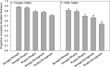
Figure 1 shows the mean proportion of sentences correctly recalled depending on the goodness of fit of the word-pair combinations with the stimulus sentences for the young (left panel) and older (right panel) participants.

The proportion of sentences correctly recalled depending on the goodness of fit of the word-pair combinations with the stimulus sentences for the (a) younger and (b) older adults. Error bars represent 1 SE.
The data shown in Figure 1 were submitted to a 2 (Age) ×5 (Word Pair) analysis of variance (ANOVA), with word pair as a within-participants variable.
As can be seen in Figure 1, accuracy for sentence recall decreased as conceptual fit of items in the word pair decreased. Recall of the full sentence was best when both items from the word pair were highly congruent with the sentence (strongly congruent/strongly congruent) and poorest when a weakly congruent word was paired with a word that was not congruent with the sentence content (weakly congruent/incongruent). This observation was supported by a significant main effect of word pair, F (4, 232) = 52.48, p < .001, η2 = .48. As can also be seen in Figure 1, this pattern of effects was similar for both the young and older participants. The Age × Word Pair interaction was not significant, F (4, 232) = 1.79, ns, η2 = .03.
Although an attempt was made to put both age groups on the same baseline by using different speech presentation rates for the two groups, the young participants showed an overall higher level of recall accuracy than the older adults, as confirmed by a main effect of age, F (1, 58) = 28.50, p < .001, η2 = .33. The suggestion in Figure 1 of the age difference increasing as one moves from the strongly congruent/strongly congruent to the weakly congruent/incongruent condition was not, as indicated above, supported by a significant Age × Word Pair interaction.
Accuracy of word-pair recall
Recall of the selected word
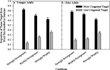
In this analysis we focus on the question of which word of the word pair was recalled with the sentence in just those three of the five conditions in which the two members of the word pair differed in their degree of congruency with the sentence (strongly congruent/incongruent; weakly congruent/incongruent; strongly congruent/weakly congruent). These data are shown in Figure 2, in which we plot the proportion of times the words with higher or lower congruency with the sentences were recalled in the sentence for those cases where the full sentence was correctly recalled. These data are shown for the younger and older adults.

The proportion of times the more congruent word or less congruent word from the word pair was chosen for recall in the sentence for (a) younger and (b) older adults. Data are shown only for pair combinations unequal in their degree of congruency with sentence content. Error bars represent 1 SE.
The data shown in Figure 2 were submitted to a 2 (Age) × 3 (Word Pair) × 2 (Level of Semantic Fit of a Word in the Word Pair Relative to the Other Member of the Pair) ANOVA, with word pair and level of semantic fit as within-participants variables. As suggested by inspection of Figure 2, there was a significant main effect of level of semantic fit, F (1, 58) = 399.21, p < .001, η2 = .87, reflecting the finding that in all cases the word that was more strongly congruent with the sentence content was the one that was recalled with the sentence. However, there was a significant Word Pair × Level of Semantic Fit interaction, F (2, 116) = 37.24, p < .001, η2 = .39, reflecting the finding that as the words in the word pair became more equivalent in congruency, the probability of recalling the more congruent word in the sentence decreased. There was no significant main effect of age nor did age interact with either of the variables, consistent with the younger and older adults, demonstrating the same contextual bias for which word would be recalled with the sentence.
Even though accuracy was greatly reduced as the congruency between the word and sentence decreased, all subjects showed recall significantly greater than zero, demonstrating that they were able to recall the weakly congruent word and were not reconstructing the sentence without influence from the word that was presented, t (58) = 11.57, p < .01.
Recall of the nonselected word
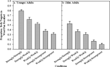
In Figure 3 we show the proportion of cases when both words, one recalled with the sentence and one recalled following the sentence, were correctly reported. These cases are shown for all five word-pair combination conditions used in the present experiment. The young adult data are shown in the left panel and the older adult data shown in the right panel.

The proportion of times that participants were able to report both presented words as a function of the goodness of fit of the word-pair combinations. Data are shown for the (a) younger and (b) older adults. Error bars represent 1 SE.
The data shown in Figure 3 were submitted to a 2 (Age) × 5 (Word Pair) ANOVA. As with the overall sentence recall accuracy shown in Figure 1, Figure 3 shows there was a significant main effect of congruency of the word pair on recall, F (4, 232) = 126.94, p < .001, η2 = .69, indicating that it was easier to recall both words from the dichotic pair when both words fit well within the semantic context of the sentence. Once again there was a significant main effect of age, F (1, 58) = 45.64, p < .001, η2 = .44, confirming that older adults were not able to recall both words from the dichotic pair as often as the young participants. The observation in Figure 3 that the pattern of effects across the five word-pair conditions was similar for both age groups was consistent with the absence of a significant Age × Word Pair interaction, F (4, 232), p < 1, η2 = .01.
Recognition memory
As indicated previously, a recognition task was administered following sentence and word recall in the two conditions in which an incongruent word was presented (strongly congruent/incongruent and weakly congruent/incongruent conditions). Trials in which participants were successful in recalling the incongruent word, whether the incongruent word was recalled with the sentence or after the sentence, were excluded from this analysis.
The young adults accurately identified target probes 42.3% of the time (SD = 24.8) while correctly rejecting both the semantically related items (M = 97.6%, SD = 8.8) and unrelated items (M = 97.9% correct, SD = 4.9). Similar to the young, the older adults accurately identified target probes 30.1% of the time (SD = 18.5) while correctly rejecting both the semantically related items (M = 96.8%, SD = 6.7) and unrelated items (M = 97.9% correct, SD = 4.6).
A signal detection analysis was carried out on the recognition data for both the younger and older adults. Young adults showed higher levels of discrimination between the targets and lures (d′ = 2.31, SD = 1.17) compared to the older adults (d′ = 1.80, SD = 0.99), F (1, 60) = 4.19, p < .05. However, both younger and older adults had very strict criteria in judgments of accuracy (younger: β = 1.43, SD = 0.71; older: β = 1.59, SD = 0.60) as observed in false alarm rates under 3% for both groups. Although these data for both age groups excluded a substantial number of trials on which the incongruent word was recalled in or after the sentence, these results suggest that when not given in recall there was at best a weak trace of these words still available in what we presume to be the phonological store.
DISCUSSION
Potter et al. (1998) used an RSVP presentation of written sentences, with a concurrent pair of words, one above the other, visually presented at a certain point in the sentence presentation. In all cases one of these words was congruent with the sentence content while the other was incongruent with the meaning of the sentence. Potter et al. reported two key findings: first, that the congruent word was more likely to be recalled with the sentence than the incongruent word, and second, that when recall of the nonrecalled incongruent word was requested, participants were unable to supply this word in the majority of cases. In the present experiment we demonstrated that this pattern holds across presentation modalities, with similar results obtained for young adults hearing spoken sentences with a dichotically presented congruent/incongruent word pair given at a certain point in the sentence. As found by Potter et al., incongruent words were less likely to be recalled with the sentences than a word congruent with the meaning of the sentence, and participants were also unable in most cases to recall these incongruent words when requested.
In addition to replicating Potter et al.'s (1998) findings across modalities of presentation, we were also able to show that these findings generalize across age groups. The older adults tested in the present experiment showed overall lower levels of recall than the young adults even though the young adults had the sentences presented at a faster rate to more nearly equate them for general sentence recall level. Such a finding of reduced recall by older adults relative to young adults would not be unexpected.
Beyond the general memory deficit for verbal materials associated with older adulthood (cf., Kausler, 1994; Salthouse, 1991; Wingfield & Kahana, 2002; Wingfield & Stine-Morrow, 2000) there would also be a challenge imposed by simultaneous presentations of the word pairs using a dichotic format. Word identification in such cases would require a rapid switching of attention between the two inputs, a task that would be expected to put older adults at a greater disadvantage relative to young adults. This would be true whether, as in the case of Potter et al. (1998), the word-pair presentations involved reading vertically presented word pairs (Connelly, Hasher, & Zacks, 1991) or, as in the present case, hearing simultaneously presented words, one to each ear (Barr & Giambra, 1990; Tun, O'Kane, & Wingfield, 2002).
Although we will argue that the formation of a conceptual memory for a spoken (or written) sentence takes place rapidly, our experimental task of recalling both members of a word pair and holding nonrecalled words for later recognition testing would be expected to be constrained by working memory capacity, a capacity that generally declines in adult aging (Kausler, 1994). We use the term working memory in its conventional sense of the ability to concurrently store and manipulate information in performance of an experimental task (Baddeley, 1986, 1992), an operation that may, in turn be constrained by the ability to control attention to these elements in memory (e.g., Engle, Tuholski, Lauglin, & Conway, 1999). Thus, while sentence comprehension and the rapid formation of a conceptual trace of what has been heard may show minimal age differences, overall performance levels would be expected to be constrained by older adults' working memory limitations. In view of this it is especially striking that the pattern of effects of semantic congruency on sentence recall do not show significant age differences.
This finding is consistent with the view that sentence comprehension at the interpretive level is not ordinarily constrained by general working memory resources (Caplan & Waters, 1999). The interaction between conceptual and phonological traces and working memory resources may appear when there are impediments to ordinarily rapid online comprehension operations. Two examples might be the need for the holding power of working memory and access to a phonological or articulatory trace for second-pass operations such as those associated with repairing initial parsing errors, as can occur with garden path sentences, or for sentences with especially complex syntax, such as sentences with left-branching or embedded clause structures (cf., Caplan & Waters, 1999; McCarthy & Warrington, 1999).
A second factor relates to the issue of hearing acuity. Although the older adults in this study had hearing acuity that was clinically normal for speech (Hall & Mueller, 1997), the older adults had on average poorer hearing acuity than their younger counterparts. Even though the older adults' hearing was adequate for correct identification of the spoken stimuli, there is a concern in the literature that the extra effort required for such perceptual success for older adults may come at a cost to resources that might otherwise be available for encoding the material in memory or other higher level analyses (e.g., McCoy et al., 2005; Murphy, Craik, Li, & Schneider, 2000; Rabbitt, 1991). (An analogous argument has also been made for age effects in recall of written presentations; Dickinson & Rabbitt, 1991.)
Regardless of the age difference in overall sentence recall, however, of critical importance to our argument was the replication with older adults of Potter et al.'s (1998) two major findings: the congruent member of a word pair was more likely to be recalled with a sentence than an incongruent word, and there was an apparent inability to recall the nonrecalled incongruent words when this was requested. This pattern for both age groups was also maintained when memory for the nonrecalled incongruent words was tested using a recognition paradigm.
The use of recognition testing for incongruent words that were not otherwise recalled supports the interpretation that incongruent words are not conceptually encoded along with the sentence but are available only from a rapidly decaying verbatim or phonological store. To further probe the nature of the memory trace for incongruent words the recognition task also included lures that were semantically related to the incongruent words. Our findings showed that for both young and older adults a word semantically related to the incongruent word was almost never misidentified as having been heard in the dichotic word pair. We take this as support for the position that incongruent words are not encoded in the CSTM along with the sentence, but are retained solely as a transient phonological representation.
The current findings are consistent with a dual-coding model, in which a sentence presentation lays down two concurrent traces characterized by different encoding representations. One of these would be characterized as a verbatim phonological trace of the input and the second a conceptual representation also formed as the sentence is being heard. In principle, recall would be possible from either trace, although for a meaningful sentence one would expect the conceptual trace stored in a CSTM to take priority. To the extent that an incongruent word could be recalled, it would have to be activated from the rapidly decaying phonological representation of the stimulus input.
There is a final suggestion that derives from the model. This would be a prediction that strongly congruent items should provide good environmental support for sentence recall such as might occur when both members of a word pair are congruent with the sentence meaning. As we saw, such a finding was obtained for sentence recall for both young and older participants.
Beyond testing the generality of Potter et al.'s (1998) findings, a second goal of the present study was to address possible alternative explanations for Potter et al.'s finding that participants typically recall the words congruent with the sentence content in their recall of the sentences. The CSTM model attributes this finding to the congruent words being encoded with the sentences as they were being read or heard. However, because Potter et al. always paired highly congruent words with incongruent words, it could be argued that this finding was not due to these words being encoded with the sentence in a CSTM. Rather, one might argue that during attempted recall of the sentences participants inserted into their recall words that most readily came to mind that fit the sentence context. There is ample evidence that both young and older adults will produce words in recall that are a good contextual fit, even when these words had not necessarily been presented in a sentence (Wingfield et al., 1995).
To address this issue, the current study included weakly congruent words. These were words that fit the sentence context but that were not especially predictable. If participants were simply reconstructing the sentence with predictable words during the course of recalling the sentences, their recall should have dropped significantly when weakly congruent words were contrasted with incongruent words. A comparison of the incidence of recalling a congruent, very probable word in the context (the strongly congruent/incongruent condition), relative to recall of a congruent but less predictable word (the weakly congruent/incongruent condition), showed a slight drop in sentence recall accuracy indicating sensitivity to the context manipulation. However, we did not observe a significant drop in recall of the weakly congruent words that would be expected if participants were simply showing a high-probability response bias in recall.
A second possible alternative to Potter et al.'s (1998) CSTM interpretation of their data is the previously noted possibility that participants' inability to produce incongruent words was not because they had to be produced from a parallel verbatim store with rapid decay, but that the nonrecalled incongruent words were forgotten due to response interference from the participants' sentence recall. To address this output interference question in the present experiment we contrasted the pairing of two highly congruent words with the pairing of a strongly congruent word with an incongruent word (strongly congruent/strongly congruent, strongly congruent/incongruent). These conditions were identical with the exception of the replacement of the strongly congruent word with an incongruent one. To the extent that interference prevented the incongruent word from being recalled after the sentence, one would expect equal rates of recalling the second member of the word pair in both conditions. When this contrast was examined, however, we saw that both young and older participants were more frequently able to recall both words of the word pair when both words were highly congruent with the sentence content than when one of them was a word incongruent word with the sentence meaning. These results suggest that, as would be assumed by the CSTM model, the incongruent word was lost because of its failure to be encoded with the sentence in CSTM, rather than being a consequence of output interference at the time of recall.
These results are especially interesting when one considers the nature of the selection process required when dichotic word pairs are presented as a sentence unfolds in time. In these presentations both words were heard simultaneously, with the ear of presentation counterbalanced and randomized so that the participant never knew which ear would receive the incongruent or more congruent word. To choose the most semantically plausible word both words would have to be processed to at least some extent. Despite this competition, however, the more congruent word was almost always chosen for recall with the sentence. If context was unimportant for this selection, one would expect the word recalled with the sentence to be distributed more equally between two words in the pair. The fact that participants tended to choose the more congruent word for recall in the sentence suggests that there was a conceptual representation of the sentence being formed as it was being heard.
This conceptualization of the selection processes emphasizes the potential competition between members of a dichotic word pair for encoding with a temporally unfolding sentence. As we have seen, however, the presence of two contextually relevant targets increased the likelihood of successful recall of both words, and of the sentence as a whole. This would imply that both words may have been encoded with the sentence, with each reinforcing the fit of the other.
In the context of the larger body of memory literature, Potter et al.'s (1998) CSTM model is one theory among many that propose a further fractionation of working memory, in this case allowing for a conceptually based store for verbal materials in addition to the articulatory or phonological loop (Baddeley, 2000; Caplan & Waters, 1999; Martin, 1993; Martin et al., 1994; Monsell, 1984). Two examples, both encouraged by the previously noted dissociations sometimes observed in brain-damaged patients, are most noteworthy. One of these is Caplan and Waters' (1999; Waters & Caplan, 2001) claim that working memory may have a subcomponent devoted solely to sentence processing at the syntactic–interpretive level that does not draw on general working memory resources. The other is Martin's (1999) suggestion that there may be dissociable components for the maintenance of phonological, lexical–semantic, and syntactic information during sentence processing (see the discussion in Martin, 1999). How each of these proposed components and processes map onto, or potentially feed forward into, Potter et al.'s CSTM remains unclear in the extant literature and calls for further theoretical specification.
A second area requiring clarification is a detailed understanding of how the postulated phonological and conceptual short-term traces may interact at various points in sentence processing in those cases where access to a phonological trace becomes necessary. To answer this question a more online measure would be needed rather than the off-line recall measure used in our study and that of Potter et al. (1998).
It has long been recognized that adult aging is associated with reductions in processing speed (Salthouse, 1991) and effects on a number of cognitive functions such as reduced efficiency in attention (Hartley, 1992), working memory (Kausler, 1994), and inhibition of off-target information (Zacks, Hasher, & Li, 2000). All of these may contribute to the well-established age difference in episodic memory tasks such as those associated with verbatim recall of verbal materials (Kahana et al., 2002). As indicated previously, however, such declines in verbatim word list recall stand in stark contrast with absent or small age differences in the ability to recall meaningful sentences (Kausler, 1994). One may attribute this finding for sentence recall to older adults' ability to utilize preserved linguistic knowledge (Wingfield & Stine-Morrow, 2000) and word meanings (Verhaeghen, 2003) embodied in the general consensus that, while episodic memory is impaired in adult aging, long-term semantic memory remains fundamentally spared (Kausler, 1994). One can observe these effects in reduced age differences when word lists can be organized in terms of preexisting semantic relationships among the members (Kahana & Wingfield, 2000; Wingfield, Lindfield, & Kahana, 1998). It may be the richness of these long-developed semantic networks and associated linguistic knowledge that accounts for the preservation of CSTM in adult aging that we saw evidenced by the similarity between the two age groups in the pattern of semantic congruency effects on sentence recall.
The argument for a CSTM that is spared in normal aging necessitates the preservation of the ability to rapidly employ such preexisting linguistic and semantic knowledge as the speech input is being heard. Support for this view can be seen in the similar effects of syntactic constituent structure on the way young and older adult listeners control the word rate of recorded sentences for comprehension or recall when allowed to do so (Fallon, Peelle, & Wingfield, in press; Waters & Caplan, 2001; Wingfield & Lindfield, 1995) and the similarity in syntactic complexity effects on rapid sentence comprehension (e.g., Wingfield et al., 1993).
It should be stressed that our present data in support of Potter's CSTM postulate do not argue against a role for a transient phonological code in sentence comprehension, especially in the case of second-pass operations such as dealing with temporary syntactic ambiguities such as encountered with garden path sentences (McCarthy & Warrington, 1999). Nor do the present data deny that that this form of coding and its utilization may be more limited in older than in young adults (e.g., Kemtes & Kemper, 1997). The position we wish to support is that such a phonological trace may serve as a backup when conceptual encoding fails rather than as an obligatory prior stage, or necessary gateway, for such semantic encoding to occur.
APPENDIX A

ACKNOWLEDGMENTS
This research was supported by NIH Grant AG04517 from the National Institute on Aging (to A.W.). The first author (D.M.L.) gratefully acknowledges the support from NIA Training Grant AG00204 to Brandeis University. We also gratefully acknowledge support from the W. M. Keck foundation.