Introduction
The two-spotted spider mite, Tetranychus urticae Koch (Acari: Tetranychidae), is one of the most destructive mite pests with worldwide distribution (Reference Migeon and DorkeldMigeon and Dorkeld, 2006–2017) on different crops such as maize, soybean, cotton, bean, eggplant, tomato, cucumber, potato, strawberry, currants (Sedaratian et al., Reference Sedaratian, Fathipour and Moharramipour2009, Reference Sedaratian, Fathipour and Moharramipour2011; van Leeuwen et al., Reference van Leeuwen, Vontas, Tsagkarakou, Dermauw and Tirry2010; Khanamani et al., Reference Khanamani, Fathipour and Hajiqanbar2013; Maleknia et al., Reference Maleknia, Fathipour and Soufbaf2016; Mollaloo et al., Reference Mollaloo, Kheradmand, Sadeghi and Talebi2017; Azadi-Qoort et al., Reference Azadi-Qoort, Sedaratian-Jahromi, Haghani and Ghane-Jahromi2019). Direct feeding of T. urticae causes a loss of leaf chlorophyll content reducing the net photosynthetic rate, resulting yield losses and finally decline and death of the host plants (Tomczyk and Kropczynska, Reference Tomczyk, Kropczynska, Helle and Sabelis1985; Campbell et al., Reference Campbell, Mobley and Marini1990; Park and Lee, Reference Park and Lee2002; Meck et al., Reference Meck, Walgenbach and Kennedy2012, Reference Meck, Kennedy and Walgenbach2013; Abou El-Ela, Reference Abou El-Ela2014).
Applications of synthetic acaricides are noted as the most important strategy for combating the population of this pest (Chen et al., Reference Chen, Liang, Wu, Gao, Chen and Zhang2019). Unfortunately, high reliance on these chemicals leads to some undesirable consequences such as pest resurgence, development of resistance, environmental pollutions, and negative effects on non-target organisms especially natural enemies (Croft, Reference Croft1990; Shi et al., Reference Shi, Jiang and Feng2005; Maniania et al., Reference Maniania, Bugeme, Wekesa, Delalibera and Knapp2008).
Biocontrol agents are generally discussed as safe alternatives for the management of pest mites (Wekesa et al., Reference Wekesa, Hountondji, Dara, Carrillo, José de Moraes and Peña2015), as they are compared to selective chemical pesticides and can be the main component of integrated mite management programs (Ullah and Lim, Reference Ullah and Lim2017). Among different biocontrol agents, entomopathogenic fungi (EPF) have been considered as an inseparable part of integrated strategies for suppressing different mites and insect species (Wekesa et al., Reference Wekesa, Knapp, Maniania and Boga2006). Beauveria bassiana (Bals.) Vuill. play a critical role in management programs of numerous pest species (Irigaray et al., Reference Irigaray, Marco-Mancebon and Perez-Moreno2003; Wekesa et al., Reference Wekesa, Knapp, Maniania and Boga2006; Maniania et al., Reference Maniania, Bugeme, Wekesa, Delalibera and Knapp2008; Seiedy et al., Reference Seiedy, Saboori, Allahyari, Talaei-Hassanloui and Tork2010). Indeed, a possible effect on different mite species has been documented by several researchers (Maniania et al., Reference Maniania, Bugeme, Wekesa, Delalibera and Knapp2008; Geroh et al., Reference Geroh, Gulati and Tehri2015). The usage of EPF in biological control is increasing mostly because of greater environmental awareness, food safety concerns, and the failure of conventional chemicals due to an increasing number of insecticide-resistant species (Shahid et al., Reference Shahid, Rao, Bakhsh and Husnain2012; Yuan et al., Reference Yuan, Wu, Lei, Rondon and Gao2018). Keeping these advantages in view, several limitations (I: need specific environmental conditions; II: short shelf life; III: often slow acting and require high application rate (Maina et al., Reference Maina, Galadima, Gambo and Zakaria2018)) could drastically affect the biological performance of these natural enemies, and among them, reception of sub-lethal concentrations has considerable potential (He et al., Reference He, Zhao, Zheng, Weng, Biondi, Desneux and Wu2013; Song et al., Reference Song, Zhang, Li and Zheng2013).
Little or non-toxic to non-target organisms; the narrow area of toxic action; residues have no known adverse effects on the environment; reduce chemical insecticide use; self-perpetuating under ideal environmental conditions are some of the benefits of EPF (Maina et al., Reference Maina, Galadima, Gambo and Zakaria2018). Sub-lethal effects of fungal pathogens can have important conceptions on the population density of related hosts, which finally contributes to the status of the target organisms as a pest (Arthurs and Thomas, Reference Arthurs and Thomas2000; Blanford and Thomas, Reference Blanford and Thomas2001; Hornbostel et al., Reference Hornbostel, Ostfeld, Zhioua and Benjamin2004; Quesada-Moraga et al., Reference Quesada-Moraga, Santos-Quiros, Valverde-Garcia and Santiago-Alvarez2004; Seyed-Talebi et al., Reference Seyed-Talebi, Kheradmand, Talaei-Hassanloui and TalebiJahromi2012).
Demographic toxicology has been suggested as the best way to evaluate total effects (lethal and sub-lethal) of entomopathogens, because it is based on both survivorship and fecundity parameters (Stark and Banks, Reference Stark and Banks2003; Sedaratian et al., Reference Sedaratian, Fathipour, Talaei-Hassanloui and Jurat-Fuentes2013, Reference Sedaratian, Fathipour and Talaei-Hassanloui2014; Liu et al., Reference Liu, Zhang, Beggs, Paderes, Zou and Wei2019). Considering the potential effects of sub-lethal exposure to EPF (B. bassiana) on pest populations, this study's objective is to improve the management of T. urticae.
Materials and methods
Host plant and mites
Host plant (Cucumis sativus L. cv. Veolla F1 (Cucurbitaceae)) was grown in plastic pots (10 cm height, 5 cm diameter) under controlled greenhouse condition (25 ± 5°C, 60 ± 10% RH, and a photoperiod of 16: 8 (L: D) hours). To prevent unwanted infestations, all plants were maintained in mesh cages (1.5 × 1 × 1 m). The initial population of T. urticae was collected from infected greenhouses of Pakdasht (South-Eastern part of Tehran, Iran); which had been never exposed to pesticides. The spider mites were transferred to the greenhouse conditions and released on cucumber plants after being identified in the laboratory.
Fungus
In the current study, a native strain (TV) of B. bassiana (soil origin) was obtained from the College of Agriculture and Natural Resource, University of Tehran (Tehran, Iran). This strain was grown on Potato Dextrose Agar (PDA) and maintained at 25 ± 2°C, 70 ± 5% RH, and darkness photoperiod for 2 weeks to reach the sporulation stage. Cultures were scrapped after sporulation (≈14 days) and conidia were used for experimentations (Goettel and Inglis, Reference Goettel, Inglis and Lacey1997). To prepare a homogenous suspension of conidia, the conidia harvested from the surface of the Petri dishes vortexed with distilled water in a 100 ml tube for 20 min. The mixture is passed through Whatman No. 1 filter paper to separate the spores. The spore concentration was then determined using a hemocytometer slide under a microscope (ZIESS®) with 40× magnification (Sumikarsih et al., Reference Sumikarsih, Herlinda and Pujiastuti2019).
Bioassay
In bioassays, the following were used: seven fungal concentrations (102, 103, 104, 105, 106, 107, and 108 conidia ml−1) that the mortality covering the range of 10–90%, and control treatment, where adult was treated with distilled water +0.02% Tween-80. Additionally, 20 same-aged adult mites (24 h-old ten males and ten females) were placed on the treated leaf discs (4 cm diameter) for each concentration by using a soft pointed brush. Then, the leaf discs of cucumber were sprayed (Posada et al., Reference Posada, Aime, Peterson, Rehner and Vega2007) with one of the different concentrations (102, 103, 104, 105, 106, 107, and 108 conidia ml−1 and control treatment) of B. bassiana and then, were dried for 30 min at room conditions. After this period of time, the Petri dishes lid was closed and the leaf discs were transferred to the incubator. The experiments were conducted at the laboratory conditions of 25 ± 2°C, 70 ± 5% RH and 16:8 (L:D) hours photoperiod.
Twenty-four hours later, the lids were replaced with new ones which had a hole in their center (4 cm diameter). These holes were covered with fine net mesh. After the leaf discs were inoculated with different concentrations of B. bassiana, initial mortality was counted after 5–7 days. Mites were considered dead when they did not move after stimulation. Each bioassay was replicated four times for each of the seven concentrations and control.
Life-table assay
To assess the sub-lethal effects of B. bassiana (LC10, LC20, and LC30) on the biological parameters of T. urticae, 50 adult mites were transferred into fresh cucumber leaf discs (4 cm diameter), each of which was placed on a wet cotton in a Petri dish. The leaf discs were treated with distilled water and sub-lethal concentrations of B. bassiana (table 1). After 72 h, dead mites were removed and surviving females were separately transferred onto untreated discs (4 cm diameter) and allowed to oviposit for 24 h. After this period of time, one egg was selected randomly and transferred into a new leaf disc. In this way, 70 eggs were used for the experiments in each sublethal concentration. All experiments were conducted in a growth chamber at 25 ± 2°C, 70 ± 5% RH, and a photoperiod of 16:8 (L:D) h, while the development and survival time were checked daily. After adult emergence, female individuals were coupled with males from the same treatment. Adult longevity and their survivorship were documented every day. Daily fecundity of female mites was also recorded. Observations were performed until the death of the last individual.
Toxicity of Beauveria bassiana strain TV on female individuals of Tetranychus urticae

Data analysis
To calculate the sub-lethal concentrations of B. bassiana and their 95% fiducial limits, Probit analysis was performed (SPSS ver. 19.0). The original raw data for all individuals were analyzed according to the age-stage, two-sex life table procedure (Chi and Liu, Reference Chi and Liu1985; Chi, Reference Chi1988), and computer program, TWOSEX MSChart (Chi, Reference Chi2019). All population parameters including gross (GRR) and net (R 0) reproductive rates, intrinsic (r) and finite (λ) rates of increase as well as mean generation time (T) were estimated by bootstrap procedure using ×100,000 samples. Furthermore, the paired bootstrap test was used to evaluate statistical differences among different biological parameters of T. urticae (Efron and Tibshirani, Reference Efron and Tibshirani1993; Huang and Chi, Reference Huang and Chi2012). The paired bootstrap test based on the confidence interval of differences was used to assess the differences between treatments (Wei et al., Reference Wei, Chi, Guo, Li, Zhao and Ma2020; Yang et al., Reference Yang, Sun, Chi, Kang and Zheng2020).
Results
Concentration-response bioassay
The estimated LC50 for the B. bassiana was 11.70 × 10⁵ conidia ml−1; while no mortality was recorded at control treatment. In addition, the values of LC10, LC20, and LC30 were 6.77 × 10², 8.75 × 10³, and 55.38 × 10³ conidia ml−1, respectively (table 1).
Sub-lethal effects on different developmental stages and fecundity
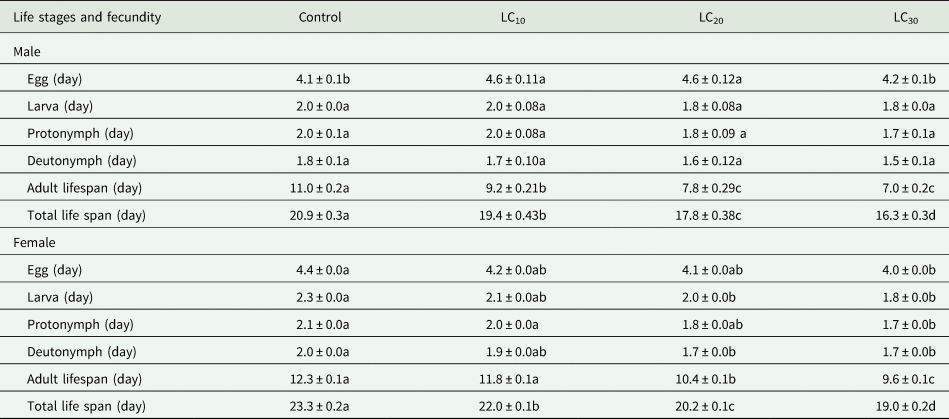
Table 2 presents the sub-lethal effects of B. bassiana on different developmental stages of both female and male individuals of T. urticae. Based on the results, a significant difference was observed between male (egg stage) and female individuals (in the duration of egg [F = 7.15, P = 0.0003, df = 3,68; female: F = 4.76, P = 0.0033, df = 3,168], larvae [male: F = 1.35, P = 0.26, df = 3,68; female: F = 9.65, P < 0.0001, df = 3,168] and protonymph [male: F = 1.87, P = 0.14, df = 3,68; female: F = 7.34, P < 0.0001, df = 3168] as well as deutonymph [male: F = 1.99, P = 0.12, df = 3,68; female: F = 6.55, P < 0.0001, df = 3,168] stages). The higher values for developmental stages at male and female individuals were observed in control and LC10 concentration. When the individuals were treated with LC30 of B. bassiana, males and adult lifespan of females, as well as total life span, were significantly affected. Adult lifespan and total life span of female individuals had the lowest values when LC30 treatment was applied (table 2).
The effect of different concentrations of Beauveria bassiana on the duration of different life stages (mean ± SE) of Tetranychus urticae

Means within a row followed by the same letter are not significantly different (paired bootstrap test, P < 0.05).
Ovipositional period and total fecundity
The females treated by the LC20 and LC30 concentrations of B. bassiana had significant shorter total pre-oviposition periods (APOP: the duration from female emergence to first oviposition; TPOP: duration from egg to first oviposition) compared to the other treatments. The value of TPOP ranged from 10.3 to 11.9 days at LC30 and Control treatments, respectively.
The adult pre-ovipositional period (APOP) was not significantly affected by different concentrations of B. bassiana (table 3). The lowest duration of ovipositional period was 7.5 days at LC30. Beauveria bassiana had significant sub-lethal effects on the total fecundity of T. urticae (table 3). Fecundity of female individuals was lowest at LC30 (18.2 eggs); whereas at Control treatment it was markedly higher (45.1 eggs).
Mean (±SE) reproductive period and total fecundity of offspring from females of Tetranychus urticae for control and different concentrations of Beauveria bassiana

Means within a row followed by the same letter are not significantly different (paired bootstrap test, P < 0.05).
a APOP = adult pre-ovipositional period (the duration from adult emergence to the first oviposition).
b TPOP = total pre-ovipositional period (the time between egg to the first oviposition).
Age-specific survivorship, age-specific and age-stage specific fecundity
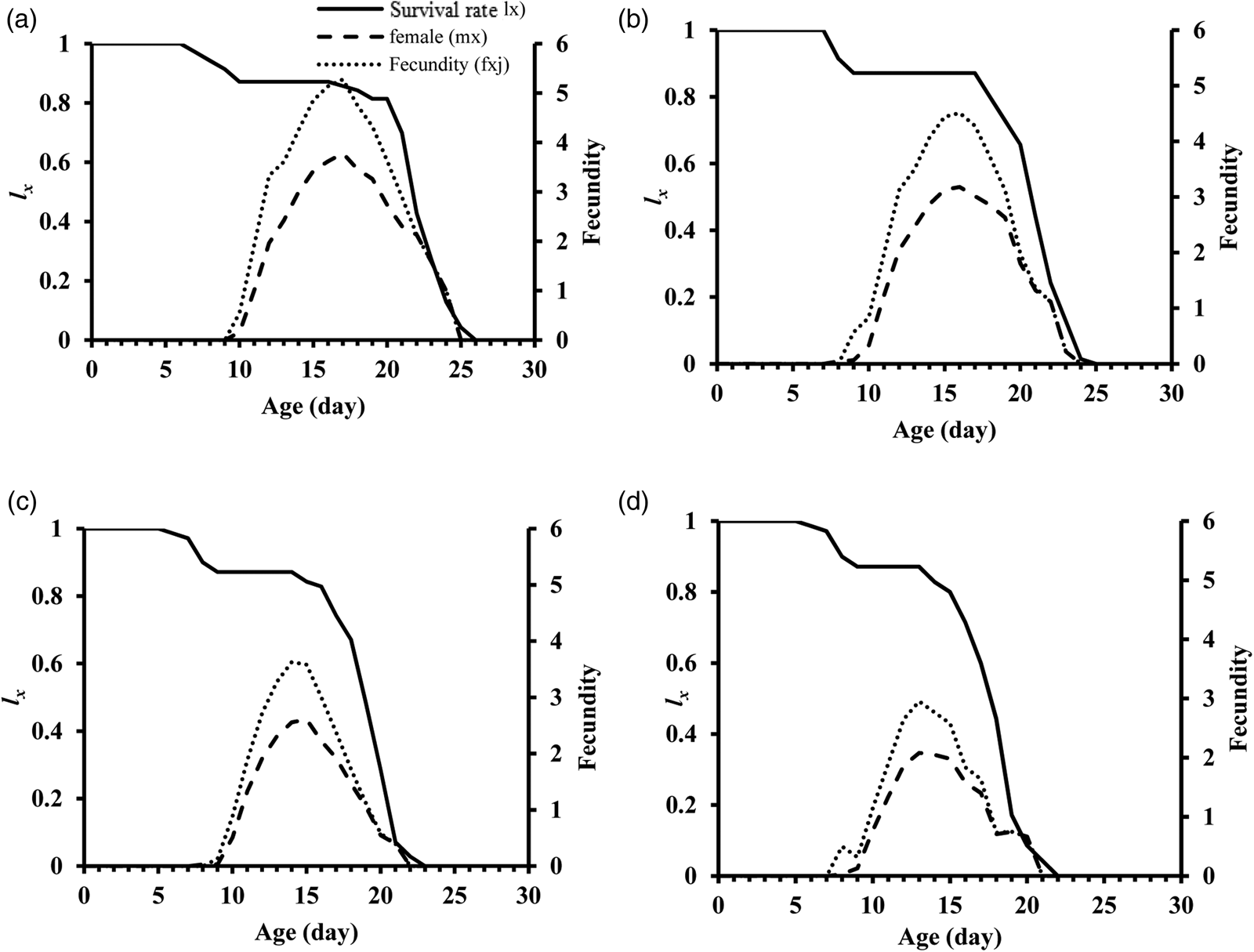
The age-stage specific survival rates (sxj) of T. urticae in different treatments are presented in fig. 1. Overlap between different developmental stages of T. urticae at different treatments was related to the variation of development rate of these biological stages (figs 1a–d). Age-specific survivorship (lx), age-specific fecundity (mx), and age-stage specific fecundity (fxj) of T. urticae at different concentrations of B. bassiana are plotted in fig. 2. Total lifetime for T. urticae was 26, 25, 23, and 22 days in Control, LC10, LC20, and LC30 treatments, respectively. The highest value of mx for control mites was 3.7 eggs/female which was observed on day 17. However, maximum values of mx for LC10, LC20, and LC30 treatments were 3.1, 2.6, and 2.0 eggs/female which occurred on days 16, 15, and 13, respectively (fig. 2).
The age-stage specific survival rate (sxj) of Tetranychus urticae at different sub-lethal concentrations (a = Control, b = LC10, c = LC20, and d = LC30) of Beauveria bassiana.

Age-specific survivorship (lx), age-specific fecundity (mx), and age-stage specific fecundity (fxj) of Tetranychus urticae at different sub-lethal treatments (a = Control, b = LC10, c = LC20, and d = LC30) of Beauveria bassiana.

Population parameters
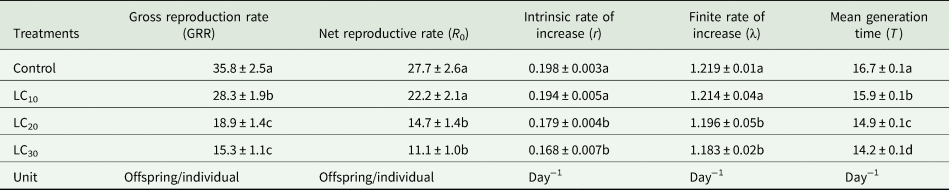
As displayed in table 4, different treatments drastically affected the population parameters of T. urticae. The gross reproductive rate (GRR) varied from 15.3 to 35.8 offspring/individual at LC30 and control treatments, respectively. Also, the lowest value of net reproductive rate (R 0) was obtained for the mites exposed to the LC30 treatment. The assessed intrinsic rate of increase (r) for mites influenced by sub-lethal concentrations ranged from 0.168 (day−1) at LC30 to 0.198 (day−1) in the control, respectively. The finite rate of increase (λ) indicated a significant difference with increasing concentration from control to LC30. The mean generation time (T) had the highest value at control (16.7 days); followed by LC10, LC20, and LC30 (table 4).
The effects of different treatments of Beauveria bassiana on the population parameters (mean ± SE) of Tetranychus urticae

Means within a column followed by the same letter are not significantly different (paired bootstrap test, P < 0.05).
Discussion
Although pesticides are considered as an economic, labor-saving, and efficient tool of pest management with great popularity in most sectors of the agricultural production, several undesirable effects have restricted their applications in modern agricultural systems (Kaplan et al., Reference Kaplan, Yorulmaz and Ay2012). Accordingly, there is a critical demand to find reliable alternatives for the sustainable management of phytophagous pests. Chandler et al. (Reference Chandler, Davidson, Pell, Ball, Shaw and Sunderland2000) reviewed the opportunities of exploiting entomopathogens for biological control of phytophagous mites. However, consideration of EPF effects should be assessed further to specify its influence on offsprings' life history, including growth, development, and reproduction (Latifian et al., Reference Latifian, Soleimannejadian, Ghazavi, Mosadegh and Hayati2010). Numerous studies have been conducted for evaluating the lethal and sub-lethal effects of different EPF such as B. bassiana and Metarhizium anisopliae Metchinkoff on Tetranychus species (Wekesa et al., Reference Wekesa, Knapp, Maniania and Boga2006; Shi and Feng, Reference Shi and Feng2009; Seyed-Talebi et al., Reference Seyed-Talebi, Kheradmand, Talaei-Hassanloui and Talebi-Jahromi2014; Wu et al., Reference Wu, Xie, Li, Xu and Lei2016). However, no evidence is available regarding the sub-lethal effects of B. bassiana on the biological attributes (such as survival, longevity, fecundity, and demographic parameters) of T. urticae.
Our findings revealed an obvious variation in susceptibility at different life stages of T. urticae to B. bassiana. In contrast with our results, Zhou et al. (Reference Zhou, Ali and Huang2010) concluded that sub-lethal doses of Isaria fumosorosea Wize had no significant effects on developmental stages of Axinoscymnus cardilobus Ren and Pang (Coleoptera: Coccinellidae).
The adult longevity and total lifespan for both sexes were significantly lower in fungus-treated individuals than Control. Our results are in agreement with those reported by Irigaray et al. (Reference Irigaray, Marco-Mancebon and Perez-Moreno2003) and Gatarayiha et al. (Reference Gatarayiha, Laing and Miller2010) which reported that B. bassiana had greater deleterious effects on adult females of T. urticae than immature stages. Afifi et al. (Reference Afifi, Mabrouk and Asran2010) reported that mite mortality was increased with increasing conidia concentration and exposure time to B. bassiana. Their results indicated that 14 days after treatment with 2 × 10⁶ and 2 × 10⁸ conidia ml−1, an average mortality of 62.5 and 83.3% for Panonychus ulmi (Koch) and 82.6 and 91.7% for Phyllocoptruta oleivora Ashmed were recorded, respectively. On the other hand, B. bassiana strain 447 had no significant effects on T. urticae under laboratory conditions, even when applied at a concentration of 1 × 10⁹ conidia ml−1 (Antonio et al., Reference Antonio, Batista and Janeiro1999). Several factors may be responsible for this variation in the efficacy of B. bassiana against spider mites, including strain identity, concentrations used, experimental conditions, host species and life stages, exposure time, etc.
Our study showed that sub-lethal concentrations of B. bassiana drastically reduced reproductive parameters of T. urticae in comparison with untreated individuals. The present study, however, exhibited that B. bassiana had no detectable effects on pre-ovipositional period of T. urticae. Our findings indicated negative effects of sub-lethal treatments on ovipositional period and total fecundity of T. urticae. These observations are in line with those reported by Shi and Feng (Reference Shi and Feng2009) in the case of B. bassiana strain Bb2860, Paecilomyces fumosoroseus and strain Pfr116 and M. anisopliae strain Ma759 on the T. urticae. Similarly, Ullah and Lim (Reference Ullah and Lim2017) illustrated that B. bassiana strain GHA significantly decreased the fecundity of T. urticae. This evidence might be derived from a decrease in the female physiological state related to: (i) fungal colonization of tissues such as fat body (source of vitellogenins) and ovaries (Blay and Yuval, Reference Blay and Yuval1999) and (ii) fungal toxin production to transcend insect cellular and humeral immune reactions (Inglis et al., Reference Inglis, Goettel, Butt and Strasser2001; Quesada-Moraga et al., Reference Quesada-Moraga, Santos-Quiros, Valverde-Garcia and Santiago-Alvarez2004). It has been shown that applying the sub-lethal concentrations of B. bassiana strain GZGY-1-3 had no significant effects on the fecundity of Frankliniella occidentalis (Pergande) (Zhang et al., Reference Zhang, Reitz, Wang and Lei2015).
The life table technique has been applied as a reliable procedure for assessing the population dynamics of both phytophagous organisms and their natural enemies (Biondi et al., Reference Biondi, Zappala, Stark and Desneux2013; Cira et al., Reference Cira, Burkness, Koch and Hutchison2017; Nawaz et al., Reference Nawaz, Cai, Jing, Zhou, Mabubu and Hua2017). Regarding the curves of the age-specific survivorship (lx) and age-specific fecundity (mx) of T. urticae at different treatments, increasing sub-lethal concentrations had detectable effects on the mortality rate and fecundity of this pest. Similar reports were published for the survivorship schedules of T. urticae, F. occidentalis, Encarsia formosa Gahan, and Planococcus citri Risso when treated by B. bassiana strain 432.99, B. bassiana strian SZ-26, and Lecanicillium longisporum strain LRC190 and L. longisporum, respectively (Chandler et al., Reference Chandler, Davidson, Pell, Ball, Shaw and Sunderland2000; Wu et al., Reference Wu, Gao, Zhang, Wang, Xu and Lei2014; Fazeli-Dinan et al., Reference Fazeli-Dinan, Talaei-Hassanloui and Goettel2016; Ghaffari et al., Reference Ghaffari, Karimi, Kamali and Moghadam2017). Among different population parameters, the intrinsic rate of increase (r) has been considered as the most applicable index that takes both fecundity and survivorship of individuals into account. The results obtained herein revealed that higher concentrations of B. bassiana obviously affected the r value of T. urticae. Likewise, Seyed-Talebi et al. (Reference Seyed-Talebi, Kheradmand, Talaei-Hassanloui and TalebiJahromi2012) and Rashki and Shirvani (Reference Rashki and Shirvani2013) reported that the r and λ values were significantly lower in T. urticae and Aphis gossypii Glover which were treated with strains EUT105 and DEBI008 of B. bassiana, respectively. Despite our results, Baverstock et al. (Reference Baverstock, Roy, Clark, Alderson and Pell2006) showed that B. bassiana has no significant effects on the r value of pea aphid, Acyrthosiphon pisum (Harris). It can also be hypothesized that feeding deficiency caused by fungal infection may drastically affect the reproductive potential of female individuals which have great energetic demands (Yuan et al., Reference Yuan, Wu, Lei, Rondon and Gao2018). In addition to these parameters, the values of net (R 0) and gross (GRR) reproduction rates and mean generation time (T) in treated individuals were also inferior to Control treatment. Similar to our findings, Huang et al. (Reference Huang, Ali, Ren and Wu2010) and Yuan et al. (Reference Yuan, Wu, Lei, Rondon and Gao2018) documented significant effects of different concentrations of I. fumosoroseus and B. bassiana strain JLGZL-14 on the R 0 and T values of Bemisia tabaci (Gennadius) and Phthorimaea operculella Zeller, respectively.
In conclusion, the present study displayed that B. bassiana not only has considerable pathogenicity to T. urticae, but also causes different sub-lethal effects such as reducing the total life-span as well as total fecundity of female individuals. Furthermore, our results clarified the considerable potential of B. bassiana strain TV, as an efficient biocontrol agent for sustainable management of T. urticae. More attention, however, should be devoted to investigate these effects under semi-field and field conditions.
Acknowledgement
We greatly appreciate the University of Tehran for supporting this project.