Introduction
On March 11, 2011, an earthquake hit the east coast of Japan. The combined impact of this earthquake, the resulting tsunami, and damage to the Fukushima nuclear power plant was devastating and incomparable to any previous Japanese disaster. A total area of 561 km2 was affected by the tsunami 1 and the number of deaths was estimated at 15,870. 2 To assist in the health response to the disaster, approximately 3,770 nurses were deployed to the disaster-affected areas. 3
Previously, the largest scale disaster in Japan before the 2011 disaster was the Great Hanshin Awaji Earthquake in 1995. Following this earthquake, there were reports of insufficient resources and a lack of preparedness among nurses to assist in the response and recovery activities. Since then, a number of strategies were employed to improve Japanese nurses’ disaster preparedness. Disaster nurses support networks, both locally and nationally, have increased the preparedness of nurses for disaster assistance. One example of this was to increase the opportunities for nurses to participate in a disaster relief nurse training course. This course is now a compulsory requirement for registration as a disaster relief nurse in the disaster deployment network system operated by the Japan Nursing Association (JNA) (Tokyo, Japan). The JNA further specified desirable criteria for disaster relief nurses such as participating in mock hospital training exercises and establishing clear communication between the hospital where a nurse works and the local nursing association to be ready for deployment when they are needed. It is estimated that approximately 7,000 nurses who work in various health service areas have registered and completed educational training regarding disaster assistance, with many more showing an interest. 3 While the role of nurses in a disaster has been described internationally, these reports have mainly been descriptive in nature, for example, outlining personal accounts of individuals who have assisted in a disaster. The literature, for example from AustraliaReference Ranse and Lenson 4 , Reference Ranse, Lenson and Aimers 5 and China,Reference Yin, He, Arbon and Zhu 6 is becoming more exploratory and is increasingly highlighting the role nurses play in disasters. However, few Japanese studies are presented and available in English. This paper is unique as it synthesizes the Japanese literature on the role nurses played in the aftermath of the Great East Earthquake to provide insight into what was efficient and what needs to be achieved in future disasters. Further, this study is unique as it explores the literature published in Japanese and presents a summary of findings in English.
This literature review aims to describe the roles of nurses who helped in the 3.11 disaster. In particular, the Japanese literature was reviewed and the findings reported in English.
Methods
Design
This project used an integrative literature review methodology. This is a research approach that “reviews, critiques, and synthesis representative literature on a topic in an integrated way such that new frameworks and perspectives on the topic are generated.”Reference Torraco 7 Russell highlights that this type of review can embody the state of current research literature in a particular field and “build a bridge” between related areas of study.Reference Russell 8 The diverse approach of this review method was well suited for this study as the role of nurses in a disaster is by nature described by personal accounts and reports of relief activities. This design was ideally suited to achieve the aims of this review: to represent the current literature on a nurse's role in a disaster in the Japanese literature and makes it accessible in English.
Data Collection
Manuscripts for this literature review were obtained from the Japanese database Ichushi Ver. 5 (Japan Medical Abstracts Society, Tokyo, Japan). This database is the most frequently used database in Japan for health sciences research. This database was searched in January 2013 using the keywords: “Higashi Nihon Daishinsai” (The Great East Earthquake), “nurse,” and “role.” Originally, 71 manuscripts were identified. The inclusion criteria of literature were that the article: (1) reported on the role of nurses in the disaster; and (2) discussed the public health nurse's role in the disaster. Due to the nature of study area, articles such as personal accounts and report of relief activities were included. Following the identification of these manuscripts, manuscripts focusing primarily on maternal health were excluded as they constituted a large number of manuscripts that did not focus on the nursing role or experience in this disaster. As a result, 27 were excluded, and this data collection strategy yielded 44 manuscripts for analysis.
Data Analysis
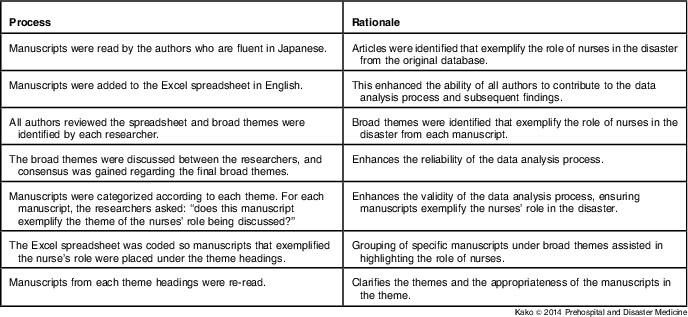
Information from each manuscript was entered into a Microsoft Excel 2010 spread sheet (Microsoft Corporation, Redmond, Washington USA). This information included the authors’ name/s, manuscript title, journal title, manuscript keywords, and summary of findings pertaining to the role of nurses. Thematic analysis of the collected manuscripts was undertaken using an approach modified from Ranse and Arbon,Reference Ranse and Arbon 9 which is outlined in Table 1. The thematic analysis highlights the roles of nurses in the 3.11 disaster.
Thematic Analysis Process, From Japanese to English (Broadly Adopted from Ranse and Arbon9)

Results
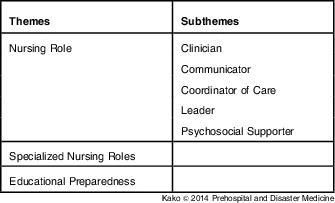
The findings of the thematic analysis of the literature highlighted three main themes and a number of subthemes (Table 2). While the findings illustrated that there were distinct themes emerging from the literature, it was evident that many of these themes were, in fact, interconnected and overlapping.
Themes From Literature

Theme 1: Nursing Roles
The working environment in a disaster often differs greatly from the day-to-day, routine work environment. The most influential aspect after a disaster is a shortage of resources. The places where nurses worked included evacuation centers, local hospitals, and nursing homes at the affected area. Water supplies to these venues were limited, and hospital materials were limited in supply. Under this constrained environment and filling the gaps between role requirements on ordinary days and those on disaster-affected days, the flexibility of nurses to adjust how they enact their nursing role was paramount.Reference Onodera and Kodama 10 For example, the importance of effective observation and assessment ability were emphasized as a universal requirement for nursing skills in the 3.11 disaster that required flexibility in their application to the disaster situation.Reference Imai 11
Communication was an important part of nursing activities during the 3.11 disaster. In a survey of emergency nurses, nurses highlighted their concern with poor communication.Reference Uchino, Ishii and Kusaka 12 Regular communication with other health professionals, as well as colleagues in various communities, was highlighted as being an integral role of a nurse.Reference Kumada 13
Nurses coordinated patient care through the regulation of patient transfers.Reference Koike 14 This coordination included the movement of patients from one hospital to another, or from the disaster area to a hospital, ensuring the right patient was at the right facility at the right time. Coordinating care between patients, facilities, and agencies occurred at any many levels of nursing. Coordination of staff was also important to ensure appropriate care of patients. Nurses organized staff to ensure the skills and experience of nurses matched the needs of potential patients within the affected area.Reference Kikuchi 15
Leadership in the emergency department was an essential role for some emergency nurses.Reference Itabashi 16 For this literature review, leadership was described as the action to lead and coordinate nursing, or health professional groups in the provision of patient care. This action is vital to smooth coordination between hospitals that lost their function and hospitals designated as back-up hospitals. Similarly, leadership was an essential nursing element when working at the Disaster Medical Assistance Team (DMAT) emergency operations center, where nurses undertook activities such as the collection of complex information, establishing effective communication routes, and coordinating with local hospitals.Reference Saito 17
Due to the large number of people affected by the disaster, the local mental health triage group could not cope with the number of presentations for their service.Reference Toyota 18 More so, due to the scarce resources available, this group was challenged to provide appropriate continuity of care. Additionally, in the neonatal department, it was reported that providing psychosocial support for parents was an essential role of a nurse.Reference Takara 19 Overall, it was argued that assessing communities’ psychosocial needs was somewhat more important than the physical needs of individuals, particularly after the acute phase of patient management had concluded.Reference Higashi 20 It also should be noted that nurses who work at the affected area may have lost their family members during the disaster, as such, creating a nursing role for the psychosocial support of all health workers should be considered.Reference Umezaki 21
Theme 2: Specialized Nursing Roles
Internationally, some nursing roles are becoming more specialized, caring for specific patient cohorts; such certified nurses (CNs) include: infection control, perioperative, neonatal, and oncology. During the 3.11 disaster, infection control nurses used alternative methods to sterilize equipment to prevent the spread of infection.Reference Hayashi 22 Nurses working in the perioperative and neonatal departments indicated that easy-to-read posters were useful for nurses to visualize their required actions in the 3.11 disaster.Reference Abe, Misumi, Yamamoto and Koegawa 23 Specialist nurses, such as oncology nurses, have existing patient networks, and therefore, an ability to identify those in the community who are vulnerable from a health perspective.Reference Shiromukai 24 However, in the 3.11 disaster, the continuity of care and treatment for oncology patients was difficult due to the loss of contact with patients.
Public health nurses also had an important role in the 3.11 disaster. In Japan, a public health nurse is “a person who provides public health activities under the occupational license of the Ministry of Health, Labor and Welfare.” 25 In the 3.11 disaster, public health nurses had a broad engagement with, and interest in, the health of the evacuees. The role of the public health nurse was reported as being primarily concerned with population health surveillance in large evacuation centers that accommodated approximately 2,000 evacuees. While undertaking public health activities, a number of issues were identified. First, the number of evacuees at the center was too large to adequately manage from a public health perspective, and second, the short-term staff turnover made it difficult to provide continuity of care and effective public health surveillance.Reference Kato and Kakegawa 26
Theme 3: Educational Preparedness
In a survey of all renal dialysis clinics in one of the 3.11 disaster-affected areas, it was highlighted that only approximately 25% of clinics utilized their disaster manual, or other written resources, to guide their practice.Reference Murakami and Inaniwa 27 Additionally, more than half did not prepare for the emergency interruption of renal dialysis.
A study that explored the experience of nurses working in the 3.11 disaster suggested that disaster education courses should include content related to nuclear incidents. Such topics could include: safe patient transfer, psychosocial care, knowledge of specific medications (such as iodine 131), decontamination of affected people and environment, and general health management after exposure to radiological substances.Reference Tsutsumi 28 Additionally, the role of nurses in the 3.11 disaster was to ensure the correct and complete information regarding radiation exposure was conveyed to help the public feel safe and secure. Furthermore, the image of nuclear fear was an influential factor to prevent public misunderstanding.Reference Kai 29 It was also reported that after the failure of the Fukushima nuclear plant, subsequent to the 3.11 disaster, the correct nuclear measurements method and an understanding of these measurements mean became important for nurses and the community.Reference Irisawa 30
Discussion
Theme 1: Nursing Roles
It has been suggested that all nurses should be disaster nurses “…because the skills required in disaster are the same as those required on a regular shift, although the setting is different and the resources are stretched….”Reference Gebbie, Hutton and Plummer 31 During the 2009 Black Saturday and Victorian bushfires in Australia, it was noted that nurses undertook a clinical role. However, they also undertook the role of psychosocial supporter, coordinator of care, and problem solver.Reference Ranse and Lenson 32 This is similar to the roles identified in the literature from the 3.11 disaster.
Communication is a crucial part of nursing. Additionally, communication is an integral part of the International Council of Nurses (ICN)/World Health Organization (WHO) competencies for disaster nursing. 33 In a disaster situation, recognition of “the chain of command” is important for effective communication and coordination. Communication is not only a tool for connecting with other health workers, but also can be used as a healing tool for those affected by a disaster. Using a narrative approach as part of daily communication, the psychosocial wellness of those affected by the disaster can be promoted by a nurse.
As a disaster becomes more complex, the number of agencies involved will increase. Coordination of information with members of DMATs is of importance. In addition to coordinating information, it is important to understand that nurses are coordinators of care. This was further exemplified from both the Australian and Chinese studies of the experience of nursing in disasters, and further supported in this literature review of the 3.11 disaster. 1 - 3
There is a paucity of literature pertaining to nursing leadership in a disaster. The literature that is published highlights the importance of nursing leadership during disasters.Reference Hayes 34 - Reference Martin 36 Some literature highlighted the importance of leadership in a disaster situation, and it seemed that leadership was required in particular situations (eg, working in a DMAT, coordinating with other organizations, working as a manager of an institution department, and commanding to, or coordinating with, staff). Although the coordination role existed in all levels of the nurses’ role, it seems that leadership roles overlapped with this coordination role, especially when this role involves communication with other departments/organizations.
Previously, the role of the nurse as a psychosocial supporter in Australian disasters has been identified and is further exemplified from this literature review regarding the 3.11 disaster.Reference Irisawa 30 It is suggested that nurses who were involved in disaster assistance should further strengthen their capacity to support in the psychosocial aspects of care, as this incorporated a large proportion of their work in the evacuation centers during the 3.11 disaster.
Theme 2: Specialized Nursing Roles
Utilizing their existing patient networks, CNs are useful in assessing the needs of specific patient cohorts during disaster events. Specialized knowledge and skills played an important part to lead specific situations. For example, in Australia, specialist renal nurses played an important role in the evacuation of patients from a hospital during a cyclone.Reference Ranse and Lenson 32 Their existing health service and client network can be a strength for CNs in disaster situations while they work as general nurses wherever necessary. However, the role and professional boundaries of some specialist nurses, such as nurse practitioners, needs further exploration in the literature. 33 , Reference Hayes 34 The ICN/WHO Disaster Nursing Competencies includes activities such as the implementation of measures to reduce risks related to the transmission of disease, and assessing immunization status and medication requirements in a community, ultimately strengthening the health of those within the disaster-affected area. In the 3.11 disaster, public health nurses undertook activities as described by the ICN/WHO, such as health surveillance, coordination, and consultation with local governments and other organizations. These activities are somewhat expected from the role of specialized nurses. However, obtaining knowledge regarding these roles for specialist nurses should also be considered as a part of the continuing education. It is possible for specialized nurses to be utilized in particular disaster situations, such as caring for cancer patients or participating as a member of DMATs.
Theme 3: Educational Preparedness
Specialized departments, such as renal dialysis and neonatal departments, should increase the opportunities to conduct disaster drills in preparation for disaster.Reference Hata 37 To develop and sustain effective disaster assistance, education may be required, especially exploring the immediate response of nurses.Reference Kanbara 38
Opportunities to receive education regarding nuclear aspects of disasters should be enhanced. In daily practice, many nurses have a minimal level of knowledge regarding the effects of nuclear radiation and the associated treatments for those who are exposed. It is suggested that educational preparedness enhances a nurse's willingness to assist in a disaster.Reference Arbon, Ranse and Cusack 39 As such, education should be a focus for disaster preparedness. Regardless of the education activity or content delivery, it should replicate the realities of what it is like to assist in a disaster.
Limitations
This literature review focuses on journals published in Japanese. As such, publications in other languages have not been included. Publications from other languages may provide further insight into the role of nurses in disasters. While this review includes all aspects of data and employed various approaches, such as personal accounts papers, validity of each paper cannot be compared due to its subjectivity.
Conclusion
This is the first review of the Japanese literature pertaining to the role of nurse during the 3.11 disaster. The main themes from the literature highlighted that the nurse undertakes roles as a clinician, communicator, leader, and psychosocial supporter. Additionally, there were some opportunities for specialized nurses to utilize their skills and knowledge while they were also basic health care providers in the disaster-affected area. Some areas of activities, such as health surveillance, coordination, and consultation with local governments and other organizations, were overlapped with the public health nurses’ role. Due to the fact that the affected population of the 3.11 disaster was large, the nurse roles were various, and needed to be various to meet care demand of affected population. Expansion of the educational opportunities should also be discussed for all nurses, including radio-nuclear disaster aspects, and should replicate the realities of what it is like to be a nurse in a disaster.
Acknowledgements
The authors would like to acknowledge Ms. Akiko Kurotaki at Hyogo University and Dr. Malinda Steenkamp for their article retrieval and editorial assistance.