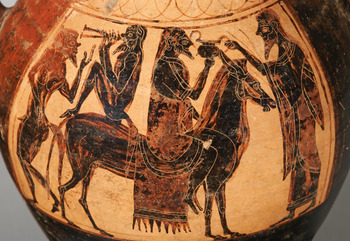
The aetiological tale about the strike of the tibicines, their voluntary exile to Tibur, and their subsequent non-voluntary return to Rome has attracted a good deal of scholarly attention. While most studies focus on the discrepancies between the sources that report the story, as well as on its relation to Roman history and religion, in an attempt to elucidate the manifold ambiguities, little has been hitherto said about its cultural context and plausible models among well-established scenarios from myth and less familiar dramatic genres. This study takes a look at the story of the famous Roman strike from the perspective of narrative traditions, arguing that these traditions may have played a paramount role in shaping the legend. Abundant parallels with the myth of Hephaestus’ return to Olympus that are popular in classical Etruscan iconography seem to indicate that the scenario of the story, even if it contains references to a historical event or reflects the cultural status of the aulos Footnote 1 and its players in the (Late) Roman Republic, is composed from well-known motifs of diverse provenance. In addition, the article explores the references to early Greek dramatic genres, above all satyric dramas, which are especially distinct in Ovid's rendition of the episode.
1. THE SOURCES OF THE TIBICINES STORY AND THEIR MAIN CHALLENGES
Apart from the unquestionable appeal of its humorous and vibrant plot, the story about the origins of Quinquatrus minusculae constantly lures classical scholars with the textual difficulties and interpretational ambiguities that plague its surviving sources.Footnote 2 Instead of narrating its plot, which has already been told and retold in numerous works, the current study will commence with reviewing in nuce the most prominent approaches to the main challenges of the story.Footnote 3 The major problem, equally addressed in past and recent scholarship, derives from significant discrepancies between the four main sources in which the tale has been preserved: Livy 9.30.5–10; Val. Max. 2.5.4; Plut. Quaest. Rom. 55 (= Mor. 277E–278B); and Ov. Fast. 6.648a–710. These include the nature of limitations imposed on the tibicines that prompted their departure to Tibur: while Livy and Valerius Maximus agree that a ban on participation in the epulum Iouis—the solemn feasting at the temple of Jupiter Optimus Maximus—sparked the strike,Footnote 4 Ovid enigmatically refers to the main reason (subito gratae frangeret artis opus, Fast. 6.662), and claims that a law reducing the number of the tibicines accompanying funeral corteges to ten, which apparently deprived many players of an easy gain,Footnote 5 was the final straw triggering their walkout from the city.Footnote 6 As is often noted, Ovid's version aligns with a law from the Twelve Tables recorded also by Cicero (Leg. 2.59) that possibly dates back to the times of the decemvirate.Footnote 7 Other plausible coincidences with Roman legislative regulations reflect the socio-legal Realien of Rome at the transition point between the Republic and the Augustan period. For instance, in an attempt to account for some inconsistencies found in Ovid's version, Barja de Quiroga argues that the tibicines lost their citizenship as a consequence of the strike (mutare ciuitatem) and could not return to Rome even if they wished to do so.Footnote 8 On their conspiratorial and apparently illegal return, they had to cover their faces with masks to avoid being recognized by the Senate. The loss of citizenship would therefore justify the use of masks, which is foreshadowed by Minerva at the beginning of the aition (quid sibi personae, quid stola longa uolunt?, Fast. 6.654), but is explained rather vaguely in the final part of the narrative.Footnote 9 In this respect Ovid's version differs from the account of Valerius Maximus, who attributes the need to cover the pipers’ faces to their feeling of shame over inebriation (personarum usus pudorem circumuentae temulentiae causam habet).
It has been generally agreed that the tale is more legendary than historical, yet vigorous attempts to identify its historical context comprise a large part of a long-standing debate on its problems.Footnote 10 Owing to the lack of practically any other evidence, Livy's dating (311 b.c.) emerges as essentially the most precise and consequently the most widely accepted.Footnote 11 At the same time, however, Plutarch's dating to the decemvirate of the fifth century b.c., which may or may not be supported by Ovid,Footnote 12 is usually dismissed as spurious. There are many ways to account for this discrepancy; for instance, as an obviously popular tale,Footnote 13 the anecdote might have been preserved in various sources that scarcely depended on historiography.Footnote 14 This renders the dating attempts not only largely futile but also of somewhat secondary importance in the hierarchy of the challenges that the story poses. Above all, the origin of its plot that is interspersed with a wealth of intriguing literary motifs calls for a closer investigation.
2. THE RETURN OF HEPHAESTUS/SETHLANS AND THE RETURN OF THE TIBICINES FROM EXILE
A few attempts at identifying plausible cultural paradigms that gave rise to the tale about the strike have already been made. For instance, Dumézil pinpointed its multiple similarities to a Vedic myth recounting the ‘strike’ of Aurora, the goddess of dawn.Footnote 15 Buchet meanwhile made a connection between the return of the tibicines on strike and the attack of the Tiburtines on Rome narrated by Livy at 7.12.1–4.Footnote 16 These analogies imply that the story may follow a certain pattern common for a larger group of at least Graeco-Roman and maybe even Indo-European myths.Footnote 17 It seems, however, that the scholarship on the Quinquatrus has hitherto neglected a possible correspondence of the tale to a popular Greek myth, which appears to exceed the limits of what might be considered a mere coincidence. The myth of the return of Hephaestus to Olympus is an especially frequent subject of depictions in Archaic and Classical Greek vase-painting, but only occasionally makes an appearance in later written sources.Footnote 18 By far the earliest literary rendition of the entire myth comes from Pausanias (1.20.3), who recounted it in reference to wall paintings from the Athenian temple of Dionysos and thus attested to its particular relation with visual arts.
The main events in the two stories about a strike and a return unfold according to an essentially identical scenario.Footnote 19 Both Hephaestus and the pipers go on exile. In the case of Hephaestus, the exile is non-voluntary: he was cast down from Olympus by his mother Hera; in revenge he sent her a trap—a golden throne equipped with invisible fetters—and afterwards steadfastly refused all offers of reconciliation. The musicians, however, leave Rome of their own accord, rebelling against the restrictions imposed upon them. Soon the forsaken communities (the Olympian gods and the Romans) find out that the exiles were in fact indispensable, and their absence disrupts the local social order (Hera is trapped on her throne and the Romans risk committing hybris when making offerings unaccompanied by ritual musicFootnote 20). A shrewd plan is therefore hatched to bring the strikers back. According to the Greek myth, the author of the plan is Dionysos, while the versions of the pipers’ story vary as to who was responsible for the trickery; Ovid (Fast. 6.669–70) and Plutarch (Mor. 277F6–7) entrust this key role to a freedman, who organized a feast intended to lure the wine-thirsty pipers. The overlap between Dionysos, particularly his Latin equivalent Liber Pater, and a Tiburtine libertinus may be purely coincidental, but given the general Dionysian tenor of the pipers’ story and its associations with the concept of libertas Footnote 21 it appears more than fortuitous. At any event, the deception involved getting the exiles drunk and transporting them back to their communities, thus restoring the status quo, whereby both comebacks were accompanied by a carnivalesque procession. The final parallel refers to the outcome of the two exiles and returns: in both cases a festival resembling the homecoming procession was founded in memory of the event. The return of Hephaestus gave rise, according to the myth, to genres related to Dionysiac processional ritual. Likewise, the pipers’ return inspired the institution of the Quinquatrus minusculae that were depicted by Ovid as a comic performance.Footnote 22 The ending of both stories is not marked, in fact, by the restoration of the status quo but by the theme of a compensated loss converted into a gain, identified by Pailler as the topos of felix culpa.Footnote 23
Obviously, the two plots significantly differ in details and emphases, of which perhaps the most striking difference concerns the main character: a single protagonist as opposed to a group. In this respect a transition from an Olympian god to a group of pipers cannot be easily accounted for in terms of narrative techniques and, if we are further going to consider the potential connections between the two stories, we need to solve this problem first. One way of solving it would be to limit the parallels to the scenarios of the stories, leaving out their protagonists. But since the tales display a range of other analogies than just plot outlines, this approach would only reduce the comparison. It is perhaps worth noting that a collective treatment of aulos players in both Greek and Latin literary traditions as well as in iconography is rather infrequent and thus unusual. In fact, the story of the strike is the only literary testimony which pays attention to pipers as a social and professional group. Following Valerius Maximus’ reference to the collegium tibicinum—the guild of Roman pipers (2.5.4 tibicinum quoque collegium solet in foro uulgi oculos in se conuertere), most commentators agree that the rebellious musicians were indeed members of the college, while the strike itself is often perceived as the first known case of a craftsmen group standing up for its own rights.Footnote 24 The guild was therefore an institution which rendered an important service to the Roman state, and its functions were regulated by the Roman law.Footnote 25 What is more, this service—providing musical accompaniment to sacrificial offerings—was indispensable for the city's sacred rites. Consequently, the parallel between the college of pipers as a state institution and the Greek god, albeit still peculiar, becomes more plausible on account of the important position both entities held in their respective societies.
Before we proceed to the similarities between the two plots, let us briefly consider the implications of the collective image of pipers mentioned above. As Moore notes, referring to the practice of συναυλία, most vocal music in fifth-century Athens was accompanied by a single player, while the participation of multiple musicians is attested mainly for Panathenaic processions.Footnote 26 He also observes that the presence of many aulētai seems to have been perceived as synonymous with a dreadful noise.Footnote 27 Even though performative practices underwent a significant change over time, and Rome more eagerly indulged in boisterous spectacles where quantity of instrumentalists prevailed over the quality of harmony they produced, the collective portrayals of tibicines in Latin literature are still very few in comparison to the depictions of single players.Footnote 28 Similarly, the theme of obnoxious sounds emitted from numerous discordant pipes has endured as a characteristic feature of many of these representations. For instance, according to Apuleius, Antigenidas refused to acknowledge funeral tibicines as musicians,Footnote 29 because, as we may guess, the abominable noise they made did not resemble what he considered music. Offences against musical art, committed especially in groups, as well as other negative features, such as a predilection for wine and parasitic tendencies, emerge occasionally as part of the characteristics of aulos players in both Greek and Roman comedies.Footnote 30 Certainly, the portrayal of our pipers, who also found funerals particularly profitable (cantabat maestis tibia funeribus; | dulcis erat mercede labor, Ov. Fast. 6.660–1; cf. n. 5 above) and wine tempting (… et uino, cuius auidum ferme id genus est … Livy 9.31), was not conceived as disconnected from the long-standing literary tradition and from associations that such a group of musicians might have evoked in the Roman audience. This image, not only associative but also ocular, is another plausible link with the myth of Hephaestus’ return. Ovid, in particular, provides a vivid account of the pipers’ drunkenness, their swaying and stumbling on yielding legs as they attempt to walk (nec mora, conuiuae ualido titubantia uino | membra mouent; dubii stantque labantque pedes, Fast. 6.677–8), which is highly evocative of iconographic representations that depict drunken participants of the Dionysiac thiasos accompanying Hephaestus on his homeward journey. These, apart from the intoxicated god himself often portrayed riding a mule, usually also include Dionysos and crapulous satyrs (silēnoi)Footnote 31 wildly prancing about, holding various, mainly symposiac, attributes such as wine vessels, ivy wreaths, thyrsi and musical instruments—most frequently auloi.Footnote 32 In fact, the aulos is not merely a satyric attribute in this context but also an indication of sound quality that accompanied the procession. By this means, the representations cross the boundaries of the visual to evoke also the aural dimension of a Dionysiac ritual. We know both from iconography and from literature that the aulos typically provided instrumental accompaniment for dithyrambs,Footnote 33 a genre which is very often associated with the depictions of Dionysos’ triumph and also with the return of Hephaestus.Footnote 34 Accordingly, the role of the aulos as a musical instrument of cultic significance, so pronounced especially in Ovid's rendition of the pipers’ story and also apparent in this case, may be yet another link between the two narratives. Finally, visual analogies between aulos-playing satyrs and the story of the strike are additionally reinforced by the figure of Marsyas—a satyr par excellence—often depicted as a member of Hephaestus’ homecoming entourage and also present in Ovid's account of the episode as part of the aition on the invention of the tibia.Footnote 35
3. ETRUSCAN PATHWAYS
Having shed some light on the plausible affinity between the return of Hephaestus and the return of the pipers, we ought to consider the pathways that the myth might have taken on its journey from Classical Athens to Republican Rome. As has already been mentioned (n. 18 above), apart from visual arts, the myth survives mostly in later written sources. No references to it are extant from the long period spanning the Late Republic and the Antonine dynasty, while the only preserved Latin text that mentions the myth in connection to Vulcan—the Roman equivalent of Hephaestus—is Fabula 166 traditionally attributed to Hyginus. However, the story no doubt made its way to the Apennine Peninsula very early on, as we find it depicted on a sixth-century Attic black-figure volute-krater unearthed in fragments from an Etruscan tomb in Chiusi, popularly known as the François Vase.Footnote 36 The representation restricted to one frieze of this multi-figured vessel gives a full account of the god's return, introducing all characters of its plot labelled by Greek inscriptions. The vase might have been acquired as part of elite-merchandise traffic on a second-hand market specifically as an item of a mortuary assemblage.Footnote 37 Whether or not the myth, just as many other Greek themes depicted on imported ceramics, was contextualized within Etruscan funerary traditions is not clear, but such a possibility cannot be entirely ruled out, especially in light of the fact that Dionysian themes in Etruscan contexts appear to have chthonic implications.Footnote 38 Its ‘Etruscanization’ is nevertheless well attested by pottery finds that narrate the episode from the Etruscan perspective, even if overtly relying on its Attic portrayals. We know that Sethlans—the Etruscan Hephaestus—had been a blacksmith deity who, following the influx of Greek figured ceramic ware, became associated with some myths they portrayed.Footnote 39 While the sixth-century Etruscan vase-depictions of the return of this god greatly depend on their Greek models,Footnote 40 later versions found predominantly on bronze mirrors and on other bronze objects increasingly diverge. Often, for instance, they show Sethlans as a youth rather than as a bearded male figure in scenes that are only distantly reminiscent of the Greek originals.Footnote 41 Such images of the deity continue to emerge until the third century b.c.,Footnote 42 which implies that around the ‘Livian’ date of the strike of the tibicines the myth still lingered, at least in Etruscan circles.
The return of Hephaestus to Olympus. Etruscan black-figure vase attributed to the Ivy-Leaf Painter. Sixth century b.c. © Archäologische Sammlung der Universität Zürich, Inv. L 552. Deposit of ETH Zürich (ETH 14). Photo: Frank Tomio. Courtesy of Martin Bürge, curator of the Archaeological Collection of the University of Zurich.

But do we have any evidence that would warrant the myth's transmission via the Etruscan channel? Our sources are silent on the possible Etruscan origin of the Quinquatrus, while other connections with Etruscan culture appear quite vague. Some of them have been, none the less, brought up in several studies on the story, and are worth a brief mention. For instance, Hentschel assumes that the Romans took over aulos playing from the Etruscans rather than from the Greeks, arguing that there was a considerable overlap between the Etruscan Menrva and the Roman Minerva—the goddess worshipped by the guild of pipers.Footnote 43 Additionally, it is generally thought that many Roman aulos players had an Etruscan background.Footnote 44 Other studies highlight the parallels between the Quinquatrus minusculae and the Quinquatrus maiores—a feast in June that had been derived from Etruscan tradition and apparently gave prominence to the tuba perceived in this case as a counterpart of the tibia, which of course enables straightforward but not necessarily valid associations with the lesser feast.Footnote 45 While all these observations merely suggest a possibility of Etruscan influences on the pipers’ story, they cannot be dismissed as entirely irrelevant in the absence of more explicit testimonies.
4. THE RETURN OF THE PIPERS AND SATYRIC-DRAMA PLOTS
In order to pursue further the associations between the return of Hephaestus and the return of the pipers respectively, we need to enquire into the dramatic genres that were connected to the Greek myth. As Hedreen convincingly argued, there is a profound relationship between the visual representations of the return of Hephaestus and processional rituals, which has not been captured by its literary accounts.Footnote 46 A clear-cut discrimination between dramatic genres based on the Dionysiac ritual is not possible owing to a considerable overlap between their various components, but it seems that the return of Hephaestus was especially strongly linked to three of them: dithyramb, satyr play and early comedy.Footnote 47 What is more, just as is shown in visual representations of the myth, the presence of the Dionysiac thiasos was central to the performance of these genres.Footnote 48 As we have already seen, the tibicines on strike display a whole range of satyric traits, such as a generic weakness for alcoholic beverages and an obvious musicality. They also wear costumes, which brings them perhaps closer to komasts, even though their outfits are most likely derived from a different tradition.Footnote 49 The only crucial satyric feature that is missing here is sexual innuendo that was so readily employed in most contexts related to satyrs. From among the four main accounts, Plutarch is the only one to imply the presence of women during the nocturnal banquet preceding the clandestine return to Rome.Footnote 50
These satyric overtones, additionally strengthened by Ovid with an allusion to Marsyas embedded in the aition of aulos playing, suggest a close affinity of the pipers’ return with the satyr play (early comedy and dithyramb being obviously ineligible for the parallel). A major difficulty posed by such an interpretation, however, is the scarcity of evidence for Roman satyric dramas. Nevertheless, T.P. Wiseman, who assiduously tracked down satyrs in Republican Rome, advocated, based mainly on visual representations, the existence of various kinds of Dionysian dramatic performances also on the Roman stage.Footnote 51 Even if, largely owing to contamination with akin dramatic genres, their generic character cannot be now precisely defined, it may be securely inferred that they inherited a good deal from the known Greek models, at least in terms of thematic scope and scenarios. In particular, it seems that excessive drinking bouts were a signature mark of satyric genres, as is perhaps attested by two dramatizations of the same episode from the Odyssey, namely the Cyclops. The fragments of Epicharmus’ and Euripides’ renditions of this episode are indicative of an elaborate symposiastic setting exceeding by far the scope of its Homeric original.Footnote 52 An extended banquet scene during which Dionysos gets Hephaestus drunk before conveying him back to Olympus is also featured in a lost satyr-play by Achaeus, entitled Hephaistos.Footnote 53 Interestingly, among multiple visual depictions of the myth, this scene appears very rarely, which may suggest that the theme was characteristic of dramas but unusual for other means of representation.Footnote 54 All the more, the particular attention that is paid—especially in the accounts by Ovid and Plutarch—to the banquet preceding the return of the pipers may be seen as a sign of an influence from satyric dramatic genres.
Using wine and inebriation as means of ruse and trickery also emerges as a key theme of the potential satyr-drama plots, whose echoes apparently resonate in Augustan poetry. As Wiseman argues,Footnote 55 for example, a story about Priapus and Vesta (Fast. 6.319–48) that narrates Priapus’ attempt on Vesta sleeping after a drinking party, or about Faunus and his daughter Fatua whom he seduced after having got her drunk (Plut. Mor. 268D–E), contains satyric material that might have been derived from dramatic performances. Likewise, links to satyr plays have been frequently noted with regard to other scenes of attempted rape and frustrated seduction that permeate Ovid's œuvre.Footnote 56 In the context of our story about the return of the pipers, the role of excessive drinking and deception as a turning point of a narrative sounds a familiar note. Although the pipers on strike were not subjected to any form of sexual violence but only to what seemed to be kidnapping,Footnote 57 the resemblance of their lot to that of many protagonists known from satyric dramas cannot be easily dismissed as mere coincidence.
Dramatic allusions in the story of the tibicines do not end here. Ovid portrays the festival of Quinquatrus minusculae in fact as a dramatic performance in its own right, when he describes the licenses allowed on the Ides of June (Fast. 6.691–2): cultuque nouo licet Idibus uti | et canere ad ueteres uerba iocosa modos. Singing humorous words to ancient tunes and wearing costumes/masks is hardly specific, however, in terms of performance practice, since other Roman festivals of parodic character included these attributes.Footnote 58 BarchiesiFootnote 59 identifies phrases employed in this passage as markers signalling references to stage traditions that involved, in particular, burlesque and comic plots. Having analysed other satyric influences in the Fasti, he furthermore concludes that the precise identification of genres and performance types is not only impossible (as our knowledge of the variety of Augustan parodic dramas is insufficient) but also largely pointless.Footnote 60 Obviously, Ovid's references to those genres are far from specific; they are rather intended as a generic experiment introducing satyric themes to a work programmed as patriotic and solemn in character. Thus the Quinquatrus festival is not differentiated from other kinds that share the ample space of comic performance. What is more, its portrayal as a procession of disguised revellers singing uerba iocosa ad ueteres modos accompanied by the aulos seems primarily evocative of the archaic Greek kōmos and dithyramb, whose echoes, as is suggested by Barchiesi, are also audible elsewhere in the Fasti.Footnote 61 This portrayal thus combines references both to the actual rites of the Quinquatrus minusculae and to bygone performative genres, possibly to present the festival as a comic performance in a broad sense while also embedding it within the long-thriving tradition of processional spectacles. We have to note that processional rites involving satyric motifs might have been brought to Rome already in the Archaic period, as Dionysius of Halicarnassus suggests in a passage of the Antiquitates Romanae (7.72.10–13) depicting Roman dancers dressed as satyrs and accompanied by aulos players.Footnote 62
Even though our episode about the pipers significantly differs from the standard mythological stories involving romantic misunderstandings and sexual frustration that patently display satyric influence, it is none the less pervaded by satyric themes and allusions on nearly every possible level of its narrative. First, the plot about the strike and the return coincides with common satyr-play scenarios, or perhaps even with a specific satyr-play, if we accept the parallels to the return of Hephaestus as an indication of the episode's source. Second, the Quinquatrus feast, instituted according to the legend as a result of the strike, draws on the comic performance in its general form. Finally, single satyric themes and images, most importantly the nocturnal banquet scene, Marsyas and the invention of the aulos, inebriation and deception, are varyingly employed depending on the version, but overall ooze generously from almost every line of the tale.
CONCLUSIONS
What do the parallels to the return of Hephaestus and to satyr drama tell us about the story of the pipers’ strike? First of all, given the scantiness of the evidence, we cannot treat them as anything more than influences, and even so with caution. What seems quite certain, however, is that these analogies cannot be coincidental, as not only the respective scenarios of the return and the strike are overlapping to a significant degree, but also both tales share a multitude of other details on a motivic level, such as a distinct symposiac and satyric character. At the same time, the scenario itself, even though possibly drawing on a more general narrative pattern, occurs uniquely in the case of the two tales. It cannot be, therefore, perceived as a kind of a typical aition plot leading to the invention of a festival. At this stage it is perhaps impossible to answer the question whether the return of Hephaestus was the source of the pipers’ strike narrative. But in the absence of a more suitable model for the pipers’ strike or a direct link between the two tales, we have to take their potential connection into consideration.
Furthermore, the existence of a corresponding scenario, even a scenario so far removed in terms of geography and time as Hephaestus’ myth is, suggests that the pipers’ story ultimately rested on a model that possibly predated the strike (provided that it was a historical event), the onset of the Quinquatrus minusculae, and the establishment of the collegium tibicinum.Footnote 63 While we will probably never be able to identify the exact moment when the plot of the exile and the return became associated with the lesser Quinquatrus festival, we know the circumstances in which it emerged as a literary motif. The authors who employed it first, Livy and Ovid, did not pursue the history of Rome and its customs in isolation from the ideological discourse of their times.Footnote 64 The episode that combined motifs related to Roman history and religion was exceptionally well suited to the agenda of ‘reinventing’ the history of the city, regardless of the fact that its scenario might have been influenced by a model that was most likely not Roman. Moreover, the practice of fictionalizing history for the sake of the cultural legitimization of state institutions such as the collegium tibicinum is also attested in the case of similar Greek organizations.Footnote 65
Finally, we may wonder how the Etruscan role in transmitting the narrative comes into the picture. It is a possibility, but the evidence is too scarce to consider it in a greater detail. We need to bear in mind, however, that the Etruscans are often seen as the source of the Roman ludi and perhaps also of some other performative genres that might have included satyric dramas.Footnote 66 Thus the modes of transmission of the return-scenario did not necessarily have to be limited to visual arts, even if this is our primary surviving evidence for satyric presence in Rome. This also implies that the transmissions through the Etruscan channel and as a satyr-drama plot might not have been mutually exclusive. Are they, however, the only means through which the Hephaestus myth could have been transmitted? While the analogies between the two stories suggest an influence of some sort, the means of transmission of the narrative model are less certain—in the absence of clear testimonies, Etruscan culture and satyr drama seem likely candidates.
In light of these assertions, the aition of the Quinquatrus minusculae emerges as a tale based on more elusive models than what is perceived as ‘literary’ tradition. Its case is all the more remarkable in that the multiple influences from dramatic genres and hypothetical connections with visual arts have been obscured by means of references to contemporary Roman Realien. Thus the narrative itself comprises a complex combination of diverse themes, which was fashioned out of a mythological plot and furnished with motifs derived from drama and history.
 On an early identification between Hephaestus and Vulcan, see D. Feeney, Literature and Religion at Rome: Cultures, Contexts, and Beliefs (Cambridge, 1998), 51.