
PREAMBLE
We appreciate this opportunity to prepare a report honoring Professor Hael Mughrabi on the occasion of his 80th birthday. The senior author (TGL) has had many enjoyable and fruitful discussions with Hael over a period of about 40 years with numerous meetings in Europe and California. A highlight occurred in 1994 at the ICSMA Conference in Haifa when he had the pleasure of accompanying Hael and his wife Sybille on a visit to Hael’s birthplace in Jerusalem. With this report, all of the authors send warmest greetings to Hael with our hopes and best wishes for many more productive years.
I. INTRODUCTION
When metals are pulled in tension, they generally break after pulling out to relatively low elongations. Nevertheless, under some limited experimental conditions it may be possible to achieve remarkably high neck-free elongations with samples pulling out to elongations up to and exceeding 1000%. This mode of flow is now called superplasticity and it was first demonstrated by Pearson in experiments conducted in the U.K. over 80 years ago when an elongation of 1950% was achieved in the tensile pulling of a Pb–Sn eutectic alloy. Reference Pearson1 Subsequently, there were many reports of superplastic flow in a range of metallic alloys and the ease of achieving high elongations led to the processing of these materials in metal forming applications and to the development of the important commercial superplastic forming industry. This industry is now used for the annual processing of thousands of tons of metals associated with the fabrication of complex shapes and curved parts for a wide range of uses in aerospace and automotive sectors in addition to applications associated with architectural designs and consumer products. Reference Barnes2
It is now recognized that two basic requirements must be fulfilled to achieve superplastic flow. Reference Langdon3 First, superplasticity occurs through the sliding of grains over each other within the polycrystalline matrix and this means the grain size must be very small and typically less than ∼10 μm. Second, since superplasticity is a diffusion-controlled process, it requires a relatively high testing temperature that is typically above ∼0.5T m where T m is the absolute melting temperature of the metal. Generally, these two requirements are incompatible because the grains in a polycrystalline matrix grow easily at elevated temperatures, and therefore it is not easy to retain very small grains for high-temperature applications. Traditionally, most superplastic alloys have been prepared through the use of appropriate thermo-mechanical processing which reduces the grain size to within the range of ∼3–10 μm. Generally, it has proven impossible using these procedures to reduce the grain size below 1 μm.
An alternative approach has become available over the last two decades which is based on an early report, appearing in 1988, describing both the ability to produce a submicrometer grain size through the application of severe plastic deformation (SPD) to a bulk coarse-grained Al–4% Cu–0.5% Zr alloy and also the potential for using this ultrafine-grained (UFG) material to achieve superplastic properties. Reference Valiev, Kaibyshev, Kuznetsov, Musalimov and Tsenev4 This early result and subsequent research has demonstrated that SPD processing provides opportunities for achieving grain sizes in the submicrometer or even in the nanometer range, and it is important to note that grains of these ultrafine dimensions cannot be attained using conventional techniques. Reference Valiev, Islamgaliev and Alexandrov5 Several different methods of SPD processing have been developed, Reference Valiev, Estrin, Horita, Langdon, Zehetbauer and Zhu6 but attention has been focused primarily on the two relatively simple procedures of equal-channel angular pressing (ECAP) and high-pressure torsion (HPT). Reference Langdon7 In ECAP, a sample, in the form of a bar or rod, is pressed through a die constrained within a channel which is bent through a sharp angle Reference Valiev and Langdon8 whereas in HPT, the sample, generally in the form of a thin disc, is subjected to a high applied pressure and concurrent torsional straining. Reference Zhilyaev and Langdon9 Both of these processes are effective in achieving exceptional grain refinement, but HPT generally leads to smaller grains Reference Zhilyaev, Nurislamova, Kim, Baró, Szpunar and Langdon10 and a higher fraction of high-angle grain boundaries. Reference Wongsa-Ngam, Kawasaki and Langdon11
Sufficient information is now available in the literature that it has become feasible to make a comprehensive review of the superplastic properties of a single selected material. The following section describes the background to producing superplastic elongations in aluminum, and the later sections tabulate and analyze the data now available for Al–Mg–Sc alloys.
II. ACHIEVING SUPERPLASTICITY IN ALUMINUM
Aluminum is the most abundant metal in the Earth’s crust and the most widely used nonferrous metal. It has many applications including extensive use in aerospace and transportation industries, in building constructions, and as a packaging material for a wide range of consumer products. Furthermore, early experiments showed that it was possible to process pure Al by ECAP to produce a grain size of ∼1 µm which is within the range required for superplastic flow. Reference Iwahashi, Horita, Nemoto and Langdon12,Reference Iwahashi, Horita, Nemoto and Langdon13 Nevertheless, superplasticity cannot be achieved in pure Al because the grains grow rapidly when the metal is heated to temperatures where diffusion occurs sufficiently rapidly. An alternative approach is to use an aluminum-based alloy such as the Al–3% Mg solid-solution alloy which has also been studied extensively using SPD techniques. Reference Park, Lee, Lee and Shin14,Reference Lee, Han, Janakiraman, Ahn, Kawasaki and Langdon15 This appears to be advantageous because the addition of Mg in solid solutions in aluminum leads to smaller grain sizes such that the equilibrium grain size in an Al–3% Mg alloy is reduced to ∼270 nm after processing by ECAP. Reference Iwahashi, Horita, Nemoto and Langdon16 Nevertheless, superplasticity is again not easily achieved in an Al–3% Mg alloy because the UFG structure is stable only up to temperatures of ∼500 K and at higher temperatures the grains grow very rapidly. Reference Wang, Iwahashi, Horita, Furukawa, Nemoto, Valiev and Langdon17,Reference Wang, Furukawa, Nemoto, Horita, Valiev and Langdon18
Early experiments showed that the advent of extensive grain growth may be delayed to ∼600 K by adding Zr to the Al–Mg alloy Reference Furukawa, Iwahashi, Horita, Nemoto, Valiev, Tsenev and Langdon19,Reference Hasegawa, Komura, Utsunomiya, Horita, Furukawa, Nemoto and Langdon20 or to ∼700 K through the addition of Sc. Reference Yamashita, Yamaguchi, Horita and Langdon21 Furthermore, very recent experiments on an Al–Mg–Sc–Zr alloy demonstrated excellent microstructural stability up to a temperature of ∼800 K. Reference Avtokratova, Sitdikov, Mukhametdinova, Markushev, Narayana Murty, Prasad and Kashyap22 This suggests that Al–Mg–Sc alloys may be ideal candidate materials for achieving excellent superplastic properties after processing using SPD techniques.
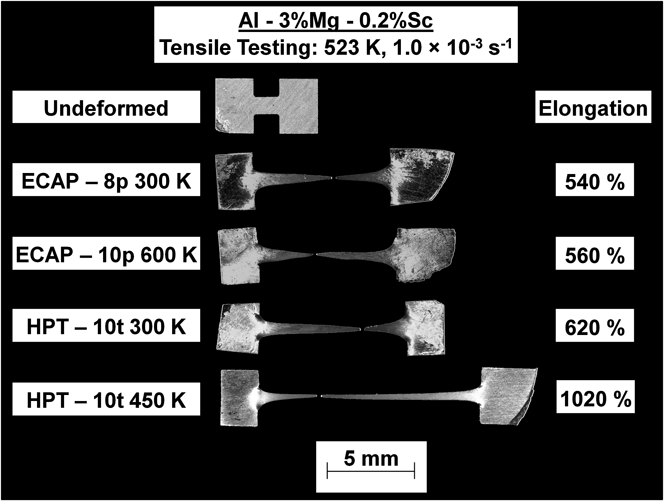
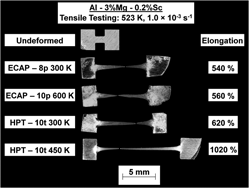
An example of the superplastic properties of an Al–3% Mg–0.2% Sc alloy is shown in Fig. 1 where all tensile testing was conducted at 523 K using a constant rate of crosshead displacement with an initial strain rate of 1.0 × 10⁻³ s−1: the upper specimen shows the initial shape of each sample and the four tensile specimens were prepared by ECAP through 8 passes (8p) at 300 K, ECAP through 10 passes at 600 K, HPT through 10 turns (10 t) at 300 K, and HPT through 10 turns at 450 K, respectively. It is readily apparent that all of these samples exhibit excellent superplastic properties.
Examples of superplasticity in Al–3% Mg–0.2% Sc specimens after processing by ECAP or HPT.

Inspection of the literature shows that a large volume of data is now available describing the occurrence of superplasticity in various Al–Mg–Sc alloys. Accordingly, the following sections tabulate and provide a detailed analysis of these results.
III. SUPERPLASTICITY IN Al–Mg–Sc ALLOYS
To provide a meaningful tabulation of the published data, it is first necessary to provide a precise definition of superplasticity. It was shown in very early work that the elongations achieved in tensile testing are directly proportional to the measured strain rate sensitivity, m. Reference Woodford23,Reference Langdon24 Specifically, the ductility increases with increasing m, and in superplastic flow the strain rate sensitivity is given by m ≈ 0.5 which corresponds to a stress exponent of n (= 1/m) ≈ 2. In solid solution alloys, the flow process is often controlled by viscous glide where the moving dislocations drag atmospheres of solute atoms so that the glide is the rate-controlling process. Under these conditions, the measured stress exponent is n ≈ 3 so that m ≈ 0.3 and there are often transitions in metallic solid solutions between the regimes of dislocation glide and dislocation climb. Reference Mohamed and Langdon25,Reference Yavari and Langdon26 It was noted in early research that high ductilities will be achieved also in solid-solution alloys undergoing creep by viscous glide where n ≈ 3 Reference Mohamed27 and these high ductilities are now used commercially in a hot blow-forming process to produce high volumes of panels of the AA5083 Al–Mg alloy for use in automotive applications. Reference Krajewski and Schroth28 However, this behavior is outside of the regime of true superplasticity and it is better designated as “enhanced ductility”. Reference Taleff, Lesuer and Wadsworth29
To avoid any overlap between results obtained in the viscous glide regime and in true superplastic flow, a critical review was undertaken of all the available literature. Reference Langdon30 This review showed that elongations of up to and slightly exceeding 300% have been recorded during creep controlled by viscous glide Reference Otsuka, Shibasaki and Kikuchi31 but there are no reports of any elongations at or above 400%. Accordingly, superplastic flow can be identified unambiguously as the achievement of tensile elongations of at least 400% and with an associated strain rate sensitivity of m ≈ 0.5. Reference Langdon30
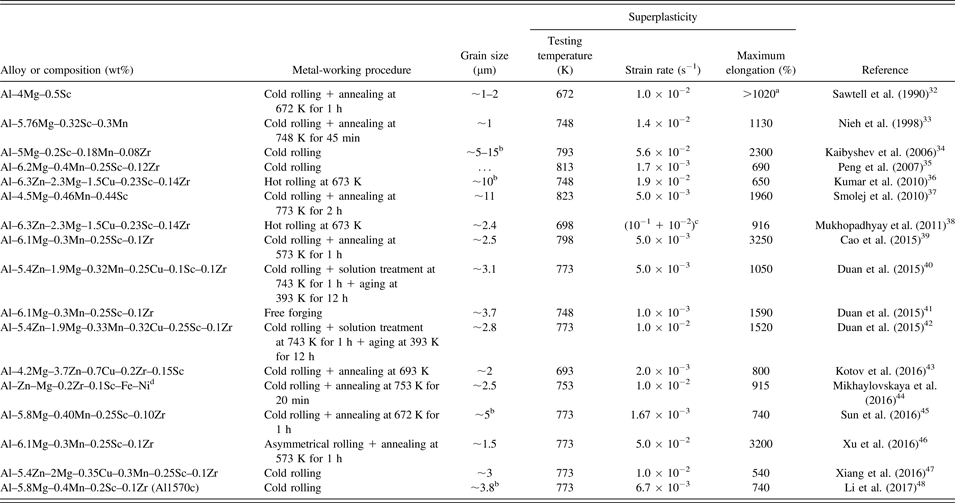
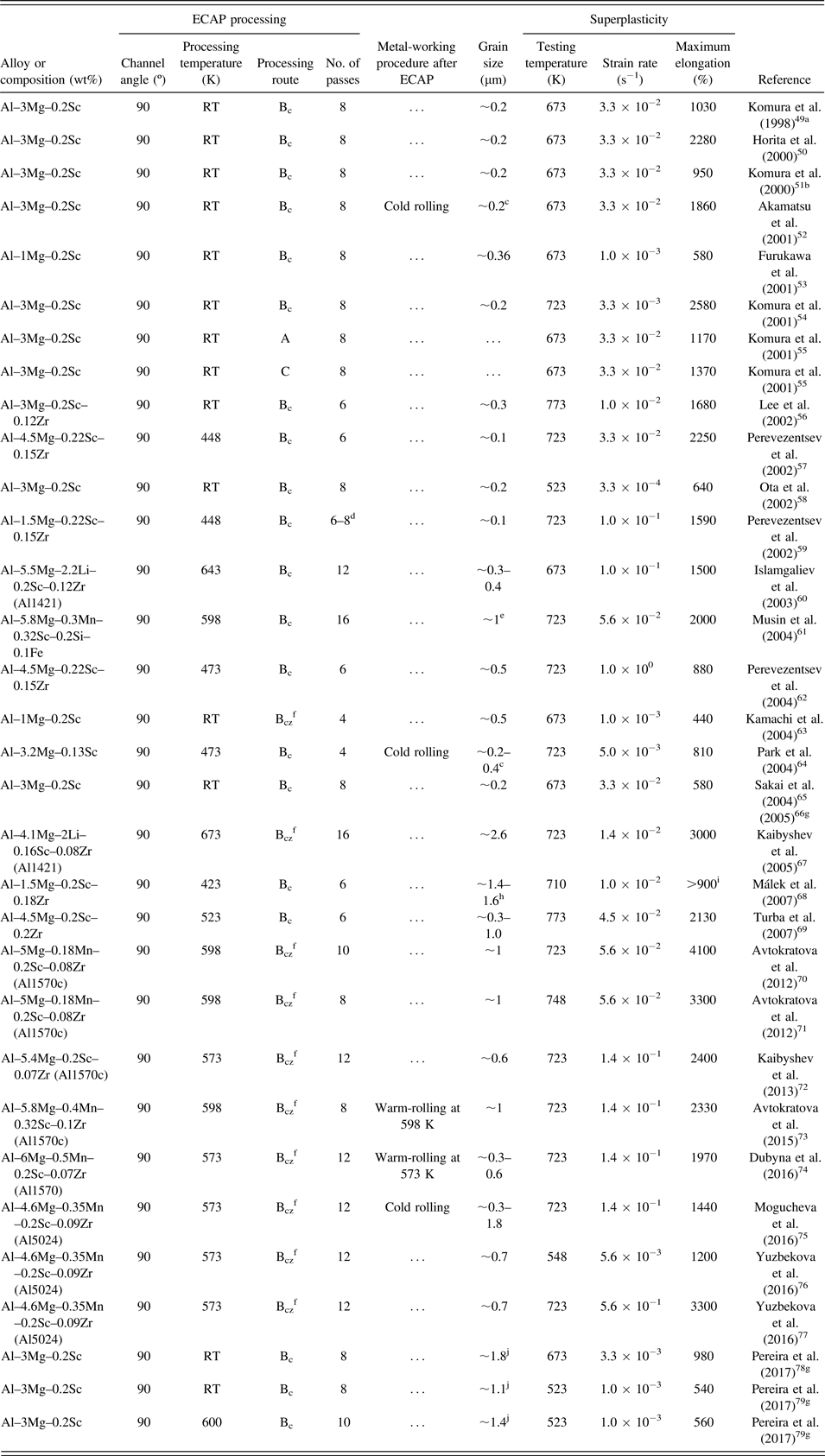
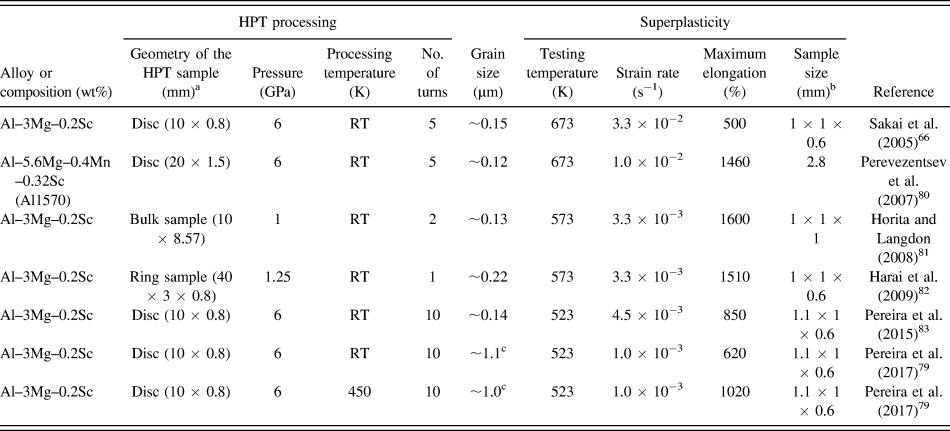
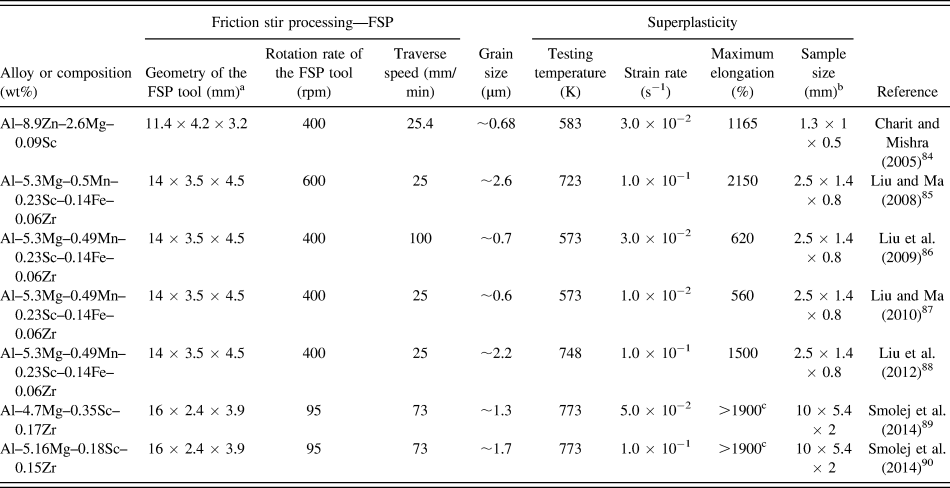
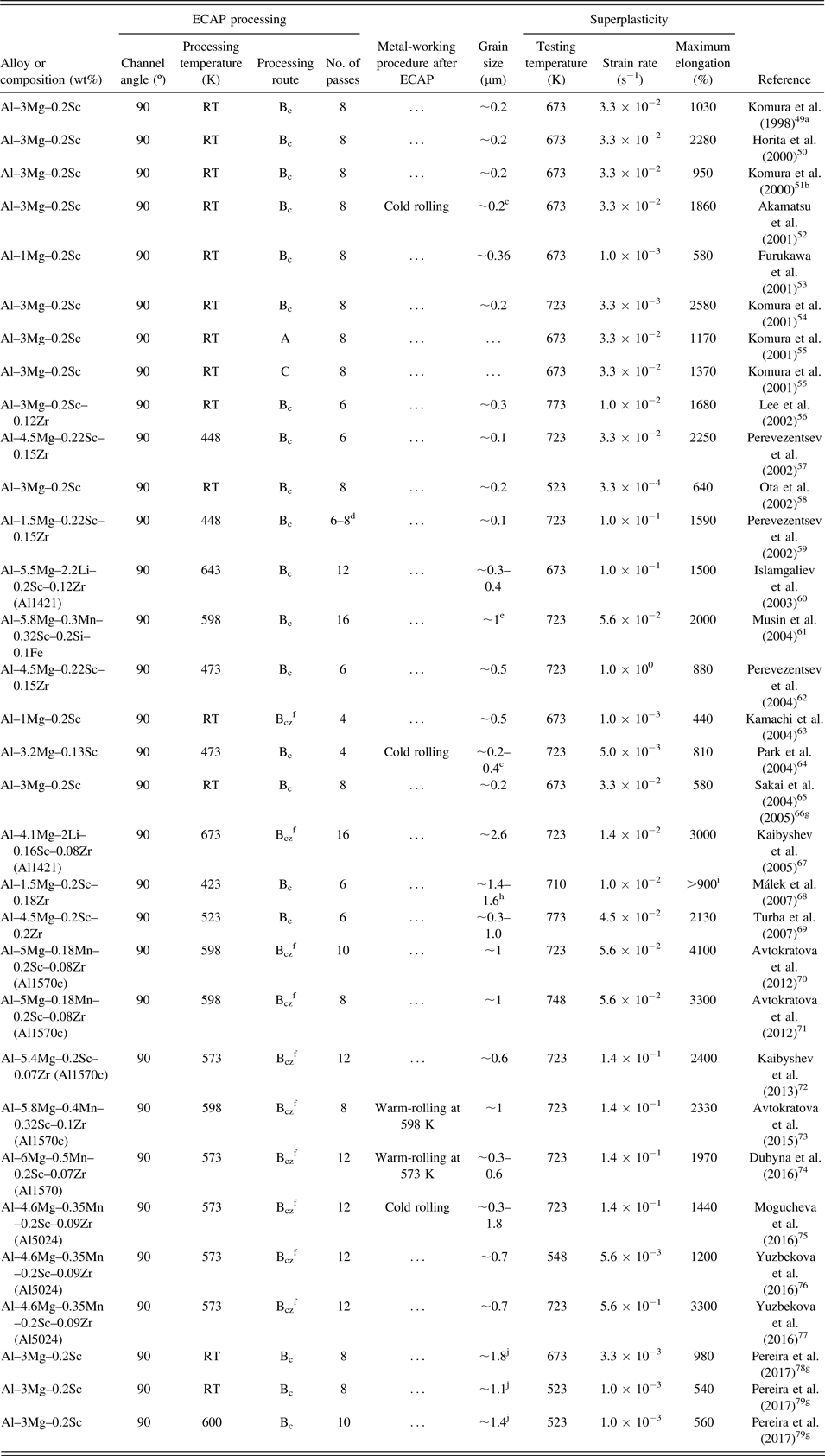
Using this definition, a series of tabulations was prepared to record all results published to date showing true superplasticity in Al–Mg–Sc alloys. First, it is important to recognize that there are numerous reports of superplasticity in Al–Mg–Sc alloys even without processing using SPD procedures. These results are summarized in Table I Reference Sawtell and Jensen32–Reference Li, Pan, Shi, Sun and Xiang48 and they cover various metal-working procedures based primarily on cold or hot rolling. Typically, the grain sizes in these materials are in the conventional superplastic range of ∼1–10 µm. For processing by SPD, results from ECAP are given in Table II where the grain sizes are now generally in the submicrometer range, Reference Komura, Berbon, Furukawa, Horita, Nemoto and Langdon49–Reference Pereira, Huang and Langdon79 Table III shows results for HPT where again the grain sizes are generally small Reference Sakai, Horita and Langdon66,Reference Pereira, Huang and Langdon79–Reference Pereira, Huang and Langdon83 and Table IV gives results for the alternative procedure of friction stir processing (FSP) Reference Charit and Mishra84–Reference Smolej, Klobčar, Skaza, Nagode, Slaček, Dragojević and Smolej90 where FSP is a solid-state joining technique developed for Al alloys and with the capability of producing a UFG microstructure over a limited region of the sample. Reference Ma91,Reference He, Gu and Ball92 In Table II, many of the materials were processed at room temperature (RT), all ECAP dies had channel angles of 90° so that a strain of ∼1 was introduced on each separate pass, Reference Iwahashi, Wang, Horita, Nemoto and Langdon93 and the various processing routes are defined as route A in which there is no rotation of the sample between passes, route BC in which the rod is rotated by 90° around the longitudinal axis in the same sense between each pass, and route C in which the rod is rotated by 180°, with route BCZ relating to plate samples in which the plates are rotated in the same direction by 90° around the vertical axis between each pass. Reference Kamachi, Furukawa, Horita and Langdon94 All of the ECAP samples exhibit excellent superplasticity with elongations up to and exceeding 2000%. Table III shows the applied pressure used in HPT and the dimensions of the samples where this is a critical parameter because of the use of small disks and the inherent limitations on the sample size. Nevertheless, HPT processing produces good superplastic elongations up to >1000%. Finally, in Table IV the processing by FSP lists the geometry of the FSP tool, the rotation rate of the tool, the traverse speed for the processing, and again there are excellent superplastic elongations. There is also a single recent report of elongations up to 1950% in an Al–3% Mg–0.2% Sc alloy processed by the new technique of high-pressure sliding which is based on the principles of HPT and relates to two sheets sliding over each other during the processing operation. Reference Takizawa, Masuda, Fujimitsu, Kajita, Watanabe, Yumoto, Otagiri and Horita95
Reports of superplasticity in Al–Mg–Sc alloys without SPD processing.

a Maximum possible elongation detected by the tensile testing facility used in the referred study.
b Grain size in the gauge area after tensile testing.
c Tensile testing conducted at 1.0 × 10⁻¹ s−1 up to a true strain of 0.73 and at 1.0 × 10⁻² s−1 afterward.
d The Mg, Zn, Ni, and Fe contents in this alloy were not reported.
Reports of superplasticity in Al–Mg–Sc alloys after ECAP.
a First report of superplasticity in Al–Mg–Sc alloys after SPD.
b Elongation after solution treatment at 873 K and further ECAP processing. At higher solution treatment temperatures, more particles are precipitated and the tensile elongations are superior.
c Grain size measured after ECAP.
d The number of passes in which the maximum elongation was attained was not specified. Nevertheless, it was reported that ECAP processing was conducted for the total of 6–8 passes.
e Grain size measured after annealing at 443 K for 4 h.
f ECAP was conducted using plate samples.
g Tensile testing conducted in miniature tensile specimens.
h Grain size measured after annealing at 710 K for 1 h.
i Maximum possible elongation detected by the tensile testing facility used in the referred study.
j Grain size in the gauge area after tensile testing.
Reports of superplasticity in Al–Mg–Sc alloys after HPT.
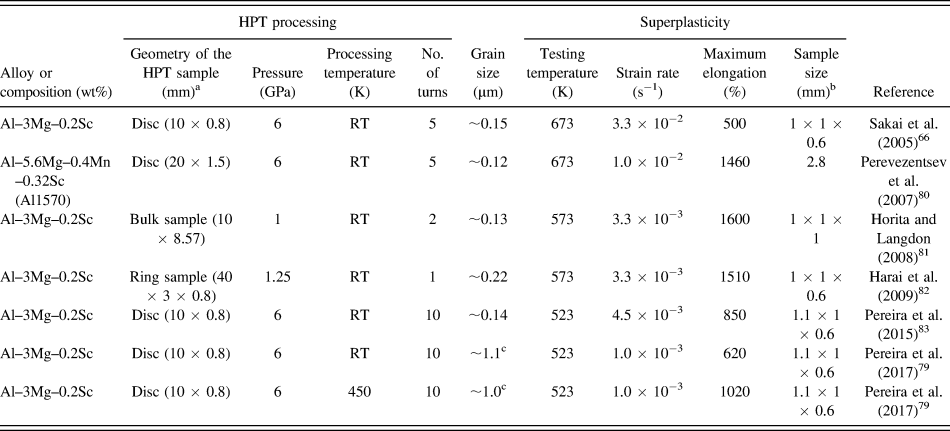
a Diameter × thickness for the discs, diameter × height for the bulk samples, and outer diameter × width × thickness for the rings.
b Gauge length or gauge length × gauge width × thickness of the tensile specimens.
c Grain size in the gauge area after tensile testing.
Reports of superplasticity in Al–Mg–Sc alloys after friction stir processing.

a Concave shoulder diameter × threaded pin diameter × threaded pin length.
b Gauge length × gauge width × thickness of the tensile specimens.
c Maximum possible elongation detected by the tensile testing facility used in the referred study.
IV. A COMPARISON OF DIFFERENT PROCESSING TECHNIQUES
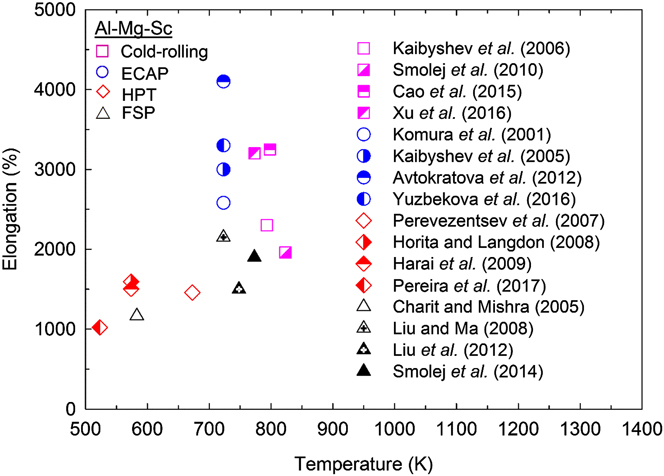
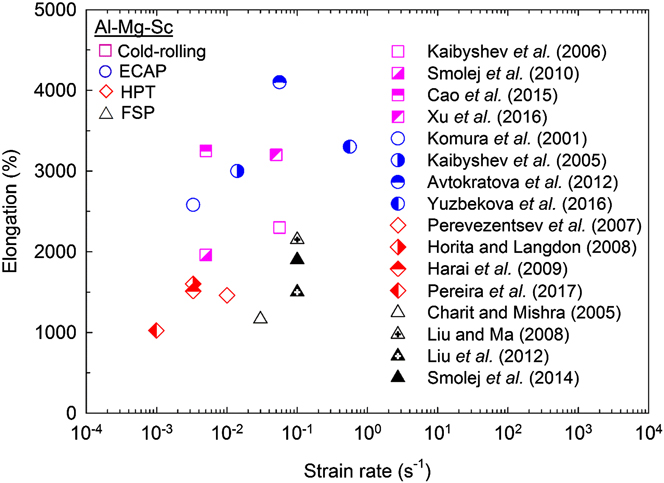
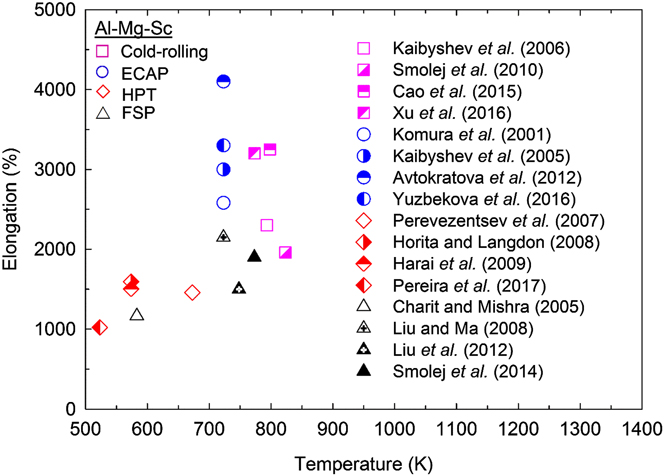
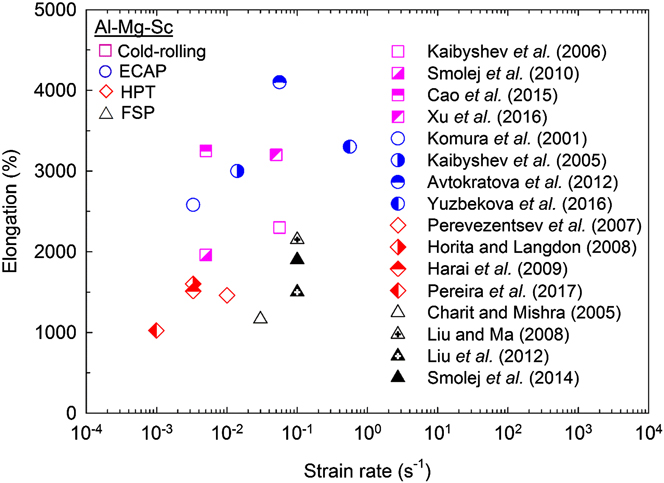
The data summarized in Tables I–IV represent four different processing procedures. To compare these different fabrication methods, it is appropriate to plot, for each separate processing technique, the results corresponding to the four highest reported elongations. These plots are shown in Figs. 2 and 3 as the elongation versus temperature and the elongation versus the initial strain rate, respectively.
Elongation versus temperature of testing for various superplastic Al–Mg–Sc alloys from different processing routes: Cold rolling, Reference Kaibyshev, Avtokratova, Apollonov and Davies34,Reference Smolej, Skaza and Dragojević37,Reference Cao, Xu, Duan, Yin, Lu and Wang39,Reference Xu, Cao, Zhang, Duan, Peng, Deng and Yin46 ECAP, Reference Komura, Horita, Furukawa, Nemoto and Langdon54,Reference Kaibyshev, Shipilova, Musin and Motohashi67,Reference Avtokratova, Sitdikov, Markushev and Mulyukov70,Reference Yuzbekova, Mogucheva and Kaibyshev76 HPT, Reference Pereira, Huang and Langdon79–Reference Harai, Edalati, Horita and Langdon82 FSP. Reference Charit and Mishra84,Reference Liu and Ma85,Reference Liu, Ma and Zhang88,Reference Smolej, Klobčar, Skaza, Nagode, Slaček, Dragojević and Smolej89
Elongation versus initial strain rate for various superplastic Al–Mg–Sc alloys from different processing routes: Cold rolling, Reference Kaibyshev, Avtokratova, Apollonov and Davies34,Reference Smolej, Skaza and Dragojević37,Reference Cao, Xu, Duan, Yin, Lu and Wang39,Reference Xu, Cao, Zhang, Duan, Peng, Deng and Yin46 ECAP, Reference Komura, Horita, Furukawa, Nemoto and Langdon54,Reference Kaibyshev, Shipilova, Musin and Motohashi67,Reference Avtokratova, Sitdikov, Markushev and Mulyukov70,Reference Yuzbekova, Mogucheva and Kaibyshev76 HPT, Reference Pereira, Huang and Langdon79–Reference Harai, Edalati, Horita and Langdon82 FSP. Reference Charit and Mishra84,Reference Liu and Ma85,Reference Liu, Ma and Zhang88,Reference Smolej, Klobčar, Skaza, Nagode, Slaček, Dragojević and Smolej89
It is readily apparent from Fig. 2 that the elongations tend to increase with increasing temperatures. Furthermore, excellent and similar results may be achieved using either ECAP or cold rolling. Lower superplastic elongations are achieved when processing by HPT but this is attributed to the small size of the HPT specimens. Thus, although the measured elongations in tensile testing tend to increase with decreasing gauge length, Reference Zhao, Guo, Wei, Dangelewicz, Xu, Zhu, Langdon, Zhou and Lavernia96,Reference Zhao, Guo, Wei, Topping, Dangelewicz, Zhu, Langdon and Lavernia97 the HPT specimens are cut from thin disks and their exceptionally reduced thicknesses of typically ∼0.6 mm lead to easy and premature failure. This is evident from inspection of Table III where the maximum elongation of 1600% was achieved using a thicker specimen cut from a small cylindrical sample. Reference Horita and Langdon81 The range of elongations achieved after FSP processing is due to the inhomogeneities that are an inherent feature of the localized and varying microstructural modifications that occur when using this type of processing.
Although the datum points in Fig. 3 are scattered, there is a general tendency to achieve higher elongations at faster strain rates. This is consistent with the very early demonstration that the exceptionally small grain sizes after SPD processing provide an opportunity for attaining superplasticity at high strain rates, Reference Valiev, Salimonenko, Tsenev, Berbon and Langdon98 where this is defined specifically as strain rates at and above 10−2 s−1. Reference Higashi, Mabuchi and Langdon99
V. THE RATE-CONTROLLING FLOW PROCESS IN THE SUPERPLASTICITY OF Al–Mg–Sc ALLOYS
It is now well established that superplasticity occurs through the relative motion of adjacent grains in grain boundary sliding (GBS). Reference Langdon100 However, the occurrence of superplasticity in isolation in a polycrystalline matrix will open cavities leading to premature failures. Instead there is now very good experimental evidence showing that the GBS in superplasticity is accommodated by dislocation slip within the adjacent grains Reference Falk, Howell, Dunlop and Langdon101–Reference Xun and Mohamed103 and these dislocations pass through the grains without hindrance because the grain size is sufficiently small that it is not possible to form subgrains. Reference Mohamed and Langdon104
It is feasible to model the flow by GBS in superplasticity and this leads to an equation in the conventional form for the rate of flow under steady-state conditions,
 $\dot \varepsilon$
:
 $$\dot \varepsilon = {{ADG{\bf{b}}} \over {kT}}{\left( {{{\bf{b}} \over d}} \right)^p}{\left( {{\sigma \over G}} \right)^n}\quad ,$$
where D is the appropriate diffusion coefficient, G is the shear modulus, b is the Burgers vector, k is Boltzmann’s constant, T is the absolute temperature, d is the grain size, σ is the applied stress, p and n are the exponents of the inverse grain size and the stress, respectively, and A is a dimensionless constant. Reference Langdon105 In the theoretical model for GBS, D = D o(gb) exp(−Q gb/kT) for the coefficient for grain boundary diffusion where D o(gb) is the frequency factor and Q gb is the activation energy for grain boundary diffusion, p = 2, n = 2, and A = 10. Reference Langdon105 Several analyses have shown that Eq. (1) is consistent with the rates of superplastic flow in numerous Al and Mg alloys after processing by ECAP or HPT. Reference Kawasaki and Langdon106–Reference Kawasaki and Langdon109
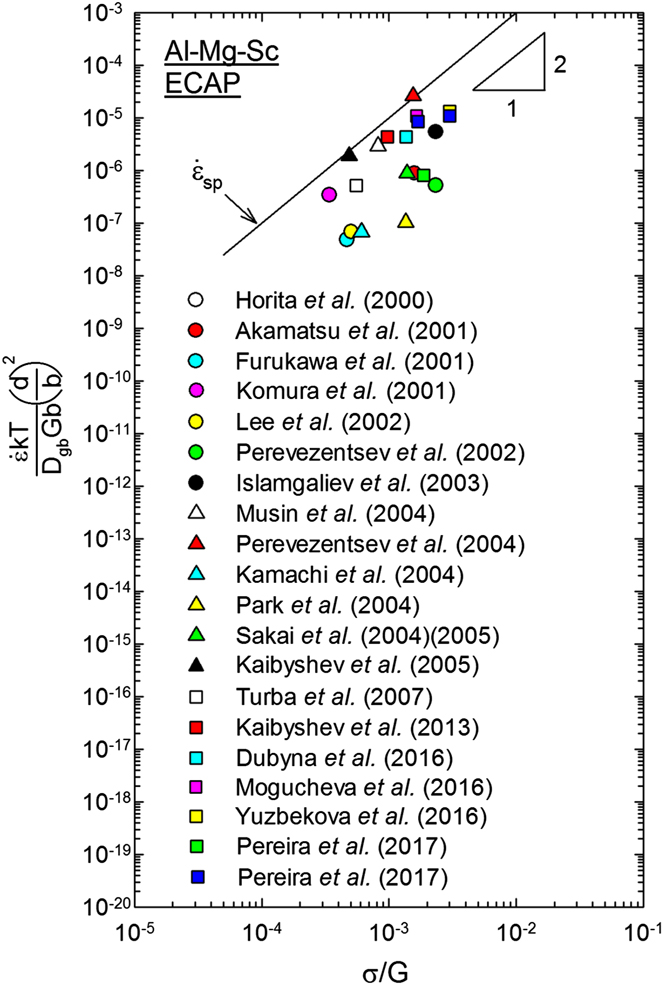
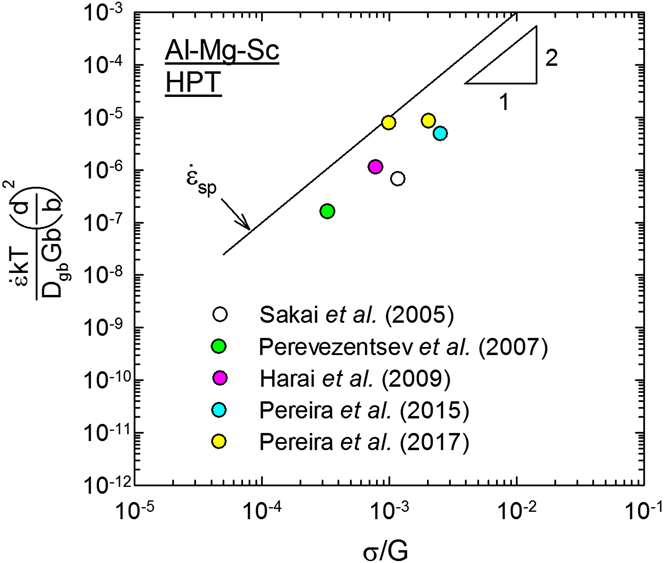
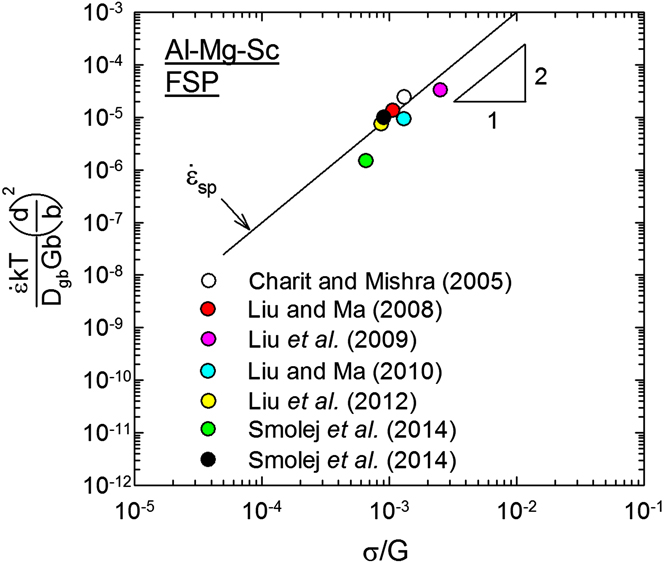
To check the applicability of Eq. (1) to the many superplastic results now available for the various Al–Mg–Sc alloys, similar analyses were conducted using the experimental data available in Tables I–IV. As in the earlier analyses, Reference Kawasaki and Langdon106–Reference Kawasaki and Langdon109 these analyses were performed using basic parameters for pure Al where D o(gb) = 1.86 × 10⁻⁴ m2/s, Reference Mohamed and Langdon110 Q gb = 86 kJ/mol, Reference Mohamed and Langdon110 b = 2.86 × 10⁻¹⁰ m, Reference Mohamed and Langdon110 and G = 3.022 × 10⁴ − 16T MPa with the temperature expressed in degrees Kelvin. Reference Mohamed and Langdon110
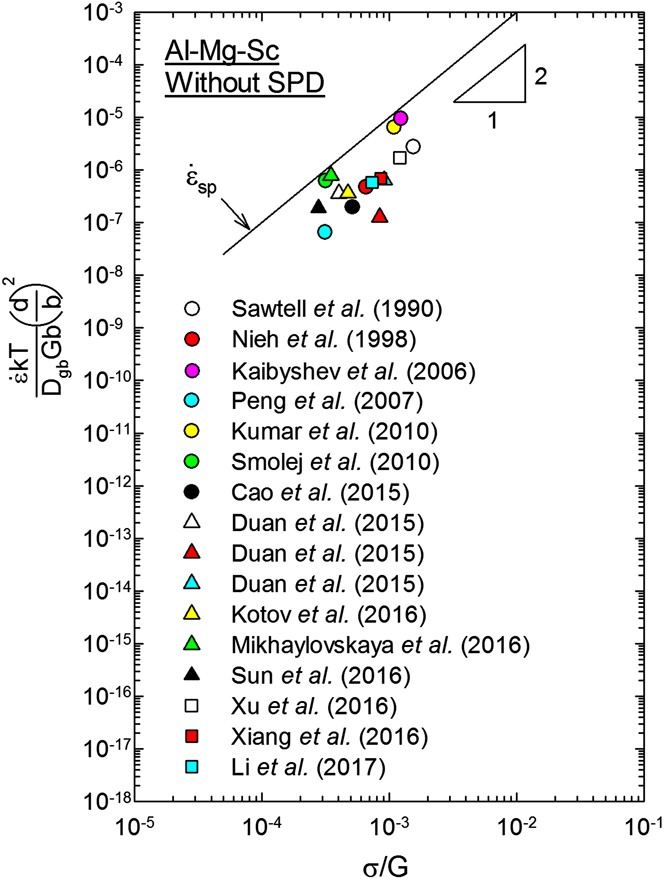
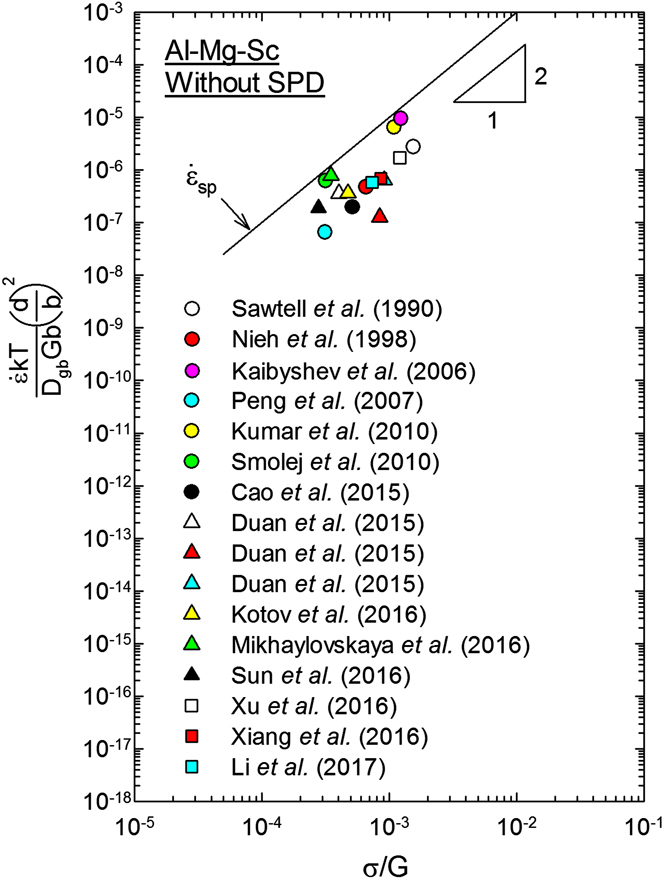
Using Eq. (1), the temperature and grain size compensated strain rate was plotted against the normalized stress as shown in Fig. 4 for results obtained without processing by SPD as listed in Table I,
Reference Sawtell and Jensen32–Reference Smolej, Skaza and Dragojević37,Reference Cao, Xu, Duan, Yin, Lu and Wang39–Reference Li, Pan, Shi, Sun and Xiang48
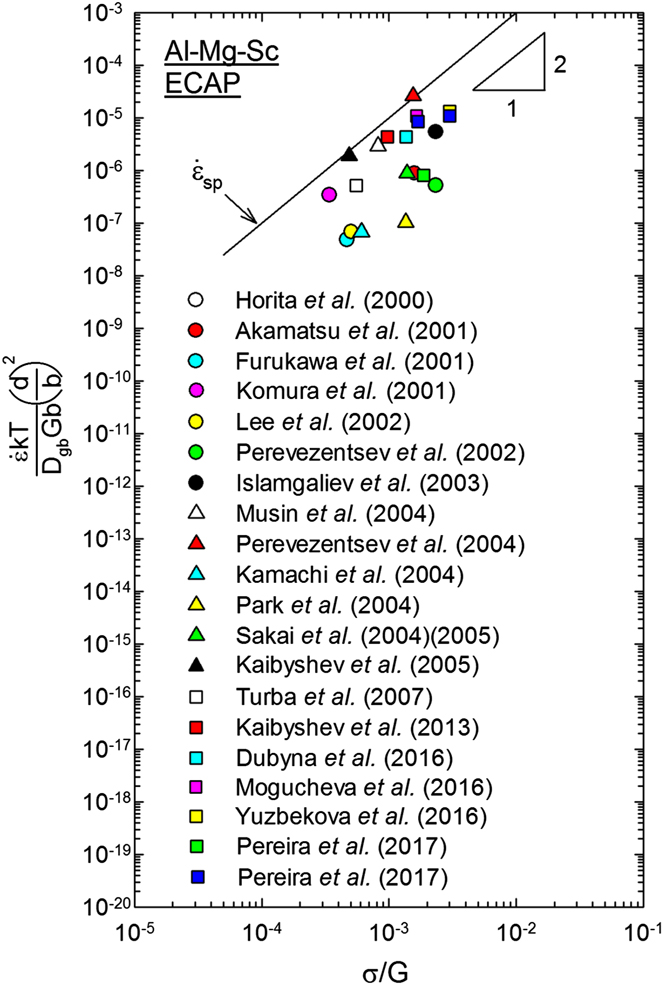
in Fig. 5 for results obtained after ECAP as listed in Table II,
Reference Horita, Furukawa, Nemoto, Barnes and Langdon50,Reference Akamatsu, Fujinami, Horita and Langdon52–Reference Komura, Horita, Furukawa, Nemoto and Langdon54,Reference Lee, Utsunomiya, Akamatsu, Neishi, Furukawa, Horita and Langdon56,Reference Perevezentsev, Chuvil’deev, Sysoev, Kopylov and Langdon59–Reference Kaibyshev, Shipilova, Musin and Motohashi67,Reference Turba, Málek and Cieslar69,Reference Kaibyshev, Zhemchuzhnikova and Mogucheva72,Reference Dubyna, Malopheyev and Kaibyshev74,Reference Mogucheva, Yuzbekova and Kaibyshev75,Reference Yuzbekova, Mogucheva and Kaibyshev77–Reference Pereira, Huang and Langdon79
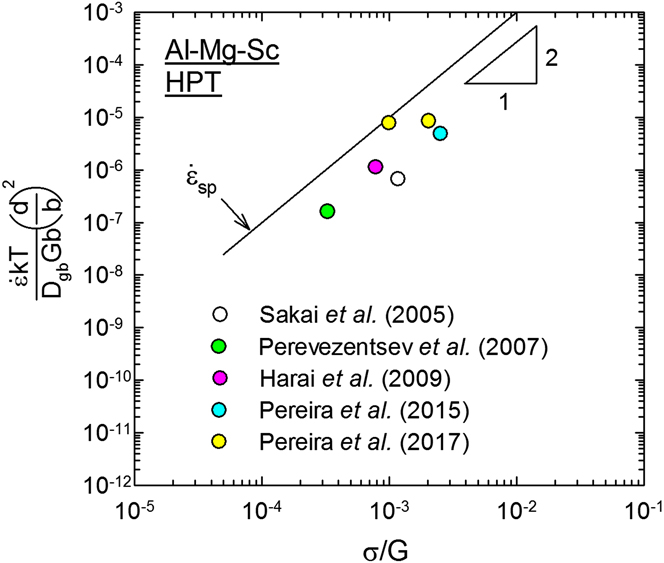
in Fig. 6 for results obtained after HPT as listed in Table III,
Reference Sakai, Horita and Langdon66,Reference Pereira, Huang and Langdon79,Reference Perevezentsev, Shcherban, Murashkin and Valiev80,Reference Harai, Edalati, Horita and Langdon82,Reference Pereira, Huang and Langdon83
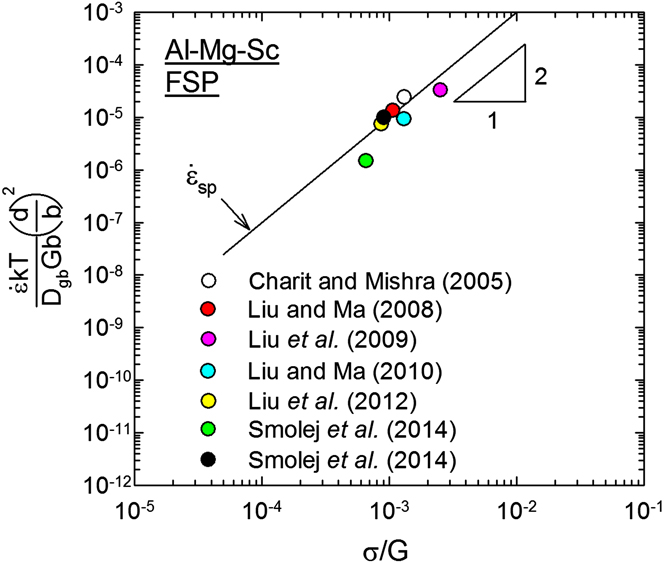
and in Fig. 7 for results obtained after FSP as listed in Table IV.
Reference Charit and Mishra84–Reference Smolej, Klobčar, Skaza, Nagode, Slaček, Dragojević and Smolej90
In each plot, the line labeled
 ${{\dot \varepsilon }}_{{\rm{sp}}}}$
corresponds to the theoretical prediction of the rate of superplasticity in conventional superplastic materials.
Temperature and grain size compensated strain rate versus normalized stress for various superplastic Al–Mg–Sc alloys without SPD processing Reference Sawtell and Jensen32–Reference Smolej, Skaza and Dragojević37,Reference Cao, Xu, Duan, Yin, Lu and Wang39–Reference Li, Pan, Shi, Sun and Xiang48 : the solid line shows the theoretical prediction for superplastic flow in conventional metals not processed using SPD techniques.
Temperature and grain size compensated strain rate versus normalized stress for various superplastic Al–Mg–Sc alloys processed by ECAP Reference Horita, Furukawa, Nemoto, Barnes and Langdon50,Reference Akamatsu, Fujinami, Horita and Langdon52–Reference Komura, Horita, Furukawa, Nemoto and Langdon54,Reference Lee, Utsunomiya, Akamatsu, Neishi, Furukawa, Horita and Langdon56,Reference Perevezentsev, Chuvil’deev, Sysoev, Kopylov and Langdon59–Reference Kaibyshev, Shipilova, Musin and Motohashi67,Reference Turba, Málek and Cieslar69,Reference Kaibyshev, Zhemchuzhnikova and Mogucheva72,Reference Dubyna, Malopheyev and Kaibyshev74,Reference Mogucheva, Yuzbekova and Kaibyshev75,Reference Yuzbekova, Mogucheva and Kaibyshev77–Reference Pereira, Huang and Langdon79 : the solid line shows the theoretical prediction for superplastic flow in conventional metals not processed using SPD techniques.
Temperature and grain size compensated strain rate versus normalized stress for various superplastic Al–Mg–Sc alloys processed by HPT Reference Sakai, Horita and Langdon66,Reference Pereira, Huang and Langdon79,Reference Perevezentsev, Shcherban, Murashkin and Valiev80,Reference Harai, Edalati, Horita and Langdon82,Reference Pereira, Huang and Langdon83 : the solid line shows the theoretical prediction for superplastic flow in conventional metals not processed using SPD techniques.
Temperature and grain size compensated strain rate versus normalized stress for various superplastic Al–Mg–Sc alloys processed by FSP Reference Charit and Mishra84–Reference Smolej, Klobčar, Skaza, Nagode, Slaček, Dragojević and Smolej90 : the solid line shows the theoretical prediction for superplastic flow in conventional metals not processed using SPD techniques.
Several conclusions may be drawn from inspections of Figs. 4–7.
First, all of the results are mutually consistent. Although the analyses are based on more than forty different publications documenting data obtained in laboratories in many different countries, all results lie together to within less than one order of magnitude of strain rate.
Second, the precise chemical compositions of the alloy play no significant role in affecting the rate of superplastic flow even though there is recent evidence for significant precipitation in severely deformed Al–Mg alloys. Reference Sauvage, Enikeev, Valiev, Nasedkina and Murashkin111,Reference Buranova, Kulitskiy, Peterlechner, Mogucheva, Kaibyshev, Divinski and Wilde112 Thus, inspection of Tables I–IV shows that there are large variations in the compositions of the various alloys with the Mg composition varying between 1 and 6%, the Sc content varying from 0.1 to 0.5% and with various additions of Zn, Cu, Mn, Zr, and other elements. Nevertheless, all of the datum points are mutually consistent with no clear dependence on composition.
Third, there is a general consistency with the predicted stress exponent of n = 2. Although the results without SPD and after ECAP and HPT tend to lie below the predicted line for conventional superplasticity, the points are generally consistent with the predicted behavior to within one order of magnitude of strain rate and they suggest a stress exponent close to ∼2. It is surprising to note that the results with the FSP specimens are in even better agreement with the theoretical model despite the inhomogeneities that are an inherent feature of these samples.
From this comprehensive analysis, it is therefore reasonable to conclude that the theoretical relationship developed originally for superplasticity in conventional alloys provides also an excellent prediction for the superplastic behavior of Al–Mg–Sc alloys prepared both without and with SPD processing.
VI. SUMMARY AND CONCLUSIONS
-
(1) The Al–Mg–Sc alloys are excellent candidate materials for exhibiting high superplastic elongations when testing in tension at elevated temperatures. Results are now available for a very large number of Al–Mg–Sc alloys and these various results were tabulated according to whether the materials were processed without the use of any SPD techniques, with SPD processing in the form of ECAP or HPT and through processing by FSP.
-
(2) Analysis of the data shows that all results are mutually consistent and the rate of superplastic flow has no significant dependence on the precise chemical composition of the alloy.
-
(3) The results confirm a stress exponent of n = 2 as predicted by the theoretical model for superplasticity in conventional materials, and the various experimental results are generally consistent with the theoretical model to within less than one order of magnitude of strain rate.
ACKNOWLEDGMENTS
This work was supported in part by the NRF Korea funded by MoE under Grant No. NRF-2016R1A6A1A03013422 and by MSIP under Grant No. NRF-2016K1A4A3914691, in part by the National Science Foundation of the United States under Grant No. DMR-1160966 and in part by the European Research Council under ERC Grant Agreement No. 267464-SPDMETALS.