Introduction
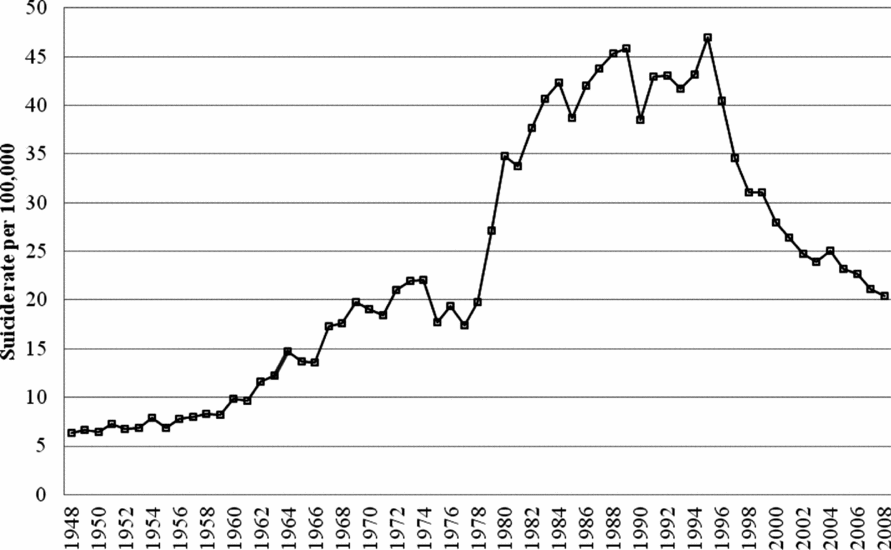
By the final decade of the twentieth century, rates of suicide in Sri Lanka ranked among the highest in the world. Rapidly increasing year after year from the middle of the twentieth century, between 1983 and 1993 more than 90,000 people were known to have committed suicide.Footnote 1 Reflecting the scale of the problem, a ‘suicide epidemic’Footnote 2 was proclaimed. However, in 1996 something strange appeared to happen. For the first time in a century, the suicide rate began to fall. This it did substantially, and by 2008, was at its lowest level in more than 30 years (see Figure 1). The most recent evidence suggests that the suicide rate, once infamous in suicidology circles, is continuing its downward trend.Footnote 3 The history of the Sri Lankan suicide rate is thus a story of two halves: an upward ‘spiral of suicide’Footnote 4 between the 1960s and 1995, and a rapid contraction ever since.
The Sri Lankan suicide rate, 1948–2008.Footnote 5

At a time when suicide rates are increasing across South Asia and many other parts of the globe, the causes of Sri Lanka's rise and fall are important and interesting. Posing problems for classic sociological theories of suicide, the decline, while reason for celebration, forces us to question some fundamental assumptions underlying social scientific approaches to the problem. Drawing from sociological, medical epidemiological, historical, and anthropological secondary sources as well as 21 months of original ethnographic in Sri Lanka, in this paper I argue that there are four possible readings of the country's suicide rate: social, methodological, cultural, and what might be called ‘Weberian’. While the first three readings provide windows onto parts of the story, the fourth—a composite view—suggests a new way of thinking about suicide not just in Sri Lanka but also cross-culturally. In so doing, the paper poses questions for how the link between suicide and society might be imagined.
The paper is divided into four parts. The first introduces the suicide rate as an artefact and a problem for study: an object of scholarly and popular fascination that seems to say something about the wellbeing of nations. The second introduces my ethnographic research into suicide in Sri Lanka and highlights key findings that reflect throughout the four readings of the suicide rate that follow. The third part moves on to consider established readings of the Sri Lankan suicide rate in the literature, while the fourth presents the composite view. As such, throughout the paper I seek to employ and combine secondary sources from a number of disciplines in new kinds of ways. I aim to show how diverse approaches to the study of suicide can greatly facilitate our knowledge and understanding of the problem. Suicidologists often recognize the diverse range of ‘causes’ of suicide that impact on any case, from genetic disposition through to psychological experience and contagion to social, cultural, and historical factors and contexts. In this paper I suggest one way in which different approaches can be combined to produce a new way of reading quantitative and qualitative sets of data.
Suicide rates and the wellbeing of nations
A suicide rate is a statistical picture of, ostensibly, the number of self-inflicted deaths occurring within any delineated population. Usually collated at the level of nations, they are calculated per 100,000 of the population, which allows for comparisons to be made between nations as well as demographic groups within them. According to the World Health Organization,Footnote 6 a suicide rate that exceeds 13 per 100,000 is ‘high’, while a suicide rate that falls below 6.5 per 100,000 is ‘low’. By this method we can say that suicide rates are ‘highest’ across Scandinavia, Russia and the old Soviet states, parts of northern and eastern Europe, Sri Lanka, and Japan; and ‘lowest’ in the United Kingdom, Italy, the Middle East, and large parts of Central and South America. Meanwhile, the data suggest that men outnumber women considerably in terms of completed suicide, while women outnumber men in terms of suicide attempts. Nowhere in the world do young children commit suicide in any significant numbers—everywhere suicide seems to be correlated with middle to old age.
Suicide rates have long been a subject of fascination, being used by nineteenth- century French moral statisticians to comment on the deviancy of populations,Footnote 7 and Emile Durkheim to demonstrate the sociological method.Footnote 8 It was through Durkheim's work that suicide rates became best known as an index of societal wellbeing, about the only use they enjoy today. For Durkheim, the suicide rate could be read as an artefact created by what he called the ‘suicidogenic current’: the conditions in society that compel individuals to end their own lives. Durkheim posited that the suicidogenic current fluctuated according to degrees of social integration and moral regulation within society. With one or both too strong or too weak, the suicide rate rose or fell depending upon conditions and experiences of what he termed egoism, anomy, altruism, and fatalism.
Briefly, egoistic suicide was produced by a lack of social integration, which exposed individuals to suicide because they did not have adequate levels of social support for dealing with their problems. Anomic suicide, meanwhile, was produced by processes of change that led people to lose their moorings in the social world and thus their sense of belonging to a social group: a lack of moral regulation. Altruistic and fatalistic forms of suicide, for their part, were produced by overly strong social integration and moral regulation respectively, and for this reason, Durkheim argued, were usually found in small-scale ‘traditional’ societies. Altruistic suicide was compelled not by some individual problem but rather a sense of commitment to the group, while fatalistic suicide followed in contexts where individuals were so embedded in their social position they could envisage no other life when that position was threatened or lost.
Over the years there have been many criticisms, defences, and elaborations of Durkheim's theory published by social scientists.Footnote 9 Generally scholars have either taken to task his data and methods of statistical analysis or poked holes in his theoretical thinking. Some have argued that Durkheim is worthless, while others have found that he is still relevant. What they all still pretty much agree on, however, is Durkheim's insistence that suicide is a product of society, and not just of individuals’ disturbed minds. Given, moreover, that suicide is fundamentally assumed to be related to some kind of social change or turbulence, Durkheim's theory of anomy has tended to reappear via the backdoor. Although many contemporary scholars tend to dismiss Durkheim's formal theory, they often nevertheless accept a causal link between social conditions and suicidal behaviour.
In the scholarly and (Western) popular imagination today, it is the loss or gain of social integration that people seem to speak about most often when discussing suicide. This can be found in media reports concerning the effects of economic recession in Europe, which are pushing up suicide rates, as well as stories of how suicide rates go down during times of war.Footnote 10 The much-reported ‘farmer suicides’ in India and Sri Lanka captured the attention of both academics and advocates,Footnote 11 with several global campaigns having been launched to try to ease the burdens of indebted agriculturalists, and the phenomenon gaining its own Wikipedia page.Footnote 12 The assumption underwriting these links is Durkheim's idea that it is not absolute poverty (or hardship, alienation or whatever) that causes people to kill themselves, but changing levels of relative poverty (or hardship, alienation, and so on) and thus satisfactory integration into society. Suicide rates are read, then, as an index of social wellbeing, as in Wilkinson's and Pickett's best-selling The Spirit Level, and used to make points about the comparative socio-economic development of nations.Footnote 13
Suicide at the local level: self-harm and self-inflicted death in Madampe
With an interest in Sri Lanka's high suicide rate, in October 2004 I travelled to the island to conduct a two-year ethnographic study of suicidal behaviour. My research was focused on the Madampe Division in the Puttalam District of northwestern Sri Lanka. Lying some 70 kilometres north of the capital, Colombo, Madampe is best described as a ‘peri-urban’ locality, comprising two towns and numerous suburbs and villages running into each other, interspersed by coconut estates and the occasional paddy field. The area is primarily ethnically and linguistically Sinhala (91.4 per cent), with a relatively large minority (5.4 per cent) of Tamil-speaking Muslims living in the west of the Division.Footnote 14 According to the 2001 census the Madampe Division had a population of 43,411, which was supported by a mixed economy of plantation agriculture, light manufacturing, public and private sector service, and overseas labour migration.Footnote 15 Overall, the area is relatively developed in socio-economic terms and can be understood as forming the fringe of the densely populated western coastline running between Chilaw in the north to Galle in the south.
During my research I conducted ethnographic studies of two Sinhala villages—Udagama and AlutwattaFootnote 16—as well as several public institutions that dealt with the suicidal behaviours that occurred in Madampe and the wider area. These included a public health and emergency centre, the divisional police station, a mental health clinic in the neighbouring town of Chilaw, and a coroners’ court in the more distant town of Kuliyapitiya. Each of these organizations held records of varying detail concerning the cases of suicidal behaviour they dealt with, and in total I was able to review the records of 600 self-harm patients and 129 suicide deaths spanning a five-year period.Footnote 17 I also had the opportunity to interview patients and staff, as well as observe counselling sessions, during the period of my fieldwork. Meanwhile, the ethnographic materials that I collected from Udagama and Alutwatta on the prevailing contexts and conditions, and causes and meanings of suicidal behaviour provided frameworks for understanding the numerous individual cases that I recorded.Footnote 18
Social contexts of suicide: hierarchy and relatedness
From these various sources I was able to develop a detailed understanding of the demographic patterns of suicidal behaviour in Madampe, as well as prevailing ‘motives, methods, and meanings’. Issues of gender, kinship, social status, and class were paramount in how people explained the reasons for their own suicidal actions or of those around them. I have explored these issues elsewhere, so here will only provide a—much simplified—summary.Footnote 19
To understand suicide in Madampe it is necessary to first understand the local ‘causal frameworks’Footnote 20 through which people live, make sense of themselves and others around them, and attribute causes to fortunes and misfortunes occurring in their lives. Principally, this means exploring the ways in which historical relationships to land and labour manifest different understandings and claims of social status and relatedness in the present.Footnote 21 Drawing from the work of ObeyesekereFootnote 22 and Stirrat,Footnote 23 I have considered how resulting structural positionalities lead to certain kinds of frameworks with regard to the causes, consequences, and ways of responding to fortunes and misfortunes in the world. Following this method I discovered that in Udagama and Alutwatta, quite distinct frameworks had come into being, from what might—again very simplistically—be called an ‘individualistic’ orientation at Udagama to a ‘collectivistic’ orientation at Alutwatta. In Madampe the expansion of coconut plantations and mass inward migration from the mid-nineteenth century onwards resulted in the creation of two kinds of village in the Division: a ‘pre-colonial ancient’ (puraṇa) settlement and a ‘colonial/post-colonial modern’ colony (estate).Footnote 24 Udagama is an example of a puraṇa village and Alutwatta, an example of an estate. For many people in Madampe whether or not one resides in a puraṇa or estate village goes a long way towards determining economic and social position, and the terms themselves provide a shorthand method of summing up ‘status’ or ‘class’ in Weber’sFootnote 25 sense. For Weber a status group was defined by a common ‘traditional’ identity and style of life, often marked through practices of bodily conduct, speech, dress, marriage, and commensality. Contrasted to this was Weber's understanding of ‘modern’ class, which, like Marx, encompassed two kinds: (1) a category of people who are simply in the same economic situation, and (2) a group of people who recognize they have shared economic interests. However, for Weber the distinction between status and class was only ideal, and in practice the two existed together in different degrees. He suggested that while classes are stratified according to the production and acquisition of material wealth, status groups are ranked by stylized consumption patterns. In this way, class and status are often, although not always, determinate of each other.Footnote 26
In Madampe, as Weber would have predicted, ‘traditional’ status groups—castes—exist alongside ‘modern’ classes. Caste in Sinhalese Sri Lanka is no easy institution to define, with some arguing that it has significantly weakened as a principle of social organizationFootnote 27 and others suggesting that it is still relevant.Footnote 28 Conversely, most scholars seem to be in agreement that class is a universally important means of social differentiation and ranking today, with the terms ‘middle class’ and ‘working class’ widely used in the literature. However, in Madampe—and in addition to caste and class—there was also a concern with individuals’ village of residence, from which people claimed ‘native’ or ‘newcomer’ status in the area, respectively. Each kind of residence status was imbued with a regard to individuals’ caste status and class level, signifying extent of land holdings as well as consumption potentialities, patterns, and styles. I contend that an analysis of suicide in Madampe must rest on a consideration of these factors, as residence, caste, class, and consumption form a quadruplet of indicators—which in turn are deeply shaped by gender and age—that, when taken together, allow people to develop a sense of themselves and their relations to others, and ultimately come to view the causes and consequences of fortunes and misfortunes in the world.
My claims can be illustrated by considering the different histories and contemporary formations of Udagama and Alutwatta. Udagama (current population 606 across 74 households) is one of those villages that suffered as a result of nineteenth-century coconut estate expansion which encouraged massive inward migration to the area. It became heavily overpopulated, native families could no longer give land as dowry or inheritance to sons and daughters, and as such they not only sought economic advance through public and, increasingly, private sector employment, but had to buy land and raise families elsewhere. Over the generations, often-violent quarrels about land led to the fracturing of kinship to the extent that although most Udagama families today could choose to claim relatedness with their neighbours, very few actually do. As such, Udagama people stress a narrow patriline and only certain affinal links such as those with wives’ husbands (massinā), but even then there is considerable disagreement over what these ties mean in practice. As one informant complained, ‘I cannot rely on my relatives for anything’, echoing a sentiment commonly held—that economic livelihoods had to be earned through individual hard work, not recourse to kin patronage.
Yet at the same time, Udagama is comprised mostly of high-caste goyigama families who, despite a lack of kin ideology, claim ancestry in the area back to the twelfth century. Today the majority of adult males of working age are in professional, white collar or skilled artisanal jobs, or else are following advanced or higher level education. Although two-thirds of marriages since the late 1970s have been the result of ‘love affairs’, parental blessing has only ever been granted when the union has been within the same caste and class. The spouse's family too must exhibit a ‘good ancestry’ (hoňda paramparāwa), which includes living in a puraṇa village like Udagama. To that extent Udagama people can be understood as forming a local middle class: through being ‘of the village’ they occupy the level of the ‘local intelligentsia’ whom Obeyesekere describes as the chief advocates of ‘Protestant Buddhism’, a middle class reform movement.Footnote 29 Indeed, the rationalist ethic that underpins Protestant Buddhism also underpins puraṇa conceptions of the world and, as will be seen, of suicide. Udagama people tend to be this-worldly oriented, in the sense that they do not tend to locate problems or misfortunes in the activities of malevolent spirits or deities but instead impersonal forces such as ‘the open economy’, ‘globalization’ or ‘political corruption’ at the national level.
Alutwatta, by contrast, is a housing colony or estate that was established under the 1935 ‘Land Development Ordinance’—the colonial administration's response to land and population pressures experienced in the coconut-growing districts. The Land Development Ordinance handed government coconut estates and wasteland to land-poor or landless individuals and families in the area. Today Alutwatta has a population of 792 across 121 households, but unlike in Udagama, living space and land inheritance are rarely causes for concern. Plots of land up to a half-acre were originally granted to individuals and families between the 1950s and 1970s, and it has become common practice for them to be divided between sons and daughters over successive generations. Equally, many Alutwatta families have sought to expand their ownership of plots within the colony by intermarrying, with two families in particular exchanging sons and daughters over three generations. As such, strong ideologies of relatedness exist in the estate, with a range of kinship classifications being used to signify how people are related and, importantly, what kinds of duties and obligations those relationships imply. Quite unlike in Udagama, then, Alutwatta families tend to be highly extended with bilateral ties stressed.
Meanwhile, Land Development Ordinance planners paid little heed to caste, with plots seemingly allocated on the basis of need rather than rank. There is no single caste group that is dominant in Alutwatta, and different castes live among each other. ‘Love marriage’ is today the norm, but cross-caste marriage is common, as it was during the decades of settlement. In relation to employment, the majority of Alutwatta people work in skilled artisanal and skilled and unskilled factory or labouring jobs. Very few are professionals or white-collar workers in either the public or private sectors, and equally few stay in education beyond the age of 14. The fact that so many Alutwatta people work in factories—three are dotted along its borders—creates a decidedly working class consciousness in the estate, witnessed in high levels of union and ‘left-wing’ (Sri Lanka Freedom Party and Janatha Vimukthi Peramuna [People's Liberation Front]) political activity; Udagama, by contrast, is staunchly ‘right-wing’ (United National Party). Gombrich and ObeyesekereFootnote 30 have argued that the growth of devotional religiosity, the modern counterpoint to Protestant Buddhism, occurred mostly among the urban and semi-urban poor. Reflecting this fact, Alutwatta is home to many more expressive forms of religious practice than Udagama, be it through measures to avoid the ‘evil eye’ or demons, appeasing local and Hindu deities or conversions to emerging evangelical Christian churches—all of which can be understood as a reflection of Alutwatta people's concern with the intimate, familial, and relational bases of fortune and misfortune in their lives.Footnote 31
In these few paragraphs I have tried to sum up a complex social situation, which is essential for understanding suicide in Madampe. I will return to this again below in the form of case studies. Let me finish this section by highlighting the main points. Social status groups and classes in Weber's sense can be understood as existing in Madampe, where they have been formed by the confluence of historical and contemporary forces that have created two distinct kinds of village community and associated categorizations of people. Broadly, they can be defined as a high-caste middle class found mostly in nucleated puraṇa villages, and a lower caste working class found mostly in estate villages. While it is by no means the case that all puraṇa people are high caste/middle class and estate people are low caste/working class, understanding the ways in which puraṇa and estate lives manifest particular conceptions of fortune and misfortune can help us to make sense of suicide in Madampe, and indeed social life in the area more broadly.
Demographic patterns of suicidal behaviour
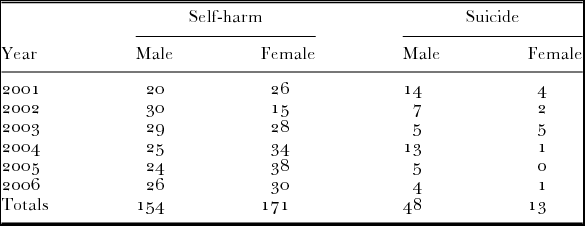
Having staked out the social context of the study, I move to a description of suicidal behaviours occurring within it. During my fieldwork in Madampe, suicides occurred on a monthly basis, acts of self-harm on a weekly basis, and suicide threats—which formed part-and-parcel of everyday discourse—on a daily basis. Reviewing files held at the Madampe Police Station and Galmuruwa Peripheral Unit, one of two local hospitals in the Division that kept self-harm data, I found that between the years 2001 and 2006, 61 suicides and 325 self-harm cases were recorded.Footnote 32 Of the suicides, two-thirds were male, and of the self-harm cases, half were male and half were female. These figures show self-harm occurred at more than five times the rate of suicide.Footnote 33
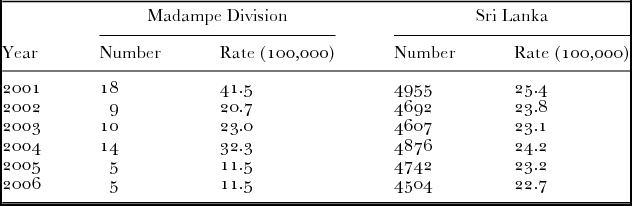
Despite the regularity with which suicidal behaviours arose, suicide rates in Madampe were not especially high when compared with the country as a whole, having historically been about average for the island. In 1974 Kearney and Miller ranked suicide rates in the wider Puttalam District as just below average for the island, at 21.3 per 100,000; the national rate was 22.1.Footnote 34 Unfortunately, I have been unable to locate any more recent district-level data, but when the divisional data for 2001 to 2006 is compared against the corresponding national data (see Table 1), Madampe still seems to have an average suicide rate. Between 2001 and 2006, the average yearly rate for Madampe was 23.4, and for Sri Lanka 23.7. As such, it seems that although the suicide rate spiralled and declined across the island between 1974 and the time of my fieldwork, Madampe's suicide rate ended up just where it started: about mid-field in the national league tables.
Suicide rates in Madampe and Sri Lanka, 2001–2006.
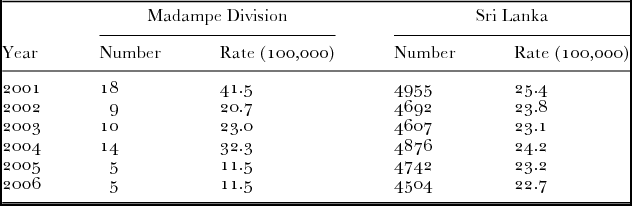
Source: Local data obtained from Madampe Police Station by author. National suicide data obtained from Sumithrayo: <http://www.srilankasumithrayo.org/statistics-and-data>, [accessed 3 May 2013]; further references in source.
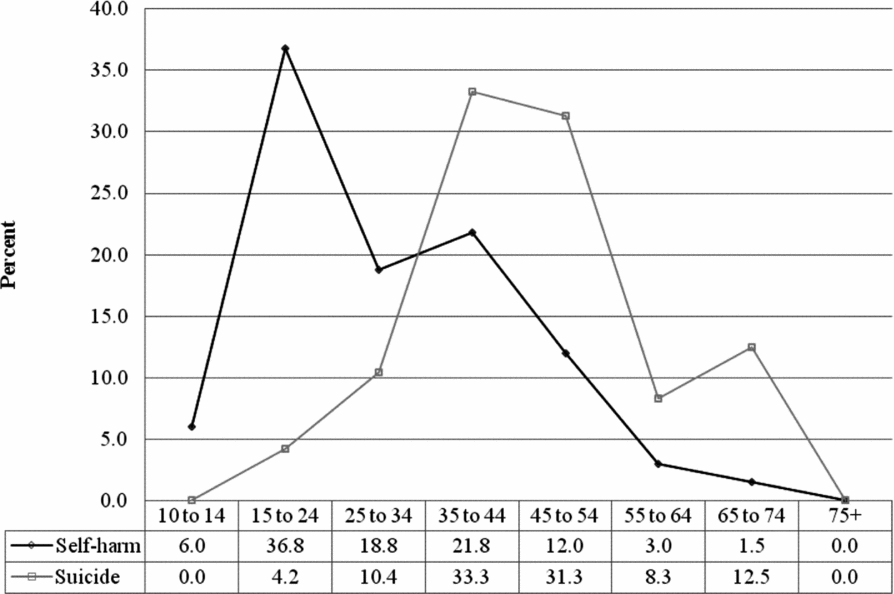
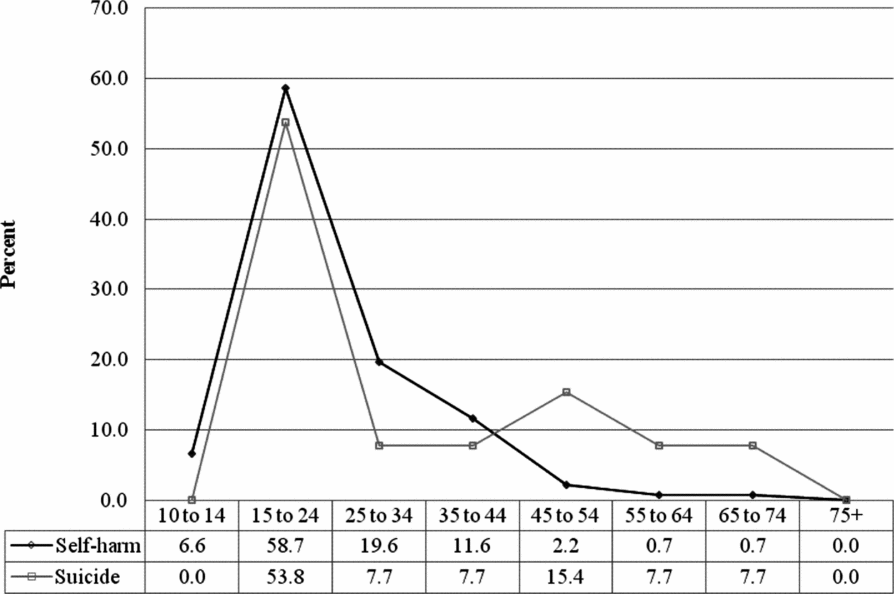
Let us now turn to the gender and age of Madampe suicides. Among males the self-harm rate was three times higher than the suicide rate, while among females it was 13 times higher (see Table 2). The average age of male self-harmers was 30.4 years (range: sevenFootnote 35 to 67 years) and 23.4 years among females (range: sevenFootnote 36 to 83 years). On the other hand, the average age of male suicides was 47.5 years (range: 18 to 80 years) and 33.6 years among females (range: 12Footnote 37 to 75 years). As such, suicide victims were on average several years older than self-harm patients, who in turn were more likely to be younger teenagers or children. Males (see Figure 2) have a peak of self-harming activity between the ages 15 and 24, which then steadily declines. However, levels of completed suicide increase during youth and early adulthood to peak between the ages of 35 and 54, after which there is a rapid decline. Females (see Figure 3) display a very different pattern. Levels of both self-harm and suicide peak between the ages of 15 and 24, after which they rapidly decline; levels of self-harm are especially low after the age of 44. The data thus suggests that while young people and women were most likely to commit acts of self-harm (and survive), older people and men especially were most likely to commit acts of suicide attempt (and die).
Number of self-harm and suicide cases recorded in Madampe, 2001–2006.
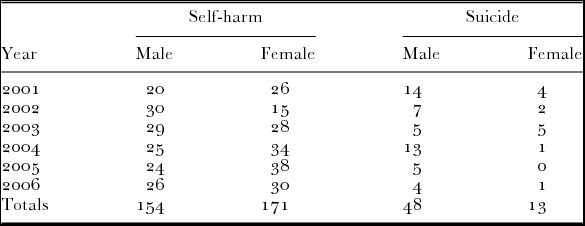
Source: Unpublished data collected from Galmuruwa Peripheral Unit and Madampe Police Station by the author.
Male self-harm (2001–2005) and suicide (2001–2006) in the Madampe Division. Source: Unpublished data collected from Galmuruwa Peripheral Unit and Madampe Police Station by the author.
Female self-harm and suicide in the Madampe Division, 2001–2006. Source: Unpublished data collected from Galmuruwa Peripheral Unit and Madampe Police Station by the author.
Comparing how suicides are distributed by gender and age in Puttalam and Sri Lanka in 1974 and 30 years later in Madampe in 2004 can help us to further gauge change during this period. First, in 1974 the suicide rate for Puttalam males and females was 32.4 and 8.9 respectively, while for Sri Lanka it was 30.3 and 13.4.Footnote 38 In 2004, the figures for Madampe were 30.0 for males and 2.3 for females: about the same for males as in 1974 but much lower for females. This suggests that although suicide rates are about the same in Madampe as they were for the whole Puttalam District in 2004 and in 1974, female suicides have significantly declined. It may be that high levels of female international labour migration in this district provide women with an alternative to suicide. Additionally, Hewamanne's ethnography of suicidal jokes and threats among garment factory workers shows how verbal suicide expressions provide young women with a means of speaking about problems in their lives.Footnote 39 For women a shift towards more symbolic kinds of suicidal behaviour may be providing means of response or redress that previously only more direct suicidal acts could offer.
Finally, no government authority in Madampe accurately or systematically collected information on the socio-economic status or class of self-harmers or suicides. Throughout my many discussions with doctors, nurses, mental health clinicians, police officers, coroners, social welfare officers, and Udagama and Alutwatta residents, the general opinion seemed to be that the local puraṇa middle class rarely engaged in self-harm but did sometimes commit suicide, while the local estate working class engaged in both. However, the relationship between suicide and class is complex, and in addition to the summary that follows, illustrative cases will also be presented at the end of this paper.
As I have discussed elsewhere, puraṇa conceptions of suicidal behaviour revolved around self-inflicted death as a ‘moral death’ in the sense of it being a ‘quiet withdrawal’ from suffering (dukkha) in the world.Footnote 40 Acts of self-harm, on the other hand, were considered to be the result of frustration (asahanaya) or anger (taraha; kopeya); emotions inappropriate for good puraṇa people to exhibit, associated as they were with shame (läjja). Yet for estate people, such (class) restraints were not relevant. Indeed for them expressions of frustration or anger through public acts of self-harm were often regarded as desirable and functional, in the sense they provided a socially accepted method of resolving relational disputes. So while people in Madampe assumed the self-harm of middle-aged puraṇa men, especially, would be fatal, the self-harm of estate men or women and youth was assumed not to result in death.
This distinction between non-fatal and fatal kinds of self-harm was found in local terminologies for suicidal behaviour. On the one hand, people spoke about wāha bonnāva and känēru bonnāva—‘drinking poison’ and ‘drinking känēru (yellow oleander)’ respectively—by which they meant acts of suicidal behaviour that were not supposed to result in death, but instead to achieve some kind of communication between intimate parties. On the other hand, people also spoke about ‘siya diivinasa ganima’—‘taking one's own life’—by which they meant acts of suicidal behaviour that were supposed to result in death, and signify escape or withdrawal from the world. In this way, people I interviewed often told me that young, female and/or estate people's self-harm was about achieving some social function, while older, male and/or puraṇa class people's suicide attempts were about withdrawing from problems in life more generally.Footnote 41 Marecek and Senadheera,Footnote 42 drawing from Taylor,Footnote 43 refer to these kinds of suicides in Sri Lanka as ‘dialogue’ and ‘monologue’ suicides respectively.
Integral to the ways in which suicide was understood in Madampe, then, were notions of the social, methodological, and cultural aspects of such behaviour within contexts and conditions shaped by gender, class, and age. Lived problems of hierarchy and relatedness were linked to broader contexts and processes of societal change such as changing marriage practices or international migration, and protest and withdrawal suicides were each defined by the use of different suicide methods as well as the cultural meanings ascribed to them. However, if protest suicides sought to engage directly with the relational contexts of problems, escape or withdrawal suicides sought to reject them—and life and its troublesome attachments—altogether. As will now be seen, these understandings are also reflected in the three established readings of the Sri Lankan suicide rate that exist in the literature.
Reading the Sri Lankan suicide rate
Like other suicide rates, the Sri Lankan suicide rate has been used as an index of the nation's wellbeing. This has either been directly, through sociological analyses of the suicide rate, or indirectly, by using the suicide rate to argue some other point. For example, Obeyesekere has often used the suicide rate to support his arguments about religious change, claiming that it demonstrates how during the twentieth century levels of frustration among the youth have been rising in the country, leading both to more suicides and also to the surging popularity of devotional religiosity. Suggesting that traditional village support mechanisms have been disappearing, Obeyesekere argues that the Buddhist appropriation of Hindu deities offers disenfranchised youth a renewed sense of belonging. The stock sociological reading of the Sri Lankan suicide rate has followed in this vein.Footnote 44
The social reading of the suicide rate
This reading of the suicide rate has long defined both academic and lay understandings of Sri Lanka's suicide problem. Essentially, the reading understands suicide as a response to anomy in the classic sense that Durkheim proposed. The argument goes something like this:
The suicide rate is a more-or-less accurate picture of the number of people in a population choosing to end their own lives. Fluctuations in the suicide rate are the result of changing social conditions that give rise to suicidal behaviour. In Sri Lanka, these conditions are often created by mismatches between expectations and realities, particularly among youth.
The earliest studies that read the Sri Lankan suicide rate in this way were published during the 1950s and 1960s.Footnote 45 Straus and StrausFootnote 46 and WoodFootnote 47 all argue that the rising number of suicides could be attributed to the effects of modernization and urbanization upon traditional caste and kinship structures. They attributed the apparent clustering of suicides in the rural Kandyan provinces to disputes between parents and children over changing marriage practices in the face of spreading ‘Western’ ideals of romantic love.Footnote 48 During the 1980s, Kearney and Miller analysed what they described as the ‘spiral of suicide’ between the years 1950 and 1978.Footnote 49 Given the fact that suicide rates as a whole had increased across the island, regardless of gender, age, and geographical region, Kearney and Miller suggested that there were country-wide ‘fundamental forces’ at work. As probable causal factors they cited four common experiences of: (1) rapid population growth; (2) expansion of education opportunities; (3) growing unemployment; and (4) internal migration.Footnote 50
The fundamental premises of these social change readings have proved enduringly popular in academic thought and are also expressed by large swathes of people in Sri Lanka today. In Madampe, suicide rates were highest among the Buddhists but lowest among the Muslims. When I asked why this was so, most people pointed to what they considered to be the integrative strength of Muslim worship compared with the ‘lackadaisical’ approach of the Buddhists. The high suicide rate within the Buddhist community was associated with nationalistic concerns that ‘Sinhala Buddhist culture’ (sanskrutiya) is being destroyed. Several academic writers too have referred to the ‘disappearing village’ of traditional, rural Sri Lanka, and the creation of an anomic and suicidal population in its stead.Footnote 51
Although well supported by the evidence relating to the economic, social, and political turbulence that Sri Lanka has experienced since Independence, the social theory does have problems. First, any statistical data relating to suicidal behaviour is prone to bias. From the always-uncertain diagnosis of a lethal injury as self-inflicted to the final classification of the cause of death, medics and law enforcement officers may unwittingly or wittingly posit homicide to be suicide, suicide to be homicide, accident to be suicide, and so on. After this, suicide data held by local, regional or national public institutions may be lost, stored inappropriately or otherwise misreported to the department responsible for collating national suicide statistics. In Sri Lanka, this problem is especially pertinent. On the one hand, large parts of the north and east of the country were, until a few years ago, in the hands of the Liberation Tigers of Tamil Eelam and therefore no suicide data has been collected from those areas for decades, which skews ‘national’ data. By the same token, in the years since Independence, the administrative reach of the state has broadened and deepened in government-controlled areas, meaning that the collection of suicide data at the local level has improved too. Fluctuations in the rate may then reflect changes in recording bias, and expansions and improvements in recording techniques. Secondly, and related to this, is the inter-cultural and cross-cultural variation in how people classify ‘self-inflicted’ death at all. For example, Willerslev has argued that deaths that are officially classified as suicides among the Chukchi of northern Siberia are, in fact, better understood as blood sacrifices.Footnote 52 In India, according to Laidlaw, the Jain practice of fasting to one's own death is considered to be a good death, and quite different from other kinds of self-inflicted deaths that are definable as suicide.Footnote 53 In Palestine, meanwhile, ‘suicide bombing’ is not considered to be suicide at all but rather ‘martyrdom’, while ‘everyday’ kinds of self-killing are classified as suicide.Footnote 54 Finally, self-enacted euthanasia is, many people would argue, an acceptable release from pain and suffering, which cannot be equated with the self-inflicted death of a well person. Nevertheless, many of these kinds of self-killing may find their way into suicide statistics.
In Sri Lanka several of these problems apply. The Buddhist practice of lay people withdrawing from the world in later life may lead to self-neglect and ultimately ‘suicide’ in the Jain sense. As I have suggested, there is at least a family resemblance between Buddhist withdrawal and withdrawal suicide, in that both are concerned with the giving up of this-worldly attachments. Moreover, in Buddhist Madampe too there is a widespread acceptance that both young and old people suffering from incurable illnesses, including those who are not terminally ill, might ‘legitimately’ kill themselves in order to be reborn a healthy person. There is little fear of being reborn as a lower being because suicide is not regarded as much of a sin and any de-merit (pav) accrued can be removed during merit-giving (pin denava) ceremonies. More generally, there is a strong sense in which some kinds of suicide might be better understood as accidental death because, although the person had indeed deliberately harmed themselves, their intention was not to die. At the very least, Durkheim's definition of suicide—as ‘all cases of death resulting directly or indirectly from a positive or negative act of the victim himself, which he knows will produce this result’—is hugely problematic in Sri Lanka.Footnote 55 Finally, the contraction in the suicide rate poses problems for the social reading. The ‘fundamental forces’ identified by Kearney and Miller do not appear to have diminished since 1995 and, in some cases, may have actually become more serious. In particular, the mismatch between educational and career aspirations and economic realities shows no sign of reducing, and internal migration has been replaced by massive levels of external labour migration to the Persian Gulf and other countries, in what is an arguably even more socially disruptive phenomenon than internal migration ever was. When these caveats are considered, it becomes less clear why the suicide rate suddenly dropped after 1996.
The methodological reading of the suicide rate
However, the methodological reading of the suicide rate, proposed in a number of studies by medical epidemiologists who are interested in preventing agrichemical and plant toxin poisonings in the country, accounts for both the spiral and the decline.Footnote 56 The fundamental idea is this:
The suicide rate is not just constituted by cases of intentional suicide but also cases of deliberate self-harm that have ‘gone wrong’. Fluctuations in the suicide rate reflect the number of cases of deliberate self-harm that accidentally result in death. The accidental death rate may fluctuate due to the spread of new methods of self-harm that display greater lethality than traditional methods, the control of existing methods, improvements in or access to medical treatments, and so on.
In the methodological reading of the suicide rate, the link between intent and outcome (cause and effect) is broken. Simply, we do not know how many people who kill themselves really meant to die. The suicide rate includes a number of cases that, were it not for the similarities between methods of suicide and methods of self-harm, would perhaps be better defined as ‘accidental death’. This was certainly the case in Madampe where protest suicides—acts of ‘intentionally non-fatal self-harm’—were not thought of as being about death but rather about life, and as a means of shaping future outcomes. Any rise or fall in the suicide rate may then be due to changing methods of self-harm that increase or decrease the suicide rate.
For example, Eddleston and Phillips argue that many apparently self-inflicted deaths in Sri Lanka are better understood as the unintended outcome of intended acts of non-fatal self-harm.Footnote 57 They suggest that the increase in the suicide rate since the 1960s was almost entirely due to an increase in pesticide and fertilizer poisonings. Pesticides and fertilizers became widespread in Sri Lanka following the Green Revolution and the introduction of agrichemicals into farming. It is highly probable that a switch from less toxic (or more treatable) to highly toxic (and more lethal) forms of self-harm took place, thus increasing the death rate. In a second study, Eddleston et al. reported on the growth in popularity of känēru (yellow oleander) poisoning.Footnote 58 Although the känēru plant is native to Sri Lanka, its use in suicidal behaviour was traditionally rare. Then, in 1980, two Jaffna schoolgirls committed suicide by swallowing känēru seeds and the story was reported widely in the media. Following this, further cases of känēru poisoning began to appear. In 1981 the Jaffna City Hospital admitted 23 cases of känēru poisoning, followed by 46 in 1982, and 103 in 1983. By the end of the decade thousands of cases were being admitted to hospital island-wide.
Meanwhile, the contraction of the suicide rate has been associated with the introduction of practical measures taken to regulate the more toxic pesticides in the country. According to Gunnell et al., restrictions placed on the import and sale of World Health Organization Class 1 toxicity pesticides in 1995 and endosulfan in 1998 coincided with reductions in suicide rates in both men and women of all ages.Footnote 59 Marecek suggests that since a government review of suicide in 1996, first aid treatments for pesticide and känēru poisoning at hospitals have improved, and the reporting of suicidal behaviour in the media has been limited, possibly reducing the ‘copy-cat effect’.Footnote 60 In addition, the Sri Lankan suicide prevention charity Sumithrayo has cited improved infrastructure, communications, and increased accessibility to private transport as factors that have combined to bring first aid centres within reach of even the most isolated rural communities.Footnote 61
With the death rate falling, however, the self-harm rate has shown a corresponding increase. Professor Ravindra Fernando of the University of Colombo recently proclaimed self-poisoning ‘a modern epidemic in Sri Lanka’.Footnote 62 In 2006, 4,504 people committed suicide, but, according to the Sri Lankan National Poisons Information Centre, some 93,733 people were admitted to hospital for känēru poisoning that same year.Footnote 63 According to the Office for the Coordination of Humanitarian Affairs, ‘[s]tate hospitals have seen a 300 percent increase in the number of patients being admitted with symptoms of poisoning in the last 20 years, but health professionals believe the figure could be much higher’.Footnote 64 De Silva et al. have shown how annual admissions for medicinal drug poisoning increased from 48.2 to 115.4 per 100,000 population between 1996 and 2008. Over the same period, annual pesticide poison admissions fell from 105.1 to 88.9. Similarly, poisoning accounted for 37.4 suicides per 100,000 in 1995 but only 11.2 in 2009. De Silva et al. suggest that the suicide rate from poison has fallen due to this trend away from ingesting pesticides towards medicinal drugs, which have a lower fatality rate.Footnote 65
The suicide rate may then chart the introduction and subsequent withdrawal of pesticides and fertilizers and improvements in medical treatments as much as it does the ‘fundamental forces’ of social change. If correct, these studies imply a rather interesting problem. For the suicide rate to have risen and fallen in the way it has done, people in Sri Lanka must have been attempting suicide at high rates prior to the spiral as well as during the contraction. The cultural reading of the suicide rate—backed up by some very suggestive, if partial, historical evidence—suggests exactly that.
The cultural reading of the suicide rate
This reading stems from the notion that there might be contexts and conditions within and under which it is ‘culturally appropriate’ to perform suicidal behaviour. Changes in the ‘culture of suicide’ may have effects on the suicide rate:
The suicide rate includes cases of intentional suicide and also cases of deliberate self-harm that accidentally result in death. Fluctuations in the suicide rate not only reflect social and methodological changes but also changes in the way that individuals within a population may legitimately respond to their problems using suicide. Fluctuations may reflect a changing ‘culture of suicide’ over time.
In certain respects the cultural reading shares similarities with Durkheim's theory of altruistic suicide, in that it assumes society ‘compels’ individuals to commit suicide by the nature of its ‘rules’. However, there is nothing about this view that depends on the presence of ‘high levels’ of moral regulation, as Durkheim would insist upon, nor is it limited to small-scale societies. Rather, the cultural reading considers how popular ideas of suicide in society shape the patterns and meanings of suicidal behaviour and directs action, both consciously and unconsciously.
Travellers and colonists in Ceylon have long commented on the phenomenon of self-poisoning and other kinds of self-harm in the island, which, like modern-day ‘protest suicides’, were apparently used to damage an adversary. In 1660, Robert Knox, an employee of the British East India Company, was captured and held in the Kandyan kingdom for 20 years. Knox kept detailed and fascinating descriptions of everyday life, which he observed and, upon his escape, published. Knox reported that under Kandyan law, a suicide by those considered ‘of sound mind’ was seen to be the fault of other villagers, who were accused of having failed in their assumed duty of care. In some cases it seems that entire villages were fined for neglect, although more commonly specific individuals were held to account. Later in his book, Knox also tells us that Kandyans possessed ‘excellent skill’ in the healing of poisons such as neiingala, a wild plant, suggesting that once the debt or other duty had been agreed to be paid, a remedy for the poison was administered.Footnote 66 If so, then such protest suicides may rarely have been fatal, and instead were performed with the express intent of motivating another into action. Similarly, Amerasinghe suggests that suspected suicides were referred to the sake-ballanda (coroners' court) for ruling, upon whose judgement culpability for a suicide was established.Footnote 67
The characterisation of Knox's protest suicides later appealed to the British, who also reported instances of debt collection using suicide threats. In 1821 the London Morning Post carried a story concerning the ‘Treatment of Debtors in Ceylon,’ which included such a reference:
Frequently the creditor will go to the person indebted to him, and say he will poison himself, unless he pays him directly. Instances have occurred of such threats being put into execution, and the debtor, who is considered the cause of his creditor's death, also forfeits his life.Footnote 68
In 1833, Sir John D’Oyly, an administrator of the colony, wrote that among the Ceylonese, suicide was ‘easily provoked. . . [by]. . . slander, non-payment of debt, damage to crops, and thwarted love affairs’.Footnote 69 In 1869, the inspector-general of police, G.W.R. Campbell expressed concern that ‘112 persons. . . put an end to themselves in the Island [this year]. . . It would be well to issue a circular to all coroners, directing them to give the causes so far as it can be ascertained, for committing suicide.’Footnote 70 Later, in 1902, H.R. Freeman, administrator of the Chilaw District in the Northwest Province of Sri Lanka, commented that ‘attempt to commit suicide’ was ‘a rather prevalent offence’ and that ‘would-be suicides generally want pulling together by the tonic of hard work’.Footnote 71 Although more work needs to be done to explore the relationship between suicide and colonialism in Ceylon, it would nevertheless appear that the ‘contemporary self-harm epidemic’ is probably quite ancient.
Finally, cultural readings of protest suicides have been provided by several scholars, including Spencer, Marecek, Hewamanne, and myself.Footnote 72 Spencer posits that suicide arises as a response to problems when the parties involved are hierarchically unequal. Inferiors do not dare to respond to perceived wrong-doing by superiors, because under normal circumstances the nature of their relationship disallows direct confrontation; suicidal behaviour thus provides a culturally appropriate means of expressing anger and frustration. Similarly, Marecek has argued that suicidal behaviour provides people with different ways of challenging inequalities in power and abuses in their lives. Taken together with my own discussion of suicide in Madampe, the cultural reading of the suicide rate suggests that under certain conditions, some people may be driven to suicidal behaviour by their status in the world.
However, these cultural readings are really only the beginning of the story. The scholars I cite, in the main, have looked at protest suicides; withdrawal suicides have been neglected. Yet in Madampe not everybody believed in the functional efficacy of protest suicides, and only certain kinds of people tended to perform them. Withdrawal suicides were also very prevalent and, furthermore, as deeply embedded in the cultural and religious histories of protest and withdrawal that I have described. Why, then, did protest suicides and withdrawal suicides manifest and distribute in the Madampe population in the ways that they did?
Towards a fourth reading: affinities for suicide
What scholars, for analytical purposes, have separated into social, methodological, and cultural readings of the suicide rate are, in reality, of course, best understood as composite. In Sri Lanka, social changes—for example, the Green Revolution—led to methodological changes as well as cultural changes in suicidal behaviour, as a new political economy brought about shifts in the nature and structure of social groups and classes in both rural and urban society. Similarly, methodological changes reflected cultural changes, as popular methods of suicide (such as swallowing känēru or pesticides) entered the popular imagination and replaced older, less lethal methods like neiingala. In turn, the use of pesticides later declined in favour of medicinal drugs, a pattern that may also reflect a shift towards more suicides in urban areas or more suicides among the sons and daughters of cultivators, who had become more distant from the land and its toxins through increased educational opportunities. The decline of female suicide in Madampe may be a reflection of women's greater use of overseas migration or suicidal jokes and threats as a response to problems, rather than any particular transformation in their subject positions more generally. Social, methodological, and cultural factors thus came together, at certain moments and under certain conditions, to create the ‘perfect storm’ of motives, methods, and meanings: what Staples, drawing from Ian Hacking, has called a ‘suicide niche’.Footnote 73
Yet none of this, I submit, is random. Social, methodological, and cultural changes only coalesce to produce suicidal behaviours in morally appropriate contexts: when people might have affinities for suicide. By ‘affinities for suicide’, I mean beliefs that suicidal behaviour, whatever its precipitating motives, methods or meanings, is caused by certain kinds of problems and has certain kinds of consequences, and that those causes and consequences are significant in the here and now. At the most general level these causes are obvious and speak only to the fact that life is ‘not worth living’, or at least is worth risking, because the consequences of suicide are ‘better’. But at a deeper level, affinities for suicide also reflect worldly dispositions: people's ideas about the causes and consequences of things in the world—be they mundane or profane, this-worldly or other-worldly—and how people perceive their abilities and scope to react to them. When set in conditions of change, the affinities reading of the suicide rate illustrates how it may have fluctuated as members of different social groups and classes came to hold beliefs that suicidal behaviour might be an efficacious solution for them. The affinities reading of the suicide rate that I wish to propose, then, is a Weberian one, in that I find it useful to think of this in terms of Weber's arguments about affinities for religion.Footnote 74
Weber's theory of religion is well known. Weber argues that affinities for different kinds of religious practice reflect the ‘ideas and interests’ of social groups and classes in the world. He most famously applied this theory to the study of Protestantism and capitalist development, arguing that the two were mutually constitutive of one another. While the Calvinist doctrine of predestination helped to legitimize the middle classes’ accumulation of financial and political capital, their piety also encouraged hard work and sacrifice. Successful Protestants had, then, both themselves and God to thank. Conversely, Weber pointed out, the labouring classes had little interest in predestination, as their menial position in society suggested divine disfavour: an unenviable situation in which to find oneself. Rather, they were more likely to reject religion altogether and turn to atheism, as they could achieve greater gains through ideologies such as socialism. The point that I wish to take from Weber is that material conditions shape ideas about the world, while ideas also shape material conditions, and that this principle can be applied to any social action.Footnote 75
The Weberian reading turns the Durkheimian reading on its head. Rather than individuals committing suicide because they have lost their moorings in society, the Weberian reading suggests that individuals may come to commit more or less lethal kinds of suicide as their beliefs in the causes and efficacy of things—including suicide and its possible motives, methods, and meanings—change. Individuals find themselves in positions in which non-lethal or lethal kinds of suicidal behaviour become an efficacious possibility. The determinism of Durkheim's ‘suicidogenic current’ is removed and replaced by a more dynamic set of social processes that allow for the interplay of material conditions and ideas—as well as social structure and subjectivity—and thus bestow the suicidal person with a great deal more agency than sociological and psychological theories usually allow. To summarize: suicide rates are not simply indexes of societal wellbeing, but also reflect the waxing and waning of affinities for different motives, methods, and meanings of suicidal behaviour.
Exploring affinities for suicide in Madampe
In the final section of this paper I will illustrate what I mean by the ‘coalescing’ of motives, methods, and meanings which lead to public or private suicidal acts of varying lethality and outcome. In so doing I will aim to show how only in some sections of Madampe society do motives, methods, and meanings happen to coalesce into a perfect storm or suicide niche. This might be when problems are understood to be caused by things in the world that are susceptible to some kind of suicidal influence or when withdrawal through suicide might be considered a morally appropriate line of action to take. Recall that in Madampe, puraṇa people were especially likely to ascribe the causes of problems to market or political alienation, while conversely estate people tended to ascribe causes to relational disputes. Affinities for suicide among puraṇa people tended to favour acts performed to withdraw from the impersonal, egoistical world, while estate people favoured acts that were performed to engage with and transform the relational world. The first case I discuss is an act of protest, the second an act of withdrawal. The first has been published before, but here I reanalyse it within the Weberian reading I am suggesting. In ‘Suicide and the morality of kinship in Sri Lanka’, I discuss the self-harm of Pradeep, a 42-year-old Sinhala Buddhist man living at Alutwatta.Footnote 76 Pradeep had been working in Italy for a number of years; upon his return he began quarrelling with his wife's brothers (massinā), who complained that Pradeep was failing to share his new-found wealth with them and said that it was a shame (läjja). As I have suggested, the settlement history of Alutwatta made it particularly conducive to the development of strong kinship ideologies and networks, and accordingly rich relatives obtain a duty of care for poorer relatives, which is difficult to ignore. In that sense, when Pradeep swallowed poison to protest against his massinās' badgering and shaming of him, the motive was a clear reflection of social changes in Sri Lanka created by the economic and social inequalities brought about by international labour migration within families and communities.
However, Pradeep did not attempt to hang himself, which everybody in Madampe knows is a near-certain cause of death. Instead he swallowed Panadol, a paracetamol that is widely available from kadi (small roadside boutiques) in rural Sri Lanka. As de Silva et al. have demonstrated, the fatality rate from such overdoses is low when compared with agrichemicals and känēru, and the clinicians who interviewed Pradeep suggested that he only displayed ‘a low intent to die’.Footnote 77 Yet Pradeep's use of Panadol was also as likely to be a matter of opportunity and convenience as it was of rational choice. Without access to pesticides or fertilizers, and with kerosene kept in the kitchen—a female domain, and the reason women tend to display greater use of that method of self-harm in Madampe—and with no känēru plants in his garden, Panadol was one of only a few options available to him. Pradeep's choice of poison may have been deliberate, but his specific use of Panadol—thus improving his chances of surviving—was probably rather more circumstantial.
Motives and methods therefore combined with the meanings of Pradeep's actions. His self-harm was committed within what is a classic context of suicidal behaviour in Sri Lanka: kinship disputes leading to shame leading in turn to a rejection of that shame and its transferral onto those who are deemed responsible for causing it.Footnote 78 By swallowing poison Pradeep made a very public declaration about what he considered to be the unfair demands of his massinā, who, as his wife's brothers, were socially subordinate to him and so in no position to be making such demands. And indeed, having been shamed by Pradeep's act of self-harm, in the aftermath of the event, the massinā dropped their claims. Thus, in this instance in Alutwatta, where personal problems are routinely described as being caused by relational disputes, motives, methods, and meanings coalesced to create for Pradeep a suicidal act that was efficacious for him. It was widely understood as an act of protest and considered by many Alutwatta people I spoke with as being a fair response, under the circumstances, to his problems and one that was ultimately thought to be effective in its outcomes.
The second case I describe is drawn from Udagama and shows how notions of withdrawal from an impersonal world infuse suicidal practices. It concerns a 50-year- old Sinhala Buddhist man named Hector, a lower-level government servant who hung himself in the main room of the house while his wife and mother cooked rice and curry in the kitchen at the back of the house. By the very fact that it was interpreted as a withdrawal suicide by Udagama people, analysis of the case is somewhat more precarious than that of Pradeep's protest suicide. As mentioned, withdrawal suicides are committed privately and quietly and without any explicit intention of transforming social relations; indeed, they are often best understood as seeking to preserve the social order. Wide knowledge about—and, importantly, discussion of—such suicides are often explicitly not advocated. As such, I first encountered Hector's case during my review of coroners’ files held at Kuliyapitiya Coroners’ Court, and only then through specific inquiries conducted at Udagama.Footnote 79
Let me begin by relating the case as I first discovered it, which is to say through the witness statement and suicide note contained in the coroner's report. Such data are admittedly sparse when compared with the rich materials produced by ethnographic work, but witness statements and suicide notes have been analysed to great effect by Fincham et al. in their study, Understanding Suicide: A Sociological Autopsy.Footnote 80 They have argued that a ‘dual paradigm’ approach is appropriate when reading such data: case materials are objective in the sense of them saying something about suicidal acts in the world, but also subjective as they form parts of the discursive field that ‘make up’ suicidal people and suicidal knowledge. First, then, the witness statement, taken from Hector's wife, sets the scene:
He drinks arrack. He had threatened suicide before and had attempted suicide before but was stopped by family members. The day of the suicide I went to meet a neighbour, when I came back it was about 4.30pm. At that time he was drunk. I went to the kitchen to begin making supper. His mother was with me. My husband came to the kitchen twice. After I had finished cooking I opened the door of his room but he was not there. I found him hanging from a beam in the sitting room. One leg was on the table, the other hanging down. I ran to the kitchen and came back with a knife and cut him down. I couldn't hold him and he fell to the ground. He was still alive at that time. The neighbours came to the house and he was taken to the hospital. . . At 7.30 pm he was pronounced dead.Footnote 81
Next, Hector's suicide note provides the deceased with a voice of his own:
Dear nanda [wife], my life is over. Don't be sad. Don't tell anyone about my life. Protect amma [mother]. Don't tell amma. Don't tell nangi [younger sister]. Don't tell anyone that I’m dead. If amma asks about me don't tell that I am dead, tell her that I am at home. My amma and duwa [daughter] please be happy, I’m always with you. From Dear tatta [father]Footnote 82
The features of the case upon which I wish to draw are contained especially within the suicide note and the reception that Hector's death received at Udagama. Although only a few sentences long, it was clear from Hector's suicide note that he wished his death to have no repercussions and that his death should be kept a secret. Completely absent are the accusations so prevalent within protest suicides, where public reception, debate, and response are all.
So how can Hector's suicide be understood in terms of its motives, methods, and meanings? Little is given away in the coroner's file. We know that Hector was drunk at the time of his death, and considered a drunkard (bebaḍa) by his wife: ‘He drinks arrack,’ she said, a claim that is synonymous with accusations of alcoholism. It is possible that Hector had been scolded by his wife or mother for drinking, which precipitated the act. Hector hung himself in the house where he would certainly be found by a family member, and indeed the fact that others were present in the next room raises questions as to whether Hector's intent to die was absolute, given rapid discovery was inevitable. Yet drinking among men of Hector's age and profession is also extremely prevalent in Madampe, and is usually accompanied by wives’ complaints about financial costs and health risks. To be scolded for drinking is considered part-and-parcel of the drinking experience, and simply adds to its allure.
But Udagama people I spoke to also thought that Hector was having problems at work, although no one could be more specific. This was, in fact, a common issue in Udagama, where people framed the sources of their problems within the opaque world of national politics and economics, not local level relations. A common refrain to be heard among Udagama men is that the sufferings of life are caused by macro-level forces, not unlike those described by Kearney and Miller.Footnote 83 If Hector had indeed committed suicide fatalistically in response to work-related issues, it was correct for him to absolve his family of any responsibility, as his suicide note clearly tried to do. Thus in this instance, in the context of Udagama where the causes of problems are located beyond household and family networks, Hector's suicide can be understood as a quiet act of withdrawal. Hector's suicide had never been spoken of by Udagama people until I came across it in the coroner's files and actively began asking questions. Similarly, for Hector's family no particular village discourse sought to lay blame or attribute shame and they were left to grieve his death on their own.
These two case studies have of course been selected because they illustrate the ways in which puraṇa and estate status and social class combine to create particular configurations of suicide motives, methods, and meanings. Yet by presenting them in such terms, I hope to have shown how individual acts of suicide at the local level have significant effects on suicide rates at the national level. By reading suicidal behaviour as a coalescing set of conditional and contextual factors that create affinities for certain kinds of suicidality among certain social status groups and classes of people, we can begin to interpret suicide statistics not simply as a barometer of ‘social change’ but also as a set of economic, political, environmental, historical, and cultural configurations that act and react in response to each other. How these actions and reactions manifest and change across contexts and time is surely a crucial question, and one that I have only just begun to explore here.
Conclusion
In this paper I have argued that suicide rates tell us much more about societies than simply their relative levels of wellbeing—they also tell us about the affinities that people have for different motives, methods, and meanings of suicidal behaviour. In Sri Lanka, the evidence exists for us to be able to map this in some detail, so that social, methodological, and cultural changes can be seen as coming together to create a ‘perfect storm’ that led, first, to the upward spiralling of the suicide rate but then—once one factor, the methodological, had been changed—towards its contraction. The first lesson that should be taken away from this is that suicide rates do not provide a quick and easy barometer of social conditions or social change but rather they indicate complex and shifting relationships between social, methodological, and cultural factors.
On the basis of my ethnographic evidence I propose a composite reading to accommodate this: that of affinities for suicide in conditions of moral change. Different social groups and classes in Madampe hold different beliefs about the kind of behaviour that suicide constitutes, how it might be performed, and of what kinds of causes and consequences it can have. Reflecting their material interests and ideas more broadly, higher status, middle class people have affinities for withdrawal suicide, while lower status, working class people have affinities for protest suicide. It is in how material interests and ideas coalesce to make different kinds suicidal behaviour an efficacious response to lived problems that accounts for the prevalence of self-inflicted death in one community or demographic group, or self-harm in another. Similarly, gender analyses suggest that women may have developed alternatives to suicide in the form of verbal suicide threats and gestures or international labour migration. So while suicide continues to hold relevance for men, it no longer does for women.
The Weberian reading thus also suggests that we need to develop time-sensitive readings of suicide rates. It may be that methodological, social, and cultural changes have short-, medium-, and long-term effects. The rapid rise and fall of the suicide rate during the second half of the twentieth century is still best explained through recourse to the methodological reading. But medium-term social changes—for example, the development of international labour migration during the last two decades of the century—shifted female suicidalities in one direction, while shifting those of men in another. And if, as I have argued, a self-harm endemic has underwritten the contemporary suicide epidemic, deep structural changes affecting suicidal dispositions and the perceived efficacies of wāha bonnāva and känēru bonnāva must also have an effect on the suicide rate. As the Sri Lankan middle class continues to grow, it is entirely possible that fewer people will come to think of self-harm as a functional response, and the epidemic will decrease. As a result, the accidental death rate should continue to fall. Of course, this may just result in more people turning instead to suicide. Yet it is also possible that the increasing levels of wellbeing in society heralded by such a shift would be enough to counteract this—the coalescing of social and cultural change—and suicide may retreat altogether as a realistic option in people's lives. On this, of course, only time will tell.