Introduction
About 30 million people in the world are estimated to have dementia, with the number expected to double every 20 years (Ferri et al., Reference Ferri2005; Alzheimer's Disease International, 2008). The projected increase in dementia incidence has emphasized the importance of identifying modifiable risk factors for preventing cognitive decline and delaying the onset of dementia (Lautenschlager et al., Reference Lautenschlager, Almeida and Flicker2003). The adoption of preventive strategies may help to reduce its future prevalence (Brookmeyer et al., Reference Brookmeyer, Gray and Kawas1998; Sloane et al., Reference Sloane2002).
Among the modifiable risks, accumulating evidence suggests that health behaviors, such as smoking, physical activity, alcohol drinking, diet, and weight significantly influence cognitive function and dementia in late life (Anstey et al., Reference Anstey, von Sanden, Salim and O'Kearney2007; Gorospe and Dave, Reference Gorospe and Dave2007; Beydoun et al., Reference Beydoun, Beydoun and Wang2008; Peters et al., Reference Peters, Peters, Warner, Beckett and Bulpitt2008). These constitute behavioral risk factors known to strongly influence health (Institute of Medicine, 2001). They are also conceptually linked with vascular risk reduction and cognitive reserve, pathways through which health behaviors could protect against cognitive decline and clinical manifestation of dementia (Qiu et al., Reference Qiu, De Ronchi and Fratiglioni2007).
Most of the earlier systematic reviews on the relationship between health behaviors and cognitive health, however, have focused on a specific risk behavior or lifestyle activity. Variability across these reviews in the inclusion criteria of studies and assessment of their quality hinder a reliable evaluation of the effects of different health behaviors. Inclusion of studies from non-representative samples and clinic-based patients in some reviews further prevents the generalization of the summarized findings to the community population. Even the recent general reviews, pertaining to studies published in 2005 or earlier, which covered a broad spectrum of modifiable risks, were limited in their extent by targeting either cognitive function (Hendrie et al., Reference Hendrie2006) or clinical dementia (Patterson et al., Reference Patterson, Feightner, Garcia and MacKnight2007).
The purpose of this study was to provide an update on the evidence on major health behavioral factors affecting cognitive function, cognitive impairment, and dementia in older people living in the community. A systematic review of current research was conducted, involving a comprehensive search of the literature and critical appraisal of studies. We focused on examining the effect of five health behaviors: physical activity, smoking, alcohol drinking, weight control (body mass index, BMI), and diet and nutrition.
Methods
Based on the recommended search strategies for detecting methodologically sound causation studies (Wilczynski et al., Reference Wilczynski and Haynes2003; Haynes et al., Reference Haynes, Kastner and Wilczynski2005), we targeted the systematic review to prospective cohort studies of community-dwelling persons aged 65 and older by using “aged” and “cohort study” or “longitudinal study” or “incidence” as search terms. In addition, “risks” or “health behaviors” or “life styles” or “primary prevention” or “health promotion” combined with “cognition” or “cognitive” or “dementia” were used as key words. Database searches of PubMed, Embase, and PsycINFO for articles published in August 2008 or earlier retrieved 12,105 references. Study abstracts were appraised independently by three readers. The study participants included were predominantly 65 years and over from a community representative population. Studies involving institutionalized participants were included if they were part of a larger community-based sample. Outcome variables included were cognitive function, cognitive decline, cognitive impairment, and all types of dementias. Studies using prospective cohort and longitudinal designs were included. Those involving only persons aged less than 65 years, non-representative samples, non-cognitive outcomes, and cross-sectional or retrospective study designs were excluded, resulting in 690 relevant articles. Full-text reading by four reviewers identified 115 articles related specifically to health behaviors, excluding studies dealing with diagnostic and treatment modalities. Data were extracted using a modified version of the Community Guide data abstraction form (U. S. Centers for Disease Control and Prevention, 1999). Non-English articles were considered for review, but congress proceedings and abstracts were not included.
Study quality was assessed based on a priori internal and external validity criteria, incorporating representativeness of the study sample, sample size, follow-up rate and period, outcome and predictor measurements, and controlled confounders (see Appendix). Studies with a representative sample, diverse population base, large sample size and power, low drop-out rate, long duration of follow-up, unbiased and detailed assessments, and control of various confounders were assigned higher scores. Summary scores were calculated, with studies scoring 16 or above out of 20 being categorized as level A (excellent), 12 to 15 as level B (good), and less than 12 as level C (limited). Studies that controlled only for demographic characteristics were excluded. In this review, only level A studies were considered.
Data synthesis involved using a spreadsheet that included the extracted data and quality assessment of all the selected studies. Identified studies were organized into summary tables for each individual health behavior. Because of heterogeneity in the measurement and categorization of health behaviors, cognitive outcome assessment, and of study population characteristics, we did not conduct a meta-analysis, but chose the narrative review to summarize our findings.
Results
Of the 115 papers retrieved, 37 met level A quality criteria. There were 9 studies on physical activity, 4 on smoking, 8 on alcohol drinking, 6 on BMI, and 15 on diet and nutrition. Multiple publications from the common data source were counted separately if they used different measures of predictor or outcome variables.
Physical activity
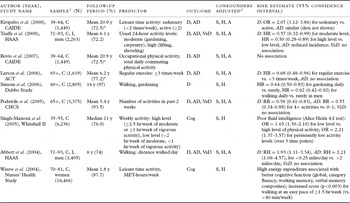
Eight of the nine selected studies exhibited significant association between physical activity and dementia or cognitive function (Table 1). Midlife physical activity was found to be associated with dementia in the CAIDE study (Rovio et al., Reference Rovio2007; Kivipelto et al., Reference Kivipelto2008) and with cognitive function in the Whitehall II study (Singh-Manoux et al., Reference Singh-Manoux, Hillsdon, Brunner and Marmot2005). Whereas physical inactivity doubled the risk of Alzheimer's disease (AD) and dementia (Abbott et al., Reference Abbott, White, Ross, Masaki, Curb and Petrovitch2004; Kivipelto et al., Reference Kivipelto2008), frequent exercise (Larson et al., Reference Larson2006) and engaging in an increased number of leisure-time activities (Podewils et al., Reference Podewils2005) were protective. Moreover, moderate levels of daily activities halved the risk of dementia (Taaffe et al., Reference Taaffe2008), with even light walking of 1.5 hours/week providing some cognitive benefit (Weuve et al., Reference Weuve, Kang, Manson, Breteler, Ware and Grodstein2004). This protective effect may be cumulative, as suggested by the higher cognitive performance observed among persons participating in long-term regular physical activity (Weuve et al., Reference Weuve, Kang, Manson, Breteler, Ware and Grodstein2004). A persistent low level of physical activity over 11 years was associated with an increased risk of poor fluid intelligence (Singh-Manoux et al., Reference Singh-Manoux, Hillsdon, Brunner and Marmot2005). The relationship between physical activity and dementia was especially strong in persons with low physical function (Larson et al., Reference Larson2006; Taaffe et al., Reference Taaffe2008). Stratified analysis by apolipoprotein (APOE) ϵ4 allele was, however, inconsistent. Kivipelto et al. (Reference Kivipelto2008) reported stronger association among carriers, but Podewils et al. (Reference Podewils2005) reported the opposite, whereas Rovio et al. (Reference Rovio2007) and Taaffe et al. (Reference Taaffe2008) found no interaction.
Summary table of physical activity and cognitive outcomes

ACT: Adult Changes in Thought study; AD: Alzheimer's disease; CAIDE: Cardiovascular Risk Factors, Aging and Dementia study; CHCS: Cardiovascular Health Cognition Study; Cog: cognitive function; D: dementia; HAAS: Honolulu-Asia Aging Study; HR: hazard ratio; MET: metabolic equivalent; OR: odds ratio; RH: relative hazard; RR: relative risk; VaD: vascular dementia.
1Age at baseline (in years), population characteristics: C (community-based), I: (institutionalized; in HAAS, of the baseline sample, 2% were in nursing homes).
2Adjusted for potential confounders: S (sociodemographics), H (health-related variables), A (apolipoprotein E).
*Analysis of drop-outs (e.g. sensitivity analysis) suggests selective attrition did not affect study results.
Smoking
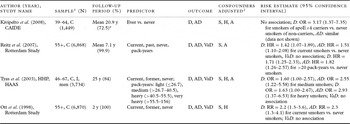
All four studies on smoking reported on the negative effect of smoking on dementia and AD (Table 2). Current smoking, but not past smoking, increased the risk of dementia, even after controlling for confounders (Ott et al., Reference Ott1998; Reitz et al., Reference Reitz, den Heijer, van Duijn, Hofman and Breteler2007). The association was stronger, the higher the number of pack-years of smoking (Reitz et al., Reference Reitz, den Heijer, van Duijn, Hofman and Breteler2007), but up to a certain level (55.5 pack-years) (Tyas et al., Reference Tyas2003). Midlife smoking was found to raise AD risk (Tyas et al., Reference Tyas2003), but no significant association was found for vascular dementia (VaD). There was, however, conflicting results on the interaction between APOE genotype and smoking, with an increased association found both among carriers (Kivipelto et al., Reference Kivipelto2008) and non-carriers (Ott et al., Reference Ott1998; Reitz et al., Reference Reitz, den Heijer, van Duijn, Hofman and Breteler2007). In the seven-year follow-up data from the Rotterdam Study (Reitz et al., Reference Reitz, den Heijer, van Duijn, Hofman and Breteler2007), the hazard ratios (HR) for non-carriers with a baseline current smoking status were 1.66 (95% CI: 1.14–2.42) for dementia and 1.95 (95% CI: 1.29–2.95) for AD. Among carriers, the associations were non-significant for dementia (HR = 1.06, 95% CI: 0.67–1.69) and likewise for AD (HR = 1.06, 95% CI: 0.62–1.79).
Summary table of smoking and cognitive outcomes

AD: Alzheimer's disease; CAIDE: Cardiovascular Risk Factors, Aging and Dementia study; D: dementia; HAAS: Honolulu-Asia Aging Study; HHP: Honolulu Heart Program; HR: hazard ratio; OR: odds ratio; RR: relative risk; VaD: vascular dementia.
1Age at baseline (in years), population characteristics: C (community-based), I (institutionalized; in HAAS, of the baseline sample, 2% were in nursing homes).
2Adjusted for potential confounders: S (sociodemographics), H (health-related variables), A (apolipoprotein E).
*Analysis of drop-outs (e.g. sensitivity analysis) suggests selective attrition did not affect study results.
Alcohol consumption
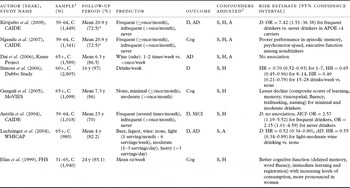
Several studies, as shown in Table 3, demonstrated beneficial effects of moderate drinking, defined as up to three servings of wine every day (Luchsinger et al., Reference Luchsinger, Tang, Siddiqui, Shea and Mayeux2004), frequency averaging between daily and weekly (Ganguli et al., Reference Ganguli, Bilt, Saxton, Shen and Dodge2005), and any from 1 to 28 drinks per week (Simons et al., Reference Simons, Simons, McCallum and Friedlander2006). The Framingham Heart Study (Elias et al., Reference Elias, Elias, D'Agostino, Silbershatz and Wolf1999), with a follow-up of 24 years, reported a stronger association of midlife drinking with cognitive performance in women than men. The protective effect of moderate consumption of wine was noted among non-carriers of the APOE ϵ4 allele (Luchsinger et al., Reference Luchsinger, Tang, Siddiqui, Shea and Mayeux2004). Harmful effects of drinking, however, have also been noted. Kivipelto et al. (Reference Kivipelto2008) observed that consumers of alcohol once per month or more have an increased dementia risk. For mild cognitive impairment (MCI), Anttila et al. (Reference Anttila2004) found the relationship to be U-shaped, with never and frequent drinkers demonstrating a significantly higher risk. Never drinkers also showed poorer cognitive function than drinkers in episodic memory, executive function, and psychomotor speed (Ngandu et al., Reference Ngandu2007). Among APOE ϵ4 carriers the risk of dementia and MCI increased with higher levels of alcohol consumption (Anttila et al., Reference Anttila2004; Kivipelto et al., Reference Kivipelto2008). Ngandu et al. (Reference Ngandu2007), however, found no significant interaction with APOE genotype.
Summary table of alcohol drinking and cognitive outcomes

AD: Alzheimer's disease; CAIDE: Cardiovascular Risk Factors, Aging and Dementia study; Cog: cognitive function; D: dementia; FHS: Framingham Heart Study; HR: hazard ratio; MCI: mild cognitive impairment; MoVIES: Monongahela Valley Independent Elders Survey; OR: odds ratio; WHICAP: Washington Heights-Inwood Columbia Aging Project.
1Age at baseline (in years), population characteristics: C (community-based).
2Adjusted for potential confounders: S (sociodemographics), H (health-related variables), A (apolipoprotein E).
*Analysis of drop-outs (e.g. sensitivity analysis) suggests selective attrition did not affect study results.
Body mass index
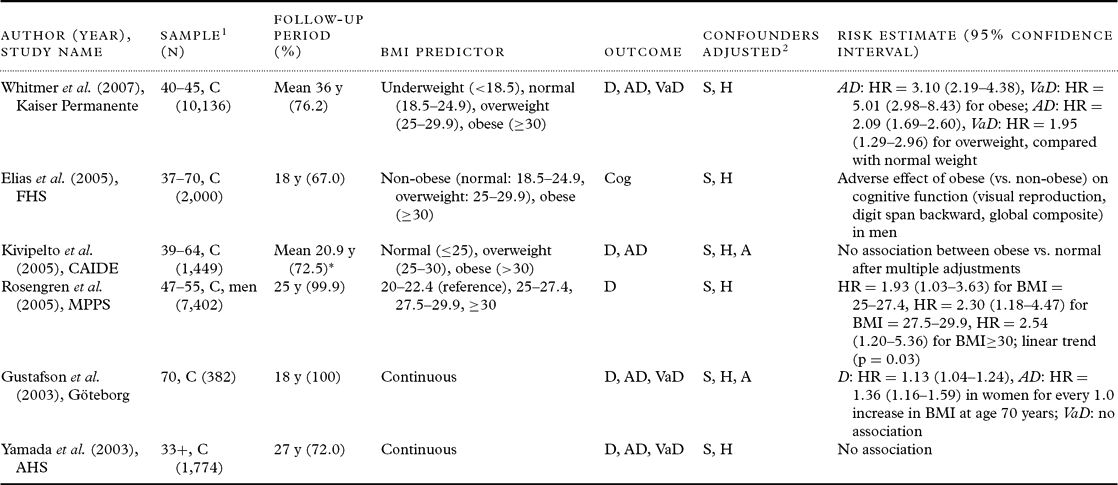
Whitmer et al. (Reference Whitmer, Gunderson, Quesenberry, Zhou and Yaffe2007) found midlife obesity and even being overweight to increase the risk of dementia (Table 4). Rosengren et al. (Reference Rosengren, Skoog, Gustafson and Wilhelmsen2005) reported a significant linear trend of increasing dementia incidence with higher level of BMI. Gustafson et al. (Reference Gustafson, Rothenberg, Blennow, Steen and Skoog2003) reported that BMI was on average 3.6 higher among women who developed AD than those who did not. In contrast, no significant association has been found following adjustment for demographics (Yamada et al., Reference Yamada, Kasagi, Sasaki, Masunari, Mimori and Suzuki2003) or health-related variables and APOE genotype (Kivipelto et al., Reference Kivipelto2005). Gender difference in the association between BMI and dementia was reported. Whereas the Kaiser Permanente study (Whitmer et al., Reference Whitmer, Gunderson, Quesenberry, Zhou and Yaffe2007) indicated that the risk for both AD and VaD increased among both obese men and women, others have found the association only in men (Elias et al., Reference Elias, Elias, Sullivan, Wolf and D'Agostino2005) or women (Gustafson et al., Reference Gustafson, Rothenberg, Blennow, Steen and Skoog2003). Two studies (Gustafson et al., Reference Gustafson, Rothenberg, Blennow, Steen and Skoog2003; Kivipelto et al., Reference Kivipelto2005) examining the effect by APOE genotype did not find any significant interaction.
Summary table of body mass index (BMI, kg/m2) and cognitive outcomes
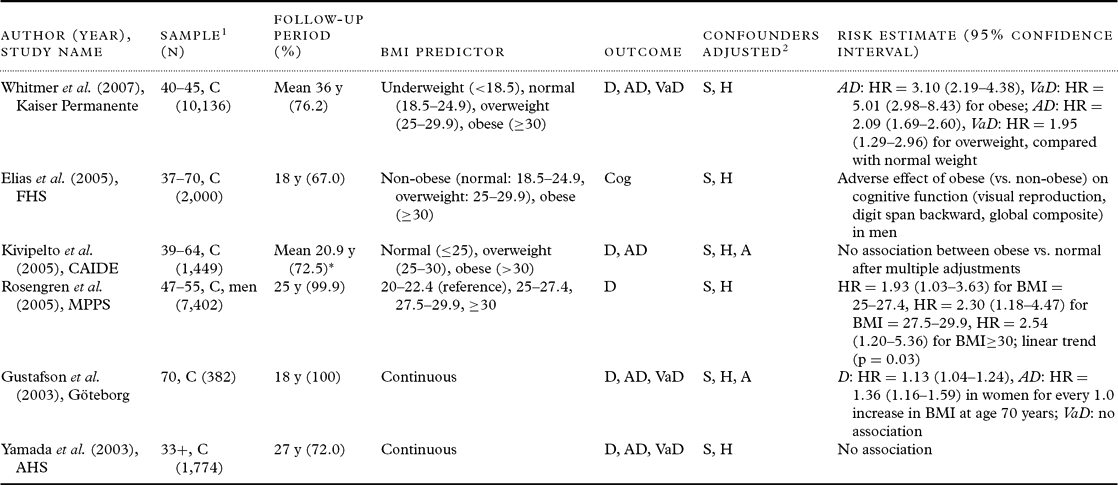
AD: Alzheimer's disease; AHS: Adult Health Study; CAIDE: Cardiovascular Risk Factors, Aging and Dementia study; Cog: cognitive function; D: dementia; FHS: Framingham Heart Study; HR: hazard ratio; MPPS: multifactor Primary Prevention Study; VaD: vascular dementia.
1Age at baseline (in years), population characteristics: C (community-based).
2Adjusted for potential confounders: S (sociodemographics), H (health-related variables), A (apolipoprotein E).
*Analysis of drop-outs (e.g. sensitivity analysis) suggests selective attrition did not affect study results.
Diet and nutrition
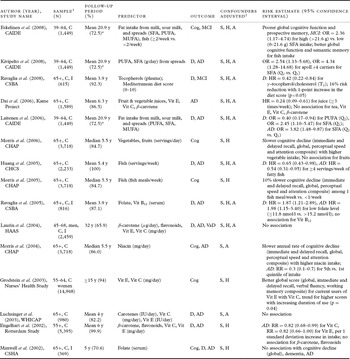
Numerous studies investigated the effect of various nutrients on cognition (Table 5). Mediterranean diet (Ravaglia et al., Reference Ravaglia2008), vegetables (Morris et al., Reference Morris, Evans, Tangney, Bienias and Wilson2006) and fatty fish (Huang et al., Reference Huang2005; Morris et al., Reference Morris, Evans, Tangney, Bienias and Wilson2005) consumption was found to lower dementia risk. In the CAIDE study, moderate intake of polyunsaturated fatty acids at midlife had a protective impact on AD (Laitinen et al., Reference Laitinen2006), whereas saturated fatty acids increased the risk of MCI (Eskelinen et al., Reference Eskelinen2008) and dementia (Laitinen et al., Reference Laitinen2006; Kivipelto et al., Reference Kivipelto2008). Major nutrients found to show protective effects were vitamin E (Engelhart et al., Reference Engelhart2002; Grodstein et al., Reference Grodstein, Chen and Willett2003; Ravaglia et al., Reference Ravaglia2008), niacin (Morris et al., Reference Morris2004), and folate (Ravaglia et al., Reference Ravaglia2005). Several studies, however, reported otherwise (Maxwell et al., Reference Maxwell, Hogan and Ebly2002; Luchsinger et al., Reference Luchsinger, Tang, Shea and Mayeux2003; Laurin et al., Reference Laurin, Masaki, Foley, White and Launer2004; Dai et al., Reference Dai, Borenstein, Wu, Jackson and Larson2006). No significant association was found for vitamin C (Luchsinger et al., Reference Luchsinger, Tang, Shea and Mayeux2003; Laurin et al., Reference Laurin, Masaki, Foley, White and Launer2004; Dai et al., Reference Dai, Borenstein, Wu, Jackson and Larson2006), carotenes (Engelhart et al., Reference Engelhart2002; Luchsinger et al., Reference Luchsinger, Tang, Shea and Mayeux2003; Laurin et al., Reference Laurin, Masaki, Foley, White and Launer2004; Dai et al., Reference Dai, Borenstein, Wu, Jackson and Larson2006), vitamin B12 (Ravaglia et al., Reference Ravaglia2005), and flavonoids (Engelhart et al., Reference Engelhart2002; Laurin et al., Reference Laurin, Masaki, Foley, White and Launer2004). Stratified analysis by APOE showed mixed results. Significant associations pertained to carriers (Dai et al., Reference Dai, Borenstein, Wu, Jackson and Larson2006; Laitinen et al., Reference Laitinen2006; Kivipelto et al., Reference Kivipelto2008), non-carriers (Huang et al., Reference Huang2005), or to neither (Engelhart et al., Reference Engelhart2002).
Summary table of diet and nutrition and cognitive outcomes

AD: Alzheimer's disease; CAIDE: Cardiovascular Risk Factors, Aging and Dementia study; CHAP: Chicago Health and Aging Project; CHCS: Cardiovascular Health Cognition Study; Cog: cognitive function; CSBA: Conselice Study of Brain Ageing; CSHA: Canadian Study of Health and Aging; D: dementia; HAAS: Honolulu-Asia Aging Study; HR: hazard ratio; MCI: mild cognitive impairment; MUFA: monounsaturated fatty acids; OR: odds ratio; PUFA: polyunsaturated fatty acids; Q1: first quartile; Q2: second quartile; RR: relative risk; SFA: saturated fatty acids; T2: second tertile; VaD: vascular dementia; Vit: vitamin.
1Age at baseline (in years), population characteristics: C (community-based), I (institutionalized; of the baseline sample 2% in HAAS, 2.5% in CSBA, 12.2% in CSHA).
2Adjusted for potential confounders: S (sociodemographics), H (health-related variables), A (apolipoprotein E).
*Analysis of drop-outs (e.g. sensitivity analysis) suggests selective attrition did not affect study results.
Discussion
Results from the overview of research activities in this area indicate that physical activity, non-smoking, moderate alcohol drinking, maintenance of normal body weight, and a healthy diet may confer some protection against cognitive decline and dementia by reducing the risk or delaying the onset. Midlife health behaviors were found to contribute to cognitive health in later years, suggesting cumulative effects of healthy lifestyles. Clustering of multiple risk factors increasing dementia risks (Kivipelto et al., Reference Kivipelto2008) further imply synergistic effects of health behaviors. An increment in global cognitive function scores have been demonstrated with each additional lifestyle factors in a recent study (Lee et al., Reference Lee, Kim and Back2009). Overall findings indicate the potential advantage of adopting multiple healthy lifestyles.
The weight of evidence favoring leisure time physical activity was very strong, with eight out of nine level A studies showing significant benefits. Even mild activities, such as walking, were found to be protective. A single study (Rovio et al., Reference Rovio2007), which examined work-related (occupational and commuting) physical activity, failed to produce a significant association. A disproportionate number of the less educated and those in manual jobs participating in occupational physical activity, a decreasing trend of occupational physical activity over the past 25 years, residual confounding, insufficient duration and intensity of work-related physical activity, and survival bias may have contributed to the non-significant result.
All four studies on smoking demonstrated detrimental effects on dementia and AD, with indications of a dose-response relationship. Four of the eight studies on alcohol consumption found that moderate drinking or increasing levels of consumption lowered the risk for dementia or cognitive decline. A U-shaped relationship, however, was suggested where non-drinkers and frequent drinkers showed an increased risk. For BMI, four of the six studies found being overweight or obese to contribute to incident dementia and cognitive decline. The effect was demonstrated to run through the life course in three separate studies, with midlife obesity being predictive of incident dementia 20 to 30 years later. Overall, there appeared to be some cognitive benefits of a healthy diet and nutrition. There was consistent evidence of a protective effect of vegetable and fish consumption (two studies each) and a negative effect for high saturated fat intake (three studies). Studies on vitamin C, folate, and fruit consumption were inconsistent. Other nutrients, such as flavonoids, carotenes, and vitamin B12, were not shown to be protective.
Although specific mechanisms for the effect of health behaviors on cognition are still uncertain, vascular risk reduction and neuroprotective effects seem to play a role. Physical activity is thought to enhance cognitive function by increasing cardiovascular fitness and cerebral perfusion, and its role in stimulating neurogenesis has been suggested (Lee et al., Reference Lee, Kim and Back2009). Smoking is a well-recognized cardiovascular risk factor and, mediated by oxidative stress, inflammation and atherosclerosis, is known to increase the risk for neurodegeneration (Swan and Lessov-Schlaggar, Reference Swan and Lessov-Schlaggar2007). Although chronic alcohol consumption has been associated with neurodegenerative diseases, moderate consumption may protect against dementia by increasing HDL cholesterol levels and fibrinolytic factors that lowers platelet aggregation, enhancing insulin sensitivity, reducing inflammatory response, and preventing oxidative damages in the brain (Peters et al., Reference Peters, Peters, Warner, Beckett and Bulpitt2008). The influence of being overweight or obese on cognitive function may be caused by a direct effect of adiposity on the neuroendocrine system or mediated through other components of the metabolic syndrome, such as hypertension and type 2 diabetes (Beydoun et al., Reference Beydoun, Beydoun and Wang2008). Vegetables with high levels of antioxidants may protect against neuronal damage (Kang et al., Reference Kang, Ascherio and Grodstein2005), while fish consumption, with high ω-3 fatty acid contents, may exert beneficial effects against pathological signs of AD such as beta-amyloid deposition (Calon and Cole, Reference Calon and Cole2007).
There were some inconsistencies in the studies, especially with regard to APOE carrier status, gender, and alcohol consumption. Differences in the characteristics of the cohorts, such as racial or ethnic composition and gender (Taaffe et al., Reference Taaffe2008), may account for the divergent findings by APOE status. Moreover, differential mortality, with elevated cardiovascular morbidity and mortality among APOE carriers, may favor significant associations in non-carriers (Reitz et al., Reference Reitz, den Heijer, van Duijn, Hofman and Breteler2007). The effect of APOE may be so strong that other risk factors do not further contribute to the relationship. With age, however, the influence of APOE may attenuate (Kivipelto et al., Reference Kivipelto2008). Mechanisms by which behavioral risks affect brain function may differ by APOE status. Smoking, in particular, may have an adverse vascular effect but could be beneficial in APOE carriers by facilitating the release of acetylcholine or increasing the density of nicotinic receptors (Ott et al., Reference Ott1998; Reitz et al., Reference Reitz, den Heijer, van Duijn, Hofman and Breteler2007).
Gender differences, particularly the more pronounced association between BMI and dementia among women, have been attributed to selective survival, metabolic differences or interaction with hormonal metabolism (e.g. estrogen), difference in body fat distribution, and insufficient sample size for men (Gustafson et al., Reference Gustafson, Rothenberg, Blennow, Steen and Skoog2003; Laurin et al., Reference Laurin, Masaki, Foley, White and Launer2004). In contrast, in the Framingham Heart Study (Elias et al., Reference Elias, Elias, Sullivan, Wolf and D'Agostino2005), an adverse effect of obesity on cognitive function was notable only in men. Controlling for education negated the significant relationship in women. This may be due to the fact that education was more highly correlated with cognitive function in obese women than in obese men.
For alcohol consumption, there were conflicting results. Although Ganguli et al. (Reference Ganguli, Bilt, Saxton, Shen and Dodge2005) reported protective effects of moderate drinking, defined as at least one alcoholic drink per month, on cognitive function, unfavorable findings were reported in a Finnish study for APOE carriers (Kivipelto et al., Reference Kivipelto2008). Binge drinking was a common practice in Finland at the time of midlife assessment. It has been suggested that APOE carrier status may interact with the binge drinking habit to increase dementia risk. The Dubbo Study (Simons et al., Reference Simons, Simons, McCallum and Friedlander2006), in contrast, found a protective influence of alcohol for up to 28 drinks per week. However, considering that only a minority (21% of men and 3% of women) of the study subjects had more than 14 drinks per week, the benefit of alcohol consumption appears to be confined to moderate drinking levels.
Several studies did not find a significant association of health behaviors with vascular dementia (Gustafson et al., Reference Gustafson, Rothenberg, Blennow, Steen and Skoog2003; Podewils et al., Reference Podewils2005; Reitz et al., Reference Reitz, den Heijer, van Duijn, Hofman and Breteler2007). This may in part be due to the relatively small sample size of vascular dementia cases. Elderly vascular dementia patients may have a disproportionately high mortality rate. Furthermore, other mechanisms, besides those triggered by increased vascular risks, may play a larger role in the pathogenesis of dementia. For instance, in smoking, increased cholinergic metabolism, oxidative stress and lower levels of antioxidant intake have been suggested as alternate pathways (Reitz et al., Reference Reitz, den Heijer, van Duijn, Hofman and Breteler2007).
One of the strengths of the present systematic review is that the influence of major health behavioral factors on cognitive function was appraised concurrently in one review. This has helped to summarize the current state of evidence on various health behaviors. The adoption of uniform criteria for the selection of studies for review has enhanced the critical appraisal of a comparable level of evidence across different health behaviors.
We employed strict quality criteria in the final selection of searched literature, limiting the review to studies that obtained high quality scores, to ensure internal validity of the results. Restricting the review to studies from community-based representative samples helped to minimize selection bias and strengthen generalizability of the results. The outcome measures included dementia as well as cognitive function and decline to encompass a broad scope of cognitive health. Studies of longer duration and higher rate of follow-up were given more weight for their ability to analyze antecedent and long-term effects of behavioral factors and to minimize attrition bias. To reduce the effects of confounding, a study was only included if it featured control of multiple covariates. Finally, we limited the study design to prospective cohort studies to address the issue of recall bias and to ensure temporality of the relationships.
Although the present findings pertain to studies with the most sound methodology, it should be noted that they were all observational in design. Limitations inherent in cohort studies, especially due to selective attrition and inadequate control of confounders, need to be taken into account. More large-scale randomized controlled trials in community settings need to be conducted to clarify the effect of health behaviors on cognitive function and dementia. For some health behaviors, such as smoking and alcohol drinking, however, it would not be feasible to carry out clinical trials.
Despite the accumulating evidence of the effect of health behaviors on cognitive function, there is still room for improvement. Among population subgroups inconsistencies abound. Differences by age, gender and genetic predispositions would need to be further explored. Studies have so far predominantly been carried out in Western populations. Studies in diverse cultures and population groups would help to strengthen the evidence base. Long-term effects of health behaviors are still unclear. As populations are followed up at frequent intervals over extended periods it will be possible to examine changes in health behaviors, their cumulative effects, and the effect of early risk exposure. Differences in health behavior measurement further hinder comparison between studies, although similar results attained using diverse measures may attest to the validity of the association. Standardization of assessment tools would help to reduce heterogeneity of the study results.
We conclude that there is growing evidence supporting the protective effect of health behaviors against cognitive decline and dementia in older persons. With this increasing evidence and a better understanding of the underlying mechanisms, lifestyle modification is likely to be increasingly promoted as a convincing strategy for maintaining cognitive health in later life.
Conflict of interest
None.
Description of authors' roles
Y. Lee formulated the research question, designed the study, searched the database, reviewed the abstracts, examined full texts, extracted data, analyzed the data, and wrote the paper. J. H. Back managed the database, reviewed the abstracts, examined full texts, extracted data, analyzed the data, and assisted with writing the paper. J. Kim read full texts, extracted data, and assisted with writing the paper. S-H. Kim reviewed the abstracts, examined full texts, and extracted data. D. L. Na formulated the research question, helped design the study, and developed the study quality criteria. H-K. Cheong and C. H. Hong assisted with the study design and development of study quality criteria. Y. G. Kim assisted with searching the database and collecting the articles.
Acknowledgments
This study was supported by the Health Promotion Fund, Ministry for Health, Welfare and Family Affairs, Republic of Korea (08–23). Partial support from the Clinical Research Center for Dementia, Ministry for Health, Welfare and Family Affairs, Republic of Korea is acknowledged. We thank the anonymous reviewers for their insightful comments.
Appendix: Study quality assessment checklist