Inflammation and infection of the mammary gland is the most common dairy cow disease worldwide (Rajala & Gröhn, Reference Rajala and Gröhn1998; Østerås et al. Reference Østerås, Solbu, Refsdal, Roalkvam, Filseth and Minsaas2007; USDA, 2007) and the importance of the dry period in maintaining good udder health in dairy herds has long been recognized (Neave et al. Reference Neave, Dodd and Henrichs1950; Eberhart, Reference Eberhart1986; Bradley & Green, Reference Bradley and Green2004). Based on early dry-cow therapy studies, at a time when contagious pathogens were the most prevalent problem, a recommendation was made to routinely treat all cows (so called blanket dry-cow therapy) (Neave et al. Reference Neave, Dodd and Henrichs1950; Smith et al. Reference Smith, Neave, Dodd and Branner1966; Eberhart & Buckalew, Reference Eberhart and Buckalew1972). Mastitis epidemiology and bacteria involved have since changed considerably (Hillerton et al. Reference Hillerton, Bramley, Staker and McKinnon1995; Myllys et al. Reference Myllys, Asplund, Brofeldt, Hirvela-Koski, Honkanen-Buzalski, Junttila, Kulkas, Myllykangas, Niskanen, Saloniemi, Sandholm and Saranpaa1998; Ekman & Østerås, Reference Ekman and Østerås2003) and environmental pathogens are currently the main challenge to good udder health in many modern dairies (Bradley & Green, Reference Bradley and Green2001a; Olde Riekerink et al. Reference Olde Riekerink, Barkema, Veenstra, Poole, Dingwell and Keefe2006; Bar et al. Reference Bar, Grohn, Bennett, Gonzalez, Hertl, Schulte, Tauer, Welcome and Schukken2007). Additionally, because of global concerns over agricultural use of antimicrobial drugs and the possible development of antimicrobial resistance in bacterial populations and the potential risk this might represent to public health (WHO, 2000; Angulo et al. Reference Angulo, Nargund and Chiller2004; Bywater, Reference Bywater2004), selective treatment of cows at dry-off has received increasing attention in recent years (Robert et al. Reference Robert, Seegers and Bareille2006; Huijps & Hogeveen, Reference Huijps and Hogeveen2007; Torres et al. Reference Torres, Rajala-Schultz, Degraves and Hoblet2008).
The goal of blanket dry-cow therapy (DCT) is twofold: therapeutic (elimination of existing infections) and prophylactic (prevention of new infections). Selective DCT (SDCT), on the other hand, promotes therapeutic use of antibiotics and treatment of infected cows only. Thus, the main difference between these approaches relates to the concept of treating uninfected cows. Studies where treatment assignment has been decided based on identifying cows as infected or uninfected, prior to administration of antibiotics at dry-off, by the use of microbiological culture of milk samples, SCC and/or clinical mastitis history, are sparse. Existing studies evaluating the need for treating uninfected cows and the effects of SDCT indicated that treated and untreated uninfected cows had similar rates of new intramammary infection (IMI) over the dry period (Schultze, Reference Schultze1983; Browning et al. Reference Browning, Mein, Barton, Nicholls and Brightling1990; Browning et al. Reference Browning, Mein, Brightling, Nicholls and Barton1994) and that treated uninfected cows had a higher incidence of CM at early lactation than untreated uninfected cows (Browning et al. Reference Browning, Mein, Barton, Nicholls and Brightling1990). In contrast to this, studies where cows/quarters have been assigned to treatment randomly and where the treatments groups consisted of both infected and uninfected cows have consistently reported higher new infection and clinical mastitis rates in the untreated than the treated groups (Schukken et al. Reference Schukken, Vanliet, Vandegeer and Grommers1993; Hassan et al. Reference Hassan, Daniel, O'Boyle and Frost1999). Thus, the general concern about SDCT in countries promoting blanket DCT is that it will be detrimental to udder health and productivity of cows if the prophylactic effect of antibiotics on healthy, uninfected cows is withdrawn. For SDCT to be economically feasible and attractive for producers to implement, it needs to maintain similar udder health and milk production level as the widely practised blanket treatment. Moreover producers will need an easy and cost-effective method to identify cows for treatment (Browning et al. Reference Browning, Mein, Barton, Nicholls and Brightling1990; Torres et al. Reference Torres, Rajala-Schultz, Degraves and Hoblet2008). Studies on the effects of SDCT in US dairy herds are missing. Furthermore, most research on dry-cow therapy has focused on assessing and reporting the effect of treatment on the infection status of quarters and/or cows and on occurrence of CM during the dry period and early lactation. On a practical level, however, the most noticeable direct measures that affect the income on a dairy farm are the amount and the quality (as measured by SCC) of milk produced. Therefore, the objective of this study was to evaluate the effect of selective treatment of cows at dry-off on milk yield and SCC during the following lactation.
Materials and Methods
Study population
Four Ohio dairy herds with Holstein cows (two private and two state institutional herds) were enrolled in the study between spring 2004 and spring 2006. A basic description of the study herds is presented in Table 1. Cows in the study herds were classified into low-SCC or high-SCC groups at dry-off based on SCC during the last 3 months of lactation and CM history during the lactation preceding the dry-off. SCC above 200 000 cells/ml in a composite sample has been traditionally accepted as an indication of infection providing the highest sensitivity and specificity to identify quarters infected with major pathogens (Dohoo & Leslie, Reference Dohoo and Leslie1991). A cut-off of 200 000 cells/ml from the last 3 months of lactation was also determined to best identify infected and uninfected cows at dry-off in the current study population (Torres et al. Reference Torres, Rajala-Schultz, Degraves and Hoblet2008). Briefly, cows without CM and with SCC ⩽200 000 cells/ml during each of the last 3 months of lactation were categorized as low-SCC cows. If a cow had experienced a case of CM during the first 90 d of the lactation preceding the dry-off, but her SCC was <100 000 cells/ml for the rest of the lactation, she was also classified as a low-SCC cow. All other cows, with a history of CM during the lactation and/or SCC above 200 000 cells/ml during any of the last 3 months of lactation were categorized as high-SCC cows. Monthly test-day milk yields during the study, 305-d milk yield from the previous lactation and SCC of every cow in each farm were obtained electronically from PCDART (Herd Manager © 2005 Dairy Records Management Systems, Raleigh NC, USA) and individual CM and other disease records were collected at each farm. After calving, cows were followed until the end of lactation (dry-off), culling, or the end of the study period, whichever came first. The study protocol was approved by OSU IACUC (Institutional Animal Care and Use Committee) prior to the commencement of the study.
Characteristics of the study herds at the time of enrolment to the study

† Somatic cell count, cells/ml
Treatment allocation
Each week when cows were dried off in the study herds, cows in the low-SCC group were randomly allocated to either receive treatment (low-DCT) or not to receive treatment at dry-off (low-no-DCT); all high-SCC cows were treated (high-DCT). No control (i.e. untreated) group was assigned for the high-SCC cows because the main interest of the study was to evaluate the need for treating healthy, uninfected cows with antibiotics at dry-off. Treatments were applied on cow level and all quarters of cows assigned to receive treatment were administered intramammary antibiotics. A commercially licensed product containing 500 mg benzathine cloxacillin (Orbenin DC™, Pfizer) was used as the DCT during the study. For a period of several months during the study, this product was not available and during that time, 300 mg of a cephapirin benzathine-containing product (Cefa-Dri™, Fort Dodge IA, USA) was used in all herds instead. No internal teat sealants were used in the herds during this study. If a cow had CM on the day of dry-off, she was excluded from the study. The list of treatment allocation was only available to the investigators while the personnel on the farms were blinded with regard to the treatment status of the cows.
Milk sampling and data collection
At dry-off, duplicate samples from mammary quarters of the cows were collected by the investigators prior to the last milking. Quarter samples within 5 d of calving were collected by farm personnel or the investigators, with a goal of getting two samples from each quarter. Instructions for sample collection were given to farm personnel before the beginning of the study and a written protocol was left on each farm. Samples collected by farm personnel were kept on the farm at −20°C until pick-up and transportation to the laboratory. Farms were visited once a week to collect and pick up milk samples, to update CM and other disease records, and to evaluate the general condition of the dry cows. The presence of abnormal milk or udder inflammation with or without systemic signs, such as fever or decreased appetite, was considered a case of CM following the standard operating procedures of each farm. Records on occurrence of early post-partum diseases (dystocia, retained placenta, metritis, hypocalcaemia, ketosis, and displaced abomasum diagnosed ⩽15 d post partum), lameness, and other diseases (e.g. traumatic reticuloperitonitis) during the subsequent lactation were obtained from the written records on each farm. Sometimes only antibiotic treatment was recorded without a specific diagnosis for cows more than 100 days in milk (DIM). As these cases had been severe enough to require treatment, they were also recorded as ‘other disease’ for the purpose of this study in order to account for their potential confounding effect on milk yield.
Definition of intramammary infections (IMI)
All milk samples were examined microbiologically according to National Mastitis Council guidelines, using 0·01 ml inoculum (Oliver et al. Reference Oliver, Gonzalez, Hogan, Jayarao and Owens2004). A quarter was considered infected if ⩾100 cfu/ml of contagious major pathogens (Staphylococcus aureus and Streptococcus agalactiae) or ⩾1000 cfu/ml of all other pathogens [coagulase negative staphylococci (CNS), streptococci other than Str. agalactiae, Corynebacterium spp., Arcanobacterium pyogenes, Bacillus spp., coliforms (Escherichia coli, Enterobacter spp. and Klebsiella spp.), yeast and other Gram-negative rods] were isolated from a single foremilk sample, collected at dry-off before the last milking or within 5 d of calving (Torres et al. Reference Torres, Rajala-Schultz and DeGraves2009). Samples with more than two types of colonies were considered contaminated. If the first quarter sample collected at a specific time point was contaminated, the second sample collected at the same time was used to assess the infection status. If both samples from a quarter were contaminated, the quarter infection status was considered unknown. A cow was considered infected when at least one quarter was infected. When infection status in one quarter was declared unknown but IMI was diagnosed in at least one of the other quarters, a cow was considered infected. If the infection status of one quarter was unknown owing to contaminated or missing samples and all other quarters were uninfected, the status of a cow was considered unknown.
Statistical analysis
The main interest of the analysis was to compare milk yield and SCC (two separate analyses) during the following lactation between low-SCC cows which were either treated with antibiotic dry-cow products or were left without treatment at dry-off. The actual SCC (which was expressed in thousands, e.g., 150 000 cells/ml was 150) was log-transformed, but owing to left skewness remaining in the data despite the log-transformation, a random number between 0 and 50 was added (using Microsoft Excel®) to each cell count prior to the log-transformation to achieve normality. This transformed SCC was used as the outcome in the analyses. This process of adding a random number between 0 and 50 to the actual SCC was repeated 5 times and the analyses repeated with each of the new outcomes to assess the impact of the random number addition. Milk yield and SCC were modelled using repeated measures analysis (PROC MIXED) in SAS® 9.2 (SAS Institute Inc., Cary NC, USA). To account for non-independence of the observations within cows, six correlation structures were tested (compound symmetry, variance components, first order autoregressive, heterogeneous first order autoregressive, spatial power, and unstructured). Herd was included in the models as a fixed effect.
The main variable of interest in the analyses was DCT-status of the cows based on SCC and CM history during the previous lactation and the treatment allocation at dry-off (i.e. low-SCC cows with DCT, low-SCC with no DCT, and high-SCC with DCT). Other explanatory variables considered were lactation number at calving (second, third or fourth and higher lactation), stage of lactation, previous lactation 305-d milk yield (scaled to reflect a 1000-kg change), calving season (winter=December–February; spring=March–May; summer=June–August; autumn=September–November), and length of the dry period (categorized into four groups: ⩽45 d; 46–60 d; 61–90 d; and >90 d). Stage of lactation was modelled according to Macciotta et al. (Reference Macciotta, Vicario and Cappio-Borlino2005) using Wilmink functions, by DIM and natural logarithm of DIM (lnDIM) in the models. Daily milk yield was also included in the analysis with SCC as the outcome. Continuous variables were centered at the median of the data to achieve a meaningful interpretation for the intercept in the model.
An indicator variable for occurrence of CM with 4 levels was created: CM occurring at 1–30 DIM; 31–90 DIM; after 90 DIM; and no CM during the lactation. Occurrence of other diseases during the subsequent lactation after dry-off was accounted for by creating three separate indicator variables as follows: early post-partum diseases (yes/no); lameness (yes/no); other diseases (yes/no); the reference group in each case included cows without the disease in question during the follow-up period. Only the first case of each disease was considered. Presence of IMI at dry-off (infected v. uninfected) and at calving (uninfected, infected or unknown) with both outcomes (milk yield and SCC) and the effect of SCC on milk yield during the following lactation were also tested in the initial screening.
Modelling procedure
Initially, the correlation structure that best fitted the data was chosen based on the Akaike's information criterion (AIC) and Schwarz’ Bayesian criterion (BIC) (Littell et al. Reference Littell, Milliken, Stroup and Wolfinger1996). The six covariance structures were tested in a model with only the risk factor of interest (DCT-status) in it. Next, each explanatory variable was modelled independently against the outcome. Variables with P value ⩽0·20 from the F test were included in the initial full model (Dohoo et al. Reference Dohoo, Martin and Stryhn2003). The risk factor of interest, DCT-status, was forced in the model. Backward selection procedure was used to run a sequence of models, dropping the least significant variable one at a time.
To evaluate whether a variable was a confounder in the association between the outcome and the risk factor of interest (i.e. DCT-status with three levels) and should be kept in the model, the change in the coefficients of DCT-status was calculated after the variable in question had been dropped from the model. Any variable that induced a change ⩾10% in at least one of the coefficients of DCT-status was kept in the model. Potential known confounders that did not make the cut in the initial screening were re-introduced and tested for significance in the final model. Variables that were deemed intervening variables, rather than true confounders, in the association and causal pathway between the risk factor of interest (DCT-status) and the outcome (milk yield or SCC), such as IMI-status at dry-off and at calving, CM, and SCC in the milk yield model, were not included in the final model to avoid overadjustment and to obtain as accurate estimates as possible for the effect of DCT-status on milk yield and SCC (Dohoo et al. Reference Dohoo, Martin and Stryhn2003).
Once a model where all independent variables were significant (P⩽0·05) or considered important confounders was established, biologically plausible two-way interactions between the main effects were tested. These included DCT-status×herd, DCT-status×parity and parity×previous lactation milk yield. Interaction terms were kept in the model if they were significant (P<0·05). Estimates for the overall difference between treated and untreated low SCC cows across herds based on the final models were obtained using ‘ESTIMATE’ statement in SAS. Herd-specific estimates were obtained by stratifying the final models by herd. Fit of the models was assessed by examining residual plots.
Results
Baseline information for the herds enrolled in the study is presented in Table 1. The herds were enrolled in the study at different times and herd 1 (the largest of the study herds) was the last one enrolled. Owing to time constraints of the study, only approximately one-third of the cows in that herd were included in the study.
Quarter level prevalence of intramammary infections at dry-off and at calving, by types of pathogens, in the four study herds are presented in Table 2. Overall, the percentage of quarters infected increased from 12% to 21% from dry-off to calving. In all herds, IMI caused by minor pathogens were most common at both times points, ranging from 3·8% to 13·6% of quarters being infected by CNS or Corynebacterium spp. Contagious pathogens were not frequently found in any of the herds: no Str. agalactiae was isolated in any of the herds and the percentage of quarters infected with Staph. aureus ranged from 0·3% to 3·6% across herds and time points. Environmental pathogens were rarely isolated from dry-off samples (prevalence ranging from 0·7% to 2·7% depending on a herd), but they were more commonly found at calving in all herds and their prevalence also tended to increase in each treatment group (results not shown).
Percentage of quarters infected with different types of pathogens in different herds and overall at dry-off and calving

† Overall intramammary infection (IMI) rate may differ slightly from the sum of the different types of infections owing to rounding of the numbers and because some quarters had mixed infections (e.g. both environmental and minor pathogens were isolated from the quarter milk sample)
‡ Staphylococcus aureus. No Streptococcus agalactiae was isolated
§ Streptococcus dysgalactiae, Streptococcus uberis, Enterococcus spp., Escherichia coli, Enterobacter spp., Klebsiella spp.
¶ Coagulase negative staphylococci and Corynebacterium spp.
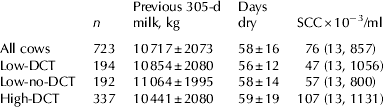
Data from a total of 414 low-SCC and 386 high-SCC cows were initially available for the analysis. Twenty-eight low (12 low-no-DCT and 16 low-DCT) and 49 high-SCC cows (9·5% of all cows enrolled at dry-off) were dropped from the analysis because they were either culled or they died during the dry period or early lactation before any test-day information was collected. Therefore, a total of 5218 test-day observations with monthly milk yields from 386 low-SCC and 337 high-SCC cows were used in the analysis. On average, cows had information from five test-days (ranging from 1 to 11). Mean and sd for length of the dry period, previous lactation 305-d milk yield, daily milk yield during the subsequent lactation after dry-off and median and 10th and 90th percentiles for SCC during the subsequent lactation after dry-off for the treatment groups are shown in Table 3.
Means±sd for previous lactation 305-d milk production (previous 305-d milk, kg), days dry, and median (and 10th and 90th percentile) for somatic cell counts (SCC) from the subsequent lactation after dry-off, for treated (DCT) and untreated (no DCT) low-SCC† and high-SCC‡ cows
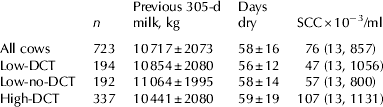
† Cows without clinical mastitis and <200 000 cells/ml during the last three months of previous lactation, or with clinical mastitis during the first 90 days in milk (DIM) and <100 000 during the rest of lactation, randomly allocated to receive (DCT) or not to receive dry cow therapy (no-DCT)
‡ Cows with ⩾200 000 cells/ml during any of the last three months of previous lactation or with clinical mastitis after 90 DIM were considered high-SCC cows and received DCT
The prevalence of IMI at dry-off at cow level, based on microbiological culture of quarter milk samples, for low-DCT, low-no-DCT and high-DCT cows was 16·7% (95% confidence interval, CI: 11·7–22·7), 19·6% (95% CI: 14·2–25·9), and 44·2% (95% CI: 38·8–49·7), respectively. Most of the quarters (95·6%) of the low-SCC cows were negative at dry-off, and when infected, CNS were the most commonly isolated pathogens. There was no significant difference in the prevalence of IMI at dry-off between treated and untreated low-SCC cows (Fisher's exact P=0·509). Infection status at calving was unknown for 85 cows (11·8%) (13 low-DCT, 12 low-no-DCT, and 60 high-DCT cows), owing to missing (n=67) or contaminated (n=18) milk samples. Among the cows with known infection status (n=638), prevalence of infection at calving was 35·1% (95% CI: 28·4–42·2), 47·9% (95% CI: 40·7–55·2) and 40·9% (95% CI: 35·7–46·4) for low-DCT, low-no-DCT and high-DCT cows, respectively. Untreated cows appeared to have higher prevalence of infections at calving than the treated cows; however, the differences were not statistically significant. During the first 30 d of lactation, 11% (6·8–16·1), 12% (7·7–17·4) and 17% (12·8–21·0) of the low-DCT, low-no-DCT and high-DCT cows, respectively, had a case of CM. The majority of the cows (75·5%) did not have any reported occurrences of other diseases. After CM, early post-partum diseases (dystocia, retained placenta, metritis, hypocalcaemia, ketosis, and displaced abomasum diagnosed ⩽15 d post partum) were the most commonly observed disorders (with 16·8% of cows reported to have at least one of these diseases).
Milk yield in low-SCC and high-SCC cows
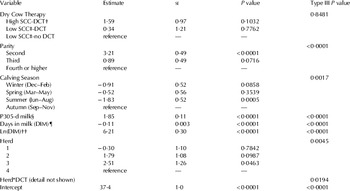
The first order heterogeneous autoregressive correlation structure provided the best fit to the data and was used in all models to account for the non-independence of observations from the same cow over time. Results from the final model for milk yield are presented in Table 4. Overall, the results suggested that dry cow therapy did not have a significant effect on milk yield of cows during the subsequent lactation after dry-off (P=0·8481) and the milk yield of treated and untreated low-SCC cows did not differ (P=0·7762). Herd, however, was a strong confounder and was significantly associated with milk yield (P=0·0045). Interaction between herd and DCT was also significant (P=0·0194). The estimated average effect of DCT among low-SCC cows across herds suggested that low-SCC cows that were treated at dry-off produced 0·24 kg more milk daily than untreated low-SCC cows (Table 5). The difference, however, was not statistically significant (P=0·6481) and furthermore, the effect of treating cows at dry-off was different in the individual herds (Table 5). In one herd (herd 3), treated low-SCC cows tended to produce less than untreated low-SCC cows, whereas the opposite was true in two herds (herds 1 and 2). In one herd, no difference at all was found between the groups. None of the differences within herds were statistically significant (Table 5).
Results from the final model estimating the effects of selective dry cow therapy (DCT) on daily milk yield (kg/d) during the subsequent lactation in four Ohio dairy herds

† Cows with ⩾200 000 cells/ml during the last three months of previous lactation or with clinical mastitis (CM) after 90 DIM were considered high somatic cell count cows and received DCT
‡ Cows without CM and <200 000 cells/ml during the last three months of previous lactation, or with CM during the first 90 DIM and <100 000 during the rest of lactation, were randomly allocated to receive or not to receive dry cow therapy (DCT)
§ Previous lactation actual 305-d milk production centered at 10 416 kg and scaled to reflect a 1000-kg change
¶ Days in milk, centered at 147 days
†† Natural logarithm of days in milk, centered at 4·99
Estimated overall and herd-specific differences in daily milk yields (kg/d) and somatic cell counts (SCC) between treated and untreated low-SCC cows from the final models. Milk yield estimates (kg/d) provide the difference between treated and untreated cows (the reference group). The estimates and standard errors for SCC are on log-scale (with log-transformed SCC as the outcome), which do not have a practical interpretation, thus the % differences between treated and untreated cows (with untreated cows as the reference group) are presented

† The percent difference was obtained by exponentiating the model coefficient for low-DCT group. This provides the ratio of SCC (in log scale) in treated low-SCC group divided by SCC (in log scale) in the untreated group. For example, exp(−0·173)=0·841; thus, the percentage difference in SCC between the groups is 15·9%
In the initial screening, parity was not significantly associated with milk yield (P>0·2) but the estimate suggested that older cows produced more than younger ones. However, when offered to the final model which included previous lactation 305-d milk yield, it became highly significant and was kept in the model (Table 4). When adjusted for their previous lactation milk yield, cows in their second lactation demonstrated a higher production capacity during the following lactation than cows in their fourth or higher lactation (P<0·0001) and also third lactation cows appeared to produce more than the older cows (P=0·0716). As expected, experiencing a case of CM during lactation, infection status at calving and SCC were also significantly associated with daily milk yield in the initial screening; however, as intervening variables in the causal pathway between DCT and milk yield, they were not included in the final model. Neither infection status at dry-off nor occurrence of lameness or other diseases during the lactation were significantly associated with milk yield (P>0·2) in the initial screening and were not included in the full model. Early post-partum diseases were significantly associated with milk yield in the initial screening, but not in the full model (P>0·3) and the variable was consequently dropped from the final model. For every 1000 kg increase in the previous lactation production, the average daily milk yield increased by 1·85 kg of milk/test day (P<0·0001) over the next lactation.
SCC in low-SCC and high-SCC cows
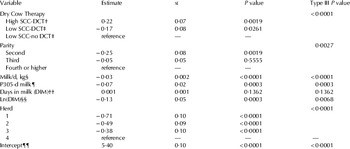
All models using log-transformed SCC with a random number between 0 and 50 added to it before the transformation produced very similar results, with only minor changes in the coefficients of any of the variables in the model. Thus, results from one of the models were randomly selected and are presented in Table 6. Overall, the results suggested that DCT had a significant effect on SCC of cows during the subsequent lactation after dry-off (P<0·0001). High-SCC cows, despite receiving treatment, continued to have significantly (P=0·0019) higher SCC during the following lactation than the untreated low-SCC cows. Treated low-SCC cows, on the other hand, had significantly lower SCC (P=0·0267) than untreated low-SCC cows. After converting the log-transformed SCC back to the original scale for ‘a median cow’ (in her 4th lactation, in Herd 4, in median DIM of 147 and with a median previous lactation 305-d milk production of 10 416 kg and a median daily milk yield of 37·6 kg) the results suggested that SCC of a treated low-SCC cow would be 16% or approximately 35 000 cells/ml lower than that of a similar untreated low-SCC cow (Table 5). Just as in the milk yield model, herd was a strong confounder and highly significantly associated with SCC levels during the following lactation (P<0·0001). When the final model was stratified by herd and the effect of DCT on SCC explored separately for each herd, a statistically significant difference between the treated and untreated low-SCC cows was observed in one of the herds (P=0·043, difference of 21% or approximately 23 000 cells/ml lower SCC in the treated than the untreated cows, Table 5.). In two other herds, treatment also appeared beneficial, whereas in one herd, treated cows tended to have higher SCC than the untreated cows. These differences, however, were not significant. Overall, the DCT effect on SCC ranged from a decrease of 27% to an increase of 20% in the SCC of the treated low-SCC cows as compared with untreated low-SCC cows (Table 5). It is important to note that since the percentage change is dependent on the starting level, the lower the SCC in the herd, the lower is the absolute change in cells/ml. Older cows (fourth of higher lactation) had significantly higher SCC than second lactation cows.
Results from the final model estimating the effects of selective dry cow therapy (DCT) on somatic cell count (SCC) on the subsequent lactation in four Ohio dairy herds. The actual SCC (expressed in thousands) was log-transformed and used as the outcome for the analysis

† Cows with ⩾200 000 cells/ml during the last three months of previous lactation or with clinical mastitis (CM) after 90 DIM were considered high somatic cell count cows and received DCT
‡ Cows without CM and <200 000 cells/ml during the last three months of previous lactation, or with CM during the first 90 DIM and <100 000 during the rest of lactation, were randomly allocated to receive or not to receive dry cow therapy (DCT)
§ Centered at 37·6 kg
¶ Previous lactation actual 305-d milk production centered at 10 416 kg and scaled to reflect a 1000-kg change
†† Days in milk, centered at 147 days
§§ Natural logarithm of days in milk, centered at 4·99
¶¶ Natural logarithm of somatic cell count
Discussion and Conclusions
Antibiotic DCT was initially developed against contagious mastitis pathogens, such as Str. agalactiae and Staph. aureus (Neave et al. Reference Neave, Dodd and Henrichs1950; Neave et al. Reference Neave, Dodd and Kingwell1966; Eberhart, Reference Eberhart1986). Consistent administration of dry-cow treatments, along with other implemented mastitis control and management practices, such as maintaining good milking hygiene and proper milking order, and regular milking machine maintenance, have indeed significantly reduced the prevalence of these mastitis pathogens in dairies worldwide (Hillerton et al. Reference Hillerton, Bramley, Staker and McKinnon1995; Olde Riekerink et al. Reference Olde Riekerink, Barkema, Veenstra, Poole, Dingwell and Keefe2006). Consequently, in many modern dairies, environmental pathogens have replaced contagious organisms as the main challenge to good udder health and as the most frequent cause of CM (Bar et al. Reference Bar, Grohn, Bennett, Gonzalez, Hertl, Schulte, Tauer, Welcome and Schukken2007). Despite this shift in epidemiology and aetiology of mastitis, the practice of routine treatment of all cows with antibiotics at the end of lactation remains the only standard recommendation for dry cow management in many countries (Dingwell et al. Reference Dingwell, Kelton and Leslie2003).
Worldwide concerns about increasing antimicrobial resistance in both human and animal pathogens have resulted in calls for more judicious and prudent use of antimicrobials (WVA, 1999; WHO, 2000; Anon, 2001). This has also brought more attention to using antimicrobial dry-cow products only for therapeutic purposes instead of administering them prophylactically to healthy cows. As antibiotic usage in animal agriculture as well as management practices in general in modern animal facilities continue to be scrutinized, it is important to re-evaluate old practices for their continued value and efficacy.
The main finding from the present study was that antibiotic DCT at the end of lactation did not have a significant effect on milk yield of low-SCC cows during the subsequent lactation. This finding is in agreement with results of Berry et al. (Reference Berry, Maas, Kirk, Reynolds, Gardner and Ahmadi1997) who did not find any statistically significant differences in milk yield, SCC and incidence of CM during the subsequent lactation among dry-treated and untreated cows in a herd with low prevalence of contagious mastitis pathogens. In that study, however, cows were randomly assigned to treatment groups regardless of their infection status at dry-off. Thus, the results reflected an overall (both therapeutic and prophylactic) efficacy of antibiotic DCT, or the lack thereof, in a herd with low prevalence of contagious mastitis pathogens. The current study, interested in the prophylactic impact of DCT, found SCC of treated low-SCC cows to be lower than that of untreated cows. Herd, however, had a significant impact on SCC and the effect varied from herd to herd. A recent New Zealand study, evaluating prophylactic effects of DCT and using a similar approach by classifying cows based on SCC and CM history, reported a lower SCC in groups treated with antibiotics compared with an untreated control group (McDougall, Reference McDougall2010). The magnitude of the effect was similar to that in the present study, even though the New Zealand study only considered the first test-day SCC after calving. If a herd receives a premium for low-SCC milk, a difference of 20 000–25 000 cells/ml may sometimes have a significant impact if that difference pushes the herd either above or below the limit.
Studies directly comparing the impact of blanket and selective DCT on milk yield are sparse, but the economic benefit of blanket treatment has been challenged previously (Gill et al. Reference Gill, W.H.H, Leslie and Lissemore1990; McNab & Meek, Reference McNab and Meek1991; Miller & Bartlett, Reference Miller and Bartlett1991; Østerås & Sandvik, Reference Østerås and Sandvik1996). Based on their meta-analysis, Robert et al. (Reference Robert, Seegers and Bareille2006) reported that while DCT decreased the risk of new IMI over the dry period and early lactation, the preventive use of DCT could only be supported by high risk of infections at the beginning of the dry period. This is in agreement with the results of Browning et al. (Reference Browning, Mein, Brightling, Nicholls and Barton1994) who reported that in low-prevalence IMI herds, the new infection rate over the dry period was 2·5% in blanket DCT and 2·4% in selective DCT groups. In high-prevalence herds, the respective new infection rates were 3·3% and 3·5%; none of the differences were statistically significant. Halasa et al. (Reference Halasa, Osteras, Hogeveen, van Werven and Nielen2009b) also concluded that blanket DCT did not provide any significant protection from new quarter IMI compared with selective DCT when the treatments were applied on a cow level. Under Dutch conditions, selective DCT was found to be economically the best option, although the differences between approaches (blanket, selective or no DCT) were small (Huijps & Hogeveen, Reference Huijps and Hogeveen2007). The investigators in that study concluded that changes in probabilities of IMI and in the input values for their economic model could influence the results and the optimal decision regarding the approach to DCT varies between farms and should be based on farm-specific calculations and producer risk tolerance. Great variability between herds was observed also in the current study. Future studies are needed to further characterize herds where antibiotic usage could potentially be reduced through implementation of SDCT without sacrificing udder health and milk quality in the herd.
It is well known that CM significantly reduces milk yield during the lactation (Rajala-Schultz et al. Reference Rajala-Schultz, Gröhn, McCulloch and Guard1999; Grohn et al. Reference Grohn, Wilson, Gonzalez, Hertl, Schulte, Bennett and Schukken2004; Hagnestam et al. Reference Hagnestam, Emanuelson and Berglund2007) and that increasing SCC is associated with decreasing milk yield (Hortet & Seegers, Reference Hortet and Seegers1998). Over 50% of clinical coliform mastitis cases in early lactation have been shown to originate during the dry period, many IMI originating from the dry period persist until the next lactation and quarters infected in early lactation are more likely than uninfected quarters to suffer from a clinical case later during the lactation (Rindsig et al. Reference Rindsig, Rodewald, Smith and Spahr1978; Browning et al. Reference Browning, Mein, Brightling, Nicholls and Barton1994; Bradley & Green, Reference Bradley and Green2000). Thus, while CM and IMI status at calving were significantly associated with both milk yield and SCC during the following lactation in the initial screening, they were not included in the final model as they were considered intervening variables in the causal pathway between DCT and the outcome (milk yield or SCC) (Dohoo et al. Reference Dohoo, Martin and Stryhn2003). This enabled us to obtain as unbiased and complete estimate of DCT effect on the outcome as possible. Indeed, when e.g. CM was included in the model for SCC, DCT was not significantly associated with SCC (but CM was), as some of DCT effect was funnelled through CM. The results from the final model also unexpectedly indicated that younger cows produced significantly more than older cows. However, without previous lactation milk yield in the model, older cows appeared to produce more as expected, whereas the final model indicated that second-parity cows have a higher capability of increasing their production in the following lactation than the older cows, when the previous lactation milk yield was accounted for.
In the present study, a majority of the low-SCC cows were uninfected at dry-off, indicating that the selection criteria used for deciding which cows could be left without DCT were quite accurate in identifying uninfected cows (Torres et al. Reference Torres, Rajala-Schultz, Degraves and Hoblet2008). However, many high-SCC cows were also uninfected at dry-off and could be considered to have been treated unnecessarily. A higher SCC cut-off would have increased specificity (fewer false positives), but decreased sensitivity. Since US dairy producers have been advised to implement blanket DCT for decades and over 75% of US dairy operations treat all cows in the herd at dry-off (USDA, 2008), leaving cows without treatment at dry-off is, in general, met with considerable reservations. Thus, high sensitivity was preferred over high specificity in this study.
One of the main factors impacting the potential ability and willingness of producers to adopt and their veterinarians to recommend the use of SDCT is having an easily accessible, cost-effective method to accurately identify cows that need treatment and those that could be left without it. The combination of CM history and SCC from the end of the lactation provide such criteria and similar criteria were also recently used in a New Zealand prophylactic DCT study (McDougall, Reference McDougall2010). It is also worthwhile to note, though, that recent studies have suggested that a cut-off of 100 000 cells/ml, or even as low as 50 000 cells/ml, may be more indicative of an infection than the conventionally accepted cut-off of 200 000 cells/ml (Dohoo & Leslie, Reference Dohoo and Leslie1991; Seegers et al. Reference Seegers, Fourichon and Beaudeau2003; Halasa et al. Reference Halasa, Nielen, De Roos, Van Hoorne, de Jong, Lam, van Werven and Hogeveen2009a).
While the overall results from this study did not show any significant differences in milk yield during the following lactation between dry-treated and untreated low-SCC cows, great variability between herds was observed, in agreement with other studies (Huijps & Hogeveen, Reference Huijps and Hogeveen2007; Halasa et al. Reference Halasa, Osteras, Hogeveen, van Werven and Nielen2009b). Large between-herd variability applied also to SCC in milk. This suggests that uniform recommendation to all herds is not optimal and emphasizes the need for careful decision-making regarding dry cow management in general in individual herds, in agreement with several previous reports (Robinson et al. Reference Robinson, Jackson and Marr1983; Browning et al. Reference Browning, Mein, Brightling, Nicholls and Barton1994; Østerås et al. Reference Østerås, Edge and Martin1999; Green et al. Reference Green, Green, Medley, Schukken and Bradley2002; Bradley et al. Reference Bradley, Breen, Payne, Williams and Green2010; Newman et al. Reference Newman, Rajala-Schultz, Degraves and Lakritz2010). Bradley et al. (Reference Bradley, Breen, Payne, Williams and Green2010) recently evaluated the efficacy of combining antibiotic DCT with internal teat sealants. For cows with high SCC prior to dry-off, the combination treatment resulted in an increased likelihood of being pathogen-free post calving and in decreased incidence of CM during the first 100 d post partum, but the benefits for low-SCC cows were less clear, compared with the teat sealant alone group. While the outcomes in the Bradley et al. (Reference Bradley, Breen, Payne, Williams and Green2010) and the current study were different (freedom from pathogens and CM v. milk yield and SCC), results from both studies suggest that overall benefit from routine antimicrobial treatment of low-SCC cows at dry-off is questionable.
One of the limitations of the current study was the small number of herds enrolled. While the herds were not a random sample of Ohio dairy herds, they represented typical dairy herds in the region with respect to milk production levels, facilities and herd sizes. It is possible that with a larger sample size the observed trend of treated low-SCC cows producing more than untreated low-SCC cows would be a significant finding. On the other hand, the current study also clearly demonstrated that there was substantial variability across herds and the treatment effect varied considerably from herd to herd, indicating that treatment of healthy cows had opposite effects, potentially beneficial in some herds and detrimental in others. It is unlikely that this variability would disappear with a larger number of herds enrolled, as no two herds are identical and it is not reasonable to assume that a standard practice would apply and benefit all herds equally. This is corroborated by the observation that a difference as small as 20 000 cell/ml in SCC within a single herd was found to be significant, suggesting that we had enough statistical power to detect differences if they existed.
In conclusion, a uniform recommendation to routinely dry-treat all cows in all herds or to advise all herds to adopt selective dry-treatment of infected cows only are not warranted. Antibiotic DCT should be only a part of an overall, holistic approach to dry-cow management (Robinson et al. Reference Robinson, Jackson and Marr1983; Bradley & Green, Reference Bradley and Green2001b). Switching to selective DCT would decrease the treatment costs at dry-off for individual producers, and on a more global level, it may also decrease the selection pressure for antibiotic resistance. This is important because while no direct cause-and-effect relationship has been demonstrated, recent studies have reported an association between use of antibiotic dry cow products and increased levels of resistance in enteric flora of dairy cows (Mollenkopf et al. Reference Mollenkopf, Glendening, Wittum, Funk, Tragesser and Morley2010) as well as in mastitis-causing organisms (Rajala-Schultz et al. Reference Rajala-Schultz, Torres, DeGraves, Gebreyes and Patchanee2009). More research is needed in determining incidence of new IMI over the dry period, prevalence of IMI at calving and identifying characteristics of farms where continued treatment of all cows may be beneficial and where selective dry treatment may be optimal and result in improved udder health.
This study was supported by the National Research Initiative of the USDA Cooperative State Research, Education and Extension Service, grant number 2005-35204-15587 and by USDA Animal Health Formula Funds through the Council for Research at the OSU College of Veterinary Medicine. The authors appreciate the cooperation of the dairy producers and farm managers involved in this project.