Introduction
Trap colour can be an important consideration in trapping programmes to detect, monitor, or sample bark and woodboring beetles (Allison and Redak Reference Allison and Redak2017; Imrei et al. Reference Imrei, Lohonyai, Csóka, Muskovits, Szanyi and Vétek2020; Dodds et al. Reference Dodds, Sweeney, Francese, Besana and Rassati2024). The invasion of the emerald ash borer, Agrilus planipennis Fairmaire (Coleoptera: Buprestidae), into North America raised awareness about trap colour for woodboring beetles. First detected in 2002, the beetle has killed millions of ash trees in North America (Poland and McCullough Reference Poland and McCullough2006; Herms and McCullough Reference Herms and McCullough2014) and continues to threaten ash trees worldwide (Sun et al. Reference Sun, Koski, Wickham, Baranchikov and Bushley2024). Research on visual cues for detection protocols for A. planipennis were a primary focus because long-range pheromones did not seem likely for the species (Crook and Mastro Reference Crook and Mastro2010).
Crook et al. (Reference Crook, Francese, Zylstra, Fraser, Sawyer and Bartels2009) found that A. planipennis are sensitive to colours in the ultraviolet, violet–purple, blue, and green regions of the electromagnetic spectrum. Responses to green and purple may have a basis in feeding and mating behaviours (Domingue et al. Reference Domingue, Lelito, Myrick, Csóka, Szöcs, Imrei and Baker2016). Green and purple intercept panel traps (sticky and nonsticky), multiple-funnel traps, and double-decker traps comprised of two sticky panels mounted on a pole have been found to be effective in trapping A. planipennis (e.g., Francese et al. Reference Francese, Mastro, Oliver, Lance, Youssef and Lavallee2005, Reference Francese, Crook, Fraser, Lance, Sawyer and Mastro2010; Crook et al. Reference Crook, Francese, Zylstra, Fraser, Sawyer and Bartels2009, Reference Crook, Francese, Rietz, Lance, Hull-Sanders and Mastro2014; Poland et al. Reference Poland, McCullough and Anulewicz2011; Poland and McCullough Reference Poland and McCullough2014; Imrei et al. Reference Imrei, Lohonyai, Csóka, Muskovits, Szanyi and Vétek2020; Dodds et al. Reference Dodds, Sweeney, Francese, Besana and Rassati2024). Green and purple traps for the detection of the emerald ash borer are manufactured per guidelines set by the United States Department of Agriculture with spectral reflectance values based on Francese et al. (Reference Francese, Crook, Fraser, Lance, Sawyer and Mastro2010, Reference Francese, Fraser, Lance and Mastro2011).
In their review of factors affecting the efficacy of coloured traps for bark and woodboring beetles, Dodds et al. (Reference Dodds, Sweeney, Francese, Besana and Rassati2024) noted a trend among Buprestidae and Cerambycidae (Coleoptera) that those species that visit flowers seem to prefer yellow, green, and blue traps, whereas dark-coloured traps are preferred by those that do not visit flowers, likely focusing on tree silhouettes in the understorey of forests. It is possible that green and purple traps could be effective for species of bark and woodboring beetles other than Agrilus species when baited with kairomones and pheromones that are broadly and strongly attractive to pine beetles and hardwood cerambycids.
The commercial availability of green, purple, and black multiple-funnel traps provided an opportunity to broadly study the effects of these three trap colours on catches of arboreal and saproxylic beetles in the understorey of forests in the southeastern United States of America. I hypothesised that baited green and purple traps would be more attractive than black traps for species that feed on foliage and/or flowers but not for species that typically respond to dark silhouettes resembling trees (Strom and Goyer Reference Strom and Goyer2001). Furthermore, I hypothesised that responses by predators should mimic the responses of their prey, thereby placing them at the same location as their prey and increasing their likelihood of finding their prey.
Methods
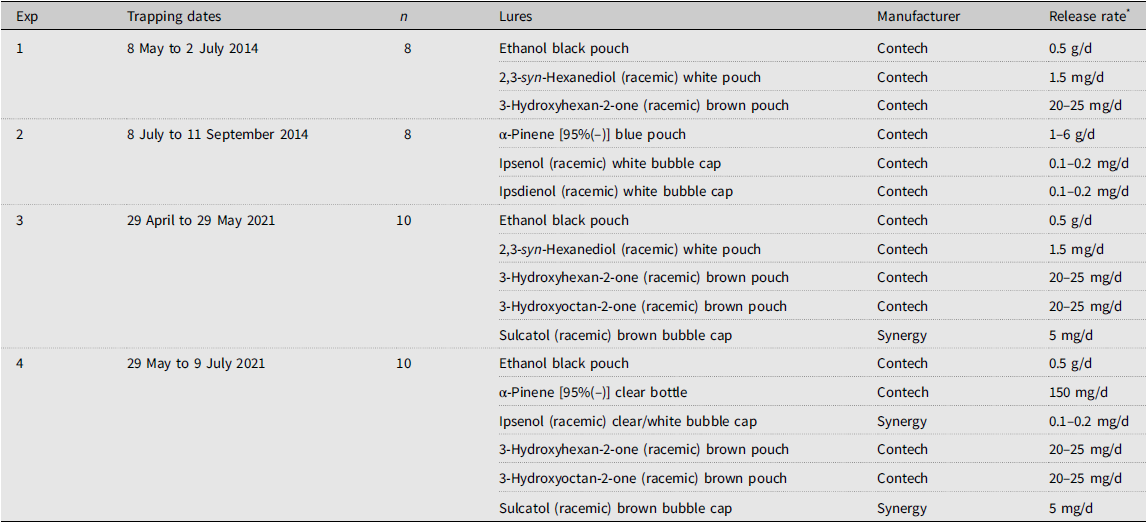
During 2014 and 2021, I conducted four trapping experiments in forest understoreys in north–central Georgia, United States of America, to determine the relative effects of semiochemical-baited green, purple, and black multiple-funnel traps on captures of bark and woodboring beetles and their associated species. Different combinations of lures were selected to target a broad array of bark and woodboring beetles and associated predators native to north–central Georgia. Ethanol, (–)-α-pinene, ipsenol, and ipsdienol are broadly attractive to numerous species of arboreal and saproxylic species of Coleoptera in the southeastern United States of America (Miller Reference Miller2006; Miller and Rabaglia Reference Miller and Rabaglia2009; Miller et al. Reference Miller, Asaro, Crowe and Duerr2011, Reference Miller, Dodds, Eglitis, Fettig, Hofstetter and Langor2013a, Reference Miller, Crowe, Dodds, Galligan, de Groot and Hoebeke2015a). Similarly, the cerambycid pheromones 2,3-syn-hexanediol, 3-hydroxyhexan-2-one, 3-hydroxyoctan-2-one, and sulcatol attract numerous species of Cerambycidae and associated predators in the same region (Miller et al. Reference Miller, Crowe, Mayo, Silk and Sweeney2015b, Reference Miller, Crowe, Mayo, Silk and Sweeney2017, Reference Miller, Mayo and Sweeney2023; Miller and Crowe Reference Miller and Crowe2020; Miller Reference Miller2022). Within each experiment, traps of the different colours were baited with the same lure blend. Lure blends used for each experiment are noted in Table 1.
Trapping dates, number of replicate blocks (n), lures, manufacturers, and release rates for four experiments (Exp) on flight responses of arboreal beetles to black, purple, and green multiple-funnel traps in north–central Georgia, United States of America. Locations of manufacturers listed in text. All compounds were released from separate lures.

* Determined by manufacturer at 20–25 ºC.
Lures were purchased from Contech Enterprises Inc. (Victoria, British Columbia, Canada) and Synergy Semiochemicals Corp. (Burnaby, British Columbia, Canada; Table 1). Experiments 1 and 2 were conducted consecutively in a young stand of Pinus taeda Linnaeus (Pinaceae) (33.42° N, 83.74° W) in the Charlie Elliott Wildlife Management Area near Mansfield, Georgia, United States of America. Experiments 3 and 4 were conducted concurrently in mature forest stands consisting of P. taeda, Pinus echinata Miller (Pinaceae), Quercus alba Linnaeus (Fagaceae), Quercus falcata Michaux (Fagaceae), Liquidambar styraciflua Linnaeus (Altingiaceae), and Carya tomentosa Sargent (Juglandaceae) in the Scull Shoals Experimental Forest, Greene County, Georgia, United States of America (33.743° N; 83.274° W).
Hexanediol and hydroxyketone lures were replaced on 3 June 2014 in experiment 1 because the longevity of these lures was estimated to be six weeks (according to the manufacturer) and the duration of the experiment was initially set at approximately two months. Hexanediol and hydroxyketone lures were not replaced in experiments 3 and 4 as the duration of these experiments were set at less than six weeks. The longevities of all other lures were sufficient for the durations of their respective experiments and did not need to be replaced.
Black, green (525 nm, 56%), and purple (417 nm, 33%; 616 nm, 19%; 682 nm, 35%) 10-unit multiple-funnel traps (not treated with fluon) were purchased from Synergy Semiochemicals (Fig. 1). Spectral reflectance wavelength maxima and percent reflection for green and purple traps were provided by the manufacturer. Traps were cleaned and modified to allow lures to be hung within funnels (Miller et al. Reference Miller, Crowe, Barnes, Gandhi and Duerr2013b) and were hung by twine between trees such that collection cups were 0.5–1.0 m above ground level. Traps were placed 8–15 m apart within a replicate block with the relative position of traps of different colours randomly allocated within the block. Replicate blocks were spaced 8–15 m apart in experiments 1 and 2 and 10–25 m apart in experiments 3 and 4. Each collection cup contained an ethanol-free aqueous solution of propylene glycol (Splash RV & Marine Antifreeze, Splash Products Inc., St. Paul, Minnesota, United States of America for experiments 1 and 2; Winter-EEZ RV & Marine Antifreeze, Southwin Ltd., Greensboro, North Carolina, United States of America for experiments 3 and 4) to kill and preserve captured beetles (Miller and Duerr Reference Miller and Duerr2008). The solution in each collection cup was replaced after each two-week collection period in all experiments. Voucher specimens were deposited in the University of Georgia Collection of Arthropods, Athens, Georgia, United States of America.
Black, green, and purple multiple-funnel traps used to trap arboreal beetles (as deployed in experiment 1).

The SYSTAT, version 13.1, and SigmaStat, version 3.01, statistical packages (SYSTAT Software Inc., Point Richmond, California, United States of America) were used to analyse trap catch data for species with total counts of at least 30 across sampling periods. Data were transformed by ln (Y + 1) as needed to ensure normality and homoscedasticity, verified by the Shapiro–Wilk and Equal Variance tests, respectively (Pepper et al. Reference Pepper, Zarnoch, DeBarr, de Groot and Tangren1997). Data were analysed by a mixed-model analysis of variance with trap colour treatment as the fixed factor, followed by the Holm–Sidak multiple-comparison test for species affected by the treatments (α = 0.05). The Holm–Sidak test controls the overall experiment-wise error rate at 0.05 (Glantz Reference Glantz2005). The paired t-test was used to analyse mean catches of Namunaria guttulata (LeConte) (Coleoptera: Zopheridae) in experiment 2 due to a lack of captures in green multiple-funnel traps.
Results
I captured a total of 47 760 beetles across the four experiments (Table 2). The most diverse family detected in the study was the Cerambycidae (Coleoptera), with 51 species representing 18% of the total number of beetles captured. The most abundant family was the Curculionidae (Coleoptera), with 60% of the total catch across 33 species. In addition, 22 species of predators (Coleoptera: Carabidae, Cleridae, Elateridae, Histeridae, Passandridae, Tenebrionidae, Trogossitidae, and Zopheridae) accounted for 21% of total captured beetles. The remainder of the catch was represented by seven species of woodborers in three other families (Coleoptera: Bostrichidae, Buprestidae, and Disteniidae). The most common Cerambycidae were Anelaphus pumilus (Newman), Monochamus titillator (Fabricius), Neoclytus mucronatus (Fabricius), and Neoclytus acuminatus (Fabricius), whereas the most common Curculionidae were Cnestus mutilatus (Blandford), Ips avulsus (Eichhoff), Ips grandicollis (Eichhoff), and Xylosandrus crassiusculus (Motschulsky). The most common predators were Coptodera aerata DeJean (Coleoptera: Carabidae), Temnoscheila virescens (Fabricius) (Coleoptera: Trogossitidae), and Pycnomerus sulcicollis LeConte (Coleoptera: Zopheridae).
Numbers of beetles (Coleoptera) captured in baited black, purple, and green multiple-funnel traps in four experiments conducted in north–central Georgia. Experiment details are provided in Table 1.

Cerambycidae
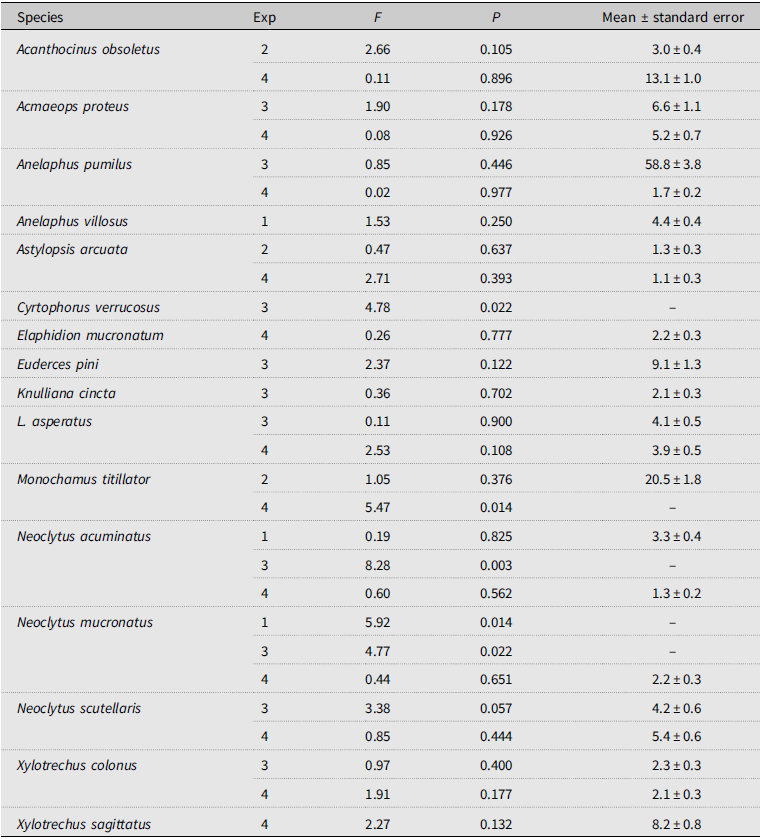
Sufficient numbers of captured beetles for 16 species of Cerambycidae (in at least one experiment) were obtained for statistical analyses (Table 2). The colour of multiple-funnel traps affected captures of four species, although effects were inconsistent between experiments for three species (Table 3). In experiment 3, catches of Cyrtophorus verrucosus (Olivier) and Neoclytus mucronatus in green traps were less than those in black and purple traps (Fig. 2A, E). Catches of Monochamus titillator in experiment 4, Neoclytus acuminatus in experiment 3, and Neoclytus mucronatus in experiment 1 were greater in black traps than in green traps (Fig. 2B, D). Trap colour had no effect on catches of Monochamus titillator in experiment 3, Neoclytus acuminatus in experiments 1 and 4, and Neoclytus mucronatus in experiment 4 (Table 3). Similarly, trap colour had no effect on catches of Acanthocinus obsoletus (Olivier), Acmaeops proteus (Kirby), Anelaphus pumilus, Anelaphus villosus (Fabricius), Elaphidion mucronatum (Say), Leptostylus asperatus (Haldeman), Neoclytus scutellaris (Olivier), Xylotrechus colonus (Fabricius), and Xylotrechus sagittatus (Germar) (Table 3).
Analysis of variance results for effects of trap colour on trap catches of longhorn beetles (Coleoptera: Cerambycidae) in experiments (Exp) 1–4, with mean ± standard error trap catches for those species unaffected by trap colour. df = 2,14 for experiments 1 and 2; df = 2,18 for experiments 3 and 4. Experiment details are provided in Table 1.

Mean (+ standard error) trap catches of the Cerambycidae A, Cyrtophorus verrucosus; B, Monochamus titillator; C, Neoclytus acuminatus; and D, E, Neoclytus mucronatus; and of the Curculionidae: F, Cnestus mutilates; G, Cossonus corticola; H, Dendroctonus terebrans; I, J, Dryoxylon onoharaense; K, Hylobius pales; L, Ips avulsus; M, Ips calligraphus; N, O, Ips grandicollis; P, Monarthrum mali; Q, R, Stenoscelis brevis; S, Xyleborinus saxesenii; and T, Xylosandrus crassiusculus in green, purple, and black multiple-funnel traps across experiments 1–4. Means for a species within an experiment followed by the same letter are not significantly different at P = 0.05 (Holm–Sidak test). Experiment details are provided in Table 1. Results of statistical analyses are presented in Tables 3 and 4.

Curculionidae
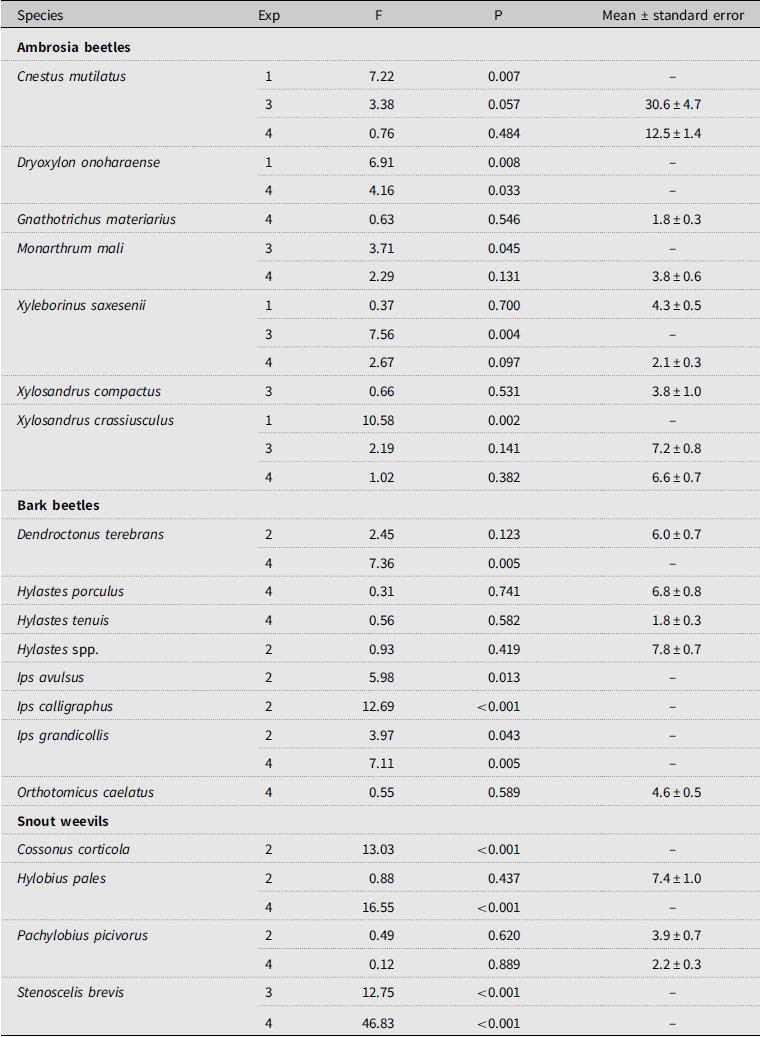
There were sufficient numbers (in at least one experiment) of 19 species of Curculionidae for analyses (Table 2). Trap colour affected catches of 12 species, although effects were inconsistent between experiments for five species (Table 4). Catches of Cnestus mutilatus in experiment 3 and Cossonus corticola Say in experiment 2 were greater in purple traps than in black traps (Fig. 2F, G); catches of Cossonus corticola were lower in green traps than in black and purple traps (Fig. 2G). Trap catches in purple and black traps were greater than those in green traps for the following species: Dendroctonus terebrans (Olivier) in experiment 4 (Fig. 2H); Dryoxylon onoharaense (Murayama) in experiments 1 and 4 (Fig. 2I, J); Ips avulsus and Ips calligraphus (Germar) in experiment 2 (Fig. 2L, M); Stenoscelis brevis (Boheman) in experiments 3 and 4 (Fig. 2Q, R); Xyleborinus saxesenii (Ratzeburg) in experiment 3 (Fig. 2S); and Xylosandrus crassiusculus in experiment 1 (Fig. 2T). In experiment 4, catches of Hylobius pales (Herbst) were greater in black traps than in green and purple traps (Fig. 2K). Trap catches in purple traps were greater than those in green traps for Ips grandicollis in experiments 2 and 4 (Fig. 2N, O) and for Monarthrum mali (Fitch) in experiment 3 (Fig. 2P).
Analysis of variance results for effects of trap colour on trap catches of ambrosia beetles, bark beetles, and snout weevils (Coleoptera: Curculionidae) in experiments (Exp) 1–4, with mean ± standard error trap catches for those species unaffected by trap colour. df = 2,14 for experiments 1 and 2; df = 2,18 for experiments 3 and 4. Experiment details are provided in Table 1.

In contrast, trap colour had no effect on catches of Dendroctonus terebrans and Hylobius pales in experiment 2, Monarthrum mali in experiment 4, Xyleborinus saxesenii in experiments 1 and 4, and Xylosandrus crassiusculus in experiments 3 and 4 (Table 4). Similarly, trap colour did not affect catches of the following species in any experiment: Gnathotrichus materiarius (Fitch), Hylastes porculus Eichhoff, Hylastes tenuis Eichhoff, and Orthotomicus caelatus (Eichhoff) (experiment 4); Hylastes species (experiment 2), Pachylobius picivorus (Germar) (experiments 2 and 4), and Xylosandrus compactus (Eichhoff) (experiment 3; Table 4).
Predators and miscellaneous species
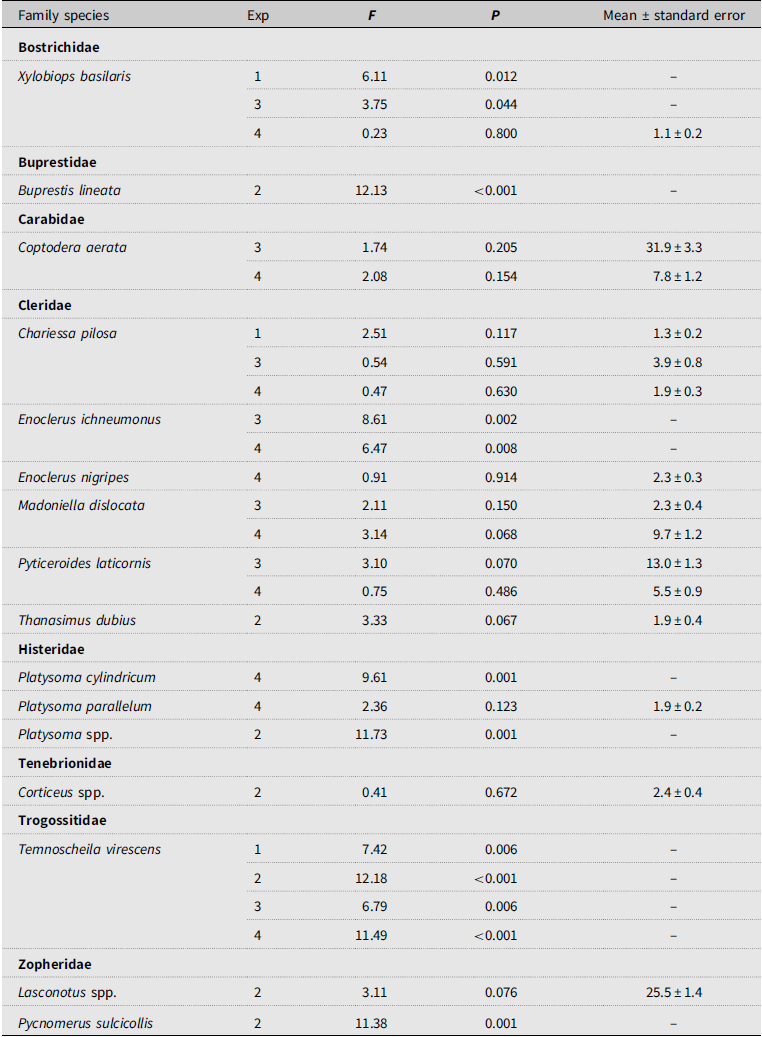
Trap colour affected catches of Xylobiops basilaris (Say) (Coleoptera: Bostrichidae) in two of three experiments (Table 5). In experiment 1, more beetles were caught in purple traps than in green or black traps (Fig. 3A). A similar pattern was noted for Xylobiops basilaris in experiment 3, although the Holm–Sidak test was unable to separate the means (Fig. 3B). In experiment 2, purple traps had greater numbers of Buprestis lineata Fabricius (Coleoptera: Buprestidae) than green or black traps did (Fig. 3C). Trap colour had no effect on catches of Coptodera aerata (Coleoptera: Carabidae) (Table 5).
Analysis of variance results for effects of trap colour on trap catches of predators and associated species (Coleoptera) in experiments (Exp) 1–4, with mean ± standard error trap catches for those species unaffected by trap colour. df = 2,14 for experiments 1 and 2; df = 2,18 for experiments 3 and 4. Experiment details are provided in Table 1.

Mean (+ standard error) trap catches of A, B, Xylobiops basilaris (Bostrichidae); C, Buprestis lineata (Buprestidae); D, E, Enoclerus ichneumonus (Cleridae); F–I, Temnoscheila virescens (Trogossitidae); J, Platysoma cylindricum; and K, Platysoma spp. (Histeridae); L, Namunaria guttulata; and M, Pycnomerus sulcicollis (Zopheridae) in green, purple, and black multiple-funnel traps across experiments 1–4. Means for a species within an experiment followed by the same letter are not significantly different at P = 0.05 (Holm–Sidak test). Treatment with an asterisk (*) had zero catches. Experiment details are provided in Table 1. Results of statistical analyses are presented in Table 5.

Only one species of Cleridae (Coleoptera) was affected by trap colour (Table 5). In experiment 3, catches of Enoclerus ichneumonus (Fabricius) were greater in green traps than in black traps, whereas catches in both green and purple traps exceeded those in black traps in experiment 4 (Fig. 3E). Trap colour had no effect on catches of the following species of Cleridae: Chariessa pilosa (Forster) (experiments 1, 3, and 4), Enoclerus nigripes (Say) (experiment 4), Madoniella dislocata (Say) (experiments 3 and 4), Thanasimus dubius (Fabricius) (experiment 2), and Pyticeroides laticornis (Say) (experiments 3 and 4).
Catches of Temnoscheila virescens were affected by trap colour in all four experiments (Table 5); black and purple traps caught more beetles than green traps (Fig. 3F–I). The same pattern was noted for Platysoma cylindricum (Paykull) (Coleoptera: Histeridae) in experiment 4 (Fig. 3J) and for Platysoma species in experiment 2 (Fig. 3K). In contrast, trap colour had no effect on catches of Platysoma parallelum (Say) (Coleoptera: Histeridae) in experiment 4. In experiment 2, catches of Corticeus species (Coleoptera: Tenebrionidae) and Lasconotus species (Coleoptera: Zopheridae) were unaffected by trap colour (Table 5).
As with Enoclerus ichneumonus in experiment 4, catches of Pycnomerus sulcicollis in experiment 2 were greater in green and purple traps than in black traps (Fig. 3M). A significant difference was observed in trap catches of Namunaria guttalata (LeConte) (Coleoptera: Zopheridae) between purple and black traps (t 7 = 4.07, P = 0.005), with catches greatest in purple traps (Fig. 3L). No beetles were captured in green traps.
Discussion
A critical issue in my experiments was that they were all conducted in forest understoreys where light intensity is expected to be lower than those found in forest canopies, forest margins, and open meadows and clearcuts. For many species of bark and woodboring beetles, the ability to detect silhouettes that resemble standing trees in the understorey seems to be an important behavioural attribute in finding host material for the development of offspring. In a trial testing traps in eight different colours, Strom and Goyer (Reference Strom and Goyer2001) found that traps displaying a dark-coloured silhouette caught more Dendroctonus frontalis Zimmermann (Coleoptera: Curculionidae) than light-coloured traps did. In Turkey, Akkuzu et al. (Reference Akkuzu, Şahin, Ugiş and Bal2021) found that catches of Ips sexdentatus (Boerner) (Coleoptera: Curculionidae) in baited traps were greater in black traps than in red, green, yellow, or white traps. In China, trap catches of Ips duplicatus (Sahlberg) (Coleoptera: Curculionidae) in baited traps were greater in black traps than in green traps (Chen et al. Reference Chen, Zhang, Wang, Liu, Zhou, Niu and Schlyter2009). Dubbel et al. (Reference Dubbel, Kerch, Sohrt and Mangold1985) found that catches of Ips typographus Linnaeus (Coleoptera: Curculionidae) and Trypodendron lineatum (Olivier) (Coleoptera: Curculionidae) were lower in white traps than in black, green, grey, and red–brown traps.
Similarly, I found that a number of bark and woodboring beetles preferred black or black and purple traps over green traps. In at least one experiment, black or purple and black traps caught more beetles than green traps did for four species of longhorn beetles (Fig. 2A–E), three species of bark beetles (Fig. 2H, L–O), four species of ambrosia beetles (Fig. 2I, J, P, S, T), and three species of snout weevils (Fig. 2G, K, Q, R). In experiment 4, the weevil Hylobius pales demonstrated a clear preference for black traps over both purple and green traps (Fig. 2K), consistent with results by Mizell and Tedders (Reference Mizell and Tedders1999).
However, trap catches for the majority of bark and woodboring beetles were not affected by trap colour. In at least one experiment, trap colour did not affect catches of 15 of 16 species of longhorn beetles, six of seven species of ambrosia beetles, five of eight species of bark beetles, and two of four species of snout weevils (Tables 3 and 4). In a shaded understorey, even green traps might present a silhouette to flying beetles for some species depending on their visual acuity. Alternatively, it is possible that some species may not be particularly influenced by vertical silhouettes. Many species of bark and woodboring beetles colonise downed trees and branches (United States Department of Agriculture 1985). In such cases, visual cues may be overshadowed by responses to semiochemicals, even for species that also colonise dead or dying standing trees.
Purple traps performed better than black traps for a few species of bark and woodboring beetles. Trap catches of Buprestis lineata were greater in purple traps than in green or black traps (Fig. 3C). These data are consistent with other species of Buprestidae (e.g., Francese et al. Reference Francese, Mastro, Oliver, Lance, Youssef and Lavallee2005; Petrice and Haack Reference Petrice and Haack2015; Imrei et al. Reference Imrei, Lohonyai, Csóka, Muskovits, Szanyi and Vétek2020; Perkovich et al. Reference Perkovich, Addesso, Basham, Fare, Youssef and Oliver2022). The reason for this preference is not clear but may relate to the iridescent purple colour associated with these species (Crook et al. Reference Crook, Francese, Zylstra, Fraser, Sawyer and Bartels2009). In the case of Buprestis lineata, the vivid purple colouration is particularly noticeable on the dorsum of the abdomen when the elytra and wings are extended (unpublished data). In the same experiment, the fungivore Namunaria guttulata, which is commonly found in fungal patches under the bark of trees (Evans Reference Evans2014), exhibited the same preference for purple traps (Fig. 3L).
Explanations for the preferences for purple traps exhibited by ambrosia beetle Cnestus mutilatus (Fig. 2F), snout weevil Cossonus corticola (Fig. 2G), and powder-post beetle Xylobiops basilaris (Fig. 3A, B) are unclear. Attraction of species such as Agrilus planipennis to green traps in the canopy likely reflects a preference for green foliage in the canopy (Crook et al. Reference Crook, Francese, Zylstra, Fraser, Sawyer and Bartels2009). Similarly, Cnestus mutilatus should have been attracted to green traps because, unlike other species of ambrosia beetles, it is more common in the canopy than in the understorey, colonising small branches in the canopy (Miller et al. Reference Miller, Crowe and Sweeney2020). The same should be true for species such as the cerambycids Monochamus titillator and Acanthocinus obsoletus, which feed as adults on needles and small branches (United States Department of Agriculture 1985) and are more common in the forest canopy (Miller et al. Reference Miller, Crowe and Sweeney2020). This could be an issue of habitat context, such as canopy compared to understorey or forest margin compared to areas within a forest.
As with bark and woodboring beetles, the majority of predators were either unaffected by trap colour (Table 5) or more attracted to black and purple traps than to green traps (Fig. 3F–K). Only two species appear to prefer green traps. In two experiments, catches of Enoclerus ichneumonus (Cleridae) were more abundant in green traps than in black traps (Fig. 3D, E). It is possible that the predator preys broadly on beetles or other insects associated with foliage. In one experiment, catches in purple traps were also greater than those in black traps (Fig. 3E), suggesting a possible association with flowers. In experiment 2, trap catches of an ironclad beetle, Pycnomerus sulcicollis, which is commonly found under the bark of dead trees (Evans Reference Evans2014), were greater in both green and purple traps than in black traps (Fig. 3M). The importance of green and purple colouration to Pycnomerus sulcicollis is unknown.
Clearly, we have insufficient information to properly interpret the results obtained in this study. Additional controlled experiments need to be conducted in the upper canopies of forests, along forest margins, and in open meadows and clearcuts. Explanations for variation within a species may relate to variation in semiochemical context, location within a stand, stands with different tree compositions, or the time of year the experiments were conducted. These were all uncontrolled factors in my experiments. For example, Agrilus planipennis are more attracted to green traps than to purple traps when they are baited with green-leaf volatiles and hung in the tree canopy, whereas purple traps are more attractive than green traps when they are hung near ground level and baited with bark volatiles (Crook and Mastro Reference Crook and Mastro2010; Francese et al. Reference Francese, Crook, Fraser, Lance, Sawyer and Mastro2010; Grant et al. Reference Grant, Ryall, Lyons and Abou-Zaid2010; Silk and Ryall Reference Silk and Ryall2015).
Among other issues, understanding the basis for any colour preferences by beetles requires a better understanding of their visual abilities, as Crook et al. (Reference Crook, Francese, Zylstra, Fraser, Sawyer and Bartels2009) determined for A. planipennis, relative to habitat use. In addition, reflectance spectra of beetles and their host plants need to be determined to better understand their behavioural responses to colour. The need for such studies is particularly important for understanding the behaviours of cerambycid and buprestid species that feed or mate on flowers or leaves and that may invade other countries (Linsley Reference Linsley1959; Hanks Reference Hanks1999; Monné et al. Reference Monné, Monné, Wang and Wang2017; Cavaletto et al. Reference Cavaletto, Faccoli, Marini, Spaethe, Magnami and Rassato2020, Reference Cavaletto, Faccoli, Marini, Spaethe, Giannone, Moino and Rassati2021).
Recent data from Europe provide support for additional trials to be conducted in North America with trap colours other than purple and green. In Italy, Cavaletto et al. (Reference Cavaletto, Faccoli, Marini, Spaethe, Magnami and Rassato2020) found that abundance and diversity of Buprestidae that visit flowers were highest in yellow, green, and red traps. Among Cerambycidae, diversity and abundance of Lepturinae were higher in yellow, green, and blue traps than in black traps, whereas diversity was highest in brown and red traps for Lamiinae and in yellow traps for Cerambycinae (Cavaletto et al. Reference Cavaletto, Faccoli, Marini, Spaethe, Giannone, Moino and Rassati2021). The association between colour preferences and flower-visiting behaviour seems particularly strong among both Buprestidae and Cerambycidae (Cavaletto et al. Reference Cavaletto, Faccoli, Marini, Spaethe, Magnami and Rassato2020, Reference Cavaletto, Faccoli, Marini, Spaethe, Giannone, Moino and Rassati2021).
In North America, several manufacturers supply black panel traps made of corrugated plastic. Sheets of corrugated plastic are inexpensive and available in various colours. They can be easily cut to size to replace the black panels on the commercial panel traps, allowing for a cost-effective method to broadly assess colours on the responses of Buprestidae and Cerambycidae to semiochemical-baited traps. Paints with specific spectral properties can also be applied to corrugated plastic (Cavaletto et al. Reference Cavaletto, Faccoli, Marini, Spaethe, Magnami and Rassato2020). However, it is critical that spectral reflectance patterns be documented for all of these experimental traps in order to properly compare results and to allow for replication by other researchers. Analyses should also consider the effects of trap lubricants such as fluon on spectral reflectance. For species that feed or mate on flowers, such trials should be conducted in forest canopies, along forest margins, and within open field or clearcuts. Any efforts to improve trapping methodologies will minimise economic impacts arising from invasions of nonnative species of bark and woodboring beetles in the future.
Acknowledgements
I thank Chris Crowe (United States Department of Agriculture, Forest Service) for field and laboratory assistance, Jon Sweeney (Natural Resources Canada, Canadian Forest Service) for providing hydroxyketone and hexanediol lures, and Richard Hoebeke (University of Georgia Collection of Arthropods) for verifications of beetle identifications. Jon Sweeney (Natural Resources Canada, Canadian Forest Service) and Kevin Dodds and Anna Conrad (United States Department of Agriculture, Forest Service) kindly reviewed the manuscript. The findings and conclusions in this paper are those of the author and should not be construed to represent any official United States Department of Agriculture or United States of America Government determination or policy. The use of trade or firm names in this publication is for reader information and does not imply endorsement by the United States Department of Agriculture of any product or service. This research was supported by the United States Department of Agriculture, Forest Service. The United States Department of Agriculture is an equal opportunity provider, employer, and lender.
Competing interests
The author declares no competing interests.