Introduction
Iran is a country vulnerable to natural disasters. A major earthquake hits the country approximately every 10 years killing thousands of people and causing widespread destruction.Reference Najafi, Ardalan, Akbarisari, Noorbala and Elmi 1 Tehran, the capital of the country, has not experienced any major earthquake in the past 150 years, while in its history, several massive earthquakes were recorded.Reference Pazouki, Pazouki and Entezari 2 The return period of earthquakes with the magnitude of 7.0 and higher has been estimated about 175 years for this city.Reference Berberian and Yeats 3 According to the studies, Tehran’s probable earthquake can lead to serious losses and damages. 4 Nevertheless, disaster preparedness in Tehran is low;Reference Louie, Earp and Collins 5 this, of course, is not the case merely in Tehran. Low levels of disaster preparedness also might be seen in some other disaster-prone cities around the world.Reference Ardalan, Mowafi and Malekafzali Ardakani 6 , Reference Ronan, Crellin, Johnston, Finnis, Paton and Becker 7
Generally, low disaster preparedness is an important public health problem in Iran. In a study by the Ministry of Health (Tehran, Iran) in 2014, the rate of household disaster preparedness was reported to be 9.3%.Reference Sadi, Finkelman and Rosenberg 8 It is logical to link disaster preparedness rates with factors associated with disaster preparedness behaviors (DPBs). A cross-sectional study conducted in Tehran showed that 90% of Tehran inhabitants have low DPB scores. According to this survey, only 3.6% of households living in Tehran completely engage in DPB. In this study, DPB was defined as activities that people can engage in to protect their health against disasters.Reference Eto, Ishikawa, Sun Kwang and Nabekura 9
Disaster preparedness behavior consists of numerous actions, and there have been some studies on this complex phenomenon, but the processes involved in the formation of DPB are not understood clearly. According to these studies, factors influencing DPB include: risk perception;Reference Najafi, Ardalan, Akbarisari, Noorbala and Jabbari 10 - Reference Miceli, Sotgiu and Settanni 13 preparedness perception;Reference Paton 14 - Reference Mulilis and Duval 16 coping style;Reference Paton 14 , Reference Mulilis and Lippa 17 - Reference Lindell and Prater 19 self-efficacy;Reference Paton 14 , Reference Mulilis and Lippa 17 , Reference Paton, Millar and Johnston 20 , Reference McClure, Allen and Walkey 21 collective efficacy;Reference McClure, Walkey and Allen 22 societal norms;Reference Paton, Bajek, Okada and McIvor 23 social trust;Reference Solberg, Rossetto and Joffe 24 sense of community;Reference Paton 25 community participation and empowerment;Reference Paton, Smith and Johnston 26 , Reference Paton 27 anxiety;Reference Ardalan, Mowafi and Malekafzali Ardakani 6 , Reference Miceli, Sotgiu and Settanni 13 , Reference Paton, McClure and Bürgelt 28 optimistic and normalization biases;Reference McClure 29 , Reference Mileti and O’Brien 30 locus of control;Reference Jackson 12 , Reference McClure, Allen and Walkey 21 , Reference Paton, McClure and Bürgelt 28 fatalism;Reference Jackson 12 , Reference Paton, Millar and Johnston 20 , Reference Paton, McClure and Bürgelt 28 , Reference Spittal, McClure, Siegert and Walkey 31 , Reference Dixey 32 responsibility towards others;Reference Flynn, Slovic, Mertz and Carlisle 33 perceived responsibility;Reference Armaş and Avram 11 , Reference Lindell and Whitney 15 available resources;Reference Paton, Smith and Johnston 26 , Reference McIvor and Paton 34 critical awareness;Reference Miceli, Sotgiu and Settanni 13 , Reference Flynn, Slovic, Mertz and Carlisle 33 , Reference Mileti and Darlington 35 and demographics.Reference Eto, Ishikawa, Sun Kwang and Nabekura 9
It is known that increasing DPB, like other behavior change interventions, is a process and individuals are at different levels of readiness to change.Reference Lindell and Prater 36 In addition, experience has revealed that behavioral interventions based on an understanding of psychosocial factors underlying people’s intentions are more likely to be effective.Reference Prochaska, DiClemente and Norcross 37 In other words, a study identifying the factors related to DPB among representatives of the priority group is an essential prerequisite for effective interventions. For a better understanding, a theory is needed to guide researchers. There are some theories and models which can help to find out the factors that play an important role in establishing and strengthening DPB; these theories include: the Theory of Planned Behavior (TPB);Reference Glanz and Bishop 38 - Reference Ajzen 41 Protection Motivation Theory;Reference Mulilis and Duval 16 , Reference Ajzen 42 Person Relative to Event Theory;Reference Lindell and Whitney 15 , Reference Mulilis and Lippa 17 , Reference Floyd, Prentice‐Dunn and Rogers 43 - Reference Mulilis and Duval 45 Protective Action Decision Model;Reference Mulilis and Duval 46 , Reference Lindell and Perry 47 and Social-Cognitive Preparation Model.Reference Miceli, Sotgiu and Settanni 13 Among these theories, the TPB is a belief-based theory, and since the aim was to find the root of the DPB, this theory was employed as the theoretical framework of the present study. So far, TPB has been widely used as a tool to help the understanding of underlying beliefs of a variety of behaviors,Reference Lindell and Perry 48 and therefore can provide a foundation for intervention design to increase DPB.
Ajzen, the author of the TPB, provides a brief description:
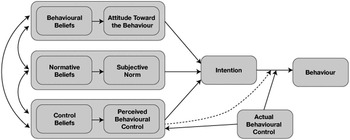
“According to the theory, human behavior is guided by three kinds of considerations: beliefs about the likely outcomes of the behavior and the evaluations of these outcomes (behavioral beliefs), beliefs about the normative expectations of others and motivation to comply with these expectations (normative beliefs), and beliefs about the presence of factors that may facilitate or impede performance of the behavior and the perceived power of these factors (control beliefs). In their respective aggregates, behavioral beliefs produce a favorable or unfavorable attitude toward the behavior; normative beliefs result in perceived social pressure or subjective norm; and control beliefs give rise to perceived behavioral control. In combination, attitude toward the behavior, subjective norm, and perception of behavioral control lead to the formation of a behavioral intention. As a general rule, the more favorable the attitude and subjective norm, and the greater the perceived control, the stronger should be the person’s intention to perform the behavior in question. Finally, given a sufficient degree of actual control over the behavior, people are expected to carry out their intentions when the opportunity arises.”Reference Ajzen 49
To put it another way, TPB suggests that the proximal determinants of volitional behavior are a person’s intention to engage in the behavior and a sufficient degree of actual control over the behavior. The intention is, in turn, determined by a combination of attitude towards the behavior, subjective norm, and perceived behavioral control. Lastly, attitude towards behavior, subjective norm, and perceived behavioral control are determined by sets of salient behavioral, normative, and control beliefs.Reference Ajzen 40 , Reference Rallis, Tsirigotis and Arvaniti 50 , Reference Ajzen 51 The TPB is schematically illustrated in Figure 1.
Theory of Planned Behavior.Reference Ajzen 40

According to TPB, only salient beliefs act as psychosocial determinants. As a result, an important step in the use of TPB is a salient belief elicitation study of the target behavior with members of the population of interest.Reference Ajzen and Fishbein 52 The purpose of elicitation research is to determine salient consequences, referents, and circumstances that shape the belief structure which underlies the intention to perform the target behavior. To determine the salient beliefs, the authors of TPB recommend that researchers should: (1) perform elicitation research with representatives of the priority group by means of open-ended questions, so as to identify salient consequences, referents, and circumstances; (2) conduct a content analysis to rank-order the beliefs; and (3) choose five to 10 most frequently mentioned items as the salient set.Reference Ajzen 40 , Reference Ajzen 51
While the TPB has been supported in many contexts, including health behaviors, it requires a salient belief elicitation; further attention to the belief elicitation step is reasonable. Although there is extensive evidence that the TPB can be used to understand a range of behaviors, there is less evidence as to the psychosocial factors underlying DPB among people.
Moreover, while there are some studies conducted in various Iranian communities to explain psychological underlying factors influencing health-related behaviors and actions,Reference Hagger, Chatzisarantis and Biddle 53 - Reference Aghamolaei, Tavafian and Madani 58 to the authors’ knowledge, no study has been conducted so far in Tehran to elicit salient beliefs underlying DPB.
In order to apply TPB to understand the salient beliefs underlying DPB, qualitative research is a necessary first step. This study aimed to identify the salient consequences of the behavior, the salient referents or social groups, and the salient circumstances of engaging in DPB as perceived by people living in Tehran. The results of this elicitation method can propose the types of interventions and also provide input to the design of close-ended questions for larger scale, theory-based, quantitative studies.
Materials and Methods
A qualitative elicitation study was conducted in 2015 to elicit salient beliefs that are shared by Tehran inhabitants about DPB. Data were collected using an open-ended questionnaire and a follow-up interview.
Participants
Tehran consists of 22 districts and 134 sub-districts. One hundred thirty-two households of different socioeconomic backgrounds were selected from 22 districts of the city. Firstly, three sub-districts were selected randomly in each district. Secondly, two households were chosen following a purposive sampling plan within each selected sub-district.
Finally, heads of households were selected as respondents, since they were considered to be the main decision makers. More specifically, the research team contacted the sub-districts council to support this study. Members working in the respective sub-districts council were used as key informants to select households in each socioeconomic group. The requirement for selecting the participating households was that they had stayed in Tehran for at least 10 years.
Instrument
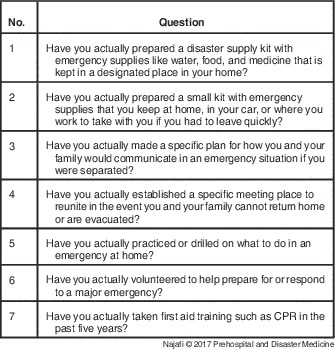
According to Ajzen,Reference Ajzen 39 considering DPB as a category of behaviors, not a single action, was studied. The behavioral elements of the public readiness index (PRI) were used for defining and assessing the DPB (Table 1). The PRI measures how prepared individuals and families are for an emergency and provides a practical “score” that measures their preparedness. The PRI is scored on a scale from zero to 10 based on the answers given to 10 questions designed to evaluate key emergency preparedness knowledge (three questions) and behavior (seven questions) elements.Reference Ali, Haidar, Ali and Maryam 59 Since the aim was to study the DPB of participants, the authors used only the behavioral elements of the PRI (which is called DPB index in this study) as they examined only emergency preparedness behavior and were scored on a scale from zero to seven (Table 1).
DPB Index: Behavioral Elements of PRI

Abbreviations: CPR, cardiopulmonary resuscitation; DPB, disaster preparedness behavior; PRI, public readiness index.
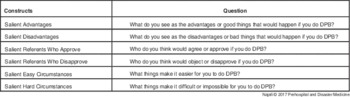
The validity and reliability of PRI have been shown in previous studies.Reference Yano, Ueda and Tellei 60 The semi-structured, self-completion questionnaire began with a cover sheet that explained DPB and the purpose of the study. Then came close-ended questions that assessed demographics and DPB index. At last, several open-ended questions (Table 2) were used to discover salient consequences, social referents, and circumstances of engaging in DPB.
Open-Ended Questions

Abbreviation: DPB, disaster preparedness behavior.
Procedure
Trained interviewers administered the self-completed questionnaire. They briefly explained to the participants the purpose and value of the study and gave instructions for completing the questionnaire. They emphasized that data collection was anonymous, that there were no right or wrong answers, and that participation was completely voluntary. For illiterates, a questionnaire-guided interview was used by the interviewers. The semi-structured questionnaire was completed within 15 minutes. Verbal probing was used with all the participants to learn how they understood the questions. None of the other household members were present during data collection.
The study was approved by the Research Ethics Committee of Tehran University of Medical Sciences (Tehran, Iran). Written consent was received from the participants and no identifying data were collected.
Content Analysis
As mentioned above, according to the authors of TPB,Reference Ajzen 40 , Reference Ajzen 51 a content analysis was conducted to rank-order the beliefs. Content analysis involves establishing categories and then counting the number of instances in which they are used in a text to determine the frequencies of the occurrence of particular categories. 61 The aim of the content analysis was to identify the categories of positive and negative outcomes or consequences of doing DPB, persons or social groups who serve as social referents, as well as easy and difficult conditions of performing DPB. Content analysis was conducted independently by two researchers who were familiar with the TPB and who could extract theoretical constructs from the responses.
The responses to open-ended questions were entered verbatim into a word processing file. Similar responses were grouped together to form the main categories of responses for each question. These groups of responses were reviewed independently by two researchers to create a final set of coding categories and to phrase the categories in terms of TPB constructs. Finally, the data were coded into these categories and entered into an SPSS (IBM Corp.; Armonk, New York USA) file.
Descriptive Analysis
The file of close-ended data was integrated with that of open-ended data. Participants who showed that they had at least a DPB score equal to five or more were classified as doers; those who reported a DPB score of four or fewer were classified as non-doers. Chi square analyses were used to compare the percentage of each category of salient consequences, social referents, and circumstances separately among doers and non-doers. No significant differences were found between doers and non-doers. Hence, the results are presented as the percent of each category of responses over the entire sample of participants.
Results
Description of Participants
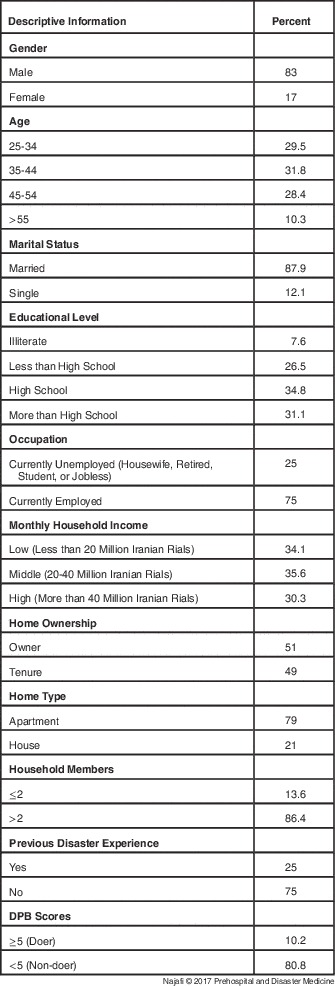
Table 3 shows the characteristics of the study participants. In this study, 83% of the participants were male. The mean age of all the participants was 44.34 years (SD=12.41) and most of them (87.9%) were married. A total of 65.9% of the participants had a high school education or more. Twenty-five percent were currently unemployed (including housewives, students, retired, and jobless). Most of the participants (35.6%) reported that they were middle income earners. Fifty-one percent were homeowners with most of them living in apartments (79%). All of them were the heads of households and 86.4% of their households had more than two members. Twenty-five percent of the respondents had experienced at least one disaster in the past 20 years. Only 10.2% of the participants had a DPB score of five or more.
Description of the Study Sample from Close-Ended Questions

Abbreviation: DPB, disaster preparedness behavior.
Salient Beliefs
Based on TPB, the authors wanted to explore the salient behavioral, normative, and control beliefs influencing DPB. So, as mentioned above, participants were asked to respond to open-ended questions designed to elicit and rank-order positive/negative consequences, approving/disapproving social referents, and easy/difficult circumstances in doing DPB. The most frequently mentioned items were selected as the salient set, as recommended by Ajzen and Fishbein.Reference Ajzen 51
Salient Consequences
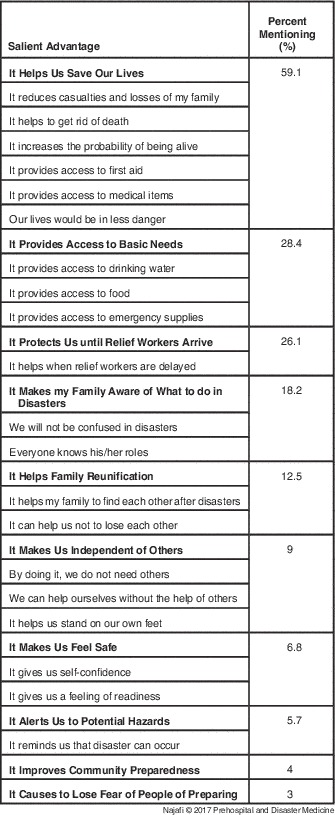
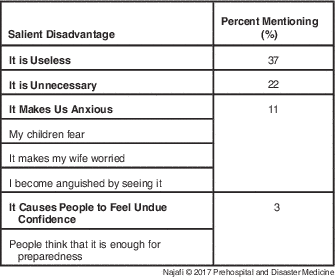
Tables 4 and 5 present the salient consequences of DPB perceived by the participants. Comparing these tables revealed that these participants saw more positive outcomes than negative ones. The most frequently mentioned advantage (that is, “it helps us to save our lives”) was mentioned by over one-half (59.1%) of the participants. Many of the perceived consequences involved health outcomes. In fact, the three most frequent advantages of DPB (that is, “it helps us to save our lives,” “it provides basic needs,” and “it protects us until relief workers arrive”) can be viewed as health outcomes. However, the participants also mentioned outcomes beyond the health consequences (eg, “it makes my family aware of what to do in disasters,” “it helps family reunification,” and “it makes us independent of others”).
Salient Advantages of DPB

Abbreviation: DPB, disaster preparedness behavior.
Salient Disadvantages of DPB

Abbreviation: DPB, disaster preparedness behavior.
The most frequently mentioned disadvantage, “DPB is useless,” was mentioned by 37% of the participants. In addition, 22% of the participants specifically mentioned that DPB “is unnecessary” while 11% of the participants stated that DPB “makes us anxious.”
Salient Referents
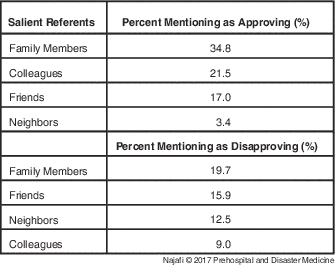
Table 6 shows the persons and groups mentioned when these participants were asked who approved and disapproved of their engaging in DPB. Most of the interviewees (69.1%) did not know about the ideas of their family and friends regarding DPB. It seemed that it was not considered so important to them that they ask about it.
Salient Social Referents for DPB

Abbreviation: DPB, disaster preparedness behavior.
The main salient referents for DPB were family members, including spouses, children, mothers, and fathers. Colleagues and friends also were mentioned by these participants. Neighbors were not mentioned very frequently. Family members were the most frequently mentioned approving group and disapproving group, and they were mentioned more frequently as approving (34.8%) than as disapproving (19.7%).
Salient Circumstances
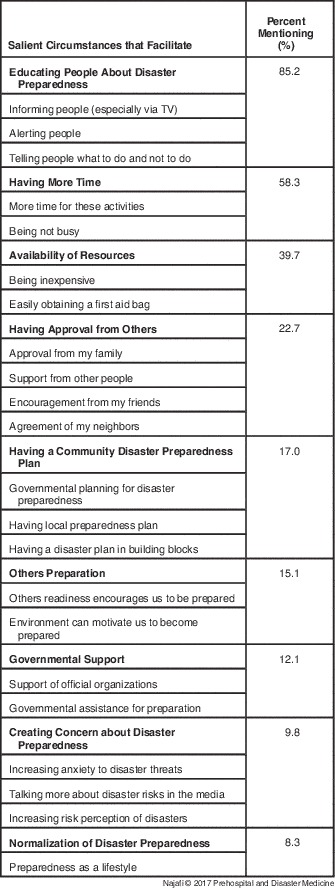
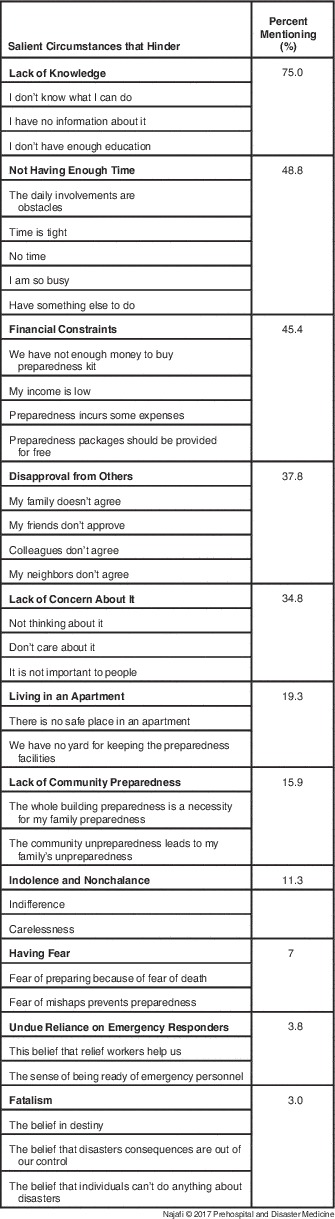
Tables 7 and 8 present the circumstances which participants believed made DPB easier and more difficult, respectively. In comparing the two tables, it becomes apparent that many of the circumstances (eg, knowledge, time, and financial issue) were perceived both as circumstances that make DPB easy and as circumstances that make it difficult.
Salient Circumstances Facilitating DPB

Abbreviation: DPB, disaster preparedness behavior.
Salient Circumstances Hindering DPB

Abbreviation: DPB, disaster preparedness behavior.
The most frequently reported facilitator of DPB, “educating people about disaster preparedness,” was mentioned by 85.2% of the participants. The most frequently mentioned barrier, “lack of knowledge,” was mentioned by 75% of the participants. Additionally, “time” was the second most frequently mentioned circumstance; 58.3% of the participants mentioned “having more time” as a facilitator and 48.8% of the participants mentioned “not having enough time” as a barrier. These data also suggest that the “availability of financial resources,” “approval from others,” and “having concern” operate as facilitating and hindering circumstances.
Discussion
While a number of the salient beliefs underlying DPB identified among Tehran inhabitants seem to be similar to those found with people in some other countries,Reference Marks and Yardley 62 , 63 there are some clear differences. The DPB advantages of feeling safe, providing basic needs, and being helpful in disasters were perceived by the people in other countries and Tehran. Similarly, the disadvantages of being useless and being unnecessary were identified in common.Reference Homish, Frazer, McCartan and Billittier 64
In this study, like the studies by the Federal Emergency Management Agency (FEMA; Washington, DC USA),Reference Marks and Yardley 62 people mentioned lack of concern about disaster preparedness, lack of time, and lack of information as barriers. However, several beliefs about the relationship between DPB and “preparedness anxiety” seemed to be unique to this sample of Tehran inhabitants. More specifically, “losing fear of people of preparing” was mentioned as advantages; “it makes us anxious” was mentioned as a disadvantage; and “normalization of disaster preparedness” and “having fear” were mentioned as easy and difficult circumstances of DPB. In the previous studies, the source of anxiety was the hazard itself, not the hazard preparedness.Reference Miceli, Sotgiu and Settanni 13 , Reference Becker, Paton, Johnston and Ronan 65 It is unclear why there is such a unique belief among Tehran inhabitants. Further studies are required to understand the “whys” behind it; however, these qualitative findings imply that some of the underlying beliefs found in other communities might not be applicable for designing interventions to encourage Tehran inhabitants to engage in DPB.
“[Disaster preparedness behavior] is useless” is similar to the belief that “preparedness will not make a difference to an outcome” in the study by Becker and his colleagues.Reference Homish, Frazer, McCartan and Billittier 64 This was a discouraged preparedness belief and the underlying reasons for it should be investigated further in light of exploratory research. The second belief that discouraged DPB was “preparing is unnecessary.” Although this needs further study, the uncertainty around the nature of disasters and their probable impacts might underpin this belief.
In terms of salient social referents, most participants said that they did not know if others approved or disapproved DPB. Lack of information about the views of others shows the absence of any talk about preparedness in the home and outdoors. “Not talking” about DPB could be considered as “indifference,” which means that the person does not care about DPB. This can be related to the technical term “critical awareness,“Reference Paton, Burgelt and Prior 66 which is identified as an important precursor of community members responding to adverse circumstances.Reference Kloos, Hill, Thomas, Wandersman and Elias 67 This variable refers to the extent to which people think and talk about a specific hazard within their environment.Reference Miceli, Sotgiu and Settanni 13 People may not be motivated to prepare if they do not perceive DPB as a critical or salient issue within their community. Nevertheless, the approval of family members was important for Tehran inhabitants. It emphasizes the main role of family members in DPB.
Although more accurate quantitative research with larger samples is necessary to explore these beliefs, these qualitative findings, as stated above, suggest that some of the salient beliefs (eg, “DPB makes us anxious”) underlying DPB found in Tehran inhabitants might be different from the beliefs of other populations. This confirms the recommendation to conduct elicitation studies to identify the salient consequences, referents, and circumstances of DPB with the specific priority group of interest as a first step in designing interventions. The findings of elicitation studies are essential to designing close-ended items for theory-based instruments to be used in larger scale, quantitative research to discover these salient beliefs.
Following the suggestions of the TPB,Reference Ajzen 40 , Reference Ajzen 51 the salient consequences, referents, and circumstances presented in Tables 4 through 8 can be used to make measures of behavioral, normative, and control beliefs. For instance, two close-ended items can be created for the salient consequences presented in Table 5: one item would assess the strength of the participant’s belief (that is, the likelihood that DPB would lead to the consequence); the other would assess the consequence (that is, the value each outcome was perceived to have for the individual). For the consequence, “DPB makes us anxious,” the two items in a self-completion format would be:
-
1. DPB Makes Us Anxious: with Unlikely being 1 and 7 being Likely (this item assesses the strength of behavioral belief); and
-
2. Making Us Anxious is: with Extremely Undesirable being -3 and Extremely Desirable being +3 (this item assesses outcome evaluation).
Moreover, the results of the qualitative study can propose implications for interventions to increase DPB among Tehran inhabitants and to offer program planners terms and words in the language of the population of interest to apply in these interventions. Once more, while there is a need to confirm them by a quantitative study with a larger sample, three related implications might be explored.
First, according to this study, these Tehran inhabitants perceived “not having enough time” and “lack of knowledge” as barriers to doing DPB. In other words, Tehran inhabitants, like the people from some other countries,Reference Dalton, Elias and Wandersman 68 considered “lack of time” as a barrier to DPB. Lack of time for a particular thing usually means that thing is not of priority concern. This might be explained by the poor risk perception and lack of knowledge regarding the DPB benefits. Previous studies, including a study conducted in Tehran,Reference Louie, Earp and Collins 5 showed that those with a greater perception of risk were more prepared. “Indolence and nonchalance” might be associated with the poor perception of risk. On the other hand, this belief may show the role of personality characteristics in DPB. More research has to be conducted on this topic.
In previous studies in Tehran, public education, especially the role of television in informing, was highlighted. 69 This emphasis indicates that the people believed that their lack of DPB is a result of their lack of knowledge. This belief also has been considered by some people from other countries.Reference Jahangiri, Izadkhah, Montazeri and Hosseini 70 Although this belief may be true, it can interpret how people justify themselves for not engaging in DPB.Reference Miceli, Sotgiu and Settanni 13
Some people perceived other benefits of engaging in DPB to include being independent in disasters, feeling safe, and alerting to potential hazards. To be effective for Tehran inhabitants, an intervention encouraging DPB might need to address the relationship between DPB and these benefits.
Second, the composition of social referents for Tehran inhabitants is relatively simple. Family members are the main sources of approval and disapproval for engaging in DPB. To be successful, disaster health promotion programs that help Tehran inhabitants increase their DPB will likely need to deal with the perceived social pressure from family members. Colleagues and friends also are important as sources of approval and disapproval. Workplace and home are the major social environments for the Tehran inhabitants. Hence, these data suggest that interventions to encourage DPB should engage the family as well as the workplace.
Third, these findings suggest that interventions address the peoples’ environment. Clearly, the factors of “not having enough time” and “financial constraints” are factors that are not under the control of most Tehran inhabitants. Although education and communication with peoples will be essential components of interventions encouraging DPB, to be effective, it is probable that these interventions will need to deal with the issue of DPB not just as individual factors, but also as social and environmental factors. Further, given the role of family members and colleagues as sources of approval, it will be important to find out the views of these groups when it comes to DPB. Finally, the findings on “others preparedness” perceived by these Tehran inhabitants showed that community preparedness and concerns about safety in the neighborhood were associated with DPB. Whatever approach is taken to increase DPB, policy makers need to be explored to build supportive community environment. Therefore, a model of community disaster health promoting could be a good approach to promote DPB.
One important result emerging from the analysis was that no significant differences were found between the behavioral, normative, and control beliefs in DPB doers and non-doers. This may suggest that TPB alone does not completely explain the variation of DPB. This should be examined in detail in larger studies.
Limitations
The study had limitations. It was qualitative research that was intended to provide information useful for a more accurate and larger scale quantitative study. Thus, the data were responses to open-ended questions and the sample size was small and based on a purposive sample of 22 districts in Tehran. It examined the perceptions of DPB held by only the heads of households. Different results might be obtained if other members of the family are involved in the study. Therefore, the findings from this study were more suggestive than affirmative.
Conclusion
The findings of this study suggest that interventions to encourage Tehran inhabitants to engage in DPB should attend to the perceived consequences of DPB on health and other factors beyond health; barriers of not having enough knowledge and time perceived to impede DPB; and social approval. The results also suggest that the perceptions of Tehran inhabitants concerning the relationship between their DPB and social environment are that there might be more important factors underlying their decisions to engage in DPB than their beliefs about the other benefits. Programs to increase DPB should concentrate on the social and environmental factors underlying these perceptions with the goal of strengthening the engagement of people in the DPB and improving educational potentials. Quantitative studies with a larger and representative sample, and with close-ended items based on the qualitative study, are needed to more completely understand the decision of Tehran’s inhabitants to engage in DPB. In addition, given the role of the family as a main social referent and the head of household’s perception of the association between DPB and the environment, research is needed to know the views of family members, managers of buildings, and community administrators.