Introduction
The analysis of heart rate variability (HRV), i.e. the variation in the cardiac interbeat interval over time, has become a useful tool for the assessment of autonomic neurocardiac function in various psychiatric disorders and in patients receiving psychotropic medications (1–6). It has been reported that schizophrenic patients treated with antipsychotic drugs show reduced HRV measures (1,7–9) and these results have been primarily interpreted as being a consequence of the effects of antipsychotics on the sympathetic and parasympathetic branches of the autonomic nervous system, such as the anticholinergic effects of antipsychotics. However, there are a number of reports showing autonomic dysfunction in drug-naÏve schizophrenic patients (Reference Zahn10,Reference Malaspina, Dalack and Leitman11). In addition, previous studies indicated that psychotic states suppress the cardiac autonomic function (Reference Toichi, Kubota and Murai12). These suggest a significant deleterious effect of psychotic symptoms on vagal modulation, which may be associated with the increased cardiac morbidity and mortality observed in schizophrenic patients (Reference Bär, Letzsch, Jochum, Wagner, Greiner and Sauer4).
Until now, the relationship between HRV parameters and disease severity in schizophrenic subjects has not yet been sufficiently investigated (Reference Hempel, Tulen, van Beveren, Röder and Hengeveld8). Moreover, it is largely unknown whether specific symptom clusters are associated with HRV variables. If the HRV parameters, which have been developed to quantify hidden fluctuations in sinus rhythm, are directly associated with the severity of specific psychotic symptoms, they will provide valuable information in assessing the neuroautonomic dysfunction in schizophrenia. Therefore, the purpose of this study was to investigate the relationship between HRV parameters and the severity of psychotic symptoms in patients with schizophrenia. In particular, we sought to identify the neuroautonomic correlates of symptoms in schizophrenia using the five-symptom factor model. An ideal approach would be to explore the association in drug-naÏve or drug-free patients; however, this is seldom feasible in routine clinical practice. Hence, we evaluated the relationship in patients receiving low-dose risperidone as monotherapy, which has been reported to have no anticholinergic activity and to have negligible effects on autonomic cardiac function (Reference Hempel, Tulen, van Beveren, Röder and Hengeveld8,Reference Silke, Campbell and King13).
Materials and methods
Subjects
The study protocol was approved by the local Ethical Committee, and all procedures used in the study were conducted in accordance with International Ethical Standards, Declaration of Helsinki (14). Twenty-one schizophrenic patients (11 men and 10 women) treated with risperidone and 21 matched normal control subjects were evaluated in this cross-sectional study. Informed consent was obtained from all subjects after a full explanation of the study procedure.
The patients were diagnosed according to the Diagnostic and Statistical Manual of Mental Disorders, 4th edition(15). None of the patients had suffered either from any diseases known to affect the autonomic cardiac function, such as cardiovascular, neurological or endocrinological diseases, or from drug dependence. The patients had a mean age of 33.0 ± 11.5 years and a mean duration of illness of 6.7 ± 9.6 years. All patients had been treated with a constant dose of risperidone as monotherapy for at least 2 weeks. The mean daily dose of risperidone was 3.4 ± 1.8 mg. None of the patients had received concomitant medications such as anticholinergics. Control subjects were screened through a complete medical and psychiatric examination and none had a history of any disease or medication that might have affected the autonomic nervous system. There were no differences between the patient and control groups with regard to age (mean ± SD years : 33.0 ± 11.5vs. 31.5 ± 9.2, t = 0.49, p = 0.63) or gender distribution (male %: 52.4 vs. 52.4).
Evaluation of schizophrenic symptoms
In the patient group, the severity of schizophrenic symptoms was assessed using the Positive and Negative Syndrome Scale (PANSS) (Reference Kay, Fiszbein and Opler16). A five-factor model of the PANSS was used based on evidence from factor analysis studies (Reference Bell, Lysaker, Beam-Goulet, Milstein and Lindenmayer17,Reference Whitehorn, Brown, Richard, Rui and Kopala18). The factors were positive, negative, cognitive/disorganisation, depression/anxiety and excitement. The mean total PANSS score of the patients was 79.0 ± 17.8.
Assessment of HRV
To exclude the influence of diurnal variations, the HRV measurements were begun between 10:00 a.m. and 11:00 a.m. (Reference Agelink, Majewski and Wurthmann1). All subjects were instructed to avoid coffee and nicotine for at least 1 h prior to the assessment of their autonomic function. After each subject had been allowed to adapt to the experimental conditions for approximately 10 min, a 5-min single channel (3-lead) electrocardiogram (ECG) recording was performed in the seated position at complete rest using the HRV Analyzer (SA-3000P) from the Medi-core Co., Ltd. (Seoul, Korea). The ECG signal was amplified and was digitised and the RR interval time series was generated using the automatic scheme in order to detect the R peak in the ECG using previously proposed methods (Reference Korpelainen, Sotaniemi, Huikuri and Myllylä19,Reference Haapaniemi, Pursiainen, Korpelainen, Huikuri, Sotaniemi and Myllylä20).
In the linear analysis of HRV, the standard deviation of all RR intervals (SDNN) and the square root of the mean squared differences of successive normal sinus intervals (RMSSD) were computed, according to standardised procedures (Reference Agelink, Majewski and Wurthmann1,Reference Haapaniemi, Pursiainen, Korpelainen, Huikuri, Sotaniemi and Myllylä20,21). For the frequency domain analysis, a spectral analysis was carried out using fast Fourier transformation and the low-frequency (LF: 0.04–0.15 Hz)/high-frequency (HF: 0.15–0.4 Hz) ratio was calculated to assess the sympathovagal balance, as previously proposed (21). For nonlinear complexity measure, the approximate entropy (ApEn) was calculated (22–26). The ApEn is a parameter developed to quantify the degree of regularity versus the unpredictability in a higher dimensional attractor reconstructed from a time series, such as the instantaneous heart rate time series. It was calculated using the method proposed by Pincus (Reference Pincus22). The ApEn measures the logarithmic likelihood that runs of patterns that are close to each other will remain close in the next incremental comparisons (Reference Ansakorpi, Korpelainen, Huikuri, Tolonen, Myllylä and Isojärvi27). It is closely related to the HF power, which mainly reflects respiratory sinus arrhythmia (Reference Yeragani, Sobolewski, Kay, Jampala and Igel23,Reference Yeragani, Sobolewski, Jampala, Kay, Yeragani and Igel24).
Statistical analysis
For each HRV variable, two-way analysis of variance (ANOVA) was performed to determine the main effects of and the interactions between group and gender. The correlations between the HRV measures and the severity of symptoms in the patient group were assessed using partial correlation analyses controlling for the dose of risperidone. The level of statistical significance was defined as p < 0.05 (two tailed). All statistical analyses were performed using SPSS 17.0 for windows (SPSS, Chicago, IL, USA).
Results
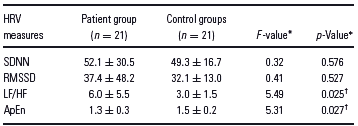
As shown in Table 1, significant main effects for group were found in LF/HF ratio (F = 5.49,p = 0.025) and ApEn (F = 5.31,p = 0.027). Subsequent one-way ANOVA showed that the value of the LF/HF ratio for the patient group was significantly higher than that for the control group (F = 5.67,p = 0.022), whereas the value of the ApEn for the patient group was significantly lower than that for the control group (F = 6.06,p = 0.018).
Main effects for group in HRV parameters
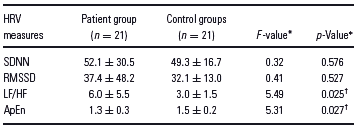
Values are presented as mean ± SD.
* F- and p-values for the main effects of the group in the two-way ANOVA between group and gender.
† p < 0.05.
There were no significant main effects for gender (SDNN: F = 0.07, p = 0.799; RMSSD:F = 0.43, p = 0.515; LF/HF ratio: F = 3.64, p = 0.064; Ap En:F = 0.02, p = 0.879) or interaction effects (SDNN: F = 2.57, p = 0.118; RMSSD: F = 2.05, p = 0.161; LF/HF: F = 1.72, p = 0.198; ApEn: F = 0.69,p = 0.410).
With regard to the correlations between the schizophrenic symptoms and the HRV parameters, the PANSS total score had significant negative correlations with SDNN (r = −0.63,p < 0.01) and RMSSD (r = −0.55,p = 0.01) (Table 2). With respect to the PANSS factors, the score of the PANSS cognitive/disorganisation factor had significant negative correlations with SDNN (r = −0.60,p = 0.01) and RMSSD (r = −0.55,p = 0.02) (Table 2).
Correlations between schizophrenic symptoms and HRV parameters

The p-values are presented in parentheses.
* p < 0.05.
** p < 0.01.
Age was not significantly correlated with any of the HRV measures (SDNN:r = −0.23,p = 0.16; RMSSD: r = −0.18, p = 0.27; LF/HF ratio: r = −0.23,p = 0.16;ApEn : r = − 0.15,p = 0.34). However, considering the potential effects of age on HRV parameters, the results of the correlation analyses were further confirmed after controlling for age. The correlations between the HRV parameters and PANSS cognitive/disorganisation factor remained significant even after controlling for age (SDNN: r = −0.53, p < 0.01; RMSSD : r = −0.39, p = 0.04). The PANSS total score had a significant negative correlation with SDNN (r = −0.39,p = 0.04) and tended to be negatively correlated with RMSSD (r = −0.29,p < 0.1), after controlling for age.
Discussion
In this study, we found that the severity of psychotic symptoms was associated with reduced HRV, suggesting a potential involvement of neuroautonomic dysfunction in the pathophysiology of symptoms in schizophrenia. In particular, we sought to identify the neuroautonomic correlates of symptoms in schizophrenia using the five-factor model of the PANSS and found that the score on the cognitive/ disorganisation factor showed significant negative correlations with SDNN and RMSSD, suggesting that decreased parasympathetic function may be associated with this symptom cluster. The results of this study are in line with previous reports regarding an inverse relationship between the severity of psychotic symptoms and the autonomic neurocardiac function (Reference Bär, Letzsch, Jochum, Wagner, Greiner and Sauer4,Reference Hempel, Tulen, van Beveren, Röder and Hengeveld8). The results also support the notion that autonomic dysfunction observed in patients with schizophrenia may indicate underlying disease-related changes, thereby increasing cardiovascular morbidity and mortality (Reference Bär, Wernich and Boettger5,Reference Mueck-Weymann, Rechlin and Ehrengut7).
Several previous studies have investigated the relationship between HRV parameters and psychopathology in schizophrenia with inconclusive results. In addition, studies to date have rarely examined the relationship using the five-symptom factor model. Bär et al. (Reference Bär, Letzsch, Jochum, Wagner, Greiner and Sauer4,Reference Bär, Boettger and Berger28) reported that impaired HRV is associated with more severe paranoid delusion, as assessed by the scale for the assessment of positive symptoms. An inverse relationship was found between HRV parameters and psychotic states, which were assessed with the PANSS total score, with no significant correlations between HRV and each subscale of the PANSS (Reference Toichi, Kubota and Murai12). Valkonen-Korhonen et al. (Reference Valkonen-Korhonen, Tarvainen and Ranta-Aho29) investigated the correlations between HRV parameters and each individual PANSS item and reported that the highest correlation between HRV and PANSS scores was found for apathy and withdrawal symptoms.
Antonius et al. (Reference Antonius, Kimhy, Harkavy-Friedman, Crystal, Goetz and Malaspina30) reported that paternal age-related schizophrenia (PARS), a distinct subgroup of schizophrenia, was associated with abnormal cardiac autonomic regulation, as evidenced by a significantly smaller sleep-related rise in HRV spectral power compared to the non-PARS and normal control groups. These findings suggest that HRV may be associated with a specific subgroup of schizophrenia.
On the other hand, Mujica-Parodi et al. (Reference Mujica-Parodi, Yeragani and Malaspina9) reported that HRV variables were unrelated to specific symptoms assessed by the PANSS. In addition, cardiac variables were also unrelated to subtypes of schizophrenia (Reference Mujica-Parodi, Yeragani and Malaspina9). In a recent study comparing acutely hospitalised patients with schizophrenia and those with bipolar disorder, the value of the LF/HF ratio was significantly correlated with the severity of manic symptoms in both groups, and the value of HF was significantly associated with the severity of manic symptoms in schizophrenia (Reference Henry, Minassian, Paulus, Geyer and Perry31). These findings suggest that decreased parasympathetic tone and a sympathovagal imbalance towards sympathetic activation may be associated with mood symptoms (Reference Henry, Minassian, Paulus, Geyer and Perry31).
With regard to the psychophysiological correlates of cognitive/disorganisation symptoms in schizophrenia, Brekke et al. (Reference Brekke, Raine and Thomson32) reported that psychophysiological dysfunction in the skin conductance orienting response showed a strong relationship to those specific symptoms that make up the disorganised symptom cluster, i.e. thought disorder, bizarre behaviour and distractibility.
If disorganisation, along with cognitive deficits, reflects a lack of sensory filtering as proposed by Zahn et al. (Reference Zahn, Frith, Steinhauer, Steinhauer, Gruzelier and Zubin33), it is expected that symptoms of disorganisation are related to an exacerbation of arousal responses, which may reflect a central inhibition of efferent vagal activity (Reference Williams, Das and Harris34). Our findings of significant negative correlations between the cognitive/disorganisation factor and parasympathetic HRV parameters, such as SDNN and RMSSD, support this argument. A detrimental cognitive overload may be strongly associated with basic autonomic changes, namely, the inhibition of vagal activity, and subsequent unopposed sympathetic activation, which causes significant impairment in the adjustment to demanding environmental strains. The altered activity of frontal-subcortical circuits has been implicated in both the pathophysiology of symptoms in schizophrenia and the autonomic nervous system reactivity (Reference Williams, Das and Harris34–Reference Crespo-Facorro, Kim, Andreasen, O'Leary, Bockholt and Magnotta36). The results of this study suggest that cognitive/disorganisation symptoms might have a distinct neuroautonomic pathophysiology. As chronic activation of the sympathetic system during rest has adverse effects on the myocardium and the peripheral circulation, the unopposed higher activation of the sympathetic nervous system may increase the risk for cardiovascular events (Reference Hempel, Tulen, van Beveren, Röder and Hengeveld8,Reference Cody37).
In group comparison, the patient group showed a significantly higher value of the LF/HF ratio than the control group, suggesting a shift in sympathetic–parasympathetic balance in favour of sympathetic tone (Reference Hempel, Tulen, van Beveren, Röder and Hengeveld8). In addition, the value of ApEn was significantly lower in patients with schizophrenia than in controls. These results are in agreement with previous findings of a significantly lower value of sample entropy (SampEn) in schizophrenia (Reference Chang, Yoo and Yi38). The SampEn is a newly developed complexity measure that properly deals with a bias induced from finite data length and self-matches in calculating the ApEn (Reference Lake, Richman, Griffin and Moorman39). The SampEn has been shown to be useful in quantifying the complexity of the short heart rate time series (Reference Kim, Yi and Yoo25). A lower value of ApEn or SampEn reflects a higher degree of regularity, and the higher the entropy value, the more random the time series. Therefore, a significant decrease in the nonlinear complexity measure in the patient group in this study strongly suggests that the degree of distribution of stochastic process is lowered (Reference Pincus and Singer40), and that the neuroautonomic control system governing the heart rate is less complex in schizophrenia (Reference Mujica-Parodi, Yeragani and Malaspina9,Reference Yeragani, Sobolewski, Jampala, Kay, Yeragani and Igel24). These alterations reduce the adaptability of cardiovascular system to changes in internal or external environment and may imply overall re-adjustment difficulties (Reference Valkonen-Korhonen, Tarvainen and Ranta-Aho29). The results of our study, along with previous reports, also suggest the utility of nonlinear complexity measures in evaluating autonomic neurocardiac function in schizophrenia.
A potential limitation of this study is that all patients were receiving antipsychotics, i.e. risperidone, and thus we cannot completely exclude the possibility that antipsychotic treatment might have influenced the results obtained. However, previous studies have reported that risperidone had no significant effect on neurocardiac function as measured by HRV, especially when administered in low doses (Reference Hempel, Tulen, van Beveren, Röder and Hengeveld8,Reference Silke, Campbell and King13). In addition, Malaspina et al. (Reference Malaspina, Dalack and Leitman11) examined cardiac vagal activity during high-potency antipsychotic treatment using 24-h Holter ECG monitoring and reported that cardiovagal modulation was unchanged during treatment. There was a report that treatment with risperidone may lead to increased cardiovagal activity in patients with acute schizophrenia, thereby improving the sympathovagal imbalance (Reference Chang, Yoo and Yi41). A recent study by Henry et al. (Reference Henry, Minassian, Paulus, Geyer and Perry31) also showed that treatment with risperidone did not have significant effects on HRV. At present, there is no substantial evidence indicating that risperidone has deleterious effects on HRV in patients with schizophrenia. Moreover, the patients in our study were receiving risperidone monotherapy without adjunctive anticholinergics. Therefore, the overall results do not seem to be significantly influenced by this factor. Nonetheless, risperidone exerts significant effects on α-adrenergic receptors, which may affect sympathetic nervous system activity (Reference Hempel, Tulen, van Beveren, Röder and Hengeveld8).
Some further caution in the interpretation of the results of this study should be considered. The cross-sectional design with a small sample size limits the firm interpretation of the results observed and the correlation coefficients were modest. As previously described, although the patients were treated with low-dose risperidone monotherapy, we cannot completely exclude the possibility that antipsychotic treatment might have influenced the correlation between HRV and psychopathology. Future prospective studies using a large number of drug-naÏve or drug-free patients are required to draw firm conclusions.
In conclusion, this study indicates that the severity of psychotic symptoms, especially cognitive/disorganisation symptoms, was significantly associated with reduced HRV, suggesting the important involvement of neuroautonomic dysfunction in the pathophysiology of specific symptoms of schizophrenia.