Introduction
Cognitive impairment is recognized as a core feature of schizophrenia (Green, Reference Green1996; Palmer et al. Reference Palmer, Dawes and Heaton2009). Mild cognitive alterations are also observed in unaffected relatives of patients who are at increased risk to develop a psychotic disorder (Snitz et al. Reference Snitz, Macdonald and Carter2006). In both patients with psychosis and their unaffected siblings, cannabis use is more prevalent than in the general population (Barnes et al. Reference Barnes, Mutsatsa, Hutton, Watt and Joyce2006; Smith et al. Reference Smith, Barch, Wolf, Mamah and Csernansky2008). In patients with psychosis, cannabis use has been associated with worse disease outcome (Linszen et al. Reference Linszen, Dingemans and Lenior1994). In unaffected siblings the psychotomimetic effect of cannabis is increased compared with control subjects, suggesting that familial liability to psychosis is associated with sensitivity to cannabis [Genetic Risk and Outcome of Psychosis (GROUP) Investigators, 2011; van Winkel, Reference van Winkel2011]. Whether cannabis use is also associated with cognitive alterations in patients with psychosis and their unaffected relatives is, however, still a matter of debate.
Acute administration of the major psychoactive component in cannabis (▵9-tetrahydrocannabinol; THC) has been shown to cause impaired attention and memory in schizophrenia patients and their unaffected siblings (D'Souza et al. Reference D'Souza, Abi-Saab, Madonick, Forselius-Bielen, Doersch, Braley, Gueorguieva, Cooper and Krystal2005; Henquet et al. Reference Henquet, Rosa, Krabbendam, Papiol, Fananás, Drukker, Ramaekers and van Os2006). These impairments in patients and siblings were larger compared with those in healthy controls, suggesting an increased sensitivity to the adverse cognitive effects of acute cannabinoid administration. On the contrary, better cognitive functioning has also been reported in cannabis-using patients compared with non-using patients on tasks of planning and reasoning, visual memory, processing speed, global cognition and working memory (Coulston et al. Reference Coulston, Perdices and Tennant2007a; Potvin et al. Reference Potvin, Joyal, Pelletier and Stip2008; Loberg & Hugdahl, Reference Loberg and Hugdahl2009; Yücel et al. Reference Yücel, Bora, Lubman, Solowij, Brewer, Cotton, Conus, Takagi, Fornito, Wood, McGorry and Pantelis2010).
This superior cognitive functioning in cannabis-using patients seems counterintuitive given the deleterious cognitive effects that have been reported in cannabis-using control subjects (Solowij & Michie, Reference Solowij and Michie2007; Morrison et al. Reference Morrison, Zois, McKeown, Lee, Holt, Powell, Kapur and Murray2009). Two hypotheses attempt to explain these results. First, it has been suggested that cannabis improves cognition, either by counteracting a putative neurotoxic process related to schizophrenia, or by stimulating prefrontal neurotransmission (Verrico et al. Reference Verrico, Jentsch and Roth2003; Jockers-Scherubl et al. Reference Jockers-Scherubl, Wolf, Radzei, Schlattmann, Rentzsch, Gomez-Carrillo and Kuhl2007; Coulston et al. Reference Coulston, Perdices and Tennant2007a, Reference Coulston, Perdices and Tennantb; Potvin et al. Reference Potvin, Joyal, Pelletier and Stip2008; Cohen et al. Reference Cohen, Solowij and Carr2008). Second, it has been suggested that causality is the other way round. In this view, patients with psychotic disorder and lifetime cannabis use may form a subgroup with a relatively lower genetic vulnerability for psychosis and better pre-morbid functioning compared with patients who have never used cannabis (Schnell et al. Reference Schnell, Koethe, Daumann and Gouzoulis-Mayfrank2009; de la Serna et al. Reference de la Serna, Baeza, Toro, Andres, Puig, Sanchez-Guistau, Romero, Bernardo and Castro-Fornieles2010; Yücel et al. Reference Yücel, Bora, Lubman, Solowij, Brewer, Cotton, Conus, Takagi, Fornito, Wood, McGorry and Pantelis2010).
Elucidating the association between cannabis use and cognitive functioning in patients and individuals at genetic high risk for psychosis is of both theoretical and clinical relevance (Loberg & Hugdahl, Reference Loberg and Hugdahl2009). Whilst spared cognitive functioning through cannabis use would be relevant for the development of cognitive-enhancing medication, a further cognitive decline associated with cannabis use should stimulate development of interventions aiming at a reduction of cannabis use.
It seems essential to account for the recency of cannabis use in studies on the association between cannabis and cognitive functioning, since contradictory findings between acute administration and lifetime cannabis use have been found (D'Souza et al. Reference D'Souza, Abi-Saab, Madonick, Forselius-Bielen, Doersch, Braley, Gueorguieva, Cooper and Krystal2005; Henquet et al. Reference Henquet, Rosa, Krabbendam, Papiol, Fananás, Drukker, Ramaekers and van Os2006; Coulston et al. Reference Coulston, Perdices and Tennant2007a; Potvin et al. Reference Potvin, Joyal, Pelletier and Stip2008; Loberg & Hugdahl, Reference Loberg and Hugdahl2009; Yücel et al. Reference Yücel, Bora, Lubman, Solowij, Brewer, Cotton, Conus, Takagi, Fornito, Wood, McGorry and Pantelis2010). In addition, the frequency of cannabis use should be taken into account in order to investigate dose–response relationships (Coulston et al. Reference Coulston, Perdices and Tennant2007a). Thus, the aim of the present study was to investigate if cognitive performance differs between cannabis users and non-users depending on the recency and frequency of use. Moreover, we wanted to investigate whether these associations are different in patients with non-affective psychosis, their unaffected siblings and control subjects. Our first hypothesis was that current cannabis use would be associated with worse cognitive functioning in the three status groups (patient, sibling, control), and that this association would be stronger with increasing frequency of use over the past year. Our second hypothesis was that there would be an interaction between status and cannabis in lifetime users. We expected lifetime cannabis use to be associated with better cognitive functioning in patients as suggested by Yücel et al. (Reference Yücel, Bora, Lubman, Solowij, Brewer, Cotton, Conus, Takagi, Fornito, Wood, McGorry and Pantelis2010), while we expected no such association in siblings and controls.
Method
Study design and population
Data pertain to baseline measures of a longitudinal study (GROUP) in the Netherlands and Belgium. In selected representative geographical areas, patients were identified through clinicians working in regional psychotic disorder services whose caseloads were screened for inclusion criteria. Subsequently, a group of patients presenting consecutively at these services as either out-patients or in-patients were recruited for the study. Controls were selected through a system of random mailings to addresses in the catchment areas of the cases.
Inclusion criteria for patients, siblings, and controls were: (1) age range of 16–50 years and (2) good command of the Dutch language. Patients had to meet Diagnostic and Statistical Manual of Mental Disorders, Fourth Edition, Text Revision (DSM-IV-TR) criteria for a non-affective psychotic disorder (APA, 2000) which was assessed with the Comprehensive Assessment of Symptoms and History interview (Andreasen et al. Reference Andreasen, Flaum and Arndt1992) or the Schedules for Clinical Assessment for Neuropsychiatry version 2.1 (Wing et al. Reference Wing, Babor, Brugha, Burke, Cooper, Giel, Jablenski, Regier and Sartorius1990). Exclusion criteria for healthy controls were a history of psychotic disorder or a first-degree family member with a history of psychotic disorder.
The study protocol was approved centrally by the Ethical Review Board of the University Medical Center Utrecht and subsequently by local review boards of each participating institute. All of the subjects gave written informed consent in accordance with the committee's guidelines.
Substance use and clinical symptoms
Substance use was assessed with a short version of the Composite International Diagnostic Interview (CIDI; WHO, 1990) sections B (tobacco use), J (alcohol use) and L (substance use), and with urinalysis. Urine was screened for the presence of THC with a cut off of 50 ng/ml, in order to infer a detection window of 1 month. Cannabis recency was categorized as current (urinalysis positive for THC), lifetime (urinalysis negative and cannabis use five or more times lifetime based on the CIDI), and never (urinalysis negative and cannabis use less than five times lifetime based on the CIDI). Although this latter group may have included subjects who had limited experience with cannabis, for simplicity this group is referred to as ‘never-users’. Cannabis frequency over the past year was categorized as daily, weekly, or less than weekly, based on the CIDI. Severity of positive and negative symptoms in patients was rated with the Positive and Negative Syndrome Scale (PANSS) with total scores for positive, negative and general symptoms (Kay et al. Reference Kay, Fiszbein and Opler1987).
Cognitive assessment
The cognitive assessment took between 90 and 120 min. Subjects were administered 10 cognitive tasks that yielded 13 outcome parameters which were used as dependent variables in the analyses. Verbal learning was assessed using the Word Learning Task (Brand & Jolles, Reference Brand and Jolles1985), with outcome parameters of immediate recall (15-word list, three learning trials) and retention rate after 20 min. Set shifting ability was assessed using the Response Shifting Task (RST), a modified version of the Competing Programs Task (Bilder et al. Reference Bilder, Turkel, Lipschutz-Broch and Lieberman1992; Nolan et al. Reference Nolan, Bilder, Lachman and Volavka2004), with outcome parameters of reaction time and accuracy. Sustained visual attention and vigilance were assessed using the Continuous Performance Task-HQ (CPT A-X; Nuechterlein & Dawson, Reference Nuechterlein and Dawson1984), with outcome parameters of reaction time and accuracy. The following subtests of the Wechsler Adult Intelligence Scale-Third Edition (WAIS-III; Wechsler, Reference Wechsler1997) were assessed: Digit-Symbol Coding as a measure of processing speed; Arithmetic as a measure of working memory; Information as a measure of acquired knowledge; and Block Design as a measure of reasoning and problem solving. The Degraded Facial Affect Recognition Task (Van ‘t Wout et al. Reference Van 't Wout, Aleman, Kessels, Larøi and Kahn2004) was used to assess recognition of neutral, happy, fearful and angry emotions. The Benton Face Recognition Task (Benton et al. Reference Benton, Sivan, Hamsher, Varney and Spreen1983) was used to assess visuospatial discrimination of unfamiliar faces. The Hinting Task (Versmissen et al. Reference Versmissen, Janssen, Myin-Germeys, Mengelers, Campo, van Os and Krabbendam2008) was used to assess theory of mind.
Statistical procedures
Differences in demographic and substance-use characteristics between patients, siblings and controls were tested with one-way analysis of variance or χ2 tests. Differences in demographic and clinical characteristics between cannabis-using patients (current and lifetime combined) and never-using patients were tested with independent t tests and χ2 tests. These tests were two-tailed with a significance level of 0.05.
Furthermore, we used a three-step procedure to assess the effect of status (patient, sibling, control) and cannabis recency (current, lifetime, never) on cognitive functioning in the entire study sample (n=2463). In the first step we built a random-effect regression model for each cognitive functioning outcome. Cognitive functioning was the dependent variable, and status, cannabis recency and the status×cannabis recency interaction were independent variables as the fixed part of the model. To take dependency of the data into account, because of intra-family correlation between patients and siblings, family was entered as a random factor with a random intercept into this regression model. For the effect of status, controls were set as the reference category, against which patients and siblings were compared. For the effect of cannabis recency, never-users were set as the reference category, against which current and lifetime users were compared. Additionally, regression analyses were repeated with current users as the reference category in order to test significant differences between current and lifetime cannabis user groups.
A similar model was built for the 612 subjects who had used cannabis in the preceding year, to assess the effect of cannabis frequency (daily, weekly, less) on cognitive functioning. Frequency of use over the past year was chosen over frequency of lifetime use, because self-report over a more recent period is less likely to be subject to recollection bias. Moreover, any frequency effects of cannabis use may be confounded by the time that has elapsed since the last use. While this time-frame may be highly variable in lifetime users (up to 10 years or more), in past-year users this is limited. Cognitive functioning was the dependent variable, and status, cannabis frequency and the status×cannabis frequency interaction were independent variables as the fixed part of the model. Family was entered as a random factor with a random intercept. Less than weekly users were set as a reference category, against which the more frequent user groups were compared.
In the second step we identified relevant confounders. Potential confounders that have been mentioned previously (Coulston et al. Reference Coulston, Perdices and Tennant2007b; Potvin et al. Reference Potvin, Joyal, Pelletier and Stip2008) were entered separately into the regression models as covariates. A potential confounder was considered a true confounder if adding the confounder to the regression model changed the effect estimates by 10% or more. The following covariates were tested: age, gender, heavy alcohol use (>14 units weekly for women and >20 units weekly for men), current nicotine use, a history of illicit substance use other than cannabis over the past year (cocaine, amphetamines, XTC, opiates, inhalants, hallucinogens), and highest parental education (ranging from 1=primary school to 8=university). In analyses with the Degraded Facial Affect Recognition task as the dependent variable, the scores on the Benton Face Recognition Task were added to the covariate set in order to differentiate facial affect recognition from non-emotional face-processing skills.
In the third step the covariate set was added to the fixed part of the random-effect regression models. If the status×cannabis recency (or cannabis frequency) interaction term was not statistically significant, it was removed from the model and analyses were repeated with the random-effect model containing only the main effects and covariates.
Since the 13 cognitive outcome parameters came from 10 cognitive tests, we divided the α level for the statistical tests by 10. Adjustment for 13 comparisons was considered too conservative, since the outcome parameters derived from the same test were strongly correlated (e.g. accuracy and reaction time as two outcome parameters of the CPT A-X and the RST). Due to the high power caused by the large n, effect sizes (Cohen's d) were calculated to distinguish relevant effects from trivial but statistical significant effects.
Normality of the dependent variables (cognitive functioning) was checked visually with histograms and box plots and confirmed if the test statistic W in the Shapiro–Wilk test exceeded 0.90. Of the 13 dependent variables, 11 were normally distributed. Due to ceiling effects, parameters for CPT accuracy and the Hinting Task were not normally distributed. Since a logarithmic transformation did not result in a normal distribution, these scores were dichotomized into ‘affected’ and ‘unaffected’ individuals. ‘Affected’ for the CPT accuracy (range 0–100%) was defined as <100% accurate responses (51.6% of total sample) and for the Hinting Task (range 0–20) as a score <20 (57.8% of total sample). Generalized estimating equation (GEE) analyses were used to assess the effect of the independent variables on these two dichotomous outcomes (Hanley et al. Reference Hanley, Negassa, Edwardes and Forrester2003). The GEE models were analysed in addition to the random-effect regression models and built in the same way. To minimize the risk of type I errors, the analysis yielding the most conservative results for these two cognitive outcomes was selected for the discussion. Analyses were performed using SPSS 17.0 for Windows (SPSS Inc., USA).
Results
Characteristics of the study sample
The GROUP sample consisted of 1120 patients with non-affective psychotic disorder, 1057 siblings of these patients and 590 unrelated controls. Subjects that had not performed cognitive testing (n=42) and subjects without a valid drug urine screening (n=255) were excluded from the current study. We excluded seven subjects with a negative urine screening because information on lifetime cannabis use was missing. Analyses were performed on the remaining 2463 subjects (956 patients, 953 unaffected siblings, 554 controls). DSM-IV-TR diagnoses of the patients were as follows: schizophrenia (DSM-IV 295.1/295.2/295.3/295.6/295.9, n=681, 71.2%), schizoaffective disorder (DSM-IV 295.7, n=111, 11.6%), other psychotic disorders (DSM-IV 297/298, n=145, 15.2%) and psychotic illness in the context of substance abuse or somatic illness (n=8, 0.8%). A total of eleven patients (1.2%) had a final diagnosis of affective psychosis although fulfilling criteria for a clinical diagnosis of non-affective psychosis at study entry.
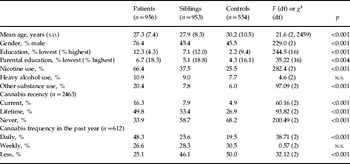
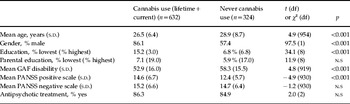
As presented in Table 1, control subjects were older (30.2 years) than patients (27.3 years) and siblings (27.9 years). Males were overrepresented in the patient group (76.4%) compared with siblings (45.4%) and controls (45.5%). Parental educational degree and subject educational degree were lowest in patients. Of all subjects, 38.3% (n=943) had used cannabis in their lifetime, and 10.5% (n=258) were current cannabis users. Patients and siblings were more likely to be current or lifetime cannabis users compared with controls. Regarding the frequency of cannabis use over the past year, patients and siblings were more likely to be daily users compared with controls. Patients were also more likely to be using nicotine or illicit substances compared with siblings and controls. Groups did not differ in the proportion of heavy alcohol users. Table 2 shows that patients with current or lifetime cannabis use were 2.4 years younger and more often male compared with never-using patients. Current and lifetime cannabis-using patients had lower functioning on the Global Assessment of Functioning (GAF; APA, 2000) disability scale (52.9 v. 58.3), higher PANSS positive symptoms (14.6 v. 12.4), but similar PANSS negative symptoms compared with patients who had never used cannabis. In both groups around 85% of patients received treatment with antipsychotics.
Demographic variables of patients, siblings, and controls

df, Degrees of freedom; s.d., standard deviation; n.s., non-significant.
Demographic and clinical variables of patients with and without a lifetime history of cannabis use

df, Degrees of freedom; s.d., standard deviation; n.s., non-significant; GAF, Global Assessment of Functioning; PANSS, Positive and Negative Syndrome Scale.
Cannabis recency
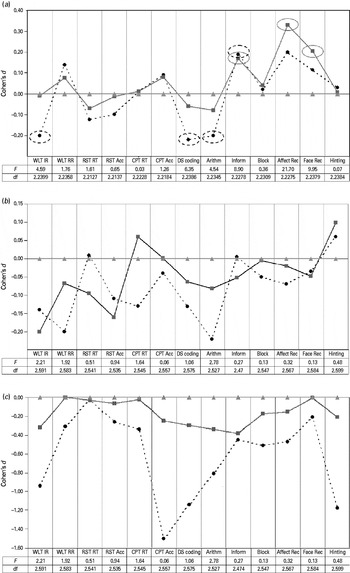
In the current user group (n=258), 59.4% were using daily, 30.3% weekly, and 10.3% less than weekly. The lifetime user group (n=943) consisted of 44.1% daily users, 25.7% weekly users, and 30.2% less than weekly users. The never-user group consisted of 1262 subjects. The interaction term between status (patient, sibling, control) and cannabis recency (current, lifetime, never) was not statistically significant for any of the cognitive variables and was therefore removed from the regression models. Fig. 1 c demonstrates that patients performed worse than controls on all cognitive parameters except RST reaction time, while siblings performed intermediate to patients and controls on selected tasks. Fig. 1a demonstrates that, while taking the main effect of status into account, current cannabis users performed significantly worse compared with never-users on the Word Learning Task immediate recall (d=−0.20), WAIS-III digit-symbol coding (d=−0.22) and WAIS-III arithmetic (d=−0.20). Lifetime cannabis users performed better than never-users on WAIS-III information (d=+0.17), the Degraded Facial Affect Recognition task (d=+0.33) and the Benton Face Recognition Task (d=+0.21). In addition, current cannabis users performed significantly better than never-users on WAIS-III information (d=+0.19). Repeating the analyses after changing the reference category to current users yielded significant differences between current and lifetime users for the Digit-Symbol Coding (d=+0.15, p<0.011) and for the Word Learning Task immediate recall (d=+0.18, p<0.001), the latter of which remained significant after adjusting for multiple comparisons.
(a) Main effects of cannabis recency on cognitive functioning: - -•- -, current users; –▪–, lifetime users; –▴–, never-users. Effects that remained significant after correction for multiple comparisons (p<0.005) in current/lifetime users compared with never-users are circled. (b) Main effects of cannabis frequency on cognitive functioning: –▪–, daily; - -•- -, weekly; –▴–, monthly. (c) Main effects of status on cognitive functioning: - -•;- -, patients; –▪–, siblings; –▴–, controls. WLT IR, Word Learning Task immediate recall; WLT RR, Word Learning Task retention rate; RST RT, Response Shifting Task reaction time; RST Acc, Response Shifting Task accuracy; CPT RT, Continuous Performance Task-HQ reaction time; CPT Acc, CPT-HQ accuracy; DS coding, Wechsler Adult Intelligence Scale-Third Edition (WAIS-III) digit-symbol coding; Arithm, WAIS-III arithmetic; Inform, WAIS-III information; Block, WAIS-III block design; Affect Rec, Degraded Facial Affect Recognition total score; Face Rec, Benton Face Recognition; Hinting, Hinting task; F, test statistic from mixed-model regression analyses; df, degrees of freedom.

GEE analyses confirmed the mixed-model regression results for the not normally distributed data. For CPT accuracy, the proportion of ‘affected’ individuals was not significantly different within current (58.8%), lifetime (53.1%) and never-users (49.0%) [Wald χ2(2)=0.98, p=0.61]. Also for the Hinting Task, the proportion of ‘affected’ individuals was not significantly different within current (64.0%), lifetime (60.0%) and never-users (54.8%) [Wald χ2(2)=0.35, p=0.84].
Cannabis frequency
The interaction term between status (patient, sibling, control) and cannabis frequency (daily, weekly, less) was not statistically significant for any of the cognitive variables and was therefore removed from the regression models. In the resulting model, including status, cannabis frequency and relevant confounders, there was no significant effect of cannabis frequency on any of the cognitive parameters (Fig. 1 b). GEE analyses confirmed the mixed-model regression results for the not normally distributed data. For CPT accuracy, the proportion of ‘affected’ individuals was not significantly different within daily (57.1%), weekly (59.6%) and less frequent users (52.6%) [Wald χ2(2)=1.87, p=0.39]. For the Hinting Task, the proportion of ‘affected’ individuals was not significantly different within daily (70.7%), weekly (60.5%) and less frequent users (60.9%) [Wald χ2(2)=1.74, p=0.42].
Status
Although not a primary aim of this study, the main effects of status on cognitive functioning are outlined in Fig. 1 c in order to facilitate interpretation of the results. The main effects of cannabis (recency and frequency) have been assessed in random-effect regression models together with the main effect of status and the interaction between cannabis and status. The interaction terms were non-significant and the main effects of cannabis and status on cognitive functioning should thus be added. We illustrate this with an example. On the Word Learning Test immediate recall, patients scored −0.95 s.d. from control mean (Fig. 1 c). Moreover, current cannabis users scored −0.2 s.d. from never-users (Fig. 1 a). Therefore, the mean score of current cannabis-using patients lies −1.15 s.d. from the mean score of never-using controls.
Discussion
The aim of this cross-sectional study was to investigate how recency and frequency of cannabis use are associated with cognitive performance in patients with non-affective psychosis, their unaffected siblings and control subjects. In line with our first hypothesis, current cannabis use was associated with worse performance on immediate verbal learning, processing speed and working memory, and this association did not differ between the three status groups. However, against our expectations, an increasing frequency of cannabis use over the past year was not associated with worse cognitive performance. Our second hypothesis was partly supported. While lifetime cannabis use was indeed associated with better performance on acquired knowledge, affect recognition and face identity recognition in patients, this association also applied to unaffected siblings and controls. Effect sizes of these associations were in the small range, which may explain why previous studies that included smaller sample sizes have found contradictory results (Coulston et al. Reference Coulston, Perdices and Tennant2007b). The interpretation of the results is discussed here. As the comparison of cognitive performance between patients, siblings and controls (Fig. 1 c) was not the primary aim of this study, we refer to our baseline study on cognitive assessment in GROUP for further interpretation of these results (J. H. Meijer, C. J. P. Simons, P. J. Quee, K. Verweij, GROUP Investigators, unpublished observations).
A negative association between cognitive functioning and current – but not lifetime – cannabis use is likely to result from a residue of cannabinoids in the central nervous system. Worse immediate verbal learning in current cannabis users is in agreement with other studies in patients with psychotic illness (Liraud & Verdoux, Reference Liraud and Verdoux2002; Pencer & Addington, Reference Pencer and Addington2003; D'Souza et al. Reference D'Souza, Abi-Saab, Madonick, Forselius-Bielen, Doersch, Braley, Gueorguieva, Cooper and Krystal2005; Sevy et al. Reference Sevy, Burdick, Visweswaraiah, Abdelmessih, Lukin, Yechiam and Bechara2007; Jockers-Scherubl et al. Reference Jockers-Scherubl, Wolf, Radzei, Schlattmann, Rentzsch, Gomez-Carrillo and Kuhl2007; Coulston et al. Reference Coulston, Perdices and Tennant2007a; Yücel et al. Reference Yücel, Bora, Lubman, Solowij, Brewer, Cotton, Conus, Takagi, Fornito, Wood, McGorry and Pantelis2010). Also in healthy controls, immediate verbal learning is one of the most consistently impaired cognitive functions after acute cannabis administration, and, congruent with our results, this effect appears to be transient after a 4-week abstinence (Grant et al. Reference Grant, Gonzalez, Carey, Natarajan and Wolfson2003; Solowij & Michie, Reference Solowij and Michie2007).
In contrast with our finding of worse processing speed in current users, the majority of studies in schizophrenia patients reported either absent, or even positive effects of both current and lifetime cannabis use on visual processing speed (Sevy et al. Reference Sevy, Burdick, Visweswaraiah, Abdelmessih, Lukin, Yechiam and Bechara2007; Jockers-Scherubl et al. Reference Jockers-Scherubl, Wolf, Radzei, Schlattmann, Rentzsch, Gomez-Carrillo and Kuhl2007; Coulston et al. Reference Coulston, Perdices and Tennant2007a; Schnell et al. Reference Schnell, Koethe, Daumann and Gouzoulis-Mayfrank2009; DeRosse et al. Reference DeRosse, Kaplan, Burdick, Lencz and Malhotra2010). Positive associations in those studies might have been driven by higher pre-morbid cognitive functioning in cannabis-using patients (Fried et al. Reference Fried, Watkinson and Gray2005; Schnell et al. Reference Schnell, Koethe, Daumann and Gouzoulis-Mayfrank2009). Our finding that current – but not lifetime – cannabis users show worse processing speed is, however, in agreement with evidence from studies in control subjects (Ehrenreich et al. Reference Ehrenreich, Rinn, Kunert, Moeller, Poser, Schilling, Gigerenzer and Hoehe1999; Fried et al. Reference Fried, Watkinson and Gray2005).
Similar to our findings, recent cannabis use in schizophrenia patients has been associated with worse working memory (Ringen et al. Reference Ringen, Vaskinn, Sundet, Engh, Jonsdottir, Simonsen, Friis, Opjordsmoen, Melle and Andreassen2010), but absent or positive associations have also been reported (Sevy et al. Reference Sevy, Burdick, Visweswaraiah, Abdelmessih, Lukin, Yechiam and Bechara2007; Mata et al. Reference Mata, Rodriguez-Sanchez, Pelayo-Teran, Perez-Iglesias, Gonzalez-Blanch, Ramirez-Bonilla, Martinez-Garcia, Vazquez-Barquero and Crespo-Facorro2008; Scholes & Martin-Iverson, Reference Scholes and Martin-Iverson2010). Opposite findings may have resulted from differing samples sizes or the heterogeneity of working memory measures that have been used. WAIS-III arithmetic may be regarded as a relatively complex measure of working memory, with split loadings on processing speed and verbal comprehension (Tellegen, Reference Tellegen2003). Our findings are supported by studies in control subjects that reported impaired working memory following intravenous THC administration and cannabis smoking (Ilan et al. Reference Ilan, Smith and Gevins2004; Morrison et al. Reference Morrison, Zois, McKeown, Lee, Holt, Powell, Kapur and Murray2009), while lifetime cannabis use was not associated with working memory impairments (Scholes & Martin-Iverson, Reference Scholes and Martin-Iverson2010).
Of those subjects who had used cannabis over the past year, daily or weekly users did not perform significantly different compared with less frequent users. Although these findings seem counterintuitive, they are corroborated by the literature in schizophrenia patients (Rodriguez-Sanchez et al. Reference Rodriguez-Sanchez, Ayesa-Arriola, Mata, Moreno-Calle, Perez-Iglesias, Gonzalez-Blanch, Perianez, Vazquez-Barquero and Crespo-Facorro2010) and in healthy subjects (Pope et al. Reference Pope, Gruber, Hudson, Huestis and Yurgelun-Todd2002). Tolerance for the adverse cognitive effects of cannabis in more frequent users might have accounted for the absence of a dose–response relationship on cognitive functioning (Ramaekers et al. Reference Ramaekers, Kauert, Theunissen, Toennes and Moeller2009). Another explanation may be that the subdivision of frequency into daily, weekly, and less frequent use was not sensitive enough to detect a dose–response relationship.
Our finding that lifetime cannabis use was not associated with worse cognitive functioning is in line with a recent review that reported no convincing evidence for sustained cognitive impairments in adult abstinent cannabis users (Van Holst & Schilt, Reference Van Holst and Schilt2011). On the other hand, both current and lifetime cannabis users performed better than never-users on acquired knowledge. Better acquired knowledge in current users may reflect the fact that current users are also lifetime users, since it is unlikely that they started using cannabis in the past month. In addition, we found that lifetime cannabis users performed better than never-users on tasks of facial affect recognition and face identity recognition. Research on the association between cannabis use and facial affect and identity processing is sparse in both patients and controls. One study reported that patients who had used cannabis prior to psychosis onset showed a relative sparing of face identity recognition at 10- to 12-year follow-up, but this difference was lost after co-varying for age at psychosis onset (Stirling et al. Reference Stirling, Lewis, Hopkins and White2005). In non-psychotic polysubstance users, cannabis use was not associated with quality of facial affect recognition, but this association might have been confounded by differing effects of other substances (Fernandez-Serrano et al. Reference Fernandez-Serrano, Perez-Garcia and Verdejo-Garcia2011).
A positive association between lifetime cannabis use and cognitive functioning may seem counterintuitive given the detrimental effects in acute administration studies (D'Souza et al. Reference D'Souza, Abi-Saab, Madonick, Forselius-Bielen, Doersch, Braley, Gueorguieva, Cooper and Krystal2005; Morrison et al. Reference Morrison, Zois, McKeown, Lee, Holt, Powell, Kapur and Murray2009). It has been suggested that substance-using patients might need better cognitive and social skills in order to maintain an illicit substance use (Joyal et al. Reference Joyal, Halle, Lapierre and Hodgins2003; Potvin et al. Reference Potvin, Briand, Prouteau, Bouchard, Lipp, Lalonde, Nicole, Lesage and Stip2005), but in the Netherlands cannabis is not illegal and can be purchased with lesser restrictions. In other words, subjects do not need superior social functioning to obtain cannabis. Moreover, in a recent meta-analysis, superior neuropsychological functioning in cannabis-using schizophrenia patients was largely driven by the inclusion of lifetime users, rather than current or recent users (Yücel et al. Reference Yücel, Bora, Lubman, Solowij, Brewer, Cotton, Conus, Takagi, Fornito, Wood, McGorry and Pantelis2010). Our results support the hypothesis that cannabis-using patients might constitute a subgroup of patients that is intrinsically less vulnerable for schizophrenia than patients who have never used cannabis (Zubin & Spring Reference Zubin and Spring1977; Mueser et al. Reference Mueser, Drake and Wallach1998). Once triggered, a drug-induced non-affective psychotic illness may be indistinguishable from psychosis due to a sufficient amount of biological vulnerability, although pre-morbid functioning and cognitive resilience may be better.
This developmental model has been supported by various studies that investigated the order in which cannabis use and psychosis occur. Three studies found that cognitive functioning was specifically preserved in patients who had started cannabis consumption before disease onset (Stirling et al. Reference Stirling, Lewis, Hopkins and White2005; Rodriguez-Sanchez et al. Reference Rodriguez-Sanchez, Ayesa-Arriola, Mata, Moreno-Calle, Perez-Iglesias, Gonzalez-Blanch, Perianez, Vazquez-Barquero and Crespo-Facorro2010) or before the age of 17 years (Jockers-Scherubl et al. Reference Jockers-Scherubl, Wolf, Radzei, Schlattmann, Rentzsch, Gomez-Carrillo and Kuhl2007). These studies suggest that it is not the cognitive effects of cannabis per se, but the contribution of cannabis to disease onset that explains better cognitive functioning in cannabis-using patients. Second, evidence from follow-up studies suggests that acutely admitted psychotic patients using cannabis have a higher recovery potential for both cognitive and clinical parameters, especially after cessation of cannabis use (Loberg & Hugdahl, Reference Loberg and Hugdahl2009; González-Pinto et al. Reference González-Pinto, Alberich, Barbeito, Gutierrez, Vega, Ibáñez, Haidar, Vieta and Arango2011). Third, studies focusing on neurodevelopmental and genetic factors have added credibility to the vulnerability hypothesis. Cannabis use before psychosis onset has been associated with fewer neurological soft signs after transition to psychosis, which is thought to reflect a lower genetic loading in those patients (Bersani et al. Reference Bersani, Orlandi, Kotzalidis and Pancheri2002; Stirling et al. Reference Stirling, Lewis, Hopkins and White2005; Ruiz-Veguilla et al. Reference Ruiz-Veguilla, Gurpegui, Barrigon, Ferrin, Marin, Rubio, Gutierrez, Pintor and Cervilla2009).
It should, however, be stressed that lifetime cannabis use in our patients was associated with a lower educational degree. In healthy individuals adolescent cannabis use is known to increase the risk of poor school performance, and in particular early school leaving (Lynskey & Hall, Reference Lynskey and Hall2000). Cannabis use is also known to make an impact negatively upon later employment in control subjects (Fergusson & Boden, Reference Fergusson and Boden2008), and the impact may be even more severe in a cognitively vulnerable population of psychotic patients.
Other than in patients with psychosis and healthy controls, evidence on the association between cannabis use and cognition in genetic high-risk subjects is sparse. In agreement with our results, Henquet et al. (Reference Henquet, Rosa, Krabbendam, Papiol, Fananás, Drukker, Ramaekers and van Os2006) found that acute THC administration in unaffected siblings and control subjects was associated with a cognitive decline in domains of verbal memory and processing speed. In addition, preliminary evidence suggested that sensitivity to the cognitive effects of THC might be moderated by a functional polymorphism in the catechol-O-methyltransferase (COMT) gene that is also known to moderate the risk of developing psychosis in reaction to cannabis use (Henquet et al. Reference Henquet, Rosa, Krabbendam, Papiol, Fananás, Drukker, Ramaekers and van Os2006). The present study is to our knowledge the first observational study to assess the relationship between daily-life cannabis use and cognitive functioning in genetic high-risk subjects.
Finally, a significant interaction term would have indicated that the association between cannabis use and cognitive functioning was different between patients, siblings and controls, but this was not the case. Although there have been suggestions of an increased vulnerability to the cognitive adverse effects of acute THC administration in patients and their siblings (D'Souza et al. Reference D'Souza, Abi-Saab, Madonick, Forselius-Bielen, Doersch, Braley, Gueorguieva, Cooper and Krystal2005; Henquet et al. Reference Henquet, Rosa, Krabbendam, Papiol, Fananás, Drukker, Ramaekers and van Os2006), we did not replicate this finding. A first explanation might be that such an interaction effect is restricted to the first hours following acute intoxication of cannabis and not applicable to effects resulting from a residue of cannabinoids in the brain. A second difference in study methodologies is the psychoactive substance of use. While previous studies found an interaction effect on cognitive functioning between psychosis vulnerability and THC, we assessed associations with current, daily-life cannabis use. Contrary to cannabis, THC is a synthetic preparation that is devoid of cannabidiol, which is a potential inhibitor of pharmacological effects of CB1 agonists (Pertwee, Reference Pertwee2008). Further research needs to clarify the association between individual cannabis components and cognitive functioning in individuals with psychosis and their unaffected relatives. Despite the absence of an interaction effect, our findings do not imply that campaigns to discourage cannabis use are without merit. The adverse effects of cannabis use on psychotic symptomatology are well acknowledged in both patients (Linszen et al. Reference Linszen, Dingemans and Lenior1994; Macleod, Reference Macleod2007; Castle, Reference Castle2008) and individuals at genetic risk for psychosis [Caspi et al. Reference Caspi, Moffitt, Cannon, McClay, Murray, Harrington, Taylor, Arseneault, Williams, Braithwaite, Poulton and Craig2005; GROUP Investigators, 2011].
The following limitations should be taken into account. First, the cross-sectional design restricts the drawing of causal inferences between cannabis use and cognitive functioning. Second, we cannot fully exclude the possibility that some of the current users in our study were tested within less than 24 h after cannabis consumption so that the effects measured were those of acute intoxication. However, instructing frequent users to abstain from cannabis use before testing could have a negative effect on cognition as well, similar to those of acute intoxication (Pope et al. Reference Pope, Gruber, Hudson, Huestis and Yurgelun-Todd2002). Third, it should be acknowledged that the amount of cannabis use in the lifetime user group could have been highly variable (ranging from five times to >100 times) which may have led to a dilution of cannabis effects. Hence, we cannot exclude that higher quantities of lifetime cannabis use may have had a significant harmful effect on cognitive functioning. On the other hand, using five times or more as a cut-off for lifetime use is likely to select out most of the users who have experimented with cannabis without proceeding into continued use. This is illustrated by Perkonigg et al. (Reference Perkonigg, Goodwin and Fiedler2008), who refer to the use of cannabis of five times or more as ‘repeated use’. Their study on the long-term natural course of cannabis use in a community sample of adolescents revealed that these repeated users were almost three times more likely to report cannabis use at 10-year follow-up (odds ratio 2.8, 95% confidence interval 1.6–4.7) compared with those who had used cannabis fewer than five times.
The strength of this study is that, due to the comprehensive database of the GROUP study, we were able to address recommendations that have been made in prior studies (Coulston et al. Reference Coulston, Perdices and Tennant2007b; Yücel et al. Reference Yücel, Bora, Lubman, Solowij, Brewer, Cotton, Conus, Takagi, Fornito, Wood, McGorry and Pantelis2010), such as investigating both recency and frequency of cannabis use, the inclusion of a cannabis-using control group, biological validation of self-report cannabis measures by urine drug screening, the assessment of a broad range of cognitive measures, and controlling for a range of possible confounders. Furthermore, the current study expanded on existing studies by the inclusion of unaffected siblings, so that we were able to draw conclusions on the association between cannabis and cognition in people at genetic high risk for psychosis.
Our findings implicate that cannabis use in patients, siblings and controls is associated with differences in cognitive performance, depending on the recency of use. Current cannabis users perform worse on tasks of short-term memory and processing speed which may reflect residual effects. Lifetime cannabis users perform better on social cognition and acquired knowledge, which is more likely to result from lower biological vulnerability and higher pre-morbid functioning rather than an effect of cannabis itself. This discrepancy between potential and actual performance is clinically relevant for those patients whose cannabis use might complicate a potentially less severe course of psychosis. Studies with a longitudinal, prospective design may optimally address this issue, as it permits within-subject comparisons of cognitive performance before initiation and after cessation of cannabis use.
Appendix: Genetic Risk and Outcome of Psychosis (GROUP) Investigators
René S. Kahn1, Don H. Linszen2, Jim van Os3, Durk Wiersma4, Richard Bruggeman4, Wiepke Cahn1, Lieuwe de Haan2, Lydia Krabbendam3 and Inez Myin-Germeys3
1University Medical Center Utrecht, Department of Psychiatry, Rudolf Magnus Institute of Neuroscience, The Netherlands; 2Academic Medical Center University of Amsterdam, Department of Psychiatry, Amsterdam The Netherlands; 3Maastricht University Medical Center, South Limburg Mental Health Research and Teaching Network, EURON, Maastricht, The Netherlands; 4University Medical Center Groningen, Department of Psychiatry, University of Groningen, The Netherlands.
Declaration of Interest
None.
Acknowledgements
The infrastructure for the GROUP study is funded by the Geestkracht program of the Dutch Health Research Council (ZON-MW, grant no. 10-000-1002) and matching funds from participating universities and mental health care organizations in the Netherlands [Amsterdam: Academic Psychiatric Center AMC, Ingeest, Arkin, Dijk en Duin, Rivierduinen, Erasmus MC, Geestelijke Gezondheidszorg (GGZ) Noord Holland Noord; Utrecht: University Medical Center Utrecht, Altrecht, Symfora, Meerkanten, Riagg Amersfoort, Delta; Groningen: University Medical Center Groningen, Lentis, GGZ Friesland, GGZ Drenthe, Dimence, Mediant, GGZ De Grote Rivieren and Parnassia Bavo Groep; Maastricht: Maastricht University Medical Center, GGZ Eindhoven en de Kempen, GGZ Midden-Brabant, GGZ Oost-Brabant, GGZ Noord- Midden Limburg, Mondriaan Zorggroep, Prins Clauscentrum Sittard, RIAGG Roermond, Universitair Centrum Sint-Jozef Kortenberg, CAPRI University of Antwerp, PC Ziekeren Sint-Truiden, PZ Sancta Maria Sint-Truiden, GGZ Overpelt, OPZ Rekem]. We would like to thank the families who gave their time and effort to make this GROUP project possible. The authors are grateful to Matt Grant for his useful comments on the final version of the paper. The research leading to these results has received funding from the European Community's Seventh Framework Program under grant agreement no. HEALTH-F2-2009-241909 (Project EU-GEI). The analyses were supported by unrestricted grants from Jansen-Cilag, Eli Lilly and Company, Astra-Zeneca and Lundbeck. J.M. has received funding from Top Institute Pharma (http://www.tipharma.nl; includes co-funding from universities, government and industry).