Introduction
Glycerin is a major product from biodiesel production. Biodiesel is mainly produced from animal, vegetable oil, micro-algae or fat. Basically, it comprises alkyl esters of fatty acids (FAAE) and is produced during the process of fat transesterification with an alcohol. Methanol is an alcohol which could be used as a donor of alkyl and could be easily recovered from glycerin purification with low cost (Feltes et al., Reference FELTES, DE OLIVEIRA and NINOW2011). Transesterification comprises of consecutive reactions of three-steps which produces monoglycerides and diglycerides as intermediary products. For each mole of triglyceride or triacylglycerol, three moles of fatty acid methyl ester and one mole of glycerin are formed at the end (Kapilakarn and Peugtong, Reference KAPILAKARN and PEUGTONG2007). Biodiesel production is a reversible process, so alcohol could be used to transfer the equilibrium to the product side. The lipids of feedstock consist of triacylglycerin (TAG), but this depends on the chemical composition. In the USA, based on a report from NBB (2007), the annual production capacity of biodiesel is about 5.26 billion litres and with another 7.15 billion litres/year of additional production from plant expansion or new construction. As a by-product of biodiesel, glycerin is supplied in large quantities, of around 4.16 × 10⁸ kg of crude glycerin (NBB, 2007).
Formerly, glycerin was only considered a suitable ingredient in the production of soaps, cosmetics, pharmaceuticals and foods (Thompson and He, Reference THOMPSON and HE2006). However, more uses are expected to be developed, particularly as an alternative energy source in poultry feed, due to its high gross energy content which is approximately 17.17 MJ/kg, as reported by Brambilla and Hill (Reference BRAMBILLA and HILL1996). Francois (Reference FRANCOIS1994) theorised that glycerin provides an energy source similar to carbohydrates and not a specific nutrient.
Swiatkiewicz and Koreleski (Reference SWIATKIEWICZ and KORELESKI2009) claimed that the content of energy and rate of absorption of glycerol, the major constituent of glycerin, are high; and this could facilitate energy production in animals and act as an alternative energy source in livestock production. In a study on broilers, Dozier et al. (2008) observed that the efficiency of using energy was about 95% of gross energy, based on the content of the sample of fatty acid, methanol and glycerin. Moreover, the efficiency of energy use may vary due to the manufacturing process as described by Retore et al. (Reference RETORE, CLAUDIO, ALICE, IVAN GRACA, BRUNA, KARLA, JOYCE and ANDREIA2012).
Many authors have postulated beneficial impacts of glycerin from the view point of body weight gain, feed consumption and feed efficiency (Suchy et al., Reference SUCHY, STRAKOVA, KROUPA and HERZING2011); however, there are still few investigations correlating these influences with changes in body composition, in addition to other factors such as animal age and inclusion levels that can affect nutritional value. Trials conducted by Cerrate et al. (Reference CERRATE, YAN, WANG, COTO, SACAKLI and WALDROUP2006) and Hanczakowska et al. (Reference HANCZAKOWSKA, WEGLARZY, SZYMCZYK and HANCZAKOWSKI2010) confirmed that the utilisation efficiency of glycerin is related to the age and species of the animal as well as the dietary inclusion level of glycerin. This review discusses the important aspects of using glycerin, including production, digestibility and metabolism of glycerin and practical applications in broiler and laying hen nutrition and production.
Production of glycerin
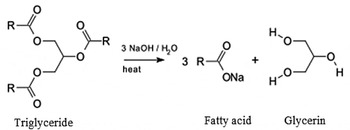
Generally, glycerin is derived from animal and plant sources, where it occurs as triglycerides. Triglycerides are known as esters of glycerol along with long-chain carboxylic acids (Nilles, Reference NILLES2005). The saponification or hydrolysis of these triglycerides results in glycerin and fatty acid ( Figure 1 ). Christoph et al. (Reference CHRISTOPH, BERND, UDO, WOLFGANG and REETTA2006) reported that crude glycerol could be purified using treatment with alkali to remove unreacted glycerol esters, ion exchange to remove salts and activated carbon to remove organic impurities.
Glycerin can be synthetically produced via various routes using propylene. The most important process is the epichlorohydrin, which facilitates the chlorination of propylene to produce allyl chloride that is oxidised with hypochlorite to give dichlorohydrins, which reacts with a strong base to produce epichlorohydrin which is then hydrolysed to produce glycerin (Christoph et al., Reference CHRISTOPH, BERND, UDO, WOLFGANG and REETTA2006).
Hydrolysis of triglyceride to fatty acids and glycerin.

Metabolism of glycerin
It has been reported that glycerin is a small molecule and plays a major role in metabolism. Furthermore, it is an essential structural component of phospholipids and triglycerides (Lin, Reference LIN1997). Glycerin produces energy via the tricarboxylic-acid and glycolytic pathways (Brisson et al., Reference BRISSON, VOHL, St-PIERRE, HUDSON and GAUDET2001). Krebs et al. (Reference KREBS, NOTTON and HEMS1966) found that glycerin constituents could be converted to glucose by the kidneys and liver and produce energy for cellular metabolism (Krebs and Lund, Reference KREBS and LUND1966). Brody (Reference BRODY1994) illustrated that, where the body uses its reserved fat as an energy source, fatty acids and glycerin are released into the bloodstream. During digestion, pancreatic lipase hydrolyses triglycerides to form glycerin and free fatty acids. The obtained glycerin is water soluble and freely enters the portal blood (Sambrook, Reference SAMBROOK1980). Directly after absorption, glycerin can be converted to glucose (Emmanuel et al., Reference EMMANUEL, BERZINS and ROBBLEE1983) through the glyconeogenesis pathway for the production of energy by glycolysis and the citric acid cycle, which can account for 60% of the glycerin metabolic fate under basal conditions (Robergs and Griffin, Reference ROBERGS and GRIFFIN1998). Glycerin, when used as an energy source from feed, decreases both cholesterol and free fatty acid levels (Francois, Reference FRANCOIS1994). Glycerin can be oxidised, producing 22 moles of ATP/mol (Guyton, Reference GUYTON1991). The intestinal absorption of glycerin has been observed to be more than 97% in laying hens (Bartelt and Schneider, Reference BARTELT and SCHNEIDER2002).
Metabolisable energy content of glycerin
Poultry are apparently not able to metabolise all absorbed glycerin at high inclusion rates because the enzymatic activation of glycerin via glycerin kinase to glycerin-3-phosphate limits the absorption process (Henz et al., Reference HENZ, NUNES, EYN, POZZA, FRANK, SCHONE and OLIVEIRA2014). It has been reported that the average apparent metabolisable energy, corrected for nitrogen (AMEn) of glycerin is 14.37 MJ/kg, and that glycerin is efficiently utilised by broiler chickens (Dozier et al., 2008). Lammers et al. (Reference LAMMERS, KERR, HONEYMAN, STALDER, DOZIER, WEBER, KIDD and BREGENDAHL2008) reported that the crude glycerin AMEn value for laying hens was 15.39 MJ/kg, while it was calculated as 14.77 MJ/kg in broilers according to Cerrate et al. (Reference CERRATE, YAN, WANG, COTO, SACAKLI and WALDROUP2006). Compared to other conventional sources of energy, glycerin AMEn is about 36% of corn oil (NRC, 1994), 40% of poultry oil (Lessire and LeClercq, Reference LESSIRE and LECLERCQ1982) and 12-10% higher than grain sorghum and corn, respectively (NRC, 1994). Therefore based on this information, glycerin can partly substitute conventional sources of energy such as plant oils and fat.
Uses of crude glycerin
Glycerin is traditionally used in the pharmaceutical, food, cosmetic and paint industries (Vancov et al., Reference VANCOV, ALSTON, BROWN and MCINTOSH2012). About two-thirds of pure glycerin is used in products for personal care, food or beverages, tobacco and oral care products (24, 16, 12 and 23% respectively; Xuan et al., Reference XUAN, LEUNG, LEUNG and NI2009). The yearly worldwide demand for glycerin in 2005 was approximately 1 billion kg/year, although this was when worldwide biodiesel production was still in its early stages (Nieto, Reference NIETO2013).
Health benefits of glycerin
Glycerin is a valuable compound for producing pharmaceuticals, soaps, food, cosmetics and medical preparations. Presently due to the wide spread of this product in the local and world markets, more applications are expected to spread and develop, particularly as a good energy source for poultry rations, where the gross energy of glycerin is stated as 4100 kcal/kg. Furthermore, glycerin plays a key role in cellular metabolism of the body.
Effect of feeding glycerin on broiler and laying hens
growth performance
Cerrate et al. (Reference CERRATE, YAN, WANG, COTO, SACAKLI and WALDROUP2006) performed an experiment on broilers feeding a pure source of glycerin in experimental diets. The study was divided into two phases (starter and grower); during the first phase, glycerin was added at 0, 5, and 10% in diets, while in second phase it was included at 0, 2.5, and 5%. They found no significant improvements in the growth rate of broilers fed diets supplemented with glycerin at 2.5 and 5%, and concluded that glycerin could be safely used as a useful energy source in broiler diets. Noll (2008) found that glycerin supplementation in both high and low density diets had no significant impact on live body weight. In another study on broilers, Abd-Elsamee et al. (Reference ABD-ELSAMEE, ABDO, EL-MANYLAWI and SALIM2010) added glycerin at 0, 2, 4, 6, and 8% of the diet and observed that the best growth performance, nutrient utilisation and carcass traits were seen in birds fed 6% glycerol.
Recently, Yalçın et al. (2010) performed a trial to evaluate the influence of glycerin (2.5, 5 and 7.5% of the diet) on the performance of laying hens. The authors concluded that enriching the diet with 2.5% glycerin could be used in laying hen nutrition without any adverse effects on productive performance compared with 5 and 10% glycerin/kg diet. Jung and Batal (Reference JUNG and BATAL2011) performed four investigations to determine the maximum concentration of crude glycerin and varying concentration of methanol in crude glycerin on the growth performance of broilers. The authors noticed that live body weight gain declined with 2.5, 5 and 7.5% glycerin addition, and feed intake decreased with glycerin addition (5 and 7.5 %). Mclea et al. (Reference MCLEA, BALL, KILPATRICK and ELLIOTT2011) used three levels of crude glycerin (33, 67, 100 g/kg) to evaluate its effects on broiler growth performance, and showed that AMEn increased linearly along with increasing glycerin level, although no significant impacts were noticed on growth performance.
To investigate the impact of raw and pure glycerin on broiler growth performance, Suchy et al. (Reference SUCHY, STRAKOVA, KROUPA and HERZING2011) used four experimental diets enriched with raw and pure glycerin used in the feeds. It was found that live body weight was statistically impacted by raw and pure glycerol. The authors concluded that glycerin derived from rapeseed processing could be a good source of energy for poultry. Lima et al. (Reference LIMA, RODRIGUES, ALVARENGA, BERNARDINO, MAKIYAMA, LIMA, CANTARELLI and ZANGERONIMO2013) reported no significant effect of different glycerin sources on the live body weight or feed intake of broilers. In Tetra SL laying hens, Nemeth et al. (Reference NEMETH, ZSEDELY and SCHMIDT2013) evaluated the effect of glycerin supplementation levels (5, 7.5 and 10 %) on productive performance. Significant depression was observed in feed conversion ratio with the 10% glycerin level. The authors concluded that crude glycerin energy could be efficiently used by laying hens better than broilers. Topal and Ozdogan (Reference TOPAL and OZDOGAN2013) evaluated the influence of dietary glycerin supplementation (0, 40 and 80 g/kg) on broiler performance. They found significant improvements in body weight gain with 40 and 80 g/kg glycerin up to 42 days of age (p<0.01).
In an experiment by Ustundag et al. (Reference USTUNDAG, TUZUN and OZDOGAN2013) boiler feed intake increased when fed diets containing 2.5% glycerin, while no differences were observed in feed efficiency with any levels of glycerin supplementation in broilers at any period. Henz et al. (Reference HENZ, NUNES, EYN, POZZA, FRANK, SCHONE and OLIVEIRA2014) revealed that a dietary level of crude glycerin up to 6.06% gave better body weight gains without influencing carcass traits. Moreover, higher levels of glycerin (12 and 15%) resulted in lower weight gains, and increasing crude glycerin level quadratically increased feed intake at 10 days of age. Mandalawi et al. (Reference MANDALAWI, KIMIAEITALAB, OBREGO, MENOYO and MATEOS2014) investigated the effects of different glycerin sources and levels in broilers diets. A 2×2 factorial design was used with four levels of inclusion (2.5, 5, 7.5 and10%), along with two sources of glycerin. They found that raw glycerin could be utilised efficiently when included at levels up to 10% of diet in the starter phase. Romano et al. (Reference ROMANO, MENTEN, FREITAS, LIMA, PEREIRA, ZAVARIZE and DIAS2014) observed a linear interaction effect between glycerin levels and bird age on daily feed intake.
Bernardino et al. (Reference BERNARDINO, RODRIGUES, FERITAS, GOMIDE, MAKIYAMA, BUENO, OLIVEIRA and LARA2015) studied the influence of pure and semi pure glycerin addition with varying levels (0, 17.5, 35, 52.5 and 70 g/kg) on broiler performance. The best body weight gain was seen in the group treated with 35.50 g/kg semi-pure glycerin. They concluded that levels of 70 g/kg of pure glycerin and 35.5 g/kg of semi pure glycerin were best in terms of broiler performance. Feed conversion ratio was worse with 70 g/kg of glycerin in the diet, but other production parameters and egg quality were not affected by the same addition (Mandalawia et al., 2015). Neves et al. (Reference NEVES, RETES, ROCHAI, FERREIRA, NAVES, ALVARENGA, FASSANI, PEREIRA, SOUSA and ZANGERONIMO2016) studied the impact of in ovo injection of glycerol at various doses (12.5, 25, 37.5 and 50 nmol/ml) on hatchability, embryonic development, mortality rate and body weight of chicks at hatching. They concluded that glycerol at a dose of 25 nmol/ml may be used as a substrate for in ovo nutrition in broilers.
slaughtering parameters
During slaughter trials, Noll (2008) showed no statistical effects of dietary glycerin addition on various traits (drumsticks, breast and thighs). However wing yield was affected with glycerin inclusion and supplementing the diet with 4% glycerin inconsistently increased abdominal fat compared with the unsupplemented control and other inclusion levels. Henz et al. (Reference HENZ, NUNES, EYN, POZZA, FRANK, SCHONE and OLIVEIRA2014) and Abd-Elsamee et al. (Reference ABD-ELSAMEE, ABDO, EL-MANYLAWI and SALIM2010) found better carcass traits in birds fed diets containing 6% crude glycerin on a DM basis. Similarly, Suchy et al. (Reference SUCHY, STRAKOVA, KROUPA and HERZING2011) postulated that glycerin supplemented diets gave significant positive results on broiler carcass weight. This was supported by Bernardino et al. (Reference BERNARDINO, RODRIGUES, FERITAS, GOMIDE, MAKIYAMA, BUENO, OLIVEIRA and LARA2015) who reported statistical improvements in breast and drumstick yield in birds fed diets containing glycerin sources. The authors added that the highest breast yield was found with 35.15 semi pure and 43.69 g/kg pure glycerin supplementation.
egg production and quality
According to Lammers et al. (Reference LAMMERS, KERR, HONEYMAN, STALDER, DOZIER, WEBER, KIDD and BREGENDAHL2008), no significant effects on egg production were observed due to dietary crude glycerin supplementation. Similar results were also obtained by Swiatkiewicz and Koreleski (Reference SWIATKIEWICZ and KORELESKI2009) who reported no statistical impact from glycerin supplemented diets on layer productive performance or egg quality traits, such as Haugh units, yolk colour, eggshell thickness, shell breaking strength and albumen density. Yalçın et al. (2010) postulated that the egg yolk cholesterol content was significantly higher (P<0.01) in hens fed diets containing 5 or 7.5% glycerin. Additionally, unsaturated fatty acid to saturated fatty acid ratio in eggs decreased (P <0.01) without any negative effects on laying performance or egg quality criteria. This study demonstrated that dietary addition of 2.5% glycerin could be used in laying hen diets without any adverse impacts on egg quality parameters, compared with issues seen when 5 and 10% glycerin were used in the diet. In this context, Nemeth et al. (Reference NEMETH, ZSEDELY and SCHMIDT2013) reported no adverse effects of dietary glycerin supplementation to laying hens diets on egg yield and quality. Nemeth's study suggested that the energy utilisation of crude glycerin in laying hens was higher compared to broilers. Raw glycerin at 60, 75 and 100 g/kg diet did not affect egg quality parameters according to the data obtained by Swiatkiewicz and Koreleski (Reference SWIATKIEWICZ and KORELESKI2009), Yalçın et al. (2010) and Németh et al. (Reference NÉMETH, ZSÉDELY, DÓKA and SCHMIDT2014), respectively.
digestibility
Data from Retore et al. (Reference RETORE, CLAUDIO, ALICE, IVAN GRACA, BRUNA, KARLA, JOYCE and ANDREIA2012) showed digestible energy on a DM basis was 20.74 and 21.35 MJ/kg with crude glycerin and vegetable oil, respectively. Mandalawi et al. (Reference MANDALAWI, KIMIAEITALAB, OBREGO, MENOYO and MATEOS2014) observed that raw glycerin could be efficiently utilised at up to 10% of the diet in the starter phase. Furthermore, the content of energy in glycerin depends on its content of glycerol. In this regard, Mandalawi et al. (Reference MANDALAWI, LÁZAROA, REDÓNB, HERRERAC, MENOYOA and MATEOS2015) pointed out that inclusion of glycerin (70 g/kg in a layer diet) did not affect the digestibility of nutrients including dry matter, organic matter, nitrogen retention or ether extract (P>0.05). In broilers, Pena et al. (Reference PENA, VIEIRA, BORSATTI, PONTIN and RIOS2014) stated that the glycerin inclusion level of 60 g/kg diet increased the AMEn of chicken diets at 25 days of age.
blood cholesterol
Using 480-day-old Japanese quail, Ustundag et al. (Reference USTUNDAG, TUZUN and OZDOGAN2013) conducted an experiment using four levels of glycerin. Blood parameters (total cholesterol, glucose and triglycerides) were not significantly affected at 21 days of age, however blood triglyceride level was statistically decreased in female quail which were fed a diet supplemented with 5% glycerin until 35 days of age. In another study, Romano et al. (Reference ROMANO, MENTEN, FREITAS, LIMA, PEREIRA, ZAVARIZE and DIAS2014) investigated the effect of glycerin on performance and blood parameters of broilers. No significant differences were detected in triacylglycerol and total cholesterol blood levels between the control and treatment groups.
gut microflora
Onder et al. (Reference ONDER, USTUNDAG, OZDOGA and OZDEMIR2013) performed an experiment on Japanese quail of different ages to examine the impacts of glycerin on a number of caecal enterobacteria, coliform bacteria, and total microorganisms. It was noticeable that minimum coliform and enterobacteria counts were found in hens at 21 days of age and male birds at 35 days of age when they received diets supplemented with 5% glycerol. In addition, enriching feed with 5% glycerin in females from one to 21 days of age and in males up to 35 days of age increased total bacterial count, microbial activity, enterobacteria and coliform bacterial populations. From a microbiological and biotechnological view, it was assumed that there was a positive relationship between glycerin and microorganisms as reported by Silva et al. (Reference SILVA, MACK and CONTIERO2009).
litter material
Henz et al. (Reference HENZ, NUNES, EYN, POZZA, FRANK, SCHONE and OLIVEIRA2014) observed a linear increase in litter moisture corresponding with higher levels of crude glycerin in the diet at 10 days of age. The authors illustrated that experimental groups receiving diets supplemented with 12 and 15% glycerin produced increased litter moisture content vs. the unsupplemented control diet. In this context, Romano et al. (Reference ROMANO, MENTEN, FREITAS, LIMA, PEREIRA, ZAVARIZE and DIAS2014) reported an appearance of diarrhoea in broilers fed diets containing 7.5 and 10% glycerin.
Conclusions
In conclusion, glycerin derived from biodiesel production could be used as an alternative and acceptable energy source in poultry diets. With a metabolisable energy values of approximately 3600 kcal/kg in poultry (depending on source), glycerin is an excellent source of calories in poultry diets. Generally it can be incorporated into poultry diets up to a level of 10% without any detrimental impacts on growth performance, feed utilisation, carcass traits and composition, apparent metabolisable energy, egg or meat quality and nutrient digestibility. However, the impacts on feed handling and manufacturing properties need to be considered when identifying inclusion levels of glycerin in poultry diets because of reduced flow ability of feed at high inclusion levels.
Conflict of interest
The authors do not have conflict of interest in this work.