Introduction
Generalist wildlife species able to use anthropogenic resources, either intentionally provisioned by land managers or unintentionally offered in crop fields and meadows, are increasingly prospering in human-modified landscapes, where they cohabite with domestic animals. Whether these wildlife hosts share pathogen species with domestic animals (and humans), participate in the dynamics of these diseases and can be affected by the pathogens carried by domestic animals are central questions (Becker et al., Reference Becker, Streicker and Altizer2015).
On the one hand, the attractivity of these resources for wild ruminants may favour pathogen transmission by increasing contacts between and within domestic and wild host populations, and by favouring population density of wild hosts (Sorensen et al., Reference Sorensen, van Beest and Brook2014; Murray et al., Reference Murray, Becker, Hall and Hernandez2016; Oja et al., Reference Oja, Velström, Moks, Jokelainen and Lassen2017). In addition, crowding of wildlife in confined spaces (e.g. places of supplementary feeding) or in the vicinity of humans has been shown to induce stress responses, which can reduce immune functions and increase susceptibility to disease (Forristal et al., Reference Forristal, Creel, Taper, Scurlock and Cross2012). On the other hand, in some cases, providing additional nutritionally reliable food resources to wildlife may lead to better host body condition and immunity (Murray et al., Reference Murray, Becker, Hall and Hernandez2016). This can either increase or decrease disease transmission – for instance, if the hosts survive better and disseminate the pathogens, or if the hosts recover and clear the pathogen.
Generalist pathogens able to infect multiple host species can circulate between wildlife, domestic animals and human beings, especially in human-modified landscapes where interfaces between species are increased. Some of these exchanges can involve zoonotic pathogens (Jones et al., Reference Jones, Patel, Levy, Storeygard, Balk, Gittleman and Daszak2008; Han et al., Reference Han, Kramer and Drake2016). As an example, in the Serengeti (Tanzania), when outbreaks of rabies occur in populations of domestic dogs, the wild carnivore hosts may become infected, hence joining the community of reservoir hosts and contributing to increased rabies transmission to livestock and humans (Lembo et al., Reference Lembo, Hampson and Haydon2008).
Although bacteria and viruses are the pathogens most often involved in emerging diseases (Jones et al., Reference Jones, Patel, Levy, Storeygard, Balk, Gittleman and Daszak2008), macroparasites can also be of concern, particularly at the interface between livestock and wild ungulates. For example, the risk of helminth transmission between Saïga antelope, Saïga tatarica, and domestic ruminants in Kazakhstan can challenge both Saiga conservation and livestock production (Morgan et al., Reference Morgan, Shaikenov, Torgerson, Medley and Milner-Gulland2005, Reference Morgan, Lundervold, Medley, Shaikenov, Torgerson and Milner-Gulland2006a, Reference Morgan, Torgerson, Shaikenov, Usenbayev, Moore, Medley and Milner-Gullandb). In the same vein, the liver fluke, Dicrocoelium dendriticum, that circulates between wapiti, Cervus elaphus, mule deer, Odocoileus hemionus, and cattle became an emerging disease in Alberta, Canada (Goater & Colwell, Reference Goater and Colwell2007). Winter et al. (Reference Winter, Rehbein and Joachim2018) identified 42 generalist helminth species of the gastrointestinal (GI) tract that can potentially be transmitted between sympatric wild and domestic ruminants in Austria. Wild ungulates are often considered as reservoirs of particular interest (Woolhouse & Gowtage-Sequeria, Reference Woolhouse and Gowtage-Sequeria2005), because of high human contact rates through hunting, and the degree of contact and relatedness between wild and domesticated species (livestock) (Han et al., Reference Han, Kramer and Drake2016).
Wild and domestic ungulates grazing successively in the same pasture can infect each other through the faecal–oral route with macroparasites that produce free-living stages able to survive in the environment. A recent study in the Amboseli ecosystem (Kenya) showed that wild ungulates and livestock share several GI helminth taxa, suggesting bidirectional exchanges of parasites (Obanda et al., Reference Obanda, Maingi, Muchemi, Ng'ang’a, Angelone and Archie2019). However, only a few experimental studies have shown effective successful cross-infection. For example, certain species of GI nematodes of sheep (administered orally as a solution of larvae) successfully established in farm red deer (C. elaphus), whereas others did not (Tapia-Escarate et al., Reference Tapia-Escarate, Pomroy, Scott, Wilson and Lopez-Villalobos2015). The abomasal nematode Ashworthius sidemi that commonly infects bison (Bison bison), red deer and roe deer (Capreolus capreolus) can also infest cattle grazing in the same pasture (Moskwa et al., Reference Moskwa, Bien, Cybulska, Kornacka, Krzysiak, Cencek and Cabaj2015). Although macroparasite exchanges between wild and domestic hosts may be important for health in both hosts, attention is generally focused more on the health of domestic animals (see Martin et al. (Reference Martin, Pastoret, Brochier, Humblet and Saegerman2011) for diseases of ungulates), and less on the health of wild herbivores (Coulson et al., Reference Coulson, Cripps, Garnick, Bristow and Beveridge2018).
In Europe, roe deer, a generalist wild herbivore, has increased in spatial range and abundance during the last century, and has invaded open landscapes such as agricultural and pastoral areas (Linnel & Sachos, Reference Linnel, Sachos, Putman, Apollonio and Anderson2011). Roe deer living in open landscapes use larger home ranges (see Ofstad et al. (Reference Ofstad, Herfindal, Solberg and Saether2016) for a review on ungulates, and Lamberti et al. (Reference Lamberti, Mauri, Merli, Dusi and Apollonio2006) for an example in roe deer) and gain better access to high-quality food, especially cultivated seeds (Abbas et al., Reference Abbas, Morellet and Hewison2011). They have a higher body mass than forest individuals (Hewison et al., Reference Hewison, Morellet and Verheyden2009). However, they can also be more exposed to parasites hosted by domestic species, such as oocysts of Toxoplasma gondii excreted by cats (Sevila et al., Reference Sevila, Richomme and Hoste2014).
In this study, we aimed to assess whether cohabitation with livestock is associated or not with variations in the parasitic GI nematode burden in wild roe deer inhabiting a rural landscape. We used spatial data from a long-term monitoring research programme on roe deer spatial behaviour (using Global Positioning System (GPS)-collared individuals) in a large study area exhibiting a gradient of forest fragmentation from closed forest to open landscape dominated by crops and pastures. Specifically, we tested the hypothesis that the individual egg excretion of digestive parasites in roe deer increases with the density of livestock in its home range.
Materials and methods
Study area
The study area is a 10,000 ha rural landscape composed of a mosaic of forests, woods, crops and pastures that vary locally in proportion, from closed forest (two blocks: 9% of the study area), to open landscape with a gradient of the proportion of woodlots (from 8 to 32% of the area depending on the sector) and hedgerow (from 1 to 6%). On average, cultivated crops composed 32% of the study area, mainly wheat (59%), sunflower (21%), maize (9%), lucerne (5%), ray grass (4%) and sorghum (2%). Pastures made up 34% of the study area and were used mainly by cattle (78% of the area), and, to a lesser extent, by horses (7%) and sheep (5%). A map of land use (woodland, hedge, human dwelling, crop and meadow) was generated each year using a Geographic Information System (GIS) (ArcView® 10.0 GIS, ESRI Software,Redlands, CA, USA). The use of pastures by livestock was included on the GIS by field surveys on a weekly basis between 2010 and 2013 during the grazing season of livestock from mid-April to mid-November (weeks 16 to 46). We recorded the presence of domestic species (cattle, sheep, horses and goats) and their abundance on the pasture using the median of the following abundance classes (0; 3:[1–5]; 8:[6–10]; 13:[11–15]; 18:[16–20]; 23:[21–25]; 38:[26–50]; 63:[51–75]; 88:[76–100]; 150:[101–200]; and 250:[201–300]).
Roe deer capture and sampling
Roe deer were caught in winter (January and February) in 2011, 2012, 2013 and 2014 using large-scale drives of 30 to 100 beaters and long nets (around 4 km) at six capture sites, one in a forest sector and the five other sectors distributed across an increasing gradient of landscape opening. Once captured, the roe deer were tranquilized with an intramuscular acepromazine injection (0.3 ml), and maintained quietly in wooden boxes before being handled at the end of the drives. Roe deer handling lasted 10 min on average. They were weighed and classified in age classes using their tooth eruption patterns (juvenile less than one year old, yearling between one and two years old, adult for the others). Individual faecal samples were collected directly from the rectum and stored in cooled boxes until analysis of the number of eggs of digestive system nematodes, within a maximum of five days. Before being released, most of the roe deer were fitted with a GPS collar (Lotek 3300 collars (Lotek Wireless Inc, Newmarket, Canada) with a drop-off system), which was programmed to record one position every 6 h for 48 weeks (see Cargnelutti et al. (Reference Cargnelutti, Coulon, Hewison, Goulard, Angibault and Morellet2007) for details on GPS collar functioning). This schedule choice is a trade-off between battery duration and number of positions recorded for a ten-month monitoring programme. The collars were then retrieved in the field in November–December and positions were downloaded at the office.
Roe deer spatial data
Individual home ranges were calculated using the fixed Kernel method with an ad-hoc approach to estimate the smoothing parameter (Worton, Reference Worton1989; Börger et al., Reference Börger, Franconi, De Michele, Gantz, Meschi, Manica, Lovari and Coulson2006). We chose the 90% home range isopleths of position density to represent the space use by the deer over the year (48 weeks). This means that an individual deer has a 90% probability of being located in this home range area. To calculate the home range, we used the positions obtained after a period of ten days following the capture event, to discard abnormal spatial behaviour due to capture stress (Morellet et al., Reference Morellet, Verheyden, Angibault, Cargnelutti, Lourtet and Hewison2009). Not all the individuals captured in a given year were equipped with GPS collars. In particular, some animals were caught several times and monitored with a GPS collar during a previous year. In these cases, we used the positions previously recorded to calculate the home range of adult roe deer, because they are known to be highly sedentary and exhibit a stable home range for their whole adult lifespan (Hewison et al., Reference Hewison, Vincent, Reby, Andersen, Duncan and Linnell1998). For juveniles, some animals disperse from their natal home range, where they have been caught, to establish in a new home range in the spring. Since we do not have sufficient position data to calculate a home range before dispersal, we excluded these individuals from the database. In addition, we disregarded individuals that were GPS monitored for less than 80 days or less than 180 positions due to GPS failure.
Cohabitation between livestock and roe deer
To quantify the potential cohabitation of roe deer with livestock, we calculated the livestock density present in their home range during the grazing season, before the capture event of roe deer (the previous year). To do this, we summed the abundance of livestock species (cumulated over the whole grazing season) on the pastures inside the home range of each roe deer, and divided by the area of the home range (ha).
Parasitological data for roe deer
Faecal egg counts (FECs) were performed using the method of McMaster, modified by Raynaud (Reference Raynaud1970). Based on the morphology of the eggs, the following groups, families, genera or species were identified: Trichostrongyles, Nematodirus spp., Trichuris spp., Capillaria spp., Dicrocoelium lanceolatum and Strongyloides spp. We calculated the total GI strongyles (=Trichostrongyles + Nematodirus spp. + Strongyloides spp.). Eggs of Capillaria spp. and D. lanceolatum were not found. Eggs of Trichuris spp. were found only once. Therefore, these three parasites were no longer considered in the statistical analyses.
Statistical analyses
To assess whether digestive nematode infections in roe deer (approached by FEC) vary with the density of livestock, we used a mixed general linear model with negative binomial link appropriate for count data. Since age and gender are known to possibly affect parasite loads in roe deer, with juveniles and males being more infested (Body et al., Reference Body, Ferté, Gaillard, Delorme, Klein and Gilot-Fromont2011), these two factors and their interactions were included in the null model. Because the survival of larvae of GI strongyles in the environment may change from year to year, due to climatic variations such as drought and/or frost, we also added year of sampling as a random factor. We hypothesized that individuals with a poor constitution – that is, those having low body mass relative to their age and gender category – may be more commonly infected (Segonds-Pichon et al., Reference Segonds-Pichon, Ferté, Gaillard, Lamarque and Duncan2000) and more susceptible to the potential risk represented by infective stages of parasites from livestock due to their reduced investment in immune defences (Gilot-Fromont et al., Reference Gilot-Fromont, Jégo, Bonenfant, Gibert, Rannou, Klein and Gaillard2012). We took into account the interaction between body mass (standardized by the mean of age and gender categories) and livestock density in the full model.
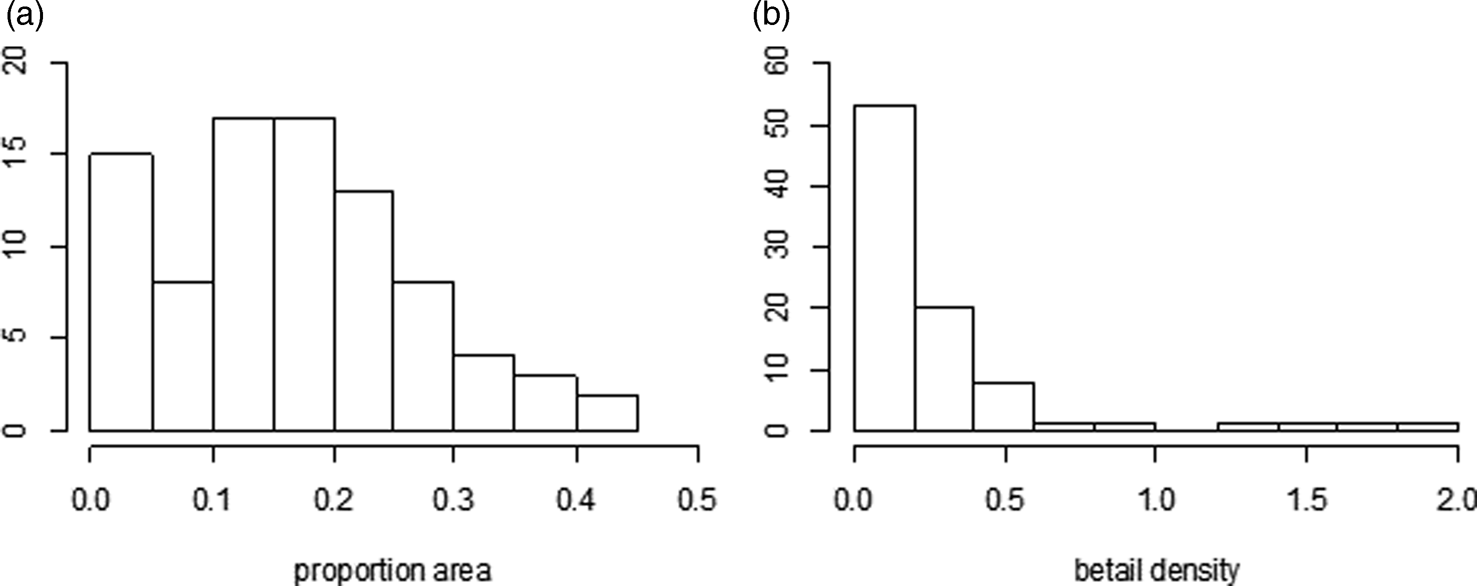
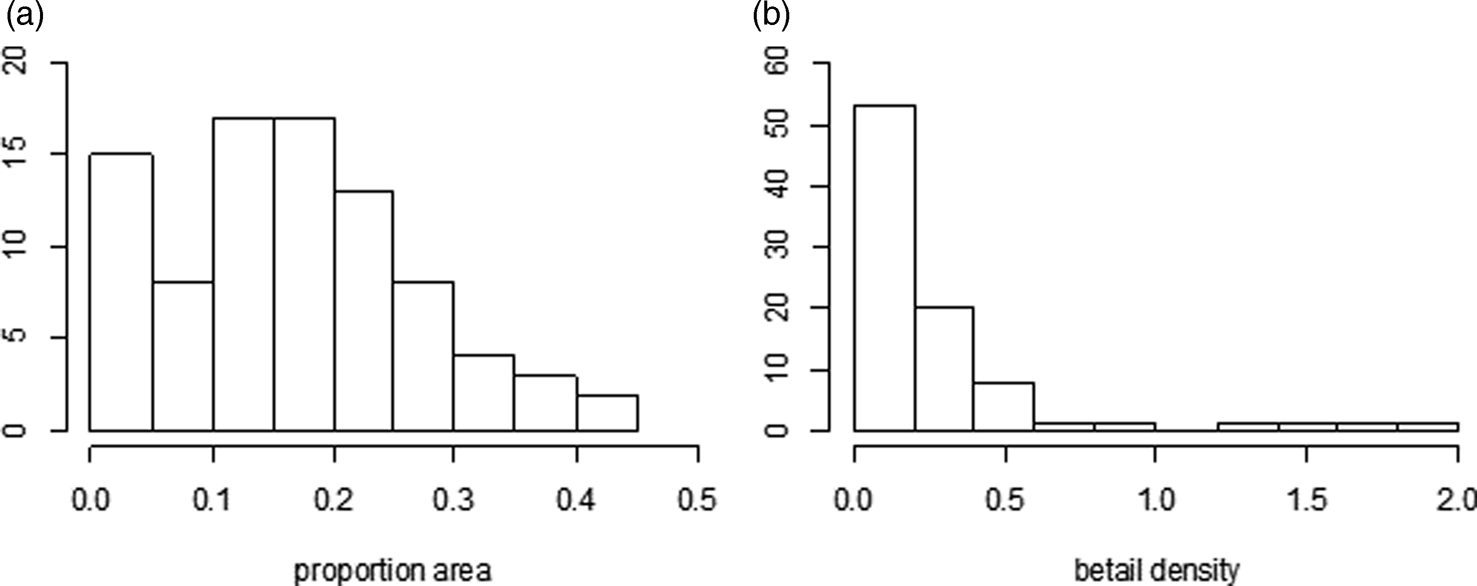
The density of livestock in the roe deer home ranges varied between 0 and 1.9 individuals/ha. However, most of the variation (for 78 roe deer out of 87) falls into the [0–0.5] individual/ha interval (see fig. 1 and supplemental material for original data). Therefore, to give less weight to extreme livestock density, and rather point to usual roe deer exposure to livestock, we converted livestock density into a semi-quantitative variable according to density levels (0:[0–0.01], 1:[0.01–0.1], 2:[0.1–0.2], 3:[0.2–0.3], 4:[0.3–0.4], 5:[0.4–0.5], 6:≥0.5 individuals/ha). We selected the best model by testing the full model against a basal one (with fixed effects: interaction between age and gender; and random effect: year), using analysis of variance. Non-significant effects were discarded from the model, step by step. All the statistical analyses were performed using R version 3.1.1 (R Development Core Team, 2013), with the glmer function (library ade4).
Distribution of (a) the proportion of the home range of roe deer containing pastures occupied by livestock, and (b) livestock density (individuals per ha) present in the home range of roe deer during the grazing season, before the capture event of roe deer (the previous year).
Results
We sampled 87 roe deer (21 in 2011, 23 in 2012, 20 in 2013 and 23 in 2014) corresponding to 74 different individuals (eight individuals were sampled twice in two different years, one three times and one four times), according to gender (53 females and 34 males) or age groups (16 juveniles, 14 yearlings and 57 adults). A total of 77% of the faecal samples showed the presence of eggs of GI nematodes (between 70 and 83% of the samples, depending on the year), with a median count of 150 eggs/g (mean 171.3 eggs/g; max 950 eggs/g). Among the 87 faecal samples analysed, only 24 contained more than 200 eggs/g. The mean home range area of the roe deer was 110.3 ha (min: 25.57; max: 957.8 ha). All of the home ranges, except four, contained pastures occupied by livestock (median proportion of area: 0.16; min: 0; max: 0.44; fig. 1).
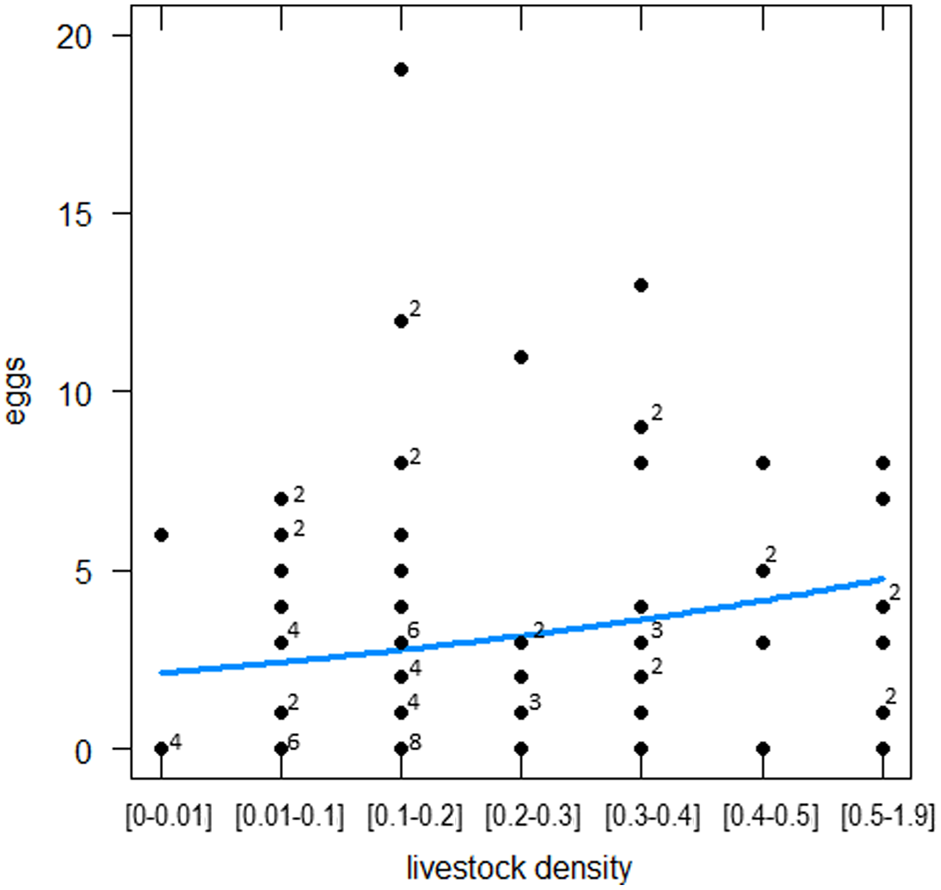
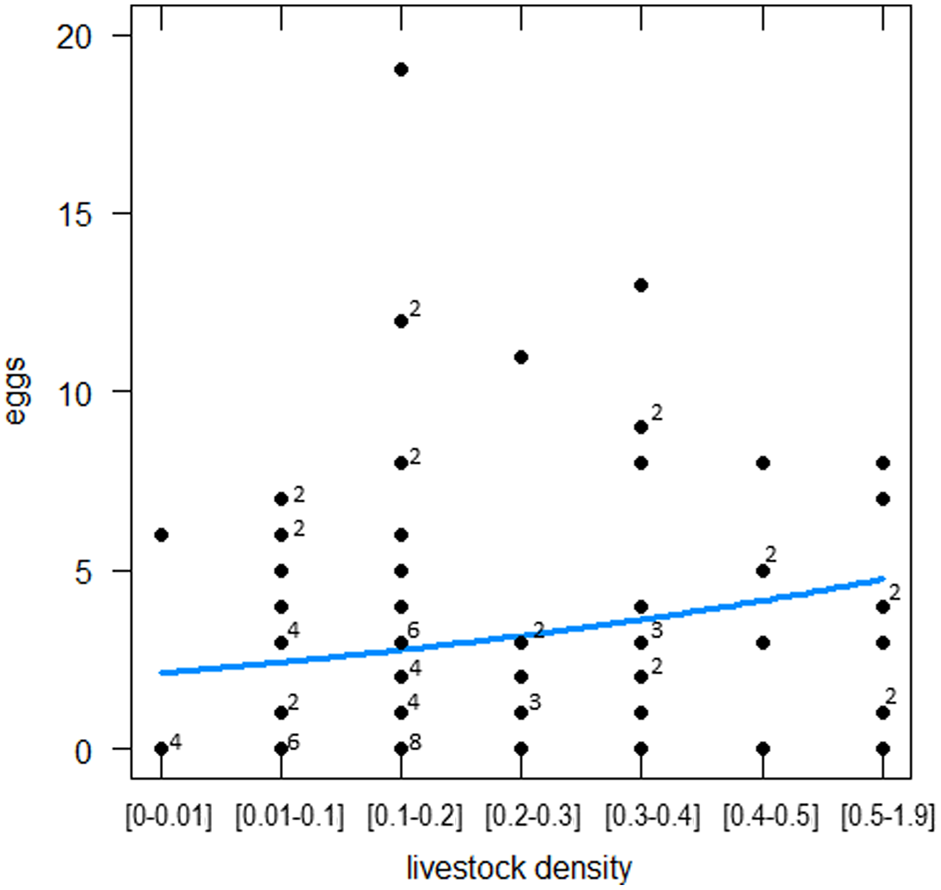
Neither the standardized body mass (Df = 1 out of 78; chi-square = 0.2627; P = 0.6083) nor the interaction between livestock density and standardized body mass (Df = 1 out of 78; chi-square = 1.2476; P = 0.264) were statistically significant factors to explain the FEC in roe deer, compared to the basal (null) model. On the other hand, the FEC tends to increase with livestock density (Df = 1 out of 78; chi-square = 3.0842; P = 0.0791) (fig. 2).
Effect of livestock density on the excretion of GI strongyle in roe deer (eggs per 20 mg of faeces, counted in the two chambers of McMaster slide). Density of livestock is measured in the home range of roe deer during the previous grazing season and expressed by density levels as follows: [0–0.01], [0.01–0.1], [0.1–0.2], [0.2–0.3], [0.3–0.4], [0.4–0.5], [0.5–1.9] individuals/ha. Points are observed values. When several points are superposed, labels indicate the number of points. The line shows the predicted values using a mixed general linear model with negative binomial link.
Discussion
We aimed to assess whether cohabitation with livestock in a rural landscape is associated with variations in the GI nematode parasitic burden in roe deer. Given the difficulty in carrying out field work concerning wild animals, we made use of valuable high-quality data on the spatial behaviour of GPS-collared wild roe deer (87 home ranges) and of local livestock density. Our sampling regime of roe deer location – one GPS position every 6 h for 48 weeks – is largely enough to obtain accurate estimates of the home range since only ten fixes collected over a few days per month are sufficient (Börger et al., Reference Börger, Franconi, De Michele, Gantz, Meschi, Manica, Lovari and Coulson2006). The GI strongyle parasitic burden in roe deer was indexed using FECs. Although this method has some drawbacks, such as the low correlation between eggs and worm burden for worms of low fecundity, the aggregative distribution of eggs within the faecal sample and the inability to detect worms in hypobiosis, FECs remain the best indirect method of evaluating GI nematode abundance in live animals (see Preston et al. (Reference Preston, Sandeman, Gonzalez and Piedrafita2014) and Roeber et al. (Reference Roeber, Jex and Gasser2013) for a review in domestic ruminants). Although published data on GIN infections based on FECs of strongyles in roe deer remain scarce, it seems that in the current study the GIN burden was lower than (Body et al., Reference Body, Ferté, Gaillard, Delorme, Klein and Gilot-Fromont2011; Tomczuk et al., Reference Tomczuk, Szczepaniak, Grzybek, Studzinska, Demkowska-Kutrzepa, Roczen-Karczmarz, Kostro and Krakowski2014) or similar to that (Segonds-Pichon et al., Reference Segonds-Pichon, Ferté, Gaillard, Lamarque and Duncan2000) previously reported in other populations in temperate climates, but higher than that observed in drier climates in Spain (Horcajada-Sánchez et al., Reference Horcajada-Sánchez, Navarro-Castilla, Boadella and Barja2018).
In the present study, we have shown that roe deer tended to excrete more GI strongyles eggs when the density of livestock in their home range increased. This result suggests a higher GI strongyle burden in roe deer exposed to higher local livestock density. A first explanation is that higher local livestock density may increase the risk of roe deer ingesting larvae of parasitic GINs disseminated by livestock dung scattered within the pasture limits. In fact, when feeding on forbs and legumes on the pasture, the roe deer may ingest larvae of GI parasites originating from eggs previously excreted in livestock faecal output. An additional explanation could be that livestock pasture and their vicinity may also be attractive for several roe deer, hence increasing local density of roe deer dung and their associated GIN larvae. Although roe deer can form large groups in winter, especially in very open landscape, individuals segregate themselves in space during most of the livestock grazing season (from March to September; Hewison et al., Reference Hewison, Vincent, Reby, Andersen, Duncan and Linnell1998). In addition, in our study area, the group size remains very small, even in winter (between two and 3.6 individuals on average; Hewison et al., Reference Hewison, Vincent, Joachim, Angibault, Cargnelutti and Cibien2001), and this will likely limit the probability for a roe deer to forage on a place previously contaminated by faecal output of conspecifics. It is also possible that pastoral landscape will offer a more favourable environment for GIN larvae survival compared to other habitats (wood) and, thus, this will enhance the risk of ingesting viable GIN larvae. To our knowledge, only one study compared GIN eggs in the faecal output of cows grazing wooded or open pasture, in Brazil (de Mendonca et al., Reference De Mendonca, Leite, Lana and Costa2014). The authors expected a higher survival of GIN larvae under tree cover and, thus, a higher infestation of cows, but they could not find any differences of infestation between the two systems.
It is known that at least some generalist nematode species are shared between domestic and wild host species: for instance, D. dendriticum in wapiti (C. elaphus) and cattle (Goater & Colwell, Reference Goater and Colwell2007); Haemonchus contortus in white-tailed deer (Odocoileus virginianus), cattle and sheep (McGhee et al., Reference McGhee, Nettles, Rollor, Prestwood and Davidson1981), roe deer and other wild ruminants (Cerutti et al., Reference Cerutti, Citterio, Bazzocchi, Epis, D'Amelio, Ferrari and Lanfranchi2010); H. contortus, Trichostrongylus axei and Trichostrongylus vitrinus in roe deer, sheep and other mountain ungulates (Zaffaroni et al., Reference Zaffaroni, Manfredi, Citterio, Sala, Piccolo and Lanfranchi2000); or A. sidemi in several wild and domestic ungulates (Moskwa et al., Reference Moskwa, Bien, Cybulska, Kornacka, Krzysiak, Cencek and Cabaj2015). In addition, studies revealing the prevalence of H. contortus resistant to anthelmintic drugs in roe deer and other wild deer species, show that the exchange of parasite from domestic to wild deer naturally occurred (Chintoan-Uta et al., Reference Chintoan-Uta, Morgan, Skuce and Coles2014; Nagy et al., Reference Nagy, Csivincsik, Sugár and Zsolnai2017). This was recently demonstrated experimentally for H. contortus that can be acquired by roe deer when grazing a pasture previously used by infested sheep (Megyesi et al., Reference Megyesi, Königová and Babják2020). Based on a review of helminth occurrence in ruminants in Austria, Winter et al. (Reference Winter, Rehbein and Joachim2018) identified 17, 22 and 26 helminth species that can potentially be shared between roe deer and goats, cattle or sheep, respectively. A more formalized network analysis based on a literature survey of parasite count in the host community, as done by Walker et al. (Reference Walker, Plein, Morgan and Vesk2017), may have revealed an even more large range of helminth and host species potential overlap. A clear limitation of our study is that we cannot distinguish the helminth species using FECs. In addition, we cannot investigate which livestock species are more or less involved in the positive link between livestock density and roe deer parasite burden because our data were not sufficiently balanced between cattle, horses, sheep and goats. A next step would be to investigate which helminth species are shared between roe deer and the neighbouring domestic animals. Advanced molecular tools are now available to analyse parasite DNA in faecal samples or coproculture-derived larvae (Avramenko et al., Reference Avramenko, Redman, Lewis, Bichuette, Palmeira, Yazwinski and Gilleard2017; Santos et al., Reference Santos, Salgado, Drummond, Bastianetto, Santos, Brasil, Taconeli and Oliveira2020). This could be used to compare the nemabiome composition of wild and domestic ungulates sharing the same area.
Although livestock occurred in almost all the home ranges of the roe deer, only a quarter of the roe deer exhibited what is qualified as significant GIN burden (i.e. more than 200 eggs/g). It is likely that roe deer exhibit a spatial heterogeneity in GIN burden according to other unmeasured factors such as environmental drivers of helminth survival and immune genotype, as evidenced recently in a study on red deer of the Isle of Rum (Albery et al., Reference Albery, Becker, Kenyon, Nussey and Pemberton2019). This last study also shows that contrasted seasonal variations may affect spatial patterns of parasite burden. In our study, we measured the FECs of roe deer in winter, the season with the lower parasite burden; we may obtain a more pronounced difference between individual and spatial heterogeneity in GIN burden in autumn when FECs are higher. Within their home range, roe deer may also be able to limit their exposure to GI larvae through behavioural adjustments such as the temporal avoidance of pasture already occupied by domestic ruminants, and fine-scale spatial avoidance of dung (Gunn & Irvine, Reference Gunn and Irvine2003; Hutchings et al., Reference Hutchings, Judge, Gordon, Athanasiadou and Kyriazakis2006). Roe deer that use pasture also appear to gain better access to nutrients (Hewison et al., Reference Hewison, Morellet and Verheyden2009), which could allow them to devote more resources toward immunity against strongyles, hence leading to a decrease in parasite fecundity and egg excretion. Finally, the typical browse diet of roe deer contains moderate concentrations of tannins (Verheyden-Tixier & Duncan, Reference Verheyden-Tixier and Duncan2000) that are known to have anthelmintic properties (Hoste et al., Reference Hoste, Jackson, Athanasiadou, Thamsborg and Hoskin2006), which may help roe deer to maintain parasite burden at a low level.
In the context of increasing overlap between deer and domestic animal ranges, the exchange of pathogens between these hosts when feeding on common resources appears plausible. How these interactions can modify the dynamics of infectious and parasitic diseases and affect the health and fitness of these hosts is a central question for future research (Becker et al., Reference Becker, Streicker and Altizer2015; Coulson et al., Reference Coulson, Cripps, Garnick, Bristow and Beveridge2018).
Acknowledgements
We would like to thank the two reviewers for their helpful comments to improve the manuscript. We thank Nicolas Morellet for his help with the statistics. We would like to thank the local hunting associations and the Fédération Départementale des Chasseurs de la Haute Garonne for allowing us to work in the study area. We thank the numerous volunteers and the members of the CEFS (INRA Comportement et Ecologie de la Faune Sauvage) who participated in roe deer sampling and monitoring. We also thank Craig Stevens, MA, ELS for English editing.
Financial support
This work was supported by the French National Research Agency (H.V., OSCAR project, grant number ANR-11-AGRO-001-04, 2011) and through a PhD project (J.S., grant) funded by ANSES and INRA, which involves two INRA departments, EFPA (Ecologie des Forêts, Prairies et milieu Aquatiques) and SA (Santé Animale).
Conflicts of interest
None.
Ethical standards
The authors declare that all the procedures contributing to this work complied with the ethical standards of the relevant national and institutional guidelines on the care and use of laboratory animals. The study was authorized by the land managers. All the procedures involving animals were approved by the Ethics Committee 115 of Toulouse and authorized by the French Ministry of Research (number APAFIS#7880-2016120209523619v5).