Introduction
While diaspora studies are often inspired by interest in ethno-national topics, they usually end up either addressing societal issues or answering ethno-national questions through the lens of social studies, though “in social sciences, the term diasporas is recent” (Anteby-Yemini and Berthomière Reference Anteby-Yemini and Berthomière2005, 262). This is because diasporas, generally marked for their strong emotional bonds with homeland, represent, as citizens, societies which are different (and sometimes too different) from their societies of origin. These societal differences, be they structural, political, or cultural, are probably the key factors affecting diasporic senses of belonging. As Cohen has rightly put it, “diasporas are positioned somewhere between ‘nations-states’ and ‘travelling cultures’ in that they involve dwelling in a nation-state in a physical sense, but travelling in an astral or spiritual sense that falls outside the nation-state’s space/time zone” (Reference Cohen1997, 135–136). Also, according to Carter, “the idea of diaspora suggests the concept of a non-essentialized self which breaks the linkage between place and identity” (Reference Carter2005, 54). As well, home and exile are often seen as two dynamic ends of what stimulates the complexity of the discourse over the nature of diasporic identity (see Voicu Reference Voicu and Boldea2014). On the other hand, the recent increased academic interest in the topic has broadened and made flexible the limits within which the term diaspora is conceptualized. Naujoks (Reference Naujoks2010, 1), for example, identifies a diaspora from three perspectives: ethnic, national, and civic. Baser, on the other hand, states that the term diaspora “has long been used to refer to specific dispersed groups such as Jews and Armenians, while currently it is also being used to describe expatriates, exiles, refugees, immigrants, and, in particular, displaced communities and ethnic minorities” (Reference Baser2016, 7). No less important is the fact that “[the] constructivist understanding of identity implies seeing diasporas not as automatically resulting from migration, but as the product of discursive constructions of community” (Demmers Reference Demmers2007, 8). Finally, “no diaspora is homogeneous, to the point that it appears often misleading to designate them as ‘a’ group” (Féron and Lefort Reference Féron and Lefort2019, 37).
Consequently, investigations of diasporic identities should consider multiple variables including those reflecting societal aspects. It is important to see, for instance, what kind of shift (if any) in socio-cultural paradigms accompany migration processes. On the other hand, recent studies focusing on diasporic identity (Anteby-Yemini and Berthomière Reference Anteby-Yemini and Berthomière2005; Oh Reference Oh2016; Schiller Reference Schiller2009; Canagarajah and Silberstein Reference Canagarajah and Silberstein2012; Cohen and Fischer Reference Cohen and Fischer2019; Liberatore and Fesenmyer Reference Liberatore and Fesenmyer2019 has been calling for the investigation of also diasporas’ language repertoires, as essential clues to understanding sustainability vs. flexibility of diasporic identity perceptions. This article therefore also problematizes the place of language (both in terms of attitudes and behavior) in identity production of Azerbaijanis in Turkey.
However, while studying diasporas’ linguistic and/or socio-cultural affiliations to understand their identity production dynamics is a legitimate one, studying attitudes and practices of a diaspora who has settled in a linguistically close country, as is the case with Azerbaijanis in Turkey, may not always appear completely impartial. First, linguistic proximity will obscure an objective assessment of linguistic (and cultural) perceptions: both the observation of linguistic practices and elicitation of language attitudes will be obscured. Second, linguistic proximity may also reduce the acuteness of communicative and socio-cultural challenges, which in themselves are interesting variables enabling a detailed investigation into sustainable identity production or reproduction. Third, even if we “push the linguistic-cultural canvas aside” and take only social structure similarities/differences as the main platform on which to measure dynamics of identity perceptions, linguistic proximity will erase a big portion of such differences (if any) due to the mystical capability of language to act as “grand text.” From this point of view, investigating any kind of perceptions (including linguistic perceptions) within broader contexts is helpful.
Accordingly, I examine the dynamics of diasporic identity production within the ethno-national, socio-cultural and socio-communicative paradigms by looking into the details of ethno-linguistic affiliation, linguistic and cultural persistence, and communicative challenges. In particular, my research tries to answer the following questions:
-
1. What are the main factors shaping self-perceptions of Azerbaijanis living in Turkey in particular in terms of Azerbaijanism vs. Turkism?
-
2. How are the linguistic repertoires of Azerbaijanis living in Turkey affected by their ethno-national and social-cultural perceptions?
-
3. What is the nature of socio-cultural and communicative challenges that Azerbaijanis living in Turkey experience, and (how) do these challenges affect (or may potentially affect) Azerbaijanis’ self-perceptions as well as their integration/reintegration tendencies?
The first question aims at revealing the extent to which each of the below factors shape perceptions of Azerbaijanis in Turkey, particularly regarding Azerbaijanism vs.Turkism, and how these perceptions are made explicit through attitudes and practices: historical awareness, linguistic and cultural proximity vs. variance, and differences in social structure. Through the second question I try to see whether the native language (both in terms of attitudes and practices), which has become iconic in post-Soviet identity formation of Azerbaijanis, renders itself vulnerable in a socially different environment. The third question tries to reveal the nature of possible sociolinguistic and socio-cultural barriers affecting the diaspora’s identity production/reproduction, senses of belonging, integration into the host society, and possible aspirations of reconnection with homeland.
I surveyed 296 participants as well as interviewed 14 informants in order to elicit specific supporting details. The respondents and informants represented various communities, including academia, healthcare professionals, people of art and media, heads of diaspora groups, labor migrants, students and housewives.
Post-Soviet Migration of Azerbaijanis to Turkey
History and Structure of Azerbaijani Migration to Turkey: Outlines
“Azerbaijanis in Turkey” is a complex and multi-layered concept. The history of Azerbaijani migration to Turkey goes back to almost 200 years ago if not earlier. Salomoni (Reference Salomoni2014, 340) reports the movement of three millions Turks and Muslims, including Azerbaijani Turks, from the Caucasus to the Ottoman Empire between 1829 and 1914. Because of continuing territorial disputes around certain borderline territories lying between the Russian Empire and the Ottoman Empire, there were several border changes involving territorial swaps. Kars, Ardahan, and Igdir, where Azerbaijanis lived along with Armenians and Kurds, were eventually returned to the Ottoman Empire while Vedi/Vedibasar, an adjacent territory where Azerbaijanis were in majority, remained in the Soviet Union as part of the Republic of Armenia. The transfer of Kars, Ardahan, and Igdir must have encouraged outflows of Azerbaijanis from the Soviet Union to the Ottoman Empire/Turkey to join their ethnic fellows and live in a culturally close country. Hence, Kars, Ardahan and Igdir are the territories with the largest Azerbaijani communities. In particular Igdir is considered an Azerbaijani land in Turkey. Further, once Soviets came, many founders of Azerbaijan Democratic Republic (1918–1920) left the country to escape Bolshevik repressions. This was followed by the immediate flow of many anti-Bolshevik intellectuals. Later, different other groups, including traders, were able to move from the Soviet Union to Turkey between 1920 and 1930 when the borders had a porous nature (see Salomoni Reference Salomoni2014, 341). There were new waves of migration of Azerbaijanis in later periods both from Soviet Armenia and Soviet Azerbaijan. In general, as Salomoni states, “the Azeris settled in Eastern Anatolia during the 1918-1925, and later a small number of Azeris fleeing Soviet forced collectivization settled in Turkish territory. Moreover Anders reports thousands of Azerbaijanis who settled in Eastern Anatolia in 1938 and then in 1944” (2014, 344).
The economic crisis following the collapse of the Soviet Union, which brought along redistribution of resources and socio-economic deprivations for certain groups, triggered new migration waves of Azerbaijanis to Turkey starting from 1990s. These new groups included circular or seasonal migrants, permanent labor migrants (mostly illegal), and intellectual migrants. With border conditions becoming more favorable, the scale of these waves increased. As Allahveranov and Huseynov report, “… if one looks at the international migration database of the OECD, Turkey appears to be becoming an increasingly important destination country for Azerbaijani migrants… . It must be noted that inflows from Azerbaijan to Turkey increased considerably during the second half of the 2000s” (Reference Allahveranov and Huseynov2013, 33). Allahveranov and Huseynov (Reference Allahveranov and Huseynov2013, 33) also report, with reference to OECD International Migration Database, an inflow of 17,123 Azerbaijani citizens to Turkey in 2009, compared to 10,564 in 2000, which accounted for ~1.3% of the entire stock of emigrants to Turkey in 2009Footnote 1 .
In 2018, Azerbaijan was among the ten top countries with emigration outflow to Turkey preceded by Iraq, Afganistan, Syria, Turkmenistan, and Iran. Azerbaijani emigrants to Turkey accounted for 6% of the total foreign immigration to the country in 2008–2017 and 5% in 2018 (OECD 2020, 242).
However, as of today, no fully reliable statistics exists. According to the non-official information provided by the Diaspora Committee of Azerbaijan, about 4,500,000 Azerbaijanis live in Turkey.Footnote 2 It is not clear however what criteria have been used for the calculation, and how many generations of Azerbaijanis as well as which population categories are included in the statistics. Even OECD data are not always reliable. According to Allahveranov and Huseynov, “OECD figures are based on applications for residence by Azerbaijani citizens. Some of the former Azerbaijan labour migrants from Germany, Russia and Turkey … told us that they had been applying for residence permits to the Ministry of Foreign Affairs in Turkey once every 3 months. Thus they had applied for legal residence permits 4 times a year and as a result each labour migrant could have been noted more than once in the OECD data – … However, apart from SSC and OECD data, there are no alternative sources of emigration information (official and non-official) that we can rely on to assess the exact scale of outflows of people from Azerbaijan” (Reference Allahveranov and Huseynov2013, 33–34).
Linguistic proximity makes it easier for Azerbaijanis to move within, and settle in different parts, of Turkey. However, like migrants from other countries, Azerbaijanis prefer to settle in the Marmara region, particularly in Istanbul.
Labor Migrants
Living Conditions
Geographical proximity is an important factor explaining the massive inflow of labor migrants from Azerbaijan, in particular from the Nakhchivan Autonomous Republic. Nakhchivan is only 24 hours away from Istanbul. Thus, labor migrants from Nakhchivan account for the greatest share of labor migration from Azerbaijan. As Salomoni explains, “Turkey is a convenient destination for those who have limited economic capital. The isolation of the Nahcevan – i.e., Nakhchivan (JG) – Autonomous Republic, which is separated from the rest of the country by the Armenian territory, whose borders are closed, and the limited opportunities offered by other neighbors (Iran), makes Turkey the ‘natural’ choice for migration candidates” (Reference Salomoni2014, 356). A great majority of these people are illegal migrants for whom Turkey is an immediate response to a variety of urgent needs, especially given “Turkey’s geopolitical location between migrant-producing areas and Europe, accompanied by a relatively large informal economy” (Kirişci Reference Kirişci2008, 4). Many of these migrants are employed at low-paid jobs without proper registration or work permit. Many come to Turkey on a 30-day visa and then overstay their visas illegally. Some stay with expired residence permits. It is likely that many Azerbaijanis with residence permits work illegally since only one to six percent of them also have a valid work permit (see Lordoğlu Reference Lordoğlu2007, 20).
Like all illegal migrants, these people live and work in poor conditions and constantly face labor exploitation. They have limited if no access to social services, including healthcare. According to Allahveranov and Huseynov,
thousands of Azerbaijan citizens illegally performing labour in Turkey are in danger of being struck by the disease called silicosis which can cause death. Migrants from different parts of the world, including those from Azerbaijan (mainly from Nakhchivan) work in workshops specialised in production of cotton products. Those workshops operate illegally and tend to be very keen on using cheap labour. Neither necessary work conditions, nor medical insurance are provided for employees working there. Technical security issues tend to not to be observed very rigorously. (Reference Allahveranov and Huseynov2013, 51–52)
Because migrants do not have health insurance, they cannot afford professional healthcare. Some report going to traditional healers for treating injuries or certain mild medical conditions. There are various other sectors that hunt for cheap labor. Among others, they include stone mines, textile industry, construction, agriculture, trade, and service networks (Kirişci Reference Kirişci2008, 6). There is a place in Istanbul where migrants seeking employment get together waiting for potential recruiters. Among themselves, migrants call this place qul bazarı (slaves’ market).
The hardships illegal migrants face is exacerbated by many of them not being able to go back to Azerbaijan as they will be faced with high fines or punishment restricting their re-entry to Turkey. Some are said to still carry Soviet passports. According to Fuad Muradov, Chairman of the State Committee on Work with Diaspora, when a large influx of Azerbaijanis, especially those from Nakhchivan, to Turkey started in 1990’s, some left Azerbaijan with a Soviet passport. For various reasons, many of these people were not able to return home to receive identity documents. With their growing children and even grandchildren whose stay in Turkey is not legalized either, these people, who have now turned into a huge army of illegal migrants, thus cannot exercise their basic rights (Aslan Reference Aslan2019, 6). During informal conversations, many migrants said they lived with an everyday panic of being deported. They try not to open the door to unknown visitors for fear of being caught by the police. These realities make it impossible to produce due statistics regarding the number of Azerbaijani labor migrants, which, according to some informants, may be as high as 500,000.
Labor migrants from Nakhchivan account also for the greatest share of recent migrations to Turkey since the early 2000s. The reason for the increased number of permanent labor migrants from the early 2000s is Turkey’s ban on cross-border oil trade between Nakhchivan and Igdir in 2003. The distance between Igdir and Nakhchivan is 168 kilometers, and it takes only two hours of ride. This made cyclical migration easy and even more beneficial for Azerbaijanis as they could spend their earnings at home. The oil trade ban transferred many cyclical traders into permanent labor migrants.
The main destinations for Azerbaijani labor migrants (in particular those coming from Nakhchivan), at least for the initial years, are the following districts of Istanbul: Gazi Osmanpasha, Bayrampasha, Sultangazi, Kuchuk Chekmeje, Halkali, and Aksaray. These districts, in particular Halkali, are densely inhabited also by Azerbaijanis of Igdir. As Salomoni (Reference Salomoni2014, 353) notes, Azerbaijanis from Nakhchivan come to Igdir daily to buy food, clothes, agricultural and home tools. Hence, these places, especially Halkali, known as an Azeri quarter (Səfərova Reference Səfərova2015), are the most natural destinations for Nakhchivani immigrants where they can receive immediate support from Azerbaijanis of Igdir with whom they may have established earlier contact. Selaheddin Ozgunduz, a Shia leader of Turks, is said to provide continuous support to Azerbaijani migrants in terms of accommodation, employment, and even means for subsistence when needed.
Many illegal labor migrants in Turkey think of returning home at some point when conditions improve and jobs are available in Azerbaijan. Many say they have lost hope to find jobs given monopolistic tendencies of the local government of Nakhchivan Autonomous Republic. However, according to one respondent from Halkali, since the beginning of the pandemic period, about 70 families have already returned to Azerbaijan as many workplaces in Istanbul have closed down. Those who have returned have either solved registration problems or have taken a risk of being fined. In the course of about two or three decades some migrant families have probably ensured sufficient financial stability to afford returning home, be it with or without penalty, thus also avoiding costs of staying in Turkey with no employment. Some respondents in fact state that they have saved money in case they are not able to find a job when they return to Azerbaijan. Being illegal residents, many probably realize that one day they may be deported unexpectedly.
The Problem of Schooling among Labor Migrants
Many children born into illegal families with no registration do not get birth certificates. A piece of paper indicating only the mother’s name and the birth date is issued upon birth. The names given to these children are not officially registered anywhere. As a result, these children grow up with no schooling, or no proper schooling, as schools do not accept undocumented children (Balabəyli Reference Balabəyli2018). As this has been the case since the earliest years of illegal migation from Azerbaijan, the situation has naturally yielded an entire generation of young people with no or poor literacy. Many adults say they left Nakhchivan when they were in elementary school and have not received any kind of education since they moved to Turkey (Səfərova Reference Səfərova2015).
Some diaspora circles have been making serious efforts to establish schools with the Azerbaijani national curriculum given the fact that undocumented children cannot attend Turkish schools. This has several challenges. As parents work hard with almost no free time, they cannot take children to schools outside the residential area. However, there is either no available land in Azerbaijani inhabited areas, or property is too expensive to rent. With some assistance, only two circles have recently succeeded in establishing schools with minimal fees in Bayrampasha. One school, established under the auspices of the Azerbaijan Education and Culture Circle, offers only primary education. Acording to Hasanoghlu, Head of the Circle, the school is facing serious financial problems. The other one, established by the Social Solidarity Circle headed by Shargiya Mammadova, is coping with the problem of class size due to a shortage of classrooms and a lack of financial support to pay staff costs. However, this school is more successful and as of fall 2020, the enrollment numbered around 600. Mammadova reports that the teaching staff is enthusiastic and very dedicated, and that many work for a compensation lower than the minimum salary rate. The teachers, as Mammadova states, come from Azerbaijani diaspora families. When needed, they also engage themselves in the maintenance and cleaning of the classrooms as well as children’s caregiving. The school gets random assistance from Azerbaijani businessmen who provide food, clothing and learning resources.Footnote 3
There is yet another school, with about 75 children, organized by the Zahra Ana Circle under the auspices of the Zeynebiye Shia Mosque in Halkali.Footnote 4 Some circles are concerned about possible religious practices the school might initiate, which would clash with Azerbaijan’s secular education principles. In an informal conversation, one of the circle heads stated that she had succeeded, thorugh several efforts, in the removal of certain religious practices from the school’s activities program.
Azerbaijan’s State Committee on Work with Diaspora has recently been providing textbooks, learning resources, and even clothing for these schools. The Committee is also collaborating with Turkish authorities for solving the registration problem of undocumented Azerbaijanis, which would facilitate migrant children’s access to Turkish schools. According to Muradov, Chairman of the Committee, the relevant Turkish government structures have already started issuing registration documents to illegal migrants on the basis of lists submitted by Azerbaijani authorities (Aslan Reference Aslan2019, 6).
Community Life
Labor migrants in Istanbul try to abide by Azerbaijani traditions when it comes to weddings, funerals, and many holiday celebrations. Wedding hosts often bring singers or music bands from Nakhchivan. Funerals are also organized in the traditional way: death ceremonies, including the third and the seventh days of the deceased, are led by a mullah. Migrants say that they always celebrate traditional holidays, including Novruz, although the latter is not popular in Turkey due to its politicization. Only a few Azerbaijanis in Halkali said they did not celebrate Novruz publicly out of respect to their neighbors.
The Zeynebiye Shiah Mosque in Halkali, established by Igdir Azerbaijanis, is attended also by migrants from Nakhchivan. It cannot be said, however, that Igdir Azerbaijanis have become a trigger for increased religiousness of Nakhchivanis. In informal conversations, several migrants acknowledged that although they had not been practicing Islam openly due to Azerbaijan’s higher level of secularity, they had been abiding by basic religious rules also in Nakhchivan. Nevertheless, Azerbaijanis are distinguished with a lesser degree of religious fundamentalism. Some reported finding religious practices in Turkey unnecessarily complicated. A number of respondents noted that they found it strange that the Mosque insisted on a specific hand position during praying, which would emphasize affiliation with Shiism. According to these respondents, true Islam should not distinguish between Shias and Sunnis as was the case in Azerbaijan.
Migrants in Halkali say they feel comfortable living around their co-ethnics from Igdir with whom they share belief, tradition, culture, and certainly history. They speak Azerbaijani at home, and many of them still find it difficult to speak proper standard Turkish. Azerbaijanis from Igdir also encourage migrant Azerbaijanis to keep their vernacular and to guide them in terms of using proper Azerbaijani. In fact, many Azerbaijanis from Nakhchivan do not have any complex about their vernacular. Several respondents noted that Azerbaijani was the real Turkic language, purer than Turkish, and that there was no need to adapt their native vernacular to Turkish which had been subject to European influence for decades. They think that as long as there is mutual intelligibility between a Turk and an Azerbaijani, each can speak his/her own language.
Labor migrants do not usually engage in politics; however, when they do, they seem to be guided by Igdir Azerbaijanis (Məsimoğlu Reference Məsimoğlu2009). Azerbaijani labor migrants see Igdir Azerbaijanis not only as promoters of their well-being but also as active advocates of Azerbaijan’s position in sensitive international issues, including that of Karabakh. To support Azerbaijan in the Second Karabakh War, for example, Igdir Azerbaijanis organized a vehicle convoy heading to the Turkish Martyrs’ Memorial (Yıldız Reference Yıldız2020).
Intellectual Migrants
The collapse of the Soviet Union brought the collapse of the system that had held together separate but well-integrated units of a centralized economy and had been ensuring harmonious operation of various industries throughout the entire country. The sovereign Soviet states were, in many cases, only responsible for partial outputs and complemented one another in overall production processes. Major industrial products were produced by enterprises established in several Soviet states, each of which was responsible for this or another part of the entire production. Following the collapse of the Soviet Union, links ensuring the operation of centralized industries were cut off, and, consequently, each ex-Soviet state was caught in economic frustrations. As a result, faced by high unemployment risks, many scientists, engineers, and industry workers were forced to emigrate. Geographical and linguistic proximity, as well as lack of proficiency in Western languages for many, made Turkey a natural destination for early Azerbaijani intellectual migrants (Salahov Reference Salahov2009). Low payment was the greatest reason pushing many professionals also in healthcare, humanities, and liberal arts towards emigration. Besides, emerging new industries required new skills, including English, which put many ex-Soviet professionals under the risk of losing jobs. All these factors together triggered brain drain from Azerbaijan to Turkey in the earliest years of independence.
There were also many musicians, in particular those specialized in Western classical music which was one of the most prestigious spheres in Soviet Azerbaijan, who migrated to Turkey in the early 1990s. Those were the years when nationalization (and consequently, Turkification) became a top priority in every possible sphere, including language and culture. Classical music professionals were face to face with a lack of students and thus employment problems due to the gradually decreasing prestige of classical music education. Musicians had to work with three or four different orchestras to earn their living. Meanwhile, the prominence of popular music was growing, and the tendency in music education was gradually changing. Many renowned musicians left the country simply to avoid seeing the speed with which the prestige of the art they had dedicated their entire life to was falling. In the early years of independence, a significant number of famous Azerbaijani musicians migrated to Turkey where they were invited to take up prestigious positions as orchestra chefs, soloists, and professors. Meanwhile, when the iron curtain collapsed, Azerbaijan immediately became an attractive market for Turkish classical music industry often facing deficit in professionals. Before the borders with ex-Soviet countries opened, the Turkish classical music industry had been heavily recruiting professionals from Europe. When the borders opened in the early 1990’s, Azerbaijan became a natural market of new cadre given the linguistic and cultural proximity and the highly valued experience of Azerbaijani musicians in the Soviet classical music école. Naila Ahmadova, a pianist who was among the earliest migrants to Turkey, states that along with the linguistic proximity, Turks also appreciate the high quality music education that Azerbaijanis received during the Soviet times (Yaman Reference Yaman2015).
Traditional/folk music professionals were also welcomed in Turkey. Azerbaijan’s high-caliber folk musicians, with the knowledge of essentials of Western musicology and thus a diverse profile, are in great demand in Turkish music education industry. Arif Azerturk, a professional tar player who migrated to Turkey in 1993 and became an initiator of the teaching of tar at a number of Turkish conservatories (Müşfiq Reference Müşfiq2018), developed a successful career in Turkey, which would have not been as easy in Azerbaijan.
Political and Social Activism of Azerbaijani Migrants in Turkey
As in almost all ex-Soviet republics, in Azerbaijan, too, the independence movement brought nationalistic groups to power. These groups were predominantly represented by middle class intellectuals, mainly from peripheries, most of whom were dissidents during the Soviet times. In the context of Soviet realities, these people with Azerbaijani as mother tongue and first language did not occupy a place as high in the social hierarchy as that held by Baku’s Russian-speaking elites. They grew as active advocates of romantic nationalism in Azerbaijan starting from later decades of the Soviet era, in particular, from the 1960s. They promoted the ideology of Turkism as a call for the search for ethnic roots of Azerbaijanis, including Azerbaijanis living in Iran, and, as they put it, for the restoration of historic truth. They carried this ideology through their struggle for national independence and made it the core element of their de-Sovietization policy often expressed as de-Russification: Turkism was certainly also a kind of response to their traumatic experience caused by the hegemony of Russian in the Soviet Union. Azerbaijanism was articulated by them in the context of Turkism as a corporate identity and through the consciousness of a divided (between Iran and Russia) motherland. With the post-1993 political power change, the emphasis shifted to Azerbaijanism as a discrete identity. Also, the new political elite, with the rich Soviet ruling experience, came from a different socio-cultural environment where the Russian language and culture were dominant and served as markers of social prestige. These new elites did not have the same sensitivity toward the greater Turkic world. They focused on the Azerbaijanism discourse and reinforced it by establishing the term Azerbaijani language (Azərbaycan Dili), which replaced the term Turkic/Turkish language (Türk Dili) introduced by the Popular Front in the early 1990s, in the Constitution and relevant legislative documents (Garibova and Asgarova Reference Garibova and Asgarova2009, 195). Although Turkism was still an important building element in the construction of historic awareness (this was the main difference from the Soviet-times discourse of Azerbaijanism, which had almost completely excluded the Turkic affiliation of Azerbaijanis), it did not become decisive for the new elite’s identity politics. This, coupled with harsh criticism against the now opposition groups for their failed politics over Karabakh as well as Azerbaijan’s intrenational relations in general, pushed many opposition members, including opposition intellectuals, towards emigration. As the majority of these people did not represent prestigious city elites, many had no or insufficient foreign language skills. Turkey was therefore the natural destination both linguistically and ideologically. Moreover, as Ayça Ergun states, “… the nationalist discourse of the opposition became an integral part of the democratization agenda rather than the nation-building and state-building agendas. ‘Being nationalist’ and ‘being democratic’ became synonymous and were used interchangeably” (Reference Ergun2021, 7). This probably explains the sympathy many Azerbaijani oppositional migrants felt towards the Nationalist Movement Party (Milliyetçi Hareket Partisi [MHP]), Turkey’s far-right ultranationalist party. MHP responded well to explicit nationalistic feelings of many oppositional Azerbaijanis. It is no accident that Abulfaz Elchibey, Head of the Popular Front, a Soviet dissident who later initiated national movement in Azerbaijan, is still revered by Turkey’s nationalist circles as a true symbol of national awakening of Azerbaijanis/Azerbaijani Turks. Some of these people or their family members are still politically active. For example, Elchibey’s son-in-law, who currently lives in Turkey, heads the organization named Union of Unified Azerbaijan (Bütöv Azərbaycan Birliyi) established by Elchibey himself in 1997 and known for its Turkism-based Azerbaijani nationalism imbued with a degree of irredentist sentiment. Besides, there is a considerable number of opposition members among migrants from Nakhchivan, and MHP is a natural attraction for them too. According to some respondents, many who left Nakhchivan did not only have economic difficulties but also political disagreements with the ruling elites of the Autonomous Republic. During the interviews, some respondents stated that they did not want to return to Nakhchivan as, given their political views, they did not believe there were opportunities waiting for them under the current leadership of the Autonomous Republic.
Recently, there has been a shift in political priorities among a signifcant number of Azerbaijanis living in Turkey, in particular those representing intellectual migrants. One informant states that coming from a secular society, Azerbaijanis, especially those in intellectual spheres, did not have a strong affinity with the ruling Justice and Development Party (Adalet ve Kalkınma Partisi [AKP]) with its political Islamism. The Republican People’s Party (Cumhuriyet Halk Partisi [CHP]), although ideologically and culturally closer, held reserved attitude towards Azerbaijan and did not actively support the country in regard to the Karabakh issue. MHP with its then milder (and, according to many Azerbaijanis, healthier) nationalistic tendencies embraced Azerbaijanis more than any other party did and was a strong advocate of Azerbaijani interests in Azerbaijani-Armenian conflict. However, the growing radicalization of MHP and its alliance with AKP alienated many Azerbaijanis from the party who, according to the above-mention informant, now see Good Party (İyi Party [İP]) as a possible alternative.
Although Turkism is still a salient aspect of the diaspora’s ethno-nationality narrative, a slight shift towards Azerbaijanism is also evident from the profile and activities of some new circles organized by younger generations of Azerbaijanis in Turkey. The new groups also seem to be more open to cooperating with both the Government and opposition circles. For example, the social media profile of the Azerbaijani Culture and Solidarity Community of Istanbul University, one of these new circles, emphasizes Azerbaijanism as well as references to both Government and opposition leaders. Along with discourse over the rights of Turks around the world, they place a strong emphasis on Azerbaijan-related issues—for example, the language and cultural rights of Azerbaijanis living in Iran, the role of the Azerbaijan Democratic Republic in identity formation of Azerbaijanis, etc. While there may be differences in representations of nationalism or in political priorities, there is a close cooperation among diaspora circles in regard to issues that are considered strategic. When the Second Karabakh War broke out, for example, the Azerbaijani Culture and Solidarity Community of Istanbul University cooperated with the oppositional nationalist union named Unified Azerbaijan Hearths (Bütöv Azərbaycan Ocaqları) to organize mass demonstrations in Istanbul in support of Azerbaijan.
There exist several Azerbaijani diaspora circles in Turkey, many in Istanbul, which engage in disseminating knowledge about Azerbaijan’s history, current politics, and culture. Many of these circles increased their activities espacially in the context of the Second Karabakh War. Their involvement took various forms including the organization of events (in particular, concerts, exhibitions, and lectures), inviting key political or social figures in Turkey to contribute to conflict resolution, engaging heavily in social media campaigns, etc. The diaspora has recently increased cooperation with Azerbaijan’s Government to also deal with social issues of Azerbaijanis living in Turkey (AZƏRTAC, May 21, 2020).
Students
Turkey’s educational links with the post-Soviet Turkic Republics were among the earliest. With Azerbaijan these links were established in the early 1990’s, before the Soviet Union was dissolved. A comprehensive academic and cultural exchange program was signed between Azerbaijan and Turkey on January 10, 1990. In the 1992–1993 academic year, Turkey launched annual scholarsihps for all Turkic Republics (2000 for each), including Azerbaijan (Hüseynova Reference Hüseynova2007, 87). According to the report from Azerbaijan’s Embassy in Turkey, as of March 2020, about 21,000 Azerbaijani students studied at various Universities in 79 out of 81 regions of Turkey (Ünal Reference Ünal2020). As of 2018, about 15,000 Azerbaijani students studied in Istanbul (Firdevs Reference Firdevs2018).
The survey shows that the priority choice of Azerbaijanis seeking a university education in Turkey is the medical sphere followed by business and economics, humanities, political sciences, and engineering. The number of students studying art, philosophy, and religion is not as high.
I have included students in the survey taking into consideration the following realities. First, although students could be viewed as temporary migrants, most of them represent a specific age category (in this case 17–24) which is more responsive to social stimuli. From this point of view, it is interesting to see how people of a particular age category retain or reject their perceptions when they are plunged into a new cultural and socio-linguistic milieu as well as into an alien and challenging (but also exciting) epistemic environment. Whether or not they will stay in the host country, they will always carry elements of the host culture as part of their identity, which may further be reflected on the identity repertoire of a broader group/society. As Tomei notes, students are “migrants that have left their home country to develop abroad cultural and technical/professional competences and thus have become part of academic and professional networks… . The combination of these characteristics and the specific circumstances facilitate in the present a good integration of foreign university students upon their arrival, and lead to the hypothesis that in the future they will be able to develop an international if not cosmopolitan career” (2008, 7–8). Second, although students are typically considered temporary migrants, not all of them tend to return home after completing their education. The survey, detailed further, shows that some of the students tend to stay in the host country for work or further education, some wish to move to another country, and about 50% want to return home. The responses of older age groups reveal similar results – 50% of older age participants wish to return home at some point in the future. It seems then that there is no definite delimitation between stable and temporary migrants. Also, there are tendencies to categories both student communities and diaspora in general as transnational communities due to various types of ties. For example, Darvin and Norton state that “through more affordable travel costs, mobile communication devices, social media, and online connectivity, migrant learners are increasingly able to navigate more seamlessly between their countries of origin and of settlement, and pursue their lives with a greater sense of transnationalism” (Reference Darvin and Norton2014, 55). Tomei, on the other hand, claims that “diasporas are transnational communities that are dense, close-knit, rich both in social capital and symbolic and identity resources; but above all represent the type of transnational community which more than the others promotes the sense of responsibility of its members towards the community of origin and induces its actors to co-development” (2008, 23). According to Patterson, “transnationalism focuses on “citizens who … manage to construct and nurture social fields that intimately link their respective homelands and their new diasporic locations” (Reference Patterson2006, 1891). Although considered from two different angles, both students and diaspora in its classical sense can be viewed as transnationals due to various types of ties, whether through mobility or other structured transnational practices, they establish with their home countries. As well, if “a transnational community within which members have a high level of exchanges - both instrumental and expressive (transnational ties) - can be defined as a diaspora if there is also a high and shared level of belonging, a strong sense of identification, and a high level of support and help among members” (Tomei Reference Tomei2008, 6), then students fit well within this category.
On the Question of Identity and Affiliation
As Pemberton and Nijhawan report, there is a growing concern about “the possible erosion of a classical standpoint of social science theory through explorations of identity formation”, “which could eventually lead … to a weakening of analytical precision, which is foundational to any sociological, anthropological, and historical inquiry” (Reference Pemberton, Nijhawan, Pemberton and Nijhawan2009, 6). Identity is multilayered, multidimensional, unstable and often contextual. As Janssens notes, “not only can a person use a different frame of reference over time, but the content of the terms with which they identify themselves are also subject to change, especially if they cover a sensitive political content” (Reference Janssens, Kraus and Grin2018, 78). According to Hall, “identity is not as transparent or unproblematic as we think. Perhaps, instead of thinking of identity as an already accomplished fact, which the new cultural practices then represent, we should think, instead, of identity as a ‘production’, which is never complete, always in process, and always constituted within, not outside, representation” (Reference Hall and Rutherford1990, 222). As far as the relationship between identity and language is concerned, “the discourse of language and identity is grounded in the belief that language and culture are profoundly entwined” (Makoni and Trudell Reference Makoni, Trudell, Kleifgen and Bond2009, 39).
Furthermore, attitude, which is a cognitive and psychological construct (Oppenheim Reference Oppenheim, Breakwell, Foot and Gilmour1982, 39; Garrett Reference Garrett2010, 19–20), is a core element in self-identification in spite of the fact that, as Allport (Reference Allport1935, 839) states in his mentalist definition, attitudes cannot be directly observed but only inferred. There were several attempts “to redefine attitude in more measurable terms” (Agheyisi and Fishman Reference Agheyisi and Fishman1970, 138) following Allport’s definition, such as an attempt to interpret attitude as a latent psychological variable (Agheyisi and Fishman Reference Agheyisi and Fishman1970, 138–139). Some definitions, especially mentalist ones, define three aspects of attitude (cognitive, affective and conative) thus including behavior as its component (Dittmar Reference Dittmar, Sand, Pieter and Whiteley1976, 181; Kellermann Reference Kellermann2001, 102–105; Ryan, Giles and Sebastian Reference Ryan, Giles, Sebastian, Ryan and Giles1982, 7). These three aspects, respectively, entail a person’s feeling towards, knowledge about, and behavior (or readiness to act) in relation to the attitude object. In any case, as Garrett puts it, “the relationship between attitudes and behavior is problematic” (Reference Garrett2010, 6), and attitude, in many cases, is independent from our unconscious behavior.
Likewise, language attitude is not always reflected through unconscious language use. Therefore, people’s unconscious language use is not, in all circumstances, a reflection of their self-identification (Garibova Reference Garibova2018, 23). As Kasfir puts it, “the language spoken can provide a definition of the ethnic group. However, the degree of emotional attachment to the language is an equally important criterion for identifying groups” (Reference Kasfir1972, 56). Thus, persistence or changeability of not only language behavior, but also of language attitudes, which, according to Loureiro-Rodriguez, Boggess and Goldsmith (Reference Loureiro-Rodriguez, Boggess and Goldsmith2013, 137), is a key factor in language transmission and survival, will shed light on the continuity of, or disruption in, identity perceptions within diaspora communities. It is important to state this here because in some cases the language behavior of individuals is directly interpreted as their attitude towards a relevant language or language community. In reality, however, people’s capacity to interfere with linguistic elements in order to emphasize their attitude towards a certain language or language community is limited. In fact, people’s conscious change of language behavior will in most cases be restricted to those changes (such as shifting to a certain register etc.), which are easily achieved. For example, insisting on dialect forms or using scorned features of language (Edwards Reference Edwards2009, 5–6) to manifest group solidarity is not always easy.
On the other hand, both behavior and attitudes, whether societal or linguistic, are significantly affected by external factors such as the level of exposure to ethno-nationalist rhetoric, socio-cultural differences between the home and host societies, sociolinguistic and communicative challenges, as well as language acquisition/language maintenance opportunities. Consequently, any relationship of a community’s sense of belonging with its linguistic and cultural repertoires can be better interpreted within the context of such external factors.
We also need to clarify how the concept of affiliation is construed in diaspora-related literature. Diaspora’s affiliation with the home community is usually viewed as tendencies of reconnection or reintegration, which are conceptualized in related literature as various levels of contact (physical, virtual, lateral etc.) with homeland ranging from frequent physical journeys (territorial connection) to political, economic and social remittances to various forms of non-physical connection including digital networking, mass media, regeneration of memories, transfer of treasured material objects from place to place, and transmission of these objects across generations (Cohen and Fischer Reference Cohen and Fischer2019, 7–8; Oonk Reference Oonk2019 285; Tomei Reference Tomei2008). Liberatore and Fesenmyer speak about (re)connection at the level of religion and note that thinking of diasporas as a category of process would enable us “to explore the ways in which diasporas are activated and transformed by religious practices, ideas, and experiences” (Reference Liberatore and Fesenmyer2019, 235). Oonk rightly notes that “the reconnection with the mother country … obviously refers to a strong feeling of embeddedness, cosiness, cordiality, and the affectionateness of family, friends, and like-minded people” (Reference Oonk2019, 287). However, the stability and sustainability of the feeling of coziness in a family or among close friends can easily be disturbed by triggers from a bigger society. In the first place, habits (including food and dressing habits) and behavior patterns acquired in the host country may not always be easy or comfortable to regenerate in the home country: a socio-culturally different society is always a challenge for (re)connection, and therefore, as Oonk suggests, “in diaspora literature as well as in family life, homecoming may not be pleasant, joyful or ‘natural’” (Reference Oonk2019, 287). Moreover, diasporas either have a feeling or are aware that they are expected to be permanent agents and advocates for their home communities: they are “there” to do something for their homeland. This often creates a tension between a diaspora community and its homeland. In some other cases, language becomes a barrier if migrants have shifted from the mother tongue, but this mostly happens starting at least with the second generation. So, as Oonk states, “the umbilical cord is not self-evident. It needs to be nurtured and negotiated, and even then it might disappear” (Reference Oonk2019, 296).
On the other hand, being physically present is not always necessary for affiliation with the place of origin; instead, it is often being away that enhances sense of belonging to the place of origin, which is achieved through multiple social and mental frameworks such as through “multiple connections between the present ‘here’ and a past or future ‘there’” (Carter Reference Carter2005, 54), or through the perception that “dwelling here assumes a solidarity and connection there” (Clifford Reference Clifford1994, 322).
Findings and Discussion
The quantitative data I obtained from the surveys are presented in tables, and a qualitative analysis is provided for each category of survey questions.
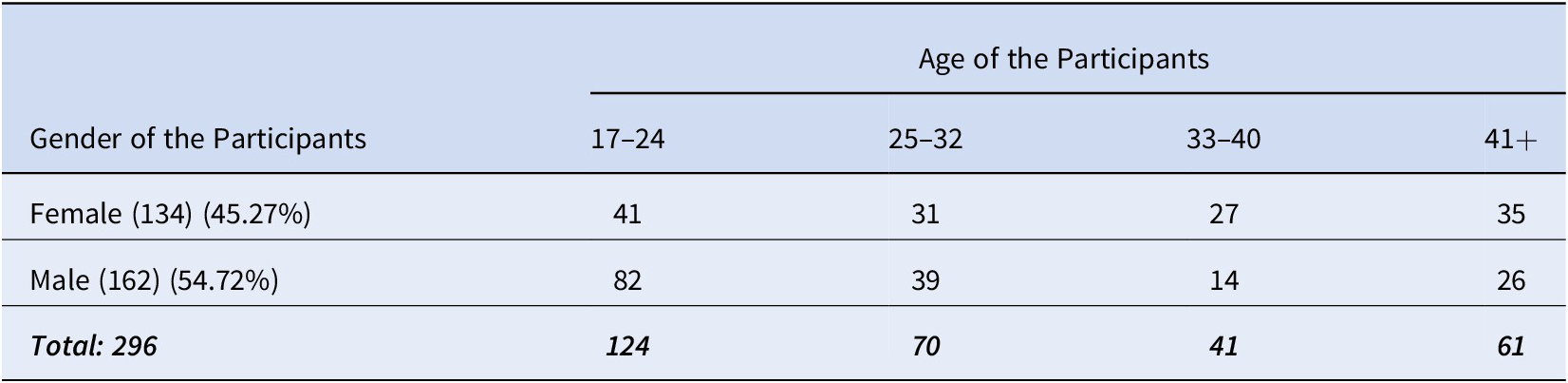
Table 1 below shows the age and gender profile of the participants.
Participants’ Age and Gender
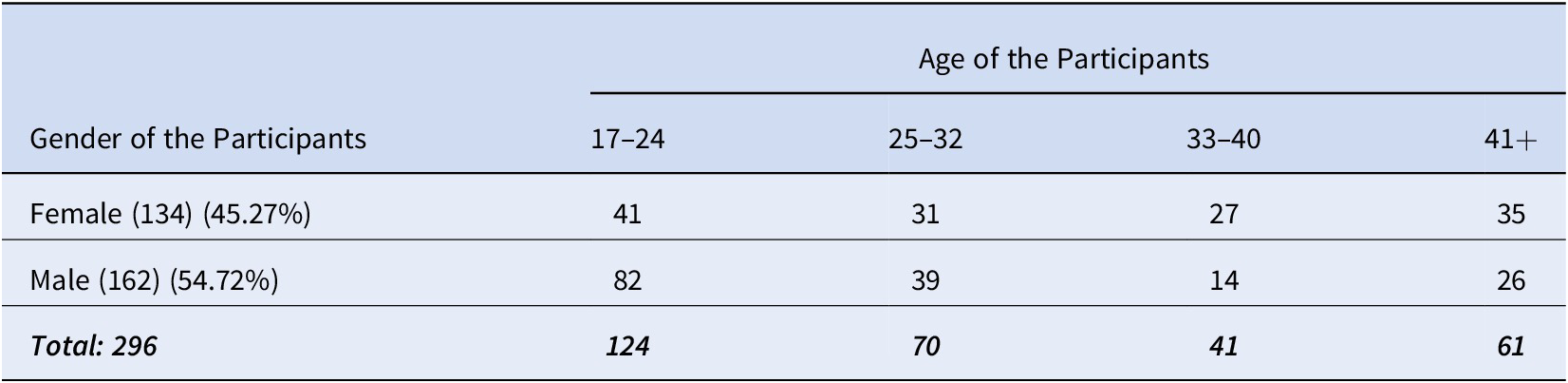
About 50% of the respondents were born in Baku. Nine participants represent minority groups, and six of them affiliate themselves first with Azerbaijani and then with the relevant ethnic identity.
Ethno-Linguistic Affiliation
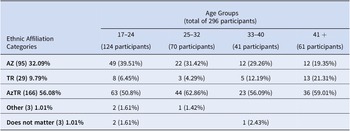
In terms of personal ethnic affiliation, the participants’ responses are as follows (table 2).
Expression of Personal Ethnic Identification
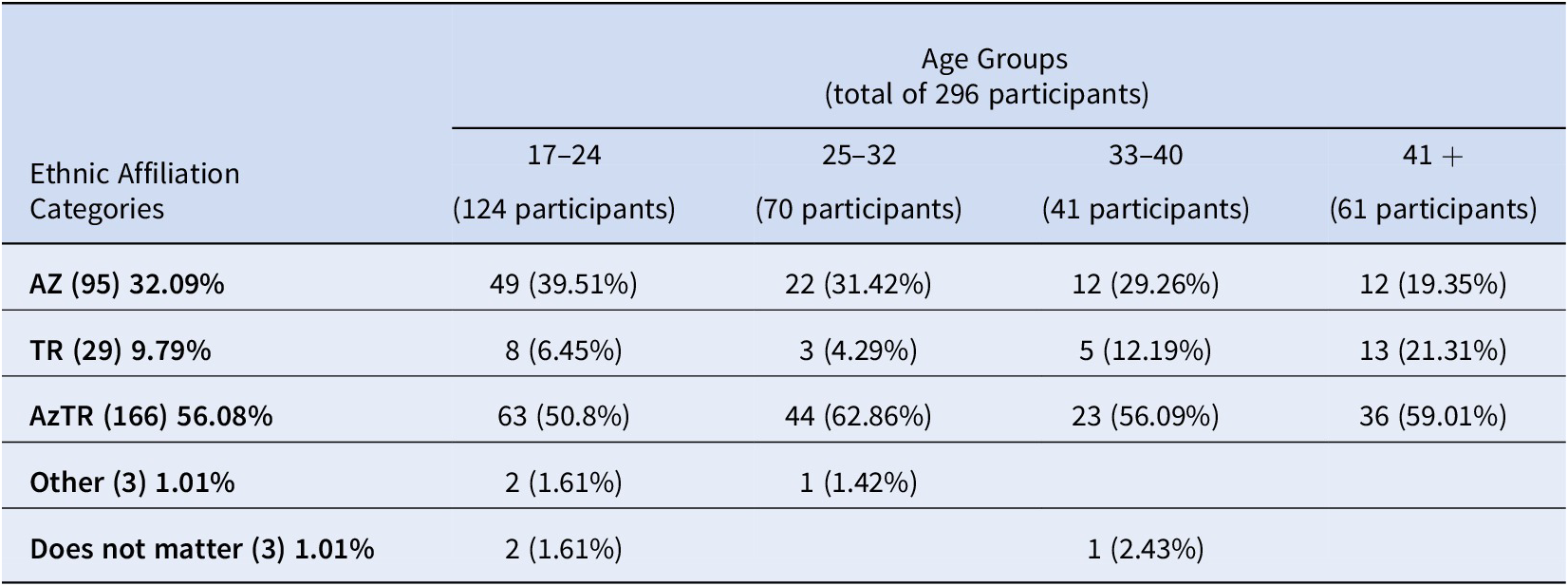
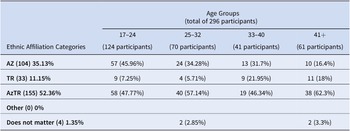
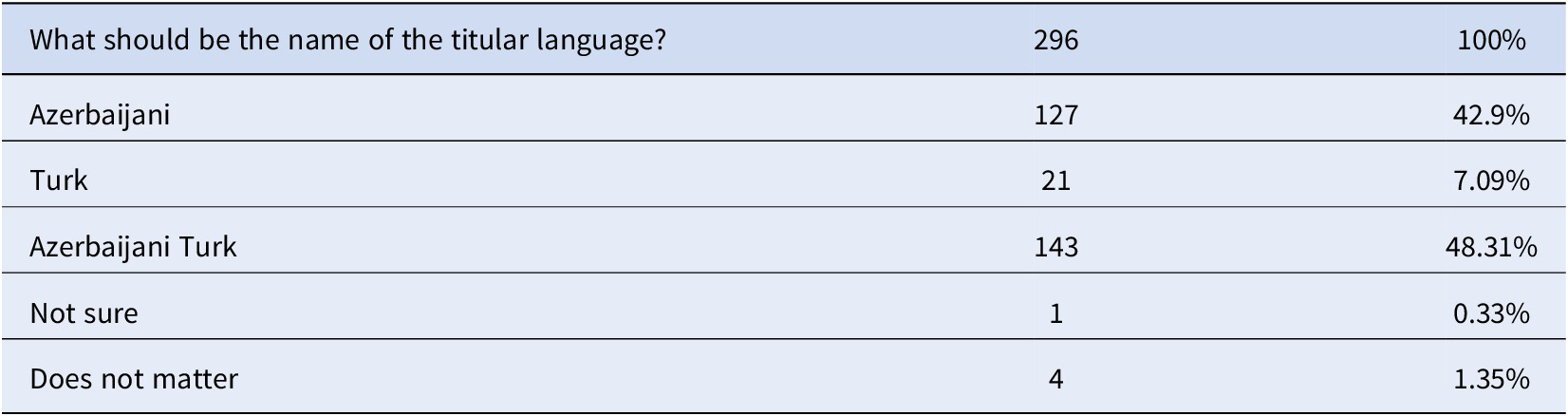
Table 3 shows how the participants identify Azerbaijan’s titular group.
Titular Group’s Ethnic Identification by the Participants
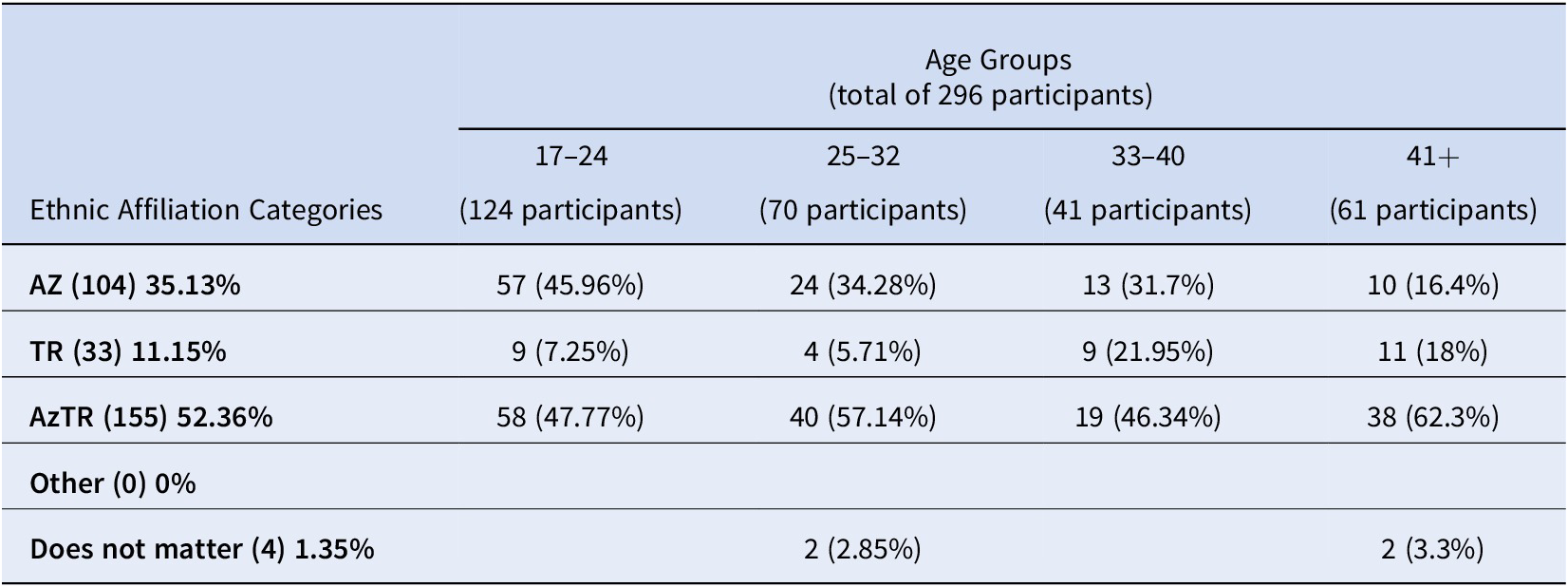
As the findings suggest, self-identification and identification of the titular group as Azerbaijani Turk prevails among other paradigms. This can be explained, first of all, by the fact that despite the well-entrenched ideology of Azerbaijanism shaped by Soviet policy-makersFootnote 5, the lost or retreated consciousness is at least to some extent brought back when Azerbaijanis find themselves in a larger Turkic-speaking environment. Hence, self-identification as Azerbaijani Turk should to a certain degree be seen as part of self-identification as Turk in that it still reveals the ownership of the name Turk but in/from a different territoryFootnote 6.
However, there is still a significant number of participants who affiliate with Azerbaijaniness, which shows that this identity paradigm is quite strong and distinctly expressed. Moreover, the younger the age category, the more pronounced the affiliation with the Azerbaijani identity. This is naturally explained, first of all, by the fact that the younger respondents are predominantly students who have not yet spent sufficient time in Turkey to be influenced by the discourse of Turkism. Instead, in Azerbaijan they were exposed to various channels, including public discourse, social activism, as well as culture promotion and awareness, through which the image of Azerbaijan and Azerbaijanis as citizens has recently been enhanced and made prominent. Besides, the Karabakh conflict and the related discourse have also certainly contributed to the increased affiliation with Azerbaijaniness among the youth.
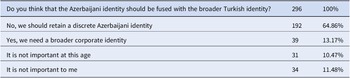
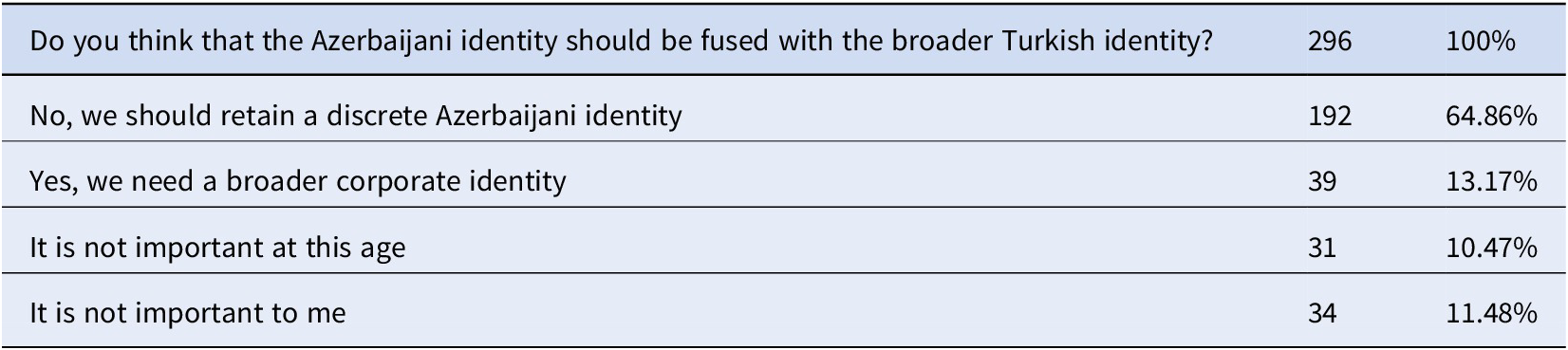
It should however be noted that, while not excluding the idea of Turkicness, the term Azerbaijani Turk is still specific and somewhat particularistic by nature. As was noted above, the strong affinity with the grand Turkic world expressed in early years of independence started declining slowly after the Popular Front, the nationalistic government that came to power in 1993, was succeeded by the new political elite. As Soltanov claims, “the process of de-romanticisation probably started as early as when the two countries began to explore each other in the first years of the 1990s” (Reference Soltanov, Ismayilov and Graham2016, 38). Optimism and positive social imaging of Turkey, which replaced early romanticism, and which was powerfully entrenched in, and sustained through, associating Turkey with secular principles of Kemalism, also started declining with increased politicization of Islam (Şirin Reference Şirin2016). This can explain well why many Azerbaijanis favor a discrete identity as Azerbaijani Turk, quite often as a source of pride (Ergun Reference Ergun2021, 7), and avoid the generic definition of Turk. The survey results also reveal this tendency: about 65% of the respondents (including 67% of those who identify themselves as Azerbaijani Turks) think that the self-perception of Azerbaijanis is strong and sufficiently discrete and therefore should not be assimilated within the global Turkic (or the dominating Turkish) identity (table 4).
Attitudes about Belonging
The survey contained a question seeking an evaluation of the role Shah Ismail Khatai (Ismail I), founder of the Safavid dynasty, played in the identity formation of Azerbaijanis. Because Khatai is highly revered in current public discourse as one of the most influential historic personalities who founded a great empire on the territory of Azerbaijan (Nazarli Reference Nazarli2017), and because this discourse is not without controversies, I thought that perceptions of Khatai would also provide insights into the identity constructions of Azerbaijanis in TurkeyFootnote 7 . The survey has revealed diverse perspectives. The participants’ opinions are mostly positive: most respondents appreciate him as founder of Azerbaijan’s statehood traditions, a ruler who authorized the use of Azerbaijani in palace affairs, a great personality who shaped the discrete identity of Azerbaijani Turks, the first historic statesman who expanded the territories of the Safavid Empire and who “saved Azerbaijani Turks from being ruled by Persians”, a great poet who contributed to the development of literary Azerbaijani, etc. Seventy four respondents think Khatai was just a historic personality. Twenty three participants who are critical about Khatai’s historic role think that it was due to his wrong policy, aimed at ongoing battles with the Ottoman Empire and the imposition of Shiism as state politics, that most Azerbaijanis lost their identity as Turks. However, even when respondents are critical of Khatai’s anti-Ottoman policy, they still highly value his positive role in promoting the use of Azerbaijani Turkic in certain state affairs.
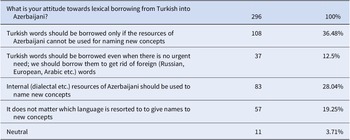
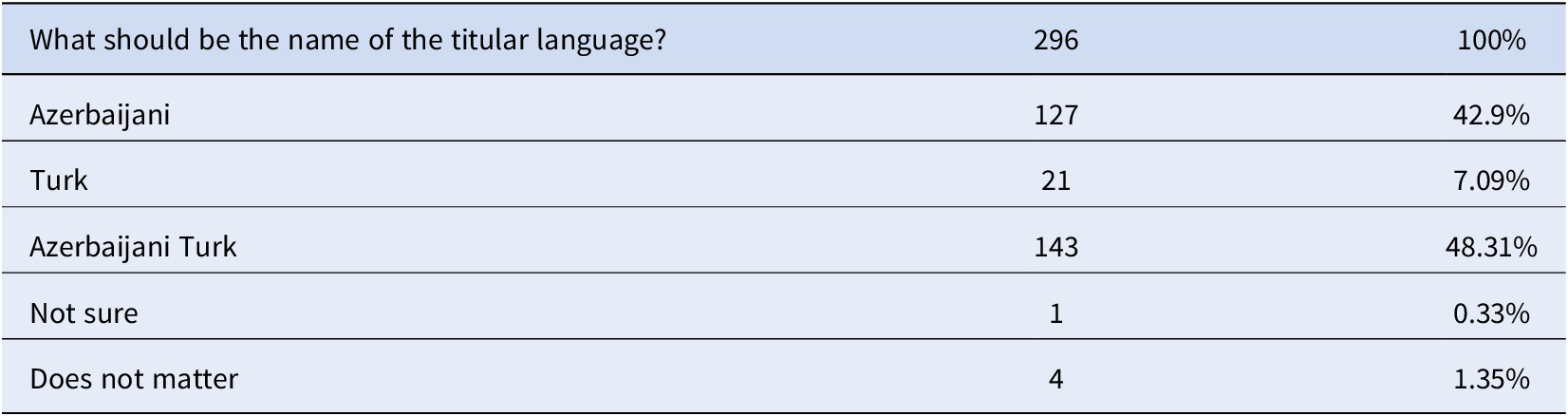
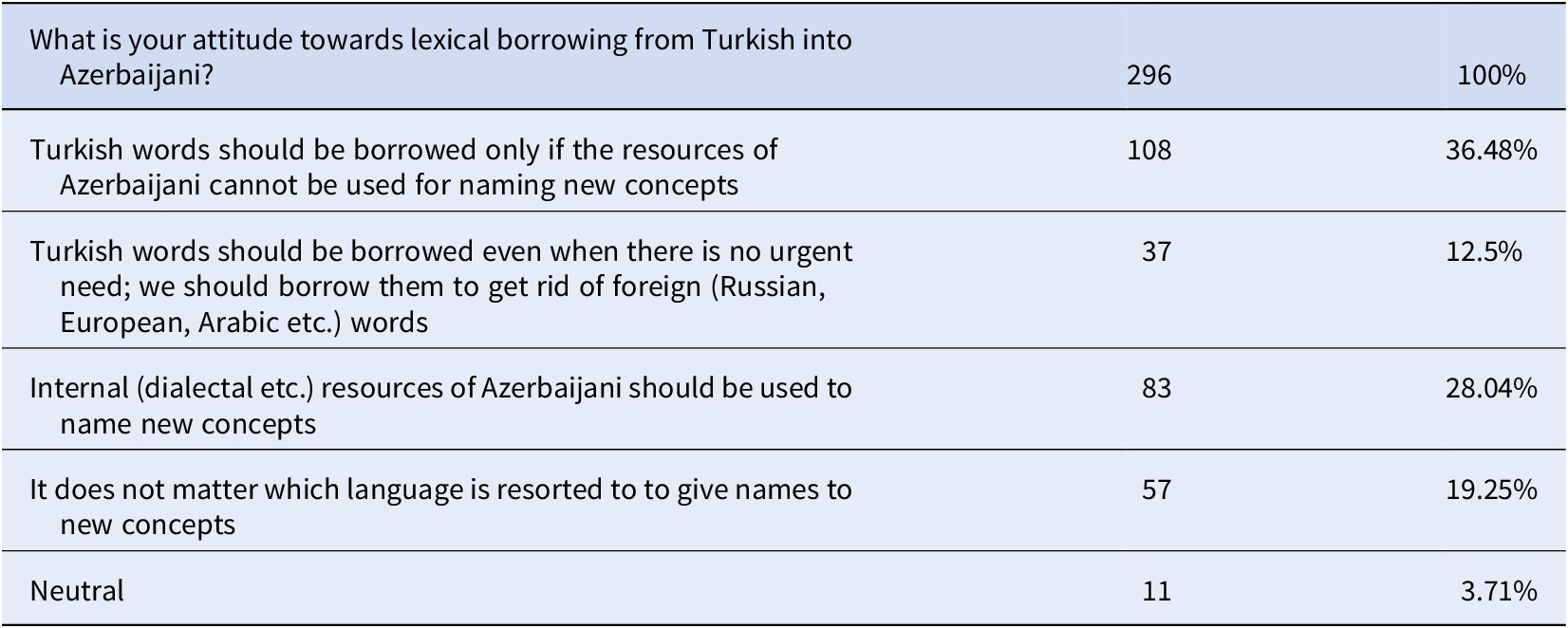
As tables 5 and 6 show, responses revealing linguistic affiliation support claims of ethnic identity perceptions significantly.
Attitudes towards the Titular Language Name
Attitudes towards Language Per Se
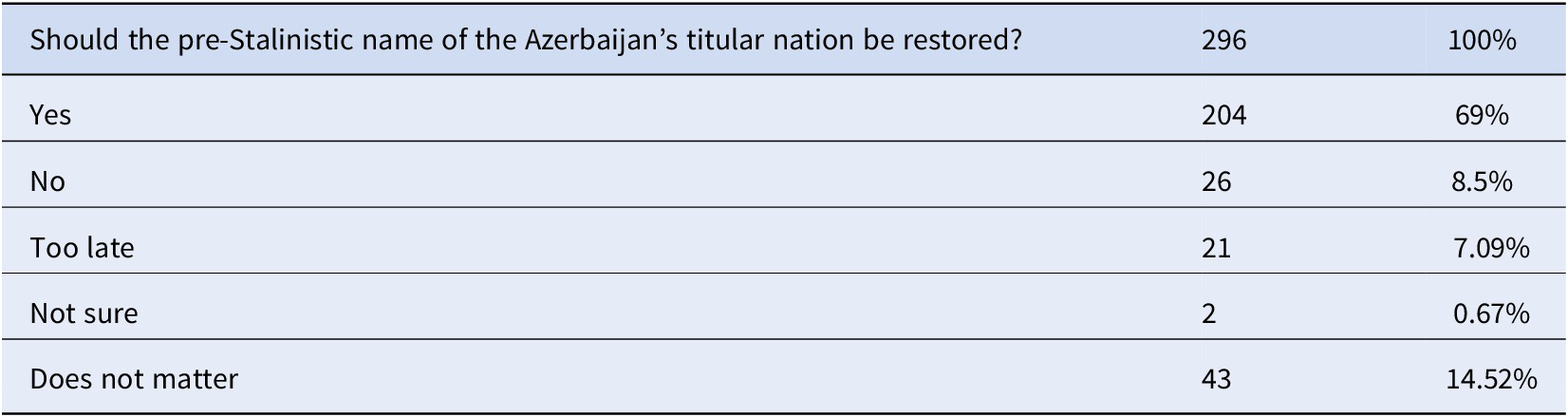
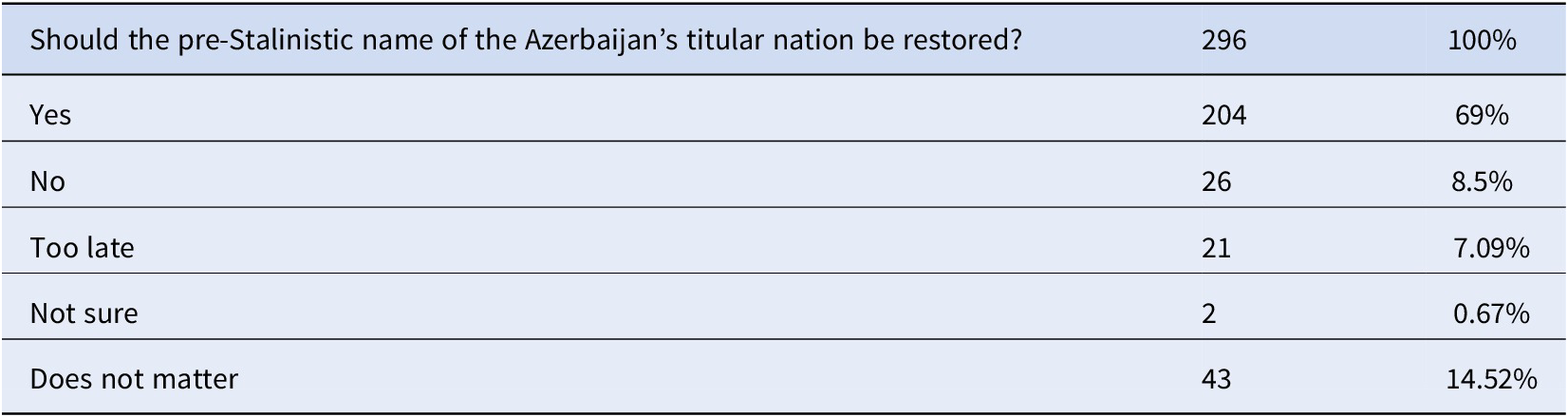
Further, as both the survey and the interviews have revealed, a considerable number of Azerbaijanis believe that the title Turk should be owned rather by Azerbaijani Turks than Turks of Turkey. They claim that historically Azerbaijani Turks did not mix with other ethnicities as much as Turks of the Ottoman Empire/Turkey did, and that Azerbaijani is much purer in terms of containing original Turkic linguistic elements. Some said they were concerned that Turks of Turkey considered themselves more Turk than Turks of Azerbaijan did, and some think that the term Azerbaijani was a political game orchestrated by Stalin and that Azerbaijanis were more Turk than Turks of Turkey. Hence, 69% of participants (including 82% of those who identify themselves as Azerbaijani Turk) support the idea of restoring the historic name Turk of the titular ethnic group (table 7).
Attitudes towards the Historic Name of the Titular Group
To understand how clear and consistent the delimitation between the concept of Azerbaijani and the concept of Turk/Azerbaijani Turk is, I looked at the correspondence of participants’ identification of Azerbaijan’s titular ethnic group with their own self-identification. For this purpose I considered only the participants belonging to the titular ethnic group, and excluded the representatives of minority groups and those who preferred not to express any ethnic affiliation either for themselves, for the titular group, or for both. As a result, I looked at 280 responses which revealed that not always was the term Azerbaijani understood clearly: some think the term Azerbaijani is the name of the titular nation, and some say it implies citizens of Azerbaijan regardless of ethnic belonging. Some, however, suggest that the titular nation of Azerbaijan should be named Azerbaijani as there are other ethnic groups living in Azerbaijan. As I had foreseen the risk of terminological confusionFootnote 8 , I had provided an explanation of what the word “titular” meant. Nevertheless, the confusion is obvious: 58 (20.71%) participants’ self-identification differs from their identification of Azerbaijan’s titular nation: 33 (11.78%) participants identify themselves as Azerbaijani Turks while defining Azerbaijan’s titular nation as Azerbaijani; and 25 (8.92%) participants identify themselves as Azerbaijani and think that the titular nation of Azerbaijan should be named Turk or Azerbaijani Turk. Meanwhile, 224 (80%) participants’ identification of Azerbaijan’s titular nation corresponds to their own self-identification: 66 (23.57%) of these participants identify themselves and the titular nation as Azerbaijani; and 158 (56.42%) participants identify both themselves and the nation as either Turk or Azerbaijani Turk.
Further clarification elicited through interviews was also confusing. Some respondents stated that they considered themselves Azerbaijani Turks because they lived in Turkey, and consequently, they were Turks, while the titular nation should be identified as Azerbaijani because they were based in Azerbaijan. One respondent, who identify herself as Azerbaijani Turk, and the titular nation as Azerbaijani, stated that she had spent several hours thinking about it. When she was asked to explain why she had defined her ethnic affiliation differently from how she identified Azerbaijan’s titular population (the original assumption from my side being that there may have been a relevant shift in her identity repertoire), her explanation was as follows: “If I lived in Azerbaijan, I would have identified myself as Azerbaijani - as a citizen of Azerbaijan; but since I live in Turkey, I identify myself as Azerbaijani Turk (a Turk from Azerbaijan).” Another participant who identifies herself as Azerbaijani Turk and the titular nation as Turk explained her position as follows: “We are all Turks as are the peoples of Central Asia. The individual identification should be different from the identification of the nation: I identify myself as Azerbaijani Turk just to refer to my geographical affiliation.”
At certain conceptualization levels, relative consistency between self-identification and ethno-linguistic perceptions is observed. For example, out of 25 respondents who have expressed a negative attitude toward restoring the historic name of the Azerbaijani people, 20 (80%) identify themselves as Azerbaijani. On the other hand, 18 (62%) out of 29 participants who identify themselves as Turk, have expressed a positive attitude towards possible convergence between Azerbaijani and Turkish. Besides, out of 37 participants who support borrowing from Turkish, only four identify themselves as Azerbaijani.
Linguistic Persistence
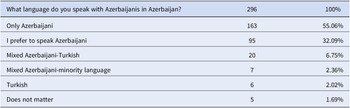
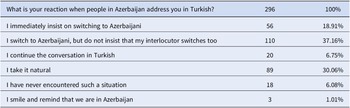
Only a few respondents who have lived in Turkey for many years and some who married Turkish nationals said they used mixed Azerbaijani-Turkish code at home. All other respondents reported speaking Azerbaijani at home and said they never used Turkish as a language of interaction with Azerbaijanis in Azerbaijan. However, while Azerbaijanis favor distinct identification of the native language and ensure its active use and maintenance, many see specific instances of language-mixing as a normal behavior due to linguistic proximity and as a functional tool facilitating communication and efficiency (table 8[a, b, c]). In fact, a significant Turkish influence on the speech of participants, especially those with a long experience of life in Turkey, is observable.
Attitudes towards Practical Language Behavior (Participants’ Own Behavior)

Attitudes towards Practical Language Behavior (the Behavior of Others)

Attitudes towards Practical Language Behavior (Language-Mixing)

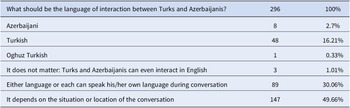
This function-oriented approach is also obvious from attitudes towards what/which language should be used in interaction between Azerbaijanis and Turks (table 9).
Attitudes towards the Choice of a Language of Interaction
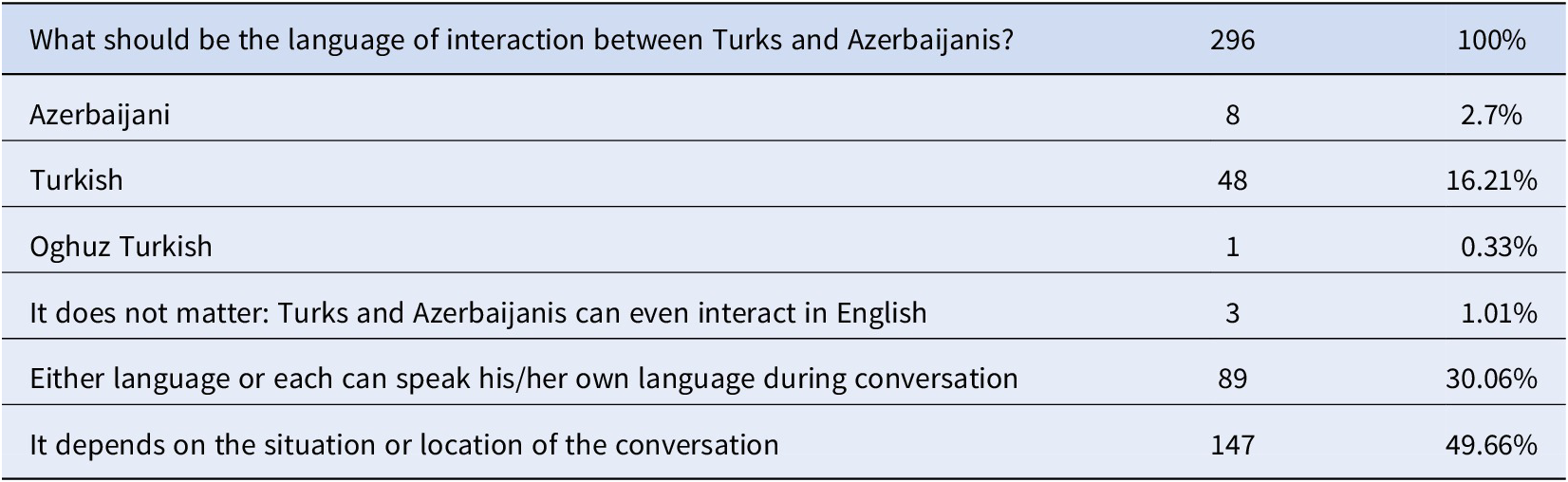
Nevertheless, the younger participants seem to be more persistent in terms of the mother tongue use: out of 56 participants who have reported insisting on a shift to Azerbaijani if their interlocutor initiated a conversation in Turkish, 46 (82.14%) are younger than 32.
Cultural Persistence
Azerbaijanis stay connected with their home community through maintained, regenerated, and transmitted traditions. Among the survey participants, 192 (64.86%) are active and 62 (20.94%) are moderate Azerbaijani media readers. About 73% of the respondents report celebrating all Azerbaijani public holidays, and 25.5% report celebrating only some of them. This is also true about traditional holidays including Novruz, the most important and favorite holiday of Azerbaijanis, and those inherited during the Soviet times, in particular New Year. Neither Novruz nor New Year is publicly celebrated in Turkey – the former for being associated with the Kurdish political movement, and the second, with Christianity. Nevertheless, the majority of Azerbaijanis do not seem affected by either the public discourse or the social behavior in regard to these holidays. Out of the total of 296 participants, 275 (92.9%) have reported celebrating Novruz. Among these, 221 (74.6%) celebrate it with the traditional Azerbaijani attributes. Only 19 participants (6.4%) have reported not celebrating Novruz, and some say they have stopped celebrating it after having moved to Turkey. Diaspora circles always organize large-scale Novruz celebrations that bring Azerbaijanis together. Some have even recently been able to bring Turkish high-level political figures to these celebrations. Two hundred forty four participants (almost 83.1 %) celebrate New Year; 145 of them decorate a New Year Tree as part of celebration, as is customary in Azerbaijan. Out of the 50 participants who do not celebrate New Year, only 29 state that they have stopped celebrating it after moving to Turkey. A few respondents said they did not want to attract their neighbors’ attention by decorating a New Year Tree, and some reported getting negative (or surprised) comments from their neighbors.
In terms of maintaining the food culture, the survey reveals that more than 77% of the participants have maintained the traditional tea culture typical of Azerbaijan. Also, except for 6% of the respondents, all others cook the traditional Azerbaijani cuisine either exclusively or along with complementing it with the Turkish cuisine.
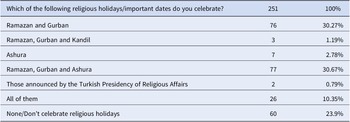
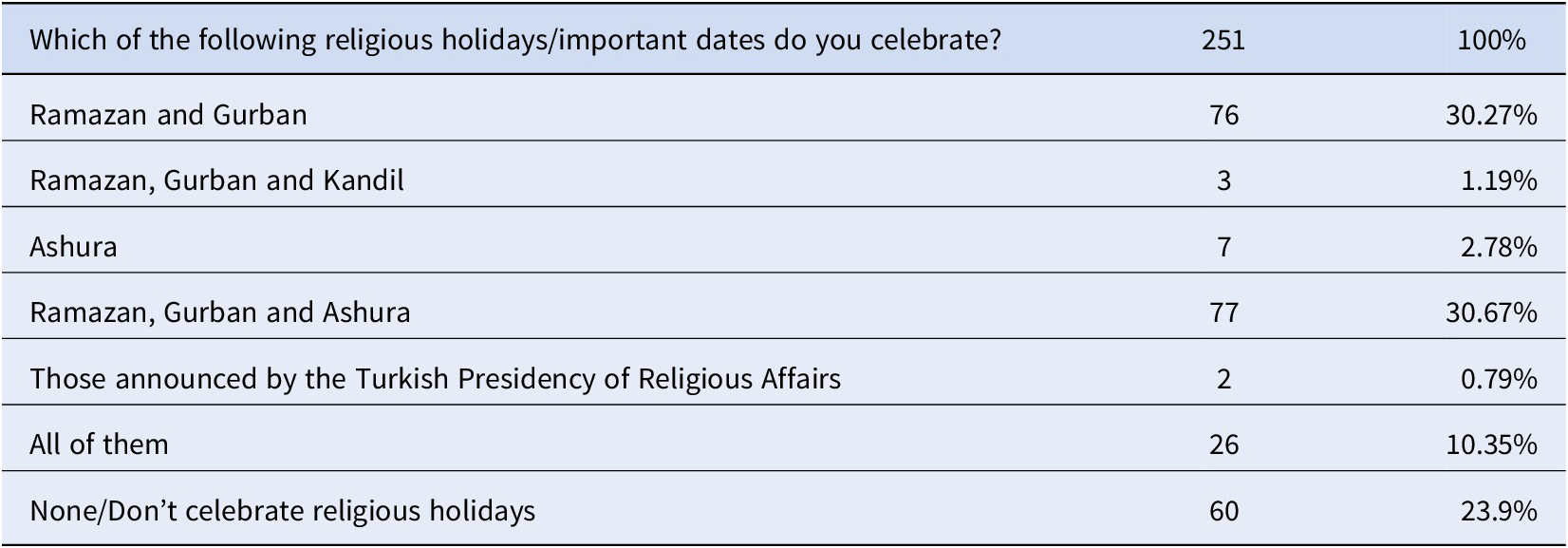
Religious practices also reveal interesting results. It appears that many Azerbaijanis, while celebrating Novruz and New Year, also celebrate major Muslim holidays such as Ramazan and Gurban and observe Shia traditions. Some have maintained a secular way of life. Out of 296 respondents, 110 (37.9%) observe Ashura, a holy day for Shias, which marks martyrdom of Husain Ibn Ali, grandson of Prophet Mohammad. Sixty participants (23.9%) said they did not celebrate religious holidays (table 10).
Religions Holidays Celebrated by Participants
Socio-Communicative Challenges
The participants have reported the following socio-communicative problems they say they encounter in Azerbaijan: pessimism (35 responses); communication ethics (89 responses); inefficiency and uncertainty (including lack of concreteness in time perception) (46 responses); insistence (9 responses). A few (6) respondents have mentioned other factors including bureaucracy, queuing culture, etc. Five participants have reported experiencing all or several of the cited socio-cultural and socio-psychological communicative challenges. Ninety-two people, or approximately 31% of the respondents, have stated that they have not experienced any socio-cultural or socio-psychological challenges of communication in Azerbaijan. Fourteen participants have not answered this question.
Thus, 190 participants (64.1%) report facing one or several socio-communicative challenges in the home country. This may certainly emerge as a factor potentially affecting perceptions about the home society and consequently hampering reintegration. In fact, according to 53 participants, Turkey was ahead of Azerbaijan, especially in terms of social and communicative culture, and therefore they felt more at home in Turkey. Additionally, 17 participants said they had started feeling alienated from the Azerbaijani society, and two said they felt they did not belong to either Turkey or Azerbaijan.
Nevertheless, these challenges seem to be more easily tolerated if (re)connection is exercised through short-term trips and involves concentrated interaction with close family and friends. In the case of Azerbaijanis living in Turkey, the sustainability of such (re)connection is facilitated by a relatively short distance between the two countries, frequent flights, absence of visa requirements, and the new regulation of the possibility of travelling without an international passport. Also, the recent COVID-19-triggered developments in virtual communication must have changed the entire attitude towards reintegration and have probably facilitated participation and time input. A great number of Azerbaijani diaspora members in Turkey have actively been participating in various online cultural and academic events, conferences, and political discussions organized in Azerbaijan. As survey results show, the participants are quite positive about staying connected with Azerbaijan, and being involved in socio-cultural processes taking place in the country. Many report missing close communication, food, music and cultural life in Azerbaijan. Many have noted that they miss their family members and friends. Seventy-four participants say they do not feel estranged from either Azerbaijan or Azerbaijani culture, and that they feel at home in Azerbaijan. One hundred twenty participants feel that they belong both to Turkey and Azerbaijan to the same degree and that there is no great difference between the two societies. Nineteen participants said they had recently been feeling better in Azerbaijan because Turkey was no longer the country they used to know.
Although “dispersed populations do not necessarily expect or desire a diasporic return” (Canagarajah and Silberstein Reference Canagarajah and Silberstein2012, 81), it is common for diasporic communities, at least for the first two generations, to have a sense of “living outside of a territory to which they are historically ‘rooted’” (Kafle Reference Kafle2010, 136). A significant number of survey participants (116 out of the total of 296) think of returning to Baku at some point in the future. Among them, 58 (50%) are younger than 25, and 58 (50%) are older than 25, which accounts for 46.7% and 34.1% of the respective cohorts. This is true that with intensified migration processes, it is not rare for migrants to consider Turkey as a transit country (Kirişci Reference Kirişci2004, 7), and Azerbaijanis are certainly no exception. Some respondents who do not want to stay in Turkey in fact stated a desire to move to a new country. However, the majority of these respondents want to return to Baku, and the motive is emotional. Among major reasons, the participants mostly indicate missing Baku and/or the desire to reunite with the family. Thirteen respondents, among whom seven are younger than 25, four are younger than 32, and two are older than 50, said they would like to return because they wanted to be useful to Azerbaijan and to contribute the knowledge and skills gained in Turkey to the development of their motherland. On the other hand, Karabakh emerges as an important motivator for closer reintegration. Thus, out of 116 respondents, who wish to return to Azerbaijan, 16 (four of whom are younger than 24) link their desire to the Karabakh factor. Also, 22 respondents have reported engaging in the Azerbaijani media more after the Second Karabakh War started.
The desire of repatriation is also triggered, at least for some people, by certain social factors that seem to hold Azerbaijanis back from full integration into the Turkish society. Among major reasons impeding such integration, the respondents have reported the following: (a) Turkey’s values do not coincide with those of Azerbaijan (12 responses); (b) living in Turkey is a mental/psychological challenge (10 responses); (c) living in Turkey is an economic challenge (14 responses); and (d) Turkey has lost its attractiveness (10 responses). A few other respondents complained on being challenged by the Turkish cuisine (two responses), Turkish way of living (one response), religiousness (one response), manners of communication (one response), difficulties in finding employment (one response), and the distance some Turks try to keep with Azerbaijanis (five responses).
However, the participants also indicate serious obstacles of socio-economic character standing in the way of repatriation. Almost all of the labor migrants I interviewed expressed a concern over finding a job in Azerbaijan, and some said they would consider returning if serious social and economic reforms started in Nakhchivan without which finding a decent job would be a challenge. Some are concerned about finding a proper job with sufficient remuneration and prestige. Some musicians I interviewed expressed their desire to return to contribute to the revitalization of classical music in Azerbaijan but said they were not sure whether they would ever be invited and, if they did, whether they would be offered a decent job. One famous musician says he would be honored to return and help restore the classical music traditions of Azerbaijan, and that he is hoping he will be invited to be part of the country’s music education reforms.
Conclusion
The identity production of Azerbaijani diaspora in Turkey significantly reflects tendencies of Azerbaijan’s identity politics although it is not void of nuances informed by living in the Turkish society. The balancing between the concepts of Turkism and Azerbaijanism is rooted in the nationality discourse that goes back to at least more than hundred years ago when Azerbaijan established its first Republic. With a long interruption caused by the Soviet ban on the name Turk, this balancing has survived to our days while constantly changing its character depending on political priorities and conflict mitigation strategies of ruling elites. Consequently, the identity repertoire of Azerbaijanis in Turkey is reflective of both the awareness of the Turkic roots, which is enhanced by living in Turkey, adherence to distinct Azerbaijaniness nuanced by claiming equal entitlement to the name Turk, and harmonious co-existence of both Turkism and Azerbaijanism (Ergun Reference Ergun2021, 7) as significant parts of identity paradigms. While Turkism is an important factor in terms of self-perception, Azerbaijanis tend to express their affiliation with Turkicness within the context of their geographical origin hence framing their ethnic identity territorially. This also reflects Azerbaijan’s current identity politics with a strong focus on statehood values and territorial integrity as strong societal components of the national identity. The framing becomes even more salient when we look at language and culture related attitudes of Azerbaijanis in Turkey, who treasure both the native language and the traditional culture and ensure that they are transmitted to future generations. However, if identity is a contextual and dynamic phenomenon (and it certainly is), then we also need to look at it in motion. In the context of diaspora perceptions, identity mainly emerges as or through manifestations of constant connection, reconnection, or rejection of such with homeland. As Dutt-Ballerstadt states, “as subjects are caught in … continuous process of transculturation, what is at stake is not so much the identity of the already hybrid subject, but the hybrid’s relationship to home and nation” (Reference Dutt-Ballerstadt2010, 132). In the context of such relationships, the Azerbaijani diaspora in Turkey is somewhat caught between the attractiveness of home, coupled with declining attractiveness of the host country, and socio-cultural and/or socio-economic challenges, including those of self-realization, in homeland. This is however a bidirectional dynamics: some Azerbaijanis, especially those who come from peripheries, find, instead, socio-cultural patterns existing in Turkey (in particular in urban places) challenging. These challenges often become the main obstacle for full integration into the Turkish society. Interestingly, as was observed, the more challenging the integration, the higher the resistance to Turkish linguistic elements. The opposite tendency, on the other hand – i.e., intentional avoidance of Azerbaijani linguistic elements as a reaction to reintegration challenges – is not observed.
One possible context to frame challenges of integration into the host society and those of reintegration into the home society would be Uncertainty Avoidance Index (UAI) (de Mooij and Hofstede Reference de Mooij and Hofstede2010, 90) difference between Azerbaijan and Turkey, which obviously creates a socio-psychological stress. Due to its socio-political history and Western-oriented development root (at least until recently), Turkey certainly scores higher on the Uncertainty Avoidance Index in comparison to Azerbaijan, an Eastern society which has been part of the Russian Empire and then the Soviet Union for many years. As Isurin states, “Eastern cultures, including Russia, fall into the category of collectivist cultures” (Reference Isurin2011, 105) where societal relationship models have heavily been rooted in dependence on the collective perceptions and thus lack of discreteness and concreteness, which, by itself, devalues the need for uncertainty avoidance. Models of behavior in collectivist societies, including socio-linguistic behavior, are therefore quite influential in shaping tolerance of uncertainty (Hofstede, Hofstede, and Minkov Reference Hofstede, Hofstede and Minkov2010, 112–113). It is not surprising to encounter Azerbaijanis, mainly representatives of older generations with a Soviet life experience, who feel more at ease communicating with people from post-Soviet countries than communicating with Turks from Turkey. Apparently, the Homo Post-Sovieticus is still a major framework shaping the dynamics of perceptions, integration, reintegration, and identity production.
Acknowledgements
I would like to express my gratitude to Sevdagul Aliyeva, Tural Ahmadov, Sevinj Ucgul, Huraman Hulya Agaoglu, Togrul Ismayilov, Riza Karabag, Elchin Ibrahimov, Ali Asker, Teymur Gasimli, Suer Eker, Elnur Khalilov, Nazrin Gadimova-Akbulut, and Aygun Hasanoglu for facilitating interviews and surveys. I am also immensely thankful to all my survey participants and informants.
Disclosures
None.