Introduction
There is little doubt that non-avian dinosaurs sustained complex relationships with other types of organisms that shared their environments. In particular, invertebrates and protists almost certainly played major roles in dinosaur paleobiology (e.g., Poinar and Poinar, Reference Poinar and Poinar2008; Gao et al., Reference Gao, Shih, Xu, Wang and Ren2012; Huang et al., Reference Huang, Engel, Cai, Wu and Nel2012). However, very little direct fossil evidence of interactions involving dinosaurs and small organisms has been described to date, leaving substantial gaps in our understanding of Mesozoic ecosystems. Most such reports have described arthropod borings on bones, with an emphasis on implications for vertebrate taphonomy (Rogers, Reference Rogers1992; Kirkland et al., Reference Kirkland, Delgado, Chimedtseren, Hasiotis and Fox1998; Hasiotis et al., Reference Hasiotis, Fiorillo and Hanna1999; Paik, Reference Paik2000; Nolte et al., Reference Nolte, Greenhalgh, Dangerfield, Scheetz and Britt2004; Bader, Reference Bader2005; Britt et al., Reference Britt, Dangerfield and Greenhalgh2005; Roberts et al., Reference Roberts, Rogers and Foreman2007; Chin and Bishop, Reference Chin and Bishop2007). Coprolites provide different types of evidence, including fossil dung beetle burrows (Chin and Gill, Reference Chin and Gill1996) and gastropods (Chin et al., Reference Chin, Hartman and Roth2009) in probable hadrosaur coprolites. In addition, Poinar and Boucot (Reference Poinar and Boucot2006) reported parasite cysts and eggs from a coprolite attributed to a dinosaur.
Trace fossil evidence for a previously unknown ecological relationship between non-avian dinosaurs and soft-bodied organisms now provides new insights on Cretaceous ecosystems. The trace fossils, including previously undescribed paired traces, were discovered in the gut region of an articulated subadult skeleton of a hadrosaurid dinosaur, Brachylophosaurus canadensis, from the Upper Cretaceous (middle–upper Campanian) Judith River Formation of northern Montana (Fig. 1). This dinosaur specimen (JRF 115H; Judith River Foundation, Malta, Montana, U.S.A.) is unusual because it contains plant material in the gut region that appears to represent gut contents (Tweet et al., Reference Tweet, Chin, Murphy and Braman2008). Morphology, wall chemistry, dimensions and other quantitative characteristics of the trace fossils inside the brachylophosaur skeleton were examined to evaluate the nature of the interaction and the identity and paleobiology of the trace makers.
Location of discovery site of JRF 115H (modified from Tweet et al., Reference Tweet, Chin, Murphy and Braman2008)

Materials and methods
Brachylophosaurus canadensis specimen JRF 115H was found approximately 25–30 km north of Malta, Montana, in northeast-central Phillips County (Fig. 1). The discovery site is in the middle of the Judith River Formation. The rocks at this locality are fluvial in origin, characterized by laterally discontinuous, fine- to medium-grained sandstone beds interbedded with mudstones and siltstones (Tweet et al., Reference Tweet, Chin, Murphy and Braman2008). JRF 115H was found partially encased in large carbonate concretions in a sandstone layer (Murphy et al., Reference Murphy, Trexler and Thompson2007). The probable gut contents are found in the torso and abdominal regions and consist of abundant millimeter-scale, poorly preserved plant fragments in a clay matrix. Computer-assisted image analysis of thin sections shows the average composition of the material is approximately 63% clay, 28% organic inclusions or iron-stained inclusions, and 9% silt- to sand-sized clasts, which are mostly 50–100 μm quartz grains (Tweet et al., Reference Tweet, Chin, Murphy and Braman2008). Many of the organic fragments appear to be leaf fragments of unknown taxonomic affinity (Tweet et al., Reference Tweet, Chin, Murphy and Braman2008). Sedimentologic and taphonomic evidence indicate that JRF 115H was buried in a fluvial channel setting, and the gut-region plant material has been interpreted as probable gut contents that were infiltrated by clay. The articulation of the skeleton, presence of probable gut contents, and large patches of undisturbed integument impressions indicate that the carcass was buried rapidly soon after death (Tweet et al. Reference Tweet, Chin, Murphy and Braman2008).
Samples of probable gut contents were removed from three areas of JRF 115H for analysis. Relatively few samples were extracted in order to minimize destruction of the specimen (Tweet et al., Reference Tweet, Chin, Murphy and Braman2008). Samples measured at most a few centimeters in their longest dimension, with none greater than 7.6 cm on a side. Three large samples and several small fragments were taken from a site in the thoracic region enclosed by the rib cage. Three sets of abdominal samples were taken from gut contents exposed posterior to the legs and ventral to the ischia. Eleven samples were taken from pieces recovered from a section of gut region material associated with ischial fragments that broke off during excavation (Fig. 2).
Exposures of gut region material in the brachylophosaur skeleton: (1) torso of JRF 115H, showing the thoracic sampling area in the center and the abdominal sampling area on the right, posterior to the hind legs; (2) diagram of JRF 115H, indicating sampling locations (modified from Tweet et al., Reference Tweet, Chin, Murphy and Braman2008).
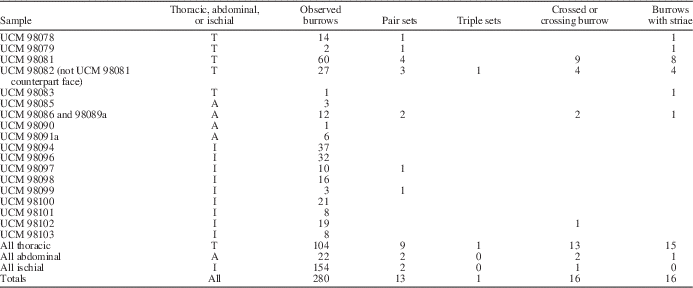
All surfaces of the 19 gut region material samples were examined with a Leica MZ 12.5 stereo microscope, revealing approximately 280 tiny trace fossils (Table 1). Although the traces were counted separately, some likely continue through multiple adjacent samples and may have been counted more than once. Characteristics of 73 trace fossils, including all well-preserved specimens exposed in planar view, were documented by photographs and digital measurements (Supplemental Data 1). Characteristics recorded included trace diameter, preservation quality, presence of a calcareous layer or lining, presence of striae in the lining, and occurrences of paired traces (two structures that share a wall), tripled traces (three parallel structures with two common walls), and crossed traces (traces that cross or are crossed by another). Because trace fossils preserved in plan view were more informative than those seen in cross-section, samples dominated by cross-sections of traces, such as ischial samples, are underrepresented in these data. The photomicrographs in Figure 3.1 and Figure 3.3 were taken with a SPOT RT digital microscope camera. The other photomicrographs that make up Figure 3 were taken with a Canon 5D Mark II digital camera, and multiple images focused at different planes were integrated with Zerene Stacker focus stacking software (Figs. 3.2, 3.4, 3.5, 3.6).
Several trace fossils and trace intersections in probable brachylophosaur gut contents: (1) multiple trace fossils, including several long, paired trace fossils across much of the photograph and an apparent example of a trace crossing a pair (lower right corner; thoracic sample UCM 98081); (2) trace fossils in cross-sectional view, showing elliptical sections of a loop (ischial sample UCM 98096); (3) an example of paired traces: two trace fossils are either coming together or separating in the lower left corner, with a sustained connection and undeformed walls for at least 1.1 mm; note that the right trace of the pair crosses over another trace in the upper right corner, which shows a circular cross section (thoracic sample UCM 98082; holotype of Parvitubulites striatus n. gen. n. sp.); (4) a close-up on a segment of tripled traces, emphasizing the shared walls (thoracic sample UCM 98082); (5) a close-up on part of the trace fossils in Figure 3.1, one of the best examples of paired traces, focused on a section with a matched directional change (thoracic sample UCM 98081); (6) fine striae incised in the inner surface of a trace lining (thin, evenly spaced lines following the overall direction of the trace) (thoracic sample UCM 98081).
Burrow characteristics by specimen. Numbers of observed burrows are estimates because of burrow incompleteness and distortion.
Four pieces of the gut region material were impregnated with epoxy so thin sections could be made. One specimen, UCM 98079 (University of Colorado Museum of Natural History, Boulder, Colorado, U.S.A.), was carbon-coated for analysis with the PGT energy-dispersive spectrometer (EDS) of a JEOL JXA 8600 electron microprobe, in order to examine the chemical composition of the calcareous layer or lining. This specimen subsequently was gold-coated so photos could be taken with an ISI SX30 scanning electron microscope (SEM).
Results
The trace fossils in the gut contents of JRF 115H are visible to the naked eye as thin, sinuous, white or beige lines in plan view (Fig. 3.1). Cross-sections of the traces are simple and circular to elliptical (Fig. 3.2). When viewed under a microscope, it is evident that the lines occupy a continuum from flattened strip-like features to partially preserved cylindrical features. No traces were observed associated with the soft-tissue impressions that cover much of the exterior of JRF 115H, but this may be due to the different substrates (cemented very fine sand on the exterior versus silt, clay, and organic fragments in the gut region). Trace fossils were not recognized in thin sections of the gut region material, possibly due to distortion caused during thin section preparation of the fragile material.
Trace diameters were measured where discernible, resulting in a sample size of 62 traces. Where possible, diameters were measured at multiple points along a single trace and then averaged. Well-preserved examples range from about 0.2 to 0.4 mm in diameter, and are typically about 0.3 mm (Supplemental Data 1). No well-preserved larger or smaller trace fossils were observed, although five poorly preserved light-colored smeared trace fossils between 0.7 mm and 1.3 mm across were documented. It is possible that these larger smears are poorly preserved examples of parallel traces.
Many of the trace fossils can be followed for several millimeters. Two traces are around 20 mm long and eight are at least 10 mm (Supplemental Data 1). Most of the traces show primarily horizontal orientation with respect to the original orientation of the carcass, with minor vertical orientation. The traces generally are gently curved to slightly sinuous. Complex meandering or branching patterns are not evident, but some trace fossils cross or reuse part of an older trace (Fig. 3.1, 3.3), forming a ridge at the site of overprinting.
Among the most distinctive characteristics of the trace fossils are paired arrangements, where two traces share a wall for a distance at least twice the diameter of an average unpaired structure (Fig. 3.1, 3.3, 3.4, 3.5). Twenty of the 73 measured trace fossils are paired, forming at least 13 pairs (Supplemental Data 1; some are paired more than once along their lengths). In one case, three parallel traces share walls. Paired traces show no gross distortion of either trace; the unshared walls maintain constant distances from the shared wall. In addition, pairs may exhibit matching directional changes (Fig. 3.1, 3.5).
EDS analysis shows that the thin (approximately 15 to 20 μm thick), light-colored, microcrystalline layer coating or lining the walls of many of the trace fossils has a strong calcium peak. The marked thinness of this lining makes it difficult to discern in cross-section and may help explain the apparent lack of visible traces in thin section: a trace fossil with such thin walls would be difficult to distinguish from other void spaces of similar size. Fine striae are evident in the calcareous layer of some of the well-preserved trace fossils; 16 of the 73 measured traces appear to have striae (22%; Table 1 and Supplemental Data 1). The individual lines are spaced about 10 to 30 μm apart and are roughly equidistant from one another (Fig. 3.6). The striae usually parallel the walls, but in one case lines run into a wall at a low angle where a trace curves. In other examples, the preservation of the calcareous lining is so poor that only an irregular whitish strip is present. Scanning electron microscope (SEM) and microprobe images show that the microcrystalline calcareous lining of the striae ridges is characterized by curves and undulations. These ridges also appear to be fractured into rectangular segments (Fig. 4).
Scanning electron microscope photomicrograph of striae from a pair set in thoracic sample UCM 98079.
Discussion
Identifying the type of trace fossil
These tiny structures have a unique combination of characteristics that have not been previously described. Several interpretations of the traces can be considered, including origins related to fungi, pedogenic processes, plant roots, and burrows. Of these, some structures can be ruled out on the basis of size. The gut region traces are much larger than individual or paired calcareous needle-fiber structures, which are reported to be no more than 20 μm in diameter (Verrecchia and Verrecchia, Reference Verrecchia and Verrecchia1994). Both needle-fiber structures (Verrecchia and Verrecchia, Reference Verrecchia and Verrecchia1994; Khormali et al., Reference Khormali, Abtahi and Stoops2006) and calcified filaments (Durand et al., Reference Durand, Monger and Canti2010) are inferred to be formed by mineralization of fungal hyphae traces, which are typically on the order of 25 μm across and are rarely greater than 50 μm (Sarjeant, Reference Sarjeant1975). In contrast, the gut region trace fossils are approximately 300 μm in diameter.
Taphonomic, diagenetic, and pedogenic processes can preserve a variety of rhizoliths—organosedimentary structures formed by or around roots (Klappa, Reference Klappa1980). Of these, rhizotubules and calcified roots can most closely resemble the gut region trace fossils. Rhizotubules are mineralized tubes that formed around a root or within the outer portion of voids left by decayed roots (e.g., Klappa, Reference Klappa1980; Kraus and Hasiotis, Reference Kraus and Hasiotis2006; Genise et al., Reference Genise, Bellosi, Verde and González2011). Roots can also become calcified when their tissues are replaced with calcite (Jaillard et al., Reference Jaillard, Guyon and Maurin1991; Khormali et al., Reference Khormali, Abtahi and Stoops2006). Although rhizotubules, calcified roots, and carbonate coatings of void spaces are common pedogenic features of calcareous soils (e.g., Jaillard et al., Reference Jaillard, Guyon and Maurin1991; Khormali et al., Reference Khormali, Abtahi and Stoops2006; Durand et al., Reference Durand, Monger and Canti2010), it should be noted that analyses of JRF 115H gut region samples indicate calcium levels of only 2.5 to 3.0 wt. % (Tweet et al., Reference Tweet, Chin, Murphy and Braman2008). The relatively low calcium content of the gut region substrate is also supported by the fact that no calcite-filled fissures in the substrate were observed.
Root systems are generally characterized by variations in diameter reflected in tapering and branching into smaller structures (e.g., Klappa, Reference Klappa1980; Retallack, Reference Retallack1983). In contrast, the gut region traces do not branch or change diameter, and all documented examples display a narrow range of diameters. In addition, well-preserved root traces can have root hairs (Klappa, Reference Klappa1980), which are not present in the trace fossils of JRF 115H. Thus, although the tubular morphology of the traces is similar to that of rhizotubules, the overall structure and patterns of the traces are different from root systems. The fine scale features of the striae are also distinctively different. Some calcified roots are characterized by discrete calcified cells that are tightly packed in tessellated arrangements (Jaillard et al., Reference Jaillard, Guyon and Maurin1991; Khormali et al., Reference Khormali, Abtahi and Stoops2006), but such cells are not present in the gut region traces. Other examples of calcified root tissues display longitudinal ridges that reflect root epidermal tissues, such as calcified Quaternary-age features figured in Klappa (Reference Klappa1980, fig. 7a). However, the linear features within JRF 115H show negative topography (with sharp edges incised into the substrate), unlike the positive topography (with rounded ridges protruding out of the substrate) illustrated in Klappa’s figures.
Although the color profile of these tiny traces within the gut region substrate superficially resembles the rhizohalos that mark redoximorphic conditions around ancient roots, the features of the gut region trace fossils indicate a different mechanism of formation. Rhizohalos form when soluble iron(II) is flushed out of sediments within the reducing environment of a root channel, while iron exposed to oxygen outside of the root channel is precipitated as insoluble iron(III). This results in a two-toned rhizolith comprised of gray, iron-deficient sediments within a root channel surrounded by oxidized red or brown sediments (Kraus and Hasiotis, Reference Kraus and Hasiotis2006). However, this model does not fit the tiny tubular traces because they are open conduits that would have been exposed to oxygen. Thus the light color of the traces does not indicate a reducing environment and is not equivalent to the light-colored sediment-filled root channels of rhizohalos.
The taphonomic context of the dinosaur carcass is also difficult to reconcile with rhizoliths. The windows of opportunity for root trace formation in JRF 115H were limited to an early interval immediately after death but before deep burial, and a modern interval as the dinosaur remains became exposed to the elements. For both intervals, the primary stumbling block is the condition of JRF 115H itself. The studied samples were collected from what had been the underside of the specimen. If there were sufficient plant growth through the specimen to produce the observed trace fossils near the base of the carcass, then there should be evidence of roots elsewhere in the carcass. Instead, the skeletal remains and integument impressions appear undisturbed by plant growth. Root colonization before deep burial is unlikely because it is implausible for the carcass to have been unburied or shallowly buried long enough for plants to grow into the corpse without it having been significantly altered by decomposition, scavengers, and other surface processes. Once buried, the development of the large carbonate concretions in an otherwise relatively unconsolidated sandstone (Murphy et al., Reference Murphy, Trexler and Thompson2007) also would have served to discourage subsequent root penetration.
Attributing the traces to modern roots is problematic as well. The erosion that brought the carcass to light cut vertically through the pelvic region, but otherwise left the majority of the specimen buried in a hillside several meters from plant growth (Tweet et al., Reference Tweet, Chin, Murphy and Braman2008). There are what appear to be several examples of modern roots or hyphae associated with some of the gut region samples, but these are not preferentially associated with the trace fossils, and instead seem to exploit weak zones. They also are much thinner than the trace fossils, with widths on the order of tens of microns, although the diameters were likely affected by dehydration.
The morphological, geochemical, and taphonomic evidence do not provide a convincing argument for a root origin for the gut region trace fossils. However, the evidence is consistent with the interpretation that the trace fossils reflect the presence and activity of small worms. As noted above, the striae on the traces indicate that sharp points or edges were incised into the substrate, unlike cell impressions of calcified roots (Klappa, Reference Klappa1980; Jaillard et al., Reference Jaillard, Guyon and Maurin1991; Khormali et al., Reference Khormali, Abtahi and Stoops2006). These striae have been formed by external anatomical features of a stationary or burrowing worm. The narrow range of diameters also is more consistent with burrows or worm morphologies than plant roots (Boyd, Reference Boyd1975). As with the potential for root growth, the taphonomic context of the brachylophosaur skeleton indicates that trace-maker activity would have been constrained to the period immediately after death. However, burrowers are mobile, and they may already have been present inside the dinosaur before its death. The horizontal orientation and length of some of the observed trace fossils suggest that they reflect burrowing activity, although it is possible that some of the hollow traces are body molds of the animals, where the remains of a worm supported the three-dimensional shape while the burrow lining was mineralizing. Given these considerations, we infer that the linear features represent trace fossils made by tiny worms.
Taphonomic aspects
The narrow range of burrow diameters and the uniform morphology of burrows suggest that only one type of burrowing worm was present. This apparent monospecific assemblage of bioturbators in the gut contents is consistent with rapid removal of the dinosaur carcass from subaerial exposure, because most terrestrial carcasses immediately attract a varied fauna of invertebrate (Payne, Reference Payne1965; Smith, Reference Smith1986) and vertebrate scavengers.
The thin calcareous layers lining the trace fossils are noteworthy, because calcite is otherwise uncommon in the gut region material (Tweet et al., Reference Tweet, Chin, Murphy and Braman2008). It is possible that the linings represent the diagenetically altered remains of mucosal secretions from the burrowing worms. Mucus is a complex organic material that many burrowing invertebrates, but not terrestrial arthropods, secrete to facilitate movement and strengthen burrow walls in watery environments (Bromley, Reference Bromley1996). Such settings may be comparable to the decaying interior of JRF 115H. Mucus production can facilitate calcite precipitation by serving as a growth medium for calcite-precipitating microorganisms, as described for mucus produced by the modern bivalves Granicorium and Samarangia (Braithwaite et al., Reference Braithwaite, Taylor and Glover2000). Schieber (Reference Schieber2002) suggested that a similar process resulted in pyritization of mucus trails. If bodily remains of the burrowers were present in some of the structures, their bodies could have also provided a growth medium for calcite-precipitating microorganisms. Under this scenario, flattened burrow structures may represent trace fossils that collapsed because they did not have the burrowers’ bodies for support.
The well-preserved state of many of these tiny, thin-walled structures indicates that they were formed after the carcass had reached its final resting place. Burrows probably would not have been preserved with such fidelity if they had been made when the body was being transported or when the gut region material was very fluid. The poorly preserved trace fossils thus may represent burrowing before the onset of optimal conditions for preservation. The post-mortem gut region material would have presented a clay-rich burrowing environment with abundant mm-scale plant fragments and less abundant silt- to sand-sized mineral clasts (Tweet et al., Reference Tweet, Chin, Murphy and Braman2008).
Burrower identity
Although it often is difficult to assign burrows to a specific group of animals (Bromley, Reference Bromley1996), in this case the field of candidates can be constrained by the size, morphology, and lining features of the burrows. The fluvial burial setting of JRF 115H offers additional clues, if the worms immigrated into the carcass from the local environment. The diameters of the burrows restrict the size of the burrowers to animals with an adult or larval diameter of approximately 0.3 mm, which is near the upper end of the meiofaunal range (Higgins and Thiel, Reference Higgins and Thiel1988). The striking uniformity of burrow diameters suggests that the animals were either at adult size, or did not grow significantly during the time period when the trace fossils were being made.
The trace fossils do not exhibit a regularly sinusoidal morphology, which suggests that they were not made by animals that move by longitudinal flexure, such as some nematodes (Moussa, Reference Moussa1970; Chamberlain, Reference Chamberlain1975; Robinson, Reference Robinson2004). Similarly, the traces do not show meniscate or annulated burrow fill, which suggests that they were not made by animals that move by strong peristaltic motions, such as some annelids and insect larvae. However, the absence of features pointing to longitudinal or peristaltic motions could be a function of preservation and/or substrate.
The striae in the mineralized walls are interpreted as bioglyphs (Ekdale and de Gibert, Reference Ekdale and de Gibert2010) that might have been produced by bristle-like external features dragged through the substrate or deposited mucus. There is no evidence for significant appendages, such as hard mandibles or legs, because major distortions or marks incised in the walls are absent. These features suggest that the ancient burrowers had circular cross-sections and smooth exteriors, except for possible fine bristle-type structures.
These lines of evidence indicate that the trace makers were vermiform, meiofaunal-scale animals with small external projections. These animals would have been either endoparasites in the brachylophosaur, or else migrants from the freshwater channel sediment that moved into the dinosaur carcass. As previously noted, the distinctive calcareous lining of the trace fossils may indicate that the burrowers produced mucus. Of modern meiofaunal groups, one group that includes taxa that fit these characteristics is Phylum Annelida (Higgins and Thiel, Reference Higgins and Thiel1988). A group of tiny oligochaete annelids, the enchytraeids, presents one possible analogue for the tiny Cretaceous burrowers. They are mucus-producing, setae-bearing worms of appropriate size and terrestrial habits, and they ingest decaying plant matter (O’Connor, Reference O’Connor1967; Dasch, Reference Dash1983). Roundworms of the Phylum Nematoda also fit some of the characteristics of the trace fossils. However, roundworms are less likely because modern examples usually are smaller than 300 μm in diameter (Goodey, Reference Goodey1963), and their typical mode of locomotion is sinusoidal. It also is possible that the trace makers represent an extinct lineage of soft-bodied worms.
Burrower paleobiology
There are several behaviors that can motivate organisms to associate with carcasses, including scavenging, sheltering, and predation on other carcass fauna (Payne, Reference Payne1965). Remnant populations of parasites, as well as their eggs, also might be present in a fresh carcass. Sheltering cannot be ruled out based on the physical evidence, but it seems unlikely that the carcass would be found by one specific type of tiny animal in need of shelter but not by a wider spectrum of animals in need of a meal. Given the lack of morphologic diversity in the trace fossils, predation on other fauna is also unlikely. An additional possibility is that the trace makers could have been associated with debris introduced into the carcass, perhaps as enchytraeid-like animals feeding on dead vegetal matter.
In the absence of well-preserved body fossils of the burrowers or unambiguous morphologic features in the fossil traces, evaluating the likelihood of specific motives must be done through consideration of the taphonomic conditions and the nature of the available resources. It is reasonable to consider the trace makers in terms of being allochthonous (scavengers) or autochthonous (remnant parasites or hatched eggs). For either allochthonous or autochthonous burrowers, a large dinosaur such as JRF 115H would have presented a tremendous resource, both in life and death.
If the trace fossils were produced by allochthonous burrowers, conditions must have protected the carcass from other opportunistic allochthonous fauna. As noted, most terrestrial carcasses quickly attract a varied fauna of invertebrate and vertebrate scavengers, yet there is only evidence for one type of animal associated with JRF 115H after its death. Considering that JRF 115H was most likely buried rapidly, we can envision a scenario where worms living in the channel sands found the carcass after it was buried beyond the reach of other potential scavengers. Alternatively, an adventitious burrower scenario could account for the absence of scavengers if it is posited that the only means of access to the carcass was through introduced debris, which transported the trace makers. It should be noted, however, that the taphonomy of the carcass suggests that the plant debris in the gut region of JRF 115H represents dinosaur gut contents rather than allochthonous debris (Tweet et al., Reference Tweet, Chin, Murphy and Braman2008). If the trace fossils were produced by autochthonous animals, the burrowers would have been either active parasites that survived the host’s death, transport, and burial, or else newly hatched parasites that emerged after the dinosaur’s death. Both possibilities are conceivable if the carcass remained largely intact after death, and if the chain of taphonomic events occurred rapidly enough.
Although there is little physical evidence to favor either autochthony or allochthony, autochthonous burrowing by remnant parasites presents a more parsimonious explanation of the condition that a single type of burrower was present in a largely undisturbed carcass. The absence of other types of bioturbation is striking, because the resources of a carcass accessible to tiny meiofaunal-scale burrowers also should have been within reach of larger burrowers that had the ability to cover more territory.
The possibility that these tiny trace fossils reflect the activity of parasitic worms inside the gut of a dinosaur is tantalizing. However, other possible scenarios to explain these intriguing trace fossils cannot be ruled out entirely.
Paleobiologic implications of the paired trace fossils
One of the most interesting characteristics of the burrows is their common occurrence in distinctive pairs with shared walls. The relative timing of pair formation is uncertain, although paired trace fossils showing identical changes in direction and the absence of distortion in the shared walls suggest that the pairs were formed by two animals aligned or moving together. Cross-cutting relationships might provide clues as to whether the paired traces were simultaneously created, but examples are equivocal. Fig. 3.1 shows a set of paired traces oriented left–right and another set, oriented top–bottom, which is clearly cut by a horizontal trace that likely represents one member of the horizontal pair.
Several plausible scenarios can be constructed for the sequence of events that resulted in the paired burrow configuration, some invoking pairs of burrowers moving at the same time, and others invoking burrowers active at different times running up against previous burrows. However, the presence of at least 13 pairs in the group of 280 observed traces suggests that coincidental formation is unlikely. Although it is not uncommon for burrows to be closely associated—for example in some types of feeding traces—the actual sharing of walls as seen here is exceedingly rare. It is more typical for burrowers to avoid other burrows (Seilacher, Reference Seilacher1967). It is conceivable that the parallel trace fossils represent a feeding strategy to concentrate foraging in areas of proven food supply, but it seems unlikely that such a strategy would be necessary in this case, because the organic fraction of the gut region material of JRF 115H appears to have been relatively homogeneous. Some other benefit seems more likely. Recurring simultaneous formation of parallel trace fossils appears to reflect intentional contact. Although some types of worms are known to aggregate in large groups, including some nematodes (Croll, Reference Croll1971) and enchytraeid annelids (O’Connor, Reference O’Connor1967; Dasch, Reference Dash1983), there are few reports in the scientific literature describing social interactions of worms. One potential motive is reproduction. Certain kinds of worms reproduce by lining up next to each other, such as has been observed in extant earthworms (Edwards and Bohlen, Reference Edwards and Bohlen1996) and some nematodes (Huettel, Reference Huettel2004: fig. 5.5).
Aside from the distinctively paired burrows, most of the gut region trace fossils are simple and gently curved, and appear to lack complex branching patterns or regular meanders. The majority of these trace fossils thus appear to be feeding traces (fodinichnia). However, it also is possible that parts of the trace fossils might represent body impressions of dead burrowers preserved within the substrate (mortichnia).
Systematic ichnology
Parvitubulites new ichnogenus
Type ichnospecies
Parvitubulites striatus new ichnogen. new ichnospecies.
Diagnosis
Unbranched burrow tubes, averaging 0.2–0.4 mm in diameter; circular to sub-circular in cross-section with a thin (15–20 μm) external calcareous layer or lining; gently curved to slightly sinuous, but not exhibiting a regular meandering pattern; predominantly horizontal orientation; often occurring in association with multiple closely spaced individuals; two or three adjacent tubes commonly share calcareous walls.
Etymology
Parvitubulites from Latin, meaning “tiny tubule”, referring to the small size and linear shape of the burrow with a distinct burrow lining.
Occurrence
As for ichnospecies.
Parvitubulites striatus new ichnospecies
Diagnosis
Parvitubulites exhibiting fine longitudinal striae manifested by numerous parallel ridges incised into the burrow lining.
Etymology
striatus from Latin, meaning “striated”, referring to the parallel, longitudinal markings on the exterior of the burrow lining.
Types
Holotype UCM 98082 (Fig. 3.3, 3.4); paratypes UCM 98078, 98079, 98081, 98083, 98085, 98086, 98089a, 98090, 98091a, 98094, 98096 to 98103.
Occurrence
Judith River Formation (middle–upper Campanian), northeast-central Phillips County, Montana, U.S.A.
Remarks
Parvitubulites striatus differs from other tubular trace fossils, such as Palaeophycus and Schaubcylindrichnus, in its uniformly very small size, very thin calcareous layer or lining, longitudinal striae, and common wall-sharing behavior by adjacent tubes. The occurrence of P. striatus in the presumed gut contents of a dinosaur is unique among all other published trace fossil occurrences. No other occurrences of P. striatus outside presumed dinosaur gut contents have been reported, so it is possible that the ichnotaxon is restricted to this unusual substrate.
Conclusions
The carcass of hadrosaurid JRF 115H contains numerous tiny trace fossils that are distinguished by a thin calcareous coating or lining often marked by fine, parallel striae. The morphology and taphonomic context of these trace fossils are most consistent with fossil burrows, but the structures also may reflect body impressions. These unique trace fossils have not been previously described and have been assigned a new ichnogenus and ichnospecies, Parvitubulites striatus. Based on morphology, the trace makers appear to have been meiofaunal invertebrates that may have secreted mucus. The burrowers are interpreted as soft-bodied worms of undetermined affinity, possibly parasitic annelids or roundworms.
These burrows provide fossil evidence for an association between a brachylophosaur carcass and soft-bodied worms that burrowed within its gut region. Although the morphology of the trace fossils does not allow identification of the trace makers with certainty, the presence of only one type of trace maker, the depth of burial, and the largely intact state of the dinosaur carcass suggest that the trace fossils were made by autochthonous organisms—that is, remnant parasites already in the dinosaur’s body at the time of death. Only one other case of possible gut parasites within nonavian dinosaurs has been reported, from a coprolite (Poinar and Boucot, Reference Poinar and Boucot2006). Whether allochthonous or autochthonous, the trace makers in the brachylophosaur gut region probably consumed decaying matter (dinosaur tissues and/or plant tissues) within the dinosaur’s gut. The wall-sharing behavior indicated by the paired trace fossils is unlike anything described in the trace fossil literature to date, and may reveal intentional contact between individuals, perhaps for mating. These minute trace fossils offer an unexpected opportunity to study the soft-bodied invertebrate fauna coexisting and interacting with dinosaurs, and provide an intriguing glimpse of terrestrial Cretaceous invertebrate diversity.
Acknowledgments
We thank the following people: T. Culver, J. Eberle, A. Moe, C. Nufio, and D. Smith of the Museum of Natural History at the University of Colorado at Boulder; P. Boni, J. Drexler, M. Kraus, F. Luiszer, and M. Sponheimer, also of the University of Colorado; N. Murphy, M. Murphy, staff of the Judith River Institute; the landowners of the discovery site; R. Bakker; and G. Poinar. Two reviewers and an editor provided a number of helpful suggestions. Funding for this project was provided by a Geological Society of America Graduate Student Grant, and funding from the University of Colorado through a Walker Van Riper Grant, Beverly Sears Graduate Student Grant, W.O. Thompson Graduate Award, Outstanding Graduate Assistant Award, and a student travel grant. We also acknowledge H. W. Caldwell and M. H. Caldwell for their support of the Chin laboratory. This paper represents part of the first author’s Master of Science thesis at the University of Colorado.
Accessibility of supplemental data
Data available from the Dryad Digital Repository: http://doi.org/10.5061/dryad.85mm7