INTRODUCTION
The Canadian High Arctic encompasses the portion of the Arctic Ocean between Davis and Hudson Straits in the east and the Canada–Alaska border in the west, as a part of the Beaufort Sea (Archambault et al., Reference Archambault, Snelgrove, Fisher, Gagnon, Garbary, Harvey, Kenchington, Lesage, Levesque, Lovejoy, Mackas, McKindsey, Nelson, Pepin, Piché and Poulin2010; Olivier et al., Reference Olivier, San Martín and Archambault2013). This area is almost entirely above the Arctic Circle (66°33.7633′N) with the exception of the southern half of the Hudson Bay. Within this marine region, the Canadian Archipelago forms a network of shallow channels that connect the Central Arctic Region with Baffin Bay (Archambault et al., Reference Archambault, Snelgrove, Fisher, Gagnon, Garbary, Harvey, Kenchington, Lesage, Levesque, Lovejoy, Mackas, McKindsey, Nelson, Pepin, Piché and Poulin2010). The extremely frigid temperatures cause perennial or seasonal ice cover, and it is in turn associated with the extremely pulsed cycle of primary production. This condition has prevailed over the Arctic Ocean for several million years and has shaped unique marine ecosystems (Darnis et al., Reference Darnis, Robert, Pomerleau, Link, Archambault, Nelson, Geoffroy, Tremblay, Lovejoy, Ferguson, Hunt and Fortier2012) characterized by young faunas with few endemic taxa (Carr, Reference Carr2012). The pace of climate warming is faster in the Arctic compared with other regions and it is especially worrying because polar marine ecosystems are particularly sensitive to slight temperature fluctuations that can have large effects on the extent and thickness of sea ice (Smetacek & Nicol, Reference Smetacek and Nicol2005), modifying oceanographic dynamics of the whole basin. Furthermore, an increase of the average temperature might promote northward range expansion of boreal species into the true Arctic ecosystems (Vermeij & Roopnarine, Reference Vermeij and Roopnarine2008). Finally, reduction of the ice cover might expose areas like the Canadian Archipelago to not only changes in natural biotic and abiotic parameters, but to new pressures such as shipping traffic, oil and gas extraction, translocation of invasive species, and large-scale commercial fishing (Gavrilchuk & Lesage, Reference Gavrilchuk and Lesage2014). As in many other oceans, arctic benthos provides key ecosystem functions such as nutrient cycling and organic matter transport (Forest et al., Reference Forest, Tremblay, Gratton, Martin, Gagnon, Darnis, Sampei, Fortier, Ardyna, Gosselin, Hattori, Nguyen, Maranger, Vaqué, Marrrasé, Pedrós-Alió, Sallon, Michel, Kellogg, Deming, Shadwick, Thomas, Link, Archambault and Piepenburg2011) and its function will likely be strongly affected by such environmental stressors, especially when considering primary production dynamics (Leu et al., Reference Leu, Søreide, Hessen, Falk-Petersen and Berge2011; Link et al., Reference Link, Chaillou, Forest, Piepenburg and Archambault2013) and the whole food webs (Wassmann et al., Reference Wassmann, Duarte, Agust and Sejr2011). Thus, it is important to gather as much information as possible about the original communities in order to prevent these changes and their consequences (Goldsmit et al., Reference Goldsmit, Howland and Archambault2014). Regarding this respect, it must be noted that in spite of the scarce knowledge of the faunal composition of the arctic benthic communities, they seem to be more diverse than the adjacent sub-arctic areas of the country, challenging the paradigm of the low biodiversity of the arctic marine ecosystems (Archambault et al., Reference Archambault, Snelgrove, Fisher, Gagnon, Garbary, Harvey, Kenchington, Lesage, Levesque, Lovejoy, Mackas, McKindsey, Nelson, Pepin, Piché and Poulin2010; Hardy et al., Reference Hardy, Carr, Hardman, Steinke, Corstophine and Mah2011; Darnis et al., Reference Darnis, Robert, Pomerleau, Link, Archambault, Nelson, Geoffroy, Tremblay, Lovejoy, Ferguson, Hunt and Fortier2012).
Polychaeta is the main group within phylum Annelida, and includes about 100 families and over 10,000 known species (Rouse & Pleijel, Reference Rouse and Pleijel2001). Worldwide, they are present in every benthic environment from littoral to bathyal depths, where they play a key role in the processing of organic matter (Siddall et al., Reference Siddall, Borda, Rouse, Cracraft and Donoghue2004). Boreal seas are not an exception to this, since polychaetes are a dominant group in soft bottoms in sub-arctic (Quijón & Snelgrove, Reference Quijón and Snelgrove2005) and arctic (Ambrose et al., Reference Ambrose, Renaud, Cochrane, Denisenko and Skardhamar2009; MacDonald et al., Reference MacDonald, Bluhm, Iken, Gagaev and Strong2010) locations. The number of polychaete species recorded from Canadian High Arctic waters sums 522, but it is estimated to be close to 900 (Carr, Reference Carr2012), showing a deep gap in the knowledge of the biodiversity of the group. The goal of this work is to increase information about the faunal composition of the benthic marine communities in the region.
MATERIALS AND METHODS
The specimens were obtained during ArcticNet surveys aboard Canadian Coast Guard Ship ‘Amundsen’ in 2011 from several subtidal stations located in the Canadian Archipelago (Figure 1); details on their location as well as on their environmental features are given in Table 1.
Map of the area showing sample locations.

Geographic locations, date and environmental parameters of the samples where the specimens were collected.

Sediment samples were collected by means of a 0.25 m2 USNEL Box-corer sampler. Sediment from 25% of the total surface area of the box corer was extracted down to a maximum depth of 2 cm and sieved through a 0.5 mm gauge mesh. The retained biological material was sorted alive to family level under dissecting microscope. Polychaete specimens were then put in 95% ethanol.
The specimens were studied in the Universidad Autónoma de Madrid. An Olympus SZX-12 stereomicroscope (7–90 × magnification) was used to examine external body structures; measurements and photographs referred to them were made with the same optical equipment adding an ocular micrometer or a JVC TK-C1360B digital camera. Chaetae were studied under an Olympus CX41 microscope (100–1000 × magnification) provided with an ocular micrometer for measurements. Detailed figures were made by means of a camera lucida drawing tube for line pictures or an Olympus Colorview camera for digital photographs.
The type series of the new species as well as the specimens belonging to the new records were deposited at the Polychaete Collection of Museum national d'Histoire Naturelle (MNHN) in Paris (France).
SYSTEMATICS
Infraclass SCOLECIDA Rouse & Fauchald, 1997
Family OPHELIIDAE Malmgren, 1867
Genus Ophelina Örsted, 1843
Ophelina brattegardi Kongsrud et al., Reference Kongsrud, Bakken and Oug2011
(Figure 2)
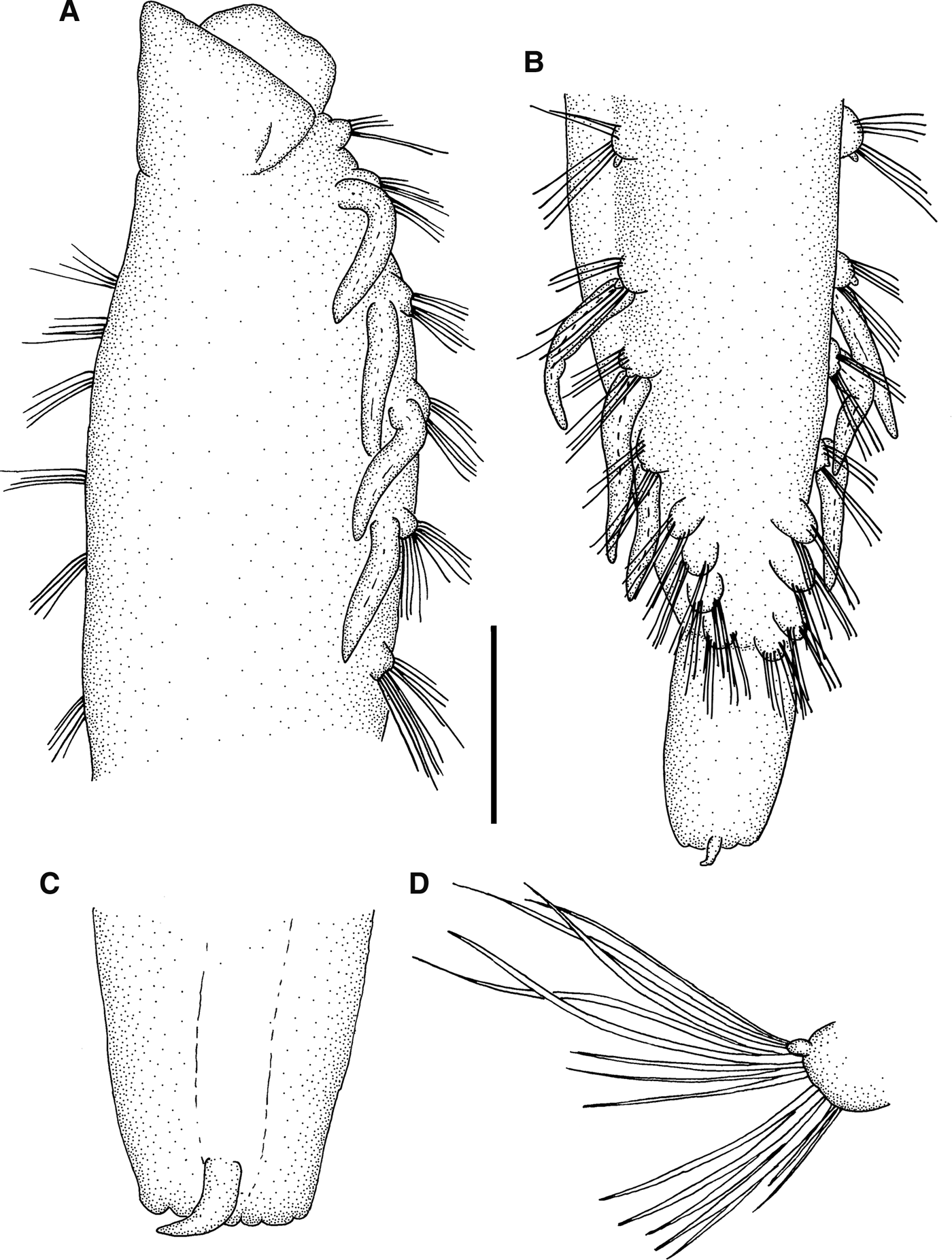
Ophelina brattegardi Kongsrud, Bakken and Oug, Reference Kongsrud, Bakken and Oug2011: (A) anterior end, dorsolateral view; (B) posterior end, ventral view; (C) detail of anal tube, ventral view; (D) left parapodium of chaetiger 7, posterior view. Scale bar: A, B, 0.25 mm; C, D, 0.10 mm.

Ophelina brattegardi Kongsrud et al., Reference Kongsrud, Bakken and Oug2011: p. 98, Figures 2 & 6B.
MATERIAL EXAMINED
MNHN-IA-2015-301: St. 310; one specimen.
DESCRIPTION
Body 3.1 mm long and 0.3 mm wide; fusiform, with 27 chaetigers, deeply grooved both laterally and ventrally. Prostomium conical, slightly shorter than wide (Figure 2A), with two distinct nuchal organs; eyes not seen in preserved specimen. Parapodia biramous, with rounded lobes, and a short piriform dorsal cirrus (Figure 2D); parapodia of last four chaetigers raised and shifted to a more ventral position (Figure 2B). All chaetae capillaries; each bundle composed of two different kinds, very thin and straight or slightly curved and much longer and broader; 7–18 capillaries in notopodia, 6–14 in neuropodia. Branchiae long and cirriform, present in chaetigers 2–5 (Figure 2A) and 21–23 (Figure 2B); absent in the first and the last four body chaetigers. Anal tube as long as last five chaetigers, three times as long as wide (Figure 2B); with several indistinct transversal furrows and scalloped posterior end; short anal cirrus attached ventrally in subterminal position (Figure 2C).
TAXONOMIC REMARKS
The specimen herein recorded fits well with the description of O. brattegardi provided by Kongsrud et al. (Reference Kongsrud, Bakken and Oug2011); although some minor differences were observed, they have not enough relevance to describe a new taxon. First, our specimen has 27 instead of 28 chaetigers, although it can be caused by its much smaller size (3.1 mm instead of 6–9 mm of the type series). Also to be noted is the presence of fewer pairs of posterior branchiae, bearing such structures in chaetigers 21–23 instead of 20–24. Other observed differences refer to features not mentioned in the description of O. brattegardi, but that might have been omitted or overlooked. Thus, authors do not describe any dorsal cirrus although this structure is usually present in Ophelina species (Parapar et al., Reference Parapar, Moreira and Helgason2011). In a similar way, it is likely that the capillary chaetae of two kinds were present in the type series of the species.
Ophelina brattegardi belongs, together with O. cylindricaudata (Hansen, 1879), O. breviata (Ehlers, 1914), O. chaetifera (Hartman, Reference Hartman1965) and O. minima Hartmann-Schröder, 1974, to a group of Ophelina species characterized by a body composed of 24–28 chaetigers, of which the last four bear ventrally shifted parapodia, as well as cylindrical anal tube (Kongsrud et al., Reference Kongsrud, Bakken and Oug2011). The specimens herein recorded can be readily distinguished from most of the species in the group by lacking branchiae in mid-body chaetigers, a character only present in O. brattegardi and O. chaetifera. However, the latter has just 26 chaetigers and bears three pairs of anterior branchiae (Hartman, Reference Hartman1965) instead of five anterior pairs.
GEOGRAPHIC DISTRIBUTION
This is the first record of the species after its original description. Up to now, the species has been collected from Arctic Ocean deep waters (1600 m) off East Greenland, so with this report its known range widens westward to the Canadian Archipelago. This taxon is very similar to O. cylindricaudata, a widely recorded boreal species (Kongsrud et al., Reference Kongsrud, Bakken and Oug2011), the chief difference being the lack of branchiae in mid-body chaetigers of O. brattegardi. Thus, it is likely that re-examination of arctic material previously identified under this denomination proves it to belong to O. brattegardi.
Infraclass CANALIPALPATA Rouse & Fauchald, 1997
Family ACROCIRRIDAE Banse, 1969
Genus Macrochaeta Grube, 1850
Macrochaeta polyonyx Eliason, Reference Eliason1962
(Figure 3)
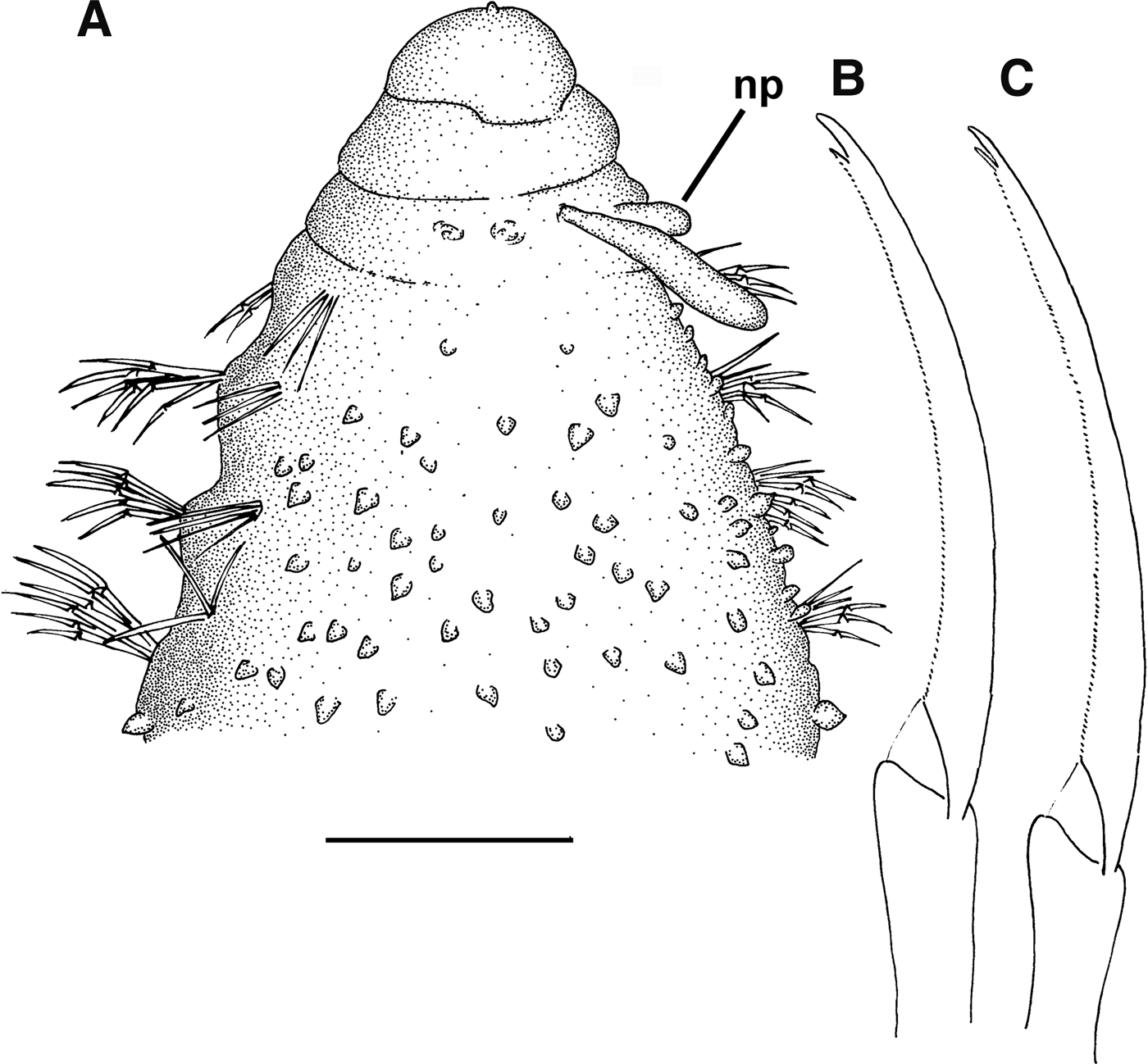
Macrochaeta polyonyx Eliason, Reference Eliason1962: (A) anterior end, dorsolateral view; (B) dorsal neurochaeta, chaetiger 2; (C) ventral neurochaeta, chaetiger 2. np: nephridial papila. Scale bar: A, 0.25 mm; B, C, 25 µm.

Macrochaeta polyonyx Eliason, Reference Eliason1962: 269, Figure 18; Hartley, Reference Hartley1981: p. 279; Parapar & Moreira, Reference Parapar and Moreira2009: p. 63, Figures 5 & 6.
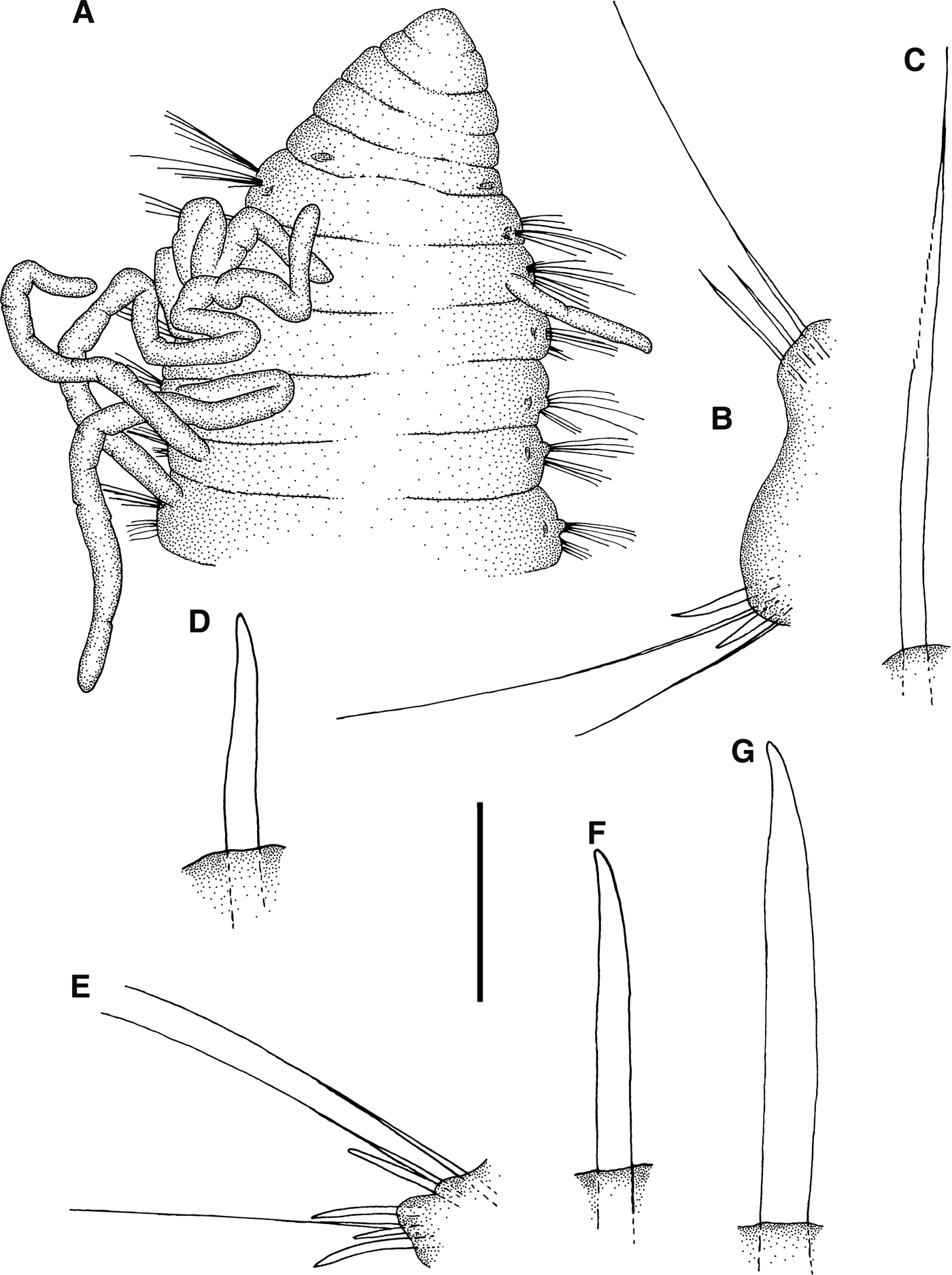
Chaetozone acuta Banse & Hobson, Reference Banse and Hobson1968: (A) anterior end, dorsal view; (B) right parapodium of chaetiger 14, anterior view; (C) short capillary notochaeta, same chaetiger; (D) neuropodial spine, same chaetiger; (E) right parapodium of chaetiger 32, anterior view; (F) small neuropodial spines, same chaetiger; (G) large neuropodial spine, same chaetiger. Scale bar: A, 0.47 mm; B, E, 0.10 mm; C, D, F, G, 27 µm.

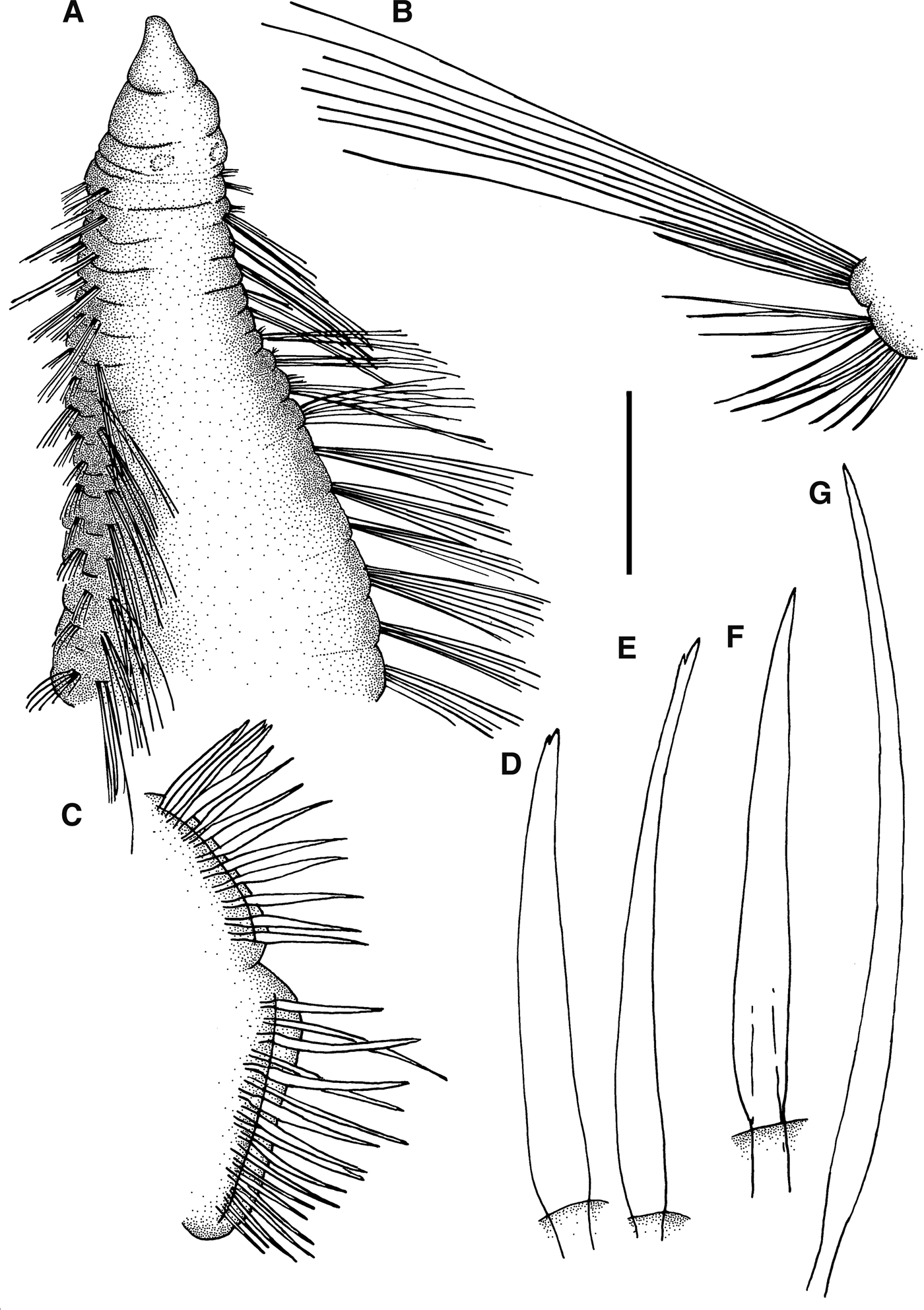
Chaetozone jubata Chambers & Woodham, Reference Chambers and Woodham2003: (A) anterior end, dorsolateral view; (B) right parapodium of chaetiger 2, anterior view; (C) left parapodium of chaetiger 48, anterior view; (D) dorsal notochaeta, same chaetiger; (E) ventral notochaeta, same chaetiger; (F) short neurochaeta, same chaetiger; (G) long neurochaeta, same chaetiger. Scale bar: A, 0.47 mm; B, C, 0.10 mm; D–G, 27 µm.

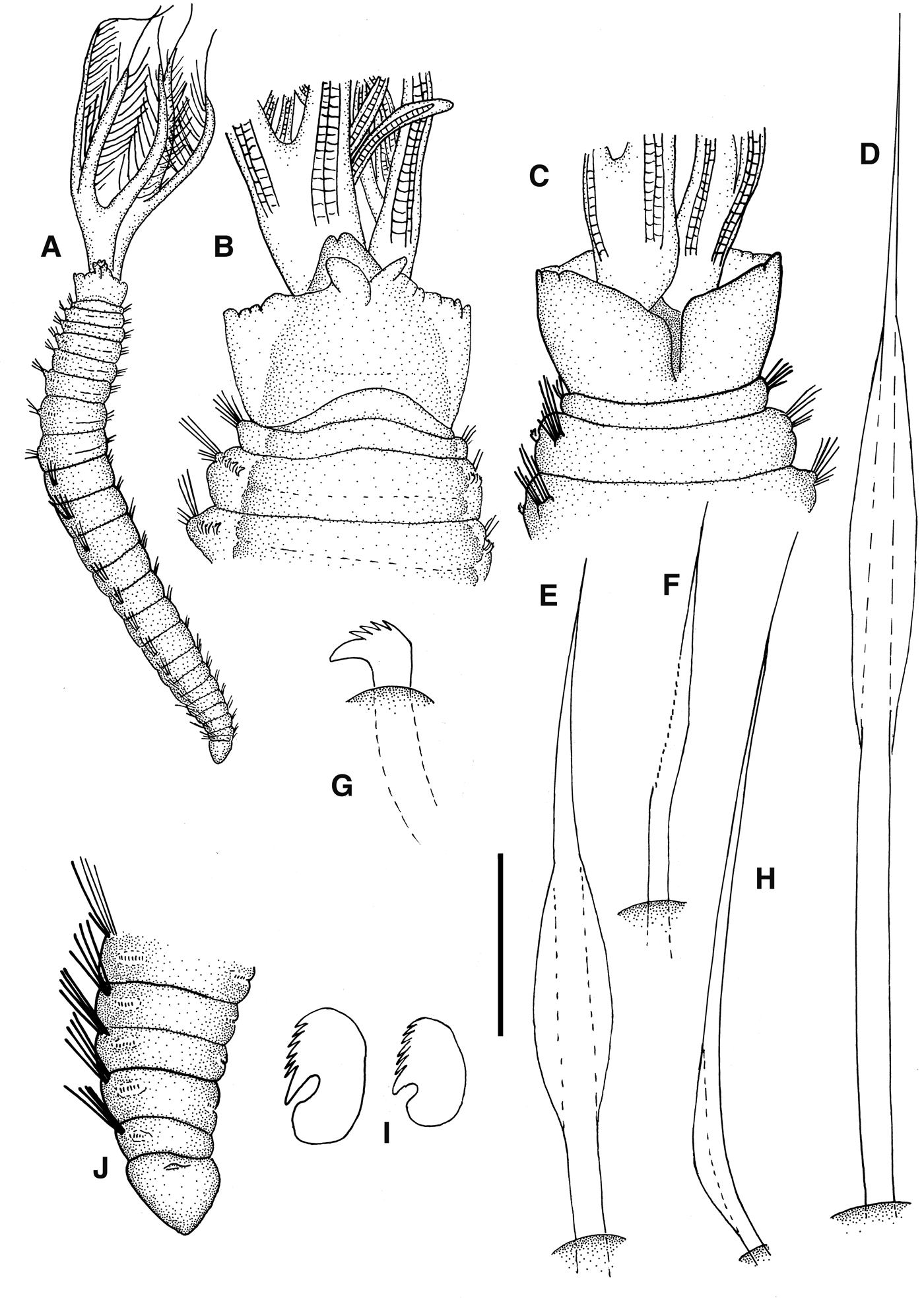
Dialychone hervyae n. sp. Holotype. (A) entire body, ventral view; (B) anterior end, ventral view; (C) anterior end, dorsal view; (D) short narrowly hooded thoracic notochaeta; (E) paleate thoracic notochaeta; (F) bayonet thoracic notochaeta; (G) thoracic uncinus (neurochaeta); (H) narrowly hooded abdominal neurochaeta; (I) abdominal uncini (notochaetae); (J) pygidium, dorsal view. Scale bar: A, 2 mm; B, C, J, 0.4 mm; D–I, 20 µm.

MATERIAL EXAMINED
MNHN-IA-2015-302: St. 115; two specimens. MNHN-IA-2015-303: St. 323; two specimens. MNHN-IA-2015-304: St. Gibbs 1; one specimen. MNHN-IA-2015-305: St. Gibbs 2; 11 specimens.
DESCRIPTION
Clavate body shape; inflated thoracic anterior region formed of 7–11 chaetigers, first 4–5 wider than long, the remainder as long as wide; abdominal region cylindrical, with longer than wide segments; longest specimen incomplete, 3.6 mm long for 16 chaetigers, 0.6 mm wide at mid-thorax level. Epithelium densely covered with triangular papillae both in dorsal and ventral body surface. Prostomium short and rounded, peristomium achaetous, divided into two rings (Figure 3A). One pair of branchiae present on dorsal surface of posterior ring peristomium, but usually lost, reaching chaetiger 2 (Figure 3A); nephridial papillae club shaped, inserted laterally to branchiae (Figure 3A). Notochaetae as thin capillaries, numbering 1–4 per parapodium (Figure 3A); surface with rows of spines resulting in a serrated appearance. Neurochaetae as compound falcigers, numbering up to 8 per parapodium in anterior chaetigers (Figure 3A) and 3–5 in posterior ones; blades bearing minute spinulation and curved, unidentate tips with a minute subterminal tendon (Figure 3B, C); dorsoventral gradation in length of blades not apparent; cutting edge of blades of thoracic chaetae directed posteriorly, those of abdominal chaetae irregularly oriented. Pygidium not observed.
TAXONOMIC REMARKS
All the collected specimens can be assigned to M. polyonyx accurately because this species is unique within the genus in having up to eight compound neurochaetae in anterior parapodia (Eliason, Reference Eliason1962; Parapar & Moreira, Reference Parapar and Moreira2009), differing from the rest of the species, which only bear one or two (Banse Reference Banse1969). The only difference with the original description refers to the number of branchiae. Our specimens only bear one pair, whereas previous records mention up to two pairs (Banse, Reference Banse1969; Parapar & Moreira, Reference Parapar and Moreira2009). Up to now, just one record of an unidentified Macrochaeta sp. exists for the Canadian Arctic (MacDonald et al., Reference MacDonald, Bluhm, Iken, Gagaev and Strong2010), but the authors gave no details that might permit even an approximate identification. There are several other records for nearest marine areas (Carr, Reference Carr2012), such as M. leidyii (Verrill, 1882) and M. sexoculata (Webster & Benedict, 1887), from Massachusetts and Maine respectively, or M. pege Banse, Reference Banse1969, from Washington, but all of them belong to species having one or two compound neurochaetae in anterior chaetigers. Moreover, these species bear a higher number of branchiae distributed on as many segments, possessing four pairs as in M. leidyii and M. pege or 5–6 pairs as in M. sexoculata (Banse, Reference Banse1969).
GEOGRAPHIC DISTRIBUTION
This species was described from Skagerrak off Norwegian coast (Eliason, Reference Eliason1962) and subsequently it has been recorded from a number of localities in the North Atlantic, such as British waters (Hartley, Reference Hartley1981), the deep shelf of NW Spain (Parapar & Moreira, Reference Parapar and Moreira2009) or Jan Mayen Island (Bakken et al., Reference Bakken, Kongsrud, Oug, Cochrane, Moen and Solbakken2010). This is the first report of the species for the Canadian High Arctic and the west side of the Atlantic Ocean.
Family CIRRATULIDAE Carus, 1863
Genus Chaetozone Malmgren, 1867
Chaetozone acuta Banse & Hobson, Reference Banse and Hobson1968
(Figure 4)
Chaetozone acuta Banse & Hobson, Reference Banse and Hobson1968: p. 32, Figure 7A–B; Blake, Reference Blake, Blake, Hilbig and Scott1996: p. 276, Figure 8.2.
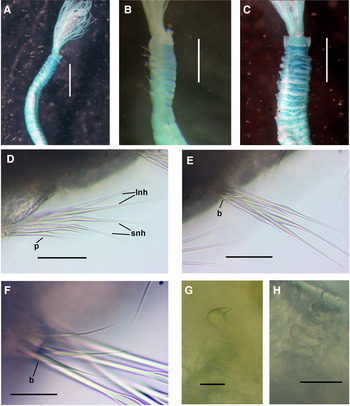
Dialychone hervyae n. sp. Holotype. (A) body, lateral view; (B) anterior end, lateral view; (C) anterior end, ventral view; (D) thoracic notopodial lobe, fourth chaetiger; (E) thoracic notopodial lobe, fifth chaetiger; (F) detail of bayonet notochaetae, fifth chaetiger; (G) thoracic uncinus, sixth chaetiger; (H) abdominal uncini, twelfth chaetiger. lnh, long narrowly hooded chaeta; snh, short narrowly hooded chaeta; p, paleate chaeta; b, bayonet chaeta. Scale bar: A, 2 mm; B, C, 0.8 mm; D–E, 30 µm; F, 15 µm; G–H, 10 µm.

MATERIAL EXAMINED
MNHN-IA-2015-306: St. 323; one specimen.
DESCRIPTION
Specimen complete, 7 mm long for 35 chaetigers, 0.8 mm wide at tenth chaetiger level. Body surfaces smooth; anterior and mid-body regions slightly wider than posterior region; dorsal and ventral surfaces flattened in anterior and mid-body regions. Colour of preserved material creamy white. Prostomium conical, without eyes; peristomium achaetous, divided into two rings (Figure 4A). First segment achaetous, remaining ones all biramous (Figure 4A); notopodial and neuropodial lobes slightly separated all along body (Figure 4B, E). Pair of tentacular palps inserted on first, achaetous segment; first pair of branchiae arising in second segment; branchiae arising dorsal to notopodia and occurring in every segment in first six chaetigers (Figure 4A), absent in mid-body and posterior body regions. Chaetae simple and unidentate, of three types: long capillaries, short capillaries and spines. Long capillaries similar in length to maximum body width, with acute, straight tips; present in both noto- and neuropodia; arranged in fascicles composed of up to eight chaetae in anterior chaetigers, gradually reducing in number to 2–3 in posterior chaetigers. Short capillaries (Figure 4C) about a third as long as long ones but wider, with oblique tips; present in both neuropodia and notopodia of chaetigers 9 to 14, absent in the rest of body. Spines at least one and a half wider at base than long capillaries; 1–2 notopodial spines present from chaetiger 22, unidentate and somewhat curved, all similar in size; 3–4 neuropodial spines present from chaetiger 13, neuropodial fascicles composed of small and large spines, small ones identical to notopodial ones (Figure 4 D, F), large ones similarly shaped but approximately double sized (Figure 4G); spines accompanied by up to three capillaries in both noto- and neuropodia. Pygidium with ventral, rounded lobe.
REMARKS
Chaetozone acuta belongs to a group of Boreal-Pacific species characterized by possessing a biannulated peristomium followed by an achaetous segment, by having palps inserted in the posterior half of the peristomium and first pair of branchiae inserted on achaetous segment, and by bearing neuropodial spines from anterior third of body, appearing from chaetiger 5 to 40 (Blake, Reference Blake2015). Along with C. acuta, this group is composed of C. bathyala Blake, Reference Blake2015, C. palaea Blake, Reference Blake2006 and C. pigmentata Blake, Reference Blake2015. Among them, C. palaea is unique because it possesses very broad and flattened spines in posterior chaetigers (Blake, Reference Blake2006), clearly different to the rounded in section ones of our specimen. Chaetozone acuta can be distinguished from the two other species by having much fewer spines on posterior chaetigers, bearing up to eight instead of 13–19 as in C. pigmentata or 20–22 as in C. bathyala (Blake, Reference Blake2015). In addition, C. pigmentata is characterized by a very distinct colour pattern composed of black speckles and a prominent ventral ridge (Blake, Reference Blake2015), both features absent in C. acuta.
The specimen herein described fits well with the most recent re-description of the species based on the type series (Blake, Reference Blake, Blake, Hilbig and Scott1996), sharing diagnostic characters such as the presence of capillaries with oblique tips, the spines appearing in the anterior third of the body and always arranged in bundles composed of few chaetae, the biannulate peristomium accompanied by an achaetous segment, and the palps inserted before the branchiae. However, it also shows some minor differences. For instance, neither the small lateral eyes nor the pigmentation of the nuchal organs cited by Blake (Reference Blake, Blake, Hilbig and Scott1996) were observed, although this fact could be caused by decolouration due to the preservation process. Other differences refer to the details in the structure of the chaetae. Firstly, pointed short capillaries are thinner than smaller spines in our specimen, whereas they are figured in descriptions as being as thick as spines (Banse & Hobson, Reference Banse and Hobson1968; Blake, Reference Blake, Blake, Hilbig and Scott1996). The number of spines in mid-body parapodial lobes is fewer than originally described, since our material bears 1–2 in notopodia and 3–4 in neuropodia, instead of bearing 2–5 in notopodia and 5–7 in neuropodia (Banse & Hobson, Reference Banse and Hobson1968). In this respect, the number is closer to the diagnoses provided later by Blake (Reference Blake, Blake, Hilbig and Scott1996, Reference Blake2015), in which the species is described as having up to eight spines on each side. Furthermore, the ridges on convex side of spines that are recorded in the description were not seen in our material. We do not consider these differences important enough to describe a new taxon.
GEOGRAPHIC DISTRIBUTION
Previously to this record, the species has been reported only from shallow depths in its type locality (Puget Sound, Washington State, USA) and close locations (Blake, Reference Blake, Blake, Hilbig and Scott1996). This report extends its known range northwards to the Canadian Archipelago, leaving a wide gap between the two known localities. However, the genus is in need of a deep revision (Blake, Reference Blake, Blake, Hilbig and Scott1996), and it is likely that careful re-examination of the abundant material from the Pacific coast of Canada referred to other species of genus Chaetozone (Carr, Reference Carr2012) might show some of them to belong to this species.
Chaetozone jubata Chambers & Woodham, Reference Chambers and Woodham2003
(Figure 5)
Chaetozone jubata Chambers & Woodham, Reference Chambers and Woodham2003: p. 43, Figure 2.
MATERIAL EXAMINED
MNHN-IA-2015-307: St. Gibbs 2; 21 specimens.
DESCRIPTION
Longest specimen complete, 6.2 mm long for 45 chaetigers, 0.6 mm wide at tenth chaetiger level. Body surfaces smooth; anterior and mid-body regions wider than posterior region; dorsal and ventral surfaces flattened in anterior and mid-body regions, ventral surface with longitudinal groove. Colour of preserved material creamy white. Prostomium conical, without eyes (Figure 5A). Peristomium achaetous, divided into two rings, anterior one clearly longer than posterior one; pair of tentacular palps inserted in posterior half of second ring (Figure 5A). First segment achaetous and very short, remaining ones all biramous (Figure 5B). First pair of branchiae arising in first chaetiger segment; branchiae arising dorsal to notopodia and occurring in every segment in first 5–10 chaetigers, more sporadically in mid-body, and absent in posterior body region. Chaetae simple and unidentate, of three types: very long capillaries, short capillaries and spines. Very long capillaries about three times as long as maximum body width, present in notopodia only, numbering 4–8 from chaetiger 2 to about chaetiger 28, gradually reducing in number to 1–2 in posterior chaetigers (Figure 5B). Short capillaries about a quarter the length of long ones; in notopodia 1–2 capillaries from chaetiger 2 to 29–30; in neuropodia 4–8 capillaries from chaetiger 2 to 18–19 (Figure 5B), then progressively thicker and shorter, becoming true spines in chaetiger 29–31. Spines twice wider at base than capillaries, present in both rami from chaetiger 30–31; first alternating with capillaries in notopodia and then alone, alone always in neuropodia; number gradually increasing from 2–4 in the mid-body region to up to 17 in each ramus of posterior chaetigers (Figure 5C); notopodial spines all similar in length and minutely bidentate (Figure 5D, E); neuropodial spines unidentate, alternating short and long ones (Figure 5F, G). Pygidium with ventral, sub-spherical lobe.
TAXONOMIC REMARKS
Historically, specimens of Chaetozone having spines arranged in large cinctures on posterior segments were referred globally to C. setosa Malmgren, 1867, originally described from Spitsbergen. However, more recent studies showed that in the Arctic there is a complete array of species which can be distinguished by a number of characters that usually are overlooked (Blake, Reference Blake2015). Concerning C. jubata, it is easily identifiable within this group of species resembling C. setosa by the distribution of very long capillary chaetae, which are concentrated on the anterior part of the body (in chaetigers 2–15 in C. jubata instead of chaetigers 20–50 in C. setosa). Chambers and Woodham (Reference Chambers and Woodham2003) also described differences in the shape and number of spines in the posterior segments, which were thinner (6.3 vs 16.8 µm) and more numerous (up to 14 in each fascicle instead of up to 8) in C. jubata. However, the most recent redescription of C. setosa (Blake and Petersen in Blake, Reference Blake2015) reduces this difference since their data on the spines show higher variability in this species, with values that may be closer to that of C. jubata. In addition, these authors describe C. setosa as bearing an enlarged dorsal swelling on the peristomium, although it is not always very evident (Chambers, Reference Chambers2000). This swelling is altogether absent in the herein recorded specimens as well as in the original description of C. jubata.
GEOGRAPHIC DISTRIBUTION
Previously to this record, the species has been reported only from deep waters of the Faroe–Shetlands Channel and from the Faroes Rise, between these islands and Iceland (Chambers & Woodham, Reference Chambers and Woodham2003). Although they were collected from subarctic latitudes in the north-east Atlantic Ocean, the authors indicated environmental conditions to be very cold in both sites due to the effect of the deep water flowing southwards from the Norwegian Sea. It suggests a preference for cold waters and probably an arctic distribution that has been neglected because of the superficial similarity of this taxon with the widely recorded C. setosa.
MATERIAL EXAMINED
MNHN-IA-TYPE 1770: St. 312; holotype. MNHN-IA-TYPE 1771: St. 312; four paratypes. MNHN-IA-TYPE 1772: St. 310; three paratypes. MNHN-IA-TYPE 1773: St. 323; one paratype. MNHN-IA-TYPE 1774: St. Gibbs 2; one paratype.
DESCRIPTION
Holotype, largest specimen, complete; 0.3 mm wide, 5.3 mm long without branchial crown. Body cylindrical (Figures 6A & 7A), creamy white coloured when preserved; methyl green staining pattern uniformly light turquoise, except for deeper coloured pygidium and ventral shields, those of thoracic chaetigers showing two transversal bands of stained cells (Figure 7A–C). Insertion of the branchial crown not exposed beyond collar (Figures 6C & 7A, B); branchial crown up to 2.4 mm long (holotype), composed of four pairs of radioles, tips up to one quarter of total radiole length; median pinnules not longer than more basal ones; radiolar flanges narrow; palmate membrane extending through one quarter of crown length; one pair of ventral radiolar appendages, about half the length of crown; dorsal pinnular appendages not observed. Anterior peristomial ring bearing a ventral projection barely extending beyond collar, distally bilobed (Figure 6B). Posterior peristomial ring collar with ventral, dorsal and lateral margins irregularly wrinkled (Figure 6A–C); ventral margin higher than lateral ones (Figure 6B); dorsal margin forming a narrow gap (Figure 6C), ventral margin folded in two lobes (Figure 7C); dorsal pockets present; ventral collar shield crescentic (Figure 6B); length ratio of collar vs second chaetiger 1.5:1 in lateral view. Thorax composed of eight biannulate chaetigers (Figure 6A), mid-segmental furrow dorsally inconspicuous; glandular ridge on second chaetiger very narrow and inconspicuous, subtly pigmented in pink after methyl-green staining. First chaetiger with two rows of narrowly hooded chaetae, those of anterior one clearly longer; uncini absent. Remaining thoracic chaetigers with notopodia bearing dorsally two rows of narrowly hooded chaetae (Figures 6D & 7D, E) similar to those of first chaetiger and ventrally one row of paleate chaetae with very long mucro (Figures 6E & 7D) and another row of bayonet chaetae (Figures 6F & 7F); neuropodia with one row of acicular uncini, main fang surmounted by four rows of teeth covering two-thirds of fang length, size of teeth progressively decreasing to apex (Figures 6G & 7G). Abdomen composed of 16 chaetigers (Figure 6A); neuropodia with two rows of very narrowly hooded chaetae (Figure 6H), those of ventral row twice longer than dorsal ones; neuropodia of anterior abdomen bearing one row of rectangular uncini with the main fang surmounted by up to six rows of teeth extending through half of the fang length; uncini of posterior segments rectangular with proportionately smaller main fang surmounted by up to six rows of teeth extending through almost entire fang length (Figures 6I & 7H). Pygidium with rounded posterior margin (Figure 6J); prepygidial depression occupying last six abdominal chaetigers.
REMARKS
Dialychone hervyae n. sp. belongs to a group of species defined by Tovar-Hernández (Reference Tovar-Hernández2008) and characterized by their anterior peristomial ring bearing a bilobed ventral projection that extends beyond the collar (Tovar-Hernández, Reference Tovar-Hernández2008). Apart from D. hervyae n. sp., the group is formed by D. collaris (Langerhans, 1881), from the eastern Atlantic and the Mediterranean Sea (Tovar-Hernández, Reference Tovar-Hernández2008), D. normani (McIntosh, 1916), from Scotland (Tovar-Hernández, Reference Tovar-Hernández2007a), D. quebecensis (Tovar-Hernández, Reference Tovar-Hernández, Licciano and Giangrande2007), from the Gulf of Saint Lawrence (Tovar-Hernández, Reference Tovar-Hernández2007b), D. trilineata (Tovar-Hernández, Reference Tovar-Hernández, Licciano and Giangrande2007), from California (Tovar-Hernández, Reference Tovar-Hernández2007b), D. dunerificta (Tovar-Hernández et al., Reference Tovar-Hernández, Licciano and Giangrande2007), D. longiseta (Giangrande, Reference Giangrande1992) and D. egyptica (Selim et al., Reference Selim, Rzhavsky and Britayev2012), the three latter species from the Mediterranean Sea (Giangrande, Reference Giangrande1992; Tovar-Hernández et al., Reference Tovar-Hernández, Licciano and Giangrande2007; Selim et al., Reference Selim, Rzhavsky and Britayev2012). The new species is characterized from D. dunerificta, D. quebecensis, D. trilineata and D. collaris by its distinctive pattern of methyl-green staining and by the shape of its paleate thoracic notochaetae, which bear very long mucros. Furthermore, the posterior margin of its pygidium is rounded, whereas in the first three species it is triangular and pointed in the fourth. The shape of the collar is another useful feature to distinguish the new species from D. collaris, as the latter bears a clearly and regularly scalloped collar, whereas D. hervyae n. sp. has a collar subtly and irregularly wrinkled. Moreover, D. collaris possesses radioles with proportionately shorter tips than those of D. hervyae n. sp.
Dialychone longiseta, D. normani and D. egyptica are the most similar species since they possess paleate chaetae with very long mucros (Giangrande, Reference Giangrande1992; Tovar-Hernández, Reference Tovar-Hernández2007a, Reference Tovar-Hernández2008). However, D. egyptica is easily told apart from the other species by its very characteristic abdominal glandular ridge on chaetiger 13 and by having a conspicuous pygidial cirrus. Dialychone longiseta is a more similar species, but it can be distinguished by the shape of the ventral shield in the collar segment (which is rectangular in D. longiseta), by the number (6–10 pairs in D. longiseta, three pairs in the new species) and the shape of the radioles, which are clearly broader and with longer tips in the Mediterranean species (up to half of the radiole length in D. longiseta, up to one quarter in the new species). Finally, D. normani, although showing a very similar methyl green staining pattern, differs in some details. Some of them can be observed in the branchial crown, such as the number of radioles (four pairs in D. hervyae n. sp. instead of six), the length of median pinnules (clearly longer in D. normani, similar to the rest in the herein described specimens), and the distinctly narrower tips and lateral flanges of the radioles in D. hervyae n. sp. Other differences refer to thoracic uncini, that in D. normani bear apical teeth over half the length of the main fang and over two thirds in our specimens.
ETYMOLOGY
The new species is named in honour of Annie Olivier, the second author's mother, whose maiden name ‘Hervy’ comes from a family from St-Malo (France).
ACKNOWLEDGEMENTS
The authors deeply appreciate the assistance and support of the crew of the Canadian Coast Guard icebreaker ‘CCGS Amundsen’ and several other people for technical support during the fieldwork, especially V. Roy. We are also grateful to J. Moreira and G. San Martín (Universidad Autónoma de Madrid), for their help in the identification of the material and for the loan of bibliography. An especial acknowledgement is due to Y. Gratton, D. Boisvert and S. Nahavandian, from Institut National de la Recherche Scientifique, Canada, and C. Marec, from Centre National de la Recherche Scientifique, France, who provided environmental data for sampling stations, and to an anonymous reviewer, whose comments greatly improved the clarity and scientific value of this work.
FINANCIAL SUPPORT
This investigation was conducted in the framework of the International Laboratory BeBEST funded by the Institut des Sciences de la Mer de Rimouski (UQAR, Quebec) and the Institut Environnement Ecologie (CNRS, France). The study was also financially supported by ArcticNet, the Canadian Healthy Oceans Network (CHONe), the Natural Sciences and Engineering Research Council of Canada and Québec-Océan. Additionally, it benefited from a 3-year secondment of the second author at the ISMER/UQAR provided by the MNHN.