In a manifesto on typography, published in an issue of Kurt Schwitters’ amazing little magazine Merz (1923), El Lissitzky ends his description of the new typography with an emphatic invocation of the THE ELECTRO-LIBRARY. He bombastically proclaims, “The printed surface transcends space and time. The printed surface, the infinity of books, must be transcended. THE ELECTRO-LIBRARY”Footnote 1
Lissitzsky was summoning a future context for the new typography of his generation. This setting was fully imagined in concert with the technological changes of the moment, of increased industrialization of the urban sphere and changing speeds of communication. As with many publications of the historical avant-garde, there was a clear agenda to agitate the existing formats of print design and there was an endless pursuit of ‘the new’, even to the degree, in Lissitzsky's case, to imagine a departure from print itself. It is hard not to relate this context to our present situation in regards to print culture and our various digital media languages, of the feeling we are on the horizon of something else. When we think of the history of technology, elements of hybridity and mixture of different media languages may feel specific to our 21st century context and the current state of the ‘page’. However, these are also defining characteristics of modernity in the early 20th century, with its new mass media and the interrelations between print media, visual media like photography, film and sound media like the telephone, gramophone, and other techniques of recording the voice.
Also, as we recognize a growing self-consciousness of media, of a critical recognition of media tools and how they operate in our contemporary context, it is helpful to recall the impact of the writings of Marshall McLuhan in the 1960s, whose writings on media became the keywords of counterculture movements that attempted to re-route how media was produced and distributed. McLuhan discussed aspects of the end of the epoch of the book already in the early 1960s and he also provided an impetus to a new generation of artists and designers to create alternative networks for their media projects. The Whole Earth catalog (1968–1972) was one pivotal example of a new media tool for the dispersal of information, a self-published information service directly inspired by the critical writings of McLuhan, which would later be described by Steve Jobs as the ‘Google of his generation’.Footnote 2 A digital book perhaps. It is no accident that a self-publishing movement of artists, photographers, designers and architects also emerged at this moment, creating, publishing, distributing their own little books and journals.
The language that we often use for describing artists’ books originated at this historical moment and reflected on artists’ practices that incorporated the book, often self-published as a critical means for distributing new work, for short-circuiting the normal spaces in which one could encounter art. We are reminded of a predecessor of ours at MoMA Library, former director Clive Phillpot, and his work in the 1970s in charting the field of artists’ publications during a time where the genre was growing and becoming an element in a discussion of new artist-directed spaces for the exhibition and staging of works.
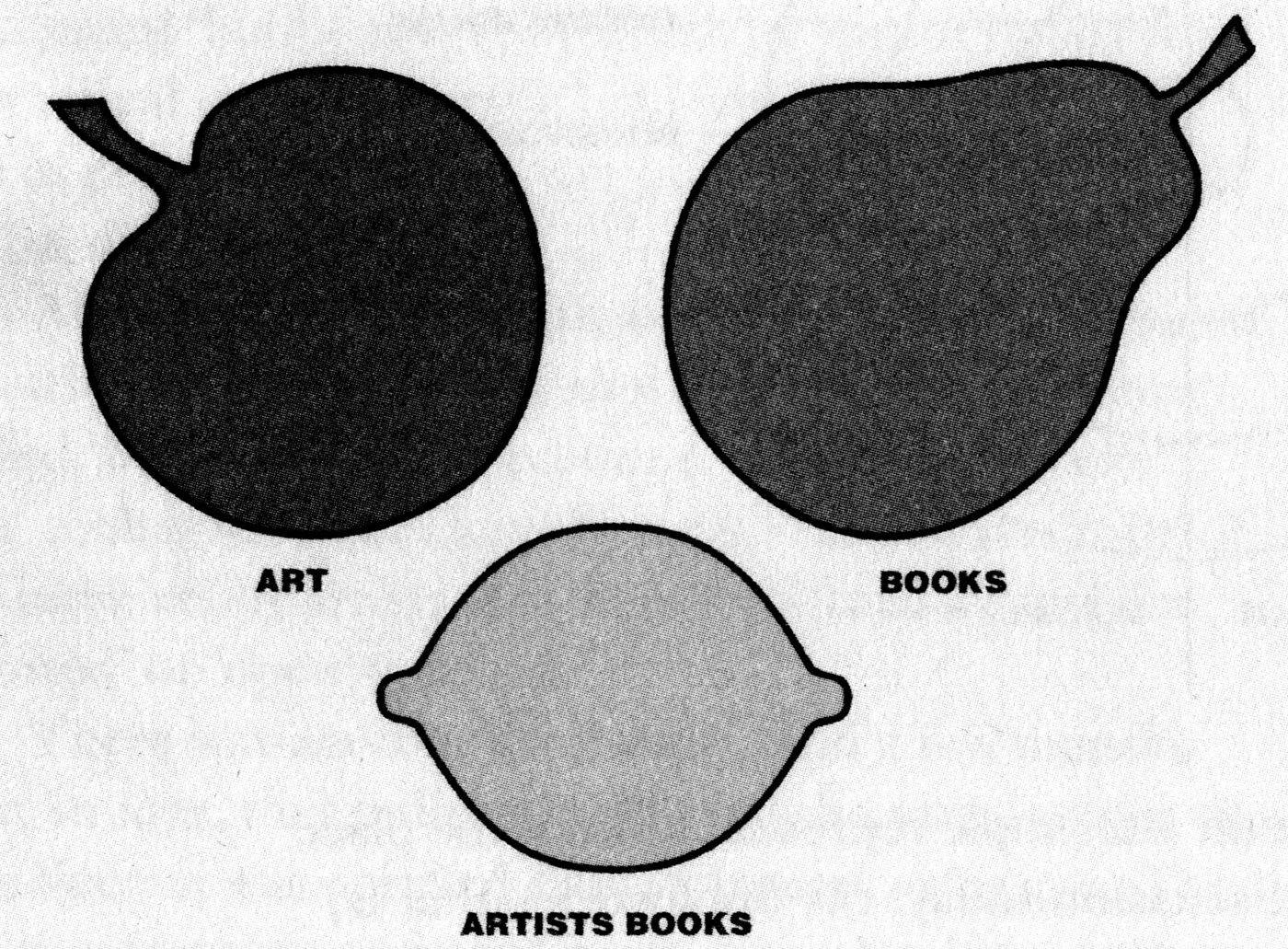
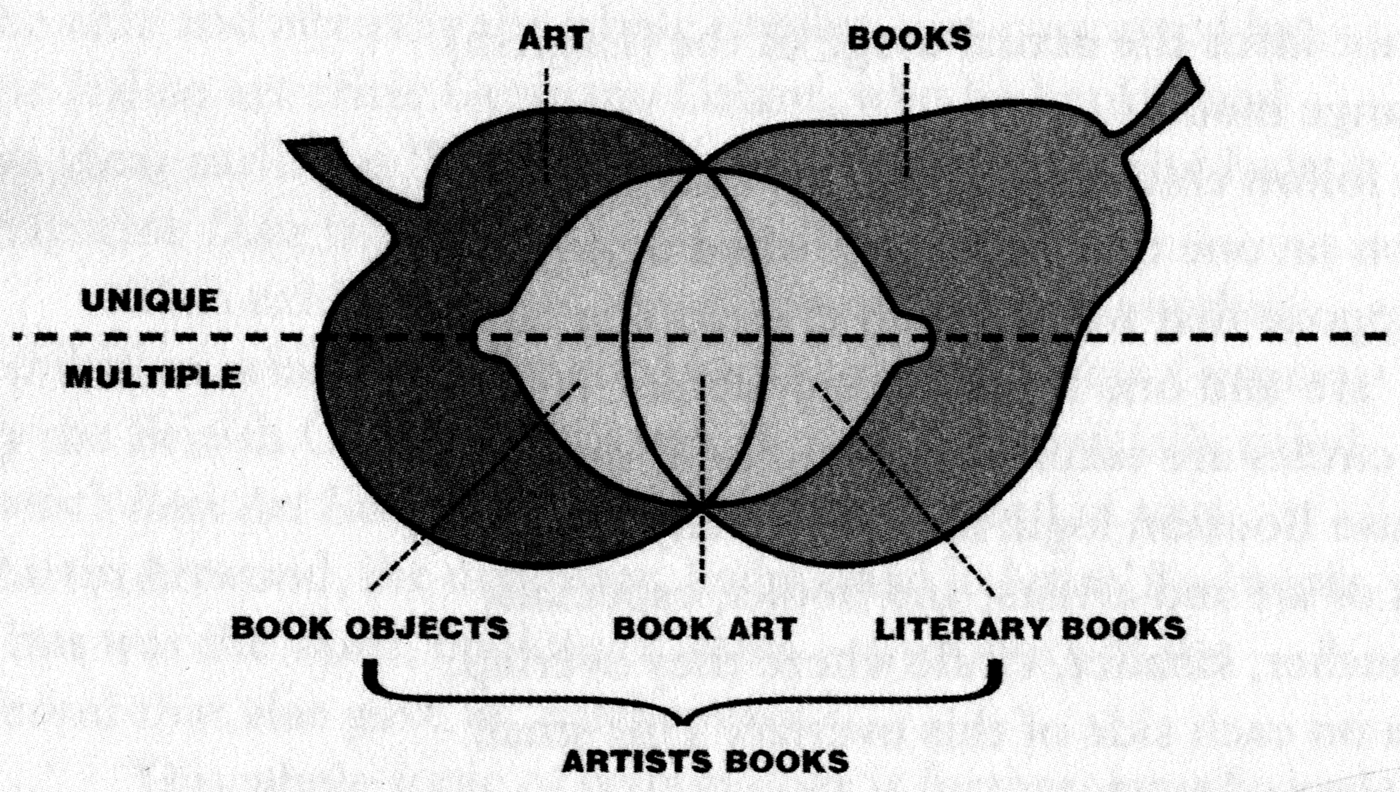
As we can see from Phillpot's chart, with a pear, an apple and a lemon, he was trying to help distinguish a spectrum of works that pivoted upon two central axes: 1) published vs. unique; and 2) books that used the architecture of the codex as sculptural material vs. using the codex as a container for images and texts that formed a work. Through this visual tool, he created a framework through which one could distinguish categories of works within the genre of artists’ books. In the second example of Phillpot's, we also have some distinction based on content, whether it is verbal or visual or some mixture of both. We can see traces of McLuhan in Phillpot's categories (most specifically one could recall the book Verbi-Voco-Visual explorations that McLuhan published with Dick Higgins’ Something Else Press in 1967). When discussing our own collection development policy at MoMA for our artists’ books collection, these categories and distinctions still hold up in many ways for the massive amounts of new printed materials being produced in this genre. Particularly, a great volume of new works still exist firmly within this spectrum between language art and photobooks — the verbi-visual spectrum — most bearing a graphic choreography between text and image, of montage and sequencing.
Clive Phillpot, Artists' Book Fruit Salad Diagram. Image Courtesy of Clive Phillpot.

Looking at these charts, in the context of our current discussion of new critical vocabularies for artists’ books, what is their relevance? What can we borrow and what becomes hard to locate on Phillpot's schema? In terms of the categories of digital books or digital publications, does this terminology need to be remapped — or at least re-wired for our current purposes? One question with digital books and our terminology for them is whether we need to add new fruit to Clive's chart, or maybe, other varieties of pear, apple, or lemon?
Kione Kochi proposed one update of Phillpot's fruit diagram in a risograph poster series produced with Chicago-based publishing collaborative Temporary Services in 2015.Footnote 3 Kochi's poster adds ‘large print runs’ and ‘digital editions’ to Clive's axes of ‘unique’ and ‘multiple.’ He shows ants carrying away chunks of ‘apple’ and ‘pear’ in the form of epub, .PDF and print-on-demand formats, and commercial galleries, collectors, and gatekeepers appear as flies feeding off the fruit. This is a clever revision, though there may be other ways to think about how artists are distributing content online, and how these categories often overlap.
Clive Phillpot, Artists' Book Fruit Salad Diagram. Image Courtesy of Clive Phillpot.
Perhaps, we can first just focus on the meridian of the multiple and drill down from there. We have a handy term, ‘artists’ publications’ that can be a rather large umbrella for a huge variety of subcategories. This term is really useful as an inclusive term for projects like posters, ephemera, sound (LP, cassette, CD, DVD, USB), magazines, et al. In our digital spheres, what would we exclude from this category of ‘publications’? A legion of new forms can considered as ‘artists’ publications’ and it becomes an immense chore to try and name these categories. Social media sites like Twitter, Tumblr, Instagram, Facebook, Yelp, Vine are all populated with artists’ interventions. Other categories are slightly more conventional settings, such as artists’ websites, digital journals and book publishers as well as digital archives that reproduce and circulate discrete image, sound, video and text files.
Critical writing on hypertexts from the 1990s and 2000s positioned the reader in a new space to travel through texts or between texts and images. The CD-rom and other interactive online media were given the pride of place in terms of the new horizon for the future reader. The essential aspect in the current context seems less about the space occupied by the images and texts, than the communication networks that are shared and the condition of exchange and constant movement that define many of these digital contexts. Digital books with defined borders and, perhaps most significantly, defined paywalls are a very small fraction of the content of what we apprehend as artists’ publications in digital formats.
The surprise of our current context is the degree that digital networks, image exchange, coding languages are feeding into an increased output of printed artists’ books, magazines and little architecture and design publications. It is a counterintuitive idea: that many works in print are completely bound to a digital media language. Like in the 1960s and 1970s, artists’ publishing or little magazines of architecture and design were often considered alongside activities like newly possible video projects or guerilla television experiments as new practices in artists’ communications and information distribution projects. These production methods were reckoning with new kinds of mass media such as television, newspapers and magazines and the types of commercial advertising language that infested each of these media-scapes. Artists’ books of this time period investigated and appropriated these formats in a kind of critical analysis. Now, artists and designers work directly from the Internet, drawing out its content for various new kinds of inspection, analysis and play. Artists’ books and other kinds of print experiments use the space of the book to distill and rework online content – often creating new taxonomies for images or texts.
These books are wholly dependent on our current digital milieu. They are digital books in print. This focus is not to discount the absolutely vast amount of visual and text experiments that are happening online, but it is worth exploring this unexpected possibility of the printed book helping us understand, or at least, parse the new media languages, memes and rapid revolutions that populate our digital worlds. This is part of the reason that we can conceive of these works as new media, as being a wholly new kind of mixture of technologies of reading, publishing and distribution. They are completely dependent upon digital modes of image exchange and searching, on the reproduction and movement of language across social media, popular memes and moving image sites like Youtube. Furthermore, as Florian Cramer writes, the zine and artists’ book communities ‘use print as a form of social networking which is not controlled by Google, Twitter or Facebook’.Footnote 4
Beyond making individual artists’ books, artists are experimenting with distribution systems by creating serials, published exhibitions, presses and archives that traverse print and online communication. Such artists’ publishing projects are nothing new, calling to mind well-known examples like George Maciunas’ Flux Boxes and Dick Higgins’ aforementioned Something Else Press. What is novel is the way that they investigate the multiple materialities of information in today's context: these projects are ‘hybrid’ publications that exist in print and online, privileging no one media over another. Artist and designer Paul Soulellis refers to this process as ‘performing publishing’: ‘our ability, as artists, to disseminate a notion as an array of possibilities that amplifies and expands along networks’.Footnote 5
We will quickly introduce several projects here that express some of these characteristics of hybrid publications and the various modes of performing publishing between print and digital media. The first project is the result of a decade-long collaboration between the graphic designers David Reinfurt and Stuart Bailey, who established Dexter Sinister, a design workshop and bookstore, and edited issues of the journal Dot dot dot. For the last five years, the two have also teamed with the artist Angie Keefer in producing The Serving Library, a publishing program, online text archive and roving project space.
Dexter Sinister can be viewed as an early adopter of this now common scenario of artists and designers switching between multiple media to broadcast works, to publish. There was not a decisive movement from a print to digital platform, but an affirmation of the new kinds of hybrid media spaces made possible in our contemporary context. Both of their projects explore the way that texts can circulate. The Dexter Sinister project space existed in Manhattan's Lower East Side from 2006–2011.Footnote 6 As part of their practice, they were also hosting a library of files they named Portable Document Formats. They began also to chart how the PDF's circulated and how many downloads were logged for each file. This digital circulation of texts was an essential aspect of their project, consistently developing an infrastructure for them to move in both print and digital spaces. Reinfurt and Bailey, with Keefer, still work in this way, with a printed journal called Bulletins of the serving library, with all the texts from the issues available as PDF files on their website. MoMA Library subscribes to the print issue of the Bulletins of the serving library and also, with a link to their site with all articles from the last ten issues available for download.Footnote 7 These projects are characterized by a play between media formats, in which each issue of the journal becomes an experiment with different possible mixtures of these design tools.
As examples of web-to-print materials, like Bulletins of the serving library, started to accumulate in the aughts and early this decade, some participants in the publishing community started to take note and create documentation around this genre. Paul Soulellis’ Library of the printed web is both a publishing project and an archive of web-to-print artists’ publishing, and is one of the most substantial sources of information on the way artists’ publications investigate the circulation of images in a new media context. The project consists of a physical archive and a Tumblr, Library of the printed web, that documents printed artists’ books that re-deploy Web content, and a semi-annual publication, Printed web, which invites artists to submit network-based works for the printed page.Footnote 8 Soulellis considers the Printed web serial to be an exhibition space:
Each issue is a group show (after Seth Siegelaub). By circulating this work myself, I can enact various publishing experiments, including print-on-demand as an intentional, performative artistic practice, and how versioning enables published works to occupy different positions, depending on how it's dispersed.Footnote 9
The Printed web publication and the digital archive are distinct but overlapping projects that inform, extend and retranslate one another.
Many of the works featured in Library of the printed web are self-published using print-on-demand technology. The works demonstrate the vast accessibility of the tools necessary to compile, design, and publish an artists’ book in the digital age. As Soulellis writes, these publications ‘enact a kind of performance with the data, between the web and the printed page, negotiating vast piles of existing material. Almost all of the artists here use the search engine, in one form or another, for navigation and discovery’.Footnote 10
The individual web-to-print works in archives like Library of the printed web highlight the condition of images within digital information networks. Rather than presenting ‘originals’ they manipulate content, making visible the ways that images migrate across different media and platforms. They are ‘circulationist’ works, in Hito Steyerl's terms: ‘Circulationism is not about the art of making an image but of postproducing, launching and accelerating it’.Footnote 11 Soulellis believes the transitional and fluid nature of these practices relates to Marcel Duchamp's concept of the infrathin, ‘the immeasurable gap between two things as they transition or pass into one another’.Footnote 12 Soulellis delineates several actions that artists use to make books from web content – grabbing, hunting, and performing. The first two strategies might be thought of digital updates of traditional collage practices while the latter more directly illuminates the infrathin condition by activating its informational flows.Footnote 13 While this list may not be exhaustive, it is a useful starting point for thinking about how these books function critically.
Paul Soulellis, Printed Web #1, 2014.
Grabbing
‘Grabbing’ involves conducting a web search and then presenting the results in an organized way. ‘The grabbing is done with intent, around a particular concept, but of primary importance is the taking of whole images that have been authored by someone else, usually pulled from the depths of a massive database that can only be navigated via search engine’.Footnote 14 These works fall into the lineage of appropriation art, though the images are often so far removed from their (often anonymous) original creator that they call into question the idea of authorship.
Sabrina Fernandez Casas’ zine Ecce homo is a prime example of a ‘grabbing’ project.Footnote 15 The zine is based around the ‘potato Jesus’ meme, a botched art restoration by 81-year old Cecilia Gimenez of a 19th century Fresco depicting Jesus. Casas’ zine, titled after the painting, consists of screen captures of Google Image searches for the meme around the height of its popularity. The cheap, black-and white prints of the search results exemplify Steyerl's notion of the ‘poor image’: ‘the poor image has been uploaded, downloaded, shared, reformatted, and reedited. It transforms quality into accessibility, exhibition value into cult value, films into clips, contemplation into distraction’.Footnote 16
Sabrina Fernandez Casas, Ecce Homo, 2013.
A text-based example of a grabbing project is Cory Arcangel's Working on my novel. Footnote 17 The book is based on a Twitter account, created by Arcangel, that re-tweets selected tweets featuring the phrase ‘working on my novel’. Arcangel claims to explore the ‘gap between the different ways we express ourselves today’, opposing the humor and banality of the tweets to the socially validated creative act of writing a novel.Footnote 18 While there is some curation involved, the book still derives from a simple search of a massive online aggregate of information.
Hunting
‘Hunting’ projects are less interested in presenting a mass of information as filtered through a search engine than they are in selecting highly exceptional images, outliers, or glitches. Soulellis writes, ‘The hunter takes what's needed and nothing more, usually a highly specific screen capture that functions as evidence to support an idea’.Footnote 19 These ‘exceptional’ cases often point to the rule, calling into question the truth factor of the algorithms and imaging systems that structure our ways of making digital sense of the world. Mishka Henner's Dutch landscapes is a characteristic ‘hunting’ work, representing the artist's practice of collecting Google Earth images to create print-on-demand photobooks.Footnote 20 The project beautifully explores the issues of visibility and government censorship that emerge with Google Earth's satellite imaging. According to Henner's project statement:
When Google introduced its free satellite imagery service, governments concerned about the visibility of political, economic and military locations, exerted considerable influence on suppliers of this imagery to censor sites deemed vital to national security. One of the most vociferous of all governments to enforce this form of censorship were the Dutch. Their method of censorship is notable for its stylistic intervention compared to other countries; imposing bold, [multicolored] polygons over sites rather than the subtler and more standard techniques employed in other countries.Footnote 21
As digital mapping and surveillance technology increasingly make the world visible and knowable, Henner's project shows the great lengths taken to preserve secrecy, and thus to preserve power. Because of the project's visual appeal and political resonance, the images were widely dispersed, circulating in major online news sources such as CNN and the New Yorker. Henner also created large-scale photographic prints of the series for gallery display in addition to the low cost, open edition print-on-demand book.
Andrew Norman Wilson's ScanOps series is a ‘hunting’ project that was distributed at the higher end of the artists’ book spectrum. Wilson worked at Google for a period of time, and ScanOps is one of several works in his oeuvre that examines the conditions of production at the Googleplex.Footnote 22 To create the work, Wilson combed through the Google Books image archive to search for errors, particularly instances in which the workers’ hands are visible. The series reveals the hidden conditions of labour – generally repetitive and low-paid – that go into the scanning monolith that is Google Books. Like Henner, Wilson created fine photographic prints of the digital images for gallery display, as well as an artist's publication. In this case, the publication is a multiple distributed through Art Metropole, containing nine prints of the Google Books images and a pair of white gloves, similar to those used in rare book rooms. The gloves mirror those worn by the workers in the prints, but their preciousness contrasts the rote monotony of the labour represented in the pictures.
Performing
Certain web-to-print works can be thought of as a kind of performance with data. These works, Soulellis writes, ‘involve the acting out of a procedure, in a narrative fashion, from A to B. The procedure is a way to interact with data and a kind of performance between web and print’.Footnote 23 The printed publication often serves as a summation of the procedure, creating an archive of the trails that one forges through the web. David Horvitz is an artist who is known for investigating (or infiltrating) online platforms for circulating information as a kind of performance work. In particular, his projects are often tied to Wikipedia and questions of the public domain.
In A Wikipedia reader, Horvitz asked friends and colleagues to map a thought process through Wikipedia articles – and then designed a publication that charted this process. In his own words, ‘What follows is the documentation of 23 travels within Wikipedia (navigating from article to article via a connecting hyper-link, producing a string of connecting articles). The string of articles produced by each travel can be understood as a kind of mental map: a wandering in thought, or deeper continuous investigation. The decisions that each contributor made will hopefully produce not only an array of interesting subjects, but also serve as a kind of supplement reader to their own creative practice.’Footnote 24 In one example, the artist Amy Yao starts with Stokely Carmichael, then to the CIA, Missile technology, mobile phone technology, John LeCarre and somehow winding up with Charlie Brown and Peanuts gang.
Horvitz's more recent work has related to digital databases of stock photography like Getty and Corbis. Sad, depressed, people shows on its cover the catalogue numbers of the images in the books from these databases.Footnote 25 And the book is a collection of reproduced images that Horvitz found when he searched keywords: Sad, Depressed People. The results revealed a selection of stock photography often used by the pharmaceutical industry to advertise for antidepressants and other mood disorders. Being interested in this phenomenon of stock photography, particularly as it relates to mental illness and the pharmaceutical industry, Horvitz had recently inserted his own picture into the Wikipedia entry for Mood disorder. In the picture, he took a portrait of himself in a gesture similar to many of the images that he had found within the stock photography archives. Once inserted into the Wiki format, Horvitz gave permission for the free use of the image. His most recent publication, Mood disorder, simply traces the numerous web articles in which his image has appeared.Footnote 26 He did a reverse Google image search to find these examples and then published these screen-shots of various uses of his Mood Disorder images in web articles from across the globe. The book presents a small archive, an image search, that traces how his image travelled, providing a view into a digital economy of images as they circulate.
David Horvitz, Mood Disorder, 2015.
Like this example from David Horvitz's Mood disorder, web-to-print artists’ books have, intentionally or inadvertently, an archival quality, in that they fix ephemeral online phenomena in a stable printed form. Often, however, these books are just one part of a ‘hybrid’ project that might span the printed page, the gallery, and the web. While art library collections can collect and preserve the printed books, they lose context without the accompanying projects on the web. Therefore, it may make sense to foster collaborations between digital archivists and librarians to preserve experimental publishing online and offline.
Rhizome's Digital Conservation team has already made strides into preserving artworks that exist on web and social media platforms. For instance, in 2016, Rhizome created a dynamic archival version of the Instagram account @veteranas_y_rucas, as part of a project to document how artists self-preserve and archive cultural memory online.Footnote 27 Closer to the topic of artists’ books, Rhizome's Artbase contains the archived website of Paper Rad, a prolific collective that produced artist comics, zines, installations, animation, and music between 2001 and 2008. The brightly hued, maximalist page is both a time capsule of early-aughts web animation and an emblem of Paper Rad's lo-fi, punk inflected style.Footnote 28
Web archiving is still developing to meet the challenges of rapidly evolving media environments, varied media formats, and the sheer mass of art information being generated online. We might never be able, for example, to re-create the Google searches Sabrina Fernandez Casas conducted for Ecce Homo, but preserving the Tumblr of Library of the printed web is within reach. Though it is easy to view web-to-print and artists’ publishing as a challenge to limited library resources, Silvio Lorusso offers a more optimistic outlook on these poor mediaFootnote 29:
The modest simplicity of poor media doesn't contradict the ability to preserve them. The duplicating aura they carry amplifies their resilience: “lots of copies keep stuff safe,” as archivists say.Footnote 30