Introduction
The relationship between abortion and subsequent mental health has been a topic of scientific debate and public interest for the past three decades (Adler et al. Reference Adler, David, Major, Roth, Russo and Wyatt1992; American Psychological Association Task Force on Mental Health and Abortion, 2008; Charles et al. Reference Charles, Polis, Sridhara and Blum2008; National Collaborating Centre for Mental Health at the Royal College of Psychiatrists, 2011). While several reviews have concluded that there is no relationship between abortion and mental health, reviews have also called for stronger study designs including assessment of mental health prior to abortion, control for other adverse experiences which may be associated with both abortion and subsequent mental health problems, and selection of comparison groups that reflect possible alternatives to abortion for women who experience an unwanted pregnancy (Adler et al. Reference Adler, David, Major, Roth, Russo and Wyatt1992; American Psychological Association Task Force on Mental Health and Abortion, 2008; Charles et al. Reference Charles, Polis, Sridhara and Blum2008; National Collaborating Centre for Mental Health at the Royal College of Psychiatrists, 2011). Few studies have been designed specifically to examine the relationship between abortion and subsequent mental health (National Collaborating Centre for Mental Health at the Royal College of Psychiatrists, 2011). Instead, many rely on secondary analyses of data collected for other purposes and retrospective recall of both abortion and mental health, and have been mostly limited to women having first-trimester abortions (Adler et al. Reference Adler, David, Major, Roth, Russo and Wyatt1992; Cougle et al. Reference Cougle, Reardon and Coleman2003; American Psychological Association Task Force on Mental Health and Abortion, 2008; Charles et al. Reference Charles, Polis, Sridhara and Blum2008; Dingle et al. Reference Dingle, Alati, Clavarino, Najman and Williams2008; Steinberg & Russo, Reference Steinberg and Russo2008; Coleman et al. Reference Coleman, Coyle, Shuping and Rue2009; Mota et al. Reference Mota, Burnett and Sareen2010; National Collaborating Centre for Mental Health at the Royal College of Psychiatrists, 2011; Steinberg et al. Reference Steinberg, Becker and Henderson2011; Steinberg & Finer, Reference Steinberg and Finer2012). We conducted a prospective cohort study – The Turnaway Study – designed specifically to examine the relationship between abortion and subsequent mental health and address four significant weaknesses found in the current literature on this topic, as identified by three major reviews including that from the American Psychological Association (American Psychological Association Task Force on Mental Health and Abortion, 2008; Charles et al. Reference Charles, Polis, Sridhara and Blum2008; National Collaborating Centre for Mental Health at the Royal College of Psychiatrists, 2011). First, we assess mental health in a prospective manner, interviewing women five times over the course of 2 years after seeking an abortion. Second, we compare women having later abortions with women denied abortions, an important comparison group rarely used in the literature and that represents what women's experiences would have been if they were unable to receive an abortion. This study design allowed us to examine women seeking later abortions, a previously understudied group. We do this with a natural quasi-experimental design based on the different gestational limits of abortion facilities, and follow women seeking abortion just below a facility's gestational limit who receive abortions and women just over a facility's limit who are denied abortions. The imposition of gestational-age limits by facilities and state law enables this quasi-experimental design. Finally, we compare trajectories of depressive and anxiety symptoms between women who have an abortion and women denied one, rather than only testing differences at specific discrete points in time. This is the first prospective study of women denied abortions in the USA and is the first comparing two groups of women who do not want to carry their pregnancy to term. This is an important contribution to the literature, because most other studies have compared abortion-seeking women with women intending to carry their pregnancies to term.
Method
Study design
The Turnaway Study is a 5-year telephone interview study looking at the impact of receiving versus being denied an abortion on women's physical and mental health and socio-economic well-being. Study details have been published previously (Gould et al. Reference Gould, Perrucci, Barar, Sinkford and Foster2012; Rocca et al. Reference Rocca, Kimport, Gould and Foster2013; Upadhyay et al. Reference Upadhyay, Weitz, Jones, Barar and Foster2013). Facilities with the latest gestational limit of any other facility within 150 miles (241 km) were identified using the National Abortion Federation directory and contacts within the abortion research community. All but two facilities recruited participated; one was replaced with a facility with a similar catchment area and similar patient volume. Gestational-age limits for the 30 participating facilities ranged from 10 weeks through to the end of the second trimester.
Study participants include English- and Spanish-speaking women aged 15 years or older, with no known fetal anomalies or demise, presenting for abortion care between 2008 and 2010 at facilities throughout the USA within the gestational-age specifications of one of three designated study groups. Study groups were recruited in a 2:1:1 ratio and include: the near-limit abortion group (Near-limits) – women presenting for abortion up to 2 weeks under a facility's gestational limit and receiving abortions (n = 452); Turnaways –women presenting for abortion up to 3 weeks over a facility's gestational limit and denied abortion (n = 231); and the first-trimester abortion group (First-trimesters) – women who received a first-trimester abortion (n = 273). Turnaways who gave birth (Turnaway-births) were evaluated separately from those who miscarried or later had an abortion (Turnaway-no-births) to isolate the effect of carrying a pregnancy to term. The 15 Turnaways who placed their baby for adoption are included in the Turnaway-birth group. Near-limits serve as the reference group to allow simultaneous comparisons of Near-limits with Turnaway-births (main study comparison) and First-trimesters (secondary comparison). First-trimesters were recruited to assess if Near-limits, most of whom are in the second trimester, differed from the typical experience of abortion in the USA, 90% of which occur in the first trimester (Pazol et al. Reference Pazol, Zane, Parker, Hall, Gamble, Hamdan, Berg and Cook2011).
Women were interviewed by telephone 8 days after abortion seeking and then every 6 months. Data presented here come from the first five interview waves or 2 years post-abortion seeking. Women are currently being followed for another 3 years.
Outcome measures
We use two measures of mental health as our outcome variables. The Brief Symptom Inventory (BSI), a validated psychological instrument, was used to assess depression and anxiety symptoms in the past week as continuous outcomes (Derogatis, Reference Derogatis2001). The depression and anxiety subscales are each six items and have been used in previous research on abortion and mental health (Major & Gramzow, Reference Major and Gramzow1999; Cozzarelli et al. Reference Cozzarelli, Major, Karrasch and Fuegen2000; Major et al. Reference Major, Cozzarelli, Cooper, Zubek, Richards, Wilhite and Gramzow2000). Internal consistency and reliability Cronbach's α coefficients were 0.82 and 0.83, respectively. Items for each subscale range from 0 ‘not at all’ to 4 ‘a great deal’, with total scores for each subscale ranging from 0 to 24 (Derogatis, Reference Derogatis2001). The nine-item Primary Care Evaluation of Mental Disorders Patient Health Questionnaire (PHQ-9) (Cronbach's α = 0.84) asks about symptoms in the previous 2 weeks and was used as an additional continuous outcome measure of depression (Spitzer et al. Reference Spitzer, Kroenke and Williams1999). The PHQ-9 was included from the second interview (6 months post-abortion seeking), forward. The total PHQ-9 score for the nine items ranges from 0 to 27.
Control variables
Models adjust for baseline covariates that could confound the relationship between study group and mental health outcomes. We used an additional measure of mental health history as a control variable. At baseline, participants were asked whether a doctor or health professional had ever told them that they had a depressive disorder like major depression, depression, dysthymia, or bipolar disorder. Separately they were asked whether a doctor or health professional had ever told them that they had an anxiety disorder including panic, obsessive–compulsive, anxiety and post-traumatic stress disorders. This variable was then coded as a four-part variable which included: (1) no history of an anxiety or depressive disorder; (2) history of an anxiety disorder only; (3) history of a depressive disorder only; or (4) history of an anxiety and depressive disorder. Additional model covariates include baseline age, race/ethnicity, education, employment, parity, marital status, history of child abuse/neglect, drug use prior to pregnancy recognition, and problem alcohol use (either drinking first thing in the morning or not being able to remember what happened the night before) prior to pregnancy recognition. Gestational age was not included as a covariate because, by study design, it determined study group.
Statistical analyses
The main statistical analyses compare depression and anxiety symptom trajectories (levels and trends) between Near-limits and Turnaway-births. Longitudinal analyses assess mental health immediately (8 days) after receiving or being denied an abortion through to 2 years. We fit adjusted linear mixed-effects models for the continuous outcomes depression and anxiety symptoms (McCulloch et al. Reference McCulloch, Searle and Neuhaus2008). Models include study group, time, and group × time interactions as the primary independent variables. Time was measured in months since seeking an abortion. We tested whether adding group × time interactions improved the model fit using a likelihood ratio test. The interaction terms assess study group differences in trajectories for each outcome.
All analyses include random intercepts for facility to accommodate possible correlation of outcomes within facilities, as well as subject-specific random intercepts to accommodate possible correlations of outcomes within the same subject. Subject-specific random slopes and a fixed quadratic term for months were included in cases where they improved the model fit. We performed a sensitivity analysis excluding facilities where fewer than 50% of eligible participants consented, to assess whether findings were consistent in the portion of the sample less affected by potential selection bias. To test whether study groups differed at 2 years, a separate series of regression analyses restricted to data from just the fifth interview were conducted. Because this type of cross-sectional analysis has its limitations – it does not adjust for loss to follow-up, it does not use exact elapsed time, and it does not use the full dataset – we view this as a confirmatory secondary analysis. We used STATA 13 (USA) to conduct all analyses. The study was approved by the Committee for Human Research at the University of California, San Francisco.
Study sample
Among eligible participants approached, 37.5% consented to 5 years of semi-annual interviews, of which 85% (n = 956) completed the baseline interview, with no differential participation by study group. Participation rates for 11 of the 30 facilities were over 50%. Of participants who completed a baseline interview, 92% were retained at the 6-month follow-up and 77% (n = 672) at 2 years. History of depression or anxiety and study group were not associated with loss to follow-up.
One facility with an 11-week gestational limit (n = 76) was excluded from analysis because 95% of Turnaway participants obtained an abortion elsewhere, leaving insufficient participants who carried the pregnancy to term. Three additional participants are excluded because, after study enrollment, they reported that they had not had an abortion, leaving a final sample of 877 participants. Among the 210 remaining Turnaways, 44 (21%) received an abortion elsewhere and five (2%) reported having a miscarriage (Turnaway-no-births) later. The final four study groups included 413 Near-limits, 161 Turnaway-births, 49 Turnaway-no-births, and 254 First-trimesters.
Ethical standards
All procedures contributing to this work comply with the ethical standards of University of California, San Francisco, Institutional Review Board.
Results
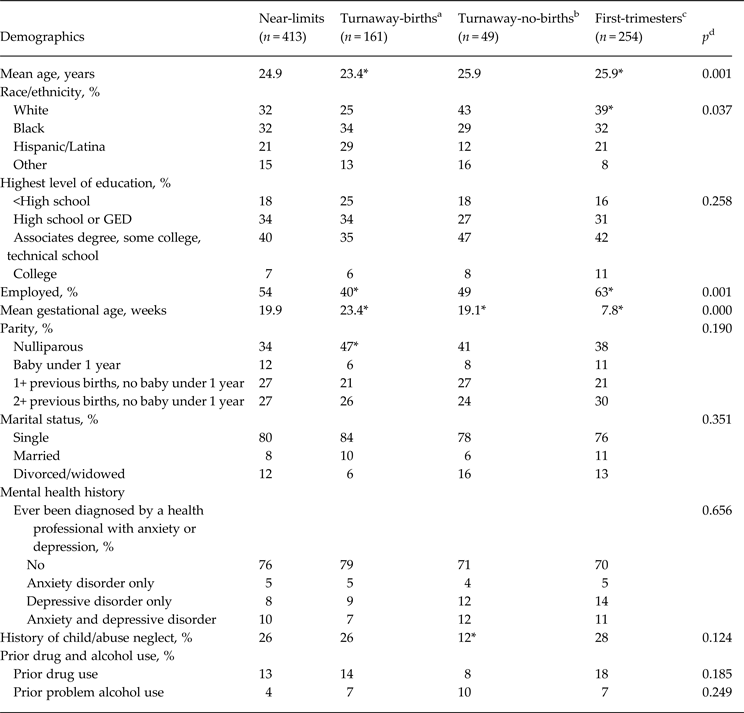
Mental health history, educational level, marital status, and prior drug and problem alcohol use were similar across groups (Table 1). By design, gestational age at recruitment differed across study groups. At baseline, when compared with Near-limits (mean = 24.9), Turnaway-births were younger (mean = 23.4 years) and First-trimesters were older (mean = 25.9 years). Relative to Near-limits (54%, 224/413), Turnaway-births were less likely (40%, 64/161) and First-trimesters were more likely to be employed (63%, 161/254). Turnaway-births had lower parity, and Turnaway-no-births were less likely to report a history of child abuse or neglect than Near-limits.
Characteristics of participants by study group (n = 877)

GED, General Educational Development.
a Turnaway-births compared with Near-limits.
b Turnaway-no-births compared with Near-limits.
c First-trimesters compared with Near-limits.
d p Value is based on multiple comparisons using a post-estimation command.
* p < 0.05 for comparisons between Near-limits and other study groups.
Depression
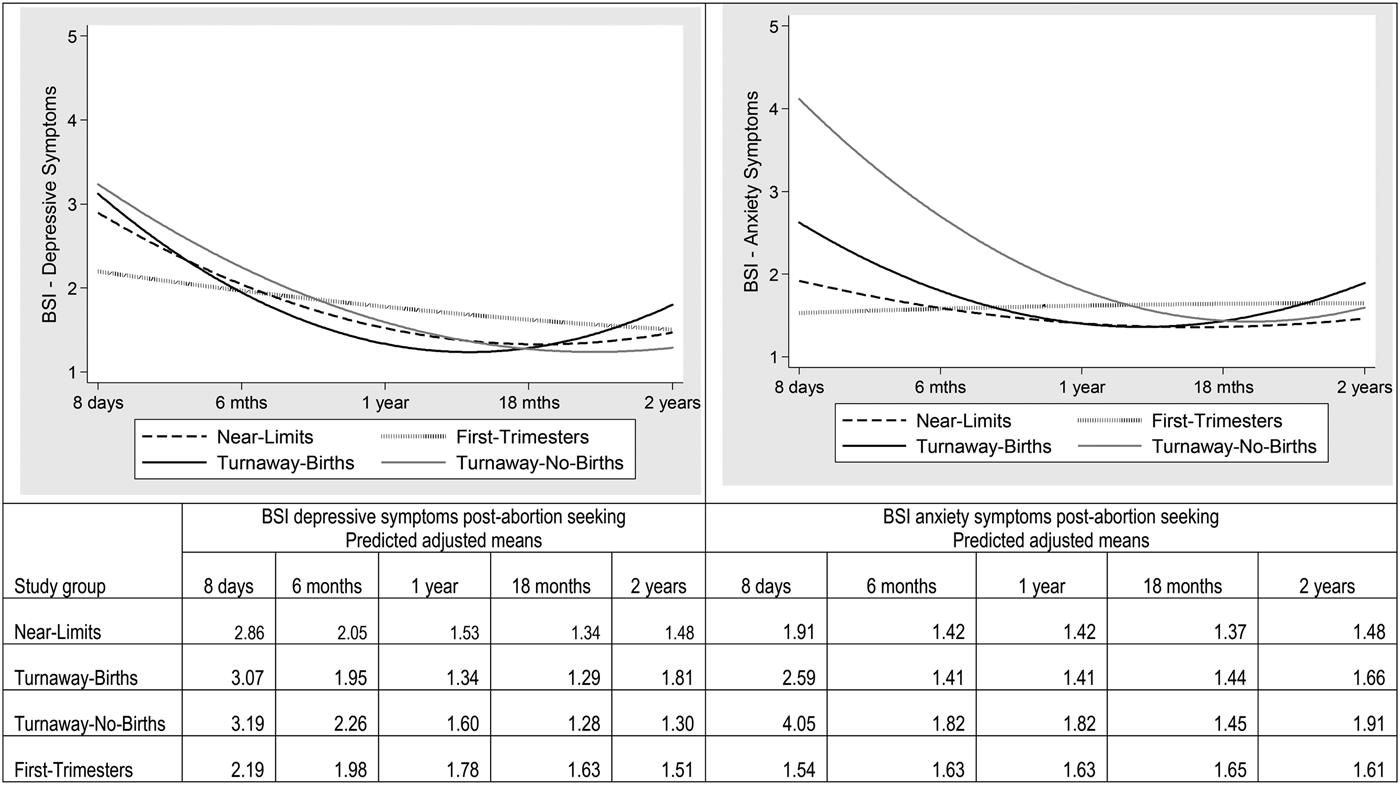
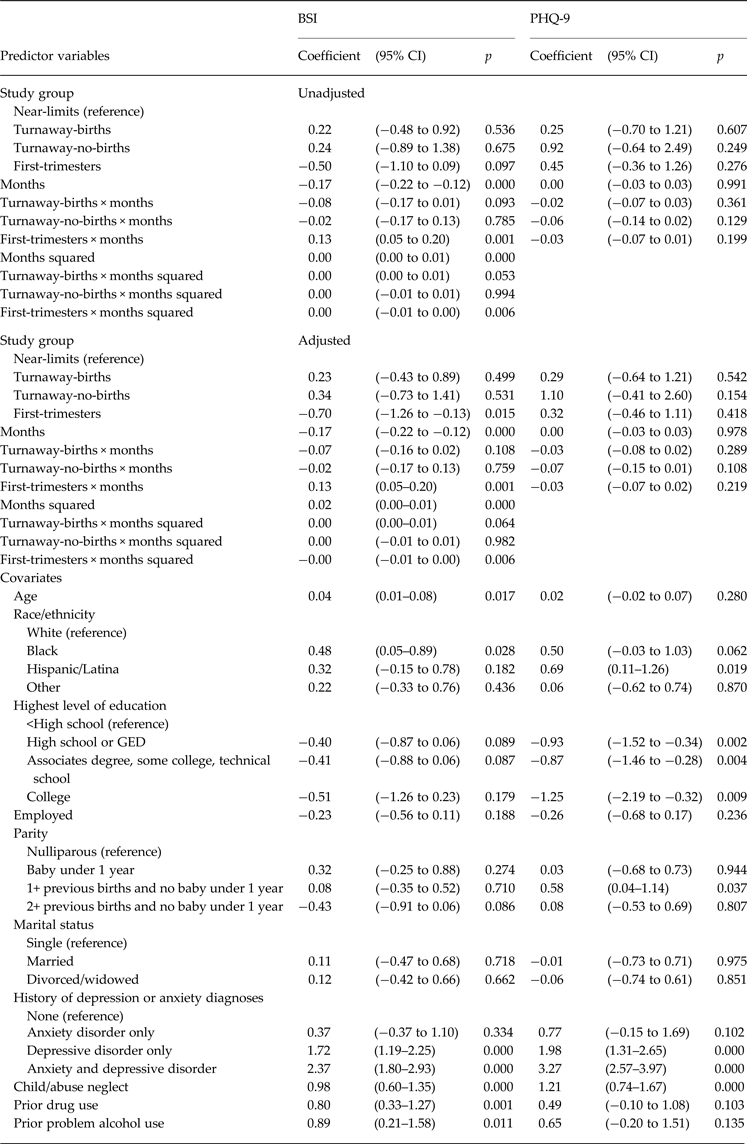
In a model of responses to BSI depression symptoms, significant likelihood ratio tests (p < 0.01, not shown) indicated that subject-specific random slopes and fixed quadratic terms for time improved the model fit and are included in the adjusted linear mixed-effects regression model of depressive symptom trajectories (Table 2). In the model without group × time interactions, overall depressive symptoms declined over time [B = −0.15, 95% confidence interval (CI) −0.18 to −0.11 for months not shown]. Including group × time interactions improved the model fit, suggesting that group trajectories differ. Table 2 and Fig. 1 present the results of the unadjusted and adjusted linear mixed-effects regression models with group × time interactions. As indicated by the significant linear (months) and quadratic components (months squared) of depressive symptom trajectories, depressive symptoms decline non-linearly over time for Near-limits (the reference group). As indicated by the non-significant group × time interactions (Turnaway-births × months, Turnaway-no births × months) in both the unadjusted and adjusted models, depressive symptom trajectories for Turnaway-births and Turnaway-no-births do not differ significantly from Near-limits. In contrast, as indicated by the significant First-trimester × months interaction in the unadjusted and adjusted models, depressive symptom trajectories for First-trimesters differ significantly from Near-limits. Specifically, First-trimesters start with fewer depressive symptoms and their decrease is more gradual when compared with Near-limits. According to predicted values based on the adjusted model (see values below Fig. 1), mean depressive symptoms shortly after getting or being denied an abortion (baseline) are similar for Turnaway-births (mean = 3.07), Turnaway-no-births (mean = 3.19), and Near-limits (mean = 2.86), but significantly lower for First-trimesters (mean = 2.19, p = 0.02). In a regression analysis limited to the fifth interview wave, levels of BSI depressive symptoms did not differ by study group at 2 years post-abortion seeking.
Women's depressive and anxiety symptom trajectories up to 2 years after abortion seeking, based on adjusted predicted values, by study group. BSI, Brief Symptom Inventory.

Longitudinal unadjusted and adjusted linear mixed-effects regression analyses predicting depressive symptoms based on the BSI and PHQ-9 (n = 877)

BSI, Brief Symptom Inventory; PHQ-9, nine-item Primary Care Evaluation of Mental Disorders Patient Health Questionnaire; CI, confidence interval; GED, General Educational Development.
In the unadjusted and adjusted models predicting depressive symptoms from 6 months to 2 years after seeking an abortion using the PHQ-9, likelihood ratio tests indicated that fixed quadric terms did not improve the model fit (p > 0.05) but subject-specific random slopes (p < 0.001) did. Thus, subject-specific random slopes are included in the adjusted linear mixed-effects regression model of PHQ-9 depressive symptom trajectories. The model without group × time interactions indicates that PHQ-9 depressive symptoms do not decline over time (B = −0.00, 95% CI −0.03 to 0.03 for months not shown). Adding group × time interactions did not improve the fit of the model (likelihood ratio test, p = 0.2915), indicating that trajectories for depression do not differ by group. This is further confirmed in the model with the group × time interactions, where PHQ-9 depressive symptoms did not differ by study group at 6 months after seeking abortion nor were there any differences in depressive symptom trajectories over time (Table 3). A cross-sectional analysis indicated no study group differences in PHQ-9 depressive symptoms at 2 years.
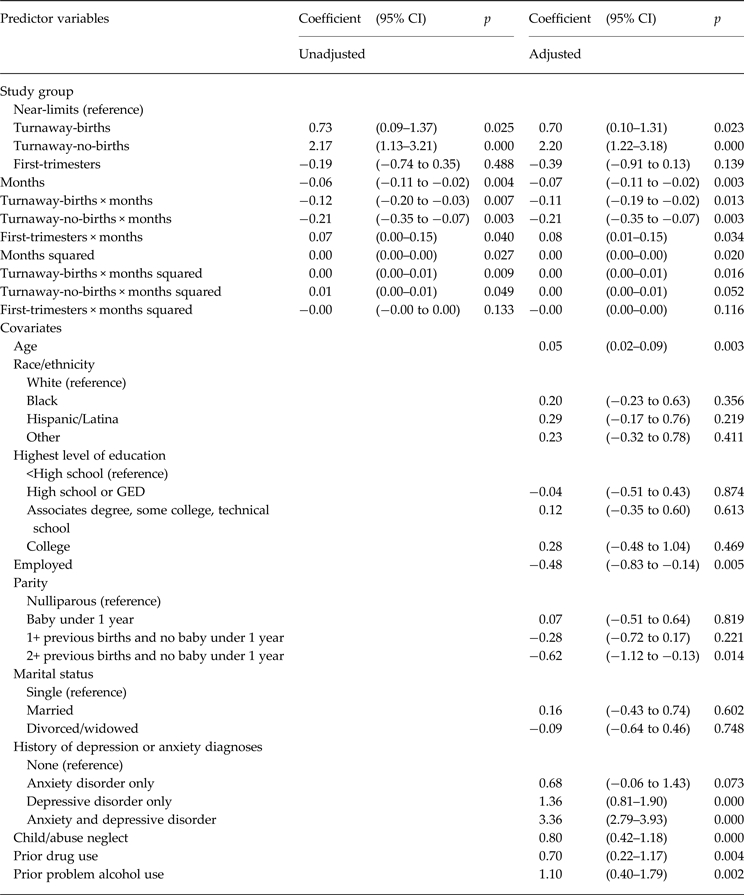
Longitudinal unadjusted and adjusted linear mixed-effects regression analyses predicting anxiety symptoms based on the BSI (n = 877)

BSI, Brief Symptom Inventory; CI, confidence interval; GED, General Educational Development.
Anxiety
Random slopes for individual and quadratic terms for time improved the fit (likelihood ratio tests, p < 0.01) of the anxiety symptoms model, and are included. The model without group × time interactions indicates that anxiety symptoms decline over time (B = −0.07, 95% CI −0.11 to −0.04 for months not shown). Adding group × time interactions improves the fit of the unadjusted and adjusted models (likelihood ratio test, p < 0.01), indicating that trajectories for anxiety symptoms differ by group, decreasing for Near-limits, Turnaway-births and Turnaway-no-births and remaining steady for First-trimesters (Table 2 and Fig. 1). Anxiety symptoms declined more rapidly among the Turnaway-births and Turnaway-no-births compared with the Near-limits. According to adjusted model-based predicted values, mean levels of anxiety 1 week post-abortion seeking are significantly higher for Turnaway-births (2.59) and Turnaway-no-births (4.05) and similar for First-trimesters (1.54), when compared with Near-limits (1.91), and similar across groups after approximately 1 year (Fig. 1) At 2 years, anxiety symptoms did not differ by study group in a cross-sectional analysis.
Sensitivity analyses
When we limit our sample to the 11 facilities with a participation rate greater than 50%, results are similar in direction but not in magnitude when compared with the main analyses. In this restricted sample, depressive symptom trajectories between First-trimesters and Near-limits no longer differ significantly by study group although the direction of the effects is similar (not shown). Statistically significant differences in anxiety symptom trajectories between Near-limits and both Turnaway groups remain in the restricted sample. Differences in anxiety symptom trajectories comparing the First-trimesters and Near-limits remain similar in magnitude; however, they are no longer significant in the restricted sample.
Discussion
If women with unwanted pregnancies experienced mental health problems as a result of having an abortion, we would expect anxiety and depressive symptoms to be more common or even to increase over time among women receiving an abortion. Instead, we found that among women receiving an abortion, depression and anxiety symptoms remained steady or decreased over the 2 years after receiving an abortion. We did not find that anxiety or depressive symptoms were more common among women having an abortion. Rather, we found that initial and subsequent levels of depression were similar between women who received and women who were denied abortions near the facility gestational limit. Levels of anxiety symptoms were initially higher among those denied an abortion compared with those receiving one, but again the two groups converged over time.
While women in the Near-limit group had later abortions than typical in the USA (Jones & Kavanaugh, Reference Jones and Kavanaugh2011), the comparison with the First-trimester group suggests mental health experiences of women having later versus earlier abortions do not differ and that later abortions may not have more mental health consequences than first-trimester abortions. Women in the First-trimester group initially had fewer depressive symptoms than those receiving abortions closer to the facility's gestational limit, but these differences were not sustained over time.
Among women initially denied an abortion, 21%, primarily those at a lower gestational age, went on to receive an abortion elsewhere. The greater anxiety symptoms among women who terminated their pregnancies after initially being denied may be a function of the stress of having to continue to search for an abortion or, alternatively, the experience of anxiety may motivate the continued search for an abortion.
This study has a number of strengths. The first is its comparison groups. The one known study comparing mental health among women having abortions with women denied abortions was conducted in the UK in 1995 (Gilchrist et al. Reference Gilchrist, Hannaford, Frank and Kay1995). It looked at clinical diagnoses that resulted in hospital admissions, rather than examining the full range of mental health symptoms that women may experience before being considered a case. Most studies have compared women who terminate pregnancies with women who have never had an abortion, never been pregnant, or miscarry, or all women who give birth, without regard to pregnancy intention (Adler et al. Reference Adler, David, Major, Roth, Russo and Wyatt1992; American Psychological Association Task Force on Mental Health and Abortion, 2008; Charles et al. Reference Charles, Polis, Sridhara and Blum2008; National Collaborating Centre for Mental Health at the Royal College of Psychiatrists, 2011). By comparing two groups of abortion-seeking women, we were able to ensure that factors – such as wantedness of pregnancy, which are associated with the experience of an unintended pregnancy and the decision to terminate, and may contribute to women's depression or anxiety – were similar in both study groups.
Second, most previous research on abortion and mental health has been conducted with women who had first-trimester abortions (American Psychological Association Task Force on Mental Health and Abortion, 2008). This study has a large sample of women who received abortions in their second trimester, a group that might be thought to have a more difficult abortion experience. While we found that levels of depression among First-trimesters were lower than Near-limits shortly after their abortion, this difference disappeared over time. In contrast, when looking at anxiety symptoms over time, there were no statistically significant differences between First-trimesters and Near-limits at baseline or at 2 years. However, their anxiety trajectories differed slightly; levels of anxiety for First-trimesters remained steady over time, whereas they steadily decreased for the Near-limits.
A third strength of this study was that mental health data were collected longitudinally, which probably minimized error in recall, and allowed us to chart women's mental health trajectories over time. Few previous studies have done this (Charles et al. Reference Charles, Polis, Sridhara and Blum2008).
A fourth strength was that we considered the role of prior mental health, child abuse/neglect, alcohol and drug use, and sociodemographic factors, all of which may influence both the timing of presentation for abortion and subsequent anxiety and depressive symptoms. Near-limits and Turnaways were similar on most of these characteristics at baseline, including history of mental health diagnoses, indicating that the quasi-experimental design was a success. Consistent with prior studies, our findings show that these factors were strongly associated with subsequent mental health outcomes (Steinberg & Finer, Reference Steinberg and Finer2012; Steinberg et al. Reference Steinberg, McCulloch and Adler2014).
There were also some limitations with the study. We did not use a structured psychiatric interview to assess clinical-level mental health disorders according to classifications in the Diagnostic and Statistical Manual of Mental Disorders (American Psychiatric Association, 2000; Kessler & Ustun, Reference Kessler and Ustun2004). Instead, we used women's self-report of their mental health symptoms and resulting scores on the PHQ-9 and BSI depression and anxiety subscales. By relying on these validated measures we were able to capture a range of women's experiences of mental health symptoms, including subclinical cases, and we were not limited to those seeking medical treatment.
This study had an overall participation rate of 37.5%, similar to other prospective cohort studies (Morton et al. Reference Morton, Cahill and Hartge2006; Galea & Tracy, Reference Galea and Tracy2007) and probably a consequence of the large demands of study participation (11 interviews over 5 years), the stigmatized nature of abortion and the requirement of providing identifying information to researchers. Findings from our sensitivity analyses suggest that our findings do not differ by level of participation. Our retention rate of 77% at 2 years and lack of significant differences in baseline mental health among those participating and those subsequently lost to follow-up strengthens the validity of our findings. Although our sample (by design) is disproportionately represented by women seeking abortions later in gestation than women receiving abortion nationally, the participants’ emotional responses to their abortions and demographic characteristics mirror those of national samples of women who have abortions (Jones & Kavanaugh, Reference Jones and Kavanaugh2011; Jones & Finer, Reference Jones and Finer2012; Rocca et al. Reference Rocca, Kimport, Gould and Foster2013). Our comparison with women having first-trimester abortions suggests that our results are generalizable.
Finally, we could not assess whether abortion conferred benefits for women who sought abortion specifically for mental health reasons. One in five women in our study requested an abortion because they felt emotionally or mentally unprepared to raise a child; most gave financial or partner-related reasons or cited concern for existing children (Biggs et al. Reference Biggs, Gould and Foster2013).
Our findings show that relative to unwanted childbearing, abortion does not lead to an increased risk of mental health problems among women. Women having near-limit abortions initially had similar levels of depression and lower levels of anxiety than women who were denied abortions and subsequently carried their pregnancies to term. Mental health differences by study group observed 1 week post-abortion seeking were not sustained over time. Policies based on the notion that abortion harms women's mental health are not supported by this work.
Acknowledgements
This study was supported by research and institutional grants from the Wallace Alexander Gerbode Foundation, the David and Lucile Packard Foundation, The William and Flora Hewlett Foundation and an anonymous foundation. J.R.S.'s time was supported by National Institutes of Health/National Institute of Child Health and Human Development (NIH/NICHD) Building Interdisciplinary Research Careers in Women's Health (BIRCWH) HD052163 and NIH/NICHD K01 HD075834. The authors thank Rana Barar, Heather Gould and Sandy Stonesifer for study coordination and management; Janine Carpenter, Undine Darney, Ivette Gomez, Selena Phipps, Claire Schreiber and Danielle Sinkford for conducting interviews; Michaela Ferrari and Elisette Weiss for project support; Jay Fraser for statistical and database assistance and all the participating providers for their assistance with recruitment.
Declaration of Interest
None.