Intergenerational links in family violence, particularly child maltreatment and the cycle of maltreatment hypothesis, have been the focus of much research attention, yet there is still some question as to whether individuals’ experiences of maltreatment from their parents in childhood predict their own perpetration of maltreatment toward their children in adulthood. Furthermore, understanding of the roles of possible mediators (intervening mechanisms linking these behaviors) and moderators (factors associated with stronger or weaker associations) is still relatively limited. In the present study, we focus on intergenerational associations in physical maltreatment; we examined mediational effects of antisocial behavior, as assessed by criminal behaviors and substance use (alcohol and drug use), and we also examined the extent to which parental angry temperament moderated any indirect effects of antisocial behavior.
Regarding intergenerational associations in maltreatment more broadly (including neglect and sexual abuse), Thornberry, Knight, and Lovegrove (Reference Thornberry, Knight and Lovegrove2012) conducted a systematic review of intergenerational studies that tested whether a history of maltreatment victimization in childhood is a risk factor for later perpetration of such maltreatment. The included studies had to meet a number of criteria, such as representative samples and prospective designs. Relatively few studies met the criteria, and findings of the methodologically stronger studies indicated mixed support for the intergenerational hypothesis. A further study by Thornberry and Henry (Reference Thornberry and Henry2013) using a strong design, including careful controls, found that a history of maltreatment victimization during adolescence (but not maltreatment limited to earlier childhood) was related to a fivefold increase in the risk of becoming a perpetrator of maltreatment, according to Child Protective Services records. This finding is supported by work regarding transmission of physical maltreatment with the Oregon Youth Study (OYS) meeting similar criteria (Pears & Capaldi, Reference Pears and Capaldi2001), which involved Generation 1 (G1) and G2 of the sample used in the present study. However, using documented maltreatment, Widom, Czaja, and DuMont (Reference Widom, Czaja and DuMont2015) did not find significant associations across generations G2 and G3 of their study for physical maltreatment (although they found associations for neglect). Physically maltreated G2 were not significantly more likely than controls to have a physical abuse report toward G3 (5.6% vs. 5.4%) or to self-report this behavior (31.7% vs. 23.9%). Thus, although there is evidence supporting intergenerational associations in physical maltreatment, it is not as consistent or as strong as frequently assumed, which leads to questions about whether there are identifiable processes that exacerbate or disrupt intergenerational continuities in family violence.
Definition of Maltreatment
According to the World Health Organization, child maltreatment includes all forms of physical and emotional ill treatment, sexual abuse, neglect, and exploitation that result in actual or potential harm to the child's health, development, or dignity. Even focusing only on physical maltreatment, this definition is relatively broad, depending on the interpretation of potential harm. Numerous studies have examined only cases coming to the official attention of Child Services or similar agencies in order to focus on more severe, documented cases. The drawback of this approach is that many children may experience maltreatment that is not officially recorded. Nevertheless, studies with a broader focus on the intergenerational transmission of negative aspects of parenting have ranged from examining family conflict and harsh and inconsistent discipline to clearly abusive and destructive behaviors. Physically aggressive behaviors of parents toward their children range from pushing and shoving to severe beatings. Spanking and hitting with a hand are generally more commonly reported than more severe physical aggression, such as spanking with an object (Straus & Stewart, Reference Straus and Stewart1999), yet would appear to meet the World Health Organization maltreatment definition. It is possible that there are stronger associations across generations for more severe, compared with less severe, forms of physical maltreatment. With the OYS data set, Pears and Capaldi (Reference Pears and Capaldi2001) found that G1 parents who were most severely maltreated themselves (physical acts and multiple injuries) had the highest level of abuse of G2, whereas moderately severely maltreated G1 parents (physical acts and one injury) did not differ from less severely maltreated or nonmaltreated G1 parents in their abusive punishment of G2. To address these issues, in the present study of transmission from G2 to G3, latent classes were formed of endorsement of physical maltreatment experienced in childhood, and the association of these classes with the level of physical maltreatment perpetrated toward children in adulthood was examined.
Mediation of Intergenerational Association in Maltreatment
Modest intergenerational associations in maltreatment indicate the need to understand the mechanisms by which some individuals go on to perpetrate the maltreatment they experienced in childhood, whereas others do not (Kerr & Capaldi, Reference Kerr, Capaldi and Bornsteinin press; Thornberry et al., Reference Thornberry, Knight and Lovegrove2012). Social learning models have predominated in the area, as intergenerational associations in maltreatment are posited to be due to the fact that physically maltreated children learn to use violent approaches to managing parent–child conflict or the cycle of violence hypothesis (Widom, Reference Widom1989) and fail to learn nonviolent parenting approaches (Reid, Patterson, & Snyder, Reference Reid, Patterson and Snyder2002). It is also the case that much physical maltreatment of children occurs not because parents choose or prefer such an approach, but because they lose their temper; thus, much maltreatment may be an undercontrolled behavior (Stith et al., Reference Stith, Liu, Davies, Boykin, Alder, Harris and Dees2009). Relatedly, it has been demonstrated that very young children show higher levels of physical aggression (e.g., pushing a peer who has a toy they want), which then decrease across childhood (Tremblay et al., Reference Tremblay, Nagin, Séguin, Zoccolillo, Zelazo, Boivin and Japel2004). Children who are physically maltreated may fail to improve in the self-control that allows them to inhibit such aggressive impulses. Several intergenerational studies began to examine mediational issues by examining social learning pathways linking antisocial behavior across generations via poor parenting (e.g., Patterson, Reference Patterson1998). Several studies support this model (Belsky, Conger, & Capaldi, Reference Belsky, Conger and Capaldi2009; Neppl, Conger, Scaramella, & Ontai, Reference Neppl, Conger, Scaramella and Ontai2009; Thornberry, Freeman-Gallant, Lizotte, Krohn, & Smith, Reference Thornberry, Freeman-Gallant, Lizotte, Krohn and Smith2003); however, there are some important exceptions (Bailey, Hill, Oesterle, & Hawkins, Reference Bailey, Hill, Oesterle and Hawkins2009). This provided groundwork for intergenerational parenting research on whether the development of antisocial behavior at least partially mediated the association of experiencing harsh or poor parenting in the family of origin and using such parental tactics toward offspring in the family of procreation. Overall, findings from a limited number of studies indicate a mediating role of antisocial behavior for harsh discipline or physical maltreatment.
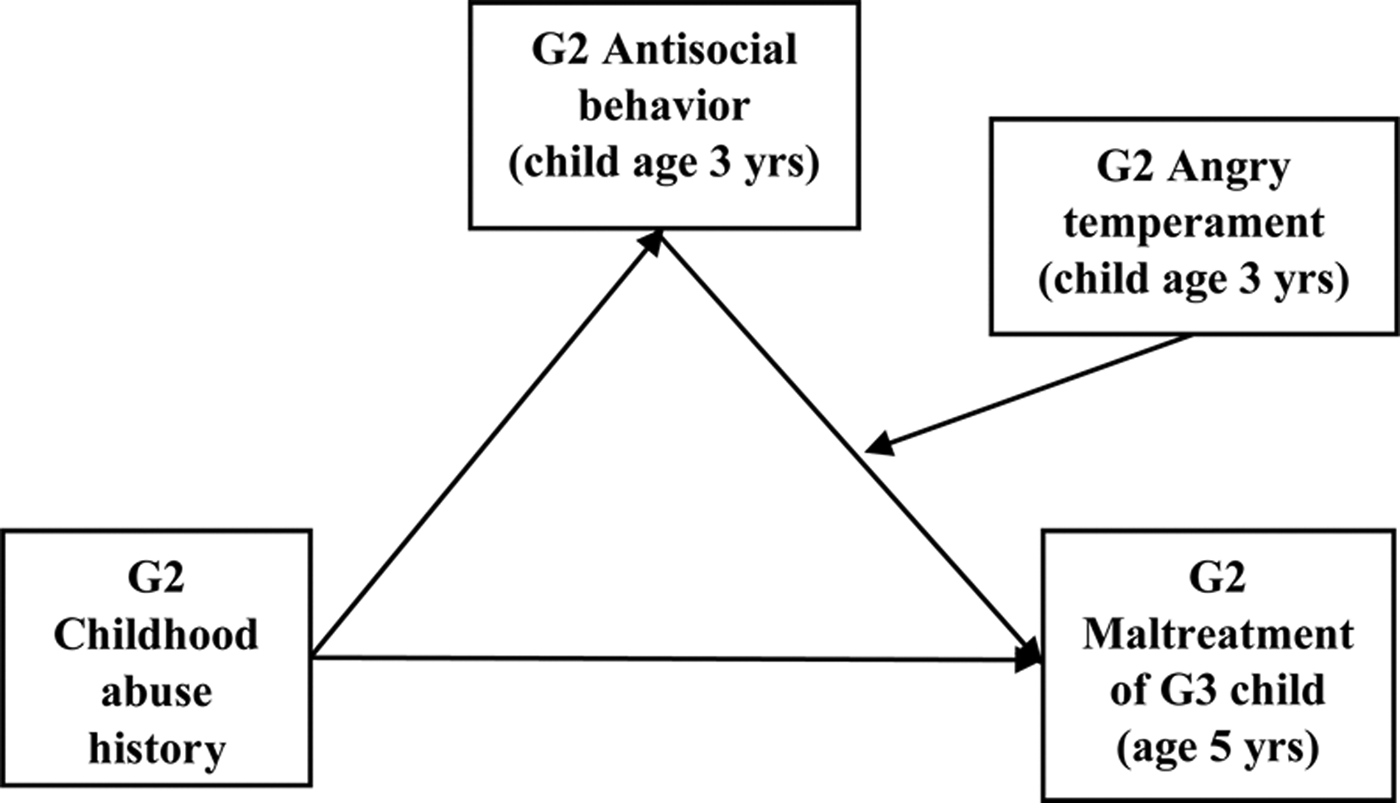
Poorly controlled anger is related to antisocial behavior and may be the characteristic that particularly indicates risk for losing control in parent–child conflict situations, resulting in a physically aggressive parental response to the child; thus, anger may act as a moderator of mediational associations via antisocial behavior (see Figure 1). The role of anger in intergenerational transmission of maltreatment has been little examined. Berlin, Appleyard, and Dodge (Reference Berlin, Appleyard and Dodge2011) examined mediational effects of a measure related to maternal anger. They reported that mothers’ reports of being physically maltreated in childhood were associated with increased risk to offspring of being maltreated (according to county records), and the effect was fully mediated by mothers’ aggressive responses to hypothetical vignettes about ambiguous/provocative interpersonal events. Thus, Berlin et al.’s (Reference Berlin, Appleyard and Dodge2011) work suggested experiencing childhood physical maltreatment may put mothers at risk for maltreating their own children by contributing to a tendency toward hostile attributions and aggressive behavior in general.
Intergenerational model of maltreatment.

Substance use, particularly alcohol and drug use, is a further domain of individual risk mechanisms that may contribute to association in physical maltreatment across generations. Both alcohol and drug use have been found to be associated with later violence perpetration (Widom & Wilson, Reference Widom, Wilson, Lindert and Levav2015), which within the family includes intimate partner violence (Capaldi, Knoble, Shortt, & Kim, Reference Capaldi, Knoble, Shortt and Kim2012; Feingold, Kerr, & Capaldi, Reference Feingold, Kerr and Capaldi2008; Foran & O'Leary, Reference Foran and O'Leary2008) and child maltreatment (Walsh, MacMillan, & Jamieson, Reference Walsh, MacMillan and Jamieson2003). Maltreated parents may be more likely to fall back on and repeat abusive behaviors they learned in childhood when they are intoxicated or otherwise impaired. With regard to the association of drug use and parenting, Bailey et al. (Reference Bailey, Hill, Guttmannova, Oesterle, Hawkins, Catalano and McMahon2013) found that the contextual factor of substance use may not be causal of intergenerational associations in parenting, but rather an additional outcome of antisocial traits. However, further tests of such hypotheses regarding the role of alcohol and drug use in intergenerational associations in parenting are needed. In addition, whereas prior studies of the roles of parental substance use have involved diagnosed drug use disorders, it is possible that substance use not resulting in dependence symptoms reaching diagnostic criteria still may be relevant to poor parenting and maltreatment. Such hypotheses have been relatively little tested in relation to physical maltreatment, or other parent behaviors for that matter (Kerr & Capaldi, Reference Kerr, Capaldi and Bornsteinin press).
Overall, the relatively modest evidence of mediational effects regarding intergenerational associations in maltreatment suggests further work is needed, and the substantial discontinuity in maltreatment across generations leads to questions about moderators (i.e., interactive effects such as associations that depend on child gender; Thornberry, Reference Thornberry, Shanahan, Mortimer and Johnson2016).
Hypotheses
First, it was hypothesized, both for G2 mothers and fathers, that more severe physical maltreatment in childhood would predict greater maltreatment toward offspring (i.e., direct intergenerational effect). Second, it was hypothesized that more severe physical maltreatment in childhood would predict greater engagement in risky behaviors in adulthood (specifically delinquent behaviors and substance use), which would in turn predict greater physical maltreatment toward offspring (i.e., mediated intergenerational effects). Third, as depicted in Figure 1, maternal and paternal anger were posited to moderate the strength of the mediating effects of delinquent behaviors and substance use in explaining the intergenerational transmission of child physical maltreatment (i.e., moderated mediation of intergenerational effects); specifically, angrier temperament among parents who experienced more versus less (or no) physical abuse as children was expected to exacerbate the extent to which greater engagement in delinquent behaviors and substance use predicted subsequent physical maltreatment toward offspring.
We chose to estimate the childhood maltreatment classes separately for G2 mothers and fathers, which allowed for separate maternal and paternal hypothesis tests for the entire conceptual model, including direct, indirect, or moderated indirect effects. Given the sample size, however, hypothesis tests of whether the direct, indirect, or moderated indirect effects differed for mothers or fathers were not performed. Note also that, if the G2 maltreatment class models had been estimated aggregated across G2 parents, it would be hard to interpret the results, given that both mothers and fathers would have been assigned to the maltreatment classes whereas the mediators pertained to mothers’ and fathers’ behaviors separately.
Method
Participants
The study involved children (N = 283) of 143 fathers and 177 mothers. Fathers were originally recruited as boys to the OYS (from 1984 to 1985), a community-based sample that involved recruiting all boys in the fourth-grade classes (aged 9–10 years) of schools in neighborhoods (74%; n = 206 participation) with higher-than-average rates of delinquency in a medium-sized metropolitan area in the Pacific Northwest. Participants were representative of the neighborhoods at the time; 90% of the boys were White, and most were from families of lower socioeconomic status, predominantly below college level, and in manual jobs (Hollingshead, Reference Hollingshead1975). Participation rates were 89% or better at each assessment following the boys then men from ages 9–10 to 37–38 years.
The Three Generational Study (3GS) recruited the offspring of the OYS men and these children's mothers. After initial assessments, recruitment was limited to the first two biological children per woman (i.e., OYS men who fathered children with more than one woman could have more than two children followed in 3GS). Child assessments occur at age 21 months (Time 1) and ages 3, 5, 7, 9, 11–12, 13–14, 15–16, and 17–18 years (Time 2–Time 9). The study is ongoing as children are still being born to the OYS men, with a 90% retention rate of G3 children. However, the N available for each wave is determined by timing of the children's births. For the present study, the sample consisted of those offspring who were old enough to have completed the age 5 assessment. As of fall 2017, this resulted in an N of 283 (49% male, n = 139) children of 143 OYS fathers (49 with 1 child, 61 with 2 children, 24 with 3 children, 7 with 4 children, 1 with 5 children, and 1 with 7 children) with 177 different biological mothers. Analytic adjustment for dependence among siblings’ scores is discussed below. Of the 283 participating children, 258 were biologically related to the OYS men and 25 were stepchildren.
Procedures
Assessments of the OYS boys/men included interviews and questionnaires. Assessments of the men's children in the 3GS included child- and parent-report questionnaires, interviews, and staff coding and ratings of father–child and mother–child interactions. All measures and procedures were approved by the Oregon Social Learning Center Internal Review Board.
Measures
G1 parental maltreatment of G2
When the OYS G2 men were on average age 20.8 years (range 20.0–23.0 years), they completed an abbreviated version of the Assessing Environments—III Questionnaire (Berger, Knutson, Mehm, & Perkins, Reference Berger, Knutson, Mehm and Perkins1988). The original version consisted of 162 true/false questions regarding a range of parental and home environment behaviors (e.g., I received injuries from the discipline used by my parents). The Assessing Environments—III Questionnaire has been shown to distinguish between maltreated and nonmaltreated adolescents (Berger et al., Reference Berger, Knutson, Mehm and Perkins1988). A modified version of 23 items was used with the OYS G2 men, each assessed on a 5-point scale (0 = never true to 4 = very true), and 9 of these items formed the maltreatment scale (e.g., I had a parent [or stepparent] who used to punch me when they got angry with me). G2 mothers also answered the same 23 items the first time they participated in 3GS with their first G3 child. Mothers were, on average, 22.9 years of age when they reported on their childhood abuse histories (range 16.6–37.2 years of age). G2 mother and father latent classes were estimated based on 11 items, which were recoded from the original Likert scale to binary (0 = never true and 1= rarely true through very true). Although composite scale scores were not used in the present analyses, Cronbach's unstandardized α for the binary items was 0.88 for mothers and 0.85 for fathers.
G2 parental maltreatment of the G3 child
Physical maltreatment of G3 children was assessed at the 3GS child age 5 assessment by mother and father report using the physical aggression subscale from the Parent–Child Conflict Tactics Scale (Straus & Hamby, Reference Straus, Hamby, Kantor and Jasinski1997). Parents reported on their own and their (ex)partners’ (i.e., the child's other biological parent's) physical aggression toward G3. The scale was formed from four items of physical aggression directed toward the child, including threw something; pushed, grabbed, shoved; spanked; and spanked with object, each assessed on a scale of 0 (never) to 6 (almost every day). Given the small number of items, all of which clearly assessed physical aggression toward the child, scale reliability analyses were not conducted.
Substance use
Mothers’ and fathers’ alcohol, marijuana, and other illicit drug use (which included use of opiates, cocaine, hallucinogens, inhalants, uppers, and downers) was assessed via self-report at the 3GS child age 3 assessment. Separately for alcohol and marijuana, mothers and fathers self-reported on their frequency and quantity of use on a typical occasion in the last year; for other illicit drugs, prevalence of use in the last year was reported for each substance. Response scales for frequency of use were either continuous (i.e., open-ended items) or categorical. Categorical responses were recoded to reflect the midpoints of the categories, denoting frequency of use in the last year, capped at daily use (once or twice = 1.5, once every 2–3 months = 5, once a month = 12, once every 2–3 weeks = 20.8, once a week = 52, 2–3 times a week = 130, and once a day and 2–3 times a day = 365). Alcohol use included the aggregate use of beer, wine, and distilled spirits (denoted as the number of drinks on a typical occasion in the last year). Quantity of marijuana use was converted into grams as follows: one joint = 1 g, one toke or bong hit = 1/10 g, and 1 ounce = 28 g. For other illicit drug use, prevalence of having used one or more illicit substances was calculated. Whereas for alcohol and marijuana, parental substance use scores were calculated as the product of frequency and quantity of use and were log transformed to reduce positive skew. Substance use scores were standardized and then averaged to create a single composite score of overall substance use. Prevalence of alcohol, marijuana, and other illicit drug use was, respectively, 82.0%, 22.0%, and 42.8% for mothers and 85.8%, 36.0%, and 36.2% for fathers. Within a parent, significant associations were found for fathers’ substance use (correlations ranging from r = .16 to r = .29, p = .01 to p < .001), mothers’ alcohol and marijuana use (r = .25, p < .001), and mothers’ alcohol and other illicit drug use (r = .15, p = .03).
G2 delinquency
For most of the G3 cases (approximately 75%), the father delinquency subscale came from the Self-Report Delinquency Scale (Elliott, Reference Elliott1983; Elliott, Ageton, Huizinga, Knowles, & Canter Reference Elliott, Ageton, Huizinga, Knowles and Canter1983) at the closest OYS wave to the 3GS child age 3 assessment (within 365 days). The remaining 73 cases came via the same instrument given to the father at the age 3 3GS assessment, which was administered if the father had not been interviewed within 1 year. Mother's delinquency was assessed by an abbreviated 16-item version of the self-report delinquency sybscale. The father score was calculated using the same 16 items, in order to match that of the mother. For each parent, the raw counts were recoded to binary 0–1 and then summed. Cronbach's unstandardized α for the binary items was 0.63 for mothers and 0.69 for fathers.
Temperament anger scale
The Emotionality, Activity, Sociability, and Impulsivity Temperament Survey for Adults (Buss & Plomin, Reference Buss and Plomin1984) was given at 3GS Time 2 (child age 3 years). The anger subscale consisted of four items, (e.g., I am known as hot blooded and quick tempered). Cronbach's unstandardized alpha was 0.67 for mother and 0.66 for father scales.
Data analytic plan
First, latent class analysis (LCA) was used to examine heterogeneity in G2 parental abuse histories from childhood, and intergenerational transmission of abuse was examined by testing whether the prevalence or severity of G2-parent-to-G3-child physical aggression in early childhood (age 5 years) significantly differed across the parental abuse history classes. LCA enabled differentiation among different types of childhood abuse histories for parents, ranging from no abuse, minor abuse in the form of spanking only, to severe abuse. In addition, although many parents reported having been spanked as children (83% for mothers and 79% for fathers) or hit with a switch, belt, or paddle (50% for mothers and 45% for fathers), prevalence of the more severe abuse items was quite low (i.e., ranging from 2% to 17% for having been kicked, choked, beat up, tied up, locked in a closet, or injured from discipline that required medical attention). Thus, LCA was used to both account for low endorsement for many of the abuse indicators and discriminate among direct and indirect effects of G3 child maltreatment for parents who had experienced various forms of abuse in their own childhoods. Second, we examined whether parent antisocial behavior in adulthood (i.e., delinquency and substance use) during their children's early childhood (age 3 years) mediated the association between their prior abuse from childhood and subsequent physical aggression toward their own children at age 5 years. Third, we examined whether greater parental anger moderated the extent to which greater delinquent behaviors and substance use explained the intergenerational transmission of physical maltreatment toward children (i.e., moderated mediation).
Heterogeneity in G2 parental childhood abuse histories
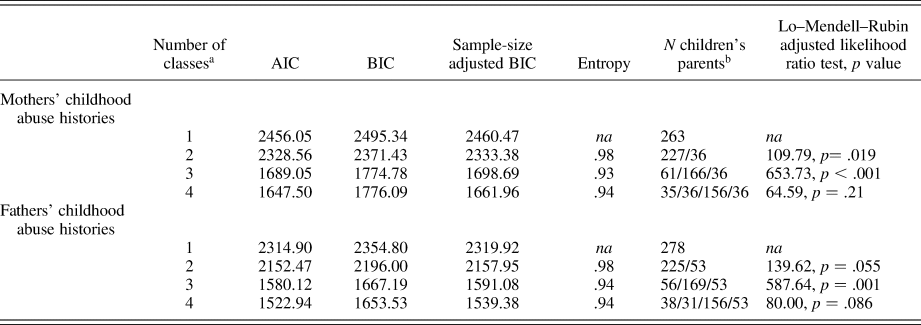
Heterogeneity in mothers’ and fathers’ prevalence of having been maltreated as children, which included behaviors ranging from spanking to severe aggression such as punching, choking, and having injuries resulting from discipline, was examined using LCA. Analyses were run separately for mothers and fathers using data on up to N = 283 children. Standard errors were adjusted in all analyses to account for dependence among siblings’ scores using a sandwich estimator via the COMPLEX option in Mplus version 7.3 (Muthén & Muthén, Reference Muthén and Muthén1998–2015). To differentiate between parents who were versus were not maltreated as children, LCA models were estimated such that one of the classes was defined to be a no childhood maltreatment class by constraining all of the indicators to have zero probability of endorsement. In all other classes, average probabilities of endorsement of the abuse indicators were freely estimated. The number of latent classes necessary to adequately summarize heterogeneity in parental childhood abuse histories was evaluated using both information criteria (i.e., Akaike information criteria, Akaike, Reference Akaike1987; Bayesian information criteria and sample-size adjusted Bayesian information criteria, Nylund, Asparouhov, & Muthén, Reference Nylund, Asparouhov and Muthén2007) and the Lo–Mendell–Rubin test, which examines for significant change in model fit for a (c) versus (c + 1) class model (Lo, Mendell, & Rubin, Reference Lo, Mendell and Rubin2001). The probability of each parent belonging to one of at least two latent classes, posited to include a spanking only class and at least one other class indicative of more severe abusive behaviors, in addition to the no abuse class, served as the antecedents in the mediation model.
Intergenerational transmission of child physical maltreatment
Intergenerational transmission of maltreatment was examined by testing whether G2-parent-to-G3-child physical aggression in early childhood (age 5 years) significantly differed across the parental abuse history classes using the DE3STEP procedure in Mplus (Asparouhov & Muthén, Reference Asparouhov and Muthén2014). Indirect effects of intergenerational transmission of child physical maltreatment via delinquency and substance use were evaluated using the product of coefficients method (MacKinnon, Reference MacKinnon2008).
Finally, the extent to which parent angry temperament moderated the indirect effects of delinquency and substance use in explaining intergenerational transmission of child physical maltreatment was tested using moderated mediation (Preacher, Rucker, & Hayes, Reference Preacher, Rucker and Hayes2007). Specifically, we tested whether parent anger moderated the extent to which higher levels of delinquency and substance use explained physical maltreatment in the offspring generation that is attributable to parents’ own childhood maltreatment histories (i.e., moderation of the paths from the mediator to outcome).
Results
Heterogeneity in G2 parent maltreatment histories in childhood: LCA
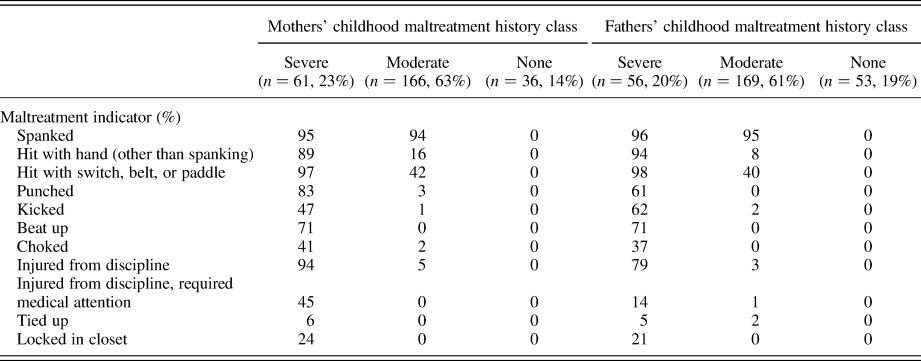
Three classes were needed to adequately summarize the heterogeneity in G2 parents’ childhood maltreatment histories (see Table 1). These LCA results yielded, for both mothers and fathers, the no maltreatment class (predefined), plus a moderate maltreatment class, and a severe maltreatment class. The estimated prevalence of each abusive behavior within each class is shown in Table 2. The moderate maltreatment class was the largest, and included a relatively high prevalence of having been spanked, hit (other than spanked), and hit with an object (e.g., belt, paddle, or switch). The severe maltreatment class was the next largest class for both mothers and fathers and also included a high prevalence of experiencing, as a child, these same parental physically aggressive behaviors, as well as a number of other severely aggressive behaviors and a high prevalence of injury. Of note, there was no apparent association between mothers’ and fathers’ maltreatment history observed class membership, χ2 (df = 4) = 4.67, p = .323.
Fit comparisons for latent class analysis models

Note: aAll GMMs fit with two or more classes were estimated such that one of the classes was defined as a long-term alcohol/no-HED class or a long-term no-alcohol-related-problems class. bN denotes most likely class membership. Maternal and paternal models include N = 263 children of 129 mothers and N = 278 children of N = 141 fathers. AIC, Akaike information criterion. BIC, Bayesian information criterion. Lo–Mendell–Rubin adjusted likelihood ratio test (Lo, Mendell, & Rubin, Reference Lo, Mendell and Rubin2001) denotes change in overall model fit for a (c) versus (c + 1) class model (e.g., one- vs. two-class model).
Three-class latent class analysis model results

Intergenerational associations in physical maltreatment
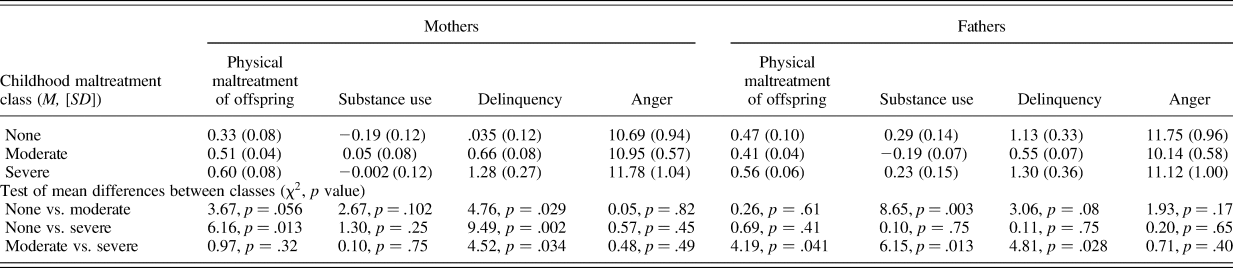
For G2 parents’ classes with childhood histories of severe, moderate, and no maltreatment, the mean levels of G2 physical maltreatment of G3 offspring were estimated to be .60, .51, and .33 on average for mothers’ perpetration and .56, .41, and .47 on average for fathers’ perpetration, respectively. Tests of mean differences in physical maltreatment of G3 across G2 child maltreatment classes revealed no significant differences between parents who had experienced moderate maltreatment in childhood compared to parents who were not maltreated in childhood (χ2 = 3.67, p = .056 for mothers and χ2 = 0.26, p = .61 for fathers), although the association did approach significance for mothers. However, significant differences did emerge for G2 parents who were severely maltreated in childhood. For mothers, the severely maltreated class perpetrated significantly more physical aggression toward their own offspring than did mothers who were not maltreated in childhood (χ2 = 6.16, p = .013) but not compared to mothers who were moderately maltreated (χ2 = 0.97, p = .32). Whereas for fathers, the severely maltreated class perpetrated significantly more physical aggression toward their own offspring than fathers who were moderately maltreated in childhood (χ2 = 4.06, p = .044) but not than fathers who were not maltreated (χ2 = 0.72, p = .40). Thus, there was evidence of transmission of physical maltreatment across generations for both mothers and fathers for the severely maltreated classes. Parents who reported severe childhood maltreatment perpetrated more aggression toward the offspring generation than parents who reported no or a moderate history of childhood maltreatment.
Association of G2 childhood maltreatment with hypothesized mediators
Results for differences in parent anger and antisocial behaviors, given their own childhood maltreatment history classes (Table 3), indicate salient effects for mothers’ delinquent behaviors, with all class comparisons yielding significant results in the posited directions. For fathers, delinquency was significantly greater for men who were severely maltreated compared to men in the moderate maltreatment class, but this was the only significant mean difference in delinquency across classes. For fathers, substance use was significantly greater for men who were severely maltreated compared to men in the moderate maltreatment class. However, men who were not maltreated as children used significantly more substances as adults than men who experienced moderate maltreatment as children. Finally, mothers’ average substance use did not significantly differ across all class comparisons, nor did parental anger for either mothers or fathers.
Tests of mean differences in physical maltreatment of G3 offspring and G2 parental antisocial behaviors and anger across parental childhood maltreatment history classes

Associations of hypothesized mediators with the G2 perpetration of maltreatment toward G3
Next, we examined whether greater parental antisocial behaviors in adulthood (at offspring age 3 years) was predictive of subsequent physical maltreatment toward their children at age 5 years. Parental substance use and delinquency were not significantly predictive of physical maltreatment of the offspring generation for mothers, b (SE) = .04 (.04), p = .26 and .09 (.06), p = .09, respectively, or fathers b (SE) = .04 (.04), p = .30, and –.02 (.03), p = .62, respectively. Thus, neither of the hypothesized mediators significantly predicted physical maltreatment of G3 children.
Mediating and moderation of mediating mechanisms of intergenerational transmission of physical maltreatment
Neither G2 maternal nor paternal substance use nor delinquency significantly mediated the intergenerational transmission of physical maltreatment (see Table 4). Furthermore, neither maternal nor paternal anger significantly moderated the mediating effects of parental delinquency or substance use in explaining intergenerational transmission of child physical maltreatment (see Table 5). Thus, no mediating mechanisms of parent antisocial behavior that account for the transmission of child physical maltreatment across generations were supported, nor did parental anger moderate the strength of such mediated effects.
Indirect effects of G2 parental antisocial behaviors

Indirect effects of G2 parental substance use and delinquency moderated by anger

Discussion
In this study, intergenerational associations were examined between the severity of physical maltreatment mothers and fathers experienced in childhood and the physical maltreatment they perpetrated toward their own child. Parents’ delinquent or criminal behavior and substance use also were examined as potential mediational mechanisms of intergenerational associations. An innovation and strength of the present study was the consideration of a range of parent maltreatment experiences (spanning from being spanked to requiring medical attention due to severe “discipline”) and the use of LCA to identify parents who had experienced no maltreatment (a predefined class) and those who had experienced moderate or severe maltreatment (two freely estimated classes). One fifth to one quarter of the G2 parents had experienced severe physical maltreatment in childhood. Only a relatively small proportion of parents, less than one fifth of mothers and fathers, reported experiencing no physical maltreatment in childhood. This may reflect that at the time the G2 parents were children, spanking was still relatively common (Straus & Mathur, Reference Straus, Mathur, Frehsee, Horn and Bussman1996). In addition, OYS families were recruited from neighborhoods with higher-than-average incidences of delinquency, and levels of violence in a community are associated with levels of physical child maltreatment (Lynch & Cicchetti, Reference Lynch and Cicchetti1998).
As hypothesized, there were significant associations between G2's childhood experience and adult perpetration of physical maltreatment. Intergenerational effects indicated generally that those who experienced severe maltreatment were more at risk of perpetrating severe maltreatment toward their own child than were parents who experienced no maltreatment. However, associations between G2 parents’ childhood maltreatment classes and physical maltreatment of G3 indicated small effects. Specifically, the strongest association was observed when comparing physical maltreatment of G3 by G2 mothers who were severely versus not maltreated as children. Note, however, that fathers reported on their experience of maltreatment within their family of origin at age 21 years, whereas mothers’ reports were assessed approximately 2–3 years prior to their reports of maltreatment of their own offspring. This reporting difference may have related to the stronger findings for mothers. Findings were similar to those of Pears and Capaldi (Reference Pears and Capaldi2001) for transmission of physical maltreatment from G1 to G2 for the present sample, in that stronger effects were found for transmission when maltreatment was severe. Overall, the findings are in keeping with the review by Thornberry et al. (Reference Thornberry, Knight and Lovegrove2012) of relatively modest intergenerational associations in physical maltreatment of offspring.
Contrary to hypotheses, intergenerational effects of child physical maltreatment were not found to be mediated by G2 parental delinquency and substance use, and parental anger did not significantly moderate indirect effects of parental antisocial behaviors. Whereas childhood experiences of physical maltreatment showed some relation to delinquent behavior and substance use (particularly for G2 mothers’ delinquency), these behaviors were not significantly associated with physical maltreatment toward G3; thus, there was no support for mediational effects via these factors.
These findings suggest several possibilities. First, severe physical maltreatment may be learned from parents in the family of origin and reenacted with offspring, in some cases, without this process being via developmental mediators. Second, other factors than those examined in the present study may mediate the association. Given that externalizing behaviors relate to aggression and violence, intergenerational mechanisms were expected in that domain. Possible internalizing mechanisms, including depression and anxiety, were not included in the study. Some internalizing symptoms (e.g., feeling unable to cope and irritability), however, may possibly be mediational mechanisms for intergenerational transmission of maltreatment. These should be considered in future studies.
Regarding the relatively weak intergenerational associations in maltreatment observed presently and in prior studies (e.g., Thornberry et al., Reference Thornberry, Knight and Lovegrove2012), it may be that many individuals have painful memories of such experiences and actively reject using such punitive approaches with their children. It may also be that increasingly negative attitudes toward physical punishment of children in recent decades (Straus & Mathur, Reference Straus, Mathur, Frehsee, Horn and Bussman1996; Yankelvich, Reference Yankelvich2000) has resulted in attenuation of intergenerational associations. Furthermore, for some individuals, the tendency to parent harshly or to maltreat one's offspring arises de novo, in the absence of comparable childhood experiences. Without identified moderators, a mixture of intergenerational transmission patterns (e.g., strong, null, reversal, de novo) would tend to weaken the mean association. Presently, we did not find support for parental anger as a moderator of mediating mechanisms, but other studies have identified some moderating influences on the intergenerational transmission of harsh parenting and maltreatment. For example, in their meta-analysis of five studies using retrospective and prospective designs, Schofield, Lee, and Merrick (Reference Schofield, Lee and Merrick2013) found not only intergenerational associations in child maltreatment risk but also a critical factor that could break the link, a safe, stable, nurturing relationship in the lives of G2, which included but was not limited to support from an intimate partner. Of further interest, Schofield, Conger, and Conger (Reference Schofield, Conger and Conger2017) found that associations between G1 maternal harsh parenting (including observed criticism, rejection, hostility, and physical attack) and G2 and G2 tendencies to engage in similarly negative behavior with G3 were substantially weakened for G2 parents who had more self-control and a partner who communicated with her or him more positively and had a warmer relationship with G3. In a follow-up analysis, the simultaneous effect of all three protective factors was to not just weaken but actually reverse the association between G1 and G2 harsh parenting, that is, a negative correlation. Thus, the search for moderators of intergenerational maltreatment should continue, perhaps with greater focus on the ameliorative effects from close relationships.
To our surprise, fathers in the group who experience no maltreatment in childhood showed similar levels of maltreatment of offspring as fathers who had experienced moderate maltreatment. Furthermore, they showed significantly higher levels of substance use than moderately maltreated fathers. This may indicate that moderately physically maltreated men (whose experiences were largely limited to experiencing spanking) do not suffer long-term consequences, at least within the domains examined in the present study. Another possibility is that as spanking was a very common behavior of the parents of the men in the present study, perhaps a lack of spanking was indicative of some lack of parental involvement or neglect. However, these findings would require further replication and study to interpret adequately.
Despite the long-term nature of the present longitudinal study and a number of strengths, including that both the mothers and fathers of the G3 children were included in the study, the study had several limitations. Most important, G2 physical maltreatment in the family of origin was assessed by retrospective reports by G2, when the men were approximately aged 21 years, and similar reports (closer in time to the G3 assessment) by the G2 mothers of their childhood maltreatment experiences. This approach overcame some drawbacks of reliance on official reports (e.g., missing some maltreatment cases) and allowed for examination of latent classes of levels of maltreatment experienced by G2. However, it was subject to the limitations of retrospective reporting (see Hardt & Rutter, Reference Hardt and Rutter2004). Furthermore, the G2 parents reported on their own maltreatment perpetration of G3; thus, the same reporters were used for abuse in each generation. The sample was also originally from one state in the Western United States and had limited numbers of ethnic minority participants. Finally, the sample size was relatively small; thus, power was limited.
In conclusion, the study identified three latent classes of parental physical maltreatment and found that the parents’ experience of being severely maltreated in childhood was modestly associated with physical maltreatment of their own offspring. However, mediation via hypothesized social learning pathways was not supported. Given the magnitude of child maltreatment as a public health issue, findings indicate that individuals who have experienced severe maltreatment should receive at least a brief intervention to help prevent maltreatment of their own offspring, preferably prior to becoming parents or as expectant parents.
Funding Statement
This work was supported by the National Institutes of Health (NIH), U.S. PHS, the National Institute on Drug Abuse (NIDA) Grant R01 DA015485, and the National Institute on Alcohol Abuse and Alcoholism (NIAAA) GrantR01 AA018669. The content is solely the responsibility of the authors and does not necessarily represent the official views of the NIH, NIDA, or NIAAA. The authors thank Jane Wilson and Shivan Tucci for decades of data collection and management efforts, and Sally Schwader for editorial assistance.