Introduction
During winter months, warm-season turfgrasses are dormant and thus vulnerable to the infestation of winter annual and perennial weeds (Johnson Reference Johnson1975; Toler et al. Reference Toler, Willis, Estes and McCarty2007). Controlling winter weeds in dormant turfgrass can improve the aesthetic value and stand quality of turfgrass. A variety of herbicides including acetolactate synthase (ALS) inhibitors such as trifloxysulfuron, protoporphyrinogen oxidase inhibitors such as flumioxazin, the photosystem II (PS II) inhibitor simazine, synthetic auxins such as dicamba and 2,4-D, photosystem I electron diverter diquat, glutamine synthetase inhibitor glufosinate, and the enolpyruvulshikimate 5-phosphate synthase (EPSPS) inhibitor glyphosate are used for postemergence (POST) control of winter weeds in dormant turfgrass (Brosnan et al. Reference Brosnan, Elmore and Bagavathiannan2020a, Reference Brosnan, Vargas, Spesard, Netzband, Zobel, Chen and Patterson2020b; Flessner et al. Reference Flessner, McElroy, Baird and Barnes2013; Heap Reference Heap2021; McCullough et al. Reference McCullough, McElroy, Yu, Zhang, Miller, Chen, Johnston and Czarnota2016, Reference McCullough, Yu and Czarnota2017; Yu et al. Reference Yu, McCullough and Czarnota2015, Reference Yu, McCullough and Czarnota2018).
In dormant bermudagrass [Cynodon dactylon (L.) Pers.] and zoysiagrass, glyphosate is the most commonly used nonselective herbicide for weed control (Johnson and Riordan Reference Johnson and Riordan1999; Toler et al. Reference Toler, Willis, Estes and McCarty2007). However, glyphosate-resistant weeds, especially annual bluegrass (Poa annua L.), are frequently reported in managed turfgrass systems (Binkholder et al. Reference Binkholder, Fresenburg, Teuton, Xiong and Smeda2011; Brosnan et al. Reference Brosnan, Breeden and Mueller2012; Heap Reference Heap2021; Singh et al. Reference Singh, Dos Reis, Reynolds, Elmore and Bagavathiannan2021). In Australia, an annual bluegrass population has evolved multiple-resistance to bispyribac-sodium, rimsulfuron, simazine, glyphosate, pronamide, and endothall (Heap Reference Heap2021). The prevalence of multiple herbicide resistance can significantly reduce the herbicide options available for weed control and pose serious challenges to sustainable turfgrass management (Singh et al. Reference Singh, Dos Reis, Reynolds, Elmore and Bagavathiannan2021). Brosnan et al. (Reference Brosnan, Elmore and Bagavathiannan2020a) suggested that continued reliance on glyphosate to control annual bluegrass in dormant turfgrass may increase selection pressure for glyphosate resistance on other winter weed species, especially broadleaves, which are the dominant weed spectrum apart from annual bluegrass. Therefore, a critical need exists to develop alternative options for controlling winter weeds in dormant turfgrass.
The use of acids for weed control has been documented prior to the discovery of the first synthetic herbicide, 2,4-dichlorophenoxyacetic acid (Aslander Reference Aslander1927; Ball and French Reference Ball and French1935; Crafts Reference Crafts1933; Hansen Reference Hansen1918). The idea of applying crude carbolic acid for control of Canada thistle [Cirsium arvense (L.) Scop.] dates back to the 1910s (Hansen Reference Hansen1918). Other acids, such as acetic, pelargonic, and sulfuric, have demonstrated efficacy for weed control (Aslander Reference Aslander1927; Carroll et al. Reference Carroll, Kaminski and Borger2020; Crafts Reference Crafts1933, Reference Crafts1960). Crafts (Reference Crafts1960) reported that sulfuric acid can serve as a selective herbicide to kill broadleaf weeds in cereal crops. The concentration of the acid influences the efficacy level. Chinery (Reference Chinery2001) found that 5% acetic acid effectively controlled crabgrass species (Digitaria spp.) and broadleaf plantain (Plantago major L.), but only provided short-term control of ground ivy (Glechoma hederacea L.) and quackgrass [Elymus repens (L.) Gould], whereas 20% acetic acid effectively controlled all these weed species (Chinery Reference Chinery2001). The author noted that the use of 5% and 20% acetic acid for weed control would cost an estimated US$1,107 and US$4,426 per hectare, respectively. Recently, Carroll et al. (Reference Carroll, Kaminski and Borger2020) reported that horticultural vinegar containing 30% acetic acid applied at 374 L ha−1 controlled white clover and dandelion (Taraxacum officinale G.H. Weber ex Wiggers) in perennial ryegrass (Lolium perenne L.) turf, but it also injured the turfgrass. There is a potential for safe use of acids for weed control in dormant turfgrass, but this aspect has not been investigated.
Pyrolysis is an anaerobic process that thermally converts lignocellulosic materials to wood vinegar along with several other products such as charcoal and tar (Heo et al. Reference Heo, Park, Park, Ryu, Dong, Suh, Yim and Kim2010; Tiilikkala et al. Reference Tiilikkala, Fagernäs and Tiilikkala2010; Wang et al. Reference Wang, Zhang, Wu, Sun and Lyu2020). Wood vinegar contains various organic compounds such as acids, alcohols, carbohydrates, esters, and phenols. However, the largest proportion of wood vinegar is acetic acid (Wang et al. Reference Wang, Zhang, Wu, Sun and Lyu2020). Wood vinegar has been shown to be active against termites, fungi, and other microbes (Oramahi and Yoshimura Reference Oramahi and Yoshimura2013; Tillikkala et al. 2010) and can be used as a fertilizer when applied in dilution (Lee et al. Reference Lee, Ahn and Cho2010; Mungkunkamchao et al. Reference Mungkunkamchao, Kesmala, Pimratch, Toomsan and Jothityangkoon2013). However, when applied at an adequate concentration and rate, wood vinegar can also control weeds (Aguirre et al. Reference Aguirre, Baena, Martín, Nozal, González, Manjón and Peinado2020a, Reference Aguirre, Baena, Martín, González, Manjón and Peinado2020b). A careful review of the current literature suggests only few studies have examined the efficacy of wood vinegar for weed control (Aguirre et al. Reference Aguirre, Baena, Martín, Nozal, González, Manjón and Peinado2020a, Reference Aguirre, Baena, Martín, González, Manjón and Peinado2020b; Tworkoski Reference Tworkoski2002). More comprehensive research is needed to explore the utility of wood vinegar for weed control in various cropping systems.
Fruit trees such as apple, pear (Pyrus communis L.), and plum (Prunus domestica L.) need periodic pruning to maintain tree structure and to improve fruit quality and yield (Meng et al. Reference Meng, Rao, Tao, Dong, Jia and Ma2021). China is the world’s largest fruit producer (Meng et al. Reference Meng, Rao, Tao, Dong, Jia and Ma2021). Each year, lignocellulosic biomass of fruit tree branches is abandoned in landfills or burned to provide thermal energy. Previous researchers investigated the potential use of pruned branches of fruit trees for the production of renewable energy such as bioethanol (Bilanzdija et al. Reference Bilanzdija, Kricka, Matin and Jurisic2012; Sasaki et al. Reference Sasaki, Yoshida, Asada and Nakamura2016). However, there remains a need to identify alternative options for using fruit tree pruning waste.
In a preliminary study, wood vinegar produced by pyrolysis of pruning waste exhibited herbicidal activity against several winter weeds, but the impact of application rates and environmental conditions on its efficacy and its utility for weed control in dormant turf are yet to be investigated. The objectives of this research were to 1) evaluate temperature effects on wood vinegar for control of white clover; 2) evaluate rate titration of wood vinegar for white clover control in growth chamber environments; 3) determine the effective application dose of wood vinegar required to provide 50% (ED50) and 90% control (ED90) of annual fleabane, Persian speedwell, and white clover in dormant zoysiagrass; and (4) investigate turf safety with using wood vinegar for weed control in dormant zoysiagrass.
Materials and Methods
Wood Vinegar
Wood vinegar was obtained from the pyrolysis of pruned apple tree branches with a laboratory-scale reactor available at Nanjing Forestry University (NFU) in Nanjing, Jiangsu, China. Wood vinegar was sealed in a glass tank for nearly 2.5 yr prior to the initiation of the study. Gas chromatography-mass spectrometry analysis identified a variety of chemical groups including acids, alcohols, carbohydrates, ketones, phenols, esters, and nitrides; however, among all compounds identified, acetic acid expressed the largest chromatographic peak area of 16.63% (data not shown) and a pH of 3.4. The wood vinegar solution was passed through Whatman® filter papers (Hangzhou Whatman-Xinghua Filter Paper Co. Ltd, Huangzhou, China) prior to conducting the following weed control experiments.
Growth Chamber Experiments
Two growth chamber experiments were conducted from March to June 2021 at NFU to evaluate the impact of temperature gradients on white clover control by wood vinegar. The study was conducted following a completely randomized split-plot design. The main plot factor was temperature (10 C, 30 C), while the subplot factor was wood vinegar rate (1,000, 2,000, and 4,000 L ha−1). White clover seeds were obtained from a commercial vendor. Approximately 20 white clover seeds were planted in each pot (6-cm diam and 12-cm depth) filled with a commercial potting soil (Scotts Miracle-Gro®; Jiangan District, Wuhan, Hubei, China). Pots were placed in a growth chamber set at a constant temperature of 15 C under a light intensity of 350 µmol m−2 s−1 with no diurnal temperature fluctuation. Plants were watered as needed to prevent water stress. Water soluble fertilizer (Rongzhi® N, P, K 20-20-20; Huibei Nanqing FarmX Crop Nutrition Co. Ltd., Huibei, China) was sprayed to promote plant growth when plants reached the 1- to 2-trifoliate-leaf stage.
When the majority of plants reached the 3- to 4-trifoliate-leaf stage, they were transferred to separate growth chambers set at 10 C or 30 C constant temperature and light intensity of 350 µmol m−2 s−1. The plants were acclimated in the respective temperatures for 3 d prior to treatment. White clover plants were sprayed with 1,000, 2,000, or 4,000 L ha−1 wood vinegar with an air-pressured sprayer equipped with a flat-fan nozzle (9510E; Boyuan® Nozzle Technologies Inc., Guangdong, China). Application rates (spray volumes) of wood vinegar were selected based on a preliminary trial (data not shown) and previously published data on acetic acid for weed control (Evans et al. Reference Evans, Bellinder and Hahn2011; Moran Reference Moran2007; Moran and Greenberg Reference Moran and Greenberg2008). A nontreated control was included in each replication. Plant injury was visually evaluated 1, 3, 7, and 10 d after treatment (DAT) on a scale of 0% to 100%, where 0 represents no injury, and 100 represents complete foliage desiccation. Shoots were harvested with shears 10 DAT and fresh biomass was weighed immediately after harvest. Fresh shoot weights were converted to percentage reduction compared to the nontreated control prior to statistical analysis.
Data were subjected to ANOVA with the GLM procedure in SAS software (version 9.4; SAS Institute, Cary, NC, USA). Experiment by treatment interactions were not detected; therefore, data were pooled over the two runs for analysis. Data were examined for normality and homogeneity of equal variance using the Shapiro-Wilk and Levene’s tests, respectively, prior to ANOVA. Treatment means were separated with Fisher’s protected least significant difference test at the 0.05 significance level.
Field Experiments
Field research trials were conducted in January 2021, and repeated in February 2021, in roadside study sites near NFU to evaluate the use of wood vinegar to control annual fleabane, Persian speedwell, and white clover in dormant zoysiagrass. Control of each weed species was conducted as a separate study. For each weed species, the second experimental run was conducted in an area adjacent to the first run. Averaged across all plots from the two experimental runs, the initial ground cover of annual fleabane, Persian speedwell, and white clover was 39% (±2.3 SE), 75% (±2.4 SE), and 75% (±3.6 SE), respectively.
Field experiments were designed as a randomized complete block with four replications. Wood vinegar was applied at 1,000, 2,000, 3,000, 4,000, or 5,000 L ha−1, and a nontreated control was included in each replication for comparison. Treatments were applied to 0.5-m by 0.5-m plots with the aforementioned spray equipment. Weed control was visually evaluated at 1 and 2 wk after treatment (WAT) on a scale of 0% to 100%, where 0 equaled no control and 100 equaled complete control.
Data were checked for homogeneity of equal variance prior to nonlinear regression analysis in SAS with the following three-parameter growth function model:
 $$y = {\beta _{\rm{0}}} + {\beta _{\rm{1}}}\left[ {{\rm{1}} - {\rm{exp}}\left( { - {\beta _{\rm{2}}}*{\rm{x}}} \right)} \right]$$
where y is weed control (%), β0 is the intercept, β1 is the asymptote, β2 is the slope estimate, and x is the wood vinegar application dose (L ha−1). The effective wood vinegar dose that provided 50% (ED50) and 90% (ED90) control of annual fleabane, Persian speedwell, or white clover was determined from the regression equations.
Results and Discussion
Impacts of Temperature and Wood Vinegar Rate on White Clover Control
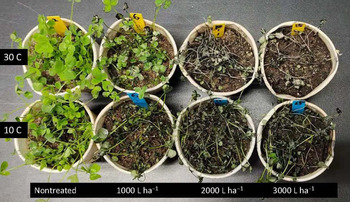
ANOVA showed that rate by temperature interaction was not significant (P > 0.05) for visual injury at 1 DAT and shoot mass reduction; as a result, only main effects are presented (Table 1). Wood vinegar rapidly desiccated white clover foliage as 1,000 L ha−1 caused 58% injury by 1 DAT, while 2,000 and 4,000 L ha−1 caused 81% and 91% injury, respectively (Figure 1). With respect to temperature treatments, wood vinegar was more effective at 10 C than 30 C. Averaged across all application rates, wood vinegar caused 83% and 71% injury at 10 C and 30 C, respectively. Wood vinegar at 2,000 and 4,000 L ha−1 reduced shoot mass compared to the nontreated control by 81% and 98%, respectively, while 1,000 L ha−1 reduced shoot mass only by 56%. Averaged across rates, shoot mass reduction did not differ between the two temperatures.
White clover injury following the application of wood vinegar at two temperature regimes.

a Injury and shoot mass reduction data were collected at 1 and 10 d after treatment, respectively.
b Different letters within a column indicate significant difference at the 0.05 probability level.
White clover injury after the application of wood vinegar at 1,000, 2,000, or 3,000 L ha−1 under a temperature of 10 C or 30 C. Photo was taken at 1 d after the treatment.

ANOVA indicated a significant rate by temperature interaction (P < 0.05) for visual injury at 3, 7, and 10 DAT; therefore, data are presented accordingly (Table 2). Wood vinegar at 1,000 L ha−1 caused 85% to 89% visual injury from 3 to 10 DAT at 10 C, but only 61% to 67% injury at 30 C. Wood vinegar application at 4,000 L ha−1 was highly effective, which caused >95% injury at these measurement timings.
White clover injury following the application of wood vinegar at two temperature regimes. a,b

a Different letters within a column indicate significant difference at the 0.05 probability level. Temperature × wood vinegar rate interactions were significant for white clover injury data collected at 3, 7, and 10 DAT.
b Abbreviation: DAT, d after treatment.
Field Dose-Response Experiments
In the field dose-response experiments, weed control generally increased as the application rate increased (Figures 2, 3, 4, and 5). The lowest rate of wood vinegar at 1,000 L ha−1 provided inadequate weed control, whereas 2,000 L ha−1 provided 75%, 76%, and 62% control of annual fleabane, Persian speedwell, and white clover at 1 WAT and 86%, 83%, and 67% control at 2 WAT, respectively. The highest rate at 5,000 L ha−1 consistently provided >90% control for all evaluated weed species at both dates of observation (1 WAT, 2 WAT).
Control of annual fleabane after wood vinegar applications at 1 and 2 wk after treatment (WAT) in two combined field research trials in 2021, in Nanjing, Jiangsu, China. Control was visually evaluated on a scale of 0% to 100%, where 0 represents no control and 100 represents complete plant desiccation. Vertical bars represent standard errors of the mean (n = 8).

Control of Persian speedwell after wood vinegar applications at 1 and 2 wk after treatment (WAT) in two combined field research trials in 2021, in Nanjing, Jiangsu, China. Control was visually evaluated on a scale of 0% to 100%, where 0 represents no control and 100 represents complete plant desiccation. Vertical bars represent standard errors of the mean (n = 8).

Control of white clover after wood vinegar applications at 1 and 2 wk after treatment (WAT) in two combined field research trials in 2021, in Nanjing, Jiangsu, China. Control was visually evaluated on a scale of 0% to 100%, where 0 represents no control and 100 represents complete plant desiccation. Vertical bars represent standard errors of the mean (n = 8).

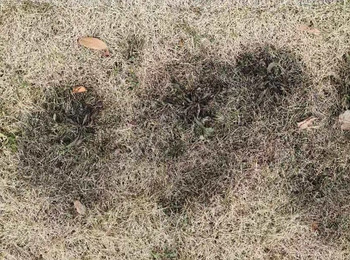
Desiccated annual fleabane following wood vinegar application at 2,000 L ha−1. Photo was taken at 1 wk after treatment.

From regression analysis, annual fleabane, Persian speedwell, and white clover ED50 values were 1,160, 1,260, and 1,470 L ha−1, respectively, at 1 WAT; those values for 2 WAT were 1,080, 1,130, and 1,420 L ha−1, respectively (Table 3). Annual fleabane, Persian speedwell, and white clover ED90 values measured 2,800, 3,100, and 4,300 L ha−1 at 1 WAT; and 2,450, 2,300, and 4,020 L ha−1 at 2 WAT, respectively. Based on 95% confidence intervals for the ED50 and ED90 values, white clover was the least susceptible to wood vinegar compared to annual fleabane and Persian speedwell.
Estimate from regression analysis for 50% (ED50) and 90% (ED90) weed control following wood vinegar application in two combined field trials. a,b

a Data were regressed with the equation y = β0 + β1 [1-exp(-β2*x)], where y is weed control (%), β0 is the intercept, β1 is the asymptote, β2 is the slope estimate, and x is the wood vinegar application rate (L ha−1). Effective wood vinegar dose that provided 50% (ED50) and 90% (ED90) control of annual fleabane, Persian speedwell, and white clover was determined from the regression equations.
b Abbreviations: CI, confidence interval; SE, standard error; WAT, weeks after treatment.
Previous studies have consistently reported that acetic acid represented the largest proportion of organic compounds present in wood vinegar (Aguirre et al. Reference Aguirre, Baena, Martín, Nozal, González, Manjón and Peinado2020a, Reference Aguirre, Baena, Martín, González, Manjón and Peinado2020b; Chen et al. Reference Chen, Feng and Mu2011; Heo et al. Reference Heo, Park, Park, Ryu, Dong, Suh, Yim and Kim2010; Tiilikkala et al. Reference Tiilikkala, Fagernäs and Tiilikkala2010; Wang et al. Reference Wang, Zhang, Wu, Sun and Lyu2020). Therefore, it is likely that acetic acid is the main active ingredient in wood vinegar that causes phytotoxicity. However, more than 200 organic compounds have been identified in wood vinegar resulting from the pyrolysis of various wood-based materials (Heo et al. Reference Heo, Park, Park, Ryu, Dong, Suh, Yim and Kim2010; Tiilikkala et al. Reference Tiilikkala, Fagernäs and Tiilikkala2010; Wang et al. Reference Wang, Zhang, Wu, Sun and Lyu2020). Lu et al. (Reference Lu, Jiang, He, Sun and Sun2019) noted that phenols in wood vinegar from the pyrolysis of Chinese fir [Cunninghamia lanceolate (Lamb.) Hook] waste caused oxidative stress and inhibited the growth of wheat (Triticum aestivum L.). Aguirre et al. (Reference Aguirre, Baena, Martín, González, Manjón and Peinado2020b) suggested that phenols may allow the acids to stick on plant leaf surface, and as a result, enhance weed control efficacy. However, the interaction between acids and other compounds in wood vinegar for weed control is largely unknown. In the present study, we noticed that wood vinegar, particularly applied at 1,000 L ha−1, was more effective at low temperatures compared with high temperatures. This result cannot be adequately explained by the authors. Additional studies are needed to explore the mechanism of action for weed control and physiological behavior of wood vinegar in plants.
The discovery of herbicides with a new mode of action (MOA) has been significantly slow in the past three decades (Duke et al. Reference Duke, Stidham and Dayan2019; Gaines et al. Reference Gaines, Duke, Morran, Rigon, Tranel, Küpper and Dayan2020; Peters and Strek Reference Peters and Strek2018). Continued reliance on limited herbicide MOAs increased the selection pressures on weeds. Numerous weed populations have now evolved resistance to multiple herbicide MOAs (Brosnan et al. Reference Brosnan, Elmore and Bagavathiannan2020a, Reference Brosnan, Vargas, Spesard, Netzband, Zobel, Chen and Patterson2020b; Duke et al. Reference Duke, Stidham and Dayan2019; Heap Reference Heap2021; McCullough et al. Reference McCullough, McElroy, Yu, Zhang, Miller, Chen, Johnston and Czarnota2016, Reference McCullough, Yu and Czarnota2017; Yu et al. Reference Yu, McCullough and Czarnota2017). At present, herbicide-resistant weed populations, especially annual bluegrass, are prevalent in turfgrass (Brosnan et al. Reference Brosnan, Elmore and Bagavathiannan2020a, Reference Brosnan, Vargas, Spesard, Netzband, Zobel, Chen and Patterson2020b; McCullough et al. Reference McCullough, McElroy, Yu, Zhang, Miller, Chen, Johnston and Czarnota2016, Reference McCullough, Yu and Czarnota2017; Singh et al. Reference Singh, Dos Reis, Reynolds, Elmore and Bagavathiannan2021). An additional study is needed to determine the application rates and regimes of using wood vinegar for control of glyphosate-resistant annual bluegrass in dormant turfgrass.
Results of the present study suggest that wood vinegar can likely be used as an alternative to the existing nonselective herbicides such as diquat, glyphosate, and glufosinate for weed control in dormant turfgrass. However, it is important to note that wood vinegar is not yet registered as an herbicide. Many countries around the world impose strict standards regarding the registration and use of naturally derived pesticides (Anonymous 2020; USEPA 2021). For example, in China, a recent policy incentivized research and development of nonsynthetic pesticides, but extensive research is required prior to legal use (Anonymous 2020).
Field experiments showed that winter annual weeds such as annual fleabane and Persian speedwell were more susceptible to wood vinegar than white clover. We observed that wood vinegar desiccated only the outer canopy of sprayed plants, whereas the inner foliage was unaffected. In addition, high application rates are important to achieve higher control. For instance, wood vinegar at a low rate (1,000 L ha−1) was more effective for control of white clover seedlings in the growth chamber experiments than the established mature plants in field experiments. These findings suggest that wood vinegar is particularly effective for controlling small-sized annual broadleaf weeds compared to established perennials with a dense canopy. Continued use of wood vinegar may also lead to species shifts. In previous research, Aguirre et al. (Reference Aguirre, Baena, Martín, González, Manjón and Peinado2020b) observed that annual weeds were replaced by perennial weeds after wood vinegar application. The authors also noted that plants with thicker stem and leaf structure with greater underground reserves are more likely to survive following wood vinegar treatments.
Previous studies have evaluated various concentrations and spray volumes of acetic acid for weed control and generally showed that acetic acid is more effective on young and actively growing weed seedlings than mature plants (Evans et al. Reference Evans, Bellinder and Hahn2011; Moran Reference Moran2007; Moran and Greenberg Reference Moran and Greenberg2008). For example, Moran (Reference Moran2007) reported that an application of 9% acetic acid at 2,400 L ha−1 provided 100% and 80% control, respectively, of 5- to 10-leaf and 10- to 20-leaf Palmer amaranth (Amaranthus palmeri S. Wats.), but failed to adequately control reproductively mature plants. Moran and Greenberg (Reference Moran and Greenberg2008) reported that 9% acetic acid applied at 2,980 L ha−1 controlled >80% of Palmer amaranth and common purslane (Portulaca oleracea L.) seedlings but provided <50% control when these weeds were mature. Evans et al. (Reference Evans, Bellinder and Hahn2011) reported that a single application of 20% acetic acid at 700 L ha−1 provided 100% control of weeds at the cotyledon to 6-leaf growth stage. Although the present study suggests that wood vinegar can be used as an alternative acetic acid source for weed management, a single application of wood vinegar is unlikely to be sufficient to provide season-long control of mature perennial weeds (Aguirre et al. Reference Aguirre, Baena, Martín, González, Manjón and Peinado2020b). Additional research is needed to evaluate control of perennial weed species using wood vinegar beyond 2 WAT, with multiple applications.
Field experiments indicate that wood vinegar needs to be applied at nearly 2,000 L ha−1 to provide adequate weed control. However, this application volume is too high to fit with the application equipment currently in use in the turfgrass industry. To adopt wood vinegar for weed management in managed turf systems, spraying equipment that can deliver higher spray volumes need to be developed to achieve broadcast application. Practitioners can also manually spot-spray wood vinegar to control weed patches. We suggest that substantially reduced wood vinegar application volumes may still provide adequate weed control when applied at the most appropriate timing, weed growth stage, and environmental conditions. Therefore, more research is needed to shed light on the impact of weed growth stages, application timings, and environmental factors on wood vinegar for weed control. Research is also needed to evaluate weed control efficacy when concentrated wood vinegar solutions are applied at reduced application volumes.
In this particular region of China, zoysiagrass typically begins to green-up in late March and is fully green by mid-April. Turf quality during the transition was not evaluated in the present study; however, turf quality was visually evaluated in late April, which did not differ between the treated and nontreated plots when zoysiagrass recovered from winter dormancy (data not shown). Considering that wood vinegar at diluted concentrations can serve as a foliar fertilizer (Lee et al. Reference Lee, Ahn and Cho2010; Mungkunkamchao et al. Reference Mungkunkamchao, Kesmala, Pimratch, Toomsan and Jothityangkoon2013; Tillikkala et al. 2010), the effect of wood vinegar on soil chemistry, fertility, and microbial community warrants further research prior to safe deployment of wood vinegar in dormant turfgrass.
Overall, the present study confirmed the effectiveness of using wood vinegar for control of annual fleabane, Persian speedwell, and white clover. Results indicated that wood vinegar has the potential to be used as an alternative to nonselective synthetic herbicides for weed control in dormant turfgrass. In addition, this research has significant implications for managing wood-based wastes. At present, lignocellulosic wastes such as abandoned wood furniture, municipal pruning waste, and sawmill waste, are often discarded in landfills. Further research is needed to develop methods to produce wood vinegar from different wood-based wastes, and also to evaluate wood vinegar as an alternative herbicide for weed management in other cropping systems.
Acknowledgements
This work was supported by the National Natural Science Foundation of China (No. 32072498), the Science and Technology Project of Taizhou (1801gy24), and the Key Research and Development Program of Zhejiang Province (2020C02028 and 2019C02030). No conflicts of interest have been declared. The authors thank Dr. Xinyou Liu for his technical assistance.