


Introduction
The rhotics are among the most difficult sounds for Spanish-speaking children to acquire; while the tap, [ɾ], is acquired around the age of four years (Acevedo, Reference Acevedo1993; Bosch Galcerán, Reference Bosch Galcerán1983; Melgar de González, Reference Melgar de González1976), the trill, [r], is acquired later, after the age of five (Acevedo, Reference Acevedo1993) or six (Bosch Galcerán, Reference Bosch Galcerán1983; Linares, Reference Linares and Padilla1981; Melgar de González, Reference Melgar de González1976).Footnote 1 Some work with Spanish–English bilinguals has documented slightly later ages of acquisition than monolingual speakers (e.g., Fabiano-Smith & Goldstein, Reference Fabiano-Smith and Goldstein2010), but Goldstein, Fabiano, and Washington (Reference Goldstein, Fabiano and Washington2005) conclude that there are fewer differences as children grow older. Studies have not followed these children beyond the onset of schooling to explore how increased exposure to English impacts their articulations. This study sets out to describe the rhotic productions of school-aged, Spanish–English bilingual children and how they differ according to age; findings will both inform our understanding of child bilingual language development as well as our descriptions of the speech of Spanish–English bilingual speakers in the southwest United States. The specific research questions that guided this project are:
1. How do Spanish–English bilingual children produce taps and trills? Do they differentiate between the two phonemic contexts? If so, how?
2. How do children's productions differ according to age?
Previous Work
Spanish tap and trill
Spanish has two rhotic phonemes, a tap /ɾ/ and a trill /r/. Although the phonemic distinction exists only in word-medial, intervocalic position (1a), the trill is categorically produced in word-initial position (1b) and the tap in onset clusters, following a tautosyllabic consonant (1c). In all other contexts, the two phones are in free variation.

Phonetic realizations of the two sounds vary across speakers, contexts, and dialects. Although phonetic manifestations of taps vary in the degree of constriction or closure, ranging from complete closure to vowel-like approximants (Blecua Falgueras, Reference Blecua Falgueras2001), greater variation is evidenced for trills. Traditional definitions describe the trill as having two or more brief occlusions (e.g., Quilis, Reference Quilis1993); nonetheless, the number of occlusions as well as the nature of the closure phases have been shown to vary. In addition, other manners of articulation have been reported for the trill, among them assibilated trills, uvular trills, approximants, taps, and pre-aspirated or pre-breathy taps (e.g., Blecua Falgueras, Reference Blecua Falgueras2001; Bradley & Willis, Reference Bradley and Willis2012; Colantoni, Reference Colantoni2001; Henrikson & Willis, Reference Henrikson, Willis and Ortega-Llebaria2010; Lipski, Reference Lipski1994; Willis & Bradley, Reference Willis, Bradley, Colantoni and Steele2008). In light of variation in manner of articulation, Willis and Bradley (Reference Willis, Bradley, Colantoni and Steele2008) and Henrikson and Willis (Reference Henrikson, Willis and Ortega-Llebaria2010) suggest that segment duration may be the acoustic cue that best distinguishes the two phonemes; trills are consistently longer in duration than taps (Blecua Falgueras, Reference Blecua Falgueras2001; Henrikson & Willis, Reference Henrikson, Willis and Ortega-Llebaria2010; Willis & Bradley, Reference Willis, Bradley, Colantoni and Steele2008). In order to distinguish expected productions from actual productions in the remainder of the paper, the terms ‘phonemic’ and ‘phonetic’ will be used. Phonemic trill and phonemic tap refer to the expected production based on the linguistic context (1a–1c), whereas phonetic trill and phonetic tap refer to actual productions or phonetic realizations.
First language (L1) acquisition of Spanish rhotics
Findings from work with typically developing, monolingual, Spanish-speaking children point to acquisition of most sounds by the age of 5;0 (e.g., Maez, Reference Maez1981); rhotics, however, are among the few sounds not acquired by this age (Acevedo, Reference Acevedo1993; Melgar de González, Reference Melgar de González1976; Mason, Smith, & Hinshaw, Reference Mason, Smith and Hinshaw1976). While most studies point to acquisition of the tap by the age of 4;0 or 4;6 (Bosch Galcerán, Reference Bosch Galcerán1983; Linares, Reference Linares and Padilla1981; Melgar de González, Reference Melgar de González1976), no study places acquisition of the trill prior to the age of 5;0. Bosch Galcerán (Reference Bosch Galcerán1983) reported 80% accuracy in trill production at age 6;0 and 90% at age 7;0 for monolingual Spanish speakers in Spain. Similar findings have been reported for Spanish monolinguals in the United States (Acevedo, Reference Acevedo1993; Jimenez, Reference Jimenez1987; Linares, Reference Linares and Padilla1981). Little detail is available on the variability in productions as children acquire the trill; only Bosch Galcerán (Reference Bosch Galcerán1983) and Carballo (Reference Carballo García1995) have noted developmental substitutions, which include omission, simplification to a tap, and lateralization. Carballo and Mendoza (Reference Carballo and Mendoza2000) concluded that accuracy in trill production is not just an effect of age; rather, it is associated with the degree of motor control.
Bilingual phonological acquisition
Different patterns of errors and rates of acquisition have been reported for bilingual phonological acquisition as a result of interaction between the two phonological systems (e.g., Dodd, So, & Li, Reference Dodd, So, Li, Dodd, Campbell and Worrall1996; Gildersleeve-Neumann & Davis, Reference Gildersleeve-Neumann and Davis1998; Goldstein & Washington, Reference Goldstein and Washington2001). In some cases, bilingualism results in acceleration of development (e.g., Kehoe, Trujillo, & Lleó, Reference Kehoe, Trujillo, Lleó, Cantone and Hinzelin2001; Lleó, Kuchenbrandt, Kehoe, & Trujillo, Reference Lleó, Kuchenbrandt, Kehoe, Trujillo and Müller2003), and in others, deceleration (e.g., Gildersleeve-Neumann, Kester, Davis, & Peña, Reference Gildersleeve-Neumann, Kester, Davis and Peña2008; Goldstein & Washington, Reference Goldstein and Washington2001), depending on a variety of factors including the overlap between the two phonetic systems and the amount of exposure to each language.
With respect to acquisition of Spanish rhotics, Fabiano-Smith and Goldstein (Reference Fabiano-Smith and Goldstein2010) find that Spanish–English bilingual preschoolers, age 3:0–4:0, are within the range of typical development despite lower accuracy rates (tap: 25% vs. 33% accuracy, trill: 4% vs. 37.5% accuracy). Accuracy of rhotic articulations continues to develop in the preschool and early elementary years (Gildersleeve-Neumann, Peña, Davis, & Kester, Reference Gildersleeve-Neumann, Peña, Davis and Kester2009; Goldstein et al., Reference Goldstein, Fabiano and Washington2005) such that as age increases, differences between bilinguals and monolinguals decrease (Goldstein et al., Reference Goldstein, Fabiano and Washington2005). The impact of increasing English proficiency on rhotic production has not been explored, however. Baker and Trofimovich (Reference Baker and Trofimovich2005) argue that cross-linguistic effects of the L2 on the L1 occur at advanced stages of L2 learning. As such, the scope of research on child bilingual phonological development must extend beyond the initial stages of L2 exposure during preschool or early elementary years. The present study examines the impact of English proficiency on the rhotic productions of a cross-sectional sample of school-aged Spanish–English bilinguals and thus expands our understanding of L1–L2 interactions in bilingual phonological development.
Methodology
Participants
A cross-sectional sample of 31 Spanish–English bilinguals living in San Antonio, Texas participated in this study. Participants were all Spanish-dominant or Spanish monolingual prior to entry into a 90:10 Spanish–English language immersion program in kindergarten. Because participants were recruited in a school setting, grade level was used as the grouping variable; biological age was relatively consistent within a grade level group, as shown in Table 1.
Participant characteristics by grade level

All grade 1, 3, 5, and 7 students in the program were invited to participate, as these grade levels represent differing amounts of content instruction in English and coincide with other studies of language use patterns (Fortune, Reference Fortune2001; Potowski, Reference Potowski2004) and phonological development (Harada, Reference Harada1999; Snow & Campbell, Reference Snow, Campbell, Bhatia and Ritchie1985) in language immersion programs. Data were collected from those students consenting to participation. Parents completed a language background questionnaire that detailed the participant's as well as the parents’ linguistic histories, and the child's language use practices outside of school. Spanish was the first language of all participants as well as the primary language of the home, used 60–80% of the time at a minimum, and both parents spoke Spanish, with at least one a native speaker. No language concerns were reported by parents or teachers for any participant. An overview of participant characteristics is presented in Table 1.
Participants were enrolled in a Spanish–English two-way (bilingual) language immersion program in a large, urban school district. Two-way immersion programs bring together majority language speakers and minority language speakers in a linguistically rich, academically challenging setting. In this program, 90% of content area instruction occurs in Spanish in Kindergarten and Grade 1; the remaining 10% is in English. The amount of subject matter instruction in Spanish decreases each year, so that by Grade 5 subject-matter instruction is distributed equally across the two languages. Language allocation by grade level is detailed in Table 2.
Instructional language distribution by grade
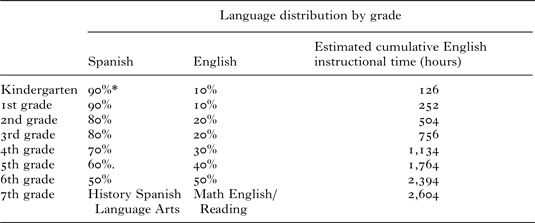
Note. * It is common for school districts to report the amount of instructional time in each language as a percentage. From these percentages, estimates of English instructional time were made based on 7 hours of instruction each day for 180 days.
Data elicitation
Participants met with the researcher in pairs during the school day in a quiet space. After a short warm-up conversation, they completed a picture-sorting task in which they looked through 30 pictures to name the animals that answered questions such as ¿Qué animales pueden vivir en el agua? ‘Which animals can live in the water?’ or ¿Qué animales comen a otros animales? ‘Which animals eat other animals?’ All sessions were audio-recorded using a Marantz digital voice recorder.
Data analysis
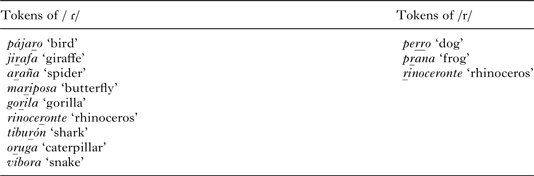
All student speech was transcribed, and all expected tap and trill productions were identified and analyzed. Tokens were limited to the word-internal intervocalic context (1a) or word-initial context (1b).Footnote 2 Syllable stress was not controlled for, as previous studies have not reported a significant relationship between lexical stress and trill production (e.g., Blecua Falgueras, Reference Blecua Falgueras2001; Willis, Reference Willis2007); tokens of ‘r’ that would be produced as a flap in English, e.g., canguro ‘kangaroo’ /kan.ˈgu. ɾo/ were not included in the analysis.Footnote 3 Tokens are listed in Table A in the ‘Appendix’.
Acoustic analyses were carried out in Praat v.5.4 (Boersma & Weenink, Reference Boersma and Weenink2015). Temporal measurements and manner of articulation classification were conducted via examination of both the waveform and spectrogram image. Total consonant duration was measured in milliseconds from the end of the preceding segment, marked by the beginning of closure duration, to the onset of the transition into the following vowel. All productions were additionally classified by manner of articulation following the categories set forth by Willis and Bradley (Reference Willis, Bradley, Colantoni and Steele2008), Bradley and Willis (Reference Bradley and Willis2012), and Rose (Reference Rose2010), described briefly here:
Tap: a single occlusion evidenced by the absence of energy in the waveform and a white stripe in the spectrogram;
Perceptual tap: perceptible to the ear, lacks reliable acoustic measurements, slight reduction in the amplitude of the waveform or formant intensity;
Continuant tap: no perceptible closure, formants continue throughout the duration of the segment, steady dip in the third and fourth formants;
Trill: at least two periods of closure indicated by periods of no energy in the waveform and white strips in the spectrogram;
Alveolar approximant: continuant in nature, low third formant, r-colored sound;
Tap+: single closure followed by frication or an approximant;
Assibilated variant: frication at a lower frequency in the spectrogram than sibilants
Elided: no phonetic trace;
Other: production that does not fit into other categories.
Statistical modeling necessitated binary classification of productions given the few number of productions in some manner of articulation categories. Therefore, each production was additionally labeled as either meeting a target or not, based upon whether productions were attested in reports of adult, monolingual speaker articulations. Taps, perceptual taps, and continuant taps were classified as meeting the target for the phonemic tap, and trills, tap+, and assibilated productions met the target for phonemic trills.
Two statistical models were developed, one for manner of articulation and another for duration. A mixed logit model (Generalized Linear Mixed Models for binomially distributed outcomes) was run in the R Statistical Package, with grade and phonemic context (expected tap or trill) as fixed effects, and a random intercept by participant, to statistically compare the phonetic realizations across phonemic contexts and grade levels. Duration data were submitted to a linear mixed-effects model with phonemic context, grade, and the interaction of phonemic context and grade as fixed effects, and a random intercept for each speaker. Because all duration data were positive, duration values were log transformed on a natural log scale prior to running the model. The predictive output of the log-transformed values was then back transformed to the normal scale to make results more interpretable.
Results
A total of 561 tokens were analyzed as part of this study. In line with frequency distributions for Spanish (Guirao & García Jurado, Reference Guirao and García Jurado1990), participants produced many more tokens of phonemic taps than trills. The number of tokens produced by participants of each grade level is broken down by phonemic context in Table 3. Results are reported first for manner of articulation and then for duration.
Tokens produced by grade level

Manner of articulation
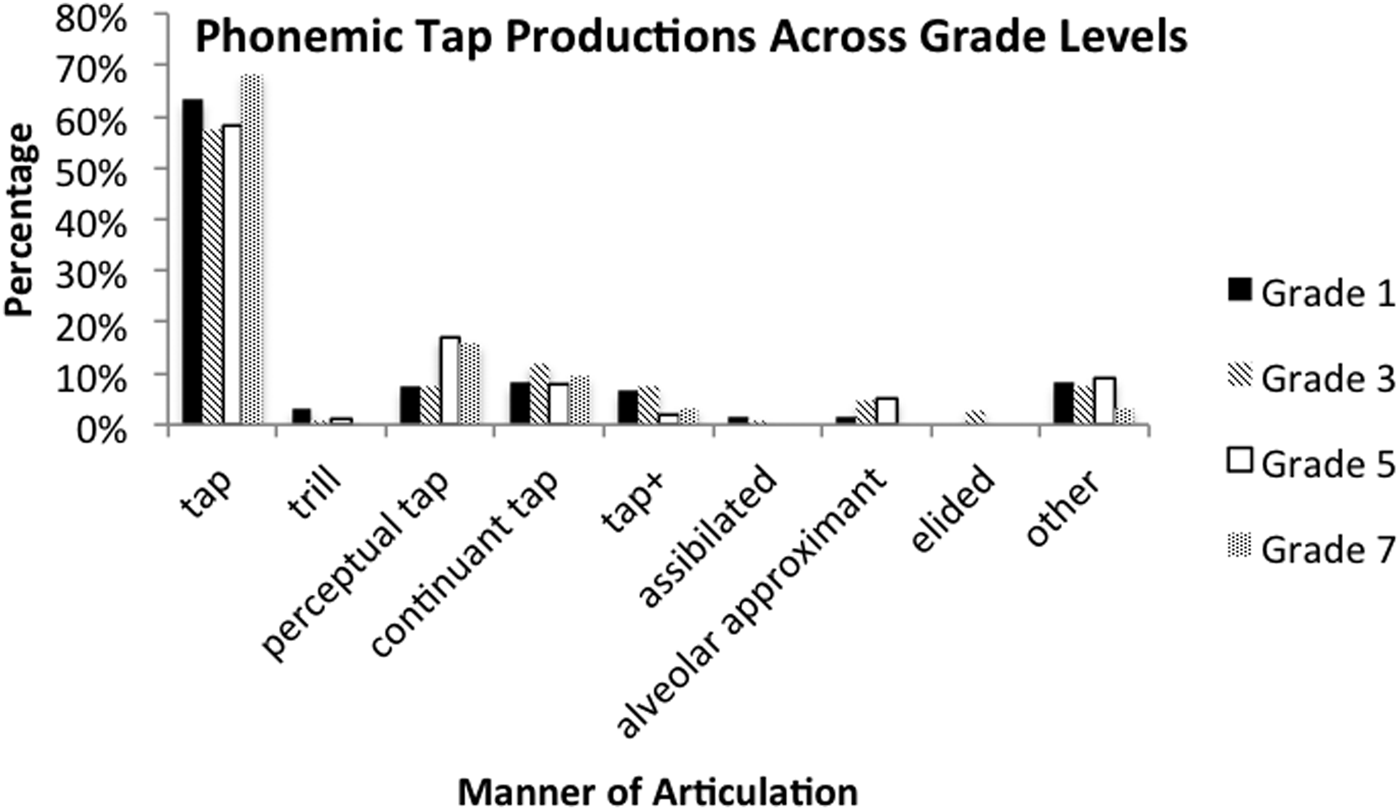
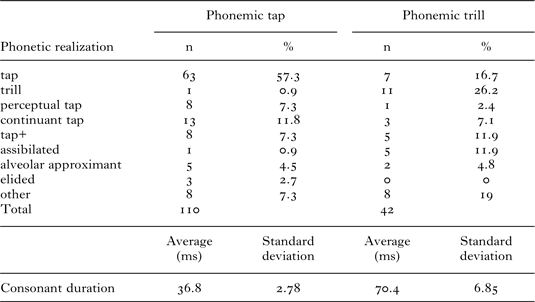
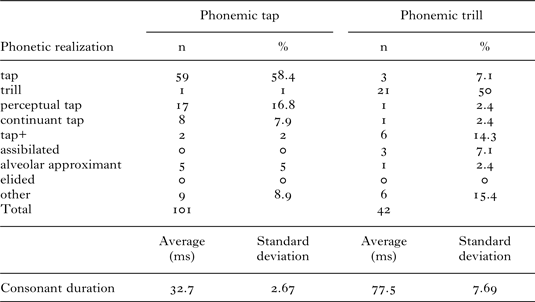
Productions for each grade level group are presented visually in Figures 1 and 2, with numeric details available in Tables B–E in the ‘Appendix’. Phonemic taps are most frequently realized as phonetic taps across all grade levels. There is not a consistent upward trend in frequency across grades, rather there is a decrease between first and third grade, followed by an increase in fifth and seventh grade. The perceptual tap shows a different trend in that its frequency is relatively low, approximately 7%, in the primary grades but is higher, approximately 16%, in the upper grades. Realizations of the phonemic tap as a continuant are relatively consistent at around 10%. Tap+ articulations decrease across grade levels as do ‘other’ productions. Finally, alveolar approximants in the phonemic tap context increase from Grade 1 to Grade 5 and then are absent among the productions of Grade 7 speakers. The most common ‘other’ productions were pre-breathy taps and combination segments, in which two manners of articulation are observed in the spectrogram.
Phonemic tap productions across grade levels.
Phonemic trill productions across grade levels.
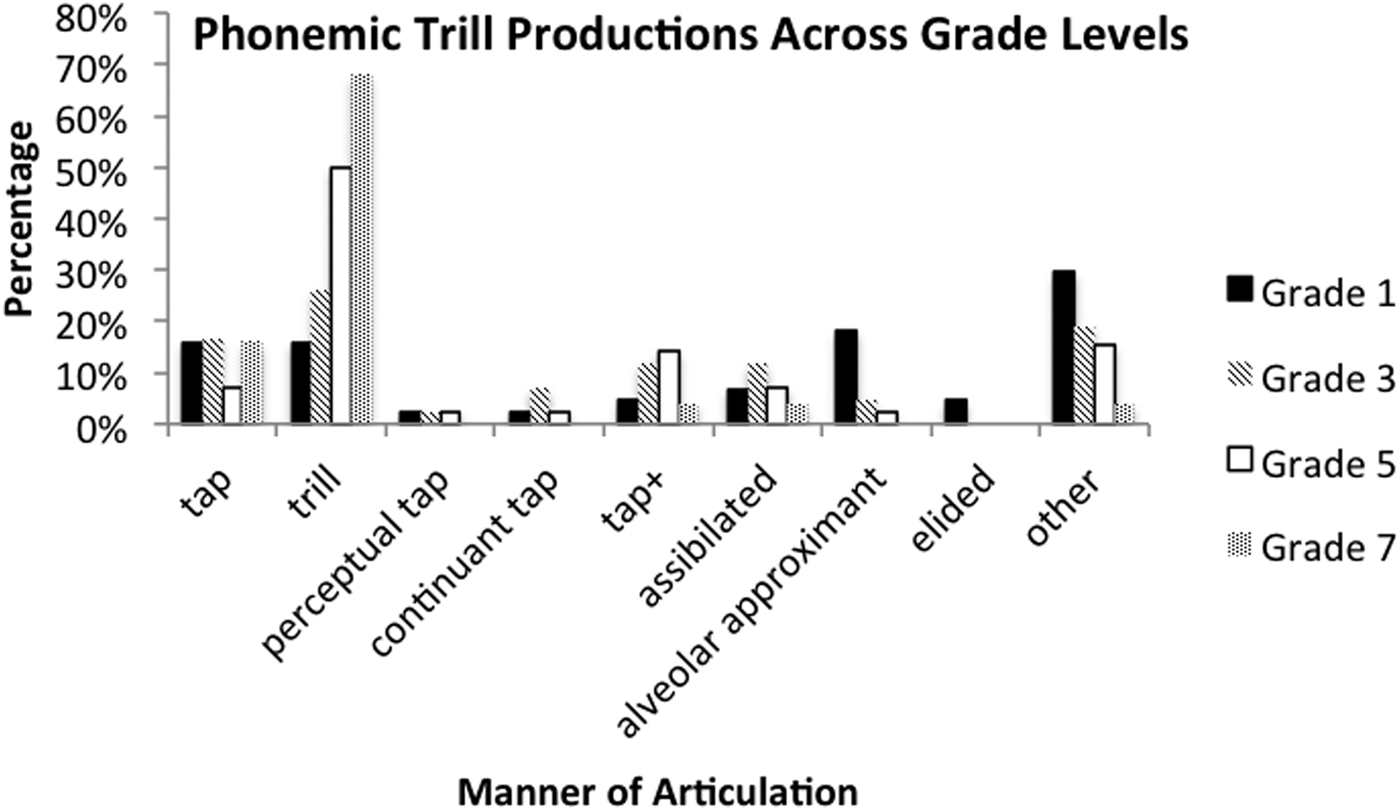
Phonemic trill productions are depicted according to manner of articulation and grade level in Figure 2. Phonetic trill production is relatively low in Grade 1 at 16%, but increases steadily across grade levels to just under 70% in Grade 7; the greatest increase occurs between Grades 3 and 5, 23.8%. Across grade levels the relative proportion of ‘other’ and alveolar approximant productions decreases. Nearly 30% of all productions by Grade 1 participants did not fit into one of the predetermined categories; by grade 7, only 4% of productions (1 token) could not be classified. Some of these productions, such as pre-breathy taps and trills are dialectal rhotic variants, whereas others are combination segments, comprised of two distinct sounds, such as alveolar approximants followed by frication. In a similar way, production of alveolar approximants decreases from 18% in Grade 1 to 0% in Grade 7. Across grade levels, the number of closures in phonetic trills is relatively consistent: 2.7 in Grade 1, 2.5 in Grade 3, 3 in Grade 5, and 2.59 in Grade 7.
Comparing productions across the two phonemic contexts reveals that the relative percentage of phonetic taps is less in the phonemic trill context than the phonemic tap context; similarly, the relative frequency of phonetic trills in the phonemic tap context is less than that in the phonemic tap context. In addition, ‘other’ productions are produced with greater relative frequency in the phonemic trill context.
A mixed logit model tested the probability of target production according to the two fixed effects of phonemic context and grade, as well as their interaction. Results are displayed in Table 4. Both fixed effects as well as their interaction are statistically significant.
Results of statistical modeling, Analysis of Deviance Table (Type II Wald chisquare tests)
Response: Target == ‘Hit’

Note. * significant at the p = .05 level.
The interaction of grade and phonemic context is statistically significant; in other words, there is evidence that the effect of grade on rhotic production is not independent of phonemic context and vice versa. As seen in Figure 3, target production of both phonemes is high in Grade 7, whereas in Grade 1, target production is only high for phonemic taps.
Target productions of phonemic taps and trills across grade levels.
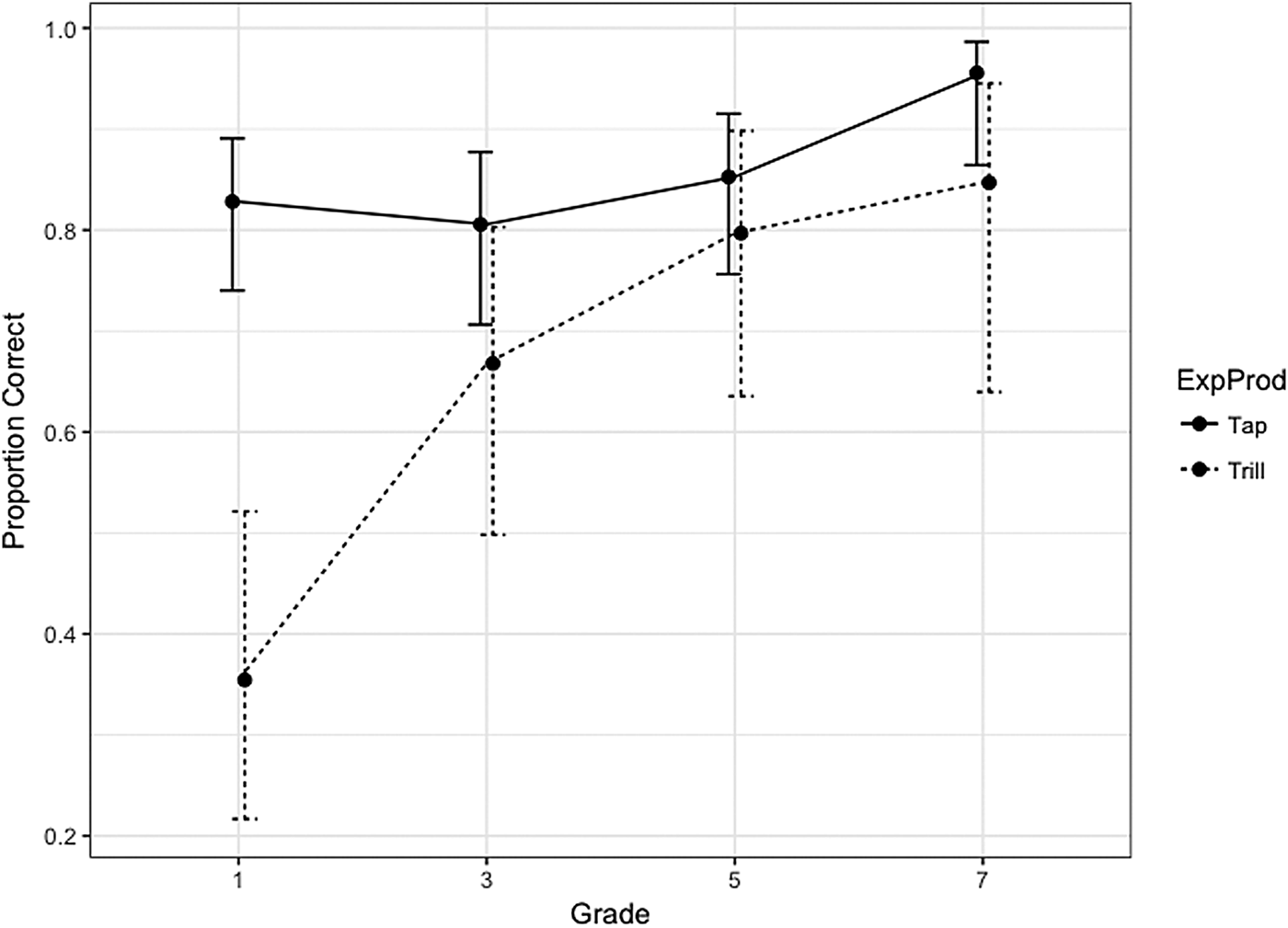
The main effect of phonemic context reaches statistical significance (χ 2(1) = 25.041, p < .0001), confirming the difference observed visually in Figure 3. Target production of phonemic taps consistently exceeds that of phonemic trills. In the primary grades, participants produce the phonetic targets of phonemic taps in more than 80% of the tokens, whereas target production of phonemic trills is only 35% in Grade 1 and 67% in Grade 3. Grade 1 and Grade 3 participants are not, however, consistently substituting a phonetic tap in the phonemic trill context, as evidenced by the greater relative frequency of phonetic trills and ‘other’ productions in this context. A greater percentage of target productions of phonemic taps are similarly produced in the upper grades despite the increase in target productions of phonemic trills to 80% in Grade 5 and 85% in Grade 7.
The main effect of grade is also significant (χ 2(3) = 13.736, p = .003). As seen in Figure 3, target productions increase as grade level increases, with the exception of target phonemic tap productions from Grade 1 to Grade 3, which show a slight decrease from 83% to 81%. At Grade 7, 96% of all phonemic taps productions hit the target. Phonemic trill productions evidence a greater increase in target productions, from 35% in Grade 1 to 85% in Grade 7.
Duration
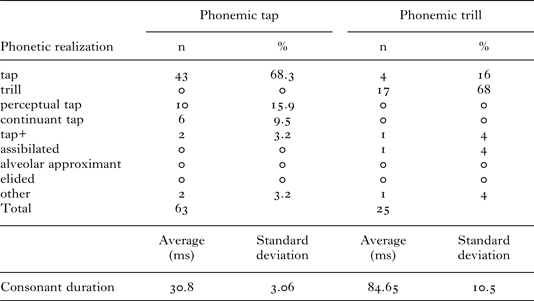
Duration data are depicted visually in Figure 4 and reported numerically in Tables B–E in the ‘Appendix’. Duration of phonemic trills exceeds that of phonemic taps across all grade levels. Results of statistical analyses show that there is a significant interaction between grade and phonemic context (χ 2(3) = 13.8669, p = .0023); the difference between the two phonemic contexts increases as grade level increases. As seen in Figure 4, phonemic trill productions are approximately 30 ms longer than phonemic tap productions in Grades 1 and 3, and 55 ms longer in Grade 7. The increase in difference results from different trends in which phonemic taps decrease in duration and phonemic trills increase. The main effects of phonemic context (χ 2(1) = 198.8909, p < .0001) and grade (χ 2(3) = 7.8714, p = .048745) are additionally significant.
Consonant duration across grade levels.

Summary of results
The first research question addresses how Spanish–English bilingual children in a two-way Spanish–English immersion program produce Spanish rhotics. Across all grade levels, the children distinguish the two phonemes via manner of articulation and total consonant duration. Although children do not produce target articulations of phonemic trills in the early grades, manner of articulation does differ across the two phonemic contexts, with fewer phonetic taps and more phonetic trills and ‘other’ productions in the phonemic trill context. In addition, phonemic trills are consistently longer in duration than phonemic taps. Differences in rhotic production according to age is addressed in this cross-sectional study via grade-level groups. The main effect of grade is statistically significant in both the manner of articulation and duration models, with more target productions of both phones produced in the upper grade levels than in the primary grades. Additional differences across grade levels are related to consonant duration; duration of phonemic taps decreases across grade levels, and duration of phonemic trills increases. The significance of these findings and their connection to previous studies is discussed in the following section.
Discussion
The Spanish–English bilingual children who participated in this study distinguish phonemic taps and trills by manner of articulation and consonant duration; there are also significant differences across grade level groups that show development toward an adult target. Nonetheless, noteworthy differences exist between the productions of this particular group of learners and those reported previously for monolingual Spanish-speaking children.
Previous accounts of rhotic acquisition report accuracy rates of 80% or higher for phonemic taps by age 4;0 or 4;6 (Bosch Galcerán, Reference Bosch Galcerán1983; Linares, Reference Linares and Padilla1981; Melgar de González, Reference Melgar de González1976) and phonemic trills by age 7;0 (Jimenez, Reference Jimenez1987). The bilingual child participants in this study meet the 80% threshold by Grade 1 (age 7;1) for the phonemic tap, but it is not until Grade 5 (age 11;0) that the 80% mark is reached for the phonemic trill, a later age than previously reported. These findings, as well as the observed variability in productions, do not align with the conclusion of Fabiano-Smith and Goldstein (Reference Fabiano-Smith and Goldstein2010) that bilingual development falls within the range of typical development. Greater exposure to English by the present study's participants as well as the use of acoustic, as opposed to impressionistic, analysis may explain the divergent findings of this study.
Previous work assumes that once a sound is acquired it is consistently produced; in other words, once a child learns to produce the tap and trill, s/he will continue to do so. The rhotic productions of Spanish–English bilingual children in the United States have not been described after the preschool years, the point at which exposure to English typically increases as a result of schooling. Work on other sound classes and in other languages has documented an effect of L2 learning on the acoustic characteristics of L1 phones, for children and adults alike (e.g., Baker & Trofimovich, Reference Baker and Trofimovich2005; Flege, Reference Flege1987; Guion, Reference Guion2003). Baker and Trofimovich (Reference Baker and Trofimovich2005) argue the L1 system of early bilinguals is highly susceptible to restructuring as a result of L2 learning, given than it is still in development. In the present study, the increase in exposure to English coincides with the period of time in which children refine the articulatory gestures needed to produce rhotics, most notably the trill. The fact that rhotics continue to be in the process of acquisition when exposure to English increases may make them more susceptible to English influence and slow the rate of acquisition.
Increased exposure to English may also explain the higher rate of cross-linguistic influence observed in this study as compared to work with Spanish–English preschoolers in the United States; compare the 18% of English-influenced production in this study to the less than 3% in Goldstein et al. (Reference Goldstein, Fabiano and Washington2005), Gildersleeve-Neumann et al. (Reference Gildersleeve-Neumann, Peña, Davis and Kester2009), and Goldstein and Washington (Reference Goldstein and Washington2001). One potential explanation is that the trill, [r], as an unshared consonant evidences higher error rates than shared sounds in bilingual speech (Goldstein & Washington, Reference Goldstein and Washington2001). Thus the lack of articulatory experience with the trill as a result of it not being common to both languages is another possible explanation for the observed higher error rates and later age of acquisition than those reported for other groups.
Goldstein and Gildersleeve-Neumann (Reference Goldstein, Gildersleeve-Neumann and Goldstein2012) highlight the difficulties of determining the source of sound substitutions given that “even monolingual children produce errors that are similar to interference in bilinguals” (p. 288). Because previous work with monolingual Spanish children has minimally described the non-target productions of children, it is not possible to determine with certainty the source of these errors; however, given that [ɹ] does not exist in the Spanish phonemic inventory, this likely stems from interaction with English. Other researchers have similarly noted its presence in English-influenced Spanish (Goldstein & Gildersleeve-Neumann, Reference Goldstein, Gildersleeve-Neumann and Goldstein2012; Ramos-Pellicia, Reference Ramos-Pellicia, Holmquist, Lorenzino and Sayahi2007).
Non-target productions are highest in the early elementary grades. The younger speakers in this study substitute sounds from the combined phonetic inventory of the two languages for the trill – taps, alveolar approximants, and combination segments (in the ‘other’ category) – suggesting that they draw on all available resources. This finding supports multiple accounts of bilingual language acquisition, such as the Unitary System Model, the Speech Learning Model, and Unified Competition Theory, in which the interdependence of the two language systems is central to the theory. As learners gain articulatory control and differentiate the two systems, substitutions decrease, and the phonetic trill is produced with greater frequency.
Willis and Bradley (Reference Willis, Bradley, Colantoni and Steele2008) and Henrikson and Willis (Reference Henrikson, Willis and Ortega-Llebaria2010) identify duration as a distinguishing feature of taps and trills; the same is observed here. Phonemic trills are consistently longer in duration than phonemic taps. Carballo and Mendoza (Reference Carballo and Mendoza2000) highlight the decrease in rhotic duration that occurs as Spanish monolingual children gain greater articulatory control.Footnote 4 While mean consonant duration and standard deviations decrease across grade levels for the phonemic tap, as predicted by previous work, the same is not observed for the phonemic trill (see Tables B–E in the ‘Appendix’). Productions of Grade 7 participants in the phonemic trill context are of longer duration than those of Grade 1, 3, and 5 participants. As learners gain motor control and are able to produce the phonetic trill, as opposed to developmental variants or substitutions, duration increases, as observed in Carballo and Mendoza (Reference Carballo and Mendoza2000).
Goldstein and Washington (Reference Goldstein and Washington2001) note the limitations of retrospective comparisons, such as those being made in the present discussion. While data elicitation methods are similar across previous studies and the current study, methods of analysis are not. Previous reports of monolingual and bilingual rhotic productions have relied on impressionistic as opposed to acoustic analysis (Acevedo, Reference Acevedo1993; Bosch Galcerán, Reference Bosch Galcerán1983; Jimenez, Reference Jimenez1987; Linares, Reference Linares and Padilla1981). Comparing articulations of this bilingual group to those of a monolingual group on the same task and with the same method of analysis would resolve the issues of retrospective analysis. An additional limitation of the current study is that development is examined via a cross-sectional, not longitudinal analysis. Consequently, developmental trends may be conflated with individual variation. Finally, because data were collected as part of a study with a different focus, a limited number of phonemic trill tokens were collected, and linguistic context (syllable stress, position in word) was not controlled. A more robust sample would allow for examination of the impact of context as well as statistical comparisons of manner of articulation. Investigating the productions of Spanish–English bilinguals longitudinally as exposure to English increases, collecting a larger sample, and controlling for linguistic context (stress, position in word) will advance our understanding of rhotic development in Spanish as well as L2 influence on L1 phonetic development.
Conclusions
The current study addresses some of the limitations of previous research by using acoustic analyses to describe the productions of phonemic taps and trills of school-aged bilingual children, beyond the previously reported age of acquisition for Spanish-speaking children. It has documented lower rates of target production than previously reported, most notably for the phonemic trill. Increased contact with English (L2), whose phonetic inventory does not include a trill, and the corresponding decrease in Spanish input, have been offered as a potential explanation. Although English-like articulations are present, so too are other Spanish phonetic variants, which in many cases serve as developmental substitutions, given their greater ease of articulation. These findings support the notion put forth in the Speech Learning Model (Flege, Reference Flege1987) that the phonetic systems of bilinguals are dynamic, and argue for continued study of the phonetic systems beyond the point of initial acquisition.
Appendix
Potential tokens
Grade 1 productions
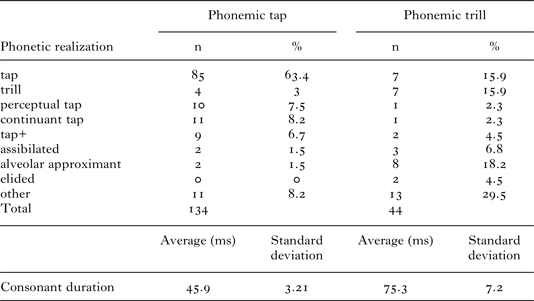
Grade 3 productions
Grade 5 productions
Grade 7 productions