Disasters that occur as a result of natural and man-made events cause loss of life and property and significantly affect the society in which they occur.Reference Marshall 1 –Reference Zibulewsky 4 Each year, the frequency and severity of disasters increase, posing significant risks to societies.Reference Tercan 5 The occurrence of natural disasters (n=16306) was reported to be the highest between 1900-2022, followed by technological disasters (n=9150) and mixed disasters (n=14).Reference Usta 6 Numerous risks that are characterized by known or unknown probability distributions of both natural and man-made disasters are present in societies. The most severe of such risks are disasters.Reference Vatsa 7 Disaster risk is the likelihood of adverse outcomes, such as death, injury, economic destruction, or harm to a specific system, society, or community. It is determined by various factors, including hazard, exposure, vulnerability, and capacity. 8 Risk perception pertains to an individual’s assessment of the level of uncertainty linked to a disaster.Reference Paul and Bhuiyan 9 , Reference Bourque, Regan and Kelley 10 The risk assessment in question is based on personal opinions and perspectives rather than being an objective and universally accepted fact.Reference Xu, Peng and Su 11 Disaster risk perception encompasses the societal acquisition of knowledge regarding disaster risk and subsequent decision-making, attitudes, and behaviors aimed at preventing or mitigating disasters and their associated losses tailored to the specific circumstances of the society.Reference Seyedin, Samadipour and Salmani 12 Individuals do not have a uniform perception of disaster risk. Personal perception of disaster risk may be influenced by factors such as the nature of the hazard, socioeconomic status, and demographic characteristics.Reference Odiase, Wilkinson and Neef 13 Their competencies and preparedness can directly influence people’s perception of disaster risk.
Earthquakes can arise either from natural causes or as a consequence of human activities.Reference Baxter 14 Earthquakes are important geological events that occur in various regions and are considered serious natural disasters.Reference Turcotte 15 Türkiye experienced 2 significant earthquakes centered in Kahramanmaraş on February 6, 2023. In the earthquakes that occurred, 53 537 people lost their lives, 107 213 people were injured, and a total of 16 million people were affected. 16 – 18 Earthquakes trigger the decline of the population’s physical, social, and health conditions.Reference Wang, Xu and Lu 19 Ensuring the uninterrupted provision of health care services is a critical and immediate challenge following an earthquake.Reference Taşkıran and Baykal 20 –Reference Altuntaş, Çiçek Korkmaz and Efe 23 Nurses are an important member of the health team responsible for the uninterrupted continuation of health services after an earthquake.Reference Karnjuš, Prosen and Ličen 24
Nursing is crucial in mitigating the adverse impact of earthquakes on the health care system.Reference Harmancı Seren and Dikeç 25 Nurses deliver health care services under challenging circumstances.Reference Uwishema 26 , Reference Tahernejad, Ghaffari and Ariza-montes 27 Nurses implement measures to safeguard and enhance public health before, during, and after calamities. 28 Nurses need to be aware of earthquakes in order to maintain professional health interventions in earthquakes. Sustainability is a comprehensive terminology that encompasses not only the environment but also its social and economic components.Reference Ovais 29 , Reference Hansmann, Mieg and Frischknecht 30 Implementing educational programs aimed at enhancing sustainable earthquake awareness can mitigate the detrimental effects of earthquakes by equipping individuals with suitable behavioral paradigms prior to, during, and following seismic events.Reference Öztürk 31 –Reference Bilen and Polat 33 Insufficient awareness and lack of equipment among nurses during and after an earthquake can hinder disaster response and recovery efforts. Conducting comprehensive studies to elucidate the nature of earthquakes to nurses and promoting awareness are crucial prerequisites for enhancing health intervention during disasters.Reference Yolcu and Bekler 34 Disasters are a significant issue that has a profound impact on public health. Prioritizing the development of disaster risk perception in prospective nurses is crucial as they will play a vital role in delivering essential health care services to the community before, during, and after disasters. Additionally, it is imperative to cultivate a lasting understanding of earthquake preparedness. The perception of high disaster risk and the cultivation of sustainable earthquake awareness among nursing students will significantly contribute to enhancing public health. More research that explicitly examines disaster risk perception and sustainable earthquake awareness of nursing students is needed. This study aims to investigate the relationship between nursing students’ disaster risk perception and sustainable earthquake awareness.
Method
Study Design
The study was descriptive and cross-sectional.
Participants
The study’s population comprised 368 students currently enrolled in Department of Nursing at Artvin Çoruh University, Faculty of Health Sciences. The sample selection process did not involve any sampling method. A total of 274 students, accounting for 74.45% of the population, were included in the study after being successfully contacted and agreeing to participate.
Data collection
The study was conducted among the students of Artvin Çoruh University, Faculty of Health Sciences, Department of Nursing between April 15 and June 30, 2023.
Data collection tool
The study utilized the “Sociodemographic characteristics form,” “Disaster Risk Perception Scale,” and “Sustainable Earthquake Awareness Scale” during the data collection phase.
Sociodemographic Characteristics Form
The researchers created the sociodemographic characteristics form. The form is a data collection instrument that details the participants’ age, gender, class, and disaster.
Disaster Risk Perception Scale (DRPS)
The Disaster Risk Perception Scale, developed by Kıymış (2022), is a robust and accurate scale comprising 25 items.Reference Kıymış 35 It is structured into 5 dimensions: Exposure/Effect (items 1-9), Probability (items 10-12), Unmanageability (items 13-15), Worry/Fear (items 16-21), and Vulnerability (items 22-25). The scale’s validity and reliability have been confirmed through rigorous analysis. The Cronbach’s Alpha coefficient for the entire scale was 0.87. The Cronbach’s Alpha coefficients for the sub-dimensions were 0.86, 0.71, 0.79, 0.77, and 0.73, respectively. The study revealed a Cronbach Alpha coefficient of 0.90. No item is the opposite of another on the scale. The calculation utilized the Likert scale, with a range of 1-5, where 1 represents “Strongly Disagree,” 2 represents “Disagree,” 3 represents “Undecided,” 4 represents “Agree,” and 5 represents “Strongly Agree.” Both the scale’s overall score and the sub-dimension’s individual scores can be assessed independently. It has been characterized as below and above the mean.Reference Kıymış 35
Sustainable Earthquake Awareness Scale (SEAS)
Genç and Sözen (2021) devised the Sustainable Earthquake Awareness Scale (SEAS) to gauge the level of earthquake awareness among college students. The SEAS framework comprises 3 factors. The first factor is referred to as the “Earthquake-Building Relationship,” the second factor is known as “Earthquake Preparedness Practice,” and the third factor is defined as “Being Prepared for Earthquake.” The initial sub-dimension was comprised of 4 items, the subsequent sub-dimension consisted of 11 items, and the final sub-dimension encompassed 7 items.Reference Genç and Sözen 36
The initial 19 items in the scale comprise affirmative statements. Three items contain negative expressions. The Preparedness for Earthquake Sub-dimension includes 3 items (20, 21, 22) that are scored inversely, with a rating of 5 points for strongly disagree and 1 point for strongly agree. The scale’s reliability was assessed using Cronbach’s alpha internal consistency coefficient. The calculated coefficients were 0.752 for the first sub-dimension, 0.838 for the second sub-dimension, and 0.827 for the third sub-dimension. The Cronbach’s alpha coefficient, which measures internal reliability, was calculated to be 0.884 for all items of SEAS.Reference Genç and Sözen 36 Gündüz et al. (2024) found the Cronbach’s Alpha value of the scale to be 0.86 in their study.Reference Gündüz, Atalay and Torpuş 37
Data analysis
The data collected during the research were analyzed using SPSS for Windows (Version 24.0, Statistical Package for Social Sciences). The data distribution was evaluated according to Skewness’s and Kurtosis’s values. Skewness’s and Kurtosis’s values were within the acceptable range of +2.0/-2.0, which showed that the data were suitable for normal distribution.Reference George and Mallery 38 , Reference George and Mallery 39 Descriptive statistics of the continuous variables in the study are shown with mean, standard deviation, minimum, and maximum values, and descriptive statistics of categorical variables are shown with frequency and percentage. For paired groups, the Independent Sample t test was employed in independent group comparisons, while the One-way ANOVA test was utilized for 3 or more groups. The group distinction was examined using the post hoc test known as the “Bonferroni correction test.” The Pearson correlation analysis was employed to ascertain the association between the measurements. The obtained data were assessed using a 95% confidence interval and a significance level of P<0.05.
Ethical considerations
Before the study, ethical approval was obtained from the Artvin Çoruh University Scientific Research Ethics Committee on 04.04.2023, with the reference number E18457941-050.99-75904. In addition, informed consent was obtained from the participants by research ethics. During the study we conducted after the earthquake, some ethical measures were taken to protect the psychological and emotional health of nursing students. First of all, participation in the study was completely voluntary. Students could withdraw from the study at any time and if they chose not to participate, this decision was respected. Before the study, clear information about the content was provided and alternative participation methods were offered to minimize possible discomfort. Anonymity and confidentiality were ensured by respecting the feelings that students did not want to share. In addition, triggering elements were avoided in the language and materials used and the risk of creating post-traumatic stress was minimized. These measures both support the well-being of the students and ensure the ethical reliability of the study.
Results
This study aims to investigate the relationship between nursing students’ disaster risk perception and sustainable earthquake awareness. The results derived from the analysis of the study data are as follows.
Table 1 displays the distribution of the participants’ sociodemographic characteristics and their responses to the disaster-related questions. The average age of the students was calculated to be 21.35, and 35.8% of them were enrolled in the first class. The study revealed that 74.5% of the participants had yet to undergo disaster training. Furthermore, 90.9% expressed a desire to receive disaster training. Regarding personal experience, 62.4% had encountered at least 1 disaster event. Additionally, 82.5% expressed a willingness to volunteer in disaster situations. Notably, 81% of the participants had not suffered the loss of any family members in any disaster. Similarly, 69.7% had not experienced any financial losses due to a disaster. According to the findings, 43.8% of the students regularly kept up with the earthquake news throughout the day. Additionally, 54% of the students believed that the Kahramanmaraş earthquake positively impacted their career outlook. Furthermore, 58.4% of the students resided in an area affected by a disaster outside school hours (Table 1).
Distribution of sociodemographic characteristics and disaster-related characteristics of students

Table 2 presents the distribution of the average total and sub-dimensional scores for DRPS and SEAS. The study revealed that the average total DRPS score of the students was 97.69 ± 15.19, while the average total SEAS score was 55.68 ± 12.54.
Disaster risk perception scale (DRPS) and sustainable earthquake awareness scale (SEAS) total and subscale score averages

Table 3 compares the sociodemographic and disaster-related characteristics of the students with the average total scores of DRPS and SEAS. A significant statistical difference was observed between the students’ class and the average total scores of DRPS and SEAS (P<0.05). The Bonferroni correction test was used to identify the group responsible for the significant difference observed in DRPS. The test revealed that the significant difference originated in the first and third class. The disaster risk perception score of the third class students was markedly more significant than that of the first-class students. The notable disparity in SEAS originated from the first and second class. The sustainable awareness score of first class students is markedly higher than that of second class students.
Comparison of sociodemographic and disaster-related characteristics of students with DRPS and SEAS total score averages

P<0.05, t: Independent Sample t test, F: One Way ANOVA.
A statistically significant difference was found between the status of experiencing any disaster and DRPS total score, between the status of wanting to receive disaster training and DRPS total score, between the status of wanting to volunteer in disasters and DRPS total score, between the status of experiencing financial loss in any disaster and DRPS total score, and between the status of living in a disaster area outside the school period and DRPS total score (P<0.05). A significant difference was also found between the aspect of the Kahramanmaraş earthquake changing the professional perspective and the total score of the SEAS. The Bonferroni correction test determined the difference between those who changed negatively and positively. It was determined that those who changed their professional perspective positively after the Kahramanmaraş earthquake had significantly higher sustainable awareness scores than those who changed their professional perspective negatively.
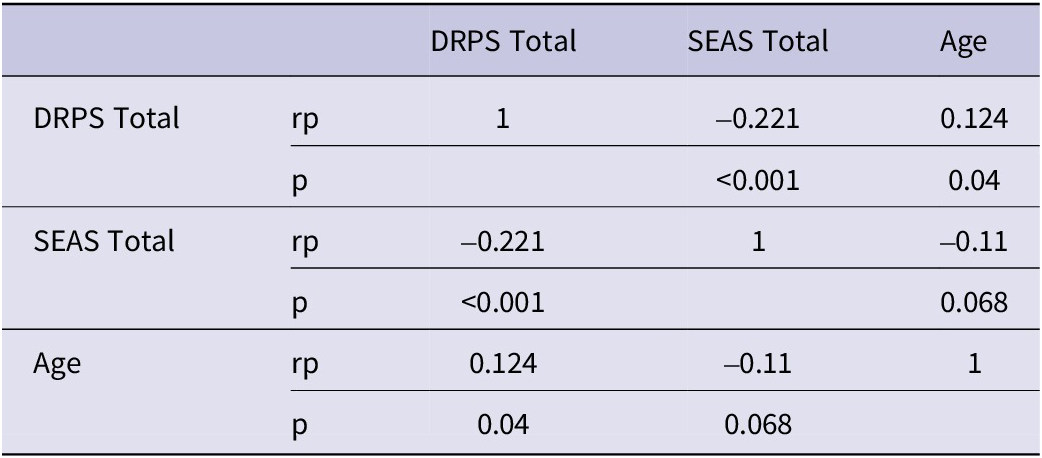
The study incorporates the correlation between the age of the participants and their scores on the DRPS and SEAS assessments. There is a strong inverse correlation between the total score of DRPS and the total score of SEAS (P<0.001). This indicates that as disaster risk perception increases, sustainable awareness decreases. Additionally, a statistically significant relationship was found between age and DRPS total score in the same direction (P<0.05). There is a positive correlation between age and disaster risk perception, meaning that as individuals age, their perception of the risk of disasters tends to increase. There was no statistically significant relationship between age and the total score of the sustainable awareness scale (P>0.05) (Table 4).
The relationship between DRPS total score, SEAS total score, and students’ age

P<0.05, rp: Pearson’s Correlation Test.
Discussion
Disaster education is a crucial educational process that imparts individuals knowledge about pre-disaster, during-disaster, and post-disaster actions.Reference Dufty 40 With the proliferation and broadening of dangers and threats on a global scale, the significance of disaster education is steadily rising.Reference Kitagawa 41 The study found that 74.5% of nursing students lacked disaster education, whereas 90.9% wanted such instruction. Hindriyastuti et al. (2019) asserted that the participants had a restricted understanding of disaster ideas and recommended that undergraduate nursing be the optimal educational level for introducing disaster information.Reference Hindriyastuti, Kako and Ranse 42 In their study, Li et al. (2015) discovered that individuals experienced a sense of unpreparedness before disasters and recognized the need for targeted training to enhance their disaster preparedness. This training would involve acquiring specialized knowledge and skills related to Disasters.Reference Li, Turale and Stone 43 Hasan et al. (2021) discovered notable positive correlations between nurses’ disaster knowledge and their disaster abilities and between nurses’ disaster knowledge and their disaster readiness.Reference Hasan, Younos and Farid 44 Enhancing the disaster literacy of nursing students before to the occurrence of disasters can guarantee the provision of sustainable health services both prior to, during, and after such events. It is imperative to incorporate a course on disaster preparedness within the undergraduate nursing curriculum or integrate it into existing courses.
Disasters are marked by a significant display of voluntary, pro-social, rational, and benevolent actions, which entail a substantial level of volunteerism as individuals prioritize helping others in distress, setting aside their interests.Reference Quarantelli 45 In a study conducted by Fothergill et al. (2005), it was discovered that there is a positive correlation between a participant’s identification as a nurse and their inclination to volunteer in emergencies.Reference Fothergill, Palumbo and Rambur 46 The study indicated that 35% of pre-nurses who strongly identified as nurses expressed interest in volunteering. This study revealed that 82.5% of nursing students desired to engage in volunteer work during times of calamities. This finding is consistent with other investigations documented in the literature. According to Arbon et al. (2006), there were variations in the rates of volunteerism among Australian nurses who offered their services for the 2004 Sumatra-Andaman earthquake and tsunami. Additionally, many of these nurses needed more preparation for their humanitarian efforts.Reference Arbon, Bobrowski and Zeitz 47 A study conducted by Satoh et al. (2018) discovered that 62.0% of nursing university students who took part in relief efforts following the 2016 Kumamoto earthquake expressed a great desire to assist the earthquake victims.Reference Satoh, Iwamitsu and Yamada 48 The high inclination of nursing students to participate in disaster relief activities has a twin impact. Firstly, it increases the pool of volunteers available during calamities. Secondly, it helps to minimize potential disruptions in health care.
The study found that the average total score of the participants on the Disaster Risk Perception Scale was 97.69±15.19 out of 125 points. Tercan (2023) found that the average total score on the Disaster Risk Perception Scale for the participants was 82.85±10.32 of a possible 105 points.Reference Tercan 5 Both investigations demonstrate consistently high mean scores. The earthquakes in Türkiye on February 6, 2023, and the disasters in different periods increased the perception of disaster risk.
The study found that participants’ average total score for Sustainable Earthquake Awareness was 55.68 ± 12.54. The study by Bilen and Polat (2022) found that earthquake disaster training, news, and films for pre-service teachers help increase their awareness and preparedness for earthquakes. An analysis was conducted on the instruments employed to foster disaster awareness throughout the community.Reference Bilen and Polat 33 Özdemir and Şahinöz (2022) found that specific strategies employed to enhance awareness were successful in increasing awareness, but others proved ineffective.Reference Özdemir and Şahinöz 49 Evaluations suggest that educating the public through social media and studying earthquake awareness can foster sustained earthquake awareness within the target population.
This study identified a statistically significant distinction between the participants’ class and their mean scores for DRPS and SEAS. The disaster risk perception of third class students is significantly higher than students in lower grades. The study found no statistically significant disparity between the degrees of exposure and impact, sub-dimensions of the disaster risk perception scale, and the academic levels of university students. The study findings indicate that the class level did not substantially impact the perception of disaster risk.Reference Usta 50 According to Mızrak and Aslan (2020), the student’s level of education did not impact their assessment of disaster risk, even though it grew as they progressed through higher grade levels. Our study deviates from the existing body of literatüre.Reference Mızrak and Aslan 51 The disparity is believed to stem from the study being conducted near the earthquake that occurred on February 6, 2023.
The study reveals a strong and statistically significant inverse correlation between the participants’ DRPS and SEAS total scores. As the impression of disaster risk rises, sustainable awareness declines. Incorporating disaster risk perception into all aspects of life and emphasizing its importance at every stage will gradually become ingrained in our daily lives, leading to automatic sustainability. The occurrence of the Kahramanmaraş Earthquakes created the necessary conditions for the implementation of this sustainability. Cultural shifts and changes in perception impact how earthquakes are perceived and the level of awareness regarding sustainability.Reference Göver 52 –Reference Çoşkun 55
This study revealed a notable correlation between age and the total DRPS score, with disaster risk perception escalating as age advanced. Tercan (2023) found a statistically significant disparity in the DRPS score based on age, gender, marital status, education level, and past disaster experience.Reference Tercan 5 In their study, Kellens et al. (2011) identified 12 characteristics that influence how individuals on the Belgian coast perceive floods. They discovered that 1 of these variables, age, has the most significant impact on flood risk perception.Reference Kellens, Zaalberg and Neutens 53 According to Edwards (1993), there is no statistically significant correlation between age and earthquake readiness.Reference Edwards 54 Age is significant in determining disaster risk perception and promoting sustained earthquake awareness. The data from our investigation exhibit similarities to the data found in the existing body of literature.
Conclusion
According to the study results, the study revealed that 74.5% of the participants had yet to undergo disaster training. Furthermore, 90.9% expressed a desire to receive disaster training. Regarding personal experience, 62.4% had encountered at least 1 disaster event. Additionally, 82.5% expressed a willingness to volunteer in disaster situations. According to the findings, 43.8% of the students regularly kept up with the earthquake news throughout the day. Additionally, 54% of the students believed that the Kahramanmaraş earthquake positively impacted their career outlook. It has been noted that most of the participants lack disaster training. However, the majority of them express an interest in getting such training. However, a significant percentage of them desired to offer their assistance in times of calamity. A statistically significant difference was observed between the students’ class and the average total scores of disaster risk perception scale and sustainable earthquake awareness scale. Significant statistical correlations were seen between degrees of disaster awareness and criteria such as personal experience with any disaster, desire to undergo disaster training, and willingness to volunteer in disaster situations. It was determined that the sustainable awareness scores of those who changed their professional perspective positively after the Kahramanmaraş earthquake showed a statistically significant difference compared to those who changed their professional perspective negatively. Courses on disaster management should be added to nursing education curricula. In order to provide disaster risk perception and sustainable earthquake awareness to nursing students, they need to take part in different activities in the field of disaster management. It is recommended that the disaster nursing course be added to the nursing curriculum in order to ensure that nursing students work effectively in the disaster management stages.
Author contribution
Kemal Torpuş: Conceptualization; Formal analysis; Funding acquisition; Investigation; Methodology; Project administration, Software; Supervision; Validation; Writing – original draft; Writing – review & editing;
Elif Işik Demirarslan: Conceptualization, Formal analysis, Investigation, Methodology, Software, Validation, Writing – original draft, Writing – review & editing.
Data availability statement
The data created within the scope of the study can be accessed from the authors upon appropriate request, provided that legal and ethical rules are respected.
Funding statement
No support received.
Competing interests
No conflict of interest has been declared.