Democratization has transformed the world in the last half of the twentieth century. Where once democracy seemed like a small island in a sea of authoritarian states, with an uncertain future, it has spread across the globe as part of the Third Wave of democratization. East Asia has participated in these global trends. The people power movement that forced Ferdinand Marcos from power in 1986 was the beginning of the East Asian Third Wave of democratization, which was quickly followed in 1987 by the end of military rule in South Korea and the lifting of martial law in Taiwan. South Korea and Taiwan might now be considered consolidated democracies, along with Japan. However, Indonesia, and Mongolia, and especially Thailand, have struggled through their democratization processes. China, Cambodia, Laos, Singapore, and Vietnam remain authoritarian states.
The extent of consolidation among the new democracies in East Asia remains an on-going research question (Dalton and Shin, Reference Dalton and Shin2006; Chu et al., Reference Chu, Diamond, Nathan and Shin2008; Shin, Reference Shin2012). The immediate answer largely depends on the actions of political elites in the government and in the opposition. In the short term, at least, democracy depends most on whether elites and political groups accept the new political order. But from a longer term perspective, we would argue that the transformation of the political culture is important for a democracy to endure and prosper (Almond and Verba, Reference Almond and Verba1963; Pye and Verba, Reference Pye and Verba1965; Eckstein, Reference Eckstein1966; Inglehart and Welzel, Reference Inglehart and Welzel2005; Welzel, Reference Welzel2013). It is difficult or nearly impossible for democracy to succeed if the political culture is not congruent with the values of the regime, because democracies are especially dependent on popular support and compliance without the repressive infrastructure of authoritarian states.
Our research examines this question of cultural change in new democracies. To what extent have the new democracies of East Asia developed a democratic culture, and what are the generational contributions to cultural change? The political culture literature argues that the socialization experiences of youth create values that generally persist through the life cycle. Yet, a change in regime requires a new set of political values to understand and participate in the new regime. Older generations need to learn new political values, or perhaps first unlearn values from the prior regime. Younger generations begin their political experience under a new regime, and presumably are more amenable to learning the values of this regime. Therefore, the degree of generational continuity and change in political values can be a valuable indicator of the democratization process.
We study generational differences in democratic-related political values across East Asian democracies based on the Second Wave of the Asian Barometer survey conducted in 2006. The survey includes several Third Wave democracies from East Asia: South Korea, Taiwan, Mongolia, and Indonesia.Footnote 1 We include Japan as a comparative case of a consolidated Asian democracy. We compare political values across generations, and then use these results to describe the processes of cultural change occurring in these nations.
The next section discusses the literature on generations and cultural change that provides the foundation for our research. Another section briefly describes the democratization experience of the five nations in our study. The following section introduces the East Asian Barometer survey and the attitudinal measures. Then we examine the generational patterns in these attitudes cross-nationally. Finally, the conclusion discusses the implications of our findings for the process of cultural change in these new democracies.
Generational change and cultural change
Tocqueville described a political culture as reflecting ‘habits of the heart’ that were deeply engrained in citizen norms. Modern political culture research has echoed this theme by stressing the role of early life socialization in developing the norms defining a political culture. Almond and Verba's (Reference Almond and Verba1963) classic The Civic Culture, for example, stressed the importance of family and school authority relations in nurturing democratic norms and beliefs. Just as the German family and social relations conspired to create an authoritarian political culture in pre-1945 Germany, more egalitarian and participatory social relations nurtured democratic norms in the United States. The importance of early life political socialization is widely repeated in the political culture literature (Niemi and Sobieszek, Reference Niemi and Sobieszek1977; Pye, Reference Pye1985). The assumption is that people learn democratic norms from family, peers, social groups and the structure of society.
The importance of early life socialization is especially salient when we turn to democratizing nations. One approach stresses the importance of direct early life learning. By definition, older generations were raised under the previous non-democratic regime where political socialization should have attempted to inculcate values congruent with this regime. To become good democrats, older generations may first have to ‘unlearn’ the norms of their earlier socialization. In some regimes, this can be challenging when the democratic transition came from above rather than bubbled up from societal change. In post-1945 Germany and post-Franco Spain, for instance, earlier surveys found that many people retained ties to the symbols, elites and political norms of the previous authoritarian regime even while these nations were attempting to democratize (Verba, Reference Verba, Pye and Verba1965; Conradt, Reference Conradt, Almond and Verba1980; Montero et al., Reference Montero, Gunther and Torcal1997; McDonough et al., Reference McDonough, Barnes and Lopez-Pina1998).
In contrast, if societal change accompanies democratic regime change, then younger generations grow up in an environment that is more conducive to learning democratic norms. Young Germans or Spaniards raised in a post-transition democratic system learnt about a different set of political norms in their schools as curricula were reformed, the media sought to reeducate the public, and even familial relationships changed from the authoritarian style of the past. Important elements in these reeducation programs were the efforts of new political elites to consciously change political norms. Consequently, longitudinal studies show that the growth of a democratic political culture in Germany and Spain occurred most rapidly among younger generations (Conradt, Reference Conradt, Almond and Verba1980; Montero et al., Reference Montero, Gunther and Torcal1997). Although earlier generations also became more democratic, the changes were smaller because of the inertia of previous learning. Thus, the consolidation of a democratic political culture was partly a function of the passage of time and the exit of older, more authoritarian citizens.
These theoretical and empirical studies do not argue that early life socialization is deterministic and incapable of change. Rather, they suggest that socialization is a Bayesian process (Bartels, Reference Bartels2001; Gerber and Green, Reference Gerber and Green1998). Early learning shapes a person's core political beliefs, and in stable political regimes one's life experiences generally reinforce these early beliefs. When regime change occurs, this earlier learning may be at odds with the norms of the new regime. The mass of this previous learning creates inertia to change; people can change, but they change more slowly if the new experiences contrast with their past. In a new political environment, little prior learning could thus facilitate new learning.
However, research from several Third Wave democracies has challenged this direct social learning model. East European publics and other Third Wave democracies often displayed surprisingly high levels of support for democracy right after the transition (Inglehart, Reference Inglehart2003; Rose, Mishler, and Haepfer, Reference Rose, Mishler and Haerpfer1998) – in sharp contrast to the evidence from Second Wave transitions. Large majorities in post-communist and other post-authoritarian nations said democracy was the best form of government, and favored democracy over authoritarian regime forms. Having democratic preferences after growing up under an authoritarian system seemed inconsistent with an early life socialization model (Mishler and Rose, Reference Mishler and Rose2007).
One explanation of the Third Wave pattern was that the social modernization can indirectly socialize citizen values even in the absence of regime change (Welzel, Reference Welzel2013; Inglehart and Welzel, Reference Inglehart and Welzel2005; Dalton and Shin, Reference Dalton and Shin2006; Rose, Mishler, and Haerpfer, Reference Rose, Mishler and Haerpfer1998).Footnote 2 This builds on the thesis that economic modernization generally leads to political modernization (Acemoglu and Robinson, Reference Acemoglu and Robinson2005), with changing citizen values as a mediating factor. Christian Welzel (Reference Welzel2013) describes this pattern of human development that links social modernization to the emergence of emancipative values which are more supportive of democracy. In Eastern Europe, for example, rising living standards and educational levels increased citizens’ political resources even under an authoritarian regime. Exposure to international media and the globalization of economic systems can facilitate the diffusion of international norms supporting democracy. East Germans, for example, could learn something about democracy by watching western TV, movies, and talking to their relatives in the West (Rohrschneider, Reference Rohrschneider1999). The growth of latent civil society groups in a complex society also can nurture democratic aspirations, even if the goals and methods of these groups are not explicitly democratic.
The modernization literature suggests that the social characteristics and social resources of individuals strongly influence their political beliefs. This also dates back to Almond and Verba (Reference Almond and Verba1963) who showed that educational groups within nations often varied in their political norms and behaviors. Much of the political modernization literature similarly stresses the importance of social status – both within and between nations – in describing the political culture. The better educated, for example, have more political resources that are relevant to democratic involvement and favor self-expressive or emancipative values that nurture a democratic political culture (Inglehart and Welzel, Reference Inglehart and Welzel2005; Welzel, Reference Welzel2013). Thus within generations there are ‘generational units’ who experienced different socialization experiences because of their social status (Mannheim, Reference Mannheim and Mannheim1952). And with the massive social modernization in many East Asian nations in recent decades, the potential for value change is substantial (Wang and Tan, Reference Wang, Tan, Dalton and Shin2006; Flanagan and Lee, Reference Flanagan and Lee2003). This study examines the potential impact of social modernization by comparing generational units defined by the historical period of their socialization and their educational level. We presume that all else being equal, the better educated within each generation would be more supportive of democratic norms.Footnote 3
These two approaches – direct social learning and indirect learning through social modernization – are the primary framework for our research. Several East Asian democracies have transitioned from authoritarian systems during the Third Wave of democratization. The political culture literature on East Asia often stressed the authoritarian or non-democratic content of the pre-democratic political cultures (Blondel and Inoguchi, Reference Blondel and Inoguchi2006; Pye, Reference Pye1985). However, it is less clear how the rapid socioeconomic modernization of the region over the past three decades affected democratic orientations among East Asians. We examine these questions in our analyses.
The process of democratization in East Asia
In East Asia, as in other regions, the democratization process followed varied courses featuring the peaceful and violent, and pacted and unpacted modes of transition (Shin, Reference Shin2008). Of the five East Asian democracies in our analysis, the Japanese transition to democracy in 1945 probably represented the sharpest change in regime form and parallels the experience of other Second Wave democracies such as Germany and Italy. The defeat of the imperial and military forces that ruled Japan in World War II led to the imposition of democracy from above. The period 1945–58 was the institutionalization of the new democratic regime, capped by the realignment of the party system in 1958. We treat this as a transition period while the new democratic system was being established. The years since 1958 should represent a more supportive democratic culture (Richardson, Reference Richardson1975). Since this transition occurred over five decades ago, current generational differences within the Japanese public should be fairly minor.
The South Korean experience includes a series of authoritarian civilian governments, as well as extensive periods of military rule (Shin, Reference Shin1999; Diamond and Shin, Reference Diamond and Shin1999). Korea’s constitution underwent six major revisions since 1949 which produced the current Sixth Republic. Simultaneously, by the late 1970s Korean society was experiencing very large improvements in living standards and educational levels of the public, and increased exposure to the international community and democratic norms. This transition period gained greater momentum in 1988 with the formation of a democratic regime.
The Taiwanese transition to democracy also occurred gradually over several decades (Gilley and Diamond, Reference Gilley and Diamond2008; Paolino and Meernik, Reference Paolino and Meernik2008; Rigger, Reference Rigger2006). Chiang Kai-shek's authoritarian leadership was institutionalized through the KMT's domination of the political system. As Taiwan society modernized and grew economically in the 1970s, latent democratic forces began to organize (within the KMT and in other groups) and found a space in the political system to advocate democratic reform. The transition period ended in 1988 with the democratic election of the government.
Taiwan slowly evolved politically within the KMT and society in general, without the ebb and flow of Korean regime changes. In both Korea and Taiwan, however, tremendous changes in socio-economic conditions presumably contributed to the pressure for democratic reform among the better-educated sectors of the public as evidenced in university student activism for democracy in both nations. This should produce distinct differences in political norms within Taiwanese generations as a function of social experiences.
The clearest case of a recent, direct authoritarian/democratic transition is Mongolia (Ganbat et al., Reference Ganbat, Tusalem, Yang, Chu, Diamond, Nathan and Shin2008; Landham et al., Reference Landman, Larizza and McEvoy2005). The Mongolian People's Revolutionary Party (MPRP) controlled a communist state with a firm hand since 1952. The Third Wave of democratization swept through Mongolia in 1990, and street demonstrations drove the MPRP from power. Since then the nation has experienced relatively stable levels of democracy according to Freedom House and other indicators.Footnote 4 Furthermore, the Mongolian transition appeared abrupt because relatively little economic development had occurred under the communist regime, and the economy suffered a modest recession in the early 1990s with the collapse of the Soviet Union and Soviet economic aid. The generations that came of age after 1990 may have stronger democratic norms than Mongolians raised under the communist regime, but the contribution to value change from social modernization should be limited.
Indonesia was the last to join the Third Wave of democratization. President Sukarno ended a short period (1949–57) of parliamentary democracy in July 1959 and began four decades of authoritarian rule. Democratic change began during the economic crisis in 1997 when various political groups challenged President Suharto's authoritarian regime (Sato, Reference Sato2003). In May 1997, the worsening economic crisis weakened the legitimacy of his regime and gave rise to mass movements challenging it. In response to these movements, Suharto attempted to liberalize his authoritarian rule from above by easing restrictions on the freedom of expression (Uhlin, Reference Uhlin1997). In the aftermath of several liberalizing measures, labor strikes and street demonstrations occurred on an increasing basis. The press reported feuds within the ruling camp. The government cracked down on the mass movements in response, which made many Indonesians increasingly aware of the need to transform their authoritarian system into a democracy. Those who came of age during this period of liberalization, therefore, can be characterized as a transitional generation. Suharto transferred his presidency to Vice President Habibbie in May 1998, which paved the way to the democratization of the political system.
These five East Asian democracies are considerably different in terms of when and how they democratized. Of these five, Japan and Indonesia represent the oldest and youngest ones. Taiwan and Mongolia represent the longest and shortest periods of democratic transition. The longer a stable and successful regime exists, the less likely is it that political generations hold distinctively different regime norms. But when regimes change, then generations can be the vehicles for cultural change.
Defining generational units
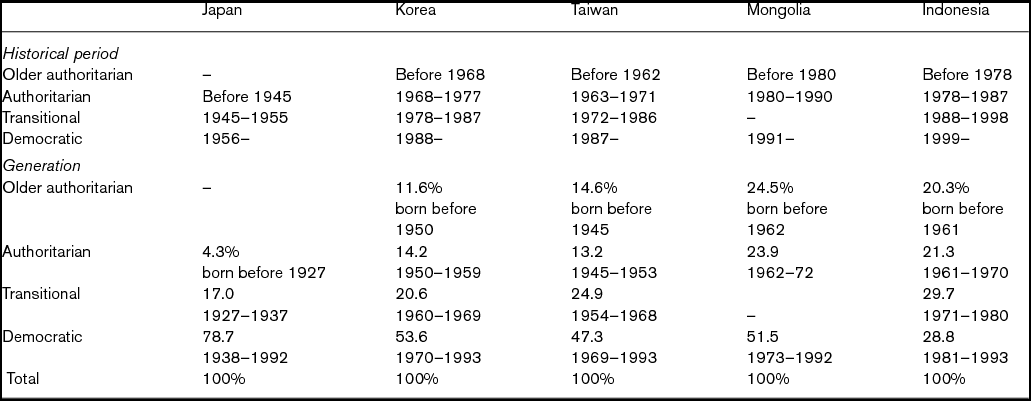
The political history of these five East Asian democracies provides the basis to define the significant generational units within each nation. We first identified specific historical periods for each nation in terms of three regime periods: authoritarian, transitional, and democratic (see Table 1). Although the literature offers varied estimates of when political values are initially formed, we define generational units as the historical period during which survey respondents reached eighteen years of age (the current legal voting age in most nations). Since several of these nations have fairly short democratic histories, we further divided the authoritarian generation into those raised in the last ten years of that regime, whose attitudes might have been more susceptible to change, and those with a longer socialization under the older regime. This produces the four generations in Table 1.
Defining generations by historical period

Note: Respondents are coded into generations based on the period when they reached age 18. The percentages indicate the percentage of each sample coded within each generational unit.
Source: Asian Barometer, Second Wave.
Table 1 also shows the distribution of each sample in terms of these generational units. Few Japanese today were raised under the authoritarian pre-1945 regime, but this represents over a quarter of the Korean and Taiwanese publics. In Mongolia and Indonesia, those raised under authoritarian rule constitute almost half of the respective populations. In contrast, about four-fifths of the Japanese have grown up in a consolidated democratic system, compared to about one-half in Korea, Mongolia, and Taiwan. In the last of these nations to democratize, less than one-third of Indonesians acquired political identity by the time of our survey in 2006.
We can further divide each national sample in the Asian Barometer into better- and less-educated groups based on the median level of education in the nation.Footnote 5 The proportions falling into the two educational groups vary systematically across the historical generations. As one should expect, the oldest authoritarian cohort has a higher percentage of less-educated respondents; the youngest democratic cohort is relatively better educated. There are a sufficient number of cases in each of the generational units to determine whether generational differences in political orientations are due to the differences in educational attainment across generations.
Measuring regime support
Of the various elements of a democratic political culture, one orientation appears more fundamental than the rest: the attitude that democracy as a regime is preferable to any of the alternatives (Diamond, Reference Diamond2008; Linz and Stepan, Reference Linz and Stepan1996; Rose et al., Reference Rose, Mishler and Haerpfer1998). This is because a commitment to democracy as the best form of government likely means a rejection of anti-democratic alternatives. Pro-democratic sentiments should replace support for the prior authoritarian regime as a new democracy develops. Therefore, democracy is more deeply rooted when an overwhelming majority of the mass citizenry embraces it as ‘the only game in town’ (Diamond, Reference Diamond2008; Linz and Stepan, Reference Linz and Stepan1996). This section describes how we use the Asian Barometer to measure regime orientations among these publics.
Attachment to authoritarian regimes
The first step in becoming democratic is to shed ties to a prior authoritarian regime. Yun-han Chu and his colleagues (Reference Chu, Diamond, Nathan and Shin2008: 24) argued that ‘authoritarian detachment is as important as democratic commitment in sustaining the legitimacy of a democratic regime’. After a democratic transition, it is often the case that some sectors of society hold residual attachment to the ancien regime, and chafe at the new political style of democratic politics (Shin, Reference Shin2012; Shin and Wells, Reference Shin and Wells2005).
To examine residual support for non-democratic regimes, the Asian Barometer asked respondents whether they favor various authoritarian regimes: get rid of parliament and have a strong leader decide, the military should govern the country, or only one party stands for election and holds office. The survey asked respondents whether they strongly agreed or strongly disagreed with each type of regime for their nation (see questions in Appendix).
Figure 1 describes generally modest support for each of these options across East Asian democracies. In the consolidated democracies of Japan, South Korea, and Taiwan, each of the authoritarian options garners approval by only about a tenth of the public.Footnote 6 In Mongolia, however, a majority (62%) favors a strong leader running the country without parliamentary oversight; an additional number (26%) approves of a one-party system. It appears that the Mongolians’ ties to their pre-democratic past are still substantial. In addition, Indonesia was ruled by the military for decades, and a significant proportion of Indonesians (30%) feel that the army should govern the country.
Favorability toward authoritarian regimes
Note: Figure entries are the percentage giving a pro-authoritarian response; this is ‘strongly approve’ or ‘approve’ responses. Missing data were included in the calculation of percentages.
Source: Asian Barometer, Second Wave.
The appeal of various types of authoritarian regimes may differ across individuals and across nations. Because of national histories, a one-party state may be more appealing to some, while a strong leader may be more appealing in another nation. Thus averaging these three regime types together would give a biased view of the real non-democratic appeal in each nation (Dalton and Shin, Reference Dalton, Shin, Dalton and Welzel2014). Therefore, we created an index that includes the most-favored authoritarian option for each individual. For example, the majority of Mongolians are positive toward a strong civilian leader, others are positive toward one-party rule; the index identifies support for the most favored authoritarian option for each Mongolian respondent. Consequently, the resulting index summarizes the pro-authoritarian sentiment in each nation, even if the preferred regime form differs across individuals.
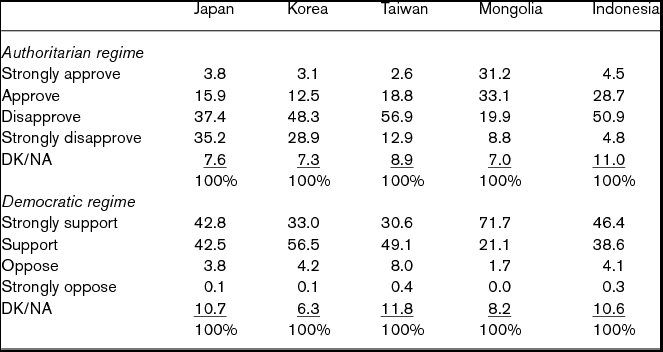
The first panel in Table 2 shows considerable variability in the appeal of an authoritarian alternative across these five countries. Nearly two-thirds of Mongolians and a third of Indonesians approve of some authoritarian regime form. This mirrors the pattern in Figure 1. These two nations are the most recent democracies, but they also represent countries where the social-economic conditions to foster a democratic culture are less developed. At the same time, we find significant approval of some authoritarian regime form in the three consolidated democracies – Japan, Korea, and Taiwan –amounting to roughly a fifth of the public.
Attachment to democratic and authoritarian regimes
Source: Asian Barometer, Second Wave.
Attachment to democracy as a regime
The democratic development of these East Asian nations should ideally be accompanied by a gradual transformation of the political culture. The rejection of an authoritarian past does not necessarily mean that people embrace a democratic future – although one might hope for such a relationship (Shin and Wells, Reference Shin and Wells2005).
To explore this topic, the Asian Barometer asked several questions on support for a democratic regime. We selected three questions (Appendix A): the desirability of democracy, the suitability of democracy, and the preferability of democracy. We consider pro-democratic responses to these questions measure democratic attachment at the regime level.
The first question asked respondents to indicate the sort of regime they found most desirable. A score of 1 indicates a desire for a ‘complete dictatorship’, while a score of 10 means ‘complete democracy’. The results in Figure 2 indicate that about 90% of the people in each country express a desire for democracy (a score of 6 or above). The second question asked people to rate the suitability of democracy for their nation. A score of 1 indicates ‘completely unsuitable’, while a score of 10 indicates ‘completely suitable’. The figure shows that a majority in every country also considers democracy suitable (a rating of 6 or above), although perceptions of democracy's suitability are somewhat lower than their desire for democracy (77% versus 89%).
Attachments to democracy as a regime
Note: Figure entries are the percentage giving a pro-democratic response; for the first two items this is a score of 6 or above on the ten point scale. Missing data were included in the calculation of percentages.
Source: Asian Barometer, Second Wave.
When people were asked whether democracy as the system of government for their country is always preferable to any other kind of government, democratic support is more modest (only 51% averaged across these nations). More notable is that in three nations – Korea, Mongolia, and Taiwan – less than half the population expressed unqualified support for democratic rule. About two-fifths of Koreans and Mongolians said that an authoritarian government was preferable under some circumstances. And in most nations about a tenth said they were indifferent toward the regime form.
Opinions on democracy's desirability, suitability, and preferability show that citizen attachments to democracy as a regime depend on comparative considerations. When considering democracy as a desirable political ideal, almost everyone embraces it as desirable. Even when they see it as a political enterprise, most people in these nations still believe that democracy is a viable political system. However, when asked if they prefer democracy as the means of running their country, a substantial number do not categorically endorse it.
In addition to evaluating these items individually, we combined responses to the first two questions into an index measuring overall support for a democratic regime to be comparable to our authoritarian support index.Footnote 7 The second panel of Table 2 reports the proportions expressing strong support for democracy and those expressing strong opposition. In all nations, only a very small minority, less than 10% of the sample, is unsupportive of democracy. Roughly a sixth of each sample receives a missing data score because they did not respond to one question.
East Asian publics vary significantly in their support for a democratic regime. Strong support for democracy ranges from 31% in Taiwan to 71% in Mongolia. A simple interpretation of learning theory, which suggests that the experience of democratic rule leads to greater support for democracy, is seemingly not confirmed because the democratic longevity of the regime is not apparent in the national levels of democratic support.
A careful comparison of these results for authoritarian and democratic regime norms reveals three different patterns in the political cultures of these nations. In Japan, Korea, and Taiwan, majorities are heavily attached to democracy and detached from authoritarian alternatives. Indonesians express majority support for democracy, but there is also substantial residual support for an authoritarian regime. Significantly, Mongolians show a majority support for an authoritarian government, while simultaneously expressing support for democracy. These patterns suggest examining support for democracy alone can give a biased impression of the regime norms in a nation. Some citizens can simultaneously express approval of both democracy and authoritarian regimes – even in consolidated democracies such as Korea and Taiwan. Thus, the comparison of regime support is necessary to fully understand the political culture of a nation.
Missing data and measurement
Before analyzing generational differences in attitudes toward political regimes, we face a prior question of how to deal with non-response in the surveys. About a tenth of the public in each country do not respond to the questions on democratic or authoritarian regime preferences, either saying they don't know or they decline to answer. Researchers often delete these responses from their analyses as missing data, but these responses have special relevance in generational studies because they are unevenly distributed across the generational units.
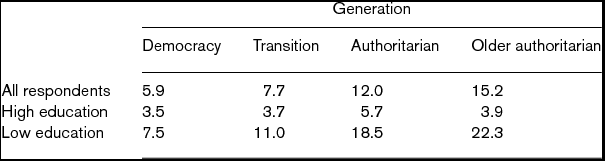
To illustrate this potential problem, we averaged the missing data responses for all five nations on the authoritarian regime index. The percent of missing responses rises from 5.9% among the democratic generation in the pooled sample to 15.2% among the oldest authoritarian generation.Footnote 8 Furthermore, there are substantial educational differences in the missing data responses. Only a small proportion of the highly educated in each generation give a missing data response, but this amounts to almost a quarter of the less educated in the oldest authoritarian generation. This wide range of percentages across generational units (from 3.5% to 22.3%) could significantly affect our results if one includes or excludes missing data responses.
We exclude these non-responses in subsequent analyses because the interpretation of these answers is unclear. But if lack of opinions is interpreted as lack of support for a democratic regime – a reasonable view given democracy's requirement of popular legitimacy – then comparisons between generational units might be attenuated by the exclusion of non-respondents.
Generations and regime preferences
If cultural change is occurring in these East Asian democracies, we expect that generational units are significant carriers of cultural change (Wang and Tan, Reference Wang, Tan, Dalton and Shin2006). Young citizens who have been raised in a democratic regime and more affluent societies should more strongly favor a democratic regime. Their elders, in contrast, may retain some residual support for the former authoritarian regime, especially if they have had to readjust to the economic and social changes accompanying the democratic transition.
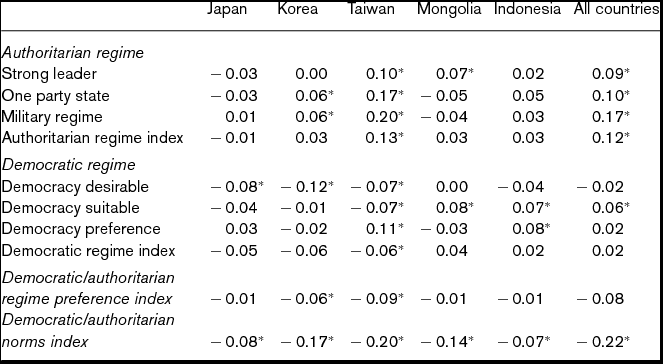
We tested this thesis by comparing approval of authoritarian regimes across the four generations. Because these comparisons would generate a large number of tables, we summarize relationships with Tau-b correlations between generations and approval of authoritarian regimes (Table 3). The table shows that support for an authoritarian regime tends to increase among older respondents who were raised under such a system. For example, using the pooled set of five nations in the far right column, generation has a modest positive correlation with the authoritarian regime index (tau-b = 0.12). The correlations are not large, but are generally in the expected direction, and all of the statistically significant correlations are in the predicted direction. These generational differences are greatest in Taiwan; South Koreans also show significant generational differences across most items. The weakest relationships are in Japan, perhaps because there is little support for any authoritarian option, few people are alive from the pre-democracy generation, and these sentiments have less meaning in contemporary Japan.
The relationship between generation and regime support
Note: Table entries are Tau-b correlations between four generations (1 is democratic and 4 is older authoritarian) and opinions on each item. Approval of the respective regimes is coded as a higher value in calculating correlations. Entries significant at 0.05 level are denoted by an asterisk.
Source: Asian Barometer, Second Wave.
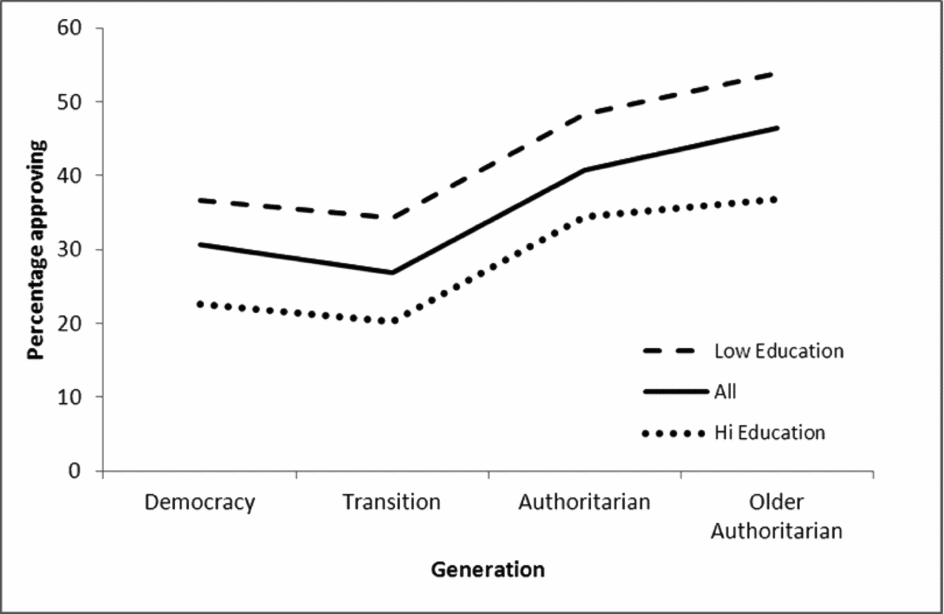
To illustrate the generational patterns underlying these correlations, Figure 3 displays approval of an authoritarian regime by the four generations for all five nations combined (the solid line in the figure), as well as the opinions of the better educated and less educated within each generation (the two dashed lines). Two aspects stand out in this figure. First, approval of an authoritarian regime is about 15 percentage points higher in the oldest generation raised under an authoritarian system, than among the youngest generation raised in a democracy. This is not a large gap, but it reflects a general trend in political socialization across these five nations.
Approval of authoritarian regime by generation
Note: Figure entries are the percentage approving the most-liked authoritarian regime from among the three options; education was coded as above or below the media in each nation.
Source: Asia Barometer, Second Wave; pooled results for Japan, Korea, Taiwan, Mongolia, and Indonesia.
The second important pattern is the contrast between better- and less-educated citizens within each generation. The less educated in each generation are more likely to approve of authoritarian regimes compared to the better educated. For example, in the older authoritarian generation, a majority (53.9%) of the less educated approve of an authoritarian regime. Among better-educated youth socialized under a democratic order, support for an authoritarian regime drops to only 22.6%. In short, both regime change and social modernization are apparent in these generational patterns.
Our next step examines generational differences in citizen preference for a democratic regime. We expect democratic learning to promote support for democracy among the post-transition generation. The lower panel of Table 3 compares the relationship between generations and support for a democratic regime. A notable feature of the table is the weak correlations between generation and democratic attitudes. Only in Korea and Taiwan, is there a consistent pattern for the generation raised in a democracy being relatively more favorable to democracy in comparison to authoritarian generations. More surprising, in Mongolia and Indonesia, the authoritarian generation sometimes expresses more support for democracy than those in the democratic generation (the positive correlations with democratic measures). Overall, democratic regime preferences do not vary consistently across the four political generations. In part, this may reflect the limited variance on the democratic index, since large majorities in all five nations espouse their democratic aspirations. But it may also reflect mixed views of the nature and value of democracy across generations.Footnote 9
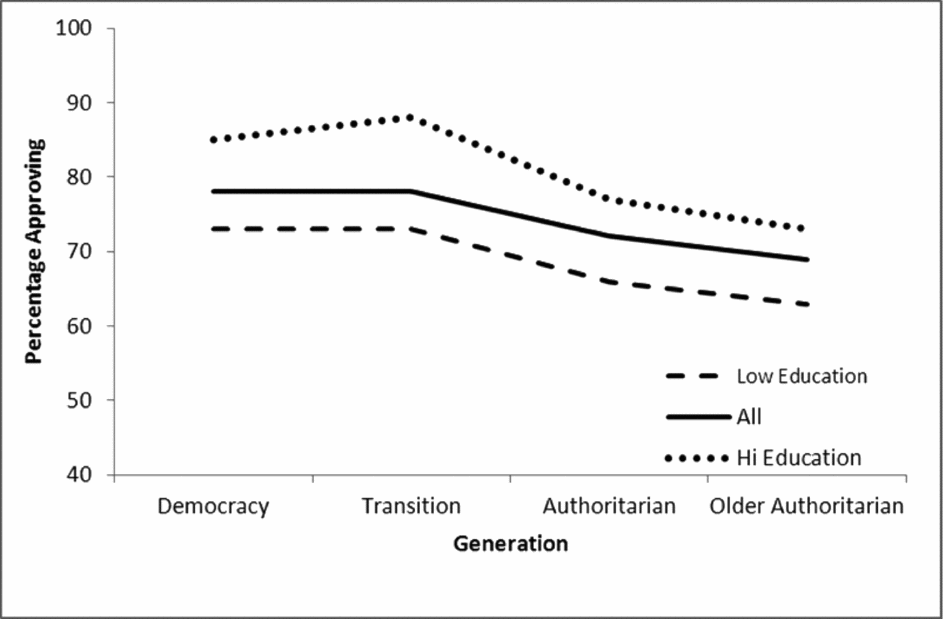
We replicated the analyses of Figure 3 to compare generational units in their support for democracy (data not shown). The first apparent pattern is the overwhelming positivity toward democracy across all four political generations – espoused support for democracy today is nearly universal. Second, the better educated are more favorable toward a democratic regime than their less-educated counterparts, regardless of whether they grew up under authoritarian or democratic regime. However, these effects are very weak, averaging only about a 3% difference in approval. The analyses indicate that neither a person's political generation nor their social environment matters a great deal in expressed support for democracy. This again raises questions about the validity of support for democracy taken alone as a measure of regime preferences.
To better tap relative regime preferences, we constructed an additional index that is the simple difference between support for democracy and support for an authoritarian regime.Footnote 10Figure 4 displays the percentages who favor a democratic regime across generational units. In contrast to attitudes toward authoritarian regimes in Figure 3, the youngest and better educated are more supportive of democracy when compared to the most liked authoritarian alternative. The next to last row of Table 3 indicates that this overall relationship is driven primarily by clear generational differences in regime preferences in Korea and Taiwan, with insignificant generational variation in the other three nations, albeit for different reasons.
Approval of democratic regime vs. authoritarian regime by generation
Note: Figure entries are the percentage approving a democratic regime in comparison to an authoritarian regime.
Source: Asia Barometer, Second Wave; pooled results for Japan, Korea, Taiwan, Mongolia, and Indonesia.
In summary, if a democratic culture requires an affinity toward a democratic regime and rejection of non-democratic alternatives, citizens in the Third Wave democracies of East Asia are only part way to this goal. Democratic aspirations are widespread across nations and generations, even in nations that are not democratic (Dalton and Shin, Reference Dalton and Shin2006; Chu et al., Reference Chu, Diamond, Nathan and Shin2008). But acceptance of authoritarian alternatives still exists among a significant subset of the population in Mongolia and Indonesia, and especially among generations raised in pre-democratic times. Many East Asians do not see democracy and authoritarian regimes as mutually exclusive. Cultural change is occurring, but is incomplete.
Democratic/authoritarian norms
Regime preferences are an important measure of the democratic orientations of the citizenry. But even if there is frequent endorsement of a democratic regime (and more limited support for authoritarian alternatives), a democratic political culture must go deeper. Democracy also depends on a set of political norms about how politics function, such as the rule of law, restrictions on government power, tolerance of differences, and related values (Dahl, Reference Dahl1971; Almond and Verba, Reference Almond and Verba1963; Rohrschneider, Reference Rohrschneider1999). Support for democracy can exist in name only if democratic values have not developed as well.
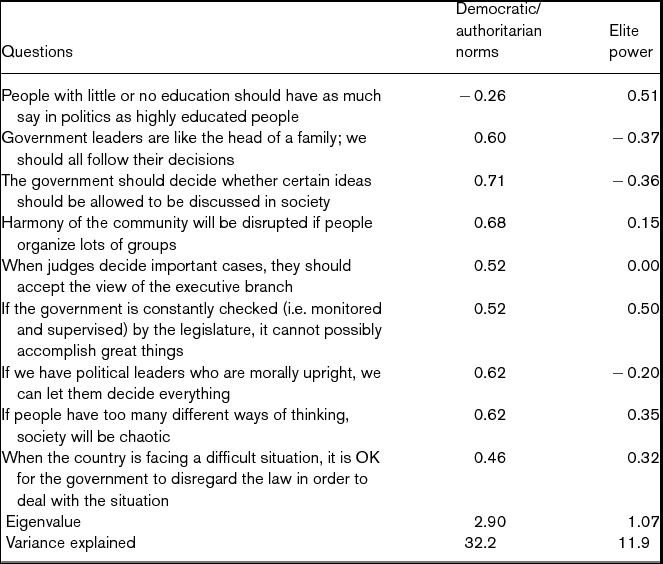
The Asian Barometer assessed these political norms with a battery of questions tapping different aspects of democratic and authoritarian orientations, such as deference to government and acceptance of restrictions of government. To construct a general dimension from these individual items, we conducted a factor analysis that identified two dimensions (Table 4). The first dimension incorporates nearly all the items and seems closest to a global measure of democratic/authoritarian norms. For instance, this dimension includes concerns about social order, the autonomy of the judicial branch, and the importance of public deliberation – all themes running through the democratic political culture literature.
Dimension of democratic/authoritarian values
Note: Table entries factor loadings from a two factor principal components analysis (unrotated). The default solution identified only two dimensions with eigenvalues greater than 1.0.
Source: Asian Barometer, Second Wave.
The factor analysis produces standardized scores for democratic/authoritarian norms based on all five nations, with an overall mean of zero. As theory would predict, there is a close congruence between the democratic consolidation of a nation and public attitudes on the democratic/authoritarian norms scale. The most pro-democratic on the first dimension is the Japanese public, averaging two-thirds of a standard deviation (0.65) above the five-nation mean. This is followed by the Korean (0.33) and Taiwanese publics (0.21), and then the Indonesians (0.04). Mongolians are the outlier on this scale; they are much more likely to lean toward the authoritarian end of the scale (–1.15). Reflecting the pattern we saw for regime norms, the current political culture of Mongolia does not provide a firm foundation for a democratic system.
Also striking are the sharp generational differences in these sentiments. Support for democratic norms steadily declines from young to old in the all five nations (negative correlations in the last row of Table 3). If we use one question to illustrate this pattern, one of the items asks whether government leaders are like heads of a family, and people should follow their decisions. A full 60% among the democratic generation in the pooled five nations disagrees, compared to only 29% among the older authoritarian generation.
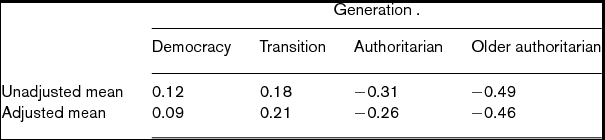
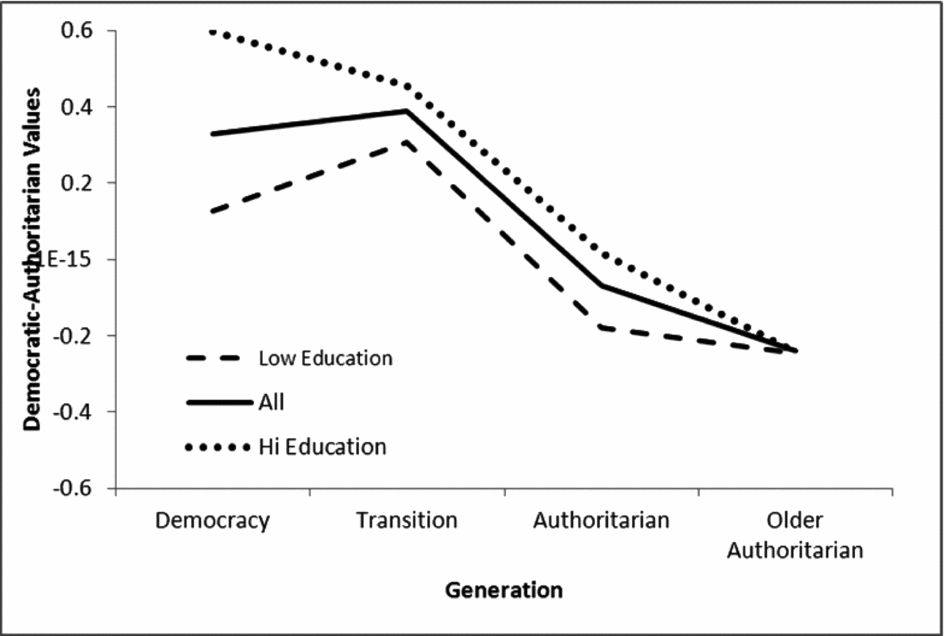
Figure 5 presents generational differences for the pooled set of nations, further differentiating between the better- and less-educated respondents. Members of the older authoritarian generation average about –0.20 on the democratic/authoritarian norms index, with little difference between the better and less educated. In contrast, the average member of the democratic generation has a 0.33 score on the values index, and the gap between the better and less educated widens with democratization. The better educated in the democratic generation score nearly 0.60 in the pro-democratic direction.
Democratic-authoritarian norms by generation
Note: Figure entries are the mean scores on democratic/authoritarian norms with positive scores representing support for democratic norms.
Source: Asia Barometer, Second Wave; pooled results for Japan, Korea, Taiwan, Mongolia, and Indonesia.
These results imply that while support for a democratic regime is widely claimed, the norms that support democracy are more variable and distinctly more common among the young raised in a democratic system. Indeed, the democratic experience may give meaning to the support for a democratic regime.
Equally important, these generational patterns are accentuated among the better educated who are more likely to be politically engaged and influential in a new democratic political order. The better educated are also more likely to be the carriers of self-expressive/emancipative values that are a broad consequence of social modernization (Inglehart and Welzel, Reference Inglehart and Welzel2005; Flanagan and Lee, Reference Flanagan and Lee2003; Welzel, Reference Welzel2013). Since the better educated are also more likely to be politically active, this further accentuates the impact of value change.
A multivariate model of generational change
Although generational differences in political attitudes are apparent in several East Asian democracies, we have noted that these patterns may be linked to broader forces of social modernization and social change. The social conditions of citizens have changed dramatically over time in many of these nations. Thus, we want to assure the robustness of our results by comparing generations to other potential predictors that represent different possible influences on democratic support.
A simple economic model of political support would link an individual's attitudes toward democracy to their current financial state. If democratic preferences are simply driven by improving personal conditions, then their present economic circumstances might dictate their attitudes toward a democratic regime. We used family income and subjective satisfaction with the household's economic situation to test whether economic performance influences support for democracy (see Appendix A for question wording). Education is another measure of social modernization, and including it in a multivariate model with income and economic satisfaction allows us to isolate the cognitive effects of education. We also include gender and urban/rural residence as other potential cultural influence. Urban citizens might be more supportive of democracy because their living conditions and occupations lead to more cosmopolitan vales than rural residents (Pye and Verba, Reference Pye and Verba1965). At least in a partial way, these predictors control for whether socio-economic modernization drives the generational patterns we have described.
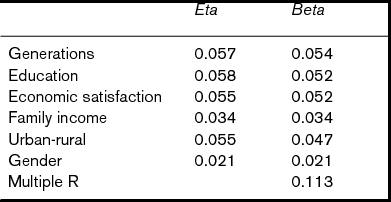
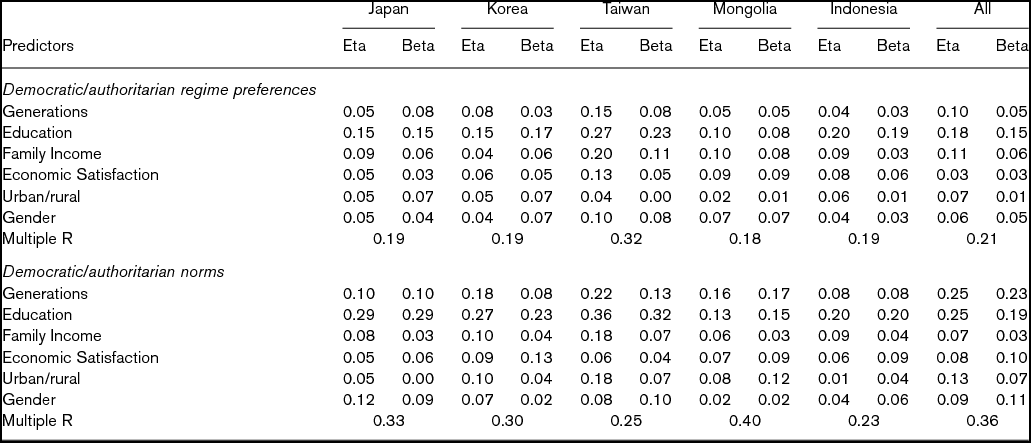
We estimated the independent effect of generations along with these other variables to predict democratic/authoritarian regime preferences (from Figure 4) and the democratic/authoritarian norms (Figure 5). Because some of the predictors might be considered nominal level variables, we used multiple classification analysis (MCA) to model these relationships. Table 5 reports the results of the MCA with eta coefficients from a bivariate Anova and beta coefficients that are equivalent to standardized regression coefficients except based on nominal relationships.Footnote 11 The model also calculates adjusted mean scores for each group, which we report below.
Multivariate model of democratic attitudes
Note: Table entries are eta and beta coefficients from Multiple Classification Analysis. The beta coefficient reflects the correlation of the predictor controlling for other predictors in the model.
Source: Asian Barometer, Second Wave.
The top panel in the table reports the MCA model for democratic/authoritarian regime preferences. In the pooled set of five nations, there is a modest (eta = 0.10) bivariate relationship between generations and regime preferences, but controlling for the other five predictors this relationship becomes much weaker (beta = 0.05). And in the individual nations, only Korea and Taiwan display modest eta coefficients. As we found above, generational differences in regime preferences are limited, perhaps because of the abstract nature of these preferences and the broad expressed support for a democratic regime across all generations.
Education emerges as a stronger predictor of regime preferences, typically with the strong eta and beta coefficients in each model. This suggests that there is a cognitive element of democratic preferences, and that the better educated are more likely to adopt the norms of the existing regime even when controlling for other social and economic variables. It is also noteworthy that education has a much greater impact than economic conditions in predicting regime preferences. In most models, family income and satisfaction with the family's economic condition have marginal influence; Taiwan is the only exception. Neither urban/rural residence nor gender demonstrates substantive differences in these models.
The lower panel in the table repeats these models with democratic/authoritarian norms as a dependent variable. Here the impact of generation is more apparent; it has the strongest independent impact (beta = 0.23) in the pooled model of all five nations.Footnote 12 In Korea, Taiwan, and Mongolia, generational patterns are also quite strong and endure even while controlling for other predictors. At the same time, education is again a consistently strong predictor of democratic norm in every model. This result deepens our sense that the impact of social modernization – represented by the cognitive skills and social values embedded in education – broadly benefit a democratic political culture.Footnote 13 In most models, the impact of education again overshadows the impact of economic conditions measured either by family income or economic satisfaction. These models also display a larger Multiple R than the regime preferences model, perhaps because our values measure lacks the routinized (and hence less predictable) responses one gets when asking about regime preferences.
Regime change and cultural change
Change to a democratic institutional structure is the most visible aspect of democratization. In the long-term, however, the endurance of a stable democracy depends on creating a democratic political culture among the citizens and contending elites. Democracy can seldom endure without a nation of democrats. The thesis behind this research was that generations can be an important vehicle for cultural change after a regime change, and we provided empirical evidence from East Asia to explore this topic. To capture the impact of socialization experiences, we defined generations by the type of regime under which respondents were raised.
We demonstrated broad support for the democratic ideal among the four Third Wave democracies in East Asia and Japan. This is a positive sign for democratization. At the same time, however, there is significant residual support for various authoritarian alternatives –especially in the newest democracies of Mongolia and Indonesia – and weak evidence of generational change that might foster democracy in the future. Even though it may appear theoretically inconsistent, some people express support for democracy in parallel to support for the previous authoritarian regime. Such patterns are even more prominent in the non-democratic nations of East Asia (Shin and Wells, Reference Shin and Wells2005; Chu et al., Reference Chu, Diamond, Nathan and Shin2008). This overlap in support for contrasting regimes tends to be most common among older and less-educated generational units – and the variance is primarily in support for an authoritarian regime rather than democracy.
It is relatively easy to express support for democracy in a public opinion survey, especially in the contemporary world where democracy predominates compared to other regime forms. Skeptics thus ask about the depth and intensity of stated regime preferences. Thus, we used a battery of attitudinal questions to probe deeper into cultural change and examine the norms underlying a democratic versus an authoritarian system. As others have found for the post-communist democratic regimes of East Europe, it is harder to actually be a democrat rather than to just express support for a democratic ideal (Rohrschneider, Reference Rohrschneider1999). This suggests that research might lessen attention on expressed support for a democratic regime, and look to competing regime norms and the attitudes underlying a democratic/authoritarian system as a better measure of the political culture.
We found that democratic norms toward the rule of law, limiting government authority, and tolerance of political disagreement are markedly higher among younger generations raised in a democratic system, especially among the better educated. The generational contrast in democratic/authoritarian norms is typically greater than differences in regime preferences. This suggests that democratic cultural development is promoted by personal knowledge of democratic politics and subjective experience with it (Shin, Reference Shin2012; Rohrschneider, Reference Rohrschneider1999).Footnote 14
Education is another strong predictor or regime preferences and democratic norms. To the extent that education broadly reflects the forces of social modernization, especially in the multivariate model, these results suggest that social change can further condition values and orientations conducive to democracy (Welzel, Reference Welzel2013; Flanagan and Lee, Reference Flanagan and Lee2003). This is also seen in the stronger generational patterns in nations with more extensive economic development – Korea and Taiwan – than in nations with more modest economic change across generations – Indonesia and Mongolia. Moreover, there is an interaction between direct socialization through generation and indirect socialization through modernization. The generational trends toward democracy are larger among the better educated, which is a positive sign for the transformation of politics and political discourse in these new democracies. In short, both generational change and social modernization appear to be at work in these East Asian nations.
In conclusion, these empirical results have mixed implications for East Asian democracies. On the positive side, democratic culture is developing in these Third Wave democracies, and further generational change and social modernization could continue these trends. These pro-democracy trends are most apparent in South Korea and Taiwan, but they exist in Mongolia and Indonesia as well. The development of additional support for democratic norms and the further decline for non-democratic regime forms would provide a firmer foundation for a democratic political culture. On the negative side, this cultural transition is still incomplete. Especially in Mongolia and Indonesia, a substantial share of the public express support for the prior non-democratic regime (while simultaneously saying they support a democratic regime), and support for democratic norms is substantially less than in the consolidated democracies. These are very new democracies without the socio-economic modernization that transformed society and politics in South Korea and Taiwan, so perhaps we should expect a less-developed democratic political culture.
Therefore, our findings broadly fit the pattern of institutional-cultural congruence that is the foundation of the political culture literature. The more democratic societies in East Asia also have the more democratic cultures. This implies that democratic norms can be learned through direct experience in a democratic system as well as through the value changes embodied in social modernization.
About the authors
Russell J. Dalton is Professor of Political Science at the University of California Irvine. His research focuses on public opinion, attitudinal change, electoral and political behavior, and party politics in contemporary democracies. He has recently authored: Citizen Politics, 6th edition (2013), The Apartisan American (2012), Political Parties and Democratic Linkage (2011), The Good Citizen (2009), and Democratic Challenges – Democratic Choices (2004). Dalton has also edited or co-edited more than a dozen volumes, including Citizens, Context and Choice (2011), Party Politics in East Asia (2008), Oxford Handbook of Political Behavior (2007), Citizens, Democracy and Markets around the Pacific Rim (2006), Democracy Transformed (2003), Parties with Partisans (2001).
Doh Chull Shin is the Jack Peltason scholar in residence at the Center for the Study of Democracy at the University of California, Irvine and Professor Emeritus, Korea Foundation Chair and the Middlebush Chair at the University of Missouri, Columbia. He is the founder of the Korea Democracy Barometer and co-founder of the Asia Barometer. His recent books include Confucianism and Democratization in East Asia (2012), The Quality of Life in Confucian Asia (2010), How East Asians View Democracy (2008), Citizens, Democracy and Markets around the Pacific Rim (2006), Mass Politics and Culture in Democratizing Korea (2000).
Appendix A: East Asian barometer survey questions
Orientations toward authoritarian regimes
There are many ways to govern a country. Would you disapprove or approve of the following alternatives? For each statement, would you say you strongly approve, approve, disapprove, or strongly disapprove?
Q121. We should get rid of parliament and have a strong leader decide things (approve).
Q123. Only one party is allowed to stand for election and hold office (approve).
Q125. The military should come in to govern the country (approve).
Orientations toward democracy as a regime
Q101. Here is a scale ranging from a lot of 1 to a high of 10. On this scale, 1 means complete dictatorship and 10 means complete democracy. To what extent do you want our country democratic now? Please choose a number on this scale.
Q103. Here is a similar scale of 1 to 10 measuring the extent to which people think democracy is suitable for our country. If ‘1’ means that democracy is completely unsuitable for your country today and ‘10’ means that it is completely suitable, where would you place our country today?
Q117. Which of the following statements comes closest to your own opinion?
(1) Democracy is always preferable to any other kind of government.
(2) Under some circumstances, an authoritarian government can be preferable to a democratic one.
(3) For people like me, it does not matter whether we have a democratic or a non-democratic regime.
The item was recoded so the ‘it does not matter’ had a middle value of 2.
Democratic/authoritarian norms
See items in Table 4. The index was constructed as factor scores from an unrotated principal components analysis.
Family income
Does the total income of your household allow you to satisfactorily cover your needs?
Economic satisfaction
As for your own family, how do you rate your economic situation today? Is it (1) Very good, (2) good, (3) so so (not good nor bad), (4) Bad, or (5) Very bad?
Generation
Based on recoding of age from Table 1.
(1) Democratic
(2) Transitional
(3) Authoritarian
(4) Older authoritarian