Implications
Technological processing of maize like preconditioning or hydrothermic processing seems to improve the efficiency in pig and poultry nutrition and the sustainability in pig- and poultry-derived food. In order to formulate diets covering the requirements of farm animals and minimizing degradation of heat labile ingredients, investigating the mode of action of hydrothermic processing and consequences on product quality is important for their successful application in compound feed production.
Introduction
Improving the nutritive value of maize is important, because it represents the major energy source in monogastric nutrition in Central Europe. Commercial diets for fattening pigs and broilers may contain up to 70% cereals, of which maize is one of the most important. Furthermore, maize contributes ~65% of the total metabolizable energy (ME) and 20% of the total protein content in diets for fattening pigs and broilers (Cowieson, Reference Cowieson2005). The high-temperature-short-time (HTST) technology like expanding and even extruding of complete mixtures is well established in compound feed production. The technology allows highly specific mechanical energy inputs (SME) per ton (kWh/t) with positive effects on hygienization, improvement in nutritive value and inactivation of anti-nutritive factors of compound feeds. However, using the HTST technology for single feeds at extremely high SME inputs is quite new. In case of maize the aim is to maximize available energy (like ME), accepting potential damage on other nutrients. Once included in the production line, the hydrothermic processing through HTST requires a preconditioning step to reduce the electric energy consumption and material wear, enhancing the feed value in further processing. Depending on the retention time in the equipment, the process can be classified as short- or long-term conditioning. During conditioning, feed is moistened and heated up to temperatures of 85°C by the use of steam (Goodarzi Boroojeni et al., Reference Goodarzi Boroojeni, Vahjen, Mader, Knorr, Ruhnke, Rohe, Hafeez, Villodre, Manner and Zentek2014). Besides the inactivation of anti-nutritional compounds like trypsin inhibitors, and an increase of the hygienic status of the feed and product safety, heat processing may cause gelatinization of starch, denaturation of protein and rupture of fibre as well as the release of lipids from cells at different magnitudes (Kraler et al., Reference Kraler, Schedle, Domig, Heine, Michlmayr and Kneifel2014; Svihus, Reference Svihus2014). However, specific consideration regarding the heat sensitive ingredients in maize like amino acids (AA), vitamins, and carotenoids must be given, especially after high SME input, as it could adversely affect animal performance and product quality also at different magnitudes (Svihus and Zimonja, Reference Svihus and Zimonja2011). High SME input for feed processing is performed to maximize ME content, as damaged nutrients may be substituted as feed additives in the diet for pigs and poultry. Therefore, due to improved nutrient digestibility, an increase of up to 10% of ME content (broilers: AMEN, fattening pigs: DE; on dry matter basis) is expected. In addition, we hypothesize that negative impact on the livestock product quality may occur, especially the quality characteristics of meat, considering the higher ME content in diets of pigs and broilers achieved with the very high SME input. Considering that compound feed is normally processed at about 10 to 15 kWh/t as SME input, the aim of the present study was to process maize to maximize starch gelatinization using very high SME per ton (~46 kWh/t) at different conditioning times with supplementation of crystalline AA to improve animal performance, digestibility and product quality of fattening pigs and broiler, assuming proportional damage on heat labile nutrients.
Material and methods
Animals and housing
Two experiments were conducted under compliance with the 1st regulation of keeping of animals (BGBl. II Nr. 485/2004). In the first experiment (pig study), 60 crossbreed barrows (Large White×Landrace)×Piétrain (OEHYB) with 30.7±0.32 kg BW were randomly allocated to one of the four dietary treatments. In the second experiment (broiler study), 384 1-day old mixed sexed broiler (ROSS 308) with an initial BW of 44±0.14 g were assigned to one of four dietary treatments.
The fattening pigs were housed in the Austrian pig testing facility (Streitdorf, Austria) and were allotted to 12 pens of five animals each (i.e. four treatments, three pens per treatment), considering litter and BW applying a randomized complete block design. Individual feed intake as well as the number of visits of the feeding system of each animal was registered and recorded daily by a transponder system. Individual BW was determined weekly.
The broiler trial was carried out at the poultry research station ‘Wimitz’ in Carinthia, Austria. Broilers were allotted to 24 pens of 16 animals each resulting in six pens per treatment. The weight of broilers was determined per pen at the start of the experiment (live day 1), on day 8, 22 and individually on day 35. Feed intake per pen was recorded on day 8, 22 and at the end of the experiment (day 35).
During both experiments, the animals had ad libitum access to mash feed and drinking water by using group feeding troughs and automatic waterers.
Maize treatment and diet formulation
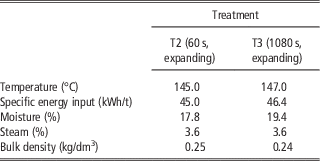
As depicted in Table 1, short- (T2, 60 s) and long-term (T3, 1080 s) conditioned and subsequently intensively expanded maize (~46 kWh/t using expander Model OEK 15.2; Amandus Kahl, Reinbek, Germany) of the same batch, respectively, was used to quantitatively replace the dried maize of the control group (T1). In T4, an additional 10% lysine supplementation (based on the assumption of 10% higher ME content after maize processing) and, if necessary, a supplementation of further essential AA to maintain the ideal protein was carried out. Technical parameters of the maize treatment are summarized in Table 1. For both experiments, conventional dried maize (S 240/ca. K 240, KWS SAAT SE, Austria) of the same batch was ground through a 2 mm sieve with a hammer mill. Afterwards, the material was steam conditioned using a paddle mixer with a total mixing time of either 60 or 1080 s at 80°C before hydrothermic processing. Unprocessed mashed maize was used as the control diet (T1). After short- and long-term preconditioning an OEK 15.2 Kahl Expander (crown gap release) was used for the hydrothermic treatment under pressure. Production rate was held constant at 1400 kg/h.
Technical parameters of the hydrothermic processing of maize

kWh/t=kilowatt hour per ton; T2: short-term conditioned and hydrothermic processed maize; T3: long-term conditioned and hydrothermic processed maize.
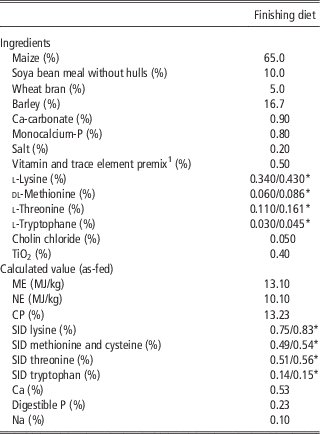
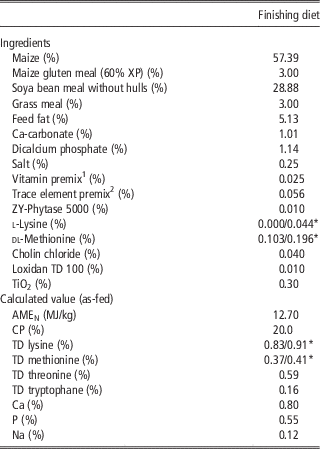
After processing, expanded maize was mixed into the diets for pigs and broilers as described in Table 2 (fattening pigs) and Table 3 (broilers). All mixtures were fed as mash. The changes in nutritional value of the maize due to hydrothermic processing were not considered, resulting in similar proportions of ingredients in each experimental diet within each species. Diets were calculated to meet or exceed recommended energy and nutrient requirements of the animals (GfE, 2006) and manufacturer recommendation (Ross 308). In T4, if necessary, the amount of essential AA was supplemented on top to reach a 10% higher essential AA content compared with the other treatments. For the determination of nutrient digestibility, titanium dioxide (TiO2) as an inert marker was used in both trials (fattening pigs: 0.4% only in the finishing diets; broilers: 0.3% in the grower and finishing diets).
Composition of finishing diets for pigs (95 to 116 kg BW)

SID=standardized ileal digestible.
T4=long-term conditioned and hydrothermic processed maize with supplementation of amino acids (*).
1 Amount per kg premix: vitamin A 1 760 000 IE; vitamin D3 391 120 IE; vitamin E (as all-rac-α-tocopheryl acetate) 11 000 mg; vitamin K3 840 mg; vitamin C 12 000 mg; vitamin B1 480 mg; vitamin B2 1200 mg; vitamin B6 (pyridoxine hydrochloride) 840 mg; vitamin B12 8400 μg; nicotinic acid 7200 mg; pantothenic acid 3000 mg; folic acid 120 mg; biotin 18 000 μg, cholin chloride 120 000 mg; iron (as iron-(II)-sulphate, monohydrate) 15 640 mg; zinc (as zinc sulphate, monohydrate) 15 640 mg; manganese (as manganese-(II)-oxide) 7800 mg; copper (as copper-(II)-sulphate, pentahydrate) 2900mg; iodine (as calcium iodate, anhydrous) 290 mg; cobalt (as alkaline cobalt-(II)-carbonate, monohydrate) 97 mg; selenium (as sodium selenite) 88 mg; antioxidants 2930 mg; calcium carbonate as carrier (21.8% calcium).
Composition of finishing diets for broilers

TD=true digestible.
T4: long-term conditioned and hydrothermic processed maize with supplementation of amino acids (*).
1 ,2Amount per kg as-fed: vitamin A 12 000 I.E.; cholecalciferol 124 μg; vitamin E (as all-rac-α-tocopheryl acetate) 50 mg; vitamin K3 4 mg; vitamin B1 3 mg; vitamin B2 7.5 mg; vitamin B6 (pyridoxine hydrochloride) 4.5 mg; vitamin B12 0.02 mg; nicotinic acid 69 mg; pantothenic acid 19.5 mg; folic acid 1.95 mg; biotin 0.12 mg; iron (as iron-(II)-sulphate, monohydrate) 67 mg; zinc (as zinc sulphate, monohydrate) 67 mg; manganese (as manganese-(II)-oxide) 100 mg; copper (as copper-(II)-sulphate, pentahydrate) 17 mg; iodine (as calcium iodate, anhydrous) 1 mg; cobalt (as alkaline cobalt-(II)-carbonate, monohydrate) 1 mg; selenium (as sodium selenite) 0.45 mg.
The pig trial was split into a two-phase fattening system, i.e. grower (up to 94.4±1 kg BW; 13.2 MJ/ME; 17.50% CP; 0.89% SID lysine as-fed) and finishing (up to 116.2±0.31 kg BW; 13.1 MJ ME; 13.23% CP; 0.75% SID lysine as-fed) phase. The feed was changed from grower to finishing diets when the average weight of the animals per pen exceeded 94.0 kg.
In the broiler study a three phase-feeding programme was applied. During the first 8 days of the experiment all chickens were fed a starter diet (12.35 AMEN; 22% CP; 1.16% SID lysine as-fed). Afterwards, a grower diet was fed for 14 days (12.80 AMEN; 21% CP; 1.05% SID lysine as-fed) and finally, up to the end of the performance study, a finishing diet (12.70 AMEN; 20% CP; 0.83% SID lysine as-fed) was fed for 14 days. Till slaughtering at day 38 the animals received their experimental diets.
Slaughter, sampling, carcass characteristics and product quality
The fattening pigs were slaughtered under standardized conditions as soon as individual BW reached 115 kg BW (mean value was 116.2±0.31 kg). Faecal samples were collected from the rectum immediately after slaughtering. Carcass characteristics and meat quality parameters were determined by trained personnel at the pig testing facility. Loin (between the 13th and 14th thoracic vertebrae) and M. semimembranosus pH at 45 min postmortem was determined with a portable temperature pH meter (Portamess, Knick, Berlin, Germany).
Both parameters, the back fat depth and loin depth were measured after 24 h chilling period at 4°C. The back fat depth of the fattening pigs was measured from the eviscerated carcass and represents the mean of three measurements: thickest section over the 1st thoracic vertebra+thinnest section over the last thoracic vertebra+thinnest section above M. gluteus medius. The loin depth was measured on a line perpendicular to the line of skin from the boundary between fat layers and M. longissimus muscle to the deep point of the muscle near the vertebrae. Furthermore after 24 h chilling period, samples of loin, between 13th and 14th rib, of each fattening pig were vacuum packed and stored (−20°C) until further analyses on meat quality (pH value, colour, cooking loss, water holding capacity, texture profile analysis).
In the broiler study, excreta samples of broilers were collected penwise during the finishing phase (day 35) to evaluate apparent total tract digestibility (ATTD). Excreta samples were stored at −20°C until further analyses. On day 38, broilers were slaughtered at the poultry research station. After 24 h at 4°C, two representative broilers (related to the median of live weight) of each pen (i.e. 12 animals per treatment) were selected to determine proportion of abdominal fat and breast meat of the broilers. Therefore the breast meat (M. pectoralis major and minor muscles) and abdominal fat was excised and weighed by skilled person. Furthermore these 48 breast tissue samples (M. pectoralis major) were used for determination of meat quality parameter measurements (pH value, colour, cooking loss, water holding capacity, fatty acid pattern, crude nutrients, texture profile analysis and antioxidative capacity).
Chemical analyses
All diets were analysed for dry matter (DM; method no. 3.1.4), crude protein (CP; method no. 4.1.1), crude fibre (CF; method no. 6.1.2), ether extract (EE; method no. 5.1.1), ether extract after acid hydrolysis (EEh; method no. 5.1.2), crude ash (CA; method no. 8.1.1), starch (method no. 7.2.1), sugar (method no. 5.1.2), and starch gelatinization (method no. 7.2.5) according to standard procedures of VDLUFA (Naumann and Bassler, Reference Naumann and Bassler2012). TiO2 was analysed according to Jagger et al. (Reference Jagger, Wiseman, Cole and Craigon1992). Briefly 0.5 g sample were digested in 25 ml concentrated sulphuric acid at 400°C for 115 min on a block digesta. Catalyst tablet was added. After removing and cooling the tubes, the volume was made up to 100 ml with distilled water. Following filtration, a 5 ml portion of each sample was taken and 1 ml 1 M sulphuric acid and 1 ml hydrogen peroxide (300 ml/l) added. The colour produced was measured at 405 nm using a Hitachi U-2001 spectrophotometer (Tokyo, Japan) and compared with that produced from a range of standard solutions made up from titanium sulphate. For the determination of the ATTD, faeces/excreta were defrosted and homogenized for DM and EEh determination. The gross energy (GE) content in feed and faeces was determined by bomb calorimetry (IKA C 200, Staufen, Germany).
Amino acid content was analysed applying the methods of Altmann (Reference Altmann1992) using HPLC after a 20 h hydroxylation process with 6 M HCl and a previous stabilization by use of tryptophan with Ba(OH)2. Separation of amino acids was made using a hyperphil ODS 250×4 mm-column after pre-column derivatization with orthophtalaldehyde.
For estimating heat damage of HTST processed maize, reactive lysine was determined photometrically by 1-fluoro-2,4-dinitrobenzene method (Booth, Reference Booth1971). Furthermore vitamin E was analysed according to Claeys et al. (Reference Claeys, Vossen and De Smet2016) in maize and broiler breast meat. Briefly 0.2 g sample of homogenized feed and lyophilized breast meat were weighed in an amber glass tube with screw cap. Six millilitres of an ethanol solution were added followed by vigorous mixing and retaining in a water bath at 78°C for 30 min, mixing the contents manually from time to time. The tubes were kept in an ice bath for at least 15 min and then centrifuged for 5 min at 750×g, followed by transferring the supernatant to another amber tube with screw cap; 2 ml of KCl (57.5 g/l) and 2 ml hexane (containing 0.02 g/l BHT) were added. The content was mixed vigorously, followed by centrifugation for 5 min at 750×g. The hexane phase was transferred to an amber vial of 1.5 ml, which was closed with a crimp cap. Analysis was always carried out immediately after extraction as well as a series of standard solutions of known concentrations of α-tocopherol using HPLC. Phosphorus was determined photometrically (U5100-spectrophotometer; Hitachi, Tokyo, Japan) using the vanado-molybdate method to measure colour intensity at 436 nm.
Total amount of carotenoids was analysed photometrically according to standard procedures of VDLUFA (method no. 12.1.1) (Naumann and Bassler, Reference Naumann and Bassler2012) while specific xanthophylls (lutein, zeaxanthin and β-cryptoxanthin) were analysed using HPLC method according to Moros et al. (Reference Moros, Darnoko, Cheryan, Perkins and Jerrell2002).
The different maize samples were extracted with diethylether and the yellowness (b value) of the extract was determined (Colour Reader CR-10; Minolta, Tokyo, Japan), which may be related to carotenoid losses in maize. All chemical analyses were performed in duplicate.
The fatty acid profile of maize, feed and lyophilized breast meat was carried out according to the one-step methylation-method of Sukhija and Palmquist (Reference Sukhija and Palmquist1988). Briefly 0.5 g of maize or feed and 0.7 g lyophilized breast samples were saponified and the fatty acids and aldehydes extracted, methylated (fatty acid methyl ester) and analysed by gas-liquid chromatography. Therefore a gas chromatograph (Agilent Technologies 7890 A GC System) was used with a FID detector and a Agilent HP-88 capillary column (100 m ×0.25 mm internal diameter, film thickness 0.2 μm), using a temperature programme of 170°C oven temperature with subsequent increase of 2°C/min until 200°C for 1 min. The column oven temperature was increased from 200°C to 230°C at 8°C/min and was held for 10 min. The detector and injector temperature was 250°C. The carrier gas was hydrogen, flowing at 35 ml/min and split 50 : 1. The peak areas were calculated for each sample qualitative and quantitatively by retention time using the Agilent ChemStation software due to reference standards and internal standardization (C:19). The total antioxidative capacity was measured photometrically by DPPH (Nishizawa et al., Reference Nishizawa, Kohno, Nishimura, Kitagawa and Niwano2005). Particle size was determined in complete diets by dry sieving as described previously (Röhe et al., Reference Röhe, Ruhnke, Knorr, Mader, Boroojeni, Lowe and Zentek2014).
The apparent faecal digestibility coefficients of DM, EEh and GE were calculated on the basis of the respective ratios of DM and crude nutrients to TiO2 in feeds and excreta/faeces using the following formula:
Apparent digestibility (%)=
 $$100{\minus}\left( {{{\displaystyle{\rm \,\%\, TiO}_{2} {\rm in \,feed}} \over \displaystyle{{\rm \,\%\, TiO}_{2} {\rm in\,faeces}\,/\,{\rm excreta}}}\atop{\times}\cr\displaystyle{{{\rm \,\%\,}\,{\rm DM}\,{\rm or}\,{\rm nutrients}\,{\rm in}\,{\rm faeces}\,/\,{\rm excreta}} \over {{\rm \,\%\,}\,{\rm DM}\,{\rm or}\,{\rm nutrients}\,{\rm in}\,{\rm feed}}}{\times}100} \right)$$
Statistical analyses
Experimental data were statistically analysed separately for each animal species by GLM procedure (SAS 6.1, Cary, NC, USA), including treatment as fixed effect in the model. In both trials the pen represents a replication in the statistical model. Outliers (data observation which was more than twofold standard deviation from the treatment group mean) were removed from the statistical evaluation. Treatment means were separated using the least-squares means statement and differences were determined using the Tukey–Kramer test. A P-value ⩽0.05 was considered as significant. Differences between P-values <0.10 and >0.05 were considered a tendency. Results are presented as least-squares means and pooled standard error of means.
Results
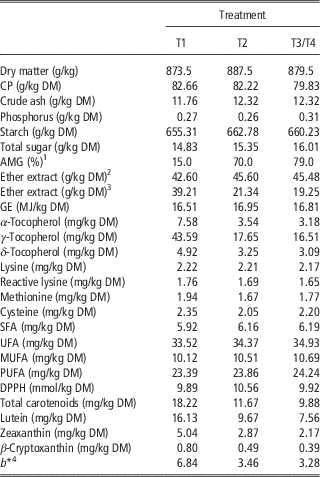
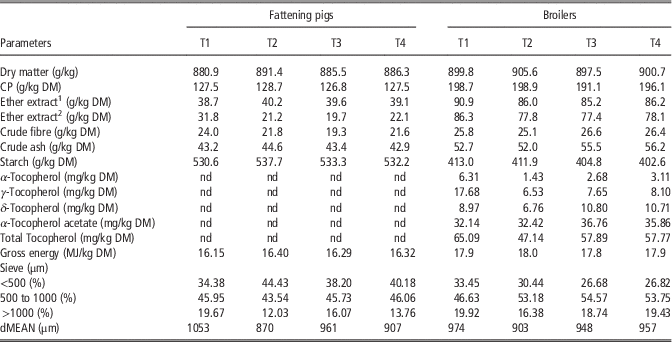
The analysed nutrient concentrations of the different maize treatments, the concentration of lysine as well as reactive lysine, the total amount of methionine and cysteine, the fatty acid composition and the content of tocopherols and amount of carotenoids and specific xanthophylls are shown in Table 4. The majority of the analysed nutrients of maize were not affected due to processing. The content of methionine and cysteine was reduced by hydrothermic maize processing. All other AA were apparently not affected after maize processing. A markedly decrease of tocopherols with an increase in conditioning time was observed and a strong increase of starch gelatinization was detected. The content of EEh did not change among treatments, but was reduced almost by half when acid hydrolysis (EE) was not applied, which corresponded to the colorimetric analysis of the EE yellowness. These observations are confirmed by markedly decreased concentration of total carotenoids and specific xanthophylls due to hydrothermic processing. However, the detection of different EE soluble substances did not affect the fatty acid profile or the antioxidative capacity. Regarding changes in the physical characteristics the bulk density of hydrothermic processed maize decreased (T1 v. T2, T3/T4: 0.62 kg/dm3 v. 0.25 kg/dm3 and 0.24 kg/dm3). The quantitative replacement of the unprocessed maize in T1 by processed maize in T2 and T3 slightly affected the nutritive value of the finishing diets as well as the discrete mean particle size. Measurements were within analytical ranges for the four treatments in both trials (Table 5), therefore meeting the nutrient recommendations. During the experimental period four animals (two in T2, one in T3, one in T4) of the pig trial and eight broilers (two in T1, three in T3, three in T4) died, without any relation to the treatments.
Nutritional and physical composition of maize treatments

SFA=saturated fatty acids; UFA=unsaturated fatty acids; MUFA=monounsaturated fatty acids; PFA=polyunsaturated fatty acids; DPPH=2,2-diphenyl-1-picrylhydrazyl.
T1: control group, unprocessed maize; T2: short-term conditioned and hydrothermically processed maize; T3: long-term conditioned and hydrothermically processed maize; T4: long-term conditioned and hydrothermically processed maize with supplementation of amino acids.
1 Amyloglucosidase – kit for starch gelatinization.
2 With acid hydrolysis.
3 Without acid hydrolysis.
4 Yellowness – colour Reader CR-10 (Minolta, Tokyo, Japan).
Analyzed nutrient content and physical characteristics of finishing diets of fattening pigs and broilers

dMEAN=discrete mean particle size; nd=not determined.
T1: control group, unprocessed maize; T2: short-term conditioned and hydrothermically processed maize; T3: long-term conditioned and hydrothermically processed maize; T4: long-term conditioned and hydrothermically processed maize with supplementation of amino acids.
1 With acid hydrolysis;
2 Without acid hydrolysis.
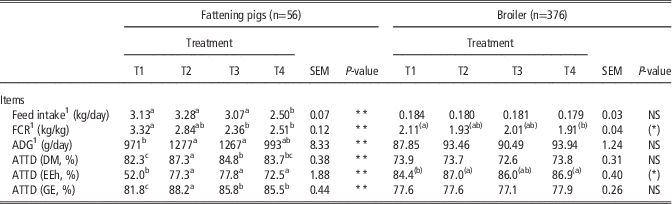
Tables 6–8 present the effects of the dietary treatment on animal performance during the finishing period, ATTD of nutrients as well as the carcass quality in both trials. For the pig trial, T1, T2 and T3 exhibited increased average daily feed intake (ADFI) compared with T4 (3.13, 3.28, and 3.07 v. 2.50 kg DM/day). In T3 and T4 the feed conversion rate (FCR) was improved in comparison to T1 (2.36 and 2.51 v. 3.32kg/kg), whereas no difference between T1 and T2 was observed (P>0.10). Higher average daily weight gain (ADG) was observed for T2, T3 and T4 compared with T1. The supplementation of AA (993 g/day) in T4 did not show any additional effect. The ATTD of dry matter was highest in T2, followed by T3, T4 and T1 (87.3%, 84.8%, 83.7% and 82.3%, respectively). Hydrothermic processing of maize also markedly increased the ATTD of EEh, which is probably related to the higher ATTD of GE.
Effect of hydrothermic treatment of maize on feed intake, feed conversion rate (FCR), average daily gain (ADG) in finishing phase and the apparent total tract digestibility (ATTD) of various nutrients

EEh=ether extract after acid hydrolysis; ATTD=apparent total tract digestibility; FCR=feed conversion ratio; ADG=average daily weight gain; GE=gross energy.
T1=control group, unprocessed maize; T2=short-term conditioned and hydrothermic processed maize; T3=long-term conditioned and hydrothermic processed maize; T4=long-term conditioned and hydrothermic processed maize with supplementation of amino acids.
a,bValues within a row with different superscripts differ significantly (P<0.05).
(a,b)Values within a row with different superscripts differ tendencially (P<0.10).
*Significant P<0.05, **highly significant P<0.01, (*) trend P<0.10, not significant NS (P>0.10).
1 Average of the finishing period.
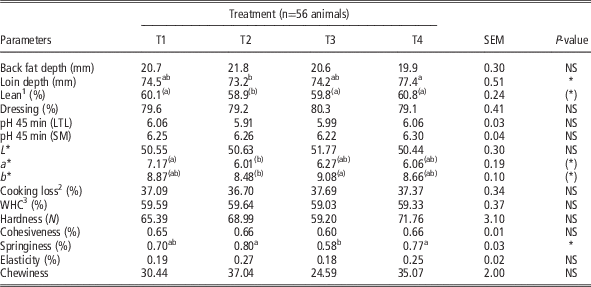
Carcass traits and quality characteristics of the loin meat of fattening pigs

WHC=water holding capacity; LTL=M. longissimus thoracis at lumbarum; SM=M. semimembranosus.
T1: control group, unprocessed maize; T2=short-term conditioned and hydrothermically processed maize; T3: long-term conditioned and hydrothermically processed maize; T4: long-term conditioned and hydrothermically processed maize with supplementation of amino acids.
a,bValues within a row with different superscripts differ significantly (P<0.05).
(a,b)Values within a row with different superscripts differ tendencially (P<0.10).
*Significant P<0.05, **highly significant P<0.01, (*) trend P<0.10, not significant NS.
1 Lean %=48.7719–0.48330×back fat depth (thinnest back fat section above M. gluteus medius)+0.23127×loin depth.
2 % Cooking loss=[(raw weight−cooked weight)/raw weight]×100.
3 WHC was calculated as: (weight after centrifugation−weight after drying)/initial weight×100.
For the broiler trial, the hydrothermic processing of maize was not as pronounced for ADFI and ADG (P>0.10) as seen in pigs. Feed conversion rate was lowest in T4 and differed from T1 (1.91 v. 2.11, P<0.10). In broiler, hydrothermic processing of maize improved ATTD of EEh (P<0.10). Apparent total tract digestibility of DM and GE were not influenced by maize processing (P>0.10).
Carcass characteristics of both trials are shown in Tables 7 and 8. Neither the hydrothermic processing nor the combination of hydrothermic processing and supplementation of AA affected the amount of back fat depth in fattening pigs (P>0.10). However, the loin depth was enhanced in T4 compared with T2 (77.4 v. 73.2 mm), whereas no difference was found between T1 and T3 (P>0.10). The percentage of lean meat in T2 was lower compared with the other treatments (T4, T1 and T3; 58.9% v. 60.8%, 60.1% and 59.8%, respectively; P<0.10).
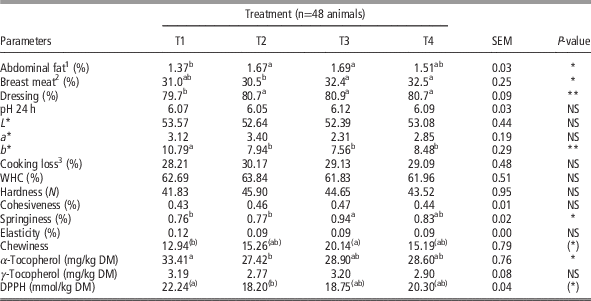
Carcass traits and quality characteristics of the breast meat of broilers

WHC=water holding capacity; DPPH=2,2-diphenyl-1-picrylhydrazyl.
T1: control group, unprocessed maize; T2: short-term conditioned and hydrothermic processed maize; T3: long-term conditioned and hydrothermic processed maize; T4: long-term conditioned and hydrothermic processed maize with supplementation of amino acids.
a,bValues within a row with different superscripts differ significantly (P<0.05).
(a,b)Values within a row with different superscripts differ tendencially (P<0.10).
*Significant P<0.05, ** highly significant P<0.01, (*) trend P<0.10, not significant NS.
1 Relative amount of abdominal fat (in % of body weight).
2 Relative amount of breast (in % of body weight).
3 % Cooking loss=[(raw weight–cooked weight)/raw weight]×100.
The broilers exhibited a lower relative amount of abdominal fat in T1 compared with T2 and T3 (1.37% v. 1.67% and 1.69%), whereas no difference to T4 was recorded (P>0.10). With regard to the relative breast meat percentage, T3 and T4 increased in amount compared to T2 (32.4% and 32.5% v. 30.5%) but did not differ from T1 (P>0.10). Hydrothermic processing of maize increased the dressing of broilers compared to T1 (79.7 v. 80.7, 80.9, 80.7% for T1, T2, T3, T4, respectively).
Quality parameter of the carcass of pigs is shown in Table 7. The loin of pigs in T2 showed the lowest redness (6.01) and yellowness (8.48). T2 differed in these parameters (P<0.10) from T1 for redness (7.17) and T3 for yellowness (9.08). The springiness of pork in T2 differed to T3 (T2 v. T3, 0.80, 0.58).
Table 8 presents the quality characteristics of the breast meat samples of the broilers. Using hydrothermically processed maize in diets for broilers reduced the yellowness of the breast muscles (10.79 v. 7.94, 7.56, 8.48 for T1, T2, T3 and T4). An increase of springiness of the breast muscles in T3 compared with T1 and T2 (0.94% v. 0.76% and 0.77%) was recorded. T3 showed a higher chewiness compared with T1 (20.14 v. 12.94; P<0.10).
The hydrothermic processing of maize reduced the content of α-tocopherol resulting in reduced total antioxidative capacity in broilers. Breast meat of T1 showed higher values compared with T2 (22.24 v. 18.20 mmol/kg DM). All other investigated parameters were unaffected when using processed maize in the diet.
Discussion
Remarks to processing steps
During the last decades, a large body of evidence pointed to the influence of hydrothermic processing of compound feed and its influence on animal performance in monogastric nutrition. The application of HTST technology for single component processing like soya bean or maize is becoming more common in the compound feed industry, for example aiming to maximize certain effects like starch gelatinization. However, influences are expected on the compound feed quality, where the single processed feed is used, for example with regard to additive effects on the nutritive value. Less is known about direct consequences on animal performance as well as on livestock product quality. Reason for that could be the animal species per se, which may provide divergent results due to their intake behaviour or physiology of the digestive tract, as observed in the present study. Other reason could be related to processing steps, that is possible degree of damage for heat sensitive nutrients, which may stay (biologically, but not economically) in contradiction to the benefits. Feed processing interactions with respect to food quality along the entire production chain are of high importance. However often data about the impact of feed processing on the resulting product quality, that is pig or poultry meat, is missing in pertinent literature.
Nutritive value of processed feeds
Several studies are presented in literature showing alterations in the nutritive value of single processed components for different animal species (Amornthewaphat et al., Reference Amornthewaphat, Lerdsuwan and Attamangkune2005; Kraler et al., Reference Kraler, Schedle, Domig, Heine, Michlmayr and Kneifel2014). Giuberti et al. (Reference Giuberti, Gallo, Cerioli and Masoero2012) measured the impact of hydrothermic processing on the chemical composition and in vitro digestibility of cereals in pigs, and came up with similar results as observed in our study. The steam flaking processed grains used in their study showed a reduced amount of EE compared with the unprocessed maize and rice. In contrast, the content of EE in barley and wheat increased after steam flaking. Tothi et al. (Reference Tothi, Lund, Weisbjerg and Hvelplund2003) analysed hydrothermic processed maize and barley by expander and subsequently pelleted maize (expander type OEE 23.1 at 105°C) for their content of EEh and did not find differences between treatments. Contents of CP, ash and starch in processed maize remain also unaffected, supporting the results of the present study. A possible reason for differences regarding EE contents with and without acid hydrolysis could be the interaction of starch and lipid, that is the formation of starch–lipid complexes, as suggested by Svihus (Reference Svihus2014). Such differences are explained by changes in gelatinisation, fragmentation and dextrinization of the starch during hydrothermic feed processing. In the study of Giuberti et al. (Reference Giuberti, Gallo, Cerioli and Masoero2012), there was a shift in the starch fractions. While comparing heat processed feeds with their raw counterparts, greater rapid digestible starch (RDS) proportions were obtained. Especially in maize, RDS increased nearly sevenfold, and in contrast, the slowly digestible and resistant starch decreased markedly. In our study the proportion of gelatinized processed maize was substantially increased compared with unprocessed maize. In addition, starch digestibility was higher for hydrothermic treated maize compared with mash, as observed by Lundblad et al. (Reference Lundblad, Issa, Hancock, Behnke, McKinney, Alavi, Prestløkken, Fledderus and Sørensen2011) for pigs and poultry. It is assumed that the degree of gelatinization until a certain amount of SME input is closely related to starch digestion.
Damage on heat labile nutrients
With regard to the potential damage on heat sensitive nutrients, data are scarce regarding the heat processing of maize and its impact on tocopherols and carotenoids as well as xanthophylls in fattening pigs and broilers. However, these substances belong to the group of antioxidants and are considered beneficial to the oxidative stability of tissues. In the present study the content of α-tocopherol of hydrothermically processed maize decreased about half, while δ-tocopherol decreased approximately one-third in comparison with unprocessed maize. In a trial of Anderson and Sunderland (Reference Anderson and Sunderland2002) the stability of vitamin C, E and astaxanthin was evaluated in extruded fish feed with very high SME input (~48 kWh/t). Vitamin C and astaxanthin were found to be fairly stable with a retention in the final product of 93% and 86%, whereas the content of vitamin E decreased by one-third. In a trial of Vaidya and Choe (Reference Vaidya and Choe2011) the heat damage of tocopherols and lutein in roasted mustard seed was highly correlated with increased oxidation of the oil.
In addition to vitamin E and carotenoids, lysine is often described as a very heat labile AA in literature. A high temperature in combination with moisture and reduced sugars provide favourable conditions for the Maillard reaction to occur. In our study there was only a numerical decrease in total and reactive lysine, although the SME input was very high, up to 46 kWh/t. However, total and reactive lysine decreased almost similarly due to heat damage. In contrast, Hejdysz et al. (Reference Hejdysz, Kaczmarek and Rutkowski2016) did not observe differences in the content of total lysine in unprocessed and extruded peas or in the content of total/reactive lysine, threonine, or methionine between unprocessed and extruded pig feed (extrusion with 22% moisture, 10 s exposure time, temperature 135±10°C and a pressure of 30 kg/cm2). The reason why almost no heat damage was observed in the present study could be the drying step before maize processing, which is prerequisite for storing stability, which may have already caused some damage.
Animal performance, nutrient digestibility in the finishing phase
Pigs and broilers responded differently to the inclusion of hydrothermically processed maize in their diets for ADFI, but similarly for FCR and ADG. This is in contrast to earlier studies, where a decrease of ADFI of fattening pigs was observed in response to expander processing (O´Doherty et al., Reference O’Doherty, McGlynn and Murphy2000; Millet et al., Reference Millet, Kumar, Boever, Ducatelle and De Brabander2012). The authors of these studies suggested that lower ADFI was caused by the higher ME content of expander processed feed, confirming observations of the present pig study. Other observations related to the altered physico-chemical properties of processed feeds were observed for pigs. Liermann et al. (Reference Liermann, Berk, Böschen and Dänicke2015) revealed that after slaughtering, agglomerated feed was present in the stomach of pigs after feeding them expanded diets (processing temperature of 113°C and 3% steam). Such observations may be a result of interactions between altered physico-chemical properties of feed like starch gelatinization, water binding capacity and viscosity. However, it does not mean that agglomerated feed is digested differently, as the swelling capacity of starch and the decreased bulk density of expanded feed using very high SME input, as in the present study, may lead to physical satiety or reduction of meal size.
Several studies show effects of processing using different processing technologies or adjustments in the processing line for a range of cereal types. For instance in an experiment of Callan et al. (Reference Callan, Garry and O’Doherty2007) the pig performance was not improved and expander processing (105°C for 5 s at 35-bar pressure) did not change digestibility of the diets. Apparent total tract digestibility of DM and GE of pigs in the present study were not affected, which is in line with observations of O’Doherty et al. (Reference O’Doherty, McGlynn and Murphy2002). Rojas and Stein (Reference Rojas and Stein2016) used pelletized, extruded (at a temperature of 115°C) or extruded and pelletized rations, which led to higher ATTD of DM and GE comparedto unprocessed diets in fattening pigs. Johnston et al. (Reference Johnston, Hines, Hancock, Behnke, Traylor, Chae and Han1999) compared standard or expander conditioned compound feed based on maize and sorghum for pigs and showed the highest GE and DM digestibility for finishing pigs fed expanded rations compared with the standard conditioned and the mash diet. In the same experiment, ADFI tended to be lower for expanded conditioned rations. In a study of Park et al. (Reference Park, Hancock, Maloney, Cao and Hines1998) conventional steam conditioning and pelleting of a wheat based diet improved FCR in fattening pigs by 2%, whereas expander processing prior to pelleting (cone pressure of 12 kg/cm2, OE 15.2) improved FCR by 7%, compared with a mash control. These results are supported by the present study, where an improvement in nutrient and energy digestibility led to an improved FCR of about 15%.
The present studies show that hydrothermic maize processing improved the digestibility of the ration for both animal species. In contrast to pigs, broilers may differentiate their feed by size, colour and form, but seldom the selection is related to the taste of the feed. Amornthewaphat et al. (Reference Amornthewaphat, Lerdsuwan and Attamangkune2005) observed lower performance of poultry after extrusion processing. The higher crude fat digestibility when using the EEh of hydrothermic processed maize in broiler agrees with data of Gracia et al. (Reference Gracia, Lázaro, Latorre, Medel, Araníbar, Jiménez-Moreno and Mateos2009), who used steam-flaked maize. It is assumed that hydrothermic processing modifies the physico-chemical structure of the feed and facilitates the access of enzymes to fat, improving its digestibility. Most of the triacylglycerols in maize grain are in the germ, inside special organelles which might be damaged by shear force during expander processing.
Influence of processing on meat quality
Improving crude fat digestibility is one possibility to improve the energy digestibility of diets. Altering the GE digestibility by processing of maize clearly impacted the carcass quality due to the higher ME available for tissue growth. The shift to higher fat proportion can be explained by improved GE digestibility, resulting in higher ME content, which led to a shift in the lysine to energy ratio and higher fat deposition in carcass (Tables 7, 8). However, detailed information about the technical adjustments carried out in compound feed processing is required to draw causal relations between processing steps and animal response, enabling one to compare different rations. However, such information is poorly available in pertinent publications. For instance, neither Kidd et al. (Reference Kidd, Corzo, Hill, Zumwalt, Robinson and Dozier2005), using extruder to process broiler diets, nor O’Doherty and Keady (Reference O’Doherty and Keady2001), using expander and extruder to process pig diets, found differences in carcass yield, amount of breast meat/loin depth and abdominal fat proportion in broiler or fattening pigs. In the trial of Liermann et al. (Reference Liermann, Berk, Böschen and Dänicke2015) carcass yield and carcass lean meat percentage remained unaffected by the hydrothermic processing of feed. Millet et al. (Reference Millet, Kumar, Boever, Ducatelle and De Brabander2012) also did not find clear effect on carcass yield, muscle or fat thickness. In the present study, considering that a higher ME would have been available after very high expander processing of maize, the supplementation of AA decreased the abdominal fat content of broilers, as observed in treatment T4 (Table 8). This means that higher ME availability after hydrothermic maize processing was not retained as fat in growing tissues, but there was a clear surplus of energy in the intermediary metabolism, combined to a lack of AA, necessary for growth.
These findings are in line with data of Durek et al. (Reference Durek, Ghadiri Khozroughi, Fröhling, Schlüter, Knorr, Mader, Goodarzi Boroojeni, Zentek, Knorr and Bolling2014). They hypothesized that the expander processing of a soy- bean–maize–wheat diet in broiler at 130°C will result in losses of AA and higher energy digestibility which impairs the protein to energy ratio and results in higher fat content in breast meat samples of broilers. Damaging antioxidant substances like carotenoids and vitamin E may influence the colour of meat from fattening pigs and broilers. Results of Cutlip et al. (Reference Cutlip, Hott, Buchanan, Rack, Latshaw and Moritz2008) demonstrate that oxidative damage occurred during hydrothermic processing, suggesting oxidation is the main reason for antioxidant losses. However, only little information is available when hydrothermic processing is considered in diet processing, especially at very high SME input. Durek et al. (Reference Durek, Ghadiri Khozroughi, Fröhling, Schlüter, Knorr, Mader, Goodarzi Boroojeni, Zentek, Knorr and Bolling2014) used ~30% maize and 25% wheat in their broiler study and found no impact of expander processing on meat colour. Contrary in our study nearly 60% maize was used which might be the reason for more meaningful results regarding the reduced meat colour. Furthermore Durek et al. (Reference Durek, Ghadiri Khozroughi, Fröhling, Schlüter, Knorr, Mader, Goodarzi Boroojeni, Zentek, Knorr and Bolling2014) concluded that the hydrothermic processing did not negatively affect broiler meat composition and further quality related parameters.
Especially effects on increased chewiness and springiness are scarce in literature. Interestingly, the effect of the hydrothermic maize processing is contrasting when springiness between pork and broiler meat is compared. The authors speculated that these observations might be the result by changes in meat fibre structure due to altered lysine to protein ratio.
Conclusion
There is a potential to improve the digestibility and animal performance using hydrothermic maize processing with very high specific mechanical energy input (as kWh/t) in pigs and broilers. It is important to consider the additional energy available after processing and to correct the ideal AA proportionally to avoid negative effects on carcass quality like higher fat proportion and lighter meat. Hydrothermic maize processing resulted in a markedly decrease of heat labile antioxidative substances, decreasing the antioxidative capacity of breast meat, which may be important for the shelf life extend. A supplementation of synthetic vitamin E might be advisable if very intensive expander processed maize is used. The reduction in yellowness of meat may be attractive for some markets, where the consumer prefers brighter meat.
Acknowledgements
The authors are thankful for the technical support and gratefully acknowledge the colleagues of the TTE and from the DÖF for valuable discussions and advice. They also thank the Technikum-team from Amandus Kahl GmbH & Co KG for their support in maize processing.