In its beginnings, psychology had a tendency to focus on psychoanalitical and behavioural approaches in explaining human behaviour and to neglect the subjective aspects of life experience. That way, it was not up to the 70s that psychology scholars started to include the study of subjective aspects of experience in their theories and research (for a detailed review, see Sirgy et al., Reference Sirgy, Michalos, Ferriss, Easterlin, Patrick and Pavot2006). More recently, positive psychology has emerged as a new current that underlines the importance of a change in the focus of psychology, from repairing problems to building positive qualities (Seligman & Csikszentmihalyi, Reference Seligman and Csikszentmihalyi2000), and research on subjective well-being has considerably expanded.
In developmental psychology, a characterization of adolescence as a conflictive developmental stage, full of risks and problems, has dominated the field for decades and led to the predominance of research devoted to the study of problematic behaviours, among others substance use and antisocial behaviours. Adolescent health was conceptualized as the absence of risk behaviours and subjective well-being and positive aspects of adolescent development were only rarely studied. In addition, preventive approaches became the norm in intervention programs.
As a reaction against this negative view of adolescence that still holds sway in our society and the mass media, the Positive Youth Development has been proposed as an alternative new perspective (Lerner, Phelps, Forman, & Bowers, Reference Lerner, Phelps, Forman, Bowers, Lerner and Steinberg2009) that, while recognising the existence of developmental challenges in adolescence, emphasizes the youth potentialities and strengths, and states that preventing youth risk behaviour is not enough to promote positive development. Accordingly, a wider range of health indicators have been incorporated to the study of adolescent mental health, including subjective well-being (Diener, Reference Diener2000; Park, Reference Park2004), and health promotion interventions based on the adolescents’ assets have been underlined as necessary complementary actions to the aforementioned preventive programs (Morgan & Ziglio, Reference Morgan, Ziglio, Morgan, Davies and Ziglio2010; Oliva et al., Reference Oliva, Ríos, Antolín, Parra, Hernando and Pertegal2010).
The current study is guided by an approach that perfectly fits with the Positive Youth Development model: salutogenesis. The aim of the salutogenic model, proposed by Antonovsky (Reference Antonovsky1987), is to determine what creates health and, especially, what factors can help an individual move toward the healthy pole of the health-disease continuum.
The salutogenic model acknowledges the importance of certain resources (among others, knowledge, social support, money and cultural capital—the so-called general resistance resources or GRRs) to cope appropriately with stressful situations and it incorporates a new disposition of paramount importance for a better understanding of health: sense of coherence (SOC).
SOC is a worldview facilitated by the GRRs and is related to the ability to use GRRs in a way that promotes effective coping with life’s demands. Specifically, SOC is defined as a global disposition that includes confidence in three areas: life events are ordered, understandable and structured (comprehensibility); the necessary resources to address life events are attainable (manageability); and life’s demands are challenges worthy of investing effort (meaningfulness). The presence of these three inextricably related components (comprehensibility, manageability and meaningfulness) results in a strong SOC, which, in turn, facilitates successful coping with everyday life stressors and satisfactory adaptation (Antonovsky, Reference Antonovsky1987), even in the face of adversity (e.g., Braun-Lewensohn, Sagy, & Roth, Reference Braun-Lewensohn, Sagy and Roth2011).
An increasing amount of research indicates that individuals with a strong SOC tend to have better health and quality of life. However, although a review of more than 500 works on this topic points in that direction (Eriksson & Lindström, Reference Eriksson and Lindström2006, Reference Eriksson and Lindström2007), it is necessary to deepen the analysis of the relationships between SOC and various health components. For instance, one of the problems that arises in the study of quality of life is that the vast majority of research has focused on clinical samples, usually patients with a specific disease condition (Eriksson & Lindström, Reference Eriksson and Lindström2007). Moreover, several studies seem to hint that the association between SOC and the physical components of health may be weaker than the relationship between SOC and psychological health (e.g. Schnyder, Büchi, Mörgeli, Sensky, & Klaghofer, Reference Schnyder, Büchi, Mörgeli, Sensky and Klaghofer1999), but this subject would benefit from more research. Furthermore, in-depth analyses of the potential interactions between SOC and demographic variables, such as gender and age, are needed (Eriksson & Lindström, Reference Eriksson and Lindström2006).
In adolescence, a strong SOC is associated with a healthy lifestyle (Mattila et al., Reference Mattila, Rautava, Honkinen, Ojanlatva, Jaakkola, Aromaa and Sillanpaa2011), whereas a low SOC tends to be related to unhealthy habits, such as skipping breakfast, alcohol use and positive attitudes towards drug consumption (Myrin & Lagerström, Reference Myrin and Lagerström2006). In addition, SOC has shown positive associations with health and well-being in adolescents from different countries (Lindström & Eriksson, Reference Lindström and Eriksson2010).
Nevertheless, the aforementioned unresolved questions in the study of SOC and health in general population apply particularly in the study of SOC in adolescents. In fact, research on this developmental stage has been comparatively scarce, and the various aspects of health have received unequal attention. Hence, most studies on SOC and health in adolescence have focused on psychosomatic complaints, providing extensive evidence that psychosomatic complaints are less frequent in adolescents with a strong SOC (Moksnes, Rannestad, Byrne, & Espnes, Reference Moksnes, Rannestad, Byrne and Espnes2010; Simonsson, Nilsson, Leppert, & Diwan, Reference Simonsson, Nilsson, Leppert and Diwan2008; Torsheim, Aaroe, & Wold, Reference Torsheim, Aaroe and Wold2001). Similarly, the relationship between SOC and quality of life has frequently been studied in adolescence, but, as in the case of adult populations, studies have focused on samples of patients with specific diseases (Nio, Reference Nio2010; Räty, Larsson, & Söderfeldt, Reference Räty, Larsson and Söderfeldt2003). Finally, it is difficult to find studies that include SOC and self-rated health (Honkinen, Suominen, Välimaa, Helenius, & Rautava, Reference Honkinen, Suominen, Välimaa, Helenius and Rautava2005), and the relationship between SOC and life satisfaction in adolescence has not been directly studied.
Additionally, the interactions between SOC and demographic variables have not yet been explored. This omission may be attributed to the contradictory results obtained for the effects of gender and age on adolescent SOC (for a detailed review, see Rivera, García-Moya, Moreno, & Ramos, Reference Rivera, García-Moya, Moreno and Ramos2013). Thus, when gender differences have been identified in a studied health component, researchers have typically opted for separate analyses of boys and girls (e.g. Koushede & Holstein, Reference Koushede and Holstein2009; Simonsson et al., Reference Simonsson, Nilsson, Leppert and Diwan2008).
Finally, increasing attention has been paid to SOC in international publications from 1985 to 2010 (Lindström & Eriksson, Reference Lindström and Eriksson2010), but research on SOC in Spain remains scarce (Rivera, Ramos, Moreno, & Hernán, Reference Rivera, Ramos, Moreno and Hernán2011) due to the delayed incorporation of SOC into Spanish research, as indicated by the publication of the first article on this topic in 1997.
The state of the art described in the preceding paragraphs illustrates the relevance of research on SOC and health among Spanish adolescents and the need to deepen the analysis of the relationships between SOC and health in adolescence. Therefore, the aims of this study are to analyse the effect of gender and age on Spanish adolescents’ SOC and to explore the relationships between SOC and several health components in adolescence while taking into account the potential moderating effect of demographic variables. This process will produce an assessment and comparison on the magnitude of the relationships between SOC and the main components of biopsychosocial health: self-rated health, somatic complaints, psychological complaints, health-related quality of life and life satisfaction.
Method
Participants
A representative sample of Spanish adolescents was selected as part of the 2010 edition of the WHO international survey Health Behavior in School-aged Children (HBSC) in Spain by means of a random multi-stage sampling stratified by conglomerates that took into account geographic area, type of school and educational level. The international protocol dictates the selection of adolescents aged 11, 13 and 15, but the Spanish part of the study also included the pair ages and the 17-18 year-olds to obtain a more complete sample of adolescents. In the current study, the sample consisted of 7,580 adolescents (3,672 boys and 3,908 girls) aged 13 to 18, with a mean age of 15.41 years. Younger adolescents were not included because the assessment of SOC was not part of the questionnaire for 11–12 year-olds.
Measures
Measures were selected from the HBSC 2010 Spanish questionnaire, an instrument that has been approved by the Experimentation Ethical Committee of the University of Seville, indicating that it complies with all ethical requirements for human research in Spain and the European Union.
The following content was selected based on the objectives of this study:
Demographic variables
Gender and age of the adolescents. Three different age groups were considered: 13–14 years old, 15–16 years old and 17–18 years old.
SOC
The SOC–29 (Antonovsky, Reference Antonovsky1987) was employed for the assessment of SOC. This instrument consists of 29 items answered on a 7-point Likert scale. This instrument has shown good reliability and validity in several countries (Antonovsky, Reference Antonovsky1993; Eriksson & Lindström, Reference Eriksson and Lindström2005). The scale provides a global SOC score as well as separate scores for each component (comprehensibility, manageability and meaningfulness). Antonovsky (Reference Antonovsky1993) stated that although the three components of SOC are conceptually different, they are inextricably related, thereby suggesting the use of a global score. This recommendation has been followed in the present work, in which Cronbach’s alpha was .87. In addition, to use SOC as an independent variable, adolescents were classified into three groups according to their global SOC score. The cut-off points were based on tertiles, a frequently used strategy in previous studies with adolescent samples (e.g. Honkinen et al., Reference Honkinen, Suominen, Välimaa, Helenius and Rautava2005; Koushede & Holstein, Reference Koushede and Holstein2009) due to the lack of validated cut-off points to distinguish high, medium and low levels of SOC. Given that differences in the original scores (ranging from 1 to 7 points) are not straightforward to interpret, identifying three subgroups facilitates meaningful comparisons among participants according to their SOC.
Finally, the health variables employed in this study represent the main components of biopsychosocial health, as shown by the fact that they have been used as indicators of a composite factorial score on global health that has shown to be appropriate for adolescents from several countries (Ramos, Moreno, Rivera, Gaspar, & Morgan, Reference Ramos, Moreno, Rivera, Gaspar and Morgan2012). Specifically, the following internationally well-known measures of physical and psychological aspects of health were employed:
Self-rated health
This is a subjective measure of health status that is based on adolescents’ perception and assessment of their own health. Specifically, the question is, Would you say your health is…? The answer values are Poor, Fair, Good or Excellent, coded on a scale from 1 to 4. The self-rated health scale is a well-established measure of perceived health, and its usefulness has been proven in large epidemiological surveys (Idler & Benyamini, Reference Idler and Benyamini1997).
Somatic and psychological complaints
These variables were assessed by means of the HBSC Symptom Checklist (King, Wold, Tudor-Smith, & Harel, Reference King, Wold, Tudor-Smith and Harel1996), a non-clinical measure of physical and mental health that assesses the frequency of psychosomatic symptoms in the last 6 months. This is an 8-item scale that has been validated in adolescent samples and provides separate information about two interrelated components (Haugland & Wold, Reference Haugland and Wold2001), psychological complaints (feeling nervous, feeling low, irritability and sleeping difficulties) and somatic complaints (headache, abdominal pain, backache and dizziness). The score ranges from 1 to 5, with higher scores representing a higher frequency of the evaluated type of complaint. In the current study, Cronbach’s alpha for the dimensions psychological and somatic complaints were .78 and .71, respectively.
Health-related quality of life
The Kidscreen-10 Index (Ravens-Sieberer & The European Kidscreen Group, Reference Ravens-Sieberer2006) was used to assess quality of life. The Kidscreen-10 Index is an internationally known 10-item instrument that has been included in the Eurobarometer as an indicator of child and adolescent mental health. Scores range from 10 to 50, with higher scores indicating higher levels of health-related quality of life. Cronbach’s alpha in this study was .81.
Life satisfaction
The Cantril Ladder (Cantril, Reference Cantril1965) was used to obtain adolescents’ global assessments of their own life satisfaction. The scale ranges from 0 to 10, with 10 representing the highest level of life satisfaction.
Procedure
Participants completed the questionnaires using computers connected to the Internet in one-hour sessions that took place during school hours in the educational centres and their anonymity was ensured. The use of the computer-assisted system allowed the automatic incorporation of the students’ answers into the survey database, thereby avoiding potential human errors as part of the data computerisation process.
For the statistical analysis, factorial ANOVA by means of an univariate general linear model was used in the analysis of the effects of demographic variables on SOC. Specifically, a complete factorial model was estimated, including the analysis of all direct effects and the possible interaction effects among the examined variables. In addition to the signification values, each effect was interpreted according to the effect size, represented by its partial eta square on the basis of the following criteria: negligible effect (lower than .01), small effect (from .01 to .059), medium effect (from .06 to .149) and large effect (higher than .15). If the variables showed a significant effect size, Bonferroni post-hoc multiple comparisons were calculated to identify the pairs of conditions in which the significant differences appeared. Finally, the magnitude of the differences between mean pairs was assessed by means of Cohen’s d and the following criteria for social sciences (Cohen, Reference Cohen1977) were used: negligible effects (lower than 0.19), small effects (from 0.20 to 0.49), medium effects (from 0.50 to 0.79) and large effects (higher than 0.80). Additionally, according to Wolf (Reference Wolf1986), d values higher than 0.50 can be interpreted as practically and clinically significant effects.
In the study of the relationships between SOC and health components, Pearson-r correlations were used to analyse the associations among all the variables examined. Employing the recommended criteria for behavioural sciences (Cohen, Cohen, West, & Aiken, Reference Cohen, Cohen, West and Aiken2003), correlations were considered small (around .10), moderate (around. 30) or large (.50 or higher). Aftewards, multivariate analysis of variance (MANOVA) was used to analyse the relationships among demographic variables, SOC and the five health variables, given that the dependent variables had been found to be significantly correlated. This analysis followed similar steps to those described for the univariate linear model.
Results
The presentation of the results will be divided in two separate subsections, each corresponding to one of the objectives of this study.
Demographic variables and SOC
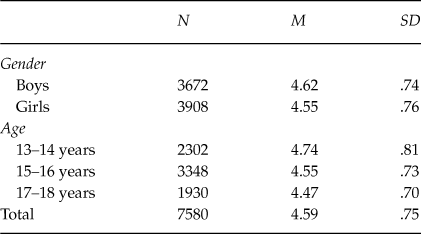
Table 1 shows SOC descriptive statistics by gender and age.
Descriptive statistics of SOC according to gender and age

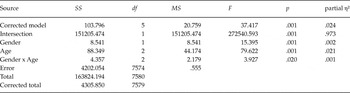
Results from the general linear model (see Table 2) indicate that the model had a low level of explanatory ability (p < .001, R 2 =.024). Among the analysed factors, only age had a significant and noticeable effect on adolescents’ SOC (p < .001, partial η² = .021). Specifically, adolescents aged 13–14 years reported significantly higher levels of SOC than adolescents aged 15–16 and 17–18 (p < .001). In both cases, the effect size associated with these differences was small (d = 0.25 and d = 0.36, respectively).
General linear model of demographic variables on SOC

Effects of SOC and demographic variables on several health components
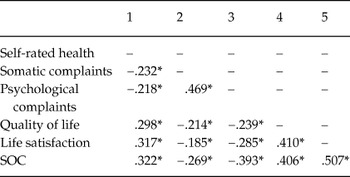
As a first step, correlations among the health measures and SOC were examined (see Table 3). This analysis showed moderate to high correlations of SOC with health measures as well as significant small to moderate correlations among the five examined health variables.
Pearson-r correlations among SOC and health variables

*p < .001
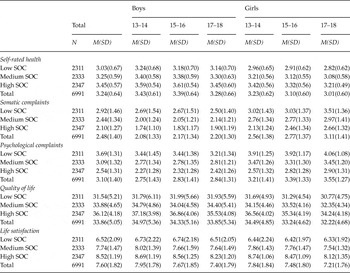
Table 4 summarises the means and standard deviations for every health component depending on the level of SOC. Information is provided on the entire sample as well as separately for boys and girls in the different age groups.
Descriptives of health in adolescents with low, medium and high SOC

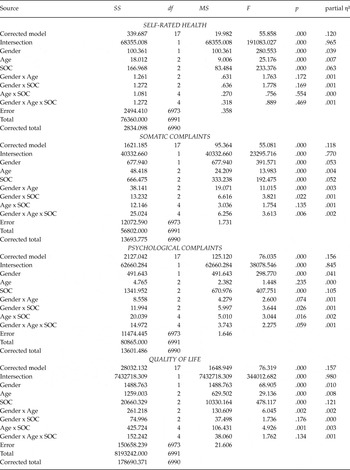
The results of MANOVA are presented in Table 5. As shown in Table 5, the model for self-rated health was significant (p < .001), reaching a level of explanation of 12% (R 2 =.120). The model indicates that SOC was associated with significant differences with a moderate effect size in self-rated health (p < .001, partial η² = .063). Specifically, as shown in Table 4, self-rated health for low-SOC adolescents was significantly lower than for adolescents with a medium SOC (p < .001), who, in turn, reported lower self-rated health than adolescents with a high SOC (p < .001). These differences had small effect sizes (d = 0.35 and d = 0.34, respectively), whereas the differences in self-rated health between adolescents with low and a high SOC had a moderate effect size (p < .001, d = 0.68). The interaction effects between demographic variables and SOC were not significant. However, a small effect of gender was found; self-rated health was slightly higher for boys than for girls (p < .001, partial η² = .039).
MANOVA of demographic variables and SOC on different health components

For somatic complaints, a significant model was obtained that explained 11.8% of the variability in the frequency of somatic symptoms (p < .001, R 2 =.118). SOC showed a significant association with a small effect size with the frequency of somatic symptoms (p < .001, partial η² = .052). Specifically, significant differences were found between the three levels of SOC (p < .001). The effect sizes associated with these differences were small between adolescents with low and medium SOC (d = 0.34) and medium and high SOC (d = 0.26). In addition, a moderate effect was found for the comparison between adolescents with low and high SOC (d = 0.60), with the former reporting a significantly higher frequency of somatic complaints than the latter. Interaction effects between SOC and demographic variables were non-significant or negligible according to effect size. In contrast, a small effect of gender was found (p < .001, partial η² = .053), with girls reporting a significantly higher frequency of somatic symptoms than boys.
With respect to psychological complaints, a significant model was obtained that accounted for 15.6% of the variability of adolescents’ reports (p < .001, R 2 = .156). SOC was the most influential variable (p < .001, partial η² = .105). In fact, all comparisons among the levels of SOC were significant (p < .001), implying a lower frequency of psychological complaints in adolescents with higher SOC. The effect size was moderate between low-SOC and medium-SOC adolescents (d = 0.46) and between medium-SOC and high-SOC adolescents (d = 0.42). In the case of differences between adolescents with a low SOC and those with high SOC levels, the effect size was large (d = 0.88). Non-significant or negligible interaction effects were found, although gender had a small direct effect on psychological complaints; girls reported a higher frequency of these symptoms than boys (p < .001, partial η² = .041).
The model obtained to explain health-related quality of life was significant and accounted for 15.7% of the variability (p < .001, R 2 =.157). SOC had a significant moderate effect on adolescents’ quality of life (p < .001, partial η² = .121). Thus, higher SOC was associated with higher levels of quality of life (see Table 4), with all comparisons between pairs being significant (p < .001). The effect size of these differences was moderate in adolescents with low SOC compared to adolescents with medium SOC (d = 0.47) as well as between adolescents with medium SOC and high SOC (d = 0.51). Between adolescents with low SOC and high SOC, the effect size was large (d = 0.98). Finally, non-significant or negligible interaction effects between SOC and demographic variables were found, although gender had a small effect on quality of life, which was slightly higher for boys than for girls (p < .001, partial η² = .010).
For life satisfaction, a significant model was obtained that accounted for a higher proportion of variability than in the previous health components (p < .001, R 2 =.213). As shown in Table 4, higher SOC was associated with higher life satisfaction, with a large effect size (p < .001, partial η² = .185). In fact, the differences between the three examined levels of SOC were significant (p < .001), with a moderate effect size between low-SOC and medium-SOC adolescents (d = 0.69) and between medium-SOC adolescents and high-SOC adolescents (d = 0.59). The magnitude of the differences was large between adolescents with high SOC and those with low SOC (d = 1.22). The interaction effects between demographic variables and SOC were not significant or had a non-meaningful effect size. Gender did not show a meaningful effect on life satisfaction either (partial η² = .001).
Discussion
One of the objectives of this study was to analyse whether significant differences associated to gender and age appeared in the Spanish adolescents’ SOC. With respect to this issue, little differences were found; only age had a significant, but small, effect. Specifically, SOC was higher for adolescents aged 13–14 than for those 15 years or older. This result coincides with several previous studies that seem to suggest the existence of a transitory decline of SOC around middle and late adolescence (Natvig, Hanestad, & Samdal, Reference Natvig, Hanestad and Samdal2006; Nilsson, Starrin, Simonsson, & Leppert, Reference Nilsson, Starrin, Simonsson and Leppert2007), which may be related to the changes and developmental tasks that characterise this stage, including among others adolescents’ increasing cognitive abilities and changes associated with personal identity development.
With regard to the study of the relationships between SOC and various health components, the present work confirms the existence of important associations between SOC and health (Eriksson & Lindström, Reference Eriksson and Lindström2006). Specifically, higher SOC tended to be associated with better self-rated health, a lower frequency of somatic and psychological complaints and higher quality of life and life satisfaction.
A comparative analysis of the magnitude of the aforementioned relationships showed moderate to large effects of SOC on life satisfaction, quality of life and frequency of psychological symptoms. In contrast, the associations of SOC with self-rated health and physical complaints were lower in magnitude, with small to moderate effect sizes. This finding seems to support the hypothesis that the association between SOC and psychological aspects of health is stronger than the association with the physical aspects of health (Lindström & Eriksson, Reference Lindström and Eriksson2010; Schnyder et al., Reference Schnyder, Büchi, Mörgeli, Sensky and Klaghofer1999).
Furthermore, the results suggest noticeable consistency in the relationship between SOC and all health components in adolescent boys and girls from all of the examined age groups. Thus, although the well-documented gender inequalities in health appeared in the analysis of self-rated health, psychosomatic complaints and, to a lesser extent, quality of life (Bisseger et al., Reference Bisseger, Cloetta, von Rueden, Abel and Ravens-Sieberer2005; Cavallo et al., Reference Cavallo, Zambon, Borraccino, Ravens-Sieberer, Torsheim and Lemma2006), the effect of SOC on the various health components was homogeneous among all of the adolescents, regardless of gender and age. An indication of this homogeneity was the absence of significant interaction effects between demographic variables and SOC, which was found for all of the examined health components (self-rated health, somatic complaints, psychological complaints, health-related quality of life and life satisfaction).
These results reinforce the idea that SOC does not have the tentative and unstable character during adolescence that was initially attributed to it (Antonovsky, Reference Antonovsky1987). On the contrary, SOC seems to act as a useful predictor of health in adolescence, as supported by its associations with positive health outcomes, which have been considered similar to those described in adult populations (Eriksson & Lindström, Reference Eriksson and Lindström2006; Torsheim et al., Reference Torsheim, Aaroe and Wold2001).
Some limitations must be considered in the interpretation of the results of this work. The main limitation involves the cross-sectional design of the study, which does not allow us to draw conclusions about the direction of the examined relationships or to identify causal relationships between the variables. Furthermore, the unavailability of validated cut-off points to distinguish between high, medium and low levels of SOC may be seen as a methodological weakness. However, the use of cut-off points derived from tertiles is supported in the present study by a large and representative sample of Spanish adolescents, which supports the applied cut-off points and the results obtained by their application.
Despite the aforementioned limitations, this work contributes significantly to broadening existing knowledge on the relationships between SOC and health in several ways. First, this study specifies the nature of the relationships between SOC and health through an analysis and comparison of the relationships between SOC and the main components of biopsychosocial health: self-rated health, somatic complaints, psychological complaints, health-related quality of life and life satisfaction. Second, this study represents a first step in the analysis of a pending question in research on SOC and health: the possible interaction effects between SOC and demographic variables (Eriksson & Lindström, Reference Eriksson and Lindström2006). To our knowledge, this work is also the first to study the relationship between SOC and quality of life in a normative sample of adolescents, and it is a pioneering work in the study of the relationship between SOC and life satisfaction in adolescence, making valuable contributions to future research aimed at expanding knowledge on these topics. Finally, this study represents an important contribution to the study of SOC in Spain, where research about SOC has been scarce.
The HBSC study in Spain was supported by an agreement signed between the Ministerio de Sanidad, Política Social e Igualdad and the Universidad de Sevilla. In addition, this work is supported by the Ministerio de Educación through the National Program FPU [grant number: AP2009–0978].