1. Introduction
Over the last four decades, the question of central bank credibility has been extensively studied by the literature on monetary policy. It has also become a major concern for many central bankers around the world, which have taken a number of measures to enhance the credibility of monetary policy. Building central bank credibility was especially strong in countries under inflation-targeting regimes, but this phenomenon was not restricted to these countries. This is not surprising, given the role that expectations have in most macroeconomic models, wherhe set of instruments is up to two lags of the consensus forece credibility serves as a way of anchoring inflation expectations.
A main problem of measuring credibility is the fact that it is elusive and different authors have proposed different measures of it. Despite that, there is a consensus in the literature that Blinder (Reference Blinder2000) offers an uncontroversial definition of credibility when he states that “A central bank is credible if people believe it will do what it says.” It is very hard to argue against such a definition of credibility, being the reason why it became so popular among central bankers and academics alike.
This paper proposes a measure of credibility that is based upon this definition. A main challenge to implement it is that one needs a measure of people’s beliefs, of what central banks say they do, and a way to compare whether the two are the same.
We approach this problem in a novel way. We focus on inflation expectation data alone, noting that inflation is arguably the main variable central banks care about. One advantage of employing expectation-survey data is that they are available for different countries and their properties have been increasingly studied. Moreover, many of these countries are users of inflation-targeting regimes. So, they provide explicit targets for inflation. Even for countries that do not employ inflation-targeting regimes there is usually a tacit agreement on what the inflation target should be. Therefore, the techniques proposed here can be broadly applied elsewhere.
The core idea in this paper is as follows. We measure people’s beliefs by using survey data on inflation’s expectationsFootnote 1 , employing the panel-data approach of Gaglianone and Issler (Reference Gaglianone and Issler2021). This allows filtering from the survey the conditional expectation of inflation using common information, which is used to represent people’s beliefs or market expectations. We also extend the approach in Gaglianone and Issler by showing how to construct 95% robust—heteroskedasticity and autocorrelation consistent (HAC)—asymptotic confidence intervals for people’s beliefs, which is then used to compare beliefs with explicit (or tacit) inflation targets. Whenever the target falls into this interval, we consider the central bank credible. We consider it not credible otherwise.
Our contribution to literature on the credibility of central banks is holistic. We advance with respect to Blinder (Reference Blinder2000) by making his definition of credibility operational by the use of econometric methods. We advance with respect to Gaglianone and Issler (Reference Gaglianone and Issler2021) by deriving the asymptotic variance of the estimate of the conditional expectation of inflation, based on common information. Once this is done, we use the resulting framework to implement Blinder’s statement on credibility of central banks using econometric tools. This entails, proposing a new test for credibility and a new index to measure credibility, but there is also a broader methodological contribution of putting all the pieces together, making it sensible.
Of course, there has been active research in the area of credibility, especially in this millennium. Regarding measurement, a pioneering work is due to Svensson (Reference Svensson1993), who proposed a simple test to check whether the inflation target is credible in the sense that market agents believe that future inflation will fall within the target range. A number of articles followed, trying to construct credibility measures and credibility indices in the last two decades; see Bomfim and Rudebusch (Reference Bomfim and Rudebusch2000), Cecchetti and Krause (Reference Cecchetti and Krause2002), De Mendonça and de Guimarães e Souza (Reference De Mendonça and G. J.2007), De Mendonça and de Guimarães e Souza (Reference De Mendonça and de Guimarães e Souza2009), Levieuge et al. (Reference Levieuge, Lucotte and Ringuedé2016), Bordo and Siklos (Reference Bordo and Siklos2015), inter alia. We discuss some of this papers below.
Compared to this literature, our contributions are as follows: (i) we measure beliefs properly. In most of the literature, people’s beliefs are not correctly estimated, since the literature employs the survey consensus (cross-sectional average of inflation expectations) as a measure of beliefs. However, it has been widely shown that the consensus is a biased estimate of beliefs; (ii) we do not use ad hoc confidence intervals. Most of these papers propose the use of ad hoc confidence bands in making comparisons between beliefs and targets. Even if these confidence bands are appropriate for a given country in a specific point in time, they may not be appropriate for a different country and/or for a different point in time in the same country; (iii) our approach can be extensively applied. It is straightforward to use it for countries under an inflation-targeting program, but it extends naturally to other countries in which a tacit target is present.
We apply our approach to study the credibility of the Brazilian Central Bank (BCB) by using the well-known Focus Survey of forecasts, kept by the BCB on inflation expectations. This choice is not merely geographic for us. The Focus Survey is a world-class database that has been featured in different studies, Carvalho and Minella (Reference Carvalho and Minella2012), Gaglianone et al. (Reference Gaglianone, Issler and Matos2017), Marins and Vicente (Reference Marins and Vicente2017), and Gaglianone et al. (Reference Gaglianone, Giacomini, Issler and Skreta2021), to name a few, and is fed daily by institutions that include commercial banks, asset management firms, consulting firms, non-financial institutions, etc.
We estimate market expectations on a monthly basis using the 12 months ahead conditional expectation of inflation based on common information, coupled with an estimate of its robust asymptotic variance and their respective 95% HAC confidence interval. Our estimates cover the period from January 2007 until April 2017. This is compared to the target in the Brazilian Inflation Target Regime. Results show that the BCB was credible 65% of the time, with the exception of a few months in the beginning of 2007 and during the interval between mid-2013 throughout mid-2016.
We also constructed a credibility index for this period and compared it with alternative measures of credibility previously proposed in the literature by Cecchetti and Krause (Reference Cecchetti and Krause2002), De Mendonça and de Guimarães e Souza (Reference De Mendonça and de Guimarães e Souza2009), De Mendonça and de Guimarães e Souza (Reference De Mendonça and G. J.2007), and Levieuge et al. (Reference Levieuge, Lucotte and Ringuedé2016). Although our index has a similar dynamic behavior when compared to the indices of De Mendonça and de Guimarães e Souza (Reference De Mendonça and G. J.2007) and Levieuge et al. (Reference Levieuge, Lucotte and Ringuedé2016), they differ on important episodes where the BCB lost credibility. While ours show that credibility was lost, theirs do not show such behavior.
The remainder of this paper is organized as follows. Section 2 discusses the existing literature on central bank credibility. Section 3 summarizes the main results in Gaglianone and Issler (Reference Gaglianone and Issler2021) to identify beliefs, provides a step-by-step description of our robust covariance matrix estimation procedure, and develops a new credibility index for central banks based on these ideas. Also, a more complete discussion of our credibility test and index is contained in Section 3. The Online Appendix also covers the contents of Section 3 in detail. Section 4 presents the empirical results evaluating the credibility of the BCB in recent years. Section 5 concludes.
2. The literature on central bank credibility
The issue of whether it is better for the policymaker to operate with pure discretion and poor accountability or to commit to a policy has long been a central question for monetary economics. Kydland and Prescott (Reference Kydland and Prescott1977) showed that a regime where policymakers have to commit is preferable to a regime that allows policymakers discretion. The main idea behind the dynamic optimization argument is that expectations play a central role in macroeconomic dynamics, since economic agents choose their current actions based on the best possible forecasts of future outcomes given available information.
Several central banks have adopted a more systematic approach to maintain price stability since the early 1990s, particularly under an inflation-targeting regime as a method of commitment, explicitly acknowledging that low and stable inflation is the goal of monetary policy, retaining constrained discretion, as argued by Bernanke and Mishkin (Reference Bernanke and Mishkin1997). At the same time, the theoretical debate in favor of monetary policy rules gained traction with Taylor (Reference Taylor1993).
The evolution and improvement of the monetary policy institutional framework is related to better economic outcomes in empirical studies. Many articles in the literature [e.g., Rogoff (Reference Rogoff1985), Alesina (Reference Alesina1988), Grilli et al. (Reference Grilli, Masciandaro and Tabellini1991), Alesina and Summers (Reference Alesina and Summers1993), and Cukierman (Reference Cukierman2008)] show that independent, transparent, accountable, and credible central banks are able to deliver better outcomes. Cecchetti and Krause (Reference Cecchetti and Krause2002) study a large sample of countries and find that credibility is the primary factor explaining the cross-country variation in macroeconomic outcomes. Carriere-Swallow et al. (Reference Carriere-Swallow, Gruss, Magud and Valencia2016) find evidence that price stability and greater monetary policy credibility are important determinants of exchange rate pass-through in a sample of 62 emerging and advanced economies.
Agents’ expectations regarding central bank policy are directly tied to the concept of credibility. In a clean and uncontroversial statement about how these two connect, Blinder (Reference Blinder2000) argues that “A central bank is credible if people believe it will do what it says”Footnote 2 . The definition of central bank credibility in the literature is usually related to a reputationFootnote 3 built based on strong aversion to inflationFootnote 4 or a framework that is characterized by an explicit contract with incentive compatibilityFootnote 5 or a commitment to a rule or a specific and clear objective.
Svensson (Reference Svensson1993) was the first to propose a test to monetary policy credibility, in the sense that market agents believe that future inflation will be on target. He proposes to compare ex-post target-consistent real interest rates with market real yields on bonds. In the case where the central bank has an explicit inflation target, Svensson (Reference Svensson2000) proposes to measure credibility as the distance between the expected inflation and the target.
Bomfim and Rudebusch (Reference Bomfim and Rudebusch2000) suggest another approach, measuring overall credibility by the extent to which the announcement of a target is believed by the private sector when forming their long-run inflation expectations. Specifically, they assume that the expectation of inflation at time
 $t$
, denoted by
 $\pi ^{e}_t$
, is a weighted average of the current target, denoted by
 $\overline \pi _t$
, and last period’s (12 months) inflation rate, denoted by
 ${\pi }_{t-1}$
:
 \begin{equation} \pi ^{e}_{t} = \lambda _t \overline \pi _t + (1-\lambda _t){\pi }_{t-1}. \end{equation}
The parameter
 $\lambda _t$
, with (
 $0\lt \lambda _t\lt 1$
), measures the credibility of the central bank. If
 $\lambda _t=1$
, there is perfect credibility, and private sector’s long-run inflation expectations will be equal to the announced long-run goal of the policymaker. If
 $\lambda _t=0$
, there is no credibility and intermediate values of
 $\lambda _t$
represent partial credibility.
Following Bomfim and Rudebusch (Reference Bomfim and Rudebusch2000), Demertzis et al. (Reference Demertzis, Marcellino and Viegi2008) model inflation and inflation expectations using a VAR, based on the fact that the two variables are intrinsically related. When the level of credibility is low, inflation will not reach its target because expectations will drive it away, and expectations themselves will not be anchored at the level the central bank wishes. They apply their framework to a group of developed countries and compute an anchoring effect based on
 $\lambda _t$
.
Cecchetti and Krause (Reference Cecchetti and Krause2002) construct an index of policy credibility that is an inverse function of the gap between expected inflation and the central bank’s target level, taking values from 0 (no credibility) to 1 (full credibility). The index is defined as follows:
 \begin{equation*} I_{CK}= \begin {cases} 1 & \text {if } \pi ^e \leq \overline {\pi }_t \\[5pt] 1-\dfrac {\pi ^e-\overline \pi _t}{20\%-\overline {\pi }_t} & \text {if } \overline {\pi }_t \leq \pi ^e \leq 20\% \\[5pt] 0 & \text {if } \pi ^e \geq 20\% \end {cases}, \end{equation*}
where
 $\pi ^e$
is the expected inflation and
 $\overline \pi _t$
is the central bank target. Between
 $0$
and
 $1$
the value of the index decreases linearly as expected inflation increases. The authors define 20% as an ad hoc upper bound
Footnote
6
.
Levieuge et al. (Reference Levieuge, Lucotte and Ringuedé2016) consider an asymmetric measure of credibility based on the linear exponential (LINEX) function, as follows:
 \begin{equation*} I_{L}=\frac {1}{exp( \phi (\pi ^e-\overline \pi )) - \phi (\pi ^e-\overline \pi )},\ \mathrm {for\ all}\ \pi ^e, \end{equation*}
where
 $\pi ^e$
is the inflation expectations of the private sector,
 $\overline \pi$
is the inflation target and, for
 $\phi =1$
, positive deviations (
 $\pi ^e\gt \overline \pi$
) will be considered more serious than negative deviations (
 $\pi ^e\lt \overline \pi$
) as the exponential part of the function dominates the linear part when the argument is positive. As the previous indices, when
 $I_{L}=1$
the central bank has full credibility and when
 $I_{L}=0$
there is no credibility at all.
Bordo and Siklos (Reference Bordo and Siklos2015) propose a comprehensive approach to find cross-country common determinants of credibility. They organize sources of changes in credibility into groups of variables that represent real, financial, and institutional determinants for the proposed central bank credibility proxy. Their preferred index to measure central bank credibility is
 \begin{equation*} I_{BS}= \begin {cases} \pi ^{e}_{t+1}-\overline {\pi }_t & \text {if } \overline {\pi }_t-1 \leq \pi ^{e}_{t+1} \leq \overline {\pi }_t+1 \\ (\pi ^{e}_{t+1}-\overline {\pi }_t)^2 & \text {if } \overline {\pi }_t-1 \gt \pi ^{e}_{t+1} \gt \overline {\pi }_t+1 \end {cases}, \end{equation*}
where
 $\pi ^{e}_{t+1}$
is the one-year-ahead inflation expectations and
 $\overline{\pi }_t$
is the central bank target. Credibility is then defined such that the penalty for missing the target is greater when expectations are outside the 1% interval than when forecasts miss the target inside this 1% range.
There is also a strand of literature that applies state space models and the Kalman filter to develop credibility measures, since it is a latent variable [see Hardouvelis and Barnhart (Reference Hardouvelis and Barnhart1989) and Demertzis et al. (Reference Demertzis, Marcellino and Viegi2012)]. In a recent contribution, Vereda et al. (Reference Vereda, Mamede, Karp and Lerípio2017) apply this framework to the term structure of inflation expectations in Brazil to estimate the long-term inflation trend, as it can be associated with the market perception about the target pursued by the central bank. They follow the methodology in Kozicki and Tinsley (Reference Kozicki and Tinsley2012) and treat the so-called shifting inflation endpoint as a latent variable estimated using the Kalman filter.
The disagreement between forecasters is also related to a credibility measure, focusing not on the consensus forecast but on the distribution of the cross-section of forecasts. Dovern et al. (Reference Dovern, Fritsche and Slacalek2012) propose that disagreement among professional forecasters of inflation reflects credibility of monetary policy and finds that it is related to measures of central bank independence among G7 economies, suggesting that more credible monetary policy can substantially contribute to anchoring of expectations about nominal variables. They argue that for expectations to be perfectly anchored it is necessary that their cross-sectional dispersion (disagreement) disappears. In that sense, Capistrán and Ramos-Francia (Reference Capistrán and Ramos-Francia2010) find that the dispersion of long-run inflation expectations is lower in targeting regimes.
Finally, Lowenkron et al. (Reference Lowenkron and Garcia2007) and Guillén and Garcia (Reference Guillén and Garcia2014) also bring relevant contributions to the Brazilian literature. Lowenkron et al. (Reference Lowenkron and Garcia2007) study the relation between agents’ inflation expectations 12 months ahead and inflation surprises and also look at inflation-linked bonds to evaluate the relation with inflation risk premia. Guillén and Garcia (Reference Guillén and Garcia2014) look at the distribution of inflation expectations using a Markov chain approach, based on the fact that if an agent is persistently optimistic or pessimistic about inflation prospectsFootnote 7 , this implicitly reveals a bias, which is an evidence of lack of credibility.
Next, we discuss two important problems with the previous literature and explain how we intend to deal with them.
The first problem relates to how beliefs are measured. It is common to employ private sector survey expectations of inflation, measured by the cross-sectional average (consensus) of 12-month ahead inflation expectations. But, from a theoretical point of view, survey-based forecasts can be a biased estimate of the conditional expectation of inflation, as long as agents have an asymmetric loss function, see, for example, Bates and Granger (Reference Bates and Granger1969), Granger (Reference Granger1999), and Christoffersen and Diebold (Reference Christoffersen and Diebold1997).
At least since Ito (Reference Ito1990), research has shown that individual forecasts are biased. The consensus forecast is biased as well, and Elliott et al. (Reference Elliott, Komunjer and Timmermann2008) establish that current rationality tests are not robust to small deviations from symmetric loss, having little ability to tell whether the forecaster is irrational or the loss function is asymmetric. Research done with Brazilian data by Guillén and Garcia (Reference Guillén and Garcia2014) has also shown that the consensus of professional forecasters is biased, as they persistently overestimate or underestimate inflation. Gaglianone and Issler (Reference Gaglianone and Issler2021) confirm these results using a different testing strategy. They fix the problem by extracting possible sources of bias from the consensus forecast. This is how we will deal with this problem here as well.
The second problem of the previous literature is that most of the credibility indices discussed above usually employ a threshold above (or below) which credibility is nil. But, in all cases, this threshold is ad hoc and cannot be suitable for all countries and/or all time periods, restricting the validity of these indices and their comparability.
To deal with ad hoc confidence intervals, we will employ a statistical procedure in constructing them, based on robust (HAC) consistent estimates of the long-run variance of inflation expectations. This allows the construction of confidence intervals for any confidence level, which will be based on a sound statistical foundation.
3. Building a credibility test and a credibility index
This section discusses the econometric methods applied in this paper. The first subsection summarizes the contribution of Gaglianone and Issler (Reference Gaglianone and Issler2021)Footnote 8 who combine survey expectations of inflationFootnote 9 to extract from them a common component as opposed to their idiosyncratic part. We identify market expectations as the common element of inflation forecasts, that is, people’s beliefs about inflation.
The second and third subsections contain, respectively, original contributions of this paper: how to construct 95% robust —HAC—asymptotic confidence intervals for people’s beliefs, and how these methods can be used to propose a credibility test and a new credibility index for central banks.
The last subsection offers a brief discussion on the techniques put forward here, covering their reach and their limitations.
3.1 Econometric methodology identifying people’s beliefs
In this section, we present a summary of the panel-data techniques proposed by Gaglianone and Issler (Reference Gaglianone and Issler2021), which are used here to identify market expectations or people’s beliefs. These techniques are appropriate for forecasting a weakly stationary and ergodic univariate process {
 $y_{t}$
}.
In our context, the forecasts of inflation,
 $y_t$
, are taken from a survey of agents’ expectations and are computed conditional on information sets lagged
 $h$
periods. These
 $h$
-step-ahead forecasts of
 $y_t$
formed in period
 $t-h$
are labeled
 $f_{i,t}^{h}$
, for individual
 $i=1,\ldots,N$
. The index for time is
 $t=1,\ldots,T$
, and the index for horizons is
 $h=1,\ldots,H$
.
The forecast of each agent,
 $f_{i,t}^{h}$
, is obtained by minimizing a heterogeneous loss function, conditional on heterogeneous information as well. The individual information set has two components: common information, available to all agents,
 $i=1,\ldots,N$
, and idiosyncratic information available only to agent
 $i$
. Moreover, common information and idiosyncratic information are orthogonal to each other.
Agents do not know the conditional density function of inflation but can approximate it using a location-scale model, which is widely employed in the forecasting literature and encompasses several density functions used in practice.
Based on this framework, Gaglianone and Issler show that the optimal individual forecasts for agents
 $i=1,\ldots,N$
,
 $f_{i,t}^{h}$
, are related to the conditional expectation using only common information,
 $\mathbb{E}_{t-h}(y_{t})$
, by an affine function:
 \begin{equation} f_{i,t}^{h}=k_{i}^{h} + \beta _{i}^{h} \cdot{\mathbb{E}}_{t-h}(y_{t}) + \varepsilon _{i,t}^{h}, \end{equation}
where the error term,
 $\varepsilon _{i,t}^{h}$
, is related only to the idiosyncratic part of individual expectations and orthogonal to common information.
Based on this result, we chose to identify market expectations or people’s beliefs as the common component of individual expectations –
 ${\mathbb{E}}_{t-h}(y_{t})$
.
Gaglianone and Issler show how to estimate market expectations or people’s beliefs,
 ${\mathbb{E}}_{t-h}(y_{t})$
, under different assumptions for the sizes of
 $N$
and
 $T$
. Here, we will only cover the case of large
 $T$
and limited
 $N$
, since they argue that today’s surveys have exactly this setup, which fits perfectly the setup of the Focus Survey of the BCB. Take the cross-sectional average of (2) and use the well-known decomposition:
 \begin{equation} y_{t}={\mathbb{E}}_{t-h}(y_{t}) + \eta _{i,t}^{h}, \end{equation}
where
 $\eta _{i,t}^{h}$
is a martingale difference, to obtain the following moment conditions after using a set of instruments and the law of iterated expectations as:
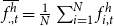
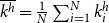
 \begin{equation} \mathbb{E}[(\overline{f_{.,t}^{h}}-\overline{k^{h}}-\overline{\beta ^{h}} \cdot y_{t})\otimes z_{t-s}]=0, \end{equation}
where
 $\overline{f_{.,t}^{h}}=\frac{1}{N} \sum _{i=1}^{N}f_{i,t}^{h}$
,
 $\overline{k^{h}}=\frac{1}{N} \sum _{i=1}^{N}k_{i}^{h}$
,
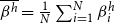 $\overline{\beta ^{h}}=\frac{1}{N} \sum _{i=1}^{N}\beta _{i}^{h}$
, and
 $z_{t-s}$
is a vector of valid instruments,
 $s\gt h$
, and
 $\otimes$
is the Kronecker product.
When
 $T \rightarrow \infty$
and
 $N$
is fixed, Gaglianone and Issler show that the feasible extended bias-corrected average forecast (BCAF),
 $\widehat{\mathbb{E}}_{t-h} (y_{t})$
, based on consistent generalized method of moment (GMM) estimates of the vector of parameters
 $\widehat{\overline{\theta ^{h}}}= \left [ \widehat{\overline{k^{h}}};\widehat{\overline{\beta ^{h}}}\right ]^{\prime}$
obeys:
 \begin{equation} {\mathbb{E}}_{t-h} (y_{t})= plim_{T\rightarrow \infty } \Bigg [\frac{1}{N}\sum _{i=1}^{N}\frac{f_{i,t}^{h}-\widehat{\overline{k^{h}}}}{\widehat{\overline{\beta ^{h}}}} \Bigg ]= plim_{T\rightarrow \infty } \widehat{\mathbb{E}}_{t-h} (y_{t}), \end{equation}
This result implies that
 $\mathbb{E}_{t-h}(y_{t})$
can be consistently estimated, as
 $T\rightarrow \infty$
, using:
 \begin{align} \widehat{\mathbb{E}}_{t-h}(y_{t})&=\frac{1}{N}\sum _{i=1}^{N}\frac{f_{i,t}^{h}-\widehat{\overline{k^{h}}}}{\widehat{\overline{\beta ^{h}}}}. \end{align}
As it is clear from equation (2), individual forecasts are in general not equal to the conditional expectation
 ${\mathbb{E}}_{t-h}(y_t)$
. This happens essentially because of asymmetric loss. Despite that, all forecasts depend on a common factor
 ${\mathbb{E}}_{t-h}(y_t)$
, which we can think of as a market forecast. Under a symmetric risk function for the market as a whole, it will be the optimal forecast for inflation, which justifies its label as the market expectation of inflation, or, as people’s beliefs, that is, Blinder (Reference Blinder2000). This is our main identification assumption here: we equate people’s beliefs or market expectations with
 ${\mathbb{E}}_{t-h}(y_t)$
. Its feasible version is estimated as in equation (6).
Next, we discuss how to obtain the asymptotic variance of
 $\widehat{\mathbb{E}}_{t-h}(y_{t})$
applying nonparametric methods.
3.2 HAC covariance matrix estimation
One of the original contributions of this paper is to derive the asymptotic variance of
 $\widehat{\mathbb{E}}_{t-h}(y_{t})$
. From equation (6), note that
 $\widehat{\mathbb{E}}_{t-h}(y_{t})$
is a function of the GMM estimates
 $\widehat{\overline{\theta ^{h}}}= \left [\widehat{\overline{k^{h}}};\widehat{\overline{\beta ^{h}}}\right ]^{\prime}$
. Hence, we will proceed here in two steps. Based on
 $T-$
asymptotics alone, c.f. equation (5), first we will employ a HAC covariance matrix estimation method to compute the asymptotic covariance matrix of these estimates. Second, we will use the Delta Method to compute the asymptotic variance of
 $\widehat{\mathbb{E}}_{t-h}(y_{t})$
.
HAC covariance matrix estimation has a wide application to moment conditions where their autocorrelation and heteroskedasticity properties are of unknown form. In this case, using nonparametric methods is the standard procedure. Newey and West (Reference Newey and West1987) and Andrews (Reference Andrews1991) are the main references.
Let
 $\Gamma _j$
denote the
 $j$
-th autocovariance of a stationary mean zero random vector
 $h_t(\theta )$
, for which a valid orthogonality condition of the form
 ${\mathbb{E}} [h_t(\theta )]=0$
applies, where
 $h_t(\theta )$
is a Kronecker product between a vector of regression errors
 $\epsilon _t(\theta )$
and a vector of instruments
 $z_{t-s}$
, that is,
 $h_t(\theta )=\epsilon _t(\theta ) \otimes z_{t-s}$
. Thus,
 $\Gamma _j={\mathbb{E}} [h_t(\theta ) h'_{\!\!t-j}(\theta )]$
. The long-run variance-covariance matrix of
 $h_t(\theta )$
is defined as the sum of all autocovariances. Since
 $\Gamma _j=\Gamma '_{-j}$
, we can write the long-run variance as:
 \begin{equation} S=\Gamma _0 + \sum _{j=1}^{\infty }(\Gamma _j+\Gamma '_{-j}), \end{equation}
as long as this sum converges.
As argued in White (Reference White1984), there are three cases of interest regarding this sum. The first is where
 $h_t(\theta )=\epsilon _t(\theta ) \otimes z_{t-s}$
is uncorrelated, so that
 $S=\Gamma _0$
. The second is where
 $h_t(\theta )=\epsilon _t(\theta ) \otimes z_{t-s}$
is finitely correlated, so that the sum can be truncated from
 $j=1$
to
 $j=m$
because covariances of order greater than
 $m$
are zero, so that
 $S=\Gamma _0 + \sum _{j=1}^{m}(\Gamma _j+\Gamma '_{\!\!-j})$
. The third and most interesting case is when
 $h_t(\theta )=\epsilon _t(\theta ) \otimes z_{t-s}$
is an asymptotically uncorrelated sequence, and an essential restriction being that
 $\Gamma _j \rightarrow 0$
as
 $j \rightarrow \infty$
. Therefore, we shall assume that
 $h_t(\theta )=\epsilon _t(\theta ) \otimes z_{t-s}$
is a mixing sequence, which suffices for asymptotic uncorrelatedness.
The idea of smoothing autocovariances in nonparametric covariance matrix estimation is to use a series of weights that obey certain properties to guarantee a positive semi-definite estimator for
 $S$
. Newey and West (Reference Newey and West1987) considered estimators defined as:
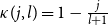
 \begin{equation} \widehat{S}=\widehat{\Gamma }_0 + \kappa (j,l) \sum _{j=1}^{l}(\widehat{\Gamma }_j+\widehat{\Gamma '}_{\!\!-j}), \end{equation}
where
 $\kappa (j,l)$
is a kernel weight that goes to zero as
 $j$
approaches
 $l$
, the bandwidth parameter. The idea is that covariances of higher order have less weight, and as they are estimated with less accuracy. Therefore, the use of a HAC estimator involves the specification of a kernel function and bandwidth parameter. In our main application, we use the Bartlett (Reference Bartlett1950) kernel as proposed by Newey and West (Reference Newey and West1987)Footnote
10
and the data-dependent method proposed by Newey and West (Reference Newey and West1994) to choose the bandwidth parameter.
Although Gaglianone and Issler (Reference Gaglianone and Issler2021) have analyzed two asymptotic cases, we will just focus here on the case when we let
 $T \rightarrow \infty$
and where
 $N$
is fixed, since it fits well the current surveys of expectations.
The population moment condition for the case where we let
 $T \rightarrow \infty$
and where
 $N$
is fixed is given by:
 \begin{equation} {\mathbb{E}} [h_t(\theta _{0}^{h})]=\mathbb{E}[(\overline{f_{.,t}^h}-\overline{k_{0}^{h}}-\overline{\beta _{0}^{h}} \cdot y_{t})\otimes z_{t-s}]=0, \end{equation}
where
 $\overline{\theta _{0}^{h}}=(\overline{k_{0}^{h}},\overline{\beta _{0}^{h}})'$
includes the true parameter values for each
 $h$
that solves equation (9). Under the suitable conditions assumed in Hansen (Reference Hansen1982), there exists a consistent estimator,
 $\widehat{\overline{\theta ^{h}}}$
, of the true parameter
 $\overline{\theta ^{h}_0}$
, such that
 ${\widehat{\overline{\theta ^{h}}}}\overset{p}{\rightarrow }$
 $\overline{\theta ^{h}_0}$
, for all
 $h$
, where
 $z_{t-s}$
is a vector of instruments with
 $dim(z_{t-s})\gt 2$
.
To find the asymptotic distribution of
 $\widehat{\mathbb{E}}_{t-h}(y_{t})$
entails the following steps. First, as proved by Hansen (Reference Hansen1982), the efficient GMM estimator
 $\widehat{\overline{\theta ^{h}}}$
is asymptotically normal as follows:
 \begin{equation} \sqrt{T}(\widehat{\overline{\theta ^{h}}} - \overline{\theta _{0}^{h}}) \xrightarrow{d} \mathcal{N}\bigg (0,\bigg (G^h{{S}^{(h)}}^{-1}{G^h}'\bigg )^{-1}\bigg ), \end{equation}
where the optimal GMM weighting matrix is
 ${S^{(h)}}^{-1}$
, with
 $S^{(h)}=\mathbb{E}[h(\theta _{0}^{(h)})h(\theta _{0}^{(h)})']$
and where
 $G^h=plim_{T \rightarrow \infty } \frac{\partial h'({{\theta }^{h}})}{\partial{{\theta }^{h}}}\Big |_{\theta ^h=\widehat{{\overline{\theta ^{h}}}}}$
.
Second, from equation (6), note that
 $\widehat{\mathbb{E}}_{t-h}(y_{t})$
is a simple function of the GMM estimates
 $\widehat{\overline{\theta ^{h}}}= \left [\widehat{\overline{k^{h}}};\widehat{\overline{\beta ^{h}}}\right ]^{\prime}$
. Applying now the Delta Method, we can find a consistent estimate of the long-run variance of
 $\hat{E}_{t-h}(y_{t})$
as follows:
 \begin{equation} \widehat{V}^{(h)}=\left [\begin{array}{cc}\\ \frac{-1}{\widehat{\overline{\beta ^{h}}}^{^{^{\;}}}} & \frac{\frac{1}{N}\sum _{i=1}^{N}(-f_{i,t}^{h}+\widehat{\overline{{k^{h}}}})}{\widehat{({\overline{\beta ^{h}}})}^{2}}\end{array}\right ]{\bigg (\widehat{G^h}\widehat{{{S}^{(h)}}^{-1}}\widehat{{G^h}^{\prime }}\bigg )^{-1} \left [\begin{array}{c}-\frac{1}{{\widehat{\overline{\beta ^{h}}}}^{^{^{\;}}}} \\ \frac{ \frac{1}{N}\sum _{i=1}^{N} (-f_{i,t}^{h}+\widehat{\overline{k^{h}}})}{\widehat{({\overline{\beta ^{h}}})}^{2}}\end{array}\right ]}, \end{equation}
where the estimate of
 $G^h$
is given by
 $\frac{\partial h'({{\theta }^{h}})}{\partial{{\theta }^{h}}}\Big |_{\theta ^h=\widehat{{\overline{\theta ^{h}}}}}$
and the estimate of
 $S$
is given by:
 \begin{equation} \widehat{S}^{(h)}= \left [\widehat{\Gamma }_{0}(\widehat{{\overline{\theta ^{h}}}})+\sum _{j=1}^{l}\kappa (j,l)(\widehat{\Gamma }_{j}(\widehat{{\overline{\theta ^{h}}}})+\widehat{\Gamma }_{j}^{\prime }(\widehat{{\overline{\theta ^{h}}}}))\right ], \end{equation}
where,
 \begin{equation} \widehat{\Gamma }_{j}(\widehat{{\overline{\theta ^{h}}}})=\frac{1}{T}\sum _{t=j+1}^{T}h_{t}(\widehat{{\overline{\theta ^{h}}}})h_{t-j}^{\prime }(\widehat{{\overline{\theta ^{h}}}}). \end{equation}
Then, we obtain
 \begin{equation} \widehat{\mathbb{E}}_{t-h}(y_{t})) \overset{Asy}{\sim } \mathcal{N} \Big ({\mathbb{E}}_{t-h}(y_{t}),\frac{V^{(h)}}{T} \Big ), \end{equation}
where
 $V^{(h)}$
can be consistently estimated by
 $\widehat{V}^{(h)}$
from equation (11).
Based on this limiting distribution, we can construct asymptotic confidence intervals for
 $\widehat{\mathbb{E}}_{t-h}(y_{t})$
for each
 $h$
, which will be of great usefulness in the construction of our measure of credibility. We discuss that in the next section.
Once we have characterized the asymptotic distributions as in equations (11) and (14), we can construct 95% HAC robust confidence intervals to be compared with the explicit or tacit targets for inflation in each point in time. This will determine whether or not the central bank was credible in that period. As we all know, there is nothing magic about 95% confidence bands and perhaps a broader approach can be employed, considering different levels of credibility risk. The use of fan charts is an interesting approach, since it allows the assessment of uncertainties surrounding point forecasts. This technique gained momentum following the publication of fan charts by the Bank of England in 1996. Because we are using asymptotic results, we will not allow asymmetries as is common place when fan charts are employed. However, the technique of expressing risk in its different layers is an interesting extension of the current setup.
3.3 A credibility test and a new credibility index
Computing the asymptotic distribution of
 $\widehat{\mathbb{E}}_{t-h}(y_{t})$
for each
 $h$
, as discussed in the previous subsection, we can use this distribution to construct a new credibility index. The basic idea is that a centered version of
 $\widehat{\mathbb{E}}_{t-h}(y_{t})$
is asymptotically normally distributed with zero mean and covariance matrix
 ${V}^{(h)}$
, which can be consistently estimated by
 $\widehat{V}^{(h)}$
from equation (11). We will argue here that the area under the probability density function of the normal distribution between the inflation target and
 $\widehat{\mathbb{E}}_{t-h}(y_{t})$
can be used to construct an index of central bank credibility. As before, this index will be based on a sound statistical basis.
Based on
 $\widehat{\mathbb{E}}_{t-h}(y_{t}) \overset{Asy}{\sim } \mathcal{N} \Big ({\mathbb{E}}_{t-h}(y_{t}),\frac{V^{(h)}}{T}\Big )$
, we can establish the cumulative distribution function of
 $\widehat{\mathbb{E}}_{t-h}(y_{t})$
, which we label as
 $F(x)$
. Here, we use
 $F(x)$
to construct a credibility index (
 $CI_{IS}$
) that has the following properties: (i) if
 $\widehat{\mathbb{E}}_{t-h}(y_{t})=\pi ^{*}$
, where
 $\pi ^{*}$
is the central bank inflation target midpoint,
 $CI_{IS}$
attains its maximum value at
 $1$
and this would be the perfect credibility case; (ii)
 $CI_{IS}$
decreases as the distance between
 $\pi ^{*}$
and
 ${\mathbb{E}}_{t-h}(y_{t})=\pi ^{*}$
increases, asymptotically going to zero.
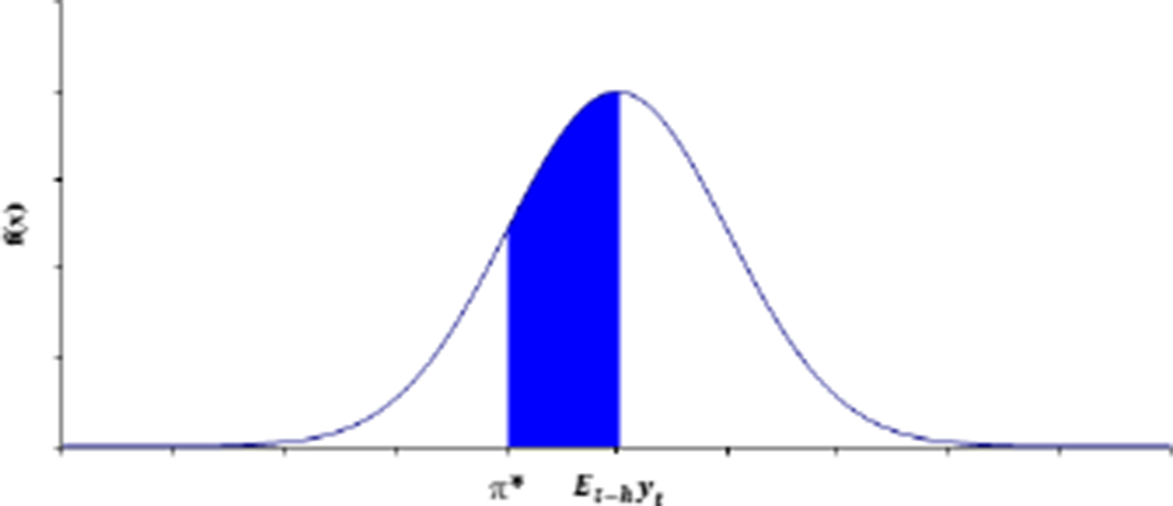
Figure 1 describes the idea behind the index that will be measured as the density of
 $F(x)$
between
 $\widehat{\mathbb{E}}_{t-h}(y_{t})$
and
 $\pi ^{*}$
, denoted in the graph by the blue area.
Normal distribution.

The new credibility index proposed here obeys
 \begin{equation*} CI_{IS}= \begin {cases} 1-\frac {|F(\widehat {\mathbb {E}}_{t-h}(y_{t}))-F(\pi ^*)|}{1/2}; & \text {if } -\infty \lt \pi ^* \lt \infty. \end {cases} \end{equation*}
The proposed index has some advantages over the existing indices in the literature. First, it relies on a pure statistical criterion and it does not depend on ad hoc bounds, making its applicability much broader. Second, it is based on a structural model for survey expectations that yields a consistent estimate of the conditional expectation. Additionally, it also encompasses the case when the consensus forecast is free of bias.
Based on the distribution of
 $\widehat{\mathbb{E}}_{t-h}(y_{t})$
, and on the inflation target
 $\pi ^*_{t}$
, the definition of credibility is the following. A central bank is credible if:
 \begin{equation} \pi ^*_{t} \subset \left[\widehat{\mathbb{E}}_{t-h}(y_{t}) -1.96 {\left(\frac{\widehat{V}^{(h)}}{T}\right)}^{1/2}, \widehat{\mathbb{E}}_{t-h}(y_{t}) + 1.96 {\left(\frac{\widehat{V}^{(h)}}{T}\right)}^{1/2} \right ]. \end{equation}
In words, a central bank is credible if the confidence interval around
 $\widehat{\mathbb{E}}_{t-h}(y_{t})$
contains the official inflation target
 $\pi ^*_{t}$
. It is not credible otherwise. Therefore, our credibility definition is based on a statistical criterion, avoiding the use of ad hoc bounds.
3.4 Discussion
As stated from the outset, there is a consensus in the literature that Blinder (Reference Blinder2000) offers an uncontroversial definition of credibility when he states that “A central bank is credible if people believe it will do what it says.” Thus, we proceed in making this statement operational to measure and test the credibility of central banks.
The first issue discussed here relates to what people stand for in Blinder’s definition. While it is difficult to argue against the definition itself, it remains unclear what people refer to. One possibility points toward everyone in the economy, or to households who make atomistic decisions about consumption, labor supply (leisure), etc. Taken as a whole, their decisions ultimately deliver an aggregate inflation index that we observe and care about.
Unfortunately, we cannot observe everyone in the economy and even some of the best household surveys do not have information on consumer’s expectations on a regular basis. Moreover, households are small relative to the size of the economy, and their individual expectations will not have an impact on inflation, only their collective expectations.
A way to circumvent these problems is to use the beliefs of professional forecasters, extracting their common component, which is common in this literature. Because they are experts, not only their expectations are surveyed on a regular basis, but they also have the power to influence the market and the opinion of other agents, including the central bank, that is, they are not small. Indeed, most of them are active financial stakeholders, which further validates the methodology proposed here.Footnote 11
Here, we equate people’s beliefs to the common component of individual expectations in the survey. This entails removing averages of the individual intercept bias and the individual slope bias, c.f. equation (6). One may argue against removing these biases since a forecast reflects a professional forecaster’s true belief. As noted by Gaglianone and Issler (Reference Gaglianone and Issler2021), individual biases are mainly due to the asymmetry of the loss function used by the forecaster and reflect the final use of an individual forecast. So, biases are admissible at the individual level. However, people’s beliefs are measured at the aggregate level and represent here market expectations. If we do not remove these biases, we will end up with a measure of market expectations that will be biased, which makes little sense.Footnote 12
A common way some economists have sought to define credibility and “anchoring” of expectations is to think about the cross-sectional distribution (standard deviation across forecasters) of their point expectations. When this distribution converges (to a point mass) on the inflation target, the central bank’s target is defined to be (fully) credible, see Reis (Reference Reis2021). One may wonder whether our panel-data approach imposes any restriction on the cross-sectional distribution of beliefs. Although we employ panel data to extract market expectations, since almost all current surveys have large
 $T$
and small
 $N$
, our asymptotic distributions relies exclusively on
 $T \rightarrow \infty$
. Hence, our approach matches our main statistics to the pattern of the surveys we find in practice, but we do not impose any restrictions on the cross-sectional distribution of beliefs.Footnote
13
Finally, although the BCB adopts a standard rule of having a fixed number as the inflation target, some countries employ ranges as targets, for example, 1%–3%, instead of 2% as a mean and bounds. If we assume a symmetric distribution, we can always find a midpoint target in this case, which can serve as the fixed target to which we compare beliefs. Note that the bounds supplied by the central banks themselves are not used in our proposed method, which avoids the incentive for them to inflate their bounds to always be on target. Indeed, the confidence intervals we compute come from the uncertainty of our estimate of market expectations. So, we let the “market” have the final word on uncertainty.Footnote 14
4. Empirical application
4.1 Data
We use the data available in the Focus Survey of forecasts of the BCB. This is a very rich database, which includes monthly and annual forecasts from roughly 250 institutions for every working day and for many important economic variables, such as different inflation indicators, exchange rates, GDP, industrial production, and balance of payments series. The survey collects data on professional forecasters, including banks, investment banks, other financial institutions, non-financial companies, consulting firms, academic institutions, etc.
The survey started in May 1999, initially collecting forecasts of around 50 institutions mainly on price indices and GDP growth. It quickly evolved to include around 250 institutions and survey data on a much broader basis. About 120 institutions are active in the system today. In November 2001, the online survey was created and in March 2010 it was improved, resulting in the present version of the Market Expectations SystemFootnote 15
Our focus is on the inflation rate measured by the Brazilian Broad Consumer Price Index (IPCA), because it is the official inflation target of the BCB. The Focus Survey contains short-term monthly forecasts, 12-month-ahead forecasts, and also year-end forecasts from 2 to 5 years ahead. These year-end forecasts are fixed-point forecasts, where the forecast horizon changes monthly as time evolves. In our main application, we will focus on 12-month ahead inflation expectations, since those are fixed-horizon forecasts that can be collected at the monthly frequency. Also, this horizon is large enough for inflation shocks to dissipate, since we do not want to associate the lack of credibility with the presence of mean-reverting shocks to inflation.
Our sample covers monthly inflation forecasts collected from November 2001 until April 2017. The survey is available since 1999, but data regarding expectations 12 months ahead are available only since November 2001. In each month
 $t$
,
 $t=1,\ldots,T$
, survey respondent
 $i$
,
 $i=1,\ldots,N$
, may inform her/his forecast for IPCA inflation rates for five calendar years, including the current year. In our sample,
 $T$
=208 months and
 $N$
is, on average, 60.
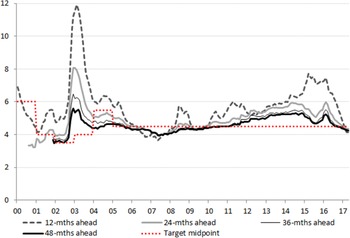
In recent years, the annual inflation rate in Brazil as measured by IPCA has increased considerably, reaching over 10% per year by the end of 2015. Inflation expectations for all horizons have also increased, as Figure 2 shows.
Focus fixed horizon inflation forecasts.
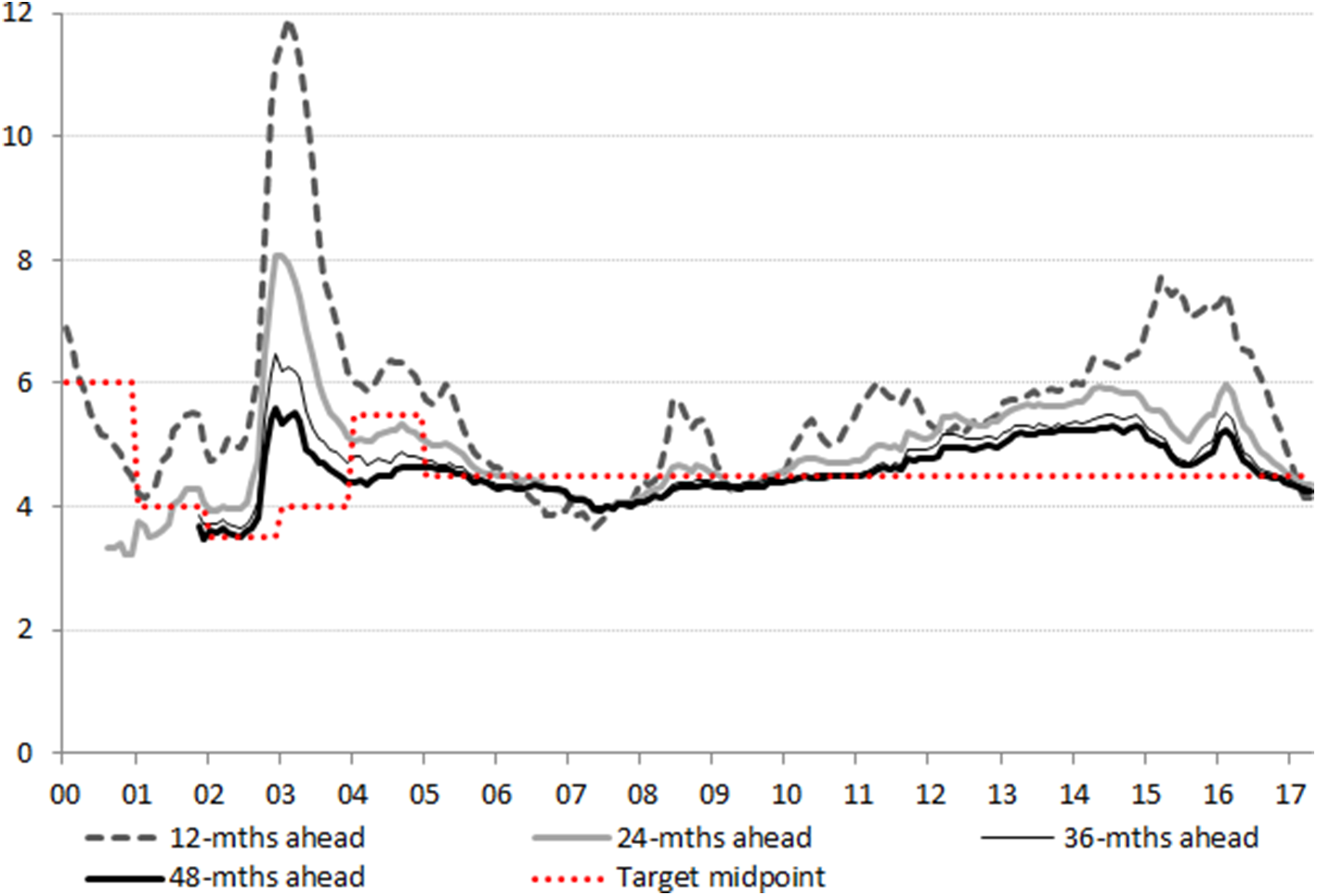
The data in Figure 2 are different across horizons, which deserves an explanation. There are fixed-horizon forecasts up to the 12-month horizon which can be extracted directly from the database in every month, posted by professional forecasters. For horizons from 24 months, 36 months, up to 48 months, there are no fixed-horizon forecasts posted in the database. What is shown in Figure 2 for these horizons are interpolated year-end forecasts using the method proposed by Dovern et al. (Reference Dovern, Fritsche and Slacalek2012).
There are two reasons why we focused only on 12-month ahead forecasts in testing for central-bank credibility: (i) For horizons from 24 through 48 months, “forecasts” are not actually posted on the database by agents but are constructed by interpolation. It is hard to imagine how different they are from proper fixed-horizon forecasts that would have been posted in the database; (ii) in Gaglianone et al. (Reference Gaglianone, Giacomini, Issler and Skreta2021), the authors have modeled inflation as an ARMA(1,1) process with monthly data. It has an estimated AR(1) coefficient of 0.44. This is the best ARMA model chosen by BIC. Its 12-month ahead impulse response is a multiplicative function of
 $(0.44)^{12}=0.000005$
, that is, it is virtually nil, showing that transitory shocks have very little impact on these forecasts. This is a necessary condition for choosing the forecast horizon for credibility tests, since short-run perturbations do not impact its final result. Choosing longer horizons would necessarily require the use of poor estimates for beliefs, which we avoid.
Figure 2 shows three distinct periods when we compare the consensus expectations 12-month ahead with the inflation target. The first is from 2002 until the end of 2003, where there is a sudden and strong deterioration of inflation expectations due to the uncertainty around the 2002 election, which was reversed sharply after it. The second period is from the end of 2003 until the end of 2010, being characterized by the stability of inflation expectation around the target midpoint. The third period starts in the beginning of 2011, where we observe a slow and sustained rise in inflation expectations. After President Rousseff’s impeachment (2016), there was a change in economic policy and in BCB. Soon after, expectations fell quickly toward the target midpoint.
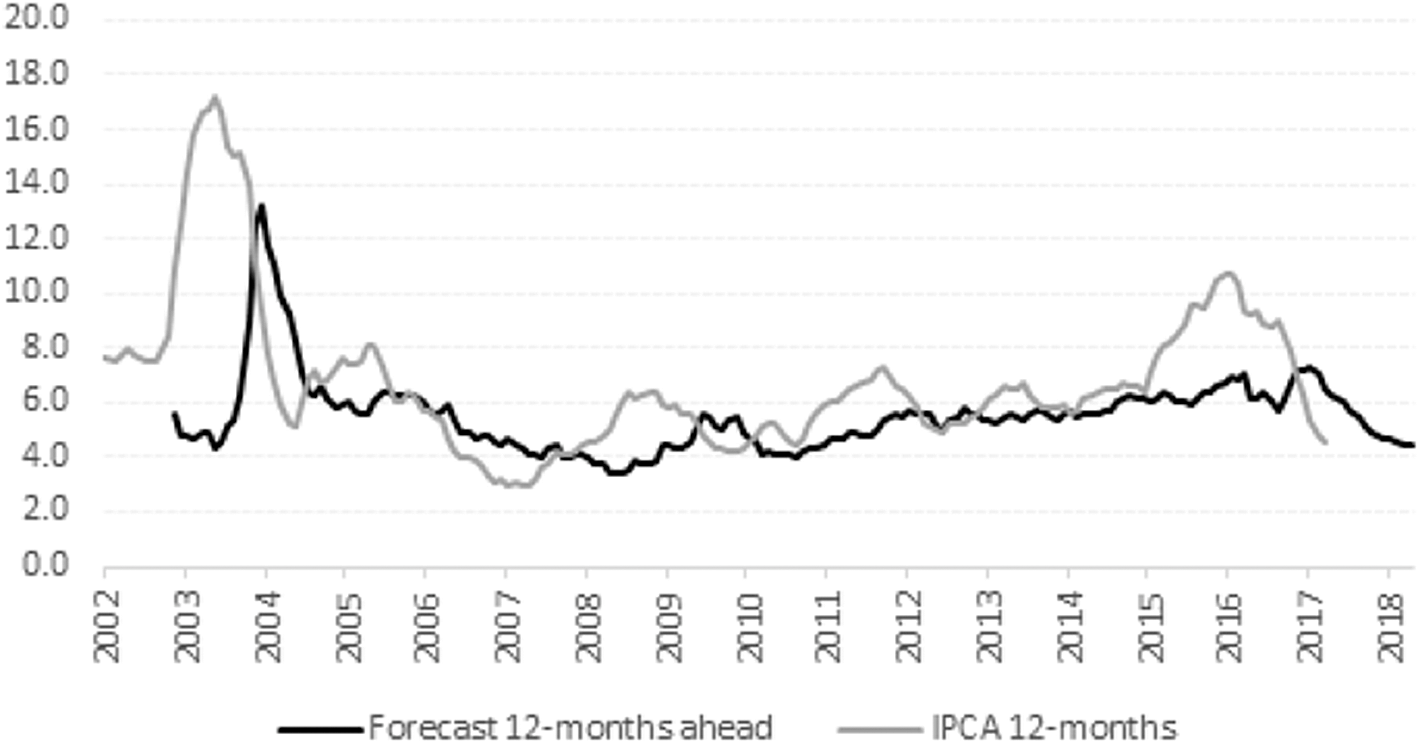
Figure 3 compares the monthly consensus forecasts,
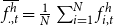 $\overline{f_{.,t}^{h}}=\frac{1}{N} \sum _{i=1}^{N}f_{i,t}^{h}$
, for inflation with the actual inflation rate for the 12-month-ahead horizon. In this figure, the measure of consensus forecasts represented by the black line was forwarded 12 months to match inflation, which it is supposed to track. In each month, we can compare IPCA inflation over the last 12 months and its respective forecast made 12 months prior.
Forecasts vs actual inflation rate for the 12 months ahead horizon.
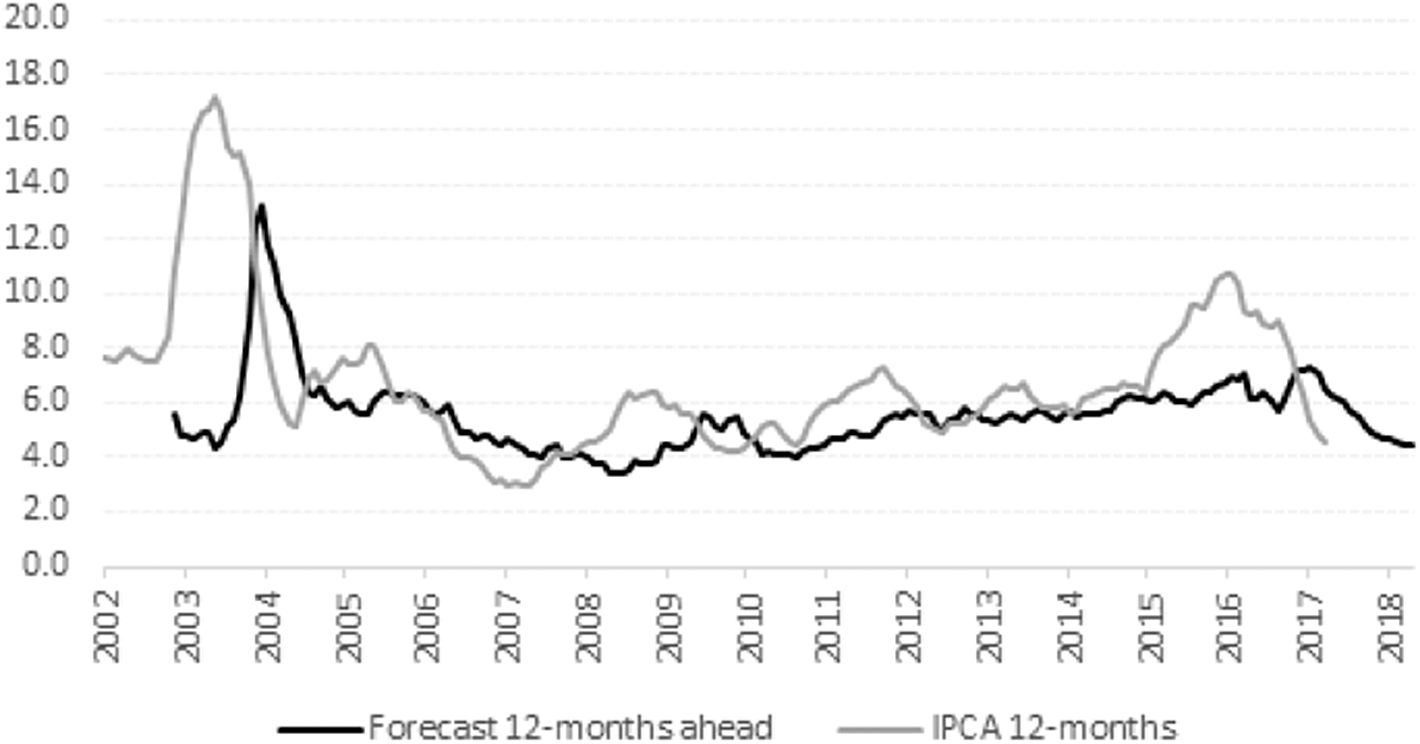
As is clear from Figure 3, the consensus forecast underestimates actual inflation quite often, and this is true in 68% of the sample.
4.2 Results
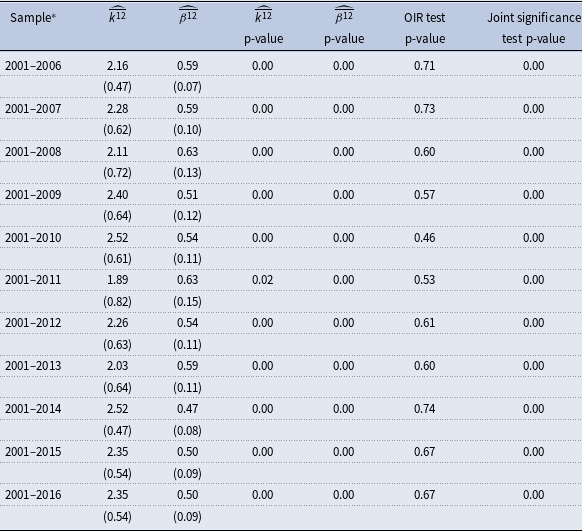
Table 1 presents the results of the GMMFootnote
16
estimation for the parameters
 $\overline{k^{h}}$
and
 $\overline{\beta ^{h}}$
, based on information about
 $f_{i,t}^{h}$
and
 $y_{t}$
. We use as instruments up to two lags of the consensuses forecasts (
 $\overline{ f_{.,t}^{h}}$
), up to two lags of the output gapFootnote
17
and up to four lags of the 12-month variation of the Commodity Price Index (IC-Br)Footnote
18
,
Footnote
19
.
GMM estimation results for the 12 months ahead forecast horizon

Notes: The set of instruments is up to two lags of the consensus forecasts, up to two lags of the output gap, and up to four lags of the 12-month variation of the Commodity Price Index (IC-Br).
* The sample used in estimation and in forecasting up to 12-month ahead.
Our sample starts in 2001 and out-of-sample forecasts are constructed for the period between 2007 and 2017Footnote 20 , re-estimating the coefficients at the end of each year, and using them to construct true out-of-sample forecasts of inflation. In the first column of Table 1, the sample denotes the period used in estimation, which is used to perform out-of-sample forecasts up to 12 months ahead. For example, the sample from 2001 to 2006 generates out-of-sample forecasts for the year of 2007; the sample from 2001 to 2007 generates out-of sample forecasts for 2008, and so on, in a growing-window setup.
In Table 1, Hansen’s over-identifying restrictionFootnote
21
test is employed in order to check the validity of instruments and GMM estimates. For all sets of estimates, we are far from rejecting the null, which is evidence that the instrument set is appropriate and orthogonal to regression errors. In the last column, we test for joint significance of the coefficients [
 $H_0$
:
 $\overline{k^{12}}=0$
and
 $\overline{\beta ^{12}}=1$
]. If the null hypothesis is not rejected, the consensus forecast is equal to the Extended BCAF and there is no evidence of any bias in it. But, we reject the null hypothesis with great confidence in all cases, a strong evidence of biases for the consensus forecast, requiring their respective extraction to construct a consistent estimate for
 ${\mathbb{E}}_{t-h}(y_{t})$
.
Our estimates in Table 1 show that both mean intercept and mean slope parameters are statistically significant for all samples. The average intercept value is 2.26, ranging from 1.89 to 2.52 and the average slope value is 0.56, ranging from 0.47 to 0.63.
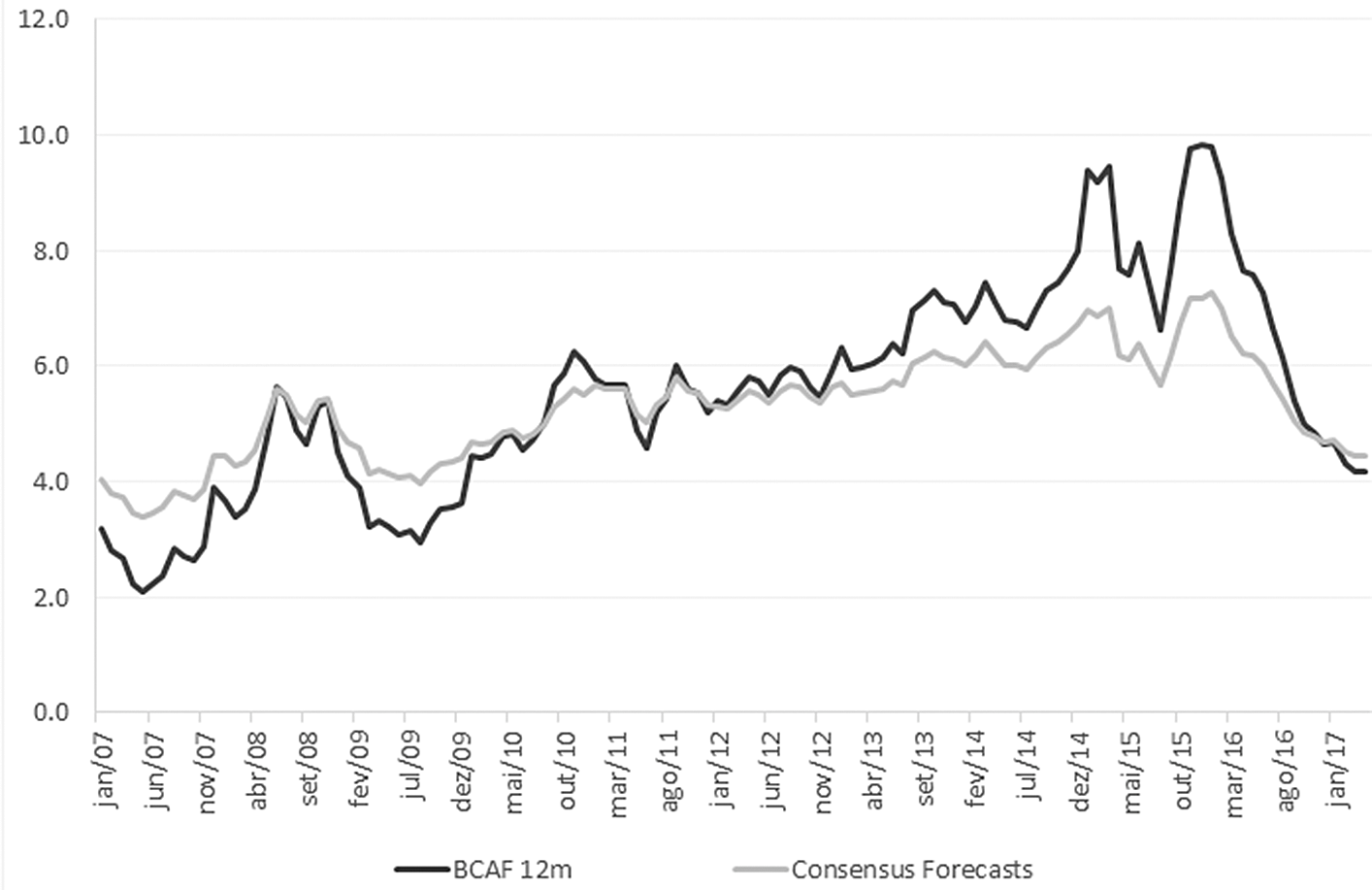
Figure 4 compares consensus forecasts with the estimated Extended BCAF, for the 12 months ahead horizon. The gray line represents the consensus forecasts for the 12 months ahead horizon, while the black line represents the estimated Extended BCAF for the same horizon. Notice that the behavior of the two is quite distinct, with our estimate of
 ${\mathbb{E}}_{t-h}(y_{t})$
below the consensus on early years and above it on later years of the sample.
Consensuses forecasts and extended BCAF (people’s beliefs).

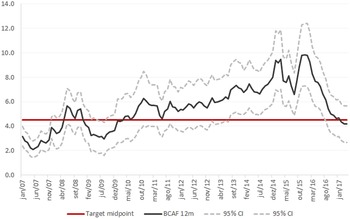
The next step is to estimate robust (HAC) covariance matrices and standard deviations based on the asymptotic distribution of the estimated Extended BCAF and then construct the respective 95% confidence interval. Figure 5 includes
 $\widehat{\mathbb{E}}_{t-h}(y_{t})$
, its respective 95% robust confidence interval, and the inflation target from 2007:1 through 2017:4.
People’s beliefs (Extended BCAF) and confidence intervals.

In Figure 5, the 95% confidence interval contains the target (4.5% throughout) slightly above 65% of the time. Credibility is lost for the BCB in the period covering almost all the year of 2007. Here, beliefs were too low compared to the 4.5% target. Another period of no credibility is between mid-2013 and mid-2016. There, beliefs are too high compared to the target. As noted before, these were times when the increase in inflation expectations was widespread, indicating a de-anchoring of inflation expectations not consistent with the target of 4.5% annual inflation rate.
From mid-2016 onward, there was a very steep fall in inflation expectations. This happened at the same time when there was a change in the economic team of the Brazilian government, including the Central Bank administration and its board of directors. Perhaps these changes helped to consolidate the fall in inflation expectations, which were re-anchored according to our criterion.
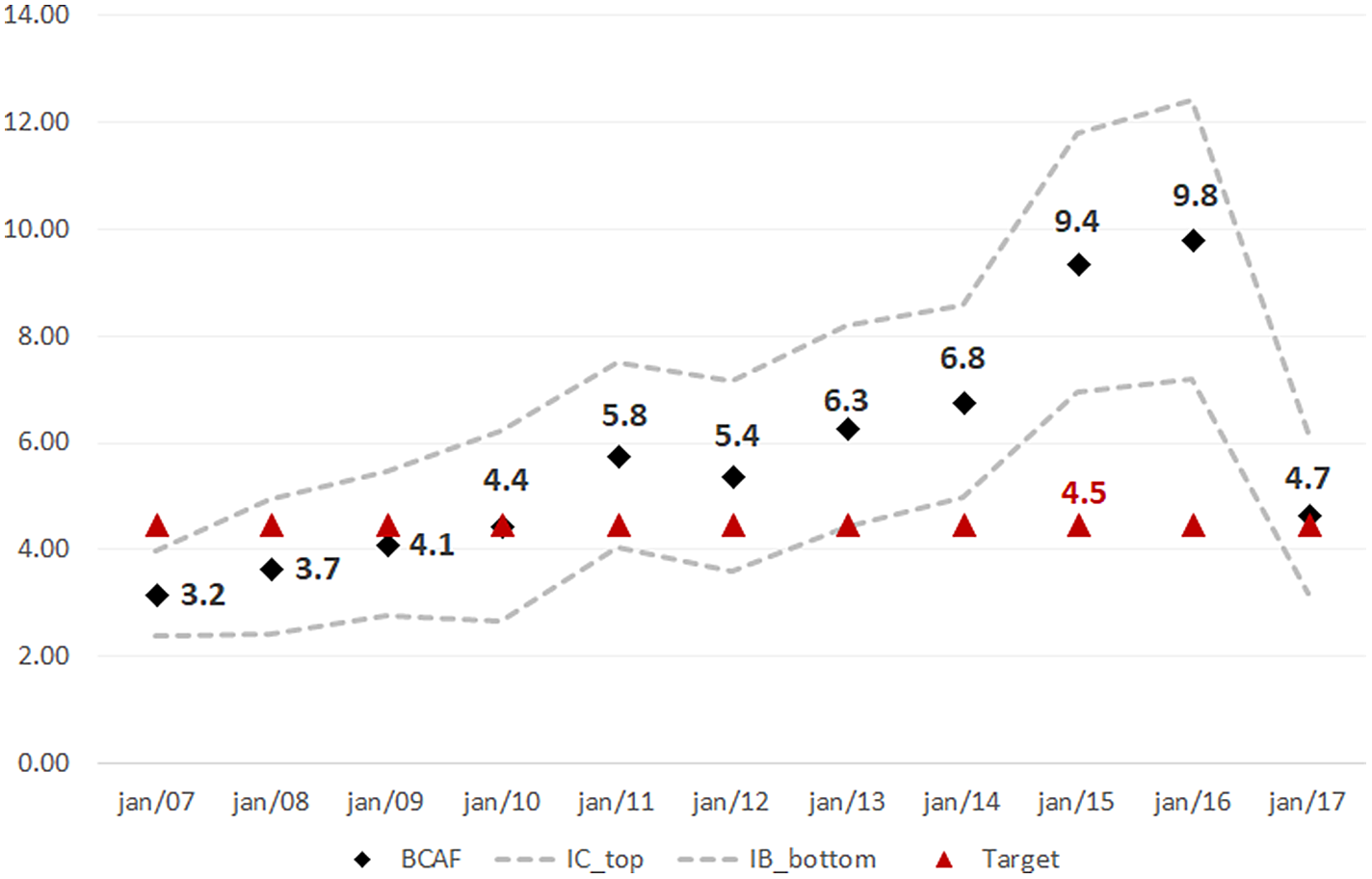
Figure 6 shows the same result as Figure 5. However, comparisons between beliefs and targets are only made at the end of each year, since, technically, the Brazilian inflation-targeting program has only year-end targets. Results are virtually unchanged: there is no credibility in 2007 and from 2013 to 2016, with the BCB recovering credibility in 2017.
BCAF, confidence intervals, and year-end targets.

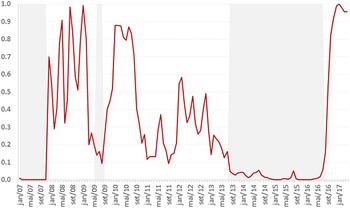
Figure 7 presents the credibility index proposed above. The shaded regions indicate when the target is outside the 95% confidence interval, therefore, when the central bank is not credible. From 2008 on, there is a decrease in the credibility index of the central bank, although with some volatility. This decrease is finally consolidated in 2013, with an almost complete loss of credibility according to our index. Agents’ forecasts were significantly above target, which shows a disbelief in the target and/or a disbelief in the capacity or the willingness of the central bank to bring current inflation toward the target. From August 2013 to July 2016, the credibility index fell close to zero and stayed around zero for three years, until august 2016, where there was a very steep rise in the index: it rose from 0.06 in July to 0.53 in September, reaching 1.0 in December. In the first months of 2017, the index stayed between 0.95 and 1.00, expectations falling below target. This is evidence of a strong recovery of central-bank credibility, and a strong re-anchoring of inflation expectations.
Credibility index.

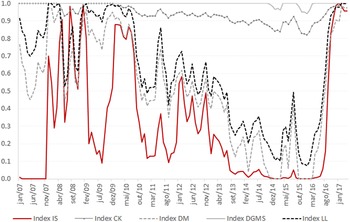
Figure 8 compares our measure of central bank credibility with other indices proposed in the literature. Our index is labeled as the “IS Index.” The other indices are labeled as the “CK Index” (Cecchetti and Krause (Reference Cecchetti and Krause2002)), the “DGMS Index” (De Mendonça and de Guimarães e Souza (Reference De Mendonça and de Guimarães e Souza2009)), the “DM Index” (De Mendonça and de Guimarães e Souza (Reference De Mendonça and G. J.2007)), and the “LL Index” (Levieuge et al. (Reference Levieuge, Lucotte and Ringuedé2016)).
Comparison between credibility indices proposed in the literature.

4.3 Comparing our credibility index with other indices in the literature
First, the behavior of our index differs from all other indices for 2007 and the beginning of 2008: ours point out to a loss in credibility, since inflation expectations fell too much during this period—the Extended BCAF was below 2% for some months. All other credibility indices are above 0.4 and in some cases close to 1.0.
Second, our index shows a loss of credibility during the global crisis of 2008–2009, whereas the other indices do not. Again, this is due to inflation expectations being very low vis-a-vis the target. After the crisis, our index shows a prolonged period where the central bank keeps its credibility, which is confirmed by all other indices.
Finally, the IS, DM, and LL indices show credibility falling to close to zero between 2013 and 2016, but the CK and the DGMS indices are kept above 0.8. In our view, this is not consistent with a severe loss of credibility shown by a rise in expectations depicted in Figure 2. All three indices (IS, DM, and LL) show strong evidence of a rise in central bank credibility by the end of the sample, being either equal or very close to one.
One could argue that the DM and the LL indices are close to ours, especially because their dynamics are similar for most of the period 2007–2017. We disagree with that. As noted above, the DM index and the LL index are very different from ours from 2007 all the way to the beginning of 2008. While ours show no credibility for the BCB, theirs show no sign of that. Note that 2007 was a year where the BCB was not credible using our test, since the target was above market expectations and above the confidence interval.
Although the dynamic behavior of the DM index and the LL index is close to that of our index after 2008, we find that these indices are higher than ours, sometimes by a wide margin. For example, in mid-2015, the gap reached about 0.45 —our index was close to 0.05 (almost no credibility) and theirs was close to 0.50 (midpoint credibility). Smaller gaps are also observed from the end of 2010 through 2014.
5. Conclusion
Although central bank credibility is elusive, Blinder (Reference Blinder2000) generated a consensus when he wrote that “A central bank is credible if people believe it will do what it says.” This paper makes this definition operational by using standard econometric methods.
First, we extract people’s beliefs about inflation from a survey of inflation expectations using the panel-data approach of Gaglianone and Issler (Reference Gaglianone and Issler2021). Second, using asymptotic theory, we propose a robust method to estimate the uncertainty underlying our estimate of people’s beliefs. Third, we propose a new method to decide whether or not a central bank is credible. It is credible, if its explicit (or tacit) inflation target lies within the 95% robust asymptotic confidence interval of people’s beliefs. We also propose a credibility index based upon these ideas.
Our methodology seems sensible from an economic point of view. Based on the results of Gaglianone and Issler, we identify market expectations (or people’s beliefs) as the common latent factor of individual inflation expectations. Since a large number of important countries adopted inflation-targeting programs, one can easily obtain data on what central banks say they do by looking at actual targets of inflation for these countries. Even if a given country has not adopted such programs, there usually exist tacit targets that could serve to that end.
From an econometric point of view, the methodology is relatively simple: we have a consistent estimate of the conditional expectation of inflation given common information—a random variable. Comparing it to explicit targets only requires constructing robust confidence intervals for these estimates. If targets lie within confidence bands, we say that targets are credible, that is, the central bank is credible. It is important to note that market expectations are extracted from a survey of expectations of professional forecasters, which are active financial stakeholders most of them. This further validates the methodology proposed here.
The approach outlined above is applied to the issue of credibility of the BCB by using the Focus Survey of professional forecasters. This is a world-class database, fed daily by institutions that include commercial banks, investment banks, asset management firms, consulting firms, large corporations, and academics, inter alia.
Based on the proposed methodology, we estimated monthly the conditional expectation of inflation (12-month-ahead), conditional on common information, and its respective robust asymptotic variance, using data from January 2007 until April 2017. This was then compared to the target in the Brazilian inflation-targeting regime. Results show that the BCB was credible 65% of the time, with the exception of a few months in the beginning of 2007 and during the interval between mid-2013 throughout mid-2016.
We also constructed a credibility index for the sample 2007–2017 and compared it with alternative measures of credibility that are popular in the literature: Cecchetti and Krause (Reference Cecchetti and Krause2002), De Mendonça and de Guimarães e Souza (Reference De Mendonça and de Guimarães e Souza2009), De Mendonça and de Guimarães e Souza (Reference De Mendonça and G. J.2007), and Levieuge et al. (Reference Levieuge, Lucotte and Ringuedé2016). Although our index has a similar dynamic behavior when compared to the indices of De Mendonça and de Guimarães e Souza (Reference De Mendonça and G. J.2007) and Levieuge et al. (Reference Levieuge, Lucotte and Ringuedé2016), they differ on important episodes where the BCB lost credibility. While ours show that credibility was lost, theirs do not show such behavior.
Supplementary material
To view supplementary material for this article, please visit https://doi.org/10.1017/S1365100522000207.