





Individuals with a severe mental illness (SMI) are six to seven times more likely to be unemployed than those without mental health problems, Reference Hoedeman1 despite the fact that most such individuals explicitly express a desire to work. Reference Franck, Bon, Dekerle, Plasse, Massoubre and Pommier2 Employment outcomes are deeply rooted in cognitive functioning, Reference McGurk, Mueser, Harvey, LaPuglia and Marder3,Reference McGurk and Mueser4 which serves as the foundational architecture for workplace adaptability and social integration. Individuals with SMI typically experience both neurocognitive Reference De la Torre, Doval, López-Sanz, García-Sedeño, Ramallo and Bernal5 and social cognitive deficits. Reference Hoertnagl and Hofer6 Regarding neurocognition, impairments in attention, memory and executive function can hinder a person’s ability to acquire new skills, follow multistep instructions and manage the logistical demands of a work schedule. This link is equally critical in the domain of social cognition, that is, the capacity to identify emotions, interpret social cues and understand others’ intentions. Deficits in these areas may lead to misinterpretations of workplace interactions, resulting in social discomfort, perceived conflict or inadvertent violations of professional norms. Overall, traditional vocational support may struggle to achieve long-term employment performance and stability for individuals with SMI without addressing these underlying cognitive barriers.
Cognitive remediation therapy aims to target these specific deficits. Evidence for its effects is both durable and significant regarding composite cognition and ‘real-world’ functioning. Reference Wykes, Huddy, Cellard, McGurk and Czobor7–Reference Vita, Barlati, Ceraso, Deste, Nibbio and Wykes10 Comprehensive programmes such as cognitive enhancement therapy address both neurocognition and social cognition, Reference Eack, Greenwald, Hogarty, Cooley, DiBarry and Montrose11 but this therapy is often long and subject to high attrition, cost and a need for unusual expertise. Alternative approaches such as cognitive adaptation training utilise environmental supports and compensatory aids to bypass deficits rather than retraining them; this approach has shown some success in the USA. Reference Quee, Stiekema, Wigman, Schneider, van der Meer and Maples12 Furthermore, larger effect sizes for functioning have been obtained when cognitive remediation programmes were integrated into broader psychosocial programmes. Reference Wykes, Huddy, Cellard, McGurk and Czobor7,Reference McGurk, Twamley, Sitzer, McHugo and Mueser13 A compelling approach involves integration of cognitive remediation directly within vocational rehabilitation programmes. In a randomised controlled trial (RCT) conducted by our group, we previously demonstrated that RECOS, a neurocognitive remediation programme, significantly improved professional insertion compared with treatment as usual for individuals in sheltered, non-competitive employment. Reference Cervello, Dubreucq, Trichanh, Dubrulle, Amado and Bralet14 Interventions such as ‘Thinking Skills for Work’ have specifically targeted individuals in supported employment and have also yielded positive vocational outcomes. Reference Christensen, Wallstrøm, Stenager, Bojesen, Gluud and Nordentoft15–Reference McGurk, Mueser, Xie, Bloch, DeTore and Pashka19
To our knowledge, most previous studies have evaluated vocational outcomes primarily in relation to neurocognitive remediation. However, the positive impact of neurocognitive remediation on occupational achievement is not unequivocal, Reference Twamley, Thomas, Burton, Vella, Jeste and Heaton20 probably because success at work necessitates skills extending beyond ‘cold’ neurocognition, Reference Horan, Kern, Green and Penn21 such as mastery of fundamental social roles. Deficits in social cognition often result in interpersonal discomfort on the job, which in turn have been shown to lead to poorer vocational outcomes. Reference Reddy and Kern22 In fact, social cognition has demonstrated a stronger association with real-world functional outcomes than neurocognition Reference Fett, Viechtbauer, Dominguez, Penn, van Os and Krabbendam23 and is a significant predictor of both wages and job tenure. Reference Reddy and Kern22
Studies testing the efficacy of social cognition programmes on work-related outcomes remain relatively scarce. Targeted interventions such as Social Cognition and Interaction Training Reference Penn, Roberts, Combs and Sterne24 have yielded promising results regarding social engagement; Reference Hasson-Ohayon, Mashiach-Eizenberg, Avidan, Roberts and Roe25 however, other studies have reported mixed or even negative findings. Reference Nahum, Lee, Fisher, Green, Hooker and Ventura26 Although interventions specifically targeting social cognition may offer greater potential efficacy than broad-based models, Reference Roberts and Velligan27 such specialised protocols frequently encounter significant obstacles across three distinct domains. First, many current targeted programmes are criticised for being prohibitively lengthy, Reference Schutt, Xie, Mueser, Killam, Delman and Eack28 indicating a pressing need for shorter, more accessible and streamlined protocols. Second, these intensive models may not be optimal for long-term maintenance of clinical gains once the active phase of treatment has concluded. Reference Roberts and Velligan27 Third, there is a recurring concern regarding the generalisation of effects, as these interventions sometimes fail to affect broader vocational outcomes or essential patient-reported outcome measures such as self-esteem, subjective recovery and self-stigma. Reference Christensen, Wallstrøm, Stenager, Bojesen, Gluud and Nordentoft15
In the current study, we aimed to address these empirical gaps through an RCT comparing a 3-month focused social cognitive remediation (SCR) programme against a robust psychoeducation active control group. This trial specifically involved individuals with an SMI engaged in sheltered employment settings, building on previous evidence demonstrating the benefits of combining employment support with cognitive remediation. Reference Christensen, Wallstrøm, Stenager, Bojesen, Gluud and Nordentoft15–Reference McGurk, Mueser, Xie, Bloch, DeTore and Pashka19 The primary objective was to evaluate whether this targeted SCR could improve a critical vocational outcome (the ratio of hours worked versus expected), and the secondary objective was to assess its impact on various patient-reported outcome measures and psychological markers. Both primary and secondary outcomes were tracked over a 6-month post-intervention period for evaluation of the sustainability of these effects.
Method
Data and design
Study design
This study was a multicentre, comparative open-label RCT with parallel groups, conducted across three sheltered employment centres in France, comparing the efficacy of an SCR programme against a control intervention consisting of psychoeducation sessions. The active phase of the therapeutic trial was designed to span 67 months, starting in February 2020, encompassing a 58-month inclusion period and a 9-month management phase for the final patient included (3 months of active intervention followed by 6 months of follow-up).
The protocol was registered at ClinicalTrials.gov (2019-A00124-53).
Setting and participants
Participants were recruited from 14 February 2020 from sheltered workshops known in France as ESATs (Établissement et Service d’Aide par le Travail). An ESAT is a medico-social structure providing individuals with disabilities with the opportunity to engage in professional activities within a protected environment, in which they can develop vocational skills while receiving comprehensive medical, social and educational support. Consequently, these structures accommodate individuals who have not yet achieved the autonomy required for competitive employment. These sheltered employment models differ fundamentally from supported employment frameworks such as Individual Placement and Support (IPS); whereas IPS prioritises rapid placement in competitive jobs without preliminary training, work activities within an ESAT remain strictly non-competitive. Reference de Pierrefeu and Charbonneau29 Three centres participated in this study: Messidor 69 (in the city of Lyon, France), Passage Pro (Allonne) and Iris Messidor (Bobigny).
Inclusion and exclusion criteria
Inclusion criteria required participants to be between 18 and 65 years of age with a diagnosis of an SMI established according to DSM-5 criteria via the MINI semi-structured interview. 30 Participants had to have been admitted to an ESAT within the 18 months before inclusion and to have a career plan extending beyond 2 years. Individuals were excluded if they were simultaneously participating in another SCR programme or if they presented with an established intellectual disability as measured by the matrices, blocks, visual puzzles, similarities, information and vocabulary subtests of the Wechsler Adult Intelligence Scale IV. Reference Lichtenberger and Kaufman31 Further exclusion criteria included insufficient French language proficiency for group verbal exchanges, inadequate visual acuity for projected materials or pregnancy (owing to the high risk of premature study withdrawal).
Randomisation
Randomisation was performed by an independent researcher (J.P.), who was uninvolved in the clinical teams, using dedicated software (https://www.randomization.com). For each site, volunteers were stratified by sex and general ability level (according to IQ estimated via the Wechsler Adult Intelligence Scale) using random block sizes. This was designed to ensure that each site could constitute six homogeneous groups of four to six participants for both the test (SCR) and the control interventions. Psychometric evaluations occurred at three specific time points: t0 (baseline), t1 (end of intervention) and t2 (6 months post intervention).
Sample size
The power calculation determined a requirement for 150 participants (75 per arm). This sample size was derived from previous data Reference Cervello, Dubreucq, Trichanh, Dubrulle, Amado and Bralet14 using the same primary outcome: the difference between total hours worked over 6 months compared with the hours scheduled in the employment contract. The expected improvement in this primary outcome was a shift from 50% in the control arm to 60% in the SCR arm (standard deviation = 0.223, effect size = 0.448). On the basis of a previous RCT that showed an increase in worked hours from 289.6 to 507.5 in remediation groups (effect size = 0.58), a risk of 5 and 90% power suggested 67 patients per group. Reference McGurk, Mueser, DeRosa and Wolfe32 This was increased to 75 per group to account for potential attrition. However, recruitment barriers associated with the COVID-19 pandemic limited the final sample to 105 randomised patients (SCR n = 53, control n = 52).
Outcome measures
The primary outcome was the ratio of total hours effectively worked to the number of hours scheduled by the ESAT employment contract over 6 months post intervention. Secondary outcomes involved self-reported measures: self-esteem via the Self-Esteem Rating Scale, Reference Lecomte, Corbière and Laisné33 internalised stigma via the Internalized Stigma of Mental Illness (ISMI) Reference Boyd Ritsher, Otilingam and Grajales34 and the recovery process via the Stages of Recovery Instrument. Reference Andresen, Caputi and Oades35 In addition, anxiety was monitored throughout the programme using the State–Trait Anxiety Inventory (STAI). Reference Spielberger and Rickman36 In the original version of the protocol, other secondary outcomes included the evaluation of social cognition parameters via the ClaCoS battery. Reference Peyroux, Prost, Danset-Alexandre, Brenugat-Herne, Carteau-Martin and Gaudelus37 These secondary outcomes were measured at the end of the intervention and at 6 months post intervention.
Interventions
Both the SCR and control interventions followed a 12-week format, consisting of 90 min weekly sessions. These were co-led by two therapists, including a neuropsychologist, in small groups of four to six participants. Weekly home tasks were assigned to facilitate the transfer of skills to the workplace. Following randomisation, both the SCR and control groups participated in a foundational individual psychoeducation session (session 1). This session provided a detailed overview of social cognition and its functional consequences for employment, while also establishing individualised practical goals for each participant. For the SCR intervention, the curriculum was derived from the Social Cognition and Interaction Training Reference Penn, Roberts, Combs and Sterne24 and RC2S Reference Peyroux, Prost, Amado, Graux, Demily and Plasse38 programmes. Sessions 2 to 5 focused on the perception of social situations, using facial and postural images from the RC2S programme to recognise basic and complex emotions and normalising experiences of paranoia. Sessions 6 to 9 addressed the interpretation of social situations, specifically targeting ‘jumping to conclusions’, theory of mind and attributional styles through strategies based on cognitive–behavioural therapy and video analysis. Sessions 10 to 12 focused on acting in social situations and social skills training, using simulations and problem-solving strategies for workplace-specific scenarios. For the control intervention, the content focused on general professional environment information and management of work-related stress, sleep hygiene and medication, supplemented by socialisation activities such as board games or cultural outings.
Covariates
The following covariates were included in the models to increase precision in the statistical estimates and predict censoring: demographic characteristics (age, sex, centre), diagnosis, intellectual level and randomisation year. In addition, baseline scores for the growth recovery stage were included in the primary outcome analysis. For each secondary outcome analysis, corresponding baseline outcome measures were incorporated into the set of covariates.
Ethics approval and consent to participate
The authors assert that all procedures contributing to this work comply with the ethical standards of the relevant national and institutional committees on human experimentation and with the Helsinki Declaration of 1975, as revised in 2013. The study protocol was approved by the Institutional Review Board (Comité de Protection des Personnes) under reference number 19.02227.001926. Written informed consent was obtained from all individual participants included in the study before enrolment. For participants under legal guardianship, consent was also obtained from their legally authorised representatives.
Analysis
Statistical analyses were conducted with R version 4.5.3 for Windows (The R Foundation for Statistical Computing, Vienna, Austria; https://www.r-project.org) and the lmtp package. Reference Williams and Díaz39 For all outcomes, both intention-to-treat (ITT) and per-protocol analyses were conducted. Although ITT analysis reflects the efficacy of an intervention in real-world clinical settings, it may not capture the efficacy of the treatment when strictly followed as intended. Therefore, the per-protocol analysis was used to estimate the effect of the intervention when participants adhered to the protocol.
In the presence of significant loss to follow-up, a standard ITT analysis can become biased if drop-out is related to treatment, outcome or background factors. Likewise, a complete-case per-protocol analysis would be biased if strict adherence to the protocol were influenced by any of these variables. Consequently, in addition to a complete-case analysis, our ITT and per-protocol analyses used inverse probability of censoring weights (IPCW) to account for missing outcomes and non-adherence to the protocol, respectively, and, in turn, to adjust for selection bias. For missing covariate data (which concerned self-esteem, self-stigma, recovery and anxiety at baseline), simple approaches such as mean imputation and the missing indicator method were used, as these have been shown to outperform multiple imputation in certain small-sample contexts. Reference Sullivan, White, Salter, Ryan and Lee40
For each individual, we first defined counterfactual outcomes Y(A) as his or her (primary or secondary) outcome score had he or she been exposed to the SCR (A 1) or control (A 0) intervention. Our causal parameter of interest was obtained by subtracting the mean counterfactual outcome E[Y(A 0)] from the mean counterfactual outcome E[Y(A 1)]. E[Y(A 0)] and E[Y(A 1)] were estimated using a doubly-robust non-parametric estimation technique. Double-robustness relies on estimation of (a) the outcome regression (in which outcome values were predicted on the basis of our set of covariates); and (b) the treatment mechanism (in which probabilities of receiving treatment were predicted according to the covariates). In a perfect RCT, the probability of receiving treatment would be theoretically independent of the covariates (random allocation). Here, treatment mechanism was modified to include censoring, allowing explicit modelling of participant drop-out (ITT analysis) and non-adherence to the protocol (per-protocol analysis) within the treatment mechanism. Reference Williams and Díaz39 For the purpose of this study, we used targeted minimum loss-based estimation, in which both estimation steps are integrated by updating (‘targeting’) the initial estimation of the predicted outcome, based on probabilities of receiving treatment, Reference Van der Laan and Rose41 with the aim of creating a pseudo-random population of observations with respect to the distribution of the covariates. This also optimises the bias/variance trade-off for the causal parameter of interest.
Doubly-robust estimators yield unbiased estimates if either the estimated outcome regression or treatment mechanism is consistently estimated. Reference Van der Laan and Rose41 When both the outcome regression and exposure mechanisms are consistently estimated, doubly-robust estimators are asymptotically efficient. Reference Van der Laan and Rose41 Doubly-robust estimators allow the use of machine learning algorithms to handle complex data structures, enhance the likelihood of correct specification in the outcome regression and treatment mechanism, and, in turn, support double-robustness. This approach offers a significant advantage over pre-specified parametric models, such as general linear models, which often impose strong assumptions on data distributions and are often mis-specified. We used an ensemble machine learning algorithm called SuperLearner, defined as a weighted linear combination of basic learners obtained through cross-validation and minimisation of a loss function. Reference Van der Laan, Polley and Hubbard42 Algorithms for the estimation of the treatment mechanism consisted of the minimal set recommended for RCTs Reference Williams and Díaz39 : the arithmetic mean (baseline reference), generalised linear models with main effects only, and generalised linear regression with L1-regularisation. We used the same library for the estimation of the outcome regression, supplemented by multivariate adaptive regression splines to account for non-linearities and interactions. All model parameters were those applied routinely within the SuperLearner R package. Reference Polley, LeDell, Kennedy, Lendle and Laan43
During the targeting step, stabilised weights were applied to the initial outcome predictions. Stabilised weights were calculated as the marginal probability of receiving the intervention (SCR or control) divided by the conditional probability of receiving that intervention given the measured covariates. Consistent with standard inverse probability weighting approaches, we ensured that each individual had a non-zero probability of experiencing counterfactual treatment scenarios given their baseline characteristics by analysing the distribution of the estimated weights. In the current study, it was inherently unlikely that we would encounter such extreme weights, because interventions were randomly assigned.
Results
Sample characteristics
Of the 105 patients randomised, 78 were diligent in session attendance (i.e. completed at least 7 sessions of the intervention), whereas 39 did not comply with the protocol and dropped out of the study at various stages (4 before the start of the intervention, 23 before the end of the intervention and 12 before the end of the trial; Fig. 1). Drop-out occurred because of resignation from the ESAT project (16), sick leave (2), hospital admission (2) or lack of diligence in the SCR intervention (11), or for other reasons (8). There were no significant differences between the SCR and control groups regarding diligence (SCR: 38, control: 40; P = 0.70) or number of participants who dropped out (SCR: 20, control: 19; P = 1.0).
CONSORT 202545 flow diagram for our randomised controlled trial. a. In analyses using inverse probability of censoring weights.

Fig. 1 Long description
A flowchart illustrating the stages of a randomized controlled trial for individuals with severe mental illness. The process begins with enrolment, where 140 individuals are assessed for eligibility. 35 individuals are excluded for various reasons such as not meeting inclusion criteria, leaving sheltered accommodation, feeling unwell, declining to participate, or other reasons. 105 individuals are randomized into two groups. Each group is allocated to an intervention, with 53 individuals in one group and 52 in the other. All individuals in both groups receive the allocated intervention. During follow-up, 19 individuals in the first group and 20 individuals in the second group discontinue the intervention due to reasons like leaving sheltered accommodation, feeling unwell, lack of diligence, or other reasons. Additionally, some individuals are lost to follow-up for the primary outcome due to similar reasons. Finally, all individuals in both groups are analyzed for the primary outcome, with none excluded from analysis.
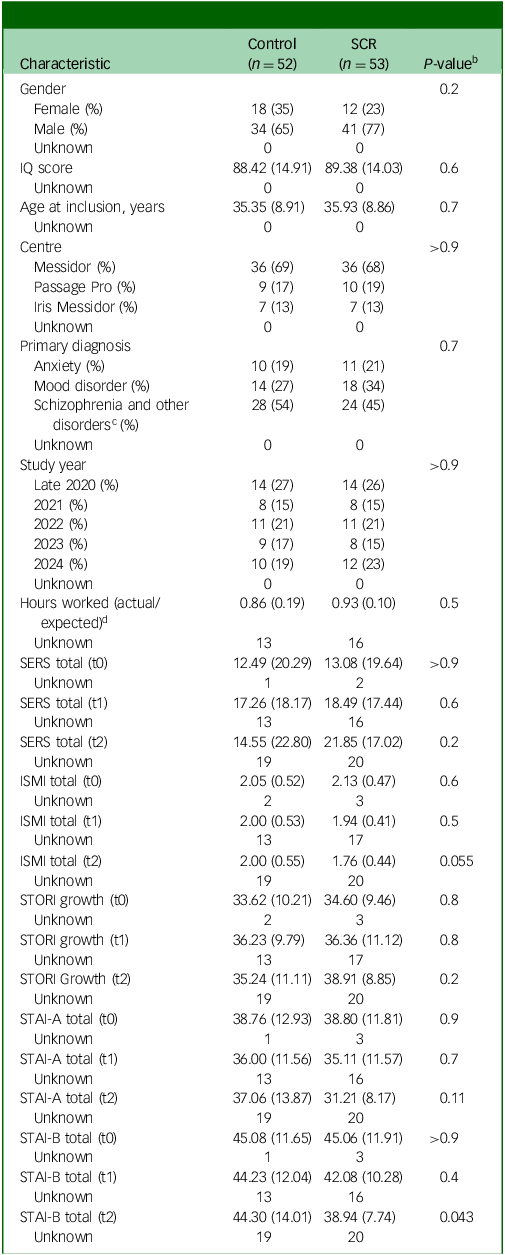
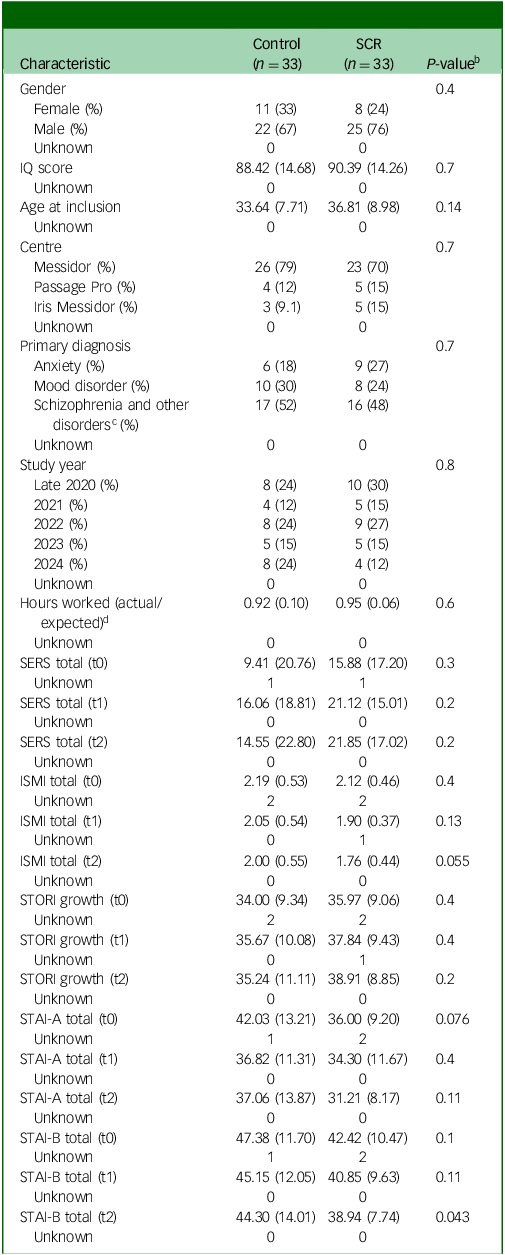
The characteristics of the ITT and per-protocol samples are described in Tables 1 and 2, respectively. Both samples demonstrated a relatively balanced distribution across clinical and demographic dimensions. The ITT sample consisted of 105 participants (SCR: n = 53, control: n = 52) and was characterised by a higher proportion of males (n = 75, 71%), with a mean age of 35.6 years (s.d. = 8.8). Schizophrenia spectrum disorders were the most prevalent diagnosis (n = 50, 48%), followed by mood disorders (31%) and anxiety disorders (20%). The number of missing observations (owing to missed assessments) was relatively low at baseline (3–4 missing observations in patient-reported outcome measures). However, missingness increased longitudinally, with approximately 29 missing observations (28%) at t1 (immediate post intervention), rising to 39 (37%) at t2 (6 months post intervention). Bivariate analysis confirmed group comparability at baseline, with no significant differences between the SCR and control groups regarding sex, global IQ (P = 0.6), age (P = 0.7), centre (P > 0.9), diagnosis (P = 0.7), study year (P > 0.9) or baseline measures of secondary outcomes (P > 0.10). Bivariate analyses indicated no significant differences between groups for the primary outcome and most secondary outcomes at t1 or t2, with the exception of trait anxiety (STAI-B, P = 0.043) and self-stigma (ISMI, P = 0.055) at t2, for which the SCR group had lower scores (Table 1).
Characteristics of the intention-to-treat samplea

Table 1 Long description
The table compares characteristics of a control group (n=52) and an SCR group (n=53) across various dimensions. It includes data on gender, IQ score, age at inclusion, center, primary diagnosis, study year, hours worked, SERS total, ISMI total, STORI growth, STAI-A total, and STAI-B total. Each row provides specific values for both groups and includes a P-value for statistical comparison. For example, the gender distribution shows 18 females (35%) and 34 males (65%) in the control group, compared to 12 females (23%) and 41 males (77%) in the SCR group, with a P-value of 0.2. The table also includes unknown values for various characteristics. Notable trends include the higher proportion of males in both groups and the prevalence of schizophrenia and other disorders as the primary diagnosis.
SCR, social cognition remediation; SERS, Self-Esteem Rating Scale; t0, baseline; t1, immediate post-treatment; t2, 6 months post-treatment; ISMI, Internalized Stigma of Mental Illness; STORI, Stages of Recovery Instrument; STAI, State–Trait Anxiety Inventory (STAI-A, state; STAI-B, trait).
a. Continuous variables indicate the median (interquartile range); categorical variables indicate n (%).
b. All P-values are from Wilcoxon rank-sum test for continuous variables and chi-squared tests for categorical variables and reflect between-group differences.
c. Includes single instances of autism spectrum disorders and antisocial personality disorders.
d. Measured during the 6-month follow-up period.
Characteristics of the per-protocol samplea

Table 2 Long description
The table compares characteristics of a per-protocol sample across control and SCR groups. It has 33 rows and 5 columns. The columns are labeled ‘Characteristic’, ‘Control (n = 33)’, ‘SCR (n = 33)’, and ‘P-value’. The table includes data on gender, IQ score, age at inclusion, center, primary diagnosis, study year, hours worked, SERS total, ISMI total, STORI growth, STAI-A total, and STAI-B total. Each row provides specific values for the control and SCR groups, along with corresponding P-values. Notable trends include the distribution of gender, primary diagnosis, and study year across both groups.
SCR, social cognition remediation; SERS, Self-Esteem Rating Scale; t0, baseline measures; t1, immediate post-treatment measures; t2, 6 months post-treatment measures; ISMI, Internalized Stigma of Mental Illness; STORI, Stages of Recovery Instrument; STAI, State–Trait Anxiety Inventory (STAI-A, state; STAI-B, trait).
a. Continuous variables indicate the median (interquartile range); categorical variables indicate n (%).
b. All P-values are from Wilcoxon rank-sum test for continuous variables and chi-squared tests for categorical variables and reflect between-group differences.
c. Includes single instances of autism spectrum disorders and antisocial personality disorders.
d. Measured during the 6-month follow-up period.
In the per-protocol sample, which included the 66 participants who complied with the protocol (SCR: n = 33, control: n = 33), the demographic profile was consistent with the ITT cohort. The sample showed a similar male predominance (71%) and a mean age of 35.2 years (s.d. = 8.4). As in the larger ITT sample, the groups within the per-protocol cohort remained comparable across all baseline sociodemographic and clinical variables. Notably, the per-protocol analysis maintained the lack of significant differences between groups in terms of the primary outcome and most secondary outcome measures, except for STAI-B (P = 0.043) and ISMI (P = 0.055) scores, which were lower in the SCR patients than in controls at t2 (Table 2).
Participants with missing primary outcome data (n = 29) were comparable with those with complete data (n = 76) across most baseline clinical and sociodemographic characteristics (Supplementary Table 1 available at https://doi.org/10.1192/bjo.2026.12124). The only significant exception was recruitment centre (P = 0.029). Furthermore, a marginal difference was observed in baseline internalised stigma (P = 0.052), with participants in the missing data group reporting slightly lower median scores compared with those with complete data. Finally, participants who completed the full protocol (n = 66) were comparable in terms of their baseline characteristics with those who did not (n = 39) (Supplementary Table 2).
Effects of SCR on primary and secondary outcomes
All analyses yielded stabilised inverse probability weights below 5.1, all of which were classified as non-extreme.
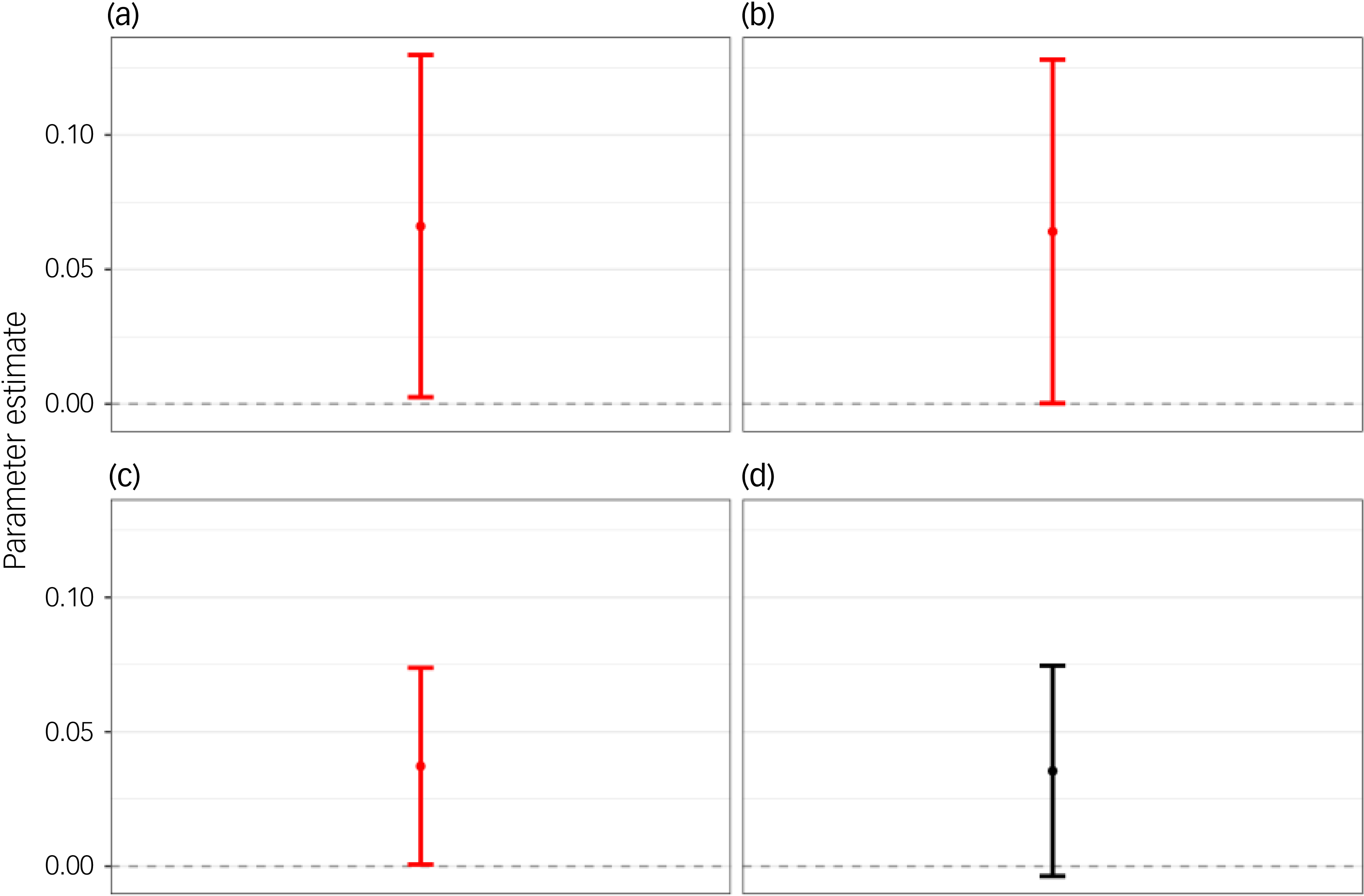
Figure 2 shows the mean parameter estimates and 95% confidence intervals for the comparison between the SCR and control groups regarding the primary outcome measure. The SCR intervention was associated with a higher ratio of hours worked relative to expectations. Specifically, the ITT analysis using IPCW showed a significant treatment effect (mean outcome difference [MOD] = 0.066; 95% CI: 0.002, 0.130; P = 0.042), consistent with the complete-case analysis (MOD = 0.064; P = 0.049). In the per-protocol analysis, the IPCW approach confirmed a significant positive effect (MOD = 0.037; P = 0.046), although the effect size reached only marginal significance in the complete-case per-protocol model (MOD = 0.035; P = 0.076). Notably, these findings were replicated in an ex-post sensitivity analysis that included baseline self-stigma as a covariate instead of recovery. This adjustment was made to account for the marginal difference in internalised stigma at baseline between participants with missing primary outcome data and those with complete data. Finally, Supplementary Figs 1–4 display the monthly mean parameter estimates and 95% confidence intervals over the 6-month post-treatment period. In the ITT analysis, the ratio of hours effectively worked versus expected was significantly (or marginally) higher in the SCR arm than in the control arm from the second month post intervention onwards (P < 0.10), with the exception of the fourth month.
Effect of SCR versus control on the primary outcome: mean difference in ratio of actual to expected work hours (measured during the 6-month follow-up period). (a) ITT: IPCW; (b) ITT: complete case; (c) per protocol: IPCW; (d) per protocol: complete case. Red indicates estimates that are statistically significant (P < 0.05). IPCW, inverse probability of censoring weights; ITT, intention-to-treat; SCR, social cognition remediation.

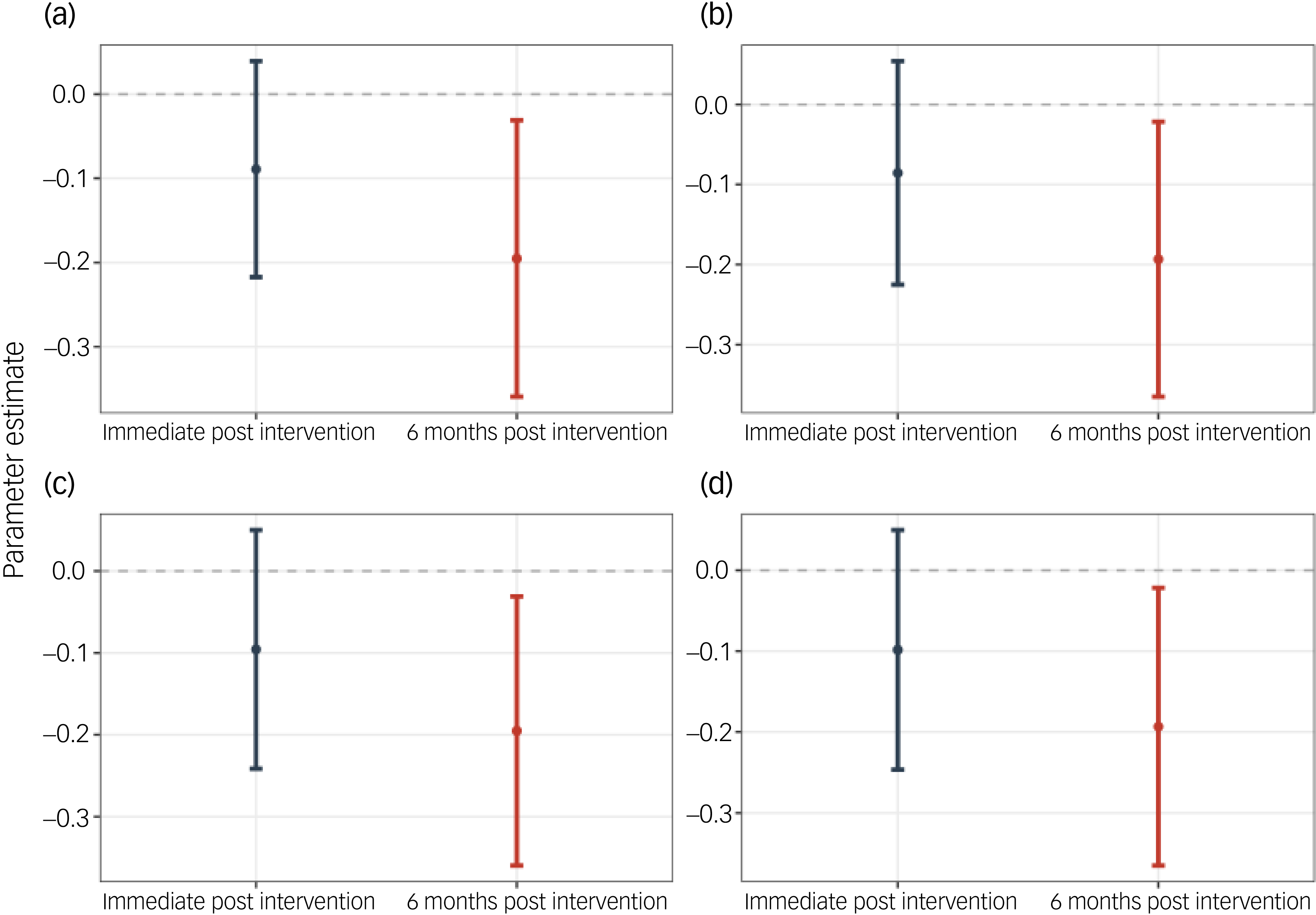
Figure 3 and Supplementary Figs 5–8 display the mean parameter estimates and 95% confidence intervals for the comparison of SCR versus control for the secondary outcomes. Regarding internalised stigma, we found a significant reduction in ISMI total scores in the SCR arm compared with the control arm 6 months post intervention (t2). This effect was consistent across all models (MOD = −0.19, P = 0.03). No significant differences in ISMI scores were observed immediately post intervention (t1). For all other secondary outcome measures, including recovery, self-esteem, and state and trait anxiety, no significant treatment effects were observed at either t1 or t2 across any of the analysed models. Finally, no significant differences were observed between the SCR and control groups for any social cognition measures at either t1 or t2.
Effect of SCR versus control on self-stigma (Internalized Stigma of Mental Illness total score) measured at 6 months post intervention. (a) ITT: IPCW; (b) ITT: complete case; (c) per protocol: IPCW; (d) per protocol: complete case. Red indicates estimates that are statistically significant (P < 0.05). IPCW, inverse probability of censoring weights; ITT, intention-to-treat; SCR, social cognition remediation.

Discussion
This RCT evaluated the efficacy of a 12-week SCR programme on work-related and patient-reported outcome measures in a clinical sample of individuals with SMI enrolled in sheltered employment programmes. Our findings provide evidence that targeted social cognitive intervention can yield meaningful improvements in functional outcomes. Our primary analysis on the ratio of hours effectively worked versus expected revealed a significant positive shift in labour participation of the SCR group in both the ITT and per-protocol analyses. The temporal analysis further suggested that this benefit emerged as early as the second month after the intervention and remained relatively stable throughout the follow-up period. Regarding our secondary outcomes, only internalised stigma demonstrated a significant improvement in the SCR relative to the control arm, and this effect was observed only at 6-month follow-up (t2). Although our hypothesis was that improvements might be seen across all secondary outcomes, other measures including self-esteem, recovery and anxiety showed non-significant changes. Nevertheless, our results suggest that SCR may be a valuable adjunct to sheltered employment programmes.
We observed increases in the ratio of hours worked of six percentage points in the ITT analysis and three percentage points increase in the per-protocol analysis. These changes were relatively modest but may represent increased reliability, higher monthly earnings, job maintenance and improved workplace integration, especially at the population level. In addition, these results were obtained in comparison with an active control group receiving 12 psychoeducation sessions, an intervention that has previously been shown to improve functional outcomes. Reference Xia, Merinder and Belgamwar44 Nonetheless, such modest effect sizes must be contextualised within the broader landscape of vocational psychiatric interventions and the substantial resources required to deliver social cognition remediation. As this intervention was embedded within a structured sheltered employment programme, the observed gains cannot be uncoupled from that supportive infrastructure. Future research should evaluate whether the resource-intensive nature of this delivery model yields a sufficient return on investment compared with alternative approaches such as IPS.
There was a plausible link between the effects of SCR on both job maintenance and self-stigma in our study, which could be explained by two opposite, non-mutually-exclusive mechanisms. First, SCR may directly decrease self-stigma by equipping patients to detect, navigate and cope with complex social cues, including the negative social perceptions associated with mental disorders. As participants become less vulnerable to the labelling and subsequent social withdrawal that often follow a diagnosis, they may find it easier to maintain a presence in professional environments, thereby increasing their effective time spent at work. Conversely, improved work performance may be a direct consequence of SCR, as it could be facilitated by more synchronous interactions with colleagues, better conflict resolution and a more accurate interpretation of workplace social norms. Such professional improvement serves as tangible, real-world evidence of competence in fulfilling occupational duties. As patients receive positive reinforcement through successful workplace integration, this also reinforces their identity as contributing members of society, eventually leading to the significant reduction in self-stigma scores observed at the 6-month follow-up. Although the limited sample size precluded a formal mediation analysis, the temporal precedence of vocational improvements suggests that enhanced work outcomes may establish the necessary foundation for a subsequent reduction in self-stigma, rather than the other way around. This delayed effect implies that the psychological benefits of social cognitive training may require a consolidation period during which participants must apply newly acquired social skills before their internal self-concept begins to undergo a measurable shift.
Our findings are consistent with and build on a complex body of literature on the impact of cognitive remediation programmes. Certain social cognition programmes have been shown to improve time spent and interaction with others, Reference Hasson-Ohayon, Mashiach-Eizenberg, Avidan, Roberts and Roe25 whereas others have struggled to show clear functional transfer. Reference Nahum, Lee, Fisher, Green, Hooker and Ventura26 A primary distinction of the current study lies in the duration and specificity of the investigated intervention. Many successful programmes, such as cognitive enhancement therapy, are highly specialised and quite long, often lasting more than a year. Reference Schutt, Xie, Mueser, Killam, Delman and Eack28 The literature also focuses on ‘broad spectrum’ programmes that mix neurocognitive and social cognitive training. In the current study, we demonstrate that a focused, 3-month social cognition programme, without a neurocognitive component, had a significant effect on objective work metrics and subjective self-stigma. This adds weight to the argument that social cognition is a primary driver of functional outcome, independent of basic cold cognition. Reference Fett, Viechtbauer, Dominguez, Penn, van Os and Krabbendam23 Finally, our results reinforce the premise that cognitive remediation programmes remain effective when delivered within the context of sheltered employment, Reference Cervello, Dubreucq, Trichanh, Dubrulle, Amado and Bralet14 rather than being limited to supported employment models such as IPS. Reference McGurk, Mueser and Pascaris16
Strengths and limitations
The primary strength of this study was the RCT design and inclusion of high-quality control group. By providing the control arm with both sheltered employment and psychoeducation sessions, we ensured that the observed effects in the SCR group were due to the social cognitive training itself, rather than increased attention or general vocational support. Furthermore, we used IPCW, a state-of-the-art statistical approach to handle missing data that reduces the bias often found in simple complete-case analyses.
Despite these strengths, several limitations must be acknowledged. First, the relatively small sample size necessitates caution in interpretation of our findings. In particular, the observed change in the primary outcome was smaller than that proposed in our initial power calculation, suggesting the trial may have been underpowered to reliably detect an effect of this magnitude. The small sample also made it impossible to robustly perform mediation or moderation analyses, which would have clarified the ‘how’ and ‘for whom’ of the intervention. Second, high attrition rates represented a significant challenge in this sample. Drop-out was likely to have been exacerbated by the COVID-19 pandemic, which disrupted the routines of patients, clinicians delivering the sessions and research assistants coordinating the trial. In addition to pandemic-related factors, attrition was driven by participant resignation from the sheltered employment programme and general issues with protocol adherence. To mitigate these challenges in future iterations, the programme could be adapted to allow participants to continue the intervention post-resignation – for instance, through their community mental health centres – or by introducing micro-financial incentives to bolster engagement. Although IPCW was used to mitigate this bias, it cannot fully serve as a substitute for a more robust participant retention rate. Third, our sample exhibited heterogeneity in terms of diagnostic composition, with 20% of primary diagnoses classified as anxiety disorders (which are generally characterised by a milder disease profile) and single instances of autism spectrum disorder and antisocial personality disorder. Fourth, cognitive gains may diminish over time, potentially leading to a decline in work performance. Reference McGurk, Mueser, Xie, Feldman, Shaya and Klein18 Whether our work gain of six percentage points would persist beyond the study period, or whether booster sessions would be required to maintain the effects, remains to be determined. Fifth, although our primary metric was the ratio of hours worked versus expected, we did not specifically isolate other dimensions of work-related outcomes, such as the transition to competitive employment. Sixth, fidelity to the SCR interventions was not formally measured; this may have introduced variability in how the intervention was delivered. Seventh, the absence of dedicated feasibility and acceptability data restricted our understanding of how well the intervention was received by both patients and clinicians.
Given these strengths and limitation, our findings should be considered to be preliminary. Future research employing larger cohorts is warranted to confirm the robustness of our results and to formally delineate the mediational pathways between social cognitive training, vocational success and mitigation of self-stigma.
Supplementary material
The supplementary material is available online at https://doi.org/10.1192/bjo.2026.12124
Data availability
The data supporting the findings of this study cannot be made publicly available. Further inquiries regarding the data used in the study may be directed to the corresponding author. The code used for data analysis is available via GitHub at https://github.com/gbarbalat/RemedEmploi.
Acknowledgements
Artificial Intelligence use: No artificial intelligence tools have been used in the research or writing process for this manuscript.
Author contributions
S.C. and N.F. conceived and designed the study; G.B. developed the methodology and performed the data analysis; J.P. and M.-C.B. assisted with data collection; N.F. supervised the project and provided critical feedback; and G.B. wrote the initial draft. All authors reviewed and edited the manuscript and approved the final version.
Funding
This study was supported by a grant from the French Ministry of Health’s Directorate General for Care Offer (Direction Générale de l’Offre de Soins, DGOS), via the National Hospital Clinical Research Program (PHRC-N 2018 Call for Projects) under reference PHRC-2018_18-0154.
Declaration of interest
None.



 Open access


eLetters
No eLetters have been published for this article.