


Introduction
In some plant species there are marked differences in salt tolerance during germination and subsequent stages of vegetative and reproductive development (Colomba et al. Reference Colomba, Tommasino, Luna, Griffa, Carloni, Ribotta, Quiroga and Grunberg2013). Colobanthus quitensis Kunth (Bartl.) occupies numerous habitats and colonizes a range of sites including waterlogged seepage areas which occasionally fill with seawater (Smith Reference Smith2003). However, studies on the ability of this species to tolerate salinity are lacking. Recently, we reported a previously undescribed population ‘La Marisma’ near Punta Arenas (53°22'S, 70°58'W), Chile, living in a salt marsh covered by brackish water at high tide (Cuba-Díaz et al. Reference Cuba-Díaz, Acuña, Klagges, Dollenz and Cordero2013). Using this population, we performed the first study of the effect of salinity on C. quitensis.
Methods
Seeds and in vitro plantlets collected from plants propagated in controlled conditions were used for the salt tolerance tests. To disinfect the seeds, they were washed with 70% ethanol for 30s, followed by 7 min in 10% commercial bleach (NaOCl 35 gl-1) and then they were washed three times with sterile deionized water. Sterilized seeds were placed in Petri dishes with MS (Murashige and Skoog) medium and 3% sucrose at pH 5.7, and NaCl solution was added to achieve a final concentration of 0 (control), 50, 100, 150 or 200 mM. Individual plantlets with 3–4 pairs of leaves and 2 mm of root tissue were placed in MS medium (Cuba-Díaz et al. Reference Cuba-Díaz, Acuña, Cordero and Klagges2014) at the same NaCl concentrations. Both seeds and plantlets were maintained in a growth chamber under 16 h/8 h light/dark periods (45 µmol m-2 s-1) at 20±2°C. Germination and survival rates (%) were evaluated. New shoots, root development (positive ones), chlorosis, plantlet death and floral apex appearance (negative ones) were measured at 28 days (Cuba-Díaz et al. Reference Cuba-Díaz, Acuña, Cordero and Klagges2014). All experiments were randomized using three replicates per treatment and an experimental unit of 13 seeds per Petri dish or six plantlets per culture flask. Statistical differences between treatments were evaluated using a one-way ANOVA and Tukey’s honest significant difference test using STATISTICA v. 6.0. An arc-sine transformation was applied to normalize data for new shoots, root development, chlorosis and floral apex appearance. Data are presented as mean±standard deviation. Graphs were developed using GraphPad Prism demo v. 6.0 for Windows (GraphPad Software, La Jolla, CA).
Results
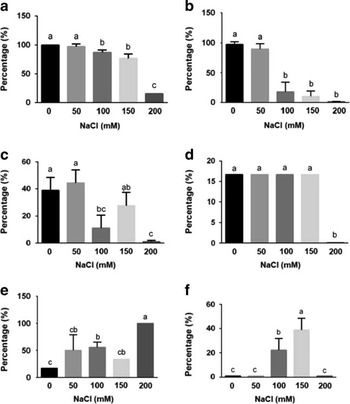
Germination decreased as NaCl concentration increased, and decreased significantly compared with control at concentrations ≥100 mM (Fig. 1a). Seedling survival decreased significantly at concentrations ≥100 mM, and was 0% at 200 mM when no true leaves were observed (Fig. 1b). The highest rate of new shoot growth was observed at 50 mM NaCl (44.4%; Fig. 1c). At 100 mM NaCl, the new shoot growth rate was significantly lower than for controls, and there were no new shoots at 200 mM. In contrast, the growth rate at 150 mM NaCl was not significantly different to controls. Root growth was very low for all treatment conditions (Fig. 1d), and there was no root development observed at 200 mM. Symptoms of leaf chlorosis were observed for <50% of plantlets in all treatment conditions, except for 200 mM, where 100% of plantlets showed chlorosis (Fig. 1e). Symptoms were generally observed on basal leaves; however, at 200 mM several leaves showed a light green coloration. Moreover, at 28 days, chlorosis was observed on both basal and apical leaves (data not shown). Some floral apices were observed at 100 and 150 mM NaCl, but not at 200 mM, when all the plants were chlorotic. None of the NaCl concentrations in our study caused plant death. Chlorotic plants recovered when they were moved to a medium without NaCl (data not shown).
Effects of NaCl salinity on a. germination, b. seedling survival, c. new shoot formation, d. root development, e. leaf chlorosis and f. floral apex appearance in C. quitensis in in vitro culture. Germination and seedling survival were evaluated for 28 days (mean ± standard deviation). Significant differences between treatments are indicated by different letters (P<0.05).

Discussion
Previous studies have shown that germination decreases as salt concentrations increase, even in plants that inhabit high salinity soils or are relatively salt-resistant (Tlig et al. Reference Tlig, Gorai and Neffati2008, Kazemi & Yadegari Reference Kazemi and Yadegari2015). Gebauer et al. (Reference Gebauer, El-Siddig, Salih and Ebert2004) demonstrated that in Tamarindus indica L. seedling growth was slightly affected at low NaCl concentrations, but markedly reduced at higher concentrations. At high salt concentrations, seedling survival is favoured over germination, a mechanism important to the successful establishment of plants. However, in C. quitensis both parameters were significantly affected at ≥100 mM NaCl. This may be due to the study conditions in which survival was evaluated in seedlings obtained from seeds germinated in the presence of salt.
In previous research, concentrations ≥100 mM NaCl caused reductions in leaf area, root length and relative growth rate for Cenchrus ciliaris L. genotypes (Colomba et al. Reference Colomba, Tommasino, Luna, Griffa, Carloni, Ribotta, Quiroga and Grunberg2013). In C. quitensis, growth was only severely affected at 200 mM. This may indicate that these concentrations are toxic to cell metabolism, inhibiting cell division, for example.
In T. indica, chlorosis was observed even at low NaCl concentrations, progressing from tips to leaflet margins (Gebauer et al. Reference Gebauer, El-Siddig, Salih and Ebert2004), while for C. quitensis it began in the basal leaves. Chlorosis in the base and/or apex of the leaves may be due to accumulation of Na+ and Cl- ions in these regions (Gebauer et al. Reference Gebauer, El-Siddig, Salih and Ebert2004). Similar results were shown in Deschampsia antarctica (Ruhland & Krna Reference Ruhland and Krna2010) and C. ciliaris (Colomba et al. Reference Colomba, Tommasino, Luna, Griffa, Carloni, Ribotta, Quiroga and Grunberg2013) without chlorotic leaves but with decreasing vegetative growth. Both species are considered to be moderately salt tolerant. Our results do not allow us to categorize C. quitensis as salt tolerant; however, we tentatively propose that it is moderately salt tolerant.
Acknowledgements
This study was supported by the Vicerrectoria de Investigación y Desarrollo at the Universidad de Concepción (Grant VRID 213.418.004-1.0). The authors thank International Journal Revisions (http://www.journalrevisions.com) for the final English language revision and also extend thanks to the anonymous reviewers.
Author contributions
Planning by MC and AM; data collection and analysis by MC, DA, AM and IC; manuscript preparation by MC, KC and AM.