INTRODUCTION
Based on a series of randomized clinical trials (RCTs), the American Society of Clinical Oncology consensus statement recommends “…the integration of palliative care services into standard oncology practice at the time a person is diagnosed with metastatic or advanced cancer” (Smith et al., Reference Smith, Temin and Alesi2012). However, researchers conducting these studies often spent significant time trying to “win over” oncologists and prevent “gate-keeping” (Bakitas et al., Reference Bakitas, Lyons and Dixon2006, 2009a). Because few centers have fully implemented palliative care, little is known about how oncologists will view their role as new care models are developed.
In 1999, the Norris Cotton Cancer Center (NCCC) conducted Project ENABLE (Educate, Nurture, Advice, Before Life Ends), to bring hospice concepts into the care of advanced cancer patients early in their disease.(Bakitas et al., Reference Bakitas, Stevens and Ahles2004, Reference Bakitas, Ahles and Skalla2008) Subsequently, an RCT (ENABLE II; NCI R01 CA530191) compared this approach to usual oncology care. Over the ensuing 6 years, the RCT and an interdisciplinary inpatient/outpatient palliative care service became well integrated into the routine care of patients newly diagnosed with an advanced cancer. To better understand oncologists' perspectives about concurrent oncology palliative care, we conducted a qualitative study to explore and understand oncology physician and nurse practitioner perspectives on the care of advanced cancer patients and their caregivers, and the ENABLE II RCT.
METHOD
Design
This RCT supplementary study was guided by a qualitative descriptive approach (Sandelowski, Reference Sandelowski1996; Polit & Beck, Reference Polit and Beck2005) and was approved by the NCCC/Dartmouth College and the Veterans Administration Medical Center (VAMC) institutional review boards.
Participants and Setting
All NCCC and VAMC oncology clinicians (oncology, hematology, and radiation oncology physicians and nurse practitioners) (n = 38) at the ENABLE II study sites were invited to participate in individual in-person, digitally recorded, semistructured interviews. The NCCC, a National Cancer Institute (NCI)-designated cancer center in Lebanon, New Hampshire, serves ~5200 new and 31,000 total cancer patients per year. The VAMC in White River Junction, Vermont provides healthcare to 94,000 eligible veterans in Vermont and four neighboring counties in New Hampshire.
The ENABLE Palliative Care Intervention and Usual Oncology Care
Half (n = 161) of ENABLE II participants received supportive care services via a nurse-led, phone-based curriculum that consisted of four structured sessions (problem solving, symptom management, advance care planning, and communication skills and education) and monthly follow-up. The other half (n = 161) of the participants received usual oncology care (Bakitas et al., 2009b). Details of the intervention and usual oncology care are described elsewhere (Bakitas et al., Reference Bakitas, Lyons and Hegel2009a, Reference Bakitas, Lyons and Hegel2009b).
Measures/Interviewer Training
The authors constructed an interview guide based on a literature review and input from an oncologist and oncology nurse practitioner. The definition of “advanced cancer” mirrored ENABLE II eligibility criteria:
…advanced stage IIIb or IV, metastatic or recurrent cancer… not likely to be cured …may be receiving investigational or standard [treatments for] disease control or palliation; prognosis 2 years or less…
The interview guide was pilot tested with two former oncologists and revised. We modified the definition of “advanced cancer” as “disease that has become refractory to therapy,” rather than stage III/IV, for hematologist interviews. The interview explored the following topics: clinicians' personal definition of palliative care and approach to advanced stage patients, appropriate patients and referral triggers for palliative care, and experiences with the institutions' palliative care services and the ENABLE II RCT. The latter question was only asked of clinicians whose patients were eligible for the RCT (i.e., those treating lung, gastrointestinal, breast, and genitourinary cancers).
Interviewer training included readings on how to ask non-leading questions and an overview of the study aims and plan. The first author trained the two interviewers. Each interviewer conducted two digitally recorded mock interviews with clinicians who were not part of the study and received immediate feedback to improve interviewing skills.
Data Analysis
Aided by ATLAS.ti Software (V 5.5.9 Berlin, Germany), the first author and two research assistants performed in vivo coding yielding an emerging code list. Coding, recoding, and memo writing were ongoing. Thematic analysis (Sandelowski, Reference Sandelowski2000; Graneheim & Lundman, Reference Graneheim and Lundman2004) progressed through an iterative process of classifying, comparing, grouping, refining, and reducing data into categories and themes. Whenever possible, the participant's language was maintained in code labels and themes. Data trustworthiness was supported through member checking (Graneheim & Lundman, Reference Graneheim and Lundman2004) in which themes were presented to the clinician participants at multiple meetings, yielding general agreement with results.
RESULTS
Sample
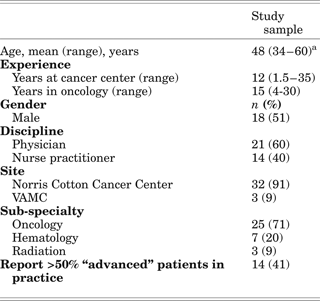
Between September and December 2007, all 38 eligible clinicians agreed to participate and signed informed consent; however, three clinicians were not able to identify a mutually convenient time to schedule the interview (response rate, 90%). Clinician characteristics are listed in Table 1. Mean age was 48 years, half were female, and most were experienced medical oncologists who had practiced at the cancer center for more than a decade.
Clinician demographic characteristics (N = 35)

a Four did not answer
Thematic Results
Results are summarized in Figure 1. The figure demonstrates that concurrent oncology palliative care is embedded in primary care (A). Oncology care (B) is introduced at diagnosis and predominates, but palliative care (C) increases in focus as the disease progresses. Hospice and bereavement care (D) are offered as appropriate, and surviving family members continue to rely on primary care providers for ongoing support (A). Themes and exemplar quotes representing oncologists self-assessments are listed above the concurrent oncology palliative care process depicted in the figure. Themes and exemplar quotes representing oncologists views of palliative care are listed below the concurrent oncology palliative care process depicted in the figure.
(Color online) Oncologists' Self-assessment and Views on Concurrent Palliative Care for Patients with Advanced Cancer: Themes and Exemplar Quotes
Oncologists' Self-Assessment of Advanced Cancer Patient Care
Treating the Whole Patient
Oncology clinicians emphasized a comprehensive approach to advanced cancer patients' physical, emotional, and spiritual consequences of illness. “Care for [advanced] cancer patients includes both supportive and disease-specific care and always attention to quality of life.” Their holistic approach focused on symptom management as a prime concern but also included attention to comfort, relief of suffering, psychosocial support, and some routinely addressed spiritual care. One nurse practitioner stated:
There's the emotional portion…a lot of role change…patients who try to continue to work, and others that just cannot work…employment is really a tricky thing because so many people define themselves by their work…[but] the biggest part, is the symptoms.
Despite feeling that they provided holistic care, most oncologists believed that additional services and a multidisciplinary approach were also needed to provide the best patient care.
Quality versus Quantity of Life Focus
When the goal was clearly palliative, clinicians focused on quality of life in treatment planning: “You just have to be more aware of the potential for short-term symptoms related to the treatment, as a balance against potential for longer-term benefits.” They offered more supportive counseling and quality of life enhancing services such as social workers, chaplaincy, and hospice. They saw the patients more frequently and often called them between appointments. They related a greater awareness of the timing of communication (particularly about prognosis) and taking cues from patients about their readiness to discuss and reframe treatment goals. Conversely, when the treatment goal was curative, they focused less on psychosocial and spiritual issues and tended to encourage patients to tolerate more toxic side effects. Some clinicians believed that their younger less-experienced colleagues might be more aggressive in their approach to patients with advanced cancer.
Some Patients Just Want to Fight
Oncologists stressed that many patients were coming to a comprehensive cancer center for aggressive anticancer treatment and were not interested in hearing about palliation: “Patients come wanting to hear in limited time–‘what are you going to do to help me fight this?'” Several clinicians felt frustrated when they couldn't help a patient shift from “fight” mode to palliation and struggled to follow patients' cues without superimposing their own values onto the patient:
…I'm not sure if it's a bad thing if someone wants to go out fighting… and we should be careful to not be too pushy… It's okay if not every patient has a wonderful death. We need to be more in tune with what the patient wants and needs and take cues from them… not satisfy our own needs.
Patients who insisted on trying treatments that were unlikely to benefit them created inner conflict:
…in patients that are not going to survive their disease, I feel very strongly against dripping things in until the last moment, or their last breath, unless that's absolutely their wish and there's no way you can talk them out of it.
Helping with Transitions; Timing is Everything
Clinicians described the complexity of helping patients transition from disease-focused to palliative treatment. Oncologists often introduced palliative care clinicians as colleagues during a scheduled outpatient oncology visit to allay patients' fears and make palliative care visits less “scary.” They involved palliative care clinicians in symptom management when newly diagnosed patients were hospitalized so that rapport could be established before more sensitive issues arose, such as end-of-life treatment planning. They did, however, feel that individualized, patient-centered timing of palliative care referral was important.
… patients are just so overwhelmed and sort of sensory overloaded and fragile… even though the contribution (of palliative care) can be very meaningful to their lives, sometimes they are just psychologically not ready to have [palliative care] come into their world. Sometimes I feel we may push patients too hard at the wrong time…wanting to have all our T's crossed and I's dotted.
Oncology Clinician Views on Palliative Care and the ENABLE II RCT
“Refer Early and Often”
Most oncologists considered newly diagnosed, advanced-stage patients appropriate for palliative care referral. Other referral “triggers” included patients needing an advocate to navigate the healthcare system, patients needing decision support, and patients with family conflicts or rapidly progressing disease.
I had a young woman with wide spread malignancy that had been growing for a number of years with very little effective systemic therapy [choices left]. She had problems with pain management, cough and dyspnea. We were embarking on a trial of a non-standard but not experimental therapy, and she has a very difficult social situation… I was looking down the road at increasing symptoms, increasing support for dysfunctional family at home in her last six months of life, which I think is not here but approaching fairly soon. I realized this could be much more than I can handle on my own, so I involved Palliative Care (early on) for help with managing all of those things… resetting goals, advanced planning, family support, and pain and dyspnea symptom control questions.
Most clinicians believed in introducing palliative support early. Disease transitions, establishing goals of care, and the need for decision support served as referral triggers:
…when I anticipate that a patient is going to move from disease modifying therapy to pure hospice therapy, it will be helpful to have [palliative care] on board for support and to help me give better case…they can be very useful in reframing the picture…getting the patient to hear from a different perspective that it's time to rethink their goals…especially if I've been frustrated in my attempts to get them to understand where they are.
There were few “negative outcomes” of early palliative referral. Although not identified as “negative,” some difficult situations included: poor timing or lack of patient preparation for the consultation, patients' lack of readiness to face the reality of their situation/prognosis, inability of palliative care to respond in a timely way or follow a patient when they were transferred to hospice or a skilled nursing facility, and if consultation for symptom issues led “prematurely” to end-of-life or “do not resuscitate” discussions:
Negative outcomes are bound to happen because of the nature of the underlying illness … it can be messy and complicated … pain is not always manageable… healing can't always happen because people can't always get there in this lifetime.
Referral Challenges: “Palliative” Equals “Hospice” “Heme Patients are Different”
Clinicians found the label “palliative care” to be a barrier, as patients often equated this with “hospice” and imminent death. “I've had patients say, ‘This is just another word you've come up for Hospice, you are writing me off!’”
Although most hematologists felt favorably about palliative care, they felt the unpredictable nature of hematologic malignancies made it difficult to identify the appropriate time to introduce palliative care. They viewed their patients as generally younger, and having a longer, well-maintained course of illness with greater potential for cure than did solid tumor patients. Hence, there were many missed opportunities because the disease could take a sudden life-threatening turn and palliative care services were introduced late or not at all.
Palliative Care Service Consultant to Co-Manager
Clinicians utilized palliative care services in myriad ways; purely as consultants, requesting “curbside” advice or only limited assistance during tumor board meetings, or they might include them as a co-managers or partners on the patient's care team:
If I can't personally provide the resources…based on time or expertise…sometimes… it's a matter of getting the patient another face, another personality to deal with. [If I] address treatment, side effects and complications of disease, then sometimes it's better to have somebody else deal with the psychosocial and the comfort issues…a lot of times they won't complain [to the oncologist] because they don't want me changing things or feeling as though they are not doing well.
If patients' needs become primarily symptom control, the oncologist might “step back” and have palliative care see them more frequently. However, oncologists were clear that they did not wish to give up the care of the patient and did not want the patient to feel abandoned (by the oncologist). A benefit of involving palliative care clinicians early as co-managers was to avoid abrupt transitions, which might be perceived as being abandonment. Common co-management requests included difficult physical problems, pain management, constipation, nausea, bowel obstruction, anxiety, delirium, and depression. One clinician described a particularly challenging situation:
I had one lady that I treated for about six years and at the end of life she had to be hospitalized and Palliative Care had been involved all along so that was really great for us and the family. It was not a good family dynamic, and she required total Palliative sedation at the end-of-life. We are just not capable of doing that in an outpatient setting, so it was great that the team all knew her, the family knew them. The mom was in active treatment for recurrent cancer, so there's a great opportunity there as well. We could not have managed her unless she was brought in under their supervision…
Clinicians also requested palliative care consultation to manage difficult symptoms in patients who were likely to be cured (e.g., during acute stem cell transplantation admissions).
Requests for non-symptom management consultation involved advance care planning, identifying or reframing goals of care (particularly in patients or families that were having difficulty accepting the reality of the prognosis), difficulty with coping, or complex social situations. Clinicians noted that since the initiation of palliative care services, advance care planning, end-of-life discussions, legacy work, estate planning, life completion, and referral to hospice and other community resources occurred more frequently.
Palliative Care “Shares the Load”
Whether palliative care was involved as a consultant or co-manager, clinicians relied on palliative care services to “share the load” of patients with complex care needs. A shared approach (including referral to pastoral care counselors; social workers; massage, music, art, or writing therapy, and volunteer services) was particularly appreciated when the oncologist lacked the time or expertise to meet the holistic needs of the patient and family. One oncologist believed that fewer patients would choose high risk, toxic chemotherapy if there was more time for a shared decision-making approach reviewing all possible options.
Oncologists felt especially supported by having palliative care nurse practitioners working beside them in the oncology clinic. “They just have such an intuitive sense of what's needed and when, and how to say something in the best possible way.” They described the services as “integrated and seamless” and “… part of standard management.” Superlatives were common including: stellar, outstanding, proactive, present, always available, phenomenal, enlightening, educational, thorough, holistic, responsive, and excellent communicators.
ENABLE Facilitated Integration
Oncology clinicians who referred their patients to the ENABLE II RCT had very positive impressions of the intervention:
It did provide a lot of aspects of palliative care, not just the medical symptom management, but support to the care giver and spiritual aspects of illness” and “It's always nice to have someone to talk to and that's one of the great things about the ENABLE intervention… there's been another pair of ears… it's a more multi-disciplinary approach for patients.
Another clinician specifically commented on the value of delivering the intervention primarily by telephone: “My sense is that they did a lot more phone support than clinical support… which I think is vital for a pocket of our population… the phone support is tremendous… a valuable service.”
Several clinicians spoke about their belief that it promoted earlier access to the Palliative Care Team:
…that's the challenge-when do you do it? When is a good time? … palliative care is something that theoretically could be initiated at diagnosis. But I think that we tended to wait until later, which might not have been the best thing to do … so, I think when everyone was being enrolled in ENABLE, it was more in my mind to refer, even if the patient wasn't a good fit for ENABLE, or refused to go to ENABLE, it would keep it in my mind that, hey, I've got all these great palliative care people that can help that patient.
DISCUSSION
To our knowledge, this is the first study describing oncologists' experiences of caring for advanced cancer patients in a well-integrated concurrent oncology palliative care environment. Oncology clinicians described their care of advanced cancer patients as holistic and focused more on quality of life than quantity of life. They believed this care somewhat differed from care with curative intent. They felt challenged when advanced stage patients wished to focus only on fighting the disease and declined discussions regarding palliation or end-of-life planning. The clinicians recognized the value of helping patients transition to a palliative focus, but acknowledged that this must be done sensitively, with much attention to timing. Possibly, the introduction of concurrent care through a carefully and rigorously conducted demonstration project and RCT may have served as a nonthreatening approach in an oncology practice that recognizes the importance of clinical trials to the development of evidence-based practice. Following the study, most clinicians viewed early introduction of palliative care favorably and, for some solid tumor patients, introduced the availability of palliative services as part of the standard disease pathway.
In contrast to other studies documenting late palliative care and hospice referral (Morita et al., Reference Morita, Akechi and Ikenaga2005), these clinicians identified a new advanced cancer diagnosis as a primary referral trigger. However, hematologists had more difficulty identifying “the right time” for a palliative referral because acute complications could cause abrupt transition to end of life. Others have noted this barrier to palliative care referral for hematology patients (McGrath & Holewa, Reference McGrath and Holewa2007; Larochelle et al., Reference Larochelle, Rodriguez and Arnold2009).
Palliative care referrals generally resulted in positive outcomes except when patients were not ready, lacked preparation for referral, or associated palliative care with hospice. As noted by others (Fadul et al., Reference Fadul, Elsayem and Palmer2009), the “palliative care” label could be a barrier. Clinicians in this study reduced this barrier by normalizing palliative care, introducing the concept early, and recognizing it as the standard of care. Of interest, a recent public opinion poll found that only 8% of consumers were “knowledgeable” about palliative care (Center to Advance Palliative Care, 2011). However, oncologists who were polled also report a similar lack of knowledge about the range of services provided by palliative care compared with hospice (Mahon & McAuley, Reference Mahon and McAuley2010); therefore, it is not surprising that many patients were also unaware that palliative care could be helpful early in the disease trajectory. With the American Society of Clinical Oncology (ASCO) consensus statement (Smith, et al., Reference Smith, Temin and Alesi2012), this approach may be adopted by other centers.
Oncologists in this study utilized palliative care clinicians as consultants and co-managers. They appreciated their assistance at tumor boards, team meetings, inpatient care, and especially in the outpatient clinic. Clinicians felt that palliative care shared the load of the care of patients with complex social situations, uncontrolled pain, and other symptoms. They valued the interdisciplinary approach and the contributions of social work, pastoral care, and healing arts members of the palliative care team. Clinicians who referred patients to ENABLE II valued the intervention and credited the RCT for promoting acceptance of the concurrent model of oncology palliative care.
The concepts of “time” and “timing” permeated the clinician responses. Oncology clinicians appreciated the extra time that palliative care was able to provide to medically or socially complex patients and families. They also recognized the importance of appropriately timed conversations. Palliative care was more likely to be received well if it was introduced skillfully when the patient was ready.
The clinicians derived personal benefits from palliative care assistance when negotiating difficult conversations with patients and families. There is a substantial literature documenting the lack of preparation and discomfort that many oncologists experience in communicating about prognosis and the transition to non-disease focused care (Cherny & Catane, Reference Cherny and Catane2003). Oncologists' lack of training or personal discomfort with these topics may cause them to avoid or obfuscate communication about end-of-life care, even when treatments are no longer effective and death is near or inevitable (Buss et al., Reference Buss, Lessen and Sullivan2007; Rodriguez et al., Reference Rodriguez, Gambino and Butow2007; von Gunten, Reference von Gunten2008). Consequently, patients may undergo unwanted aggressive treatments when they do not realize their poor prognosis (Earle et al., Reference Earle, Landrum and Souza2008), and many are referred late to hospice or other palliative resources that could provide needed care and reduce suffering (Lamont & Christakis, Reference Lamont and Christakis2002; Ferrell, Reference Ferrell2005; Morita et al., Reference Morita, Akechi and Ikenaga2005; Wetle et al., Reference Wetle, Shield and Teno2005; Lofmark et al., Reference Lofmark, Nilstun and Bolmsjo2007).
Poor communication about serious illness may also have consequences for oncologists. Frustration and stress of limited time and skill in communication may lead to burnout and professional “caregiver fatigue,” and some oncologists may even choose to leave the field (Grunfeld et al., Reference Grunfeld, Whelan and Zitzelsberger2000; Kash et al., Reference Kash, Holland and Breitbart2000). Some clinicians derive satisfaction from learning skillful communication, whereas others may be less comfortable with their skills or prefer to communicate with their patients primarily from a biomedical approach. The latter often report less job satisfaction (Jackson et al., Reference Jackson, Mack and Matsuyama2008; von Gunten, Reference von Gunten2008). Educational strategies and interventions to improve clinician communication skills, including sharing bad news, active listening, promoting shared decision-making, and sensitively assisting patients and families who are in a curative–palliative transition (Baile et al., Reference Baile, Buckman and Lenzi2000; Fallowfield et al., Reference Fallowfield, Jenkins and Farewell2002; Back et al., Reference Back, Arnold and Tulsky2003; Fallowfield et al., Reference Fallowfield, Jenkins and Farewell2003) may have an additional personal benefit for some oncologists.
Limitations
The duration and depth of palliative care integration in this setting is atypical of oncology practices in the United States. Also, the oncology physicians and nurse practitioners practice in a team model, which may also have influenced their perceptions. This study took place in a rural, tertiary care, academic, NCI-designated cancer center with clinicians and patients who are ethnically and racially homogeneous. The culture change that was apparent following the project may be more difficult to achieve in larger, more complex healthcare systems.
CONCLUSION
The results of this study have implications for both practice and research. It is obvious that successful integration of palliative care research and clinical services requires close involvement of the practicing oncologist. There needs to be flexibility of palliative care involvement such that oncologists have an opportunity to maintain the level of care intensity that they wish to have. There needs to be a shared vision of the integrated care model and how to measure successful integration. The beneficial impact of palliative care services on patients and their families has been the subject of a growing body of research (Engelhardt et al., Reference Engelhardt, McClive-Reed and Toseland2006; Bakitas et al., 2009; Temel et al., Reference Temel, Greer and Muzikansky2010; El-jawahri et al., Reference El-jawahri, Greer and Temel2011). However, the impact of a concurrent care model on oncology clinicians has received very little attention. Future research should include the impact of an integrated model on clinicians' performance, job satisfaction, and communication skills. These indirect yet important outcomes have not been routinely or systematically assessed. However, they are likely to have considerable influence on the quality of patient care and overall satisfaction for both patients and their oncology clinicians.
ACKNOWLEDGMENTS
Special thanks to Julie Wolf, Luann Graves, and Daphne Ellis for project coordination. The authors also thank the NCCC and VAMC physician and nurse practitioner faculty staff for their participation and their many years of support of the palliative care research and clinical initiatives. This study was funded by NCI/R01 CA530191 and Norris Cotton Cancer Center/Prouty Pilot Grant.