Introduction
Mass-rearing tephritid fruit flies for sterile insect technique (SIT) programmes is becoming increasingly common around the world. The success of established programmes, especially those targeting the Mediterranean fruit fly Ceratitis capitata (Wiedemann) and the melon fruit fly Bactrocera cucurbitae (Coquillett), has encouraged researchers to investigate the possibility of mass-rearing other tephritid pest species. Although species vary in the technical details required for successful mass-rearing, a potential problem common to all these efforts is that the mass-rearing environment exerts selection pressures different from those of the wild environment. Any mass-rearing effort will be affected by genetic adaptation to the mass-rearing environment (Woodworth et al., Reference Woodworth, Montgomery, Briscoe and Frankham2002; Frankham, Reference Frankham2008) and, to a lesser extent, by inbreeding (Crnokrak and Roff, Reference Crnokrak and Roff1999) and genetic drift (due to finite population size). Even when efforts are made to make the artificial environment as benign as possible, considerable adaptation may still occur (Sgro and Partridge, Reference Sgro and Partridge2000; Gilligan and Frankham, Reference Gilligan and Frankham2003). Therefore, mass-rearing inevitably produces strains that are increasingly divergent from their wild counterparts (Bush et al., Reference Bush, Neck and Kitto1976; Woodworth et al., Reference Woodworth, Montgomery, Briscoe and Frankham2002).
However, in the case of mass-rearing for the release of sterile insects, some aspects of the adaptation to captive breeding are desirable. In particular, increased fecundity, survival on artificial media and adaptation to alternate oviposition substrates improve the economic viability of the mass-rearing facility. Studies of the domestication of various tephritid species have consistently shown that as domestication proceeds, flies develop a shortened preoviposition period and increase egg production (Vargas and Carey, Reference Vargas and Carey1989; Meats et al., Reference Meats, Holmes and Kelly2004; Ekesi et al., Reference Ekesi, Nderitu and Chang2007; Hernandez et al., Reference Hernandez, Toledo, Artiaga-Lopez and Flores2009; Diamantidis et al., Reference Diamantidis, Carey, Nakas and Papadopoulos2011).
Balanced against these gains are the adverse effects of domestication on field performance. For example, in Bactrocera species, changes in life history traits have been documented (e.g. Miyatake, Reference Miyatake1998; Meats et al., Reference Meats, Holmes and Kelly2004), e.g. significant change in courtship behaviour (Matsuyama and Kuba, Reference Matsuyama and Kuba2009) and reduced dispersal ability (Gilchrist and Meats, Reference Gilchrist and Meats2012) and longevity compared with those of wild flies (Nakamori and Soemori, Reference Nakamori and Soemori1981). Adverse impacts on field performance have also been documented in Anastrepha (e.g. Rull et al., Reference Rull, Brunel and Mendez2005) and in C. capitata (Cayol Reference Cayol, Aluja and Norrbom2000; but see McInnis et al., Reference McInnis, Lance and Jackson1996).
Restoring a more wild-type phenotype in mass-reared strains involves either complete strain replacement (e.g. Ahrens et al., Reference Ahrens, Hofmann, Goodenough and Peterson1976) or outcrossing the existing mass-reared strain; whichever process is used, it should be noted that the same selective processes that produced a poorly performing strain in the first place will eventually have the same effect on a new strain, and thus eventually all strains must be replaced. Surprisingly, only two published studies have investigated the utility of outcrossing. Shelly (Reference Shelly2001) hybridized a mass-reared strain of C. capitata with wild flies and restored near-wild mating ability. After a further 10 generations, performance had declined to that of the mass-reared strain. Rull and Barreda-Landa (Reference Rull and Barreda-Landa2007) hybridized a mass-reared strain of Anastrepha ludens (Loew) with wild flies and found that hybrids combined the higher mating success of wild flies with the increased egg production of the mass-reared strain. These two studies indicated that outcrossing has the potential to maximize the benefits of increased productivity while minimizing the adverse genetic effects of adaptation to a new environment. The effectiveness of genetic approaches to strain improvement has also been demonstrated by McInnes et al. (Reference McInnes, Shelly and Komatsu2002), who used selection in field cages to rapidly improve male longevity and competitiveness.
The objective of the present study was to investigate how outcrossing could be used, in a practical way, to improve the mass-reared strain of the Queensland fruit fly Bactrocera tryoni (Froggatt). Our experimental aims were guided by the following two precepts: (i) any mass-reared strain (including a hybrid strain) will deteriorate over time and need replacement (Shelly, Reference Shelly2001), and therefore the ease of renewing the hybrid strain is a priority; and (ii) repeated collections of large numbers of wild flies for hybridization may be difficult or costly. Consequently, we specifically investigated whether outcrossing to strains that had already been partially domesticated yielded the same gains as outcrossing to wild flies.
Materials and methods
The mass-reared strain used in the experiments carried out in this study, referred to as the ‘Factory’ strain, was obtained as pupae directly from the Fruit Fly Production Facility located near Sydney, NSW, Australia. Using DNA microsatellite analysis, Gilchrist et al. (Reference Gilchrist, Sved and Meats2004) showed that the mass-reared strain of B. tryoni was inbred and genetically distinct from wild populations. Samples taken from the mass-reared strain used in the period 1999–2005 and a replacement strain produced in 2005 revealed that both were inbred when compared with wild B. tryoni: heterozygosity of 0.42 compared with 0.62 for wild populations (Gilchrist, Reference Gilchrist2010; A.S. Gilchrist and B.C. Dominiak, unpublished observations). Another highly domesticated strain used in these experiments, referred to as PH, has been maintained in our laboratory for over 100 generations.
Samples of wild B. tryoni were collected from infested loquats and stone fruit from Sydney, NSW, Australia, in October 2004. Fruits were placed in wire trays over a larger tray containing sawdust (0.5 cm deep). Later, pupae were sieved from the sawdust, and replicate colonies were established using a minimum of 1500 pupae. These replicate experimental strains were referred to as LH, LF and SH. In 2005, 2006 and 2008, additional single colonies were established from the same localities (S05, S06 and A08). All strains were cultured at 25°C under standard conditions (e.g. Meats et al., Reference Meats, Holmes and Kelly2004) using a carrot-based medium at a census size of 1500–2000 insects. Although some B. tryoni females begin egg production within a week of eclosing (4 weeks after egg-laying), we deliberately delayed egg collection in the experimental strains until at least 5 weeks after egg-laying to reduce the intensity of selection for early reproduction.
All experimental insects were reared using a standard protocol to minimize environmental variation. Egging devices, consisting of 50 ml screw-cap tubes with numerous needle holes pierced in the sides baited with guava juice, were placed in cages for 2 h. Eggs were washed off using water and placed on Petri dishes containing a semi-solid substrate of 2% w/v agar in 20% v/v apple/blackberry juice. Newly emerged first-instar larvae were collected with a fine-tip paintbrush within 24 h of hatching (which occurs at approximately 42 h at 25°C; Anderson, Reference Anderson1962). Larvae were transferred to a carrot-based larval medium (Bateman, Reference Bateman1991) at a density of 1 larva/g medium, well below the density at which crowding affects adult size (i.e. 4 larvae/g: Bateman and Sonleitner, Reference Bateman and Sonleitner1967; Fitt, Reference Fitt1984).
Pupal development time for individual flies was measured as the time taken from egg-laying to pupal ecdysis when the larvae leave the feeding medium immediately before pupation. This measurement equates the total larval feeding time of 8–10 days. As B. tryoni exhibits a strong diurnal rhythm in pupal ecdysis, with most larvae leaving the medium in the morning (Bateman, Reference Bateman1955), cumulative numbers were scored only twice per day and analysed using contingency tables. Size was measured using wing length (Gilchrist and Crisafulli, Reference Gilchrist and Crisafulli2006). All wing images from the same experiment were captured in a single session and digitized by the same operator. The daily fecundity of individual females was measured by placing single females in screened 75 ml specimen containers with three males. Each container was supplied with a wet wick, sugar and hydrolysed yeast extract. The only oviposition substrate for females was 2% w/v agar in a 20% v/v solution of apple/blackberry juice in a 3 ml cup inverted over each container. The oviposition cups were replaced daily, and the eggs within the transparent agar blocks were immediately counted under a dissecting microscope. Females did not deposit eggs anywhere else in the containers. For each strain tested, 100 females were assayed.
Measuring longevity in the field is difficult, as flies disperse over large areas and face numerous biological and physical hazards and ants and other scavengers remove the dead flies. Accordingly, most published studies on tephritids were conducted in the laboratory. In these laboratory experiments, longevity was measured in mixed-sex cohorts in screened cages, with the removal of dead flies at least every 2 days. All the flies used in the longevity experiments were produced from eggs laid on the same day and were grown at a density of 1 egg/g medium. Sucrose and protein were available to adults in separate containers, allowing flies to regulate their relative intake of protein and carbohydrate (Fanson et al., Reference Fanson, Weldon, Perez-Staples, Simpson and Taylor2009). Longevity experiments were conducted using replicate groups of 100 or 300 insects in screened 21-litre cages, giving a minimum of approximately 10 cm2 per fly of vertical surface area. For the final longevity experiment, large hanging cylindrical cages with 2500 insects per cage were used, giving an initial 10 cm2 per fly of vertical surface area. Survival was calculated using Kaplan–Meier estimates and statistical differences were assessed using log-rank tests. Experiments were terminated before the last fly died, precluding estimates of expectation of life, because parameter estimates based on a few surviving flies are unreliable (Carey Reference Carey1992, pp. 193ff).
In stress resistance studies, flies are exposed to extreme environmental or biological conditions (e.g. high temperature, low humidity, starvation and parasitism). Stress is usually treated as a surrogate measure of the nutritional reserves or behavioural responses that an organism has available to deal with it. In this study, heat stress was investigated because flies in inland horticultural areas encounter high temperatures not normally faced in their ancestral rainforest environment. In particular, days on which the temperature is 40°C often occur in areas where the B. tryoni SIT programmes are implemented (e.g. mean 4.9 days/year >40°C in Griffith, NSW), and probably this is close to the physiological limit of tolerance (Meats, Reference Meats1981). All test flies were reared at a constant density and kept in a cage with protein, sugar and water until testing 7 days after eclosion. Before exposure to 40°C in constant-temperature rooms, food and water were removed and replaced immediately after testing. Mortality was scored 24 h later. A combined total of 4546 males were tested from five strains.
Results
Development time and size
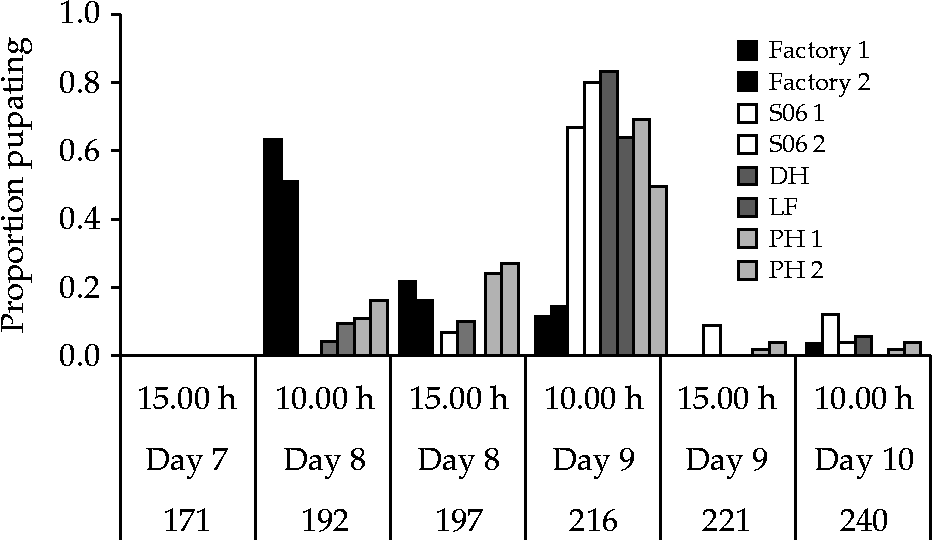
Development time from the embryo to the end of the larval period was measured in the Factory strain and in four strains: PH, S06, DH and LF, which had been domesticated for 100, 12, 3 and 3 generations, respectively. The sample sizes were as follows: 100 and 146 – Factory; 100 and 150 – PH; 91 and 15 – S06; 51 – DH; and 11 – LF. Figure 1 shows the comparative development times of the five strains, with more flies emerging before 10.00 h than before 15.00 h. While replicates of the Factory strain did not differ from each other (χ2[3]= 3.7, P= 0.3), both Factory samples had significantly shorter larval development times than the four other strains (min. χ2[4]= 22, P< 0.001).
Length of the pre-pupal development period in various strains of domesticated Bactrocera tryoni. The X-axis indicates both the time of day at which pupae were cleared from the collecting trays as well as the total development time in hours (171–240 h).

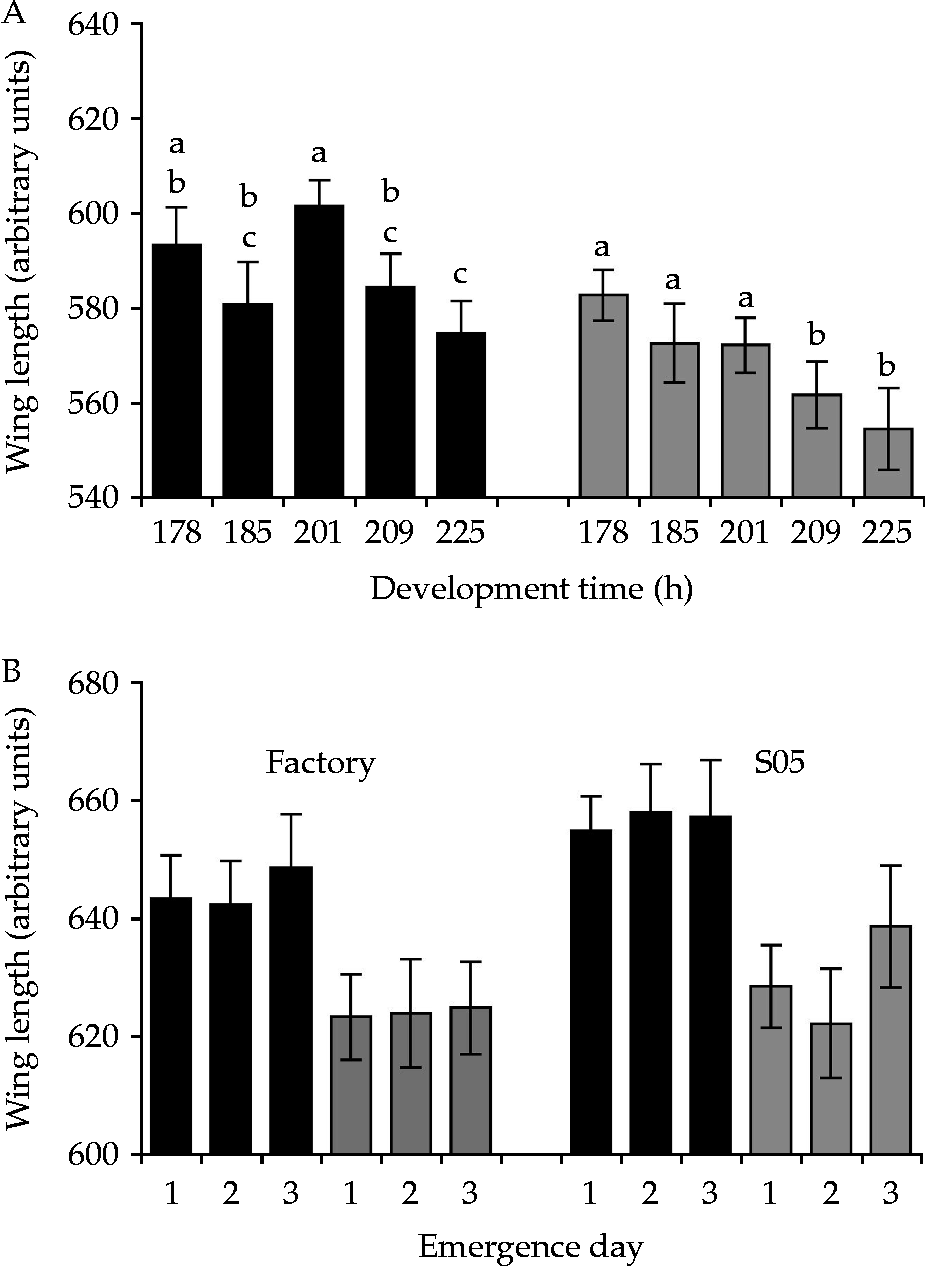
To investigate whether differences in feeding time resulted in significant variation in body size, the relationship between pupal development time and size was assessed in the Factory strain. Hopping larvae were collected twice daily (morning and afternoon) for 3 days, and the wing lengths of the adults produced from each collection were measured. As expected, a single cohort of larvae hopped in a diurnal pattern over 3 days (with only one to two on the following days). Figure 2A shows that on the first 2 days, for both sexes, wing length was greater during the morning collection than during the subsequent afternoon collection (very few flies hopped on the third afternoon for inclusion in the analysis). For both sexes, a longer larval development period did not significantly affect size until the afternoon collection on the second day (males) and the third day (females).
(A) Wing length of the Factory strain of Bactrocera tryoni (measured in arbitrary units specific to each experiment) as a function of pre-pupal development time. Different lower case letters indicate significantly different groups. (B) Wing length as a function of total pre-adult development time for two strains of B. tryoni. There were no significant differences within sexes within the strains.  , Females,
 , males.
The effect of total pre-adult development time (i.e. the sum of larval and pupal development times) on wing length was measured in both the Factory and S05 strains. Emergence of adults occurred about 21 days after egg-laying, with a single 2-h cohort of eggs emerging over at least 3 days. Samples of each strain were collected over 3 days (corresponding to 20, 21 and 22 days after egg-laying); the results are shown in Fig. 2B. Some flies emerged at both earlier and later times but not in sufficient numbers for analysis. Within each sex and strain, there was no significant relationship between total development time and wing length.
In both experiments, strain differences in wing length were small, in the range of 1–2%, compared with differences among wild B. tryoni from different populations of 8% (Gilchrist and Crisafulli, Reference Gilchrist and Crisafulli2006) or among different eastern Australian Drosophila melanogaster Meigen populations of 15–20% (Gilchrist and Partridge, Reference Gilchrist and Partridge1999).
Age-specific egg production
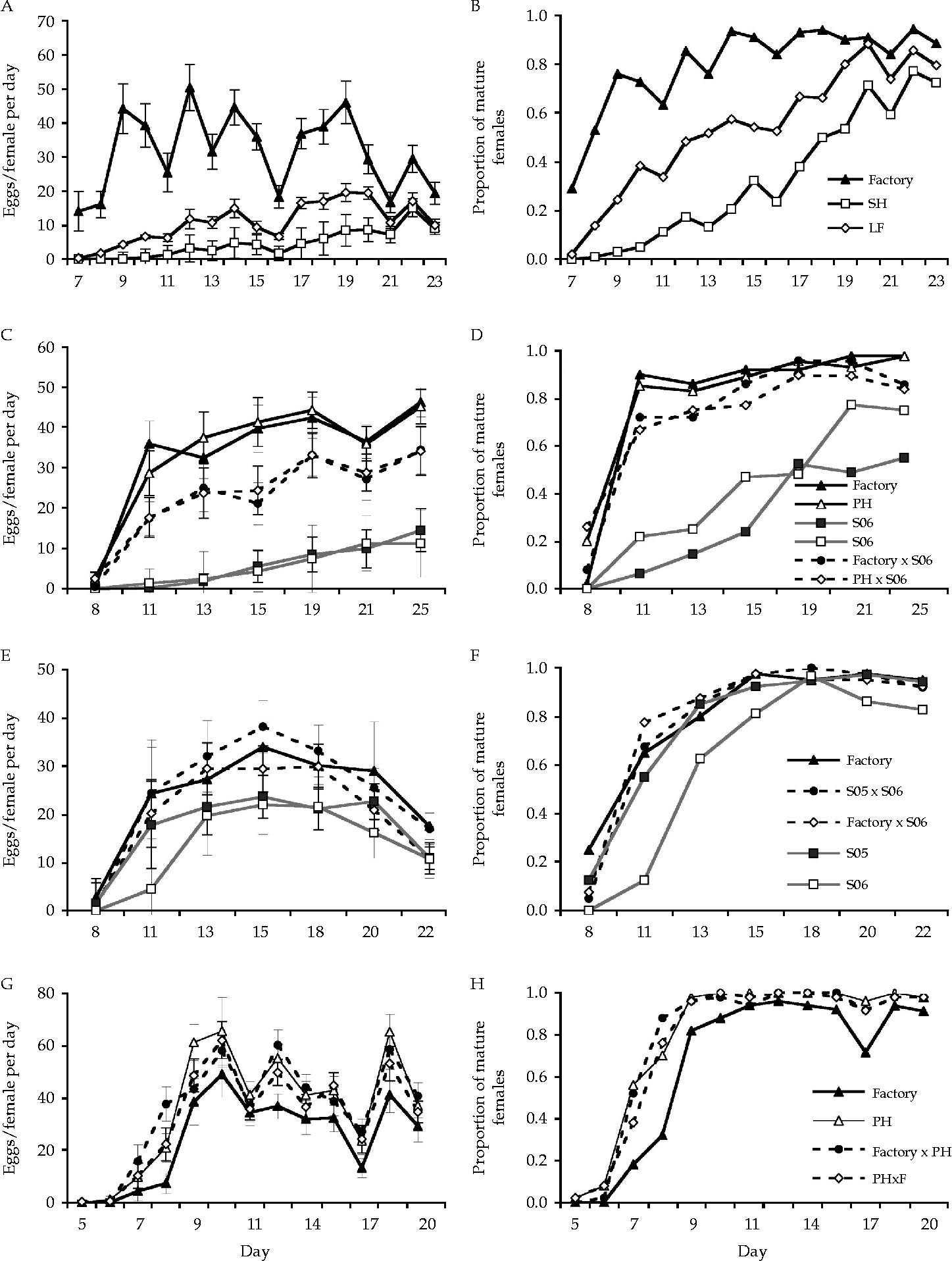
The daily fecundity of the B. tryoni Factory strain and two experimental strains, SH and LF, that had been reared in the laboratory for four generations before testing is shown in Fig. 3A. The Factory strain produced a significantly higher number of eggs than either experimental strain until the flies were 3 weeks old. Figure 3B shows that the preoviposition period was shorter for females of the Factory strain than for those of the experimental strains. For example, 75% of flies of the Factory strain were fecund by day 9, but it was day 22 before 75% of flies of either of the experimental strains were laying eggs.
Mean daily egg production (left-hand column) and proportion of females producing eggs (right-hand column) in various strains of Bactrocera tryoni in comparison with those in the Factory strain. Error bars indicate 95% CI. (A) and (B) Comparison with two strains three generations after domestication. (C) and (D) Comparison with a long-term domesticated strain (PH), replicates of a strain domesticated for four generations (S06) and two outcrossed lines. (E) and (F) Comparison after 15 (S06) and 25 (S05) generations of domestication and outcrossed lines. (G) and (H) Comparison with another long-term domesticated strain (PH) and its hybrid.
The effect of hybridization on fecundity was compared using various strains that had been domesticated for varying periods of time. Figure 3C shows a comparison of the fecundity of highly domesticated strains (Factory and PH), replicates of a newly domesticated strain (S06, four generations after domestication) and their hybrids. The highly domesticated PH strain was outcrossed in parallel to determine whether the effects of hybridization were strain specific. Notably, both hybrid strains were about 70% as productive as the highly domesticated strains. Figure 3D shows that the preoviposition period of hybrids matched that of the Factory strain, despite one of the hybrid parents having experienced only four generations of domestication.
After 15 generations of domestication, the same S06 strain was again compared with the Factory strain. A strain that had been domesticated for 25 generations (S05) was included in this experiment. Two outcrossed strains were also assayed: F × S06 and S05 × S06. Figure 3E shows that although both the S05 and S06 strains became increasingly domesticated, egg production in both strains remained significantly lower than that in the Factory strain (P< 0.002). Notably, the Factory strain and both hybrids did not differ in egg production (P>0.12). Both hybrids produced a significantly higher number of eggs than the S05 or S06 strain (0.001 < P< 0.03). The difference in egg production was not size related, as the thorax sizes of the experimental females did not differ among any of the groups (data not shown, 0.05 < P< 0.9). Figure 3F shows that the preoviposition period of all the strains tested was equal to or similar to that of the Factory strain.
To test for hybrid vigour among long-term domesticated stocks, the Factory strain, the PH strain and their hybrids were assayed. Figure 3G and H shows that all the four strains had very similar age-specific reproduction and maturation rates, suggesting that there was no F1 hybrid vigour between already highly domesticated lines.
In summary, these assays of age-specific reproduction and preoviposition period revealed that hybrids between highly domesticated lines and newly domesticated lines had egg production rates intermediate to those of the parental strains, suggesting that the trait is under largely additive genetic control and there is little heterosis. By contrast, the preoviposition period of hybrids matched that of the faster-maturing parent, suggesting that a short preoviposition period is a partially dominant trait. This observation appears not to be strain specific because the result was similar whether the faster-maturing parent was the Factory or the PH strain.
Longevity
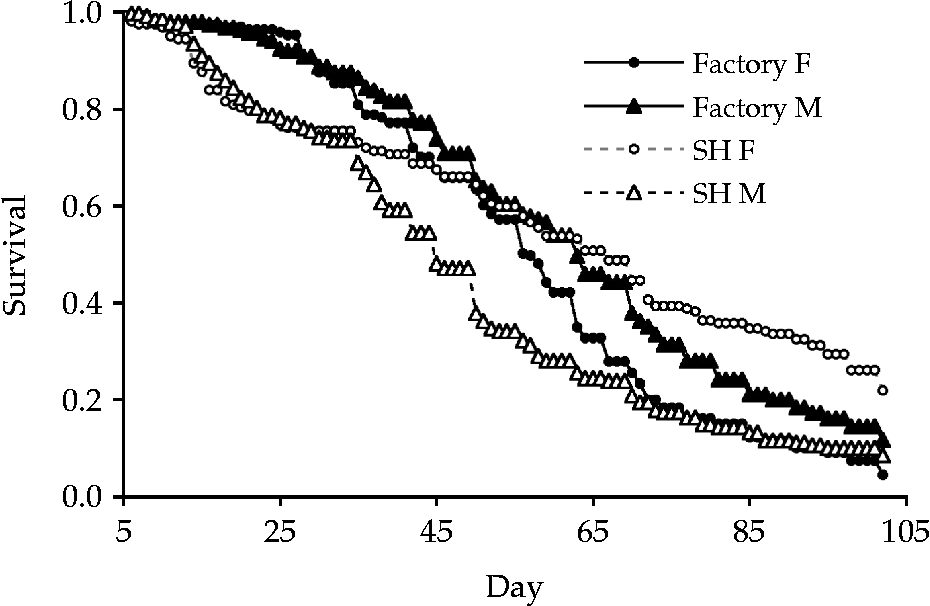
The testing of differences in longevity also involved strains that had been domesticated for varying periods of time. We first compared the basic survival of the Factory strain with that of a newly domesticated strain (SH), measured after five generations (Fig. 4). Four replicates of each strain were measured. While females of the SH strain had a longer mean survival time (57.9 vs. 52.5 days, P< 0.001, log-rank test), those of the Factory strain exhibited significantly greater early survival (days 10–25), a pattern that was reversed in the older age classes (>day 58). By contrast, males of the Factory strain exhibited a pattern of consistently higher survival at all ages with a greater mean survival time (58.5 vs. 44.3 days, P< 0.001).
Survival of the Factory strain and a strain domesticated for five generations (SH).
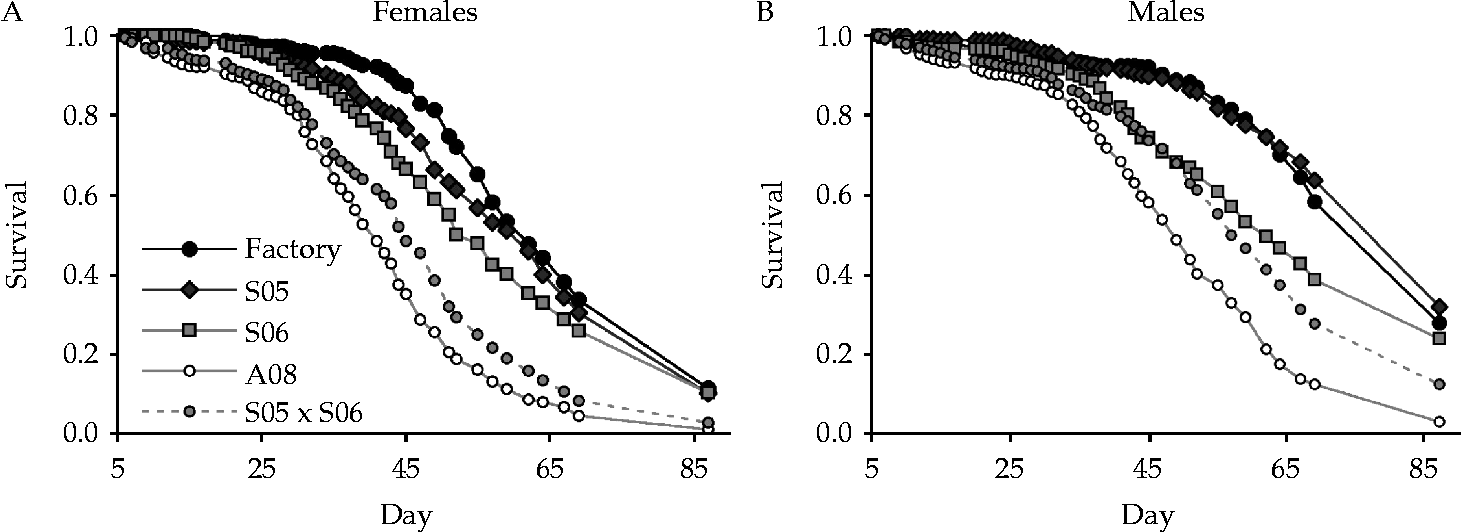
The effect of longer periods of domestication was investigated by comparing strains that had been collected in different years; the strains were A08 (nine generations), S06 (30 generations) and S05 (39 generations). Three replicates, each of 300 insects, were established for each strain. These were compared with the Factory strain and an S05 × S06 hybrid. Figure 5A and B shows that, in most age classes, survival generally increased with increasing domestication. Unlike the newly domesticated strain (SH above), the A08, S05 and S06 strains exhibited the high early survival (i.e. until about day 25) that is characteristic of domesticated strains. Mean survival increased with the number of generations of domestication. For females, survival of the S05 × S06 hybrid strain was significantly lower than that of either parent (46.2 vs. 58.3 (S06) days, χ2[1]= 62.1, P< 0.001, log-rank test). For males, survival of the S05 × S06 hybrid was closer to that of the S06 parent strain and yet still significantly lower (59.3 vs. 63.2 (S06) days, χ2[1]= 11.5, P< 0.001, log-rank test).
Comparison of survival among the Factory strain and three strains domesticated for a varying number of generations (S05 – 39 generations; S06 – 30 generations; and A08 – 9 generations) and the S05 × S06 hybrid. (A) Females and (B) males.
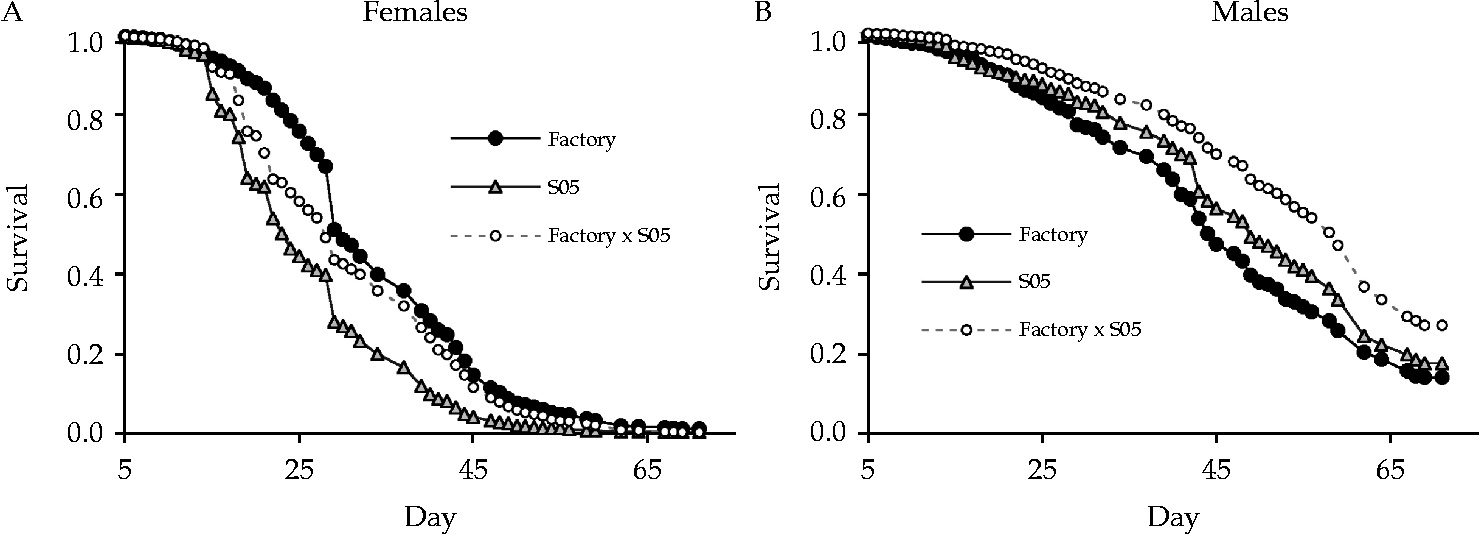
Hybridization involving the Factory strain was investigated with a larger sample size of 2500 per strain (Fig. 6A and B). Larger sample sizes enabled a more detailed comparison of survival curves. For females, mean survival times were as follows: 33.5 days – Factory; 26.1 days – S05 (42 generations); and 30.6 days – hybrid (P< 0.001 for all pairs). Hybrids were intermediate between the parents, with lower early survival but still higher than that of the S05 parent. For males, survival of the hybrids exceeded that of both parents, indicating appreciable hybrid vigour (mean survival time: 45.1 days – Factory; 48.3 days – S05; and 53.2 days – hybrid, P< 0.001 for all pairs). However, the S05 × S06 hybrid females did not exhibit similar increased survival.
Comparison of survival between the Factory strain and S05 strain 42 generations after domestication. Relative survival proportions for the two parental strains are similar to the results for the same two strains shown in Fig. 5. In the figure, 95% confidence intervals are no more than twice the width of the marker symbols. (A) Females and (B) males.
Heat tolerance
We measured stress resistance to determine how exposure to a temperature of 40°C affects the survival of male flies. According to preliminary trials, all strains exhibited almost 100% survival with exposures of up to 2 h. However, all strains had 100% mortality with exposures of 6 h or more (also see Meats, Reference Meats1984).
The outcrossed strain used was a four-way hybrid line produced with the Factory, S05, S06 and A08 strains as grandparental lines. Survival at 2.5 h was marginally greater for the outcrossed lines: 86 vs. 76% (three replicates for each strain, total sample size = 1218, likelihood ratio test, χ2[1]= 20.0, P< 0.001). After 3 h of exposure, the survival differential increased: 45% for the outcrossed males vs. 11% for the Factory males (seven replicates for each strain, total sample size = 3328, likelihood ratio test, χ2[1]= 511, P< 0.001). Results obtained for female flies revealed the same relative survival pattern (results not shown because the stress resistance of sterile females is unlikely to greatly affect a SIT programme).
Discussion
In this study, we investigated the basic life history traits of domesticated strains of B. tryoni at different stages of the domestication process. The investigation of other important traits, such as predator avoidance and sexual competitiveness, was not undertaken, but these warrant future study. The changes that we observed, including increased egg production, reduced preoviposition period and reduced lifespan, were predictable on the basis of earlier studies on this species (Meats et al., Reference Meats, Holmes and Kelly2004), other Bactrocera species (Miyatake and Yamagishi, Reference Miyatake and Yamagishi1999; Ekesi et al., Reference Ekesi, Nderitu and Chang2007) and other tephritids (Vargas and Carey, Reference Vargas and Carey1989; Hernandez et al., Reference Hernandez, Toledo, Artiaga-Lopez and Flores2009). Furthermore, previous studies have shown that outcrossing to wild flies can restore some wild-type traits of mass-reared flies (Shelly, Reference Shelly2001) while not necessarily sacrificing the high productivity required for a mass-reared strain (Rull and Barreda-Landa, Reference Rull and Barreda-Landa2007). In this study, we demonstrated that similar benefits can be achieved using independent partially domesticated strains instead of newly caught wild flies. Hybrids between the partially domesticated strains and the mass-reared strain had improved heat stress tolerance plus they retained high productivity. Using lines that are already in laboratory culture should reduce the time and effort required for the annual replacement of hybrid strains in mixed-sex mass-rearing facilities. If managers are to adopt new mass-rearing procedures, the recommendations made herein will need to be confirmed by field testing, which requires considerably more effort than laboratory testing. We have begun this process by showing that outcrossed flies disperse further than standard mass-reared B. tryoni (Gilchrist and Meats, Reference Gilchrist and Meats2012).
The process of domestication of B. tryoni was first investigated in detail by Meats et al. (Reference Meats, Holmes and Kelly2004), who, in comparison with a long-established laboratory strain, measured the changes that occurred during the first four generations of domestication. They found that the oviposition rate increased and the preoviposition period was reduced, but there were no significant changes in dry weight. In the present study, the same trends continued over longer periods of domestication (up to 3 years). After 25 generations under our selection conditions (which are more relaxed than those practised during the domestication of Factory strains), egg production and preoviposition period were nevertheless comparable to those of the Factory strain.
In addition, our results indicated that the shortened preoviposition period that develops during domestication could be genetically dominant. In all outcross experiments, the hybrid offspring had a preoviposition period similar to that of the faster-maturing parent. Dominance for the trait would explain why the trait appears early during the domestication process, as reported by Meats et al. (Reference Meats, Holmes and Kelly2004) and Diamantidis et al. (Reference Diamantidis, Carey, Nakas and Papadopoulos2011). Increased oviposition rates did not exhibit as great a degree of dominance, but when outcrossing involved an independent highly domesticated strain, there was no loss of productivity.
In the present study, differences in body size among the strains, assessed as differences in wing length, were small and exhibited no clear relationship with development time (consistent with the results reported by Meats et al. (Reference Meats, Holmes and Kelly2004)). Krainacker et al. (Reference Krainacker, Carey and Vargas1989) showed that phenotypic size variation influences fecundity and survival in Bactrocera dorsalis (Hendel) and C. capitata and that size variation is maintained within mass-reared strains. Studies in D. melanogaster (e.g. Prasad et al., Reference Prasad, Shakarad, Gohil, Sheeba, Rajamani and Joshi2000) suggested that significant differences in development time could result in changes in body size. Until further studies are carried out, we conclude that differences in body size may have only a small role in explaining differences in life history between wild and domesticated B. tryoni.
Intraspecific genetic differences in longevity have been studied previously in at least three other tephritids. In B. cucurbitae, Miyatake (Reference Miyatake1997) found evidence for a genetic trade-off between early reproduction and longevity. Hernandez et al. (Reference Hernandez, Toledo, Artiaga-Lopez and Flores2009) found that a newly domesticated strain of Anastrepha obliqua (Macquart) evolved towards the same high early reproduction/reduce longevity phenotype found in a long-term laboratory stock. Similarly, in C. capitata, Diamantidis et al. (Reference Diamantidis, Carey, Nakas and Papadopoulos2011) showed that domestication produced similar responses in strains collected from different sites around the world; all developed earlier reproduction and reduced lifespan. The same trade-off was apparent in interspecies comparisons among B. cucurbitae, B. dorsalis and C. capitata (Vargas et al., Reference Vargas, Walsh, Kanehisa, Stark and Nishida2000). The results of our study were consistent with those of the earlier studies. Comparisons between a newly domesticated strain (SH) and the Factory strain showed the expected shift towards high early reproduction/reduced longevity in the domesticated strain.
A novel aspect of our study was that in strains domesticated for long periods (30+ generations), age-specific survival continued to increase with increasing time since domestication. It is possible that after the initial increase in early survival ( < 10 generations), continued laboratory adaptation gradually extends this high survival into later age classes (probably as a correlated response, as mass-reared colonies are usually culled before reaching these later age classes). The effects of outcrossing differed between males and females. For females, outcrossing between these strains reduced early survival, suggesting that outcrossing tends to oppose the cumulative effects of domestication. For males, the changes in lifespan in outcrossed insects were smaller, being negative in one experiment and positive in another, which may be due to different trade-offs affecting male age-specific survival.
The majority of thermal tolerance studies consider pre-adult stages because disinfestation efforts directed at these life stages have important international trade implications. Studies have catalogued differences in the thermal tolerance of adults of various species (e.g. Meats, Reference Meats1984; Meats and Fitt, Reference Meats and Fitt1987; Nyamukondiwa and Terblanche, Reference Nyamukondiwa and Terblanche2009). Temperatures in the high 30 s (°C) have been shown to affect survival and fecundity in the olive fruit fly Bactrocera oleae (Rossi) (Wang et al., Reference Wang, Johnson, Daane and Nadel2009; Pappas et al., Reference Pappas, Broufas, Koufali, Pieri and Koveos2011). The effects of temperature on adult B. tryoni have mainly been investigated in relation to spring releases; therefore, studies concentrated on lower temperatures ( < 25°C). We tested a temperature of 40°C because this is a daytime temperature commonly reached in areas of inland temperate eastern Australia, where the current mass-reared strain has been released. Our results demonstrated that outcrossed flies have significantly greater stress resistance than the mass-reared strain. Further stress testing in the field could be informative.
As adaptation to the mass-rearing environment is unavoidable and inexorable, we suggest that mass-rearing facilities using mixed-sex strains plan regular strain replacement. Annual outcrossing using partially domesticated strains and the mass-reared strain has a practical advantage over using wild flies. If the strains used for outcrossing are already partially domesticated, the hybrids are immediately highly productive and fewer insects are required for the initial crosses. The partially domesticated strains can be maintained at a relatively small population size, e.g. 2000 insects, require minimal maintenance and can be replaced whenever convenient.
Acknowledgements
This study was supported by Horticulture Australia Limited and the Australian Research Council.