1. Introduction
An oft-quoted saying among many economists holds that if an economic impact cannot be measured, then it is not worth considering. The saying is particularly apt when applied to matters of public policy and government regulation. Trade disputes subject to WTO rules may be no different in this respect, other than the facts that the current system has been in existence for only a decade and that the precise economic impact of policy measures rarely needs to be known for the purposes of dispute resolution. There is consequently only a limited experience at the WTO about the role that quantitative economic models can play in interpreting WTO rules.
However, it is worth noting that, especially in a number of recent cases, economics has been used in WTO dispute settlement.Footnote 1 These examples may provide an additional incentive to consider economic methods that can help to produce evidence in support of trade policy.Footnote 2 In this article, we examine two separate, but related hypotheses. First, by way of a brief analysis of the literature and WTO case law, we hold that there seems to be room for economic modeling in trade policy analysis and, more particularly, as evidence in the interpretation of WTO rules in the context of dispute settlement. Second, and as the main part of our analysis, we focus on sunset reviews of existing antidumping (‘AD’) and countervailing duty (‘CVD’) measures carried out at the national level.Footnote 3 Here, we find that the WTO-required ‘likelihood’ analysis might be particularly amenable to economic modeling by investigating authorities and that economic models that may be used at the national level in the context of injury determinations could be readily given a probabilistic dimension.Footnote 4
In the so-called ‘sunset reviews’ of existing AD and CVD measures, pursuant to Article 11 of the Agreement on the Implementation of Article VI the General Agreement on Tariffs and Trade (GATT) 1994 (Anti-Dumping Agreement)Footnote 5 and Article 21 of the Agreement on Subsidies and Countervailing Measures (SCM Agreement)Footnote 6 respectively, Members are obliged to terminate such measures no later than five years from their imposition. They may, however, initiate a review before that date to determine whether the measures should be continued or revoked. The standard in this respect is whether expiry of the duty would be ‘likely’ to lead to continuation or recurrence of dumping (or countervailable subsidies respectively) and of injuryFootnote 7 to the local industry concerned. As of the end of 2004, WTO Members had a total of 1,784 such measures in force, of which more than 1,000 have been in force since before 2002. There shortly will be a groundswell of ‘sunset reviews’ that administering authorities are bound to consider.
As with many WTO rules, the term ‘likely’ is subject to interpretation by the various administering authorities. In practice, to date little attention, or at any rate little analytical uniformity, seems to have been brought to bear at the national level to the question of resumption of dumping and/or countervailable subsidies. The central issue more frequently debated among the parties is whether a resumption of material injury is ‘likely’. In the United States, the International Trade Commission's (ITC) determinations in this regard have been the subject of recent litigation before the reviewing court, the Court of International Trade (‘CIT’). The CIT on more than one occasion has ruled that ‘likely’ means ‘probably’.Footnote 8 We propose a practical means of measuring, through a degree of economic and statistical science, how ‘likely’ or ‘probable’ will be a resumption of material injury through the revocation of existing AD/CVD orders. We believe that the burgeoning number of orders that shortly must be reviewed in the context of sunset proceedings warrants an examination of economic tools designed to assist administering authorities in the process if they so choose.
In particular, simulation analysis could be applied in a way that quantifies the probability that the injury would continue or recur if the duty were removed or varied. As Boltuck and Kaplan (Reference Boltuck, Kaplan and Lawrence1998) note, in performing this type of analysis the counterfactual state of the world must expressly be considered. In their article on the ITC Sunset Reviews they hold that ‘[c]onsequently, the extrapolation of existing market trends, a method of analysis favored by some commissioners in present injury investigations, is of no help … in a Sunset Review’ (Boltuck and Kaplan, Reference Boltuck, Kaplan and Lawrence1998: 221). This article surveys the theory behind simulations with probabilistic components and sets forth a working illustration of real-world applications that demonstrate the power of this economic tool in counterfactual trade scenario analysis. A probabilistic dimension can be grafted on to practically any economic model. For reasons of convenience and transparency, we rely on the US ITC's Commercial Policy Analysis System (‘COMPAS’) model, because it is widely known in international circles and is available without charge from the ITC's web site.Footnote 9 The COMPAS model was designed originally to assist the ITC and participating parties in evaluating the impact of imports on local industries in AD/CVD proceedings.Footnote 10 The authors emphasize that in using COMPAS in this respect they are not seeking to promote COMPAS as an appropriate platform for administering authorities in the exercise of their function.
The next section is a brief review of the literature on the possible use of economic models in trade remedy investigations.Footnote 11 It will also highlight how quantitative economic analyses have filtered through as evidence to the WTO dispute settlement proceedings, although the most prominent examples are not from a trade remedy context. Section 3 then turns to the core topic by reviewing WTO rules on sunset reviews. Section 4 will provide a framework for the use of probabilistic simulation models in sunset reviews at the national level. Section 5 provides a review of the COMPAS model as an example, and tests on past sunset cases whether usage of the simple as opposed to the proposed probabilistic modeling framework could lead to differing conclusions and whether predictions by the latter are borne out in reality. Section 6 concludes.
2. Economic models and the interpretation of WTO rules
The use of economic models in the trade remedy literature
In the literature, there has been a notable amount of economic analysis in the context of trade remedies. Its applicability to the instant issue of sunset reviews is limited, however, because most of the work has centered on the issue of causation of serious injury by imports and non-attribution to other factors required under Article 4 of the Agreement on Safeguards, rather than on reviews pursuant to Article 11 of the Anti-Dumping Agreement and Article 21 of the SCM Agreement.Footnote 12 The applicability of some of the econometric approaches proposed in the literature is also limited in practice by the scarcity of data typically available to the administering authority and practitioners, a limitation that some of the authors have acknowledged.Footnote 13 Nevertheless, a brief review of how economic models have been conceived to support legal analysis in the broader trade remedy context is instructive for the present purpose.
The most common approach in injury analysis has been comparative static, partial equilibrium economic simulation models, such as COMPAS.Footnote 14 An early contribution is Grossman (Reference Grossman1986). Taking the example of the steel industry, Grossman (Reference Grossman1986) looks at the causation of injury by imports and other factors, using domestic production as a measure of the health of the domestic industry. Domestic production in turn is a function of the relative price of imports, the relative price of inputs, and an indicator of overall demand. In this way, Grossman determines the sensitivity of domestic production, and hence of the state of the industry, to imports as well as to domestic supply and demand factors. Pindyck and Rotemberg (Reference Pindyck and Rotemberg1987) further broaden the analysis. Using the copper industry as an example, the authors reason that import levels are not specifically controlled by prices, but are also determined by domestic tastes and technology. They use a framework that also looks at the effect of both domestic and foreign developments in these variables on changes in imports. Through the use of a model where industry performance is measured by indicia such as profits, employment, and production, the authors determine the relative effects on the industry of shifts in domestic demand, shifts in domestic supply, and changes in imports. By holding the observed level of imports constant,Footnote 15 while using actual industry values for all other variables, and by comparing this output to actual output, the authors seek to isolate the impact that imports have had on the domestic industry. Boltuck and Kaplan (Reference Boltuck, Kaplan and Lawrence1998) provide a comprehensive review of the advantages and disadvantages of comparative static simulations in injury determinations. The authors develop an improved COMPAS-type approach that allows for the more realistic assumption of less than perfect competition in the industry. While stressing the importance for sunset reviews of explicitly modeling competitive conditions (that are likely to have changed from the original situation), the authors note the remaining difficulty of finding the appropriate counterfactual of subject import price adjustment and the need to investigate other sources of information, possibly in third-country markets, where similar border measures are absent.
Prusa and Sharp (Reference Prusa and Sharp2001), looking at cold-rolled steel products, develop an econometric, simultaneous equations model as an alternative to a simulation approach that for its parameterization largely relies on the analyst's judgment. By empirically estimating demand and supply parameters in this manner, the authors are also able to better take account of other influencing factors than subject imports. In a recent piece, Irwin (Reference Irwin2003) avoids issues of model specification and the common problem of data limitations faced in many cases by suggesting a non-econometric, essentially accounting-based approach. Specifically, he builds on an econometric model originally developed by Kelly (Reference Kelly1988) and shows how this framework can be applied to distinguish conceptually the causation of injury by imports from instances when imports and injury are correlated but not causally linked. In this manner, Irwin is able to devise a simple methodology to examine issues of causation/non-attribution using only data that are routinely gathered during trade remedy investigations.
This literature shows that quantitative economic models can inject additional analytical rigor into the examination of certain legal concepts in the trade remedy context, despite being subject to confining model assumptions and data shortages. While national authorities may choose to do so, this does not necessarily imply that the economic techniques used to analyze a trade policy measure would actually be discussed in the WTO, should the measure be brought to a dispute. This may or may not happen, as will be illustrated in the following.
The use of economic models in WTO dispute settlement
At the international level, the question of whether and how economic models have been used as evidence in the interpretation of certain provisions in WTO Agreements has surfaced in only a few disputes. It goes without saying that in the vast majority of cases WTO dispute settlement has done without trade models.Footnote 16 This is because an examination by panels of the ordinary meaning of the WTO provisions in question, in their context and in the light of the object and purpose of the Agreement, is normally enough to identify whether or not a rule has been breached.
Only some WTO norms, for example the concept of ‘serious prejudice’Footnote 17 in the SCM Agreement, involve the effects of a disputed measure, and parties may submit quantitative evidence obtained from models in order to demonstrate a violation of the respective provisions. However, in the three ‘serious prejudice’ disputes to date, only the recent US–Upland Cotton case involved a discussion of the results obtained from an economic model used by the complainant to support its arguments. In the end, the panel took note of these analyses, but did not rely ‘upon the quantitative results of the modeling exercise – in terms of estimating the numerical value for the effects of the United States subsidies, nor indirectly, in our examination of the causal link’ (US–Upland Cotton, Panel Report: para. 7.1205; see also para. 7.1209).
Moreover, in other areas of WTO rules, where economic effects are not explicitly mentioned, parties on a few occasions have included quantitative analysis to substantiate their claims. Notable examples are the cross-price elasticity estimations in the Chile–Alcoholic Beverages and Japan–Alcoholic Beverages II disputes submitted by parties as evidence of the degree of competition between imported and domestic products in relation to the obligation of national treatment. Similarly, to the above situations, if parties decide to provide such quantitative evidence in their arguments, the panels/Appellate Body may or may not find it useful or necessary to their own analysis. To date, however, there has been no instance of a panel or the Appellate Body relying on results of quantitative analyses in their findings and conclusions.
Panel/Appellate Body decisions on alleged violations of WTO rules are quite different from WTO arbitrations, where the question of consistency of a disputed measure with WTO obligations is no longer at issue. In a number of arbitrations, the arbitrators themselves chose to use quantitative models in order to fulfill their mandate to determine the maximum level of countermeasures that a complaining party may apply in response to a measure outlawed by the Dispute Settlement Body (DSB). In fact, in the recent US–Offset Act (Byrd Amendment) (EC) (Article 22.6 – US) arbitration, the Arbitrator rejected the models proposed by both parties in favor of its own approach.
In trade remedy investigations, the way in which the injurious effects of imports on a domestic industry are determined is a key issue. WTO rules require that authorities evaluate all relevant factors including those listed in the Agreements in regard to both the health of the industry and sources of injury. There is no requirement that any particular methodology be applied to assess injury, causation by imports, and possible attribution to factors other than imports. Nevertheless, investigating authorities, at times, have employed economic models to support their assessments of these matters. Given the absence of multilateral rules on appropriate analytical tools, dispute settlement has little if anything to say in regard to the way economic models are used (or not) by investigating authorities. In disputes, the question therefore does not arise whether a better methodology or model exists that could have been employed, but whether a reasoned and adequate explanation is given by authorities of how the facts support their determination on the basis of the requirements contained in the agreements. So far, therefore, panels dealing with trade remedies did not have to consider the technicalities of economic models, even if parties have opted to use such models at the national level.
The situation is similar, and even less prescriptive, in the case of sunset reviews. Again, no precise methodology is laid down to assess the likelihood of continued or recurrent subsidization/dumping and injury. Neither does the agreement provide guidance as to the factors that should be examined in that context. In fact, it has been stressed by the Appellate Body that ‘a broad range of factors other than import volumes and dumping margins is potentially relevant to the authorities' likelihood determination’ (US – Corrosion Resistant Steel Sunset Review, Appellate Body Report: para. 186). Yet, assessments of ‘likelihood’ can reasonably be expected to result in probabilities associated with particular outcomes as a function of future developments of relevant factors affecting the state of the industry. None of the WTO cases to date involving sunset reviews has raised the issue of economic modeling in that regard. However, models may be employed in order to determine the likelihood of continuation or recurrence of injury in the many sunset reviews that are bound to be carried out in the near future. While these developments are going to occur at the national level and a priori do not have anything to do with WTO dispute settlement as such, this wave of reviews may generate a number of disputes. If models were to be used at the national level and prove to be critical for the decision process, it may not be inappropriate to assume that panels may be confronted with evidence concerning modeling questions that parties challenge in each other's argumentation. Hence, despite the lack of experience to date, it seems useful at this stage to prepare and examine such questions using sunset reviews as an example. The rules governing sunset reviews are further discussed in the following section.
3. WTO rules on sunset reviews
Both Article 11.3 of the Anti-Dumping Agreement and Article 21.3 of the SCM Agreement impose a temporal limitation on the maintenance of anti-dumping and countervailing duties respectively, which must be terminated within five years of their imposition unless certain conditions are met. The requirements in sunset reviews are different from those in the original investigations.Footnote 18 A central condition is the likelihood of continued dumping/subsidization and injury if the duty is removed. The Appellate Body clarified in US – Corrosion Resistant Steel Sunset Review that in the original investigation authorities had to determine whether dumping existed, while in a sunset review the question was whether the expiry of the respective anti-dumping duty would be likely to lead to continuation or recurrence of dumping (and injury) (para. 107).Footnote 19 This means, for instance, that while an anti-dumping duty may not be imposed unless a positive dumping margin (besides injury and a causal link) is determined in the original investigation, dumping margins in a sunset review, although relevant, need not be conclusive of the likelihood of continued or recurrent dumping. With regard to the interpretation of ‘likely’ in Article 11.3 of the Anti-Dumping Agreement, the Appellate Body held that, if the duty were terminated, dumping and injury were to be probable as opposed to just possible or plausible (US – Corrosion Resistant Steel Sunset Review, Appellate Body Report: para. 111).Footnote 20
Article 11.3 of the Anti-Dumping Agreement does not prescribe any particular methodology in making a likelihood determination of dumping and injury, nor does it identify specific factors that must be taken into account. The probative value of factors may vary from case to case. In US – Corrosion Resistant Steel Sunset Review it was illustrated by the Appellate Body that while a decrease in import volumes may be relevant in making an inference that dumping is likely to continue or recur, the probative value of such historical data depends, among others, on how recent it is and whether trends over time can be discerned that may be significant for an assessment of likely future behavior.Footnote 21 Therefore, a case-specific analysis of the factors behind a cessation or decline in dumped imports as well as an evaluation of the quality and an appropriate treatment of the data appear to be necessary to determine whether dumping and injury are bound to continue or recur if the duty is terminated. What matters is that the likelihood determination, as noted by the Appellate Body in US – Corrosion Resistant Steel Sunset Review, ‘is a prospective determination … [i.e.] the authorities must undertake a forward-looking analysis and seek to resolve the issue of what would be likely to occur if the duty were terminated’ (para. 105).
In the past, certain investigating authorities therefore have produced quantitative estimates for their own evaluation. Despite not being required under WTO rules, the existence of a quantification of possible future scenarios with economic models, in addition to being useful in its own right, might potentially also be seen in the context of a WTO dispute as evidence that a certain analytical rigor was brought to bear by the investigating authority in arriving at the challenged determination. The Panel in US–Steel Safeguards, in a different but not unrelated context, expressed such a view.Footnote 22 The rest of the paper lays out some methodological suggestions that national authorities may find useful in order to realistically appraise the need to terminate or renew existing anti-dumping/countervailing duty orders.
4. Simulations as a measuring tool
Administering authorities of governments around the world undertaking sunset reviews are faced with the challenge of gauging the probability that a future event will or will not occur. This probabilistic assessment is considerably different from how the same authorities typically approach initial determinations of material injury, where most past and present facts are known or determinable. The standard for the initial determination of existing or threatened material injury, where the threat must be ‘real and imminent’, suggests a very high degree of certainty based on the facts available. In contrast, the sunset standard of ‘likelihood’ suggests that administering authorities are expected to take a broader view in making their determination. It is natural under such circumstances that higher degrees of uncertainty about the future abound, in which case some reasonably scientific approach to measuring the likelihood and magnitude of the effect of revocation could prove to be useful in the sunset review process.
Fortunately, there are readily available econometric tools, more specifically simulation methods, which could provide guidance to the authorities conducting sunset deliberations. These simulations can be based on probability theory. For decades they have been used in the finance and insurance industries. But wider application of these methods in recent years has been made possible by much faster and more powerful generations of personal computers. Consequently, probabilistic methods are now being employed by many businesses and various agencies of government.
A probabilistic simulation analysis recognizes that the input variables to a model might have quite different levels of certainty associated with their values. The future values of some variables may be predictable with a high level of certainty, while others involve greater uncertainty. A probabilistic simulation model combines these variables, taking into consideration their differing levels of certainty, and arrives not only at the model's expected specific result, but also at the likelihood that this result will actually occur, considering the uncertainty associated with the inputs.
In a sunset review, such a simulation would consider the complete range of uncertainty for each of the input variables needed to estimate the price, volume, and revenue effects of continued or renewed dumping/subsidies on the domestic industry. The inputs to the simulation would include elasticities, capacity utilization, market share, and other variables. Using the description of uncertainty for each variable, a simulation would calculate an essentially unlimited number of permutations of the efct on a local industry of revoking a dumping or countervailing duty order. The value selected for each of the uncertain inputs would vary according to a probability distribution appropriate to its uncertainty level, i.e. variables with relatively little uncertainty would have a narrow distribution and those with greater uncertainty would have a wider distribution. A single value from each of these wide or narrow distributions would be randomly selected and consolidated with the selected value from each of the other variables to determine a single value for the overall effect on the domestic industry. This procedure would be repeated thousands of times to effectively create a probability distribution of the resultant effect on the domestic industry, given the particular set of input values used. Of course, it is up to national authorities to decide whether the resulting revenue effect (plus any other effects that are being simulated) would amount to injury or not, and which residual probability level should apply to a loss of that size or higher in order to make the continuation or recurrence of injury likely.
While this type of simulation model is effective in estimating the likely effects of revoking an order on the domestic industry, it is also extremely valuable for identifying those individual variables that have the most effect on the domestic industry's condition. It is generally assumed that the elasticity of substitution, margins of dumping, and subject import shares have the most effect on the domestic industry. However, many other variables can be ‘drivers’, including the elasticity of supply, the elasticity of demand, and capacity utilization. The simulations provide a rank ordering of the inputs based upon their effect on the domestic industry, which allows the administering authority to quantify the change in domestic price (revenue or volume) by changing any specific input. Results such as these could also be helpful to analysts examining, for example, the marginal effects of alternative probability distributions for individual inputs, such as the elasticity of substitution.
5. Application to sunset reviews
This section puts the spotlight on the importance of the methods used by investigating authorities. We do not suggest a specific solution to the deficiencies that may occur in any one type of investigation. We simply chose the case of sunset reviews as an example where the choice of methodology in interpreting a concept such as ‘likelihood’ could neatly be demonstrated. In the same vein, in order to illustrate the sensitivity of results to methodological questions we employ the COMPAS model developed by the ITC and applied in related contexts, simply because it is fairly well-known, available and easy to use.Footnote 23 Again, we do not make any statements about how such investigations should be carried out in general or in any particular national context, e.g. whether quantitative models should be used at all. After a short explanation of the model in Section 1, we test the performance of the probabilistic approach in determining the likelihood of a continuation or recurrence of dumping (or countervailable subsidies) and of injury. We conduct two types of tests to assess both the relative and absolute performance of the probabilistic approach: In Section 2, we compare the probabilistic to the simple COMPAS model: Looking at a recent investigation, assuming the COMPAS model had been used, we show that the probabilistic set-up may support different conclusions than the simple model depending, of course, on the selection of indicators and thresholds that the authority (hypothetically) may consider appropriate. In Section 3, we examine the accuracy with which the probabilistic model would have predicted what actually happened. Here, we look at two cases, where anti-dumping/countervailing duties have been revoked.Footnote 24
ITC's COMPAS model
COMPAS provides one of many possible frameworks for addressing the uncertainty inherent in estimating the likely impact of revocation in a sunset review.Footnote 25 COMPAS, as issued by the US ITC, accounts for uncertainty by allowing for low and high estimates (‘from’ and ‘to’) of six uncertain elasticities. Using only the low and high values, 64 estimates (26) of the effect on the US industry are possible. COMPAS, however, performs the analysis for only eight of these permutations, using both the low and high estimates for each variable four times.Footnote 26 While the results of these eight scenarios might provide a general idea of the damage to the domestic industry, they do not address the other 56 scenarios and do not address any elasticity between the low and high ends of the range. In addition, limiting the analysis to the eight scenarios might tend to overstate or understate the overall effect on the domestic industry (in contrast to an analysis examining all 64 possible permutations). In essence, these COMPAS values provide eight single-point estimates of the effect on the domestic industry, with no probabilities associated with any of them.Footnote 27 Further, even the full set of 64 estimates would provide no information about effects when the elasticities were not exactly at the low or high end of the ranges.Footnote 28
While economic theory quantifying the effects on the domestic industry of historically dumped or subsidized imports may be well established, the analysis is quite different when attempting to quantify the effect on the domestic industry of revoking a dumping order. The logic behind this distinction is quite simple; in a historical analysis, the industry's economic condition is known. In a sunset review, the industry's condition must be forecast under uncertainty, as adjustments undertaken in the meantime make it unlikely that the industry, ceteris paribus, will go back to its original state. To account for such difference, it is necessary to consider (1) making some additions to the underlying economic model used by COMPAS and (2) more precisely and completely model the uncertainty of industry factors and elasticities.
Updating the underlying COMPAS economics, for instance, could begin by adding a variable that describes market structure from perfectly competitive to perfectly monopolistic. This could account for pricing differences in changed market regimes.Footnote 29 Since the level of competition would be dependent on the prevailing margin, amongst other factors, the ‘level of competition’ could be programmed to vary with such related factors. These issues are not further elaborated on in this article.Footnote 30
Rather, working with a given model, we concentrate on the question of how to assess, on a prospective basis, the likely condition of the industry in the event that dumping/subsidies are renewed (at some determined level).Footnote 31 The crux of this problem is estimating what certain industry variables (e.g., market shares, size, domestic capacity utilization, etc.) would be in the absence of the order, in addition to estimating the six elasticities used by COMPAS.Footnote 32 If an order were to be revoked immediately after being imposed, it is realistic to assume that the industry's variables existing before the order would be reinstated, and a COMPAS-like model would be as practical as in a historical context. However, five years after the initial investigation and the imposition of an order, the industry is likely to have changed, such that these variables are unlikely to revert back to the pre-order industry situation.
Estimating the range of prospective industry variables requires an intimate knowledge of the industry and consideration of their interactive effects with the elasticities. Under such a prospective analysis, a COMPAS type of model only focusing on the low and high estimate value for each of 11 or more uncertain input variables (six elasticities, two market shares, industry size, point in the business cycle,Footnote 33 and capacity utilization), could potentially compute 2,048 possible scenarios (211) of damage to the domestic industry. Even if it were computationally tractable within the confines of a COMPAS-type model to perform these calculations, simply computing all 2,048 scenarios would still not capture any of the situations besides the low and high estimates for the variables.
A simulation model would allow one to consider the complete range of uncertainty for each of the inputs, instead of simply choosing a ‘high’ value half of the time and a ‘low’ value half of the time. Further, it would perform an (essentially) unlimited number of permutations of the effect on the domestic industry of revoking a dumping/countervailing duty order. Varying each of the 11 inputs according to a probability distributionFootnote 34 appropriate for its uncertainty level would permit this analysis.Footnote 35 The simulation procedure would randomly (weighted, based upon the defined probability distribution) select a single value from the distribution of each input to determine a single value for the effect on the domestic industry.Footnote 36 This procedure would be repeated a few thousand times to create a distribution of thousands of data points (in contrast to the eight data points on the standard COMPAS model) of the effect on the domestic industry.
Testing probabilistic against simple COMPAS model predictions
Not only does a probabilistic simulation model incorporate significantly more information regarding uncertainty than the traditional COMPAS program, its output is also much easier to read and interpret. In assessing the revenue (or price or volume) effects, analysts can view two summary data graphs that show the probability distribution of revenue effects and specific ‘cumulative’ probabilitiesFootnote 37 for various levels of revenue effects. If the administering authority chooses to consider a particular threshold for evidence of injury (e.g., revenue effect of 5%), these graphs show the likelihood of being above or below that threshold.
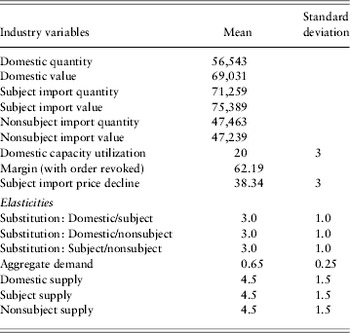
For illustrative purposes, we have conducted an example of a COMPAS analysis with a simulation using @Risk software. The data used for this example come from the recent ITC case on Certain Preserved Mushrooms. A summary of the inputs used in the model can be found in Table 1. More detailed descriptions of the elasticities, the reasoning behind their selection and other inputs can be found by consulting the ITC report directly.
Inputs to probabilistic COMPAS model

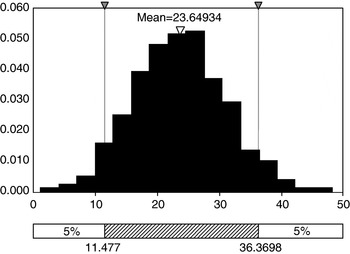
COMPAS predicts changes in the price, quantity, and revenue for the domestic, subject and non-subject imports separately, though the effect on the domestic industry is the focus when considering whether to remove a duty during a sunset review. While COMPAS predicts only the results of the eight scenarios described earlier, @Risk allows the user to predict the full range of possible scenarios. As an example, Figures 1 and 2 as well as Table 2 detail the results of 1,000 probabilistic COMPAS ‘runs’Footnote 38 for the revenue effect. Specifically, the probability distribution of predicted revenue effects in Figure 1 shows, for instance, that:
• revenue effects of approximately 20–30% are much more likely than those in the 30–40% range and
• the revenue effect is more likely than not to be less than 30%.
Probability distribution of predicted revenue effects

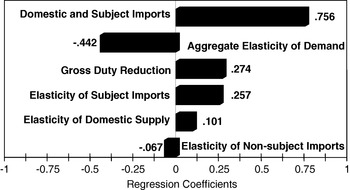
Simulation sensitivity analysis for revenue effects

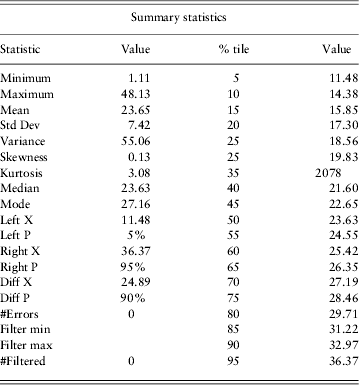
Simulation summary statistics
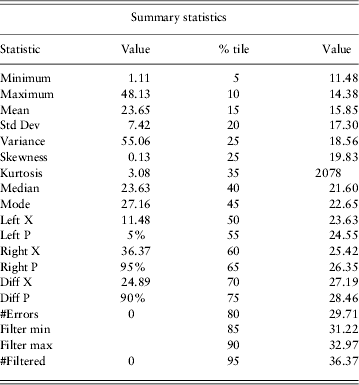
The ‘Summary Statistics’ in Table 2 directly address the need for administering authorities to measure the ‘likelihood’ of injury by detailing the probability of having a revenue effect of ‘less than or equal to’ a certain value. For example, at the 65th percentile, we can see that there is an explicit probability of 65% associated with having a revenue effect of less than 26.35%. The summary table also shows that there is a 90% probability (‘Diff P’) that the revenue effect amounts to between 11.48 (‘Left X’) and 36.37% (‘Right X’).
Another tool available with @Risk is the Sensitivity Analysis applied to this simulation and shown in Figure 2. The ‘tornado’ graph provides a graphical representation of the importance of the various input variables in determining the revenue effect. This graph can reveal to administering authorities which variables are the key drivers in the predicted result and which variables have relatively little effect. The simulation results in Figure 2 show that the elasticity of substitution between domestic and subject imports, price-elasticity of aggregate demand, and the expected reduction in duties if an order were revoked are the top three drivers of domestic revenue. Figure 2 also shows that revenues are rather insensitive to other variables, such as the elasticity of substitution between domestic and non-subject imports and the elasticity of substitution between subject and non-subject imports.Footnote 39
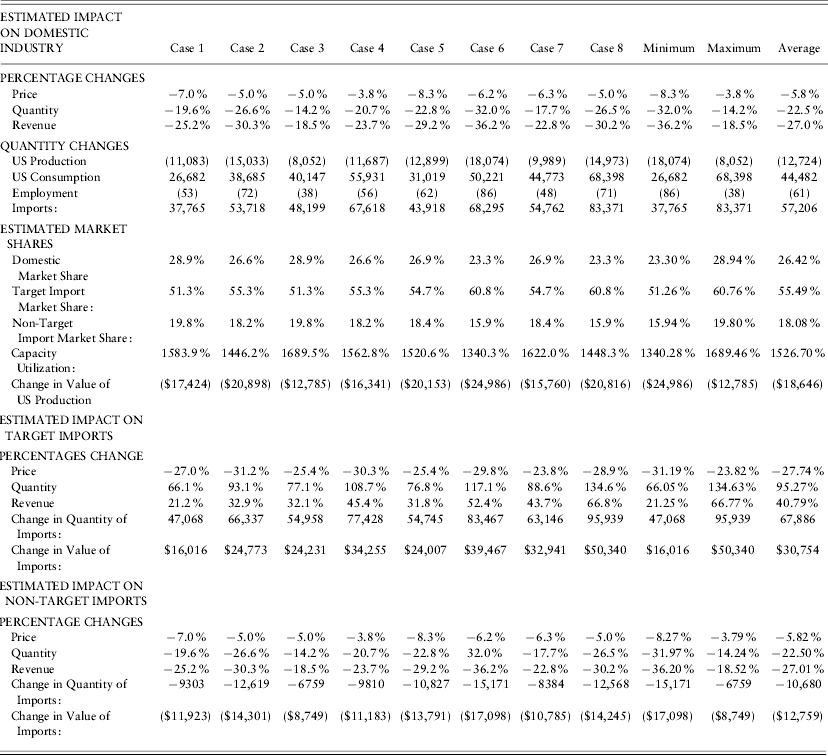
In contrast to the probabilistic simulation of COMPAS, the standard COMPAS output is given in Table 3, with the eight scenarios affecting price, volume, and revenue. The results provide a reasonable idea of high and low ends of ranges, but do not offer probability information. For example, the mean and the median revenue effects are between 23.65 and 23.63% (as seen in Figure 1), yet only two of the eight COMPAS scenarios report values within the 20–25% range. In fact, the average of the eight COMPAS scenarios (27.0%) is near the 70th percentile based on the full simulation. In addition, the standard COMPAS results do not describe any of the outcomes below the 25th percentile,Footnote 40 implying that, in this case, COMPAS alone would overestimate the effect on the domestic industry of revoking an order during a sunset review. This discussion shows that the probabilistic approach as compared to a simple COMPAS-type model not only provides disproportionately more uncertainty information,Footnote 41 but, subject to the choice of injury indicators and thresholds, may support different conclusions as to the revocation of measures.
Standard COMPAS output COMPAS versiion 1.4 (TARGET) – EFFECTS OF IMPOSING AN IMPORT DUTY ON SPECIFIC (TARGET) COUNTRIES (6/1/93)
by Joseph Francois and Keith Hall, Office of Economics, ITC
Testing probabilistic COMPAS model predictions against actual developments
Having illustrated the potentially superior performance of the probabilistic approach relative to the simple COMPAS model, we now test the performance of probabilistic simulations compared to actual developments. In that endeavor, we make ex post predictions based on the probabilistic COMPAS model,Footnote 42 and we compare results to the historical data from two US sunset reviews that resulted in revocation: (i) Sugar From the European Union, and Sugar From Belgium, France, and Germany, and (ii) Structural Steel Beams from Japan and Korea.Footnote 43
As mentioned above, we again rely on US practice because the elasticities necessary to our simulations were estimated by the ITC and published in the authority's final report. At the same time, we were challenged by the fact that, after revocation, the overall condition of the relevant local industry typically is no longer surveyed by the ITC. For this reason, we focused on the measurable behavior of the volume of subject imports and of local price movements in assessing the results of our simulations versus market realities, before and after revocation.Footnote 44
Sugar From the European Union, and Sugar From Belgium, France, and GermanyFootnote 45
The ITC voted to revoke the order on sugar in August 2005 and provided annual data in the ITC publication through 2004. In 2004, subject imports accounted for less than 1% of the total US market share. The probabilistic model gives the following price, volume, and revenue scenarios that were likely to occur with revocation of the order: (i) The median price effect turns out to be approximately 0.01% with a 90% confidence interval that the price effect will be between 0.005% and 0.016%. As in the case of likely price effects, simulation results show extremely small predicted mean volume and revenue effects, 0.007% and 0.016%, respectively with a narrow 90% confidence interval. These simulations results provide a reasonable estimate of the likely impact on the domestic industry and are supported by actual import and consumption statistics for 2006. While the ITC import statistics show an increase in subject imports in 2006, the level of these imports is still insignificant, suggesting that the volume effect of revocation to the domestic producers was insignificant, just as the simulation results suggest. Moreover, the United States Department of Agriculture (USDA) reports that sugar prices in the United States were little changed in each of the first three quarters of 2006 than in the corresponding quarter of 2005,Footnote 46 providing further support for the simulation model's predictions of an insignificant price effect.
Structural Steel Beams From Japan and Korea
In this case, initial subject imports were comparatively more significant. Using annual data through 2004 from the respective ITC publication, we again ran simulations in order to determine the predicted price, volume, and revenue effects resulting from revocation of the orders on structural steel beams from Japan and Korea, which occurred in March 2006. The probabilistic model predicts median price, volume, and revenue effects of approximately 0.02%, 0.03%, and 0.05% respectively. The 90% confidence intervals surrounding these effects are again narrow. As with the Sugar case, the ITC import statistics show that subject imports moderately increased after the duties were revoked. However, this increase occurred in part because of abnormally low levels of imports at the end of the period of review, and it was not expected that subject imports in 2006 would reach even the level of subject imports that were witnessed in the earlier years of the period of review. Furthermore, it appears that subject imports still accounted for an insignificant share of the domestic market, which suggests insignificant volume effect on the domestic industry, as was predicted by the simulation.
In sum, actual developments in both cases conform to the expectations produced by our probabilistic simulations. As shown in the previous section, predictions by the probabilistic approach can differ from the simple model (although in the latter two sunset reviews this was not the case). Taking both tests together, we are able to conclude that the probabilistic approach appears to make reasonably accurate predictions and that its main advantage lies in the probability analysis of different outcomes provided by the simulations that may prove decisive in a ‘likelihood’ analysis.
6. Conclusion
The ‘likelihood’ of continuation or recurrence of injury is a complex matter. It is influenced by a broad range of factors many of which are quantifiable and themselves subject to varying levels of uncertainty. While under WTO rules administering authorities are free to choose appropriate methodologies, subject to certain conditions, econometric models are sometimes employed in trade remedy investigations as they allow for a more rigorous analysis of influential factors on the basis of economic theory. Experience from selected WTO disputes also points to the potential usefulness of submitting evidence obtained from econometric analyses. This article has shown that adding on a probabilistic dimension to an underlying simulation model can significantly increase the value of the modeling exercise for ‘likelihood’ determinations in the context of sunset reviews.
In particular, a probabilistic simulation provides a much clearer indication of how model results can be interpreted in relation to two major questions arising in this context. First, the probability distribution of the variables of interest (e.g. revenues) and its associated statistics, such as means, standard deviations, and confidence intervals, allow for a direct reading of the ‘likelihood’ that a threshold set by authorities will be crossed. Second, the sensitivity of outcomes to various assumptions about the distribution of elasticities and influential factors can be tested. This helps to determine their relative impact in relation to imports, and, hence, contributes to assessing the ‘likelihood’ of injury from continued or recurrent dumping/subsidization.
For convenience, these features have been demonstrated in a ‘probabilistic’ re-run of several COMPAS simulations on the basis of real facts. We have shown that, in a particular case, the results are indicative of the risk of overestimating the effect on the domestic industry of a termination of orders if uncertainty about input values is modeled in an oversimplified manner. We have also demonstrated that, in a few cases where data post the revocation of the order were available, the probabilistic model would have predicted actual developments quite well. Given the speed with which multiple permutations can be carried out these days, this article has argued that an augmented econometric model incorporating the probabilistic approach can represent an even more powerful tool in support of legal reasoning in the context of sunset reviews.
Appendix
ITC cases referenced in this article

WTO cases referenced in this article

Technical differences between COMPAS and a probabilistic simulation
COMPAS and a probabilistic simulation differ in two related, but distinct ways. First, the sampling of the uncertain variables (inputs) differs. The second difference derives from the injury estimates (outputs).
COMPAS groups its six uncertain inputs into the following three groups:
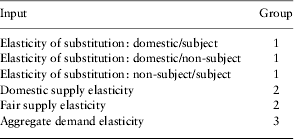
Each input within a group is assumed to move in the same manner for sampling/scenario purposes, in the sense that if one input in group 1 is at the high end of its estimated range, then the other two inputs in group 1 must also be at the high ends of their ranges. By creating this relationship, COMPAS uses eight input combinations based on high (‘H’) and low (‘L’) ends of ranges for the three groups: LLL, LLH, LHL, LHH, HHH, HHL, HLH, and HLL.
While COMPAS uses the terms low and high ends of estimated ranges, there is no consensus as to whether such a range incorporates a confidence interval of 50, 75, 90, or 100%. If such a range generally has been used by practitioners as an interquartile (50%) range, clearly the range of outputs will not describe either ‘tail’ of the complete range of potential outputs. On the other hand, if practitioners use the input range as 99% confidence, the range of outputs will give little description of the vast majority of potential outcomes (the middle 80% or more of potential outputs).
Simulation simply describes each input's (sunset review cases will likely require 11 or more of such inputs) uncertainty as a probability distribution. The inputs can be assumed to follow any distribution (e.g., normal, lognormal, binomial) and with any distribution characteristics (e.g., high or low variance, skew, etc.). For each ‘iteration’/scenario, the simulation procedure randomly and independently selects each input value, based on its probability distribution. After running, for example, three iterations that determined revenue effects of 2.3%, 3.4%, and 4.9%; the output can be described as a simple discrete distribution (e.g., 1/3 chance of 2.3%, 1/3 chance of 3.4%, and 1/3 chance of 4.9%). After running the simulation many times, the output's discrete distribution will tend to approximate a continuous (normal) distribution. The simulation program, in fact, has an internal mechanism that monitors if the output has converged. It has been our experience using our ‘prototype’ model that convergence usually occurs within 1,000 runs, and will sometimes converge within as few as 100 runs.
Having an (approximated) normal output distribution provides significant advantages over simply analyzing a discrete group of points. Using the mean and standard deviation, it is easy to give precise estimates to probability questions.