Disasters often cause extensive psychological distress and functional disabilities to victims. Among all disasters, fire disasters occur most frequently, and their scale and extent of the damage they cause are extremely broad.Reference Cavallini, Papagni and Baruffaldi1,Reference Cha2 In Korea, the average annual occurrence of fire disasters from 2014 to 2018 was about 44000, of which 26% occurred in residential facilities such as multi-family houses, apartments, and residential complexes.3 Recent large-scale fire disasters occurred at an apartment building in Uijeongbu in 2015 (5 deaths, 125 injuries); the Jecheon Olympic Sports Center in 2017 (29 deaths, 29 injuries); and the Sejong Hospital in Bucheon (45 deaths, 147 injuries). The number of such fires in 2018, was 30% more than in 2014, resulting in 20% more casualties, and 18% more damage to property.3
Due to the physical injuries they cause, fire disasters especially are accompanied by aftereffects like psychological trauma. Survivors tend to suffer severely from repeated memories of their evacuation experiences, feelings of guilt about not having been able to help victims, and fear of fire. Also, they experience psychological problems such as anxiety, fear, sleep disorder, feelings of helplessness and frustration, and suicidal impulses.Reference Lee, Na and Sim4 According to a 25-year follow-up study on the survivors of a Swedish hotel fire in 1978, 50% of the survivors reported that psychological problems have had a decisive impact on their lives and 21.3% of them still suffer in their daily lives.Reference Dalhuisen and Koenraadt5 In Korea, 46.6% of the 129 survivors of the Daegu subway fire disaster in 2003 showed post-traumatic stress disorder (PTSD) symptoms up to 5 years after the event. The Actual Condition Survey released in 2016, after follow-up studies over 13 years, reported that 71% of the 44 families still experienced PTSD symptoms.Reference Kim6 Despite fire victims’ physical pain, the problems caused by the psychological impact of the disaster were largely ignored by society, so appropriate psychological interventions were not provided to mitigate their suffering.Reference Van Loey, Van de Schoot and Faber7 Thus, it is very important to study how to provide active pre-management and effective early psychological interventions.Reference Kiliç and Nuray8
Psychological first aid (PFA) is acknowledged as the most effective early intervention approach.Reference Dieltjens, Moonens and Van Praet9 According to the World Health Organization’s 2011 PFA guide for field workers, PFA is described as providing humanitarian support to victims immediately after a disaster.Reference Snider, Van Ommeren and Schafer10 The purpose is to reduce the stress response and improve the resilience of patients by understanding their mental condition through communication and empathy.Reference Birkhead and Vermeulen11,Reference Gispen and Wu12 This process includes the following aspects: identifying the essential needs of disaster victims, conveying information about the disaster situation to them, linking them with a social support network, and helping them build resilience.
Thus, specialized PFA training is necessary for professionals, including mental health practitioners, who provide initial psychological support services during the early stages of a disaster. For instance, in the US, the activities of disaster service workers who have received PFA training since the 9/11 attacks were reported to be helpful to survivors.Reference Zhang, Zhou and Li13 However, in Korea, recent studies have demonstrated that psychological support is rarely provided in disaster situations due to a lack of education and a lack of expertise in psychological support.Reference Lee and Shin14,Reference Hyun, Kim and Ahn15 In fact, in a 2014 study, 74.7% of firefighters did not know the term PFA and 80.7% had not received training related to it. Meanwhile, 83.9% of respondents were aware of the need for PFA in the field, and 69% said they wanted proper training.Reference Cho16 Although various approaches to PFA education such as videos, handouts, and lectures have been tried, there is still a need for a more realistic and effective educational method for practitioners to provide practical help through understanding psychosocial problems suffered by disaster victims immediately after a disaster.
Simulation training has been widely adopted to improve nursing students’ field experience because they can learn better in realistic situations without being exposed to danger.Reference Lateef17 Simulation training using standardized patients (SPs) has shown especially positive results in mental health nursing practice, which highly values the formation of human relationships with patients and therapeutic communication.Reference Herbstreit, Merse and Schnell18 SPs refers to people who are trained to replicate the exact medical history, personality, emotional response, and physical symptoms of actual patients.Reference Choi19 Training using these SPs enables teachers to give immediate feedback and by adapting scenarios similar to genuine situations, enhances nurses’ and nursing students’ knowledge, self-efficacy, clinical performance, and satisfaction.Reference Herbstreit, Merse and Schnell18-Reference Jansson, Kaariainen and Kyngas20
This study focused on (1) developing a PFA simulation education program that utilized fire situation scenarios, and standardized patients for training disaster mental health practitioners; and (2) quantitatively evaluating the effectiveness of the program based on 3 factors: self-efficacy, PFA performance competence, and PFA knowledge. Therefore, by examining the improvement in these factors, this study aimed to provide an effective education method for the PFA training of mental health practitioners and provide resources for further research into advanced education methods.
METHODS
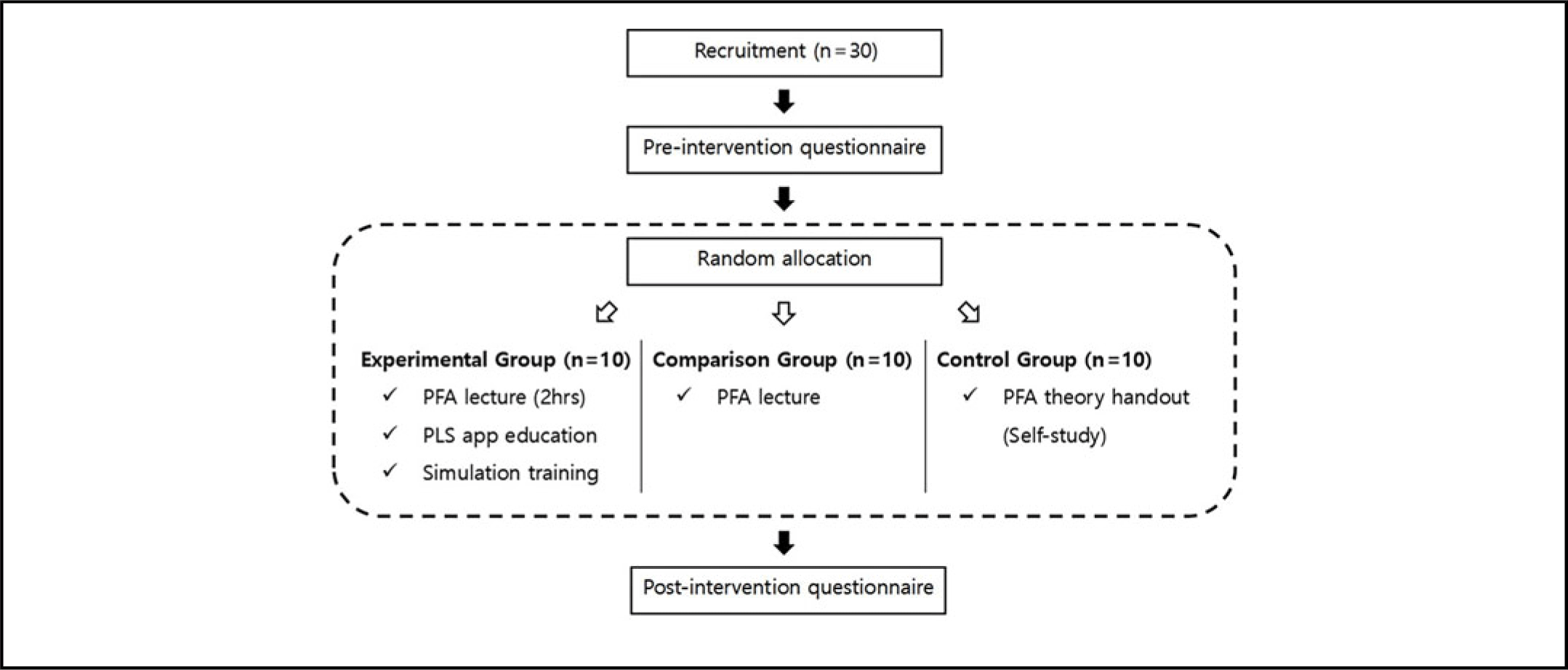
This study was a quasi-experimental study with non-equality pre- and post-design. The experimental group participated in the simulation training after attending a 2-hour lecture, while only the lecture was provided to the comparison group. The control group was given handouts about the principles of PFA and was required to study it by themselves. All three groups underwent a pre-test before the intervention and went through a post-test after the intervention (Figure 1).
Simulation Education Program Design for Psychological First Aid (PFA).

Participants
Data were collected from December 2018 to January 2019. The participants were practitioners from mental health welfare centers in Seoul and cities in Gyeonggi province. The recruitment was done by sending notices to mental health welfare centers, and the participants were selected from among the volunteers. Participants were informed of the purpose and procedure of this study, and gave written consent. A total of 30 selected participants were randomly assigned to one of three groups: 10 participants to the experimental group, 10 to the comparison group, and 10 to the control group. The study was approved by the Institutional Review Board of Chung-Ang University (IRB No: 1041078-201806-HR-129-01) in Korea.
Settings
The simulation training program for this study was structured according to PFA objectives and behavioral guidelines. The scenario for the simulation training was established based on the SP module used in the Chung-Ang university in Seoul, and specific details were organized through examining the psychological experiences of actual fire victims. The SP for this study was selected from among those who had participated in previous simulation programs related to mental health nursing or disaster psychology.
Before proceeding with the simulation training, the SP was provided with training to help her better understand her role; the SP was to play the role of a 58-year old woman who suffered third degree burns and lost her house in a fire. The SP also had to depict the condition of a victim who needed medical and social support because of the physical, psychological, and economic damage she had suffered. The training script was emailed to the SP before the first of her two training sessions. Pilot tests were conducted after this. The scenario configuration and the training script were revised based on feedbacks received from the SP. For example, descriptions of nonverbal expressions such as gestures, posture, and facial expressions that the SP should use were added to the script.
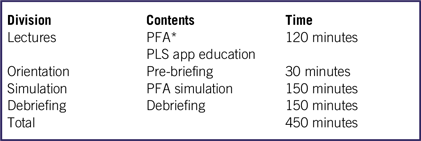
The PFA training of the experimental group was in two stages. First, a two-hour lecture, including content about using the Psychological Life Support (PLS) application,Reference Choi, Jung and Ko21 was given by the researcher. This was followed by a pre-simulation group briefing of 30 minutes, individual simulation training sessions that lasted 15 minutes per participant, and individual debriefing sessions of 15 minutes each that involved the particpants, the SP, and the researcher. The entire procedure is described in detail in Table 1.
Simulation training program operation design (n = 10)

Abbreviations: PFA, Psychological First Aid; PLC, Psychological Life Support.
Measures
Self-Efficacy
It was measured by the General Self-Efficacy Scale.Reference Sherer, Maddux and Mercandante22,Reference Lee23 Participants completed questionnaires containing 16 questions with scoring based on a 5-point Likert scale ranging from 5 points for ‘strongly agree’ to 1 point for ‘strongly disagree.’ A minimum of 16 points and a maximum of 80 points meant that the higher the score, the higher the self-efficacy. In this study, the Cronbach’s alpha of the instrument was 0.92.
PFA Performance Competence
This was measured by the tool “An instrument for measuring the core performance of disaster nursing.”Reference Yun24 In this study, 12 items were used to examine the training effect of the simulation-based practice component of PFA training. It was scored on a 5-point Likert scale ranging from 5 points for ‘strongly agree’ to 1 point for ‘strongly disagree.’ In this study, the Cronbach’s alpha of the instrument was 0.92.
PFA Performance Knowledge
A total of 10 items were selected and corrected based on the “PFA knowledge measurement instrument.”Reference Lee, You and Choi25 The content validity of the instrument was verified by one psychiatric nursing professor and two psychiatric nurses at C university. Questions mainly covered five areas (disaster mental health, basic principles and general behavioral guidelines of the PFA, core activities, and self-management of the PFA). The measurement tool used in our study has been utilized as a validated tool for different disasters, including fire disasters because it evaluates subjects’ knowledge regarding basic principles with regard to the PFA implementation and general guidelines for coping with particular disaster situations or victims.
Data Analysis
The study data were analyzed using SPSS Version 23.0 (IBM Corp, Armonk, NY). The study variables were analyzed using a paired t-test, a Kruskal-Wallis test, and a ranked ANCOVA and ANCOVA, followed by a Bonferroni correction. Variables that were not normally distributed were analyzed using the non-parametric Kruskal-Wallis test.
RESULTS
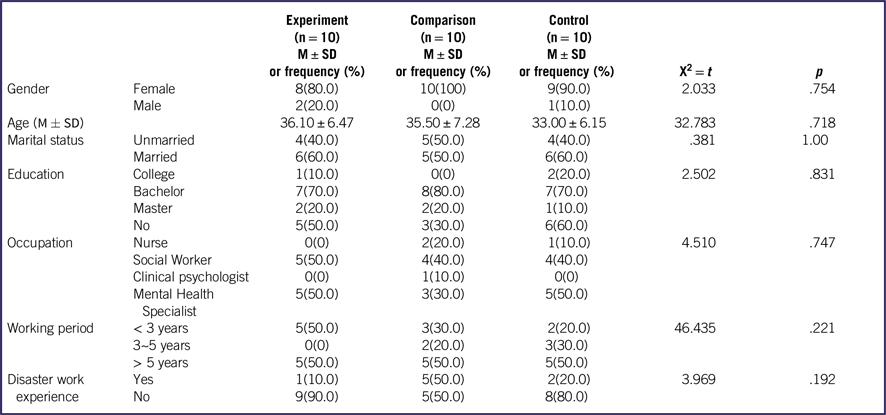
The participants included 27 females (90%) and 3 males (10%), and the mean age was 34.87 ± 6.55 years. The participants’ occupations were as follows: 13 social workers (43.3%), 13 mental health specialists (43.3%), 3 psychiatric nurses (10%), and 1 clinical psychologist (3.3%). Regarding experience in disaster situations, 22 (73.3%) of the respondents had no prior experience, while 8 (26.6%) did have such prior experience. A total of 15 (50%) of the participants had been working for more than five years, 10 (33.3%) had worked for less than three years, and five (16.6%) had worked for 3-5 years (Table 2).
Homogeneity test of general characteristics and variables (n = 30)
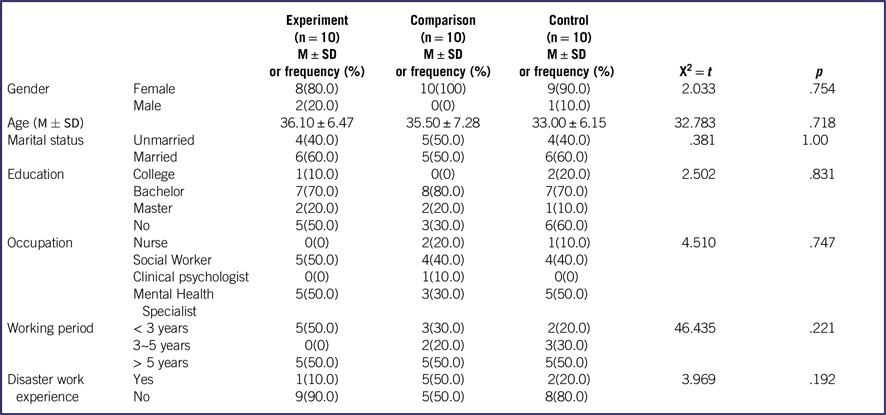
In the Shapiro-Wilk normality test, the self-efficacy and PFA performance competence, (with the exception of the PFA performance knowledge), were found to follow a normal distribution. The homogeneity of the dependent variable scores of the three groups showed that there was no statistically significant difference (Table 3).
Homogeneity verification (n = 30)

* Kruskal-Wallis test
** Psychological first aid
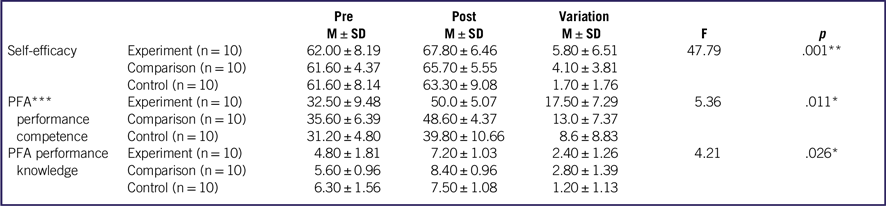
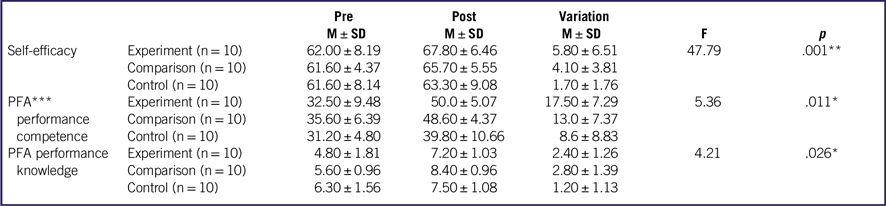
In the experimental group, the score for self-efficacy increased from 62.0 to 67.80. In the comparison group, the score increased from 61.60 to 65.70. The control group’s score also increased, from 61.60 to 63.30, and there was a statistically significant difference in the pre- and post-intervention self-efficacy scores (F = 47.79, P < 0.001).
In the experimental group, the score for PFA performance competence increased from 32.50 to 50.0. In the comparison group, the score increased from 35.60 to 48.60. The control group’s score also increased, from 31.20 to 39.80. Thus, there was a statistically significant difference in PFA performance competence scores (F = 5.36, P = 0.011) between groups and also between the pre-test and post-test scores of each group.
In the experimental group, the score for PFA performance knowledge increased from 4.80 to 7.20 and in the comparison group, the score increased from 5.60 to 8.40. The control group’s score increased, from 6.30 to 7.50, and there was a statistically significant difference in the pre-test and post-test PFA knowledge scores (F = 4.21, P = 0.026) (Table 4).
Difference verification (n = 30)
*p < .05, **p < .01
*** Psychological first aid
DISCUSSION
In the disaster psychological support field, educating professionals has been a challenging task because traditional lectures cannot satisfy practitioners’ need for realistic practices; especially since inadequate management from inexperienced practitioners could conversely cause huge distress to victims. Therefore, simulation training has become an attractive alternative to overcome the difficulty of field experience and to foster professionalism in personnel. In this regard, we developed and validated a simulation training program for PFA education that showed positive results in enhancing three important factors of practitioners in real practice: self-efficacy, performance competency, and knowledge.
All three groups showed statistically significant improvements in scores after the intervention, and a difference in terms of score improvement was observed among groups. In the post-analysis, the experimental group exhibited greater progress in self-efficacy scores compared to the other groups (i.e., control and comparison), which supports the effectiveness of the simulation education program. These results are in line with the results of improved self-efficacy after applying the simulation-based PFA training program for emergency nurses in case of an earthquake disaster.Reference Yun24 These results also are consistent with past studies, whose results showed self-efficacy improvement after using SPs for the training of nursing students, on psychology intervention with patients with schizophrenia,Reference Speeneya, Kamega and Cline26 and effectiveness in critical care nurses’ continuing education.Reference Jansson, Kaariainen and Kyngas20 Findings of a study by Joo, Sohng, and Kim27 were also consistent with our result that the simulation education stimulated greater improvement than a lecture.
Self-efficacy depends on self-evaluation regarding how well a task is accomplished in a given situation.Reference Halper and Vancouver28 This study’s statistical results showed that mental health practitioners’ self–efficacy can be enhanced by implementing a program that satisfies the educational needs of the field. Therefore, it is worth qualitatively analyzing how the debriefing was performed. Immediately after the simulation training was completed, the SP completed behavioral checklists for each participant to assess their performance level. Then, while reviewing this checklist and the video recording of each participant’s training, the researcher and the SP pointed out whether the participant’s actions and verbal expressions were adequate or inadequate when communicating with victims. Participants also received positive feedbacks from their peers. By indicating their strengths and weaknesses, participants can reflect on their responses and clarify how they could improve their disaster management skills. Thus, the debriefing process, which allowed participants to get practical feedback and discover their own solutions, might have influenced the improvement of self-efficacy scores.
There was a statistically significant difference between the pre-test and post-test scores for PFA performance in each group, and a significant difference has also been found between groups. The average score of the experimental group shows better PFA performance than the other groups, which in turn supports the effectiveness of simulation education in PFA. This is consistent with the result of a systematic study, on precedents that most studies on simulation in nursing education ensured the improvement of clinical performances.Reference Kim, Park and Shin29 Additionally, research that confirmed that emergency simulation training is an effective intervention to improve the performance of new critical care nursesReference Chang, Kwon and Kwon30 supports the arguments of this study. Although the subject matter is different, previous studies back up this study’s contention that applying simulation training using an SP, has a positive influence on the trainee’s competency.
Additionally, this study agrees with previous research that involved a one-day PFA training session consisting of lectures and simulation-based exercises. Lee et al. Reference Lee, You and Choi25 reported a medium to large effect on knowledge and competence in PFA skills; furthermore, they suggested the need for future research for evaluating PFA training effects with and without simulation training. In this regard, our study’s results prove that there was a large training effect on the PFA performance; and by further comparing the experimental and comparison groups, the effectiveness of SP-based simulation training was confirmed. It is also noteworthy that practitioners who participated in the simulation training mentioned realistic settings as the most useful feature. Our study used a realistic scenario that resembled an actual situation, and the introduction video used for the orientation described the intensity of real-world fire disasters in great detail in order to increase the immersion of participants. Therefore, this sense of realism improved the PFA skills and decision-making abilities of the learner; this in turn, enhances performance competency.
Comparing the PFA knowledge scores in this study, all three groups showed statistically significantly higher scores after they received training, and there were also statistically significant differences between the three groups. This result is consistent with the findings of a previous study that the knowledge score of the experimental group that went through simulation training was higher than that of the control group that only attended a lecture on mental health.Reference Witt, Mcgaughan and Smaldone31 Another study that demonstrated an improvement in nurses’ knowledge and confidence, after the implementation of a simulation education program focusing on deteriorating patientsReference Crowe, Ewart and Derman32, thus supporting this study.
Given that disaster and PFA knowledge is an important factor in decision-making for disaster mental health providers in a disaster situation, further development of research tools for effective knowledge transfer and knowledge improvement is needed. The results showed that participants are able to acquire knowledge by all three methods: individual learning through handouts, lectures, and simulation-based training. As for the simulation training, the results also demonstrated that an in-depth education that improves the performance of mental health practitioners can be created through integrating theory with a field placement.
Neverthless, there are several limitations that should be noted. First, while the number of participants was relatively small (n = 30), participants selected for this study were mainly from mental health care centers in Seoul and the Gyeonggi area, Korea. Thus, to ensure the generalizability of the results, expanding the geographical area or the range of occupations of the participants is necessary. Second, it is true that most of the participants were female. However, this gender ratio may reflect the actual condition of the mental health service field in Korea, where 90% of mental health practitioners are women. Third, the scenario developed in this study only featured a fire disaster scenario. Last, each group took the post-test after a different time interval. Thus, in order to ignore the effect of sustainability, it would be advisable for future researches to leave a gap of one week or more between the program and the post-test.
Despite these limitations, we believe that this study was the first meaningful attempt to provide effective teaching methods for the PFA education of mental health practitioners through the use of SPs. Though it was not demonstrated statistically, participants gave feedback after training that they were very satisfied with the tightly structured scenario, the immersive setting, and the detailed feedback on their performance in the debriefing process. Thus, simulation training with an SP can be helpful when equipping professional practitioners with the confidence to provide psychological support at actual disaster sites. Further research can be conducted with regard to the application of SP-simulation training in various areas such as nursing and education for firefighters or emergency service professionals. Furthermore, developing scenarios with different settings may facilitate repetitive education, including refresher training, in order to extend the sustainability of learners’ performance levels.
CONCLUSIONS
We developed a simulation training program with an SP to train mental health practitioners in providing PFA to victims of fire disasters, and validated its positive effect on enhancing self-efficacy, performance competency, and knowledge. Based on the results of this study, we expect that education using SPs can be a useful learning method, for nurses and nursing students as well as practitioners. Also, it is noteworthy that this study was the first attempt to analyze the effects of psychological healthcare practitioners’ PFA content by developing a scenario and applying it to a simulation program.
Funding
This work was supported by the National Research Foundation of Korea (NRF) grant funded by the Korea government (MSIT) (NRF-2020R1A2B5B0100208).