INTRODUCTION
Radiocarbon (14C) ages are the foundation of cultural and geologic histories. 14C ages become even more important in areas that have slow soil accumulation, which limits the application of other dating techniques. Wherever possible, conventional wisdom suggests that terrestrial plant macrofossils, wood and/or charcoal should be sampled for radiocarbon instead of aquatic plant macrofossils, shell-bearing organisms (ostracods, gastropods, pelecypods), and organisms that eat the above. There are many times, however, where the “less-ideal” freshwater and/or freshwater-diet organic material is the only material available for radiocarbon dating. The user must then correct for the freshwater reservoir effect (Broecker and Walton Reference Broecker and Walton1959; Keaveney and Reimer Reference Keaveney and Reimer2012). This is because organic materials are also affected by inorganic carbon present within freshwater environments (the reservoir) that overlie both carbonate rocks (Deevey et al. Reference Deevey, Gross, Hutchinson and Kraybill1954; Andree et al. Reference Andree, Oeschger, Siegenthaler and Moell1986; MacDonald et al. Reference MacDonald, Beukens, Kieser and Vitt1987), and/or lignite, coal, and carbonaceous shales (Nambudiri et al. Reference Nambudiri, Teller and Last1980). Uptake of dissolved old bicarbonate in freshwater leads to disequilibrium and “hardwater,” as the waters no longer contain the same 14C as the atmosphere (Godwin Reference Godwin1951). Hence, a freshwater reservoir age is needed to correct radiocarbon ages obtained on freshwater-derived organics. In Canada, freshwater reservoir age studies indicate that corrections can range from 0 to ∼6400 years (MacDonald et al. Reference MacDonald, Beukens, Kieser and Vitt1987; McMartin Reference McMartin2000; Lewis et al. Reference Lewis, Forbes, Todd, Nielsen, Thorleifson, Henderson, McMartin, Anderson, Betcher and Buhay2001; Daubois et al. Reference Daubois, Roy, Veillette and Menard2015; Patterson et al. Reference Patterson, Crann, Cutts, Courtney Mustaphi, Nasser, Macumber, Galloway, Swindles and Falck2017) and vary due to the following:
-
availability of dissolved old bicarbonate; linked to geology of the substrate (Arnlond Reference Arnlond1957; Broecker and Walton Reference Broecker and Walton1959; Moore et al. Reference Moore, Rea and Godsey1998);
-
changes in groundwater storage time, runoff intensity, direction of flow (Geyh et al. Reference Geyh, Schotterer and Grosjean1998; Hutchinson et al. Reference Hutchinson, James, Reimer, Bornhold and Clague2004; Osterkamp et al. Reference Osterkamp, Green, Reid and Cherkinsky2014) or the influence of glacial meltwater (Hall and Henderson Reference Hall and Henderson2001);
-
taxa dated, as old carbon settles differently in the environment, stratification of water can lead to a lack of exchange with the atmosphere, and organisms uptake carbon differently (Shotton Reference Shotton1972; Marty and Myrbo Reference Marty and Myrbo2014).
Problems interpreting a freshwater reservoir effect increase with the trophic level of the taxa dated. Keaveney and Reimer (Reference Keaveney and Reimer2012) show that there are variations due to the diet of individual fish of the same species, exclusive of variations between different species. Similar freshwater diet variations are expected for carnivorous animals and human bones, depending on the proportion of freshwater in an individual’s diet (Lanting and van der Plicht Reference Lanting and van der Plicht1998; Philippsen Reference Philippsen2013). The aim of this study is to examine the order of magnitude and degree of variability of the freshwater reservoir age in Manitoba. This incudes observation on omnivore-diet organisms, which may have eaten food derived from freshwater.
METHODS
The recently updated Manitoba radiocarbon database includes 1371 radiocarbon ages on material from 25 different laboratories (Gauthier Reference Gauthier2021; Table 1). We examined all paired terrestrial–freshwater shell and live-collected pre-bomb mollusk samples, one paired deer–loon sample, and terrestrial–omnivore diet samples. The freshwater reservoir age at each site is calculated by Equation (1) below. Data on individual radiocarbon ages, including location and depositional setting, is located within the Manitoba radiocarbon database (Gauthier Reference Gauthier2021).
 $${\rm{Freshwater}}\,\,{\rm{reservoir}}\,{\rm{age}} = {\rm{terrestria}}{{\rm{l}}\ ^{14}}{\rm{C}}\,{\rm{age}}{\hbox-}{\rm{freshwate}}{{\rm{r}}\ ^{14}}{\rm{C}}\,{\rm{age}}$$
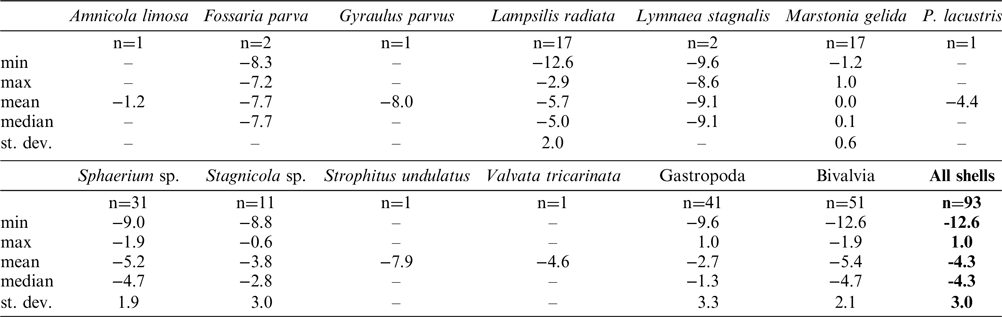
Measured δ13C values for freshwater shell samples in Manitoba

An additional correction is needed for the live-collected pre-bomb mollusk samples, to account for the radioactively inert carbon dioxide produced during the industrial revolution (Suess Reference Suess1955). This can done by using estimated atmospheric Δ14C values from Stuiver and Quay (Reference Stuiver and Quay1981) in Equation (2) below, to calculate the estimated age offset for each sample (Hua Reference Hua2009; Moore et al. Reference Moore, Rea and Godsey1998). The freshwater reservoir age for the live-collected samples is calculated using Equation (3).
 $${\rm{Age}}\,{\rm{offset}} = -8033\,{\rm{ln}}\left( {1 + {\Delta ^{14}}{\rm{C}}/1000} \right)$$
 $${\rm{Freshwater}}\,{\rm{reservoir}}\,{\rm{age}} = {\rm{fractionation}} {\hbox-} {\rm{correcte}}{{\rm{d}}\ ^{14}}{\rm{C}}\,{\rm{age}}{\hbox-}{\rm{pre}}{\hbox-}1950\,{\rm{true}}\,{\rm{age}}$$
RESULTS
Freshwater Reservoir Age
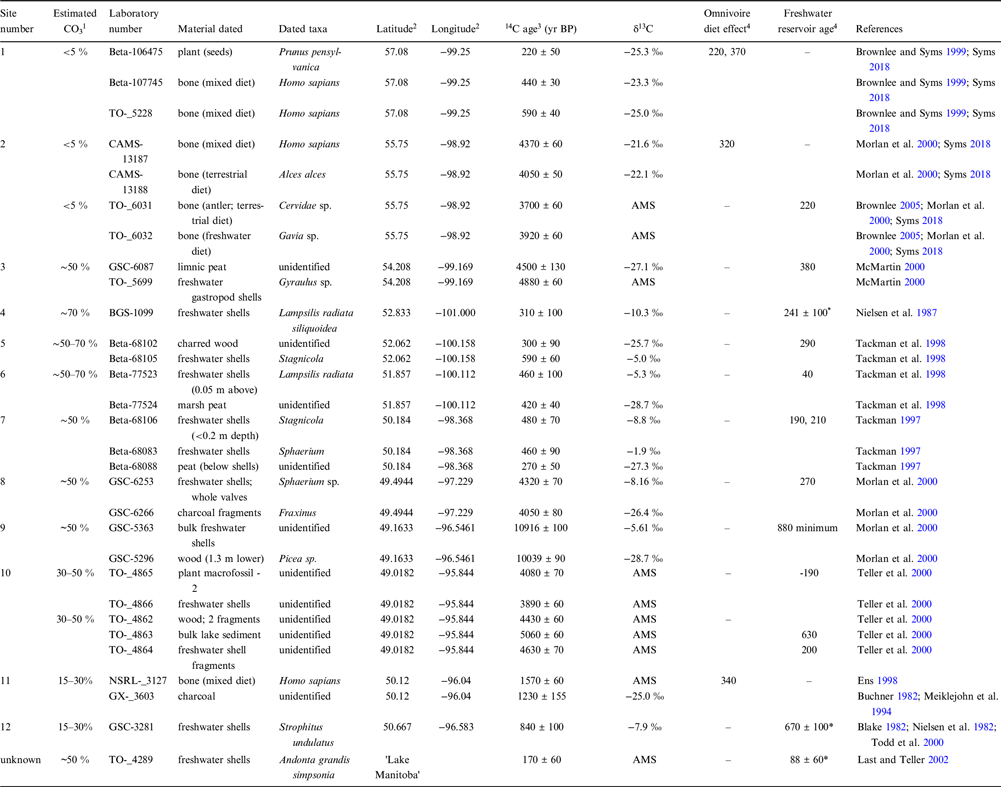
Radiocarbon ages obtained from paired terrestrial–freshwater (n=14) and live-collected pre-bomb (n=3) organic samples in Manitoba (Figure 1) are presented in Table 2. Equation (2) is factored into column “Conventional 14C age (yr BP)” of Table 2. This additional correction was not originally applied to sample TO-_4289 in Last and Teller (Reference Last and Teller2002), leading to an incorrect freshwater reservoir age of 120 instead of 88 14C years. The uncorrected age of the freshwater mollusk GCS-3281 is reported as 570 ± 100 (Blake Reference Blake1982). It was incorrectly normalized as 440 ± 100 in Nielsen et al. (Reference Nielsen, McKillop and McCoy1982), leading to an incorrect freshwater reservoir age in Lewis et al. (Reference Lewis, Forbes, Todd, Nielsen, Thorleifson, Henderson, McMartin, Anderson, Betcher and Buhay2001). The terrestrial–omnivore diet pairs were previously published in Syms (Reference Syms2018), and we include them here to provide comparison with the lower trophic level organisms.
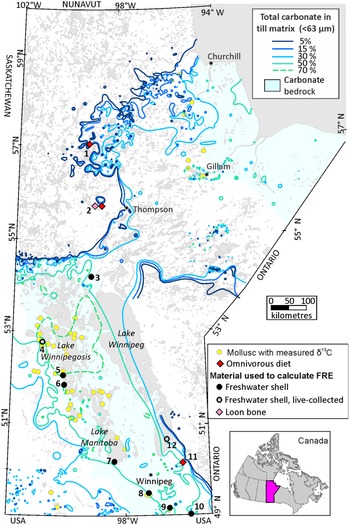
Map of Manitoba, with locations of mollusks with measured δ13C values, paired terrestrial-freshwater, terrestrial-freshwater diet, and terrestrial-omnivorous diet samples (Table 3). Mapped carbonate bedrock is modified after Manitoba Geological Survey (2006) and hand-drawn contouring of the total carbonate in the till (glacial sediment) matrix is from Manitoba Agriculture and Resource Development (2020a). The index map shows Canada, with the province of Manitoba in pink.

14C data for paired terrestrial-freshwater, terrestrial-freshwater diet, and terrestrial-omnivorous diet samples in Manitoba.

1 Based on regional total carbonate (weight percent) in the till (Figure 1). These should be considered as a relative way to compare the availability of old carbon in the respective depositional environments.
2 Geographic coordinate system North American 1983.
3 14C - conv = conventional method; 14C - AMS = accelerator mass spectrometry method.
4 Equation (1), in 14C years.
* Equation (3).
Data Exclusion
Eleven additional terrestrial–freshwater paired-sites in Manitoba were not included in Table 2. These pairs have been used to calculate freshwater reservoir age in the past, and but are based on assumptions that are incorrect. Two sites were analyzed before fractionation correction relative to δ13C = −25.0‰ PDB was conventional (GSC-215 and GSC-216, Dyck et al. Reference Dyck, Fyles and Blake1965; GSC-689 and GSC-797/-870,Lowdon and Blake Reference Lowdon and Blake1968). Three additional sites used assumed δ13C values on plant seeds (CAMS-34555 and CAMS-71709; CAMS-_38680 and CAMS-71710 and CAMS-34550 and CAMS-71708; Lewis et al. Reference Lewis, Forbes, Todd, Nielsen, Thorleifson, Henderson, McMartin, Anderson, Betcher and Buhay2001; Todd et al. Reference Todd, Lewis, Forbes, Thorleifson and Nielsen2000; Todd et al. Reference Todd, Lewis, Thorleifson and Nielsen1996), moss (Y-165, GSC-1319, TO-11762 and Beta-193587; Boyd Reference Boyd2007; Lowdon et al. Reference Lowdon, Robertson and Blake1971; Preston et al. Reference Preston, Person and Deevey1955; Ritchie and Lichti-Federovich Reference Ritchie and Lichti-Federovich1968; Teller Reference Teller1989) or wood (BGS-1851 and TO-_330; Morlan et al. Reference Morlan, McNeely and Nielsen2000; Nielsen and Thorleifson Reference Nielsen and Thorleifson1996; Rannie et al. Reference Rannie, Thorleifson and Teller1989). Data on 51 wood samples in from Manitoba shows that an assumed value is inacceptable, given that measured δ13C values on wood can range from −30 to −23.5‰ with a median of −26.9‰ and a standard deviation of 1.5 (Gauthier Reference Gauthier2021). Another freshwater reservoir age was calculated using a terrestrial sample with significant error, which makes accurate quantification of the FRE impossible (7450 ± 680 BP, TO-5816, Last and Teller Reference Last and Teller2002; Risberg et al. Reference Risberg, Sandgren, Teller and Last1999). An additional freshwater reservoir age was calculated by comparing with lake gyttja (TO-4858 and TO-4859, Teller et al. Reference Teller, Risberg, Matile and Zoltai2000). Gyttja is by definition a bulk sample that may contain older detritus, in addition to have its own FRE (Grimm et al. Reference Grimm, Maher and Nelson2009).
δ 13C Variation on Freshwater Mollusks
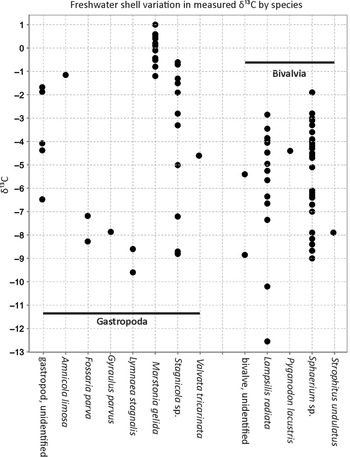
Another three excluded terrestrial–freshwater paired-sites used assumed δ13C values on mollusks (assumed a δ13C = −7.0‰ on unidentified shells, CAMS-32193 and CAMS-35495; Vance and Telka Reference Vance and Telka1998) or ostracods (assumed a δ13C = −5.0‰, CAMS-38676 and CAMS-38678; Vance and Telka Reference Vance and Telka1998). To see if the assumed fractionation correction is valid, the measured (IRMS) δ13C values were collated from 93 freshwater mollusks sampled within Manitoba (Figure 1). This data spans the entire range from live-collected (pre-bomb) to 8460 BP (not corrected for freshwater reservoir age). Measured δ13C values range from −12.6 to 1‰, and there is variability both within a single species and cross-species (Figure 1, Figure 2, Table 1). The gastropod Marstonia gelida (synonym of Marstonia lustrica) has similar median and mean, with a standard deviation of just 0.6‰. This data suggests it may be possible to estimate an assumed δ13C ratio of 0 ± 1‰ for Marstonia gelida. For all other species, however, the spread of measured δ13C is simply too wide to assign an assumed ratio (c.f. Morlan Reference Morlan1999; Stuiver and Polach Reference Stuiver and Polach1977). This could be because environmental dissolved inorganic carbon is also a factor in controlling shell δ13C (McConnaughey and Gillikin Reference McConnaughey and Gillikin2008), meaning that shells cannot be compared from different substrates/water bodies.
The range of δ13C measured on various taxa of freshwater shells from Manitoba.

Freshwater-Diet Effect
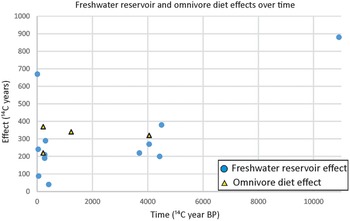
Radiocarbon ages obtained from terrestrial–omnivore diet organic samples in Manitoba (Figure 1) are presented at the bottom of Table 2. The four pairs show a discrepancy between the terrestrial age and the human age, indicating the presence of a freshwater-diet effect between 220 to 370 14C years.
DISCUSSION
Assumed Fractionation Correction on Freshwater Mollusks?
The mean and standard deviation of all Manitoban freshwater shell values, δ13C = −4.3 ± 3‰, could be used as a tentative assumed fractionation correction. This would normalize an unidentified shell with an uncorrected age of 1050 BP to 1388 BP (correction of 338 14C y). If, however, the accurate δ13C value is more like −9‰ or −2‰, the same fractionation corrected ages would be 1321 BP (correction of 262 14C y) or 1425 BP (correction of 375 14C y), respectively. This 104 14C year difference (potential error) may have a significant impact on the chronology of recent histories, or for identifying cultural changes. This potential error is not acceptable for calculating a freshwater reservoir age. As more data becomes available, use of an assumed fractionation correction should stop.
Freshwater Reservoir Age Variability
The freshwater reservoir age in Manitoba has not remained constant through time (Figure 3). The freshwater reservoir age varies between 40 and 880 14C years for the 12 freshwater mollusk samples. The largest freshwater reservoir age was measured from the oldest sample pair and likely reflects the contribution of depleted glacial meltwater into Lake Agassiz. There are no other Lake Agassiz-related freshwater reservoir age studies to compare spatial variability to. Southwest of James Bay, an even larger 4020 14C year correction is tentatively suggest for Lake Ojibway, though the two samples uses to calculate this are from different strata with an erosional contact in between (Daubois et al. Reference Daubois, Roy, Veillette and Menard2015). The dataset has a mean of 310 14C years, a median of 230 14C years and a standard deviation of 230 14C years—or roughly an average freshwater reservoir age of 310 ± 230.
Freshwater reservoir age and possible freshwater-diet effects in Manitoba over time, calculated from paired terrestrial-mollusk and terrestrial-omnivore diet radiocarbon ages.

In Lake Winnipeg, cessation of Agassiz sediments and initiation of Lake Winnipeg sediments is dated at 7.75 ka 14C BP (twigs, CAMS-32189; Vance and Telka Reference Vance and Telka1998). After separation from the larger meltwater-fed postglacial lake, the data suggests it may possible to use freshwater and freshwater-diet radiocarbon ages in large-scale regional data compilations as long as the error bars are respected. Similar-magnitude modern freshwater reservoir ages (250 to 500 14C years) were calculated for lakes Michigan and Huron, which also overlie carbonate bedrock (Moore et al. Reference Moore, Rea and Godsey1998).
Freshwater Diet Effect
The freshwater diet effect in Manitoba shows less variability through time (Figure 3), though there are only 4 samples. The values range between 220 and 370 14C years. Unfortunately, neither δ15N nor δ34S values were measured on these samples. As such, it is impossible to fully understand the dietary make up, nor quantify the proportion of diet due to the freshwater reservoir effect.
Geologic Link?
Direct measurements of water alkalinity are not available to investigate a potential link between relative availability of old carbon and calculated freshwater reservoir age in Manitoba. This is partially because five of the freshwater reservoir age samples are >3500 BP. Instead, we used the surficial geology as a proxy. Till (sediment derived directly from glaciation), meltwater-related glacial sediments (glaciofluvial, glaciolacustrine, glaciomarine), and/or postglacial sediments (fluvial, lacustrine, marine), cover most of Manitoba (Manitoba Agriculture and Resource Development a). The total-carbonate content of surface till in Manitoba varies between 0 and 80 weight percent, due to changes in underlying bedrock lithologies as well as variable transport and comminution of calcareous detritus by glaciers (Manitoba Agriculture and Resource Development b). This is measured on the <63 µm size-fraction of the till matrix. Figure 1 shows that the majority of the paired-radiocarbon sites are overlying calcareous till (∼ 50 weight % CO3), and/or within waterbodies that largely overlay calcareous till. This coincidence makes it difficult to determine if there is a predictable link between the calcareous substrate and freshwater reservoir age. It does, however, suggest that the variability in calculated freshwater reservoir age (Table 2) is not a factor of substrate alone.
CONCLUSIONS
The freshwater reservoir age in Manitoba is variable over time and space; one specific 14C year correction cannot be applied without significant error bars. Previous Manitoban studies that have either negated the freshwater reservoir age (Tackman et al. Reference Tackman, Currey, Bills and James1998; Risberg et al. Reference Risberg, Sandgren, Teller and Last1999; Last and Teller Reference Last and Teller2002) or calculated it incorrectly (Nielsen et al. Reference Nielsen, McKillop and McCoy1982, Reference Nielsen, McNeil and McKillop1987), should be re-addressed in this light. Radiocarbon ages obtained on other omnivorous or carnivorous taxa in Manitoba, and other similar boreal environments, may also need partial freshwater reservoir age corrections due to a freshwater diet effect. This study provides the first compilation of regional data and should be used to guide future projects.
ACKNOWLEDGMENTS
This study was funded by the Manitoba Geological Survey. K. Brownlee (Manitoba Museum) provided insight into the discovery of a Manitoba archeology freshwater diet effect within. A. Martindale provided discussion and data from the Canadian Archaeological Radiocarbon Database.