I. INTRODUCTION
Michal Kalecki mostly interacted in the early 1930s with three kinds of groups. The first was a socialist community, the second was a group of high-level academics and monetary economists, and the third was a group of econometricians (Assous Reference Assous2014). In connection with these three groups, each with its own political and intellectual background, Kalecki came in the 1930s and early 1940s to develop a new approach to the study of (in)-stability.
Along socialist lines, Kalecki emphasized how much capitalist development was “irrational” and prone to repetitive crises (Toporowski Reference Toporowski2013). Four arguments were raised. The first was that economies could be stuck in “quasi-equilibrium” with mass unemployment. The second was that “quasi-equilibrium” couldn’t be stationary. Changing capital stock alters investment, saving, and other behaviors, which manifest in “automatic cycles.” The third was that regular fluctuations would, in the absence of shocks, prevent any growth. The fourth was that, in the absence of public interventions, class struggle did not impinge upon the dynamics. Revolving around these four arguments, Kalecki’s vision Footnote 1 conveys the message that capitalist economies were stagnant but subject to local instability.
In 1929, Kalecki went to work at the Warsaw Institute for the Study of Business Cycles and Prices. Footnote 2 From then on, he interacted intensively with monetarist economists who were well versed in Knut Wicksell’s works. In 1934, he first sent an article to the Polish academic journal Ekonomista Footnote 3 with the aim to make an impact on Polish scholars. This paper is critical. It reveals how Kalecki came to question the stability properties of the “classical stationary state.” Footnote 4 His main achievement was to put forward new routes through which lower prices and wages could generate full employment equilibrium. However, when deflation comes with a “crisis of confidence,” lapses from classical stationary states may not be remedied automatically. Regardless of how expectations are formed, Kalecki eventually concluded, economies may be globally unstable.
Kalecki strove to embed these arguments into consistent models. Naturally, this brought him into Ragnar Frisch’s research agenda Footnote 5 and put him in contact with the Econometric Society. It was then that he resorted to nonlinear functions. His early works contain two, clear, economic presentations of nonlinear investment functions. The first, mentioned in 1935, involved eliminating the assumption of linearity of the 1933 investment function in the context of an elastic credit system. The second consisted in designing a S-shaped investment curve based on a particular analysis of expectations, a point made in the 1939 Essays in Economic Fluctuations. Kalecki did not perceive how such nonlinear functions could help him in getting endogenous cycles, even though he had all the necessary economic arguments to do it (Assous Reference Assous2003; Velupillai Reference Velupillai2004). That step was left for Nicholas Kaldor (Reference Kaldor1940), who realized the potential of this nonlinearity.
The rest of this article is organized as follows. Section II is devoted to Kalecki’s early vision. Footnote 6 Section III addresses Kalecki’s questioning of the global stability properties of “classical stationary states,” and section IV suggests a simplified formalization designed to provide a convenient instrument to interpret, assess, and extend Kalecki’s early theoretical contributions. Footnote 7 Such a reconstruction Footnote 8 is helpful for three reasons. First, it helps by pointing out the conditions under which endogenous cycles can be obtained. Second, it sheds light on Kalecki’s treatment of growth. Third, it makes clear how “class struggle,” through its impact on the dynamics of income distributive shares, operates during cycles.
II. KALECKI’S VISION
The notions of “quasi-equilibrium,” “automatic cycles,” and “class struggle” are at the heart of Kalecki’s vision. The first forms the foundation for an analysis of coordination failures, the second is the bedrock of Kalecki’s understanding of the contradictions of capitalism, and the third addresses the core of his political economy.
Quasi-equilibrium
Kalecki considered an economy to be comprised of two classes: a class of people possessing all the means of production—the capitalists; and a class of people possessing nothing but their labor force—workers. Such a differentiation of role is at the heart of his theory of profit and “quasi-equilibrium” analysis. As long as capitalists, individually, have enough capital to pledge as collateral, their expenditures, unlike those of workers, are not limited to their current income. Footnote 9 Now, if workers consume their entire wage and each capitalist receives exactly the average expenditure of capitalists as a whole, one can immediately jump to the conclusion that the more capitalists spend, the more they earn.
If some capitalists spend money, either on investment or consumption goods, their money passes to other capitalists in the form of profits. Investment or consumption of capitalists creates profits for others. Capitalists as a class gain exactly as much as they invest or consume, and if—in a closed system—they ceased to construct and consume they could not make any money at all. Thus capitalists, as a whole, determine their own profits by the extent of their investment and personal consumption. (Kalecki [Reference Kalecki and Osiatynski1933a] 1990, p. 79)
In a way, “capitalists … are masters of their fate” (Kalecki [Reference Kalecki and Osiatynski1933a] 1990, pp. 79–80), while workers, constrained to their current income, have no other choice but to adjust to the capitalists’ decisions. Naturally, this happens only for capitalists as a whole. Each capitalist, in deciding how much to invest or consume (spend on credit), needs to know the demand for their product. So, eventually, how the capitalists master their fate depends on “objective factors” (ibid.).
Kalecki’s Reference Kalecki and Osiatynski1934 paper “Three Systems” can help in understanding the nature of these constraints. Resorting to a two-sectors model—with distinct consumption and investment goods sectors—Kalecki emphasized an important aspect of modern economies, which is that no sector, in itself, can absorb its own production. Part of its revenues results necessarily from sales to the other sector. Consequently, profitability and thus investment decisions by the firms of both sectors are mutually dependent. Assume, for instance, that firms in the investment sector decide to invest unilaterally. Demand in the investment sector increases, to which firms react by producing more and hiring more workers. As workers newly employed in the investment goods sector spend their wages on consumption goods, demand also increases in the consumption goods sector, while profits are raised by the amount of money wages paid in the investment sector. Surely, part of the demand for investment goods results in higher profits in the investment goods sector, but not by the same amount. As a result, investments made in the investment goods sector can be financed only if profits realized in the consumer goods sector flow back into the investment goods sector. But then the debt structure will be modified. So we can see that the only way to prevent this from happening is that the firms of the consumer goods sector should invest too. Only then will capitalists of both sectors, with an unchanged debt burden, earn on average exactly what they spent.
In sum, in deciding how much to invest, capitalists will be affected by what they expect others to do. If they expect others will invest, they may have an incentive to invest too. Inversely, if they expect others won’t invest, they will have no incentive to do it. These interdependencies between sectors explain the possibility of multiple “quasi-equilibria.” Footnote 10 If capitalists are globally pessimistic, the economy will get stuck in a low equilibrium, characterized by a low level of investment spending. Inversely, if capitalists are globally optimistic, the economy will reach a high equilibrium. Footnote 11 The problem is that in the absence of any coordination, even though movements from one quasi-equilibrium with a low output level to another with high output may be desirable for all capitalists, no single capitalist will want to undertake the expansion unilaterally. The bottom line is that capitalists have no control over the decisions of others.
It is by extending this analysis to the medium run that Kalecki finally elaborated his business cycle theory. Kalecki introduced a time delay between the decision to invest (orders) and the actual realization. Investment decisions, as they are completed, generate expenditures and aggregate demand, but, once embodied in the form of actual investment, they entail growth in the stock of productive capital. Kalecki’s Reference Kalecki and Osiatynski1934 article precisely addressed this point:
In accordance with the aim of the present essay, we have only examined the formation of equilibrium (or quasi-equilibrium) within the already existing capital equipment of definite but essentially arbitrarily volume and structure. The level and direction of investment activity which follow the establishment of equilibrium in general will not support the previous volume and structure of this capital equipment: investments in individual industries on the whole will not be equal to the wear and tear of fixed capital in these industries.… Thus there will be a movement through a series of equilibria (or quasi-equilibria), i.e. until the final equilibrium is attained, i.e. a position in which investment activity no longer changes the volume and structure of capital equipment. Indeed, this is not the only possibility, if we still consider the time of construction of new investment goods. Then it may also turn out that the movements through a series of successive quasi-equilibria will be cyclical, and hence the position of final equilibrium will never be attained. In my opinion these are proper business fluctuations. (Kalecki [Reference Kalecki and Osiatynski1934] 1990, pp. 218–219; emphasis in original)
This change, though quite significant, did not undermine his view that economies could be stuck in “quasi-equilibria” featured by a low degree of capital utilization and mass unemployment. Still prone to stagnation, Kalecki added, economies were locally unstable, fluctuating around a stationary position devoid of growth.
Automatic Cycles
Kalecki insisted on the automatic character of business fluctuations by isolating two factors about demand and capital accumulation that result in regular fluctuations in investment, profits, employment, and national income. Footnote 12 Capitalists do not only need to form expectations of how much the rest of them will invest; they also need to take into account how decisions of others will impact the global productive capacity in the future. This obviously refers to the problem of the duality of investment. Although investments have a stimulating effect on the economy while they are being carried out, as soon as investment goods are delivered, they exert a negative effect on profitability. The problem is that in selecting investment projects, each capitalist takes as given the capital stock of other firms. As a result, none of them foresees the evolution of the global capital stock. In sum, cycles occur because firms do not internalize the impact of their investment decisions on the whole capital stock. Kalecki saw this as being the most noteworthy contradiction of capitalism: the increase of productive capacity bears within it the seeds of crisis.
Some discussion of Kalecki’s business cycle mechanism in different phases of the cycle might be helpful at this point. Let us first consider a situation at the trough of a depression in which new orders for investment goods equal the production of investment goods while the capital stock is falling. Though profits remain unchanged, the profit rate increases. So investment orders and, in the next period, gross accumulation, rise, which raises profits, further stimulating investment orders. Eventually, the higher investment activity gives rise to the delivery of new capital goods in excess of depreciation, and this increase in the capital stock slows and eventually halts the growth in the rate of profit. At the peak of the cycle, investment orders equal gross accumulation and profits are stable. Due to deliveries in excess of replacement, the capital stock keeps increasing, which lowers the rate of profit, causing investment orders and the next period’s gross accumulation to decline. Profits therefore decline, and a further decrease of investment occurs, and so on. Eventually, deliveries of capital goods begin to fall short of replacement and the capital stock starts shrinking. The trough is finally reached when the positive effect on investment of the shrinking of the capital stock exactly offsets the negative effect of the low production of investment goods on profits. Turning points thus occur due to the dual aspect of investment: actual accumulation increases income and profitability, but comes with bigger capital stock. As a result, as soon as the capital stock is changing, the economy will move cyclically through a “series of quasi-equilibria.”
Along these lines, Kalecki argued that there are always automatic factors that are likely to help an economy come out of a crisis. He considered the Great Depression to be one phase of the trade cycle that would, at least in theoretical terms, end up in an upswing as soon as the capital stock had fallen sufficiently and profitability of firms had been restored. To explain the intensity of the depression, Kalecki also appealed to psychological aspects. Footnote 13 Capitalists, observing their productive capacities underutilized, might have simply decided to postpone their investment decisions, waiting for a stronger rise of profitability. But, at the end of the day, the capacity effect that comes with the fall of the capital stock was considered strong enough to restore growth. Footnote 14
That conception of instability was tightly connected to Kalecki’s treatment of growth. The business cycle model can alternatively produce damped cycles but no trend, or a trend but no cycles. So, economies cannot endogenously break the impasse of fluctuations around a static position: thus, if one observes cyclical growth, this is due only to semi-exogenous shocks such as the effects of innovation upon investment.
Class Struggle
In the absence of any public interventions and as long as the economy is working below full capacity, class struggle does not determine the dynamics of the business cycle. This is because there is a strong complementarity between income distribution and income determination, which finds expression in the idea that even though the profit share might vary during the business cycle, its changes will have no impact on the profit rate. The profit level, according to Kalecki’s theory of profit, remains uniquely determined by capitalist expenditures resulting from past decisions. Suppose there is a rise in the profit share. Footnote 15 As long as capitalist spending stays constant, the total amount of profits does not change. But, while profits remain unyielding, the real wages and real national product decrease because of the fall in workers’ consumption, with a consequent fall in output, which will adjust just so much that the higher percentage share of profits in output results in an unchanged absolute amount of profits. Hence, we find the striking Kaleckian proposition that changing profit shares cannot impinge on the course of the cycle. Certainly, such evolution affects the amplitude of GDP changes over the cycle, but it simply has no effect on the profit rate and thus the dynamics of investment. Even though class struggle would come with the changing profit share, we see that it will have no impact on the dynamics of the economy. Class struggle is among these “internal forces” whose influence is neutral on the dynamics, a point that Kalecki attempted to make clear to Alexander Rachjman (a Polish mathematician and member of the Communist Party):
If a student of mechanics riding in a cab concluded that it would be useless to kick the front panel to speed it up, he would be right, since the assumption that the course of the cab is completely determined by its initial position, initial speed, and the influence of outsides forces excludes the possibility of internal force affecting his course. (Kalecki [Reference Kalecki and Osiatynski1933b] 1990, p. 113)
From a strict economic point of view, capitalists are thus indifferent between the high and low levels of the profit share over the course of the business cycle.
In contrast, from a political perspective, strong antagonisms between classes have a decisive impact on public interventions. Capitalists have no direct control over the business cycle, but governments can change its course. Capitalists may thus try to use governments to serve their own interests. Footnote 16 In bad times they plead for increasing public expenditures, and they advocate for austerity in good times. Capitalists’ power may especially be threatened if workers unite in social democratic parties that use the political process to demand full employment through the political process, for then the very legitimacy of de facto control over the economy by owners of the means of production is challenged. When so threatened, capitalists will engage in investment strikes likely to jeopardize economic performance, and will eventually pressure the government to comply with their demands. Such controlling devices can be interpreted as Kaleckian reactions by capitalists to what they interpret as encroachment into their own sphere by democratic government policy (Streeck Reference Streeck2011). Footnote 17
This leads to the idea of a political business cycle wherein GDP fluctuates between an upper and a lower limit. So, in addition to the automatic regulator played by the fluctuation in the capital stock, here we see the appearance of a political regulator. As unemployment falls during the expansion, workers use their power to regain control over capitalists, who finally decide to stop investing and pressure the government to cut its spending. In turn, the downturn is checked when unemployment leads to government countercyclical action and capitalists decide to reinstate investment expenditures. Local instability is also rooted in the political sphere. Besides the change in the capital stock, the dynamics of political power reinforce the unstable features of capitalism. This is the “regime of the political business cycle,” based on the assumption that a continuous full-employment capitalism undermines the power of business leaders to control workers.
III. QUESTIONING “CLASSICAL STATIONARY STATE” STABILITY
Kalecki’s approach to (in)-stability also results from his collaboration with monetarist economists. Here, his collaborations with two Polish economists—Tadeusz Slawinski and Marek Breit—were decisive. Footnote 18 The first was a co-editor of the journal Prezeglad Gospodarczy, in which Kalecki had a biweekly column in the section “Commodity Markets.” Although Slawinski was a proponent of conservative monetary and financial practices such as the gold standard, he thought that the money-creating (and -destroying) power of the commercial banks created a base for financing investments. Slawinski had a huge impact on Kalecki. It thus comes as no surprise that Kalecki paid so much attention to monetary aspects in the paper where he outlined his macro theory for the first time. Footnote 19 His reflections were clearly motivated by considerations of how economies might climb out of economic depression through a process of the creation of purchasing power. The impact of Marek Breit operated differently. Breit joined the Warsaw Institute in 1933, when Kalecki had already completed his Essay. Footnote 20 Not having been involved in the development of the Essay, he challenged Kalecki’s ideas and urged him to clarify its relation to Knut Wicksell’s approach. Footnote 21
Kalecki addressed these monetary issues in his 1934 paper “Three Systems.” On this occasion, he turned his attention to the properties of classical stationary states. Three economic conceptions were examined. The first describes an economy in which full employment is reached instantaneously. As soon as Say’s identity is assumed and all income is immediately spent, all excess supplies of labor, goods, or capital services instantaneously vanish. In system II, in which firms may vary their cash reserves, disequilibrium between aggregate demand and aggregate supply can come with “creation” and “destruction” of purchasing power. The position of stationary equilibrium remains the same, however. As long as money wages and prices are perfectly flexible, aggregate demand eventually adjusts to full employment output. How can this be accomplished? Actually, Kalecki provides an answer: the mechanism is the so-called Keynes effect. If such an effect works well, variations in all prices allow the adjustment of nominal interest rates and a change in the velocity of circulation, which comes with the creation of purchasing power. If, for instance, a shock makes real aggregate demand deficient, interest rates will fall automatically to levels low enough to induce sufficient investment to absorb full employment saving so that aggregate demand—consumption plus investment—will eventually equal full employment supply. Naturally, the money authorities will be able to keep the money rate of interest below (or above) its equilibrium value by increasing (or decreasing) the quantity of money without limit. We thus get a process of cumulative Wicksellian inflation or deflation that eventually stops as soon as the real quantity of money stops varying. Then, the economy stabilizes in a position of full employment equilibrium. In system III, since existing unemployment does not exert pressure on money wages to eliminate it, unemployment exists at the quasi-equilibrium position determined by the level of investment. Here, the money wage is not fixed, but changes in the unemployment rate (rather than its level) cause changes in the money wage. In this system the possibility of investment in new projects and changes in capitalist consumption levels change the position of the quasi-equilibrium. With the help of this model, Kalecki expresses his theory of profit and shows the possibility of quasi-equilibrium in presence of “a reserve army of the unemployed.”
Kalecki did not explicitly question the stability properties of the full employment equilibria defined by systems I and II. However, a careful reading of his 1933 Essay makes it clear that Kalecki considered that such equilibria might be unstable. There is indeed no doubt that he was aware that the potentially stabilizing effect of price deflation working through the “Keynes effect” may well be dominated by other destabilizing effects, and that the equilibrium defined by systems I and II may well be globally unstable. Footnote 22 As he wrote in 1933:
Finally, in the analysis of the money market we must still consider a “crisis of confidence” which can break out in the depression in the context of a sudden fall in prices, making it difficult or impossible to service debts and pay interests. In this case the rise of the interest rates is coined with a deepening of the depression. (Kalecki [Reference Kalecki and Osiatynski1933a] 1990, p. 98)
His point was that the destabilizing effect could come from the increased burden that lower prices imposed on debtors. In particular, his point was that deflation might well increase the real value of existing debt and generate bankruptcies, thereby causing a “crisis of confidence,” ending up in a lower level of aggregate demand. So, when the effects on bankruptcy are strong enough, a lower price level may be deviation-amplifying. If this outcome does not occur, it is because the government does not let it.
It is this same line of reasoning that Kalecki followed in his debate with Arthur Cecil Pigou, in which he argued ten years later that the classical stationary state might be globally unstable. In this respect, Kalecki thought that his analysis was more compelling than John Maynard Keynes’s one based on the revision to expected inflation in a deflationary context: “In the course of adjustment the factor you mention will tend to reduce employment, but an even more important influence in this direction will be exerted by wholesale bankruptcy and the resulting ‘crisis of confidence’, which I mention in my note (on Pigou)” (Kalecki [Reference Kalecki and Osiatynski1944] 1990, p. 132).
It emerges from this discussion that Kalecki did not think that price flexibility was sufficient to overcome the economic contradictions underlying local instability, as discussed in the 1933 Essay. If one let prices adjust along Pigovian lines, instability may be much more important and may lead to economic collapse. Kalecki, however, seriously doubted that such an evolution could occur, in view of the capitalist institutional set-up regarding wage determination and public interventionism.
IV. MODELING KALECKI’S VISION: A SUGGESTION
Kalecki’s theory of the business cycle was expounded in the 1930s by means of a linear model and a nonlinear model. While the first, couched in terms of a mixed differential equation, was resolved analytically, the second was discussed only qualitatively on the basis of a geometrical representation. With the help of simple dynamic formulations of both models, we believe that it is possible to identify more specifically the key features of Kalecki’s vision in relation to endogenous cycles, class struggle, and the relationship between growth and cycles.
A Model
According to Kalecki’s theory of profits, as long as workers spend all their wages, the following relation holds between capitalists’ consumption, accumulation, and profits: P = C + I where P is profits, C capitalists’ consumption, and I gross accumulation; i.e., the reproduction and expansion of fixed capital and the increase in inventories. Capitalists’ consumption consists of a constant amount C 0 and a part proportionate to profits; i.e., C = C 0 + (1–s c ) P where s c is capitalist marginal propensity to save.
Substituting capitalists’ consumption into the profit equation allows Kalecki to obtain the profits P corresponding to any ‘quasi-equilibrium’: that is, the equilibrium level of profit for a given level of investment and capital stock
 $$P = {{{C_0} + I} \over {{s_c}}}$$
To determine the level of output Y by the level I, Kalecki assumes a certain relationship between profits and output. When the profit share, α = P / Y, is constant, he gets
 $$Y = {{{C_0} + I} \over {{s_c}\alpha }}$$
where s c α is the social propensity to save.
In the medium run, the stock of capital changes according to
 $${{dK} \mathord{\left/ {\vphantom {{dK} {dt}}} \right. \kern-\nulldelimiterspace} {dt}} = I - D$$
where D is the depreciation of capital, which Kalecki assumes to be constant. In the discussion that follows, we use the more standard assumption that depreciation is proportional to the stock of capital, so that D = δ K where δ < 1 is the rate of depreciation.
In the presence of a gestation lag—that is, the time necessary for the construction and delivery of industrial equipment—current investment results from past investment decisions and does not depend on current economic variables. Footnote 23 Over the longer run, however, investment changes according to
 $${{dI} \mathord{\left/ {\vphantom {{dI} {dt}}} \right. \kern-\nulldelimiterspace} {dt}} = \theta \left[ {{I^d} - I} \right]$$
where I d refers to the desired investment and θ is the inverse of the characteristic time of gestation.
Then, for any specification of the investment function, one gets a two-dimension system in I and K from which can be deduced the cases discussed by Kalecki in 1933 and 1939, as well as those suggested by Kaldor in his 1940 paper.
Let us first examine the 1933 version, taking the ratio of investment plans to capital to depend on the rate of profit and the money rate of interest. The money rate of interest is assumed to be proportional to the rate of profit, which reflects general business conditions, so that the ratio of investment plans depends on the rate of profit. Kalecki assumes a linear form given by
 $${I^d}/K = m\left( {P/K} \right) - n$$
where m and n are positive constants, which implies that the desired investment is
 $${I^d} = mP - nK$$
Using equation (4), it follows that the change in investment is an increasing function of the level of profits and a decreasing function of the level of capital stock. For a given level of profits, an increase in the volume of capital means a reduction in the rate of profit.
Substituting the desired investment function in equation (4), using equation (1), one gets the following system:
 $${{dI} \over {dt}} = \theta \left( {m{{{C_0} + I} \over {{s_c}}} - nK - I} \right)$$
 $$dK/dt = I - \delta K$$
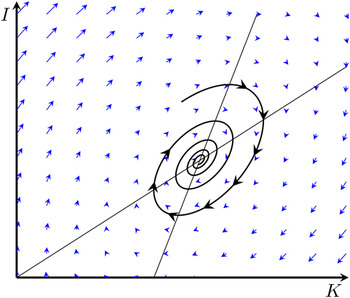
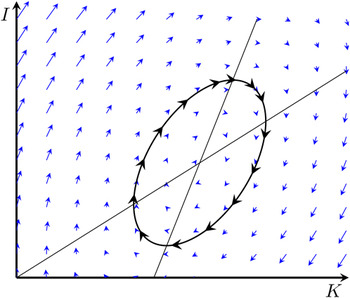
With this two-dimensional, continuous dynamical system, we can determine the equilibrium, if any, of the economic dynamics. In the (K,I) upper right plane, the economic equilibrium will be at the intersection of the isoclines dI/dt=0 and dK/dt=0. With the calculation of the Jacobian of the system, it is also possible to work out the stability conditions of the equilibrium. This mathematical analysis reveals several possible cases:
-
• when m < s c the isocline dI/dt=0 is negatively sloped: there is always an equilibrium. This equilibrium is stable and a path towards the equilibrium will possibly exhibit damped oscillations.
-
• when m > s c the dI/dt=0 isocline becomes positively sloped. We need the dI/dt=0 isocline to be steeper than the dK/dt=0 isocline: i.e.,
 $\left( {{m \over {{s_c}}} - 1} \right) &lt; {n \over \delta }$
, for an equilibrium to exist. The stability of the equilibrium then depends on the trace of the Jacobian. Three subcases can be distinguished:
-
° When the trace is positive, the equilibrium is unstable. Along a trajectory, both K and I may grow to infinity.
-
° When the trace is negative—i.e., when
$\theta \left( {{m \over {{s_c}}} - 1} \right) &lt; \delta$
—the equilibrium is stable. A trajectory converges towards this equilibrium with damped oscillations. -
° When the trace is null—i.e., when there is a particular combination of parameters so that
$\theta \left( {{m \over {{s_c}}} - 1} \right) = \delta$
—the dynamics exhibits sustained cycles.
-


The last two subcases are illustrated in figures 1 and 2, where we have drawn in the (K,I) plane the vector field of the dynamical system, the isoclines dI/dt=0 and dK/dt=0, and an example of a trajectory.
Damped cycles.

Sustained cycles.

The non-generic case where there are sustained cycles was first chosen by Kalecki as the solution of his model. Frisch objected to this solution and claimed that one must not assume a priori such values of the parameters of the business cycle equation as to render cyclical fluctuations of constant amplitude, to the exclusion of damped or explosive fluctuations. Kalecki first accepted Frisch’s criticism and retained only the damped cycles solution.
When damped cycles do occur, their occurrence is related to both the slow adjustment of desired investment to actual investment, and the negative effect of capital stock on desired investment. If θ is large so that adjustment is very rapid, the economy will always be near the dI/dt = 0, so that the adjustment to the long-run equilibrium will be smooth. Kalecki, however, assumed that the time lag between desired investment decisions and the real investment is large. Thus, the introduction of the time lag explains, according to him, a cyclical movement, even if the underlying situation is a stable one. Indeed, the condition for damped oscillations is more likely to be satisfied the longer the investment lag or the smaller the θ. If the effect of capital stock on desired investment is small (n small), the mere replacement of the depreciated capital is sufficient to lead to desired investment above current investment, thus fueling a sustained increase in investment. It is thus necessary to suppose that the equipment added during the period of the time lag has a considerable influence on the rate of profit, and hence on investment decisions.
Endogenous Cycles in the 1939 Version
In the 1939 version, Kalecki assumes a nonlinear investment function. The nonlinearity of the investment function was explained by simply recognizing that the responsiveness of investment to profits is quite low at extreme investment, profit, and output levels. The reason Kalecki gave for it was essentially that expectation elasticity was assumed to be low for extreme values of investment and high for normal values. For an explanation, we can refer to this passage of the Essays in the Theory of Economic Fluctuations:
[W]hen things are improving entrepreneurs become more optimistic about their future, and the rate of investment decisions increases strongly; but after a certain point doubts begin to arise as to the stability of this development, optimism ceases to keep pace with boom, and the rate of investment decisions tends to increase less rapidly. In the slump a symmetrical development is likely to occur. (Kalecki [Reference Kalecki1939] 1990, p. 310)
Formally, this means that the coefficient m of the investment function will not remain unchanged during the cycle. If
 $\left| {m - {s_c}} \right|$
is small enough near the stationary equilibrium, a single shock will be enough to produce oscillation of slowly diminishing amplitude, slightly damped fluctuation, and a series of shocks “establishes a state of relatively undamped fluctuation” (Kalecki [Reference Kalecki1939] 1990, p. 318n).
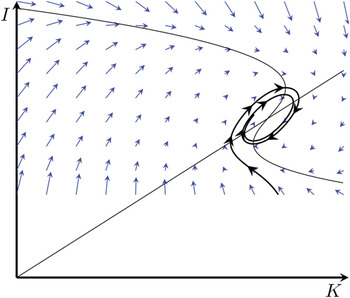
Thus, Kalecki clutches to damped endogenous fluctuations with nonlinear investment functions. He does not realize the potential of this nonlinearity to produce endogenous business cycles. Kaldor (Reference Kaldor1940), who acknowledges Kalecki’s contribution and devotes a long appendix in his paper to comparing his model with Kalecki’s, was the first to show how such a nonlinear function could help explain endogenous cycles in a slightly different model. Footnote 24 Along the same lines, a mathematical analysis shows that under specific conditions a generic endogenous cycle is possible in the nonlinear 1939 version. We show an example of such a cycle in Figure 3, where the isocline dI/dt=0 is no longer linear. Footnote 25
Endogenous cycles.

When cycles do occur, their occurrence is still related to both the adjustment of desired investment to actual investment and to the negative effect of capital stock on desired investment. But, unlike the version of 1933, the existence of self-sustained cycles no longer depends on a particular combination of reaction coefficients m, n, and time lag θ. The investment and capital dynamics create their own cycles by which investment, and thus profit, output, and employment, cannot exceed certain boundaries. The dynamic system is self-correcting and fluctuates within limits: whereas the system becomes stable at its outer boundaries, it cannot converge toward the equilibrium. Therefore, the dynamics of the system will result in cycles. Notice that the cycle is completely endogenous: no exogenous shocks are necessary to obtain constant cycles. All we need is a particular treatment of expectation for explaining the change in coefficient m and the nonlinearity of the curve of the investment decision.
Class Struggle and the Cycle
Note that the possibility of endogenous cycles, as long as the marginal propensity to save of capitalists remained unchanged, is not affected by the dynamics of the global saving rate s c α. Indeed, because any change in α has no impact on the time path of K and I, change in the global saving rate that might result from changes in α will have no effect on the dynamics of the economy. Hence, one gets Kalecki’s finding that “class struggle” is neutral in terms of its effect on the cycle. Here is certainly the most important difference between the present reformulation of Kalecki’s Reference Kalecki1939 model and the one suggested by Kaldor (Reference Kaldor1940). Kaldor claimed that any change in the saving rate in Kalecki’s model was likely to affect the stability properties of the economy and could suffice in generating a self-sustained cycle. In our reformulation, only changes in the saving rate resulting from a change in the propensity to consume by capitalists are likely to modify the stability property of the economy. If, for instance, changes in the global saving rate come from a change in income distribution, the dynamics of the economy will not be impacted (that is, neither the trace nor the determinant condition is dependent on the profit share).
Cycles and Growth
To study the possibility of sustained growth in the Kalecki model, we can rewrite the dynamical system given by equations (7) and (8) in a more convenient manner. The variables under scrutiny are no longer capital and investment, but the inverse of capital L = 1 / K and investment rate as a proportion of existing capital stock i = I / K. On a regular growth path in which K and I increase over time, L will converge towards 0 and i to a finite value. The growth rate of the capital stock, and thus of the economy, will then be i – δ.
Writing the dynamical system with this new pair of variables thus gives us:
 $${{di} \over {dt}} = \theta \left( {m{{{C_0}L + i} \over {{s_c}}} - n - i} \right) + i\left( {\delta - i} \right)$$
 $${{dL} \over {dt}} = - L\left( {i - \delta } \right)$$
We can draw two conclusions from this dynamical system, conclusions that highlight the opposition between growth and cycles in Kalecki’s vision.
First, a growth path will necessarily converge monotonically to L = 0, and the two-dimension dynamical system asymptotically is reduced to a one-dimension system that involves only the investment rate i. The investment rate i will thus reach a finite value, if it converges at all. What is important is that it is not possible to have sustained oscillations for these variables. As a consequence, there will be no cycles around the sustained growth path. Thus, a growth path will necessarily be regular: it is not possible to have oscillations around a trend.
Second, we can mathematically analyze the conditions for the existence of an equilibrium where L=0, and study the stability condition of its equilibrium. Such an analysis shows that the conditions are m > s
c
and
 $\left( {{m \over {{s_c}}} - 1} \right) &gt; {n \over \delta }$
. When these conditions are fulfilled, we know, the economy will reach a regular growth path if the initial capital is sufficiently large. What is crucial to notice is that these are precisely the conditions that rule out damped cycles around a stable equilibrium with finite capital. Thus, the possibility of a sustained economic growth is contradictory with business cycles. Kalecki interprets this impossibility in the following way: because we observed regular cycles in the actual economic dynamics, self-sustained growth is not possible in a capitalist economy.
Footnote 26
Whatever the variant, linear or nonlinear, Kalecki’s model cannot produce both cycles and growth. One can therefore see that the separation of the “pure business cycle mechanism” from growth is not made for the sake of simplicity. It is rooted in a particular view of the world in which growth can be produced only by external forces. In addition, it appears that Kalecki’s Reference Kalecki1939 model, once used for getting self-sustained cycles, is well suited for capturing the vision of a world prone to stagnation but exhibiting local instability.
V. CONCLUSION
The preceding discussion has set out an exposition of Kalecki’s approach of (in)-stability developed in the 1930s and early 1940s. On that basis, it is possible to identify Kalecki’s early vision. His view, which may fairly be summarized as the idea that economies are stagnant and subject to local instability, is shown to be well modeled with the help of the 1939 Essays in the Theory of Economic Fluctuations, once reinterpreted along Kaldorian lines.
Furthermore, our simple model that accounts for Kalecki’s early vision of macroeconomics emphasizes that cycles and growth are two incompatible phenomena. If capitalist economies are subjected to business cycles, they are doomed to local instability, but nonetheless exhibit a global but stagnant stability.
Finally, our study has addressed the political dimension of Kalecki’s vision by pointing out a clear separation between class conflict and the dynamics of the economy. It is true that this conflict, once the public authorities work for the interests of a specific group, may affect cycles and growth. But, even in that context, political forces will make the cycle inevitable.