Introduction
Quality of life (QoL) is a dynamic and multifaceted concept. Although there is a strong tendency to maintain a stable or “habitual” life satisfaction rating across adult life span (Schilling, Reference Schilling2006), there may be some slight age-related decline in the over 60 years age range. Recent evidence suggests that it is only beyond age 85 that QoL starts to decline appreciably (Netuveli and Blane, Reference Netuveli and Blane2008).
Factors consistently associated with lower QoL at older ages (65+ years) include poor financial situation, depression, dementia, and limitations with physical function; while affluence and trusted social networks have a positive association (Netuveli and Blane, Reference Netuveli and Blane2008; Webb et al., Reference Webb, Blane, McMunn and Netuveli2010). It has been speculated that QoL can remain remarkably stable during old age, regardless of illness, due to compensatory psychological strategies such as cognitive dissonance or mental incongruence (Mollenkopf and Walker, Reference Mollenkopf, Walker, Mollenkopf and Walker2007). Ill older people consider health as less important to their QoL over time, while they value other aspects as being more important (Deeg, Reference Deeg, Mollenkopf and Walker2007). It has been suggested that decline in QoL in late old age may be due to impaired capacity for compensatory strategies due to cognitive decline (Rothermund and Brandstadter, Reference Rothermund and Brandstadter2003).
People with moderate to severe dementia have a significantly lower QoL than people without dementia or people with mild cognitive impairment (Missotten et al., Reference Missotten2008). Dementia is characterized by an irreversible decline not only in intellectual functioning but also in social and physical functioning. QoL in dementia is complex and does not have a simple relationship with cognition (Selwood et al., Reference Selwood, Thorgrimsen and Orrell2005; Banerjee et al., Reference Banerjee2006; Missotten et al., Reference Missotten2008) nor is it consistently associated with sociodemographic variables or increased activity limitation (Banerjee et al., Reference Banerjee2009). Depression is the factor most consistently associated with decreased QoL in people with dementia (Selwood et al., Reference Selwood, Thorgrimsen and Orrell2005; Banerjee et al., Reference Banerjee2009), although QoL is also compromised by the functional and behavioral impairments associated with dementia, use of antipsychotic medication, and caregiver burden (Mougias et al., Reference Mougias, Politis, Lyketsos and Mavreas2011). The domains specifically identified by people with dementia as most important for their QoL included “a sense of aesthetics in living environment,” “financial situation,” “being of use/giving meaning to life,” “security and privacy,” and “self-determination and freedom” (Dröes et al., Reference Dröes2006).
Although much is known about the QoL in the elderly and how dementia may affect both functional and behavioral components, it is not clear what effects an earlier diagnosis of dementia could have on QoL. An early diagnosis of dementia can have several advantages including reduced uncertainty, recognition and management of reversible causes, peer support and education, time to organize support, and legal arrangements for the future. On the other hand, GPs perceive numerous disadvantages or barriers to an early diagnosis including the stigma associated with dementia, concern that the patient will be unable to comprehend or cope with the diagnosis, and the risk of detriment to the doctor–patient relationship (Pond et al., Reference Pond2012b). Increasingly though, timely disclosure of a dementia diagnosis is the preferred option for those with the disease (Phillips et al., Reference Phillips, Pond and Goode2011). It is speculated that the enhanced knowledge and ability to anticipate and plan for problems may improve QoL for both dementia sufferers and their carers. Identification of factors associated with QoL in dementia sufferers will also further inform strategies for maintenance and improvement of patient QoL as part of dementia care. Therefore, the aim of our study was to examine the predictors of QoL in a community-dwelling population aged over 75 years, with or without dementia.
Methods
Study population
This study utilizes cross-sectional baseline data collected from recruited GPs and their patients as part of the “Ageing in General Practice” (AGP) study, a randomized controlled trial examining the effectiveness of peer education on GP diagnostic assessment and management of dementia (Pond et al., Reference Pond2012a). Recruitment was initiated in 2007 across five Australian sites: Newcastle (NSW), Sydney (NSW), Melbourne (Victoria), Adelaide (South Australia), Bendigo (Victoria). Briefly, general practices within a 30-km catchment area of each study site were identified, listed in a random order, and approached sequentially to participate. Recruitment ceased when our participant sample size (2,000) was reached. Patients were recruited by a mail out from each consenting GP to all patients on their database who were aged 75 years or over, had visited the GP within the last 12 months, and could speak and understand English. Patients were excluded from the study if they resided in an aged care facility, or had been diagnosed with Parkinson's disease, multiple sclerosis, motor neuron disease, central nervous system inflammation, psychotic symptoms, progressive malignancy, or a developmental disability.
Ethics approval
The Human Ethics Committees of the University of Newcastle, University of NSW, Melbourne University, University of Adelaide, and Monash University approved the study protocol. All GPs and patients provided written informed consent. Additional caregiver consent was obtained for patients with dementia.
Data collection
The study collected information from patients on personal and social circumstances, QoL, cognitive function, depression, and satisfaction with GP care. Participants were interviewed in their own home by a research nurse, with their responses recorded directly onto a computerized database. All nurses were trained in administration of each instrument and adhered to a standardized interview protocol to minimize interviewer bias. The specific patient characteristics collected and the instruments and criteria used were:
Demographic data: Gender, age, marital status, housing status, and postcode were recorded. Postcode was used as an indicator of socioeconomic status using the ranks of the Index of Relative Socioeconomic Advantage and Disadvantage (IRSAD), produced from census data by the Australian Bureau of Statistics. The IRSAD is a continuous variable of advantage (high values) to disadvantage (low values) derived from variables related to both advantage and disadvantage (e.g. income, tertiary education) (Australian Bureau of Statistics, 2006). Postcode was also used as an indicator of rurality using the Australian Standard Geographical Classification Remoteness Area Structure (Australian Bureau of Statistics, 2003).
Quality of Life: The primary outcome measure for this study was the Australian version of the WHOQOL-BREF, a widely used and validated QoL instrument that measures four separate QoL domains (Hawthorne et al., Reference Hawthorne, Herrman and Murphy2006; Lucas-Carrasco et al., Reference Lucas-Carrasco, Skevington, Gomez-Benito, Rejas and March2011). This study utilized the WHOQOL-BREF as it is applicable to our entire study population i.e. both people with and without dementia. The multidimensional nature of this scale was desirable since social relations, functional ability, environment and activities, as well as health status have all been shown to influence the QoL of elderly people (Webb et al., Reference Webb, Blane, McMunn and Netuveli2010). The WHOQOL-BREF includes important dimensions commonly omitted from dementia-specific QOL measures and has recently been validated for use in persons with mild-to-moderate dementia (Lucas-Carrasco et al., Reference Lucas-Carrasco, Skevington, Gomez-Benito, Rejas and March2011). The WHOQOL-BREF contains 24 core items spanning four domains: Physical (7 items), Psychological (6 items), Social Relationships (3 items), and Environment (8 items). Following reversal of negative items, domain scores were summed and transformed into scores out of 100. Higher scores corresponded to a higher QoL.
Cognitive function: This was assessed using the CAMCOG-R subsection of the Cambridge examination for mental disorders of the elderly (CAMDEX; (Roth et al., Reference Roth, Huppert, Mountjoy and Tym1998), validated in the UK. The CAMCOG-R consists of 68 questions covering seven domains: Orientation (10 items), Language (17 items), Memory (13 items), Attention/Calculation (4 items), Praxis (8 items), Abstract Thinking (4 items), and Perception (3 items). The highest possible score is 104. A cut-point of 79/80 differentiates between those having dementia and those not having dementia with 93% sensitivity and 87% specificity (Huppert et al., Reference Huppert1996). For the purposes of this study a CAMCOG-R score of less than 80 was used as an indicator of dementia. Participants were also asked “Have you been diagnosed with a memory problem?”
Depression: This was measured using the 15-item version of the Geriatric Depression Scale (GDS) (Sheikh and Yesavage, Reference Sheikh, Yesavage and Brink1986). The GDS has been widely used in primary health care settings and found to be valid and reliable in people with dementia (Lichtenberg et al., Reference Lichtenberg, Steiner, Marcopulos and Tabscott1992); it consists of 15 questions, with possible score ranging from 0 to 15. Higher scores are indicative of increasing severity of depression. A cut-off score of 5/6 was used in this study to distinguish those without depression (<6) from those participants with mild (6–10), or moderate to severe (>10) depression. The GDS was used as a continuous variable in the linear regression analyses.
Patient Satisfaction with GP Care: This was measured over the previous 12 months using the General Practice Assessment Questionnaire Version 2 (GPAQ V2). The GPAQ is widely used in the UK as part of the GP quality outcomes framework, and has been shown to be acceptable, reliable, and having an interpretable factor structure (Mead et al., Reference Mead, Bower and Roland2008). Its use has not been specifically validated for people with dementia. The GPAQ domains utilized in this study were related to GP communication (8 questions) and patient enablement following consultation with their GP (3 questions). Mean domain scores were transformed into a percentage of the maximum possible score.
Activities of Daily Living (ADL): A 13-item questionnaire based on widely validated basic and instrumental ADL scales (Katz et al., Reference Katz, Ford, Moskowitz, Jackson and Jaffe1963; Lawton and Brody, Reference Lawton and Brody1969) was used to measure the functional abilities of patients who scored in the dementia range (<80) on the CAMCOG-R instrument. It was completed by a support person (if available) or the patient. ADL was considered impaired if the participant was “dependent” on one or more item.
GP Clinical Judgment: Independent of the patient assessment outlined earlier, GPs were asked to provide their clinical judgment of cognitive function for each of their patients who had agreed to participate in the study. The GP completed a written clinical judgment for each patient including whether the patient had dementia, with the options available being: Yes, No, Possible, or Probable. The GP clinical judgment variable was dichotomized by grouping yes/probable/possible. The rationale of this categorization was that it was the most clinically relevant option: a judgment of “possible” dementia indicated that the patient had been flagged by the GP for surveillance (albeit informal) of worsening cognition. Clinical judgment was classified correct if the GP indicated “No” for patients who scored 80 or greater on the CAMCOG-R or “Yes,” “Possible,” or “Probable” for their patients who scored less than 80 on the CAMCOG-R.
Statistical analyses
Patient demographic factors and prevalence of dementia are presented with simple descriptive statistics – percentages for categorical variables and mean scores and standard deviations for continuous variables. Differences between the dementia and non-dementia groups were analyzed initially using Students t-test and chi-square statistic for continuous and categorical data. Correlation of overall CAMCOG-R score with QoL domains was examined using Pearson's correlation coefficient for all study participants and for the non-dementia and dementia groups separately. Student's t-test was used for comparison of QOL for ADL-impaired with non-impaired participants in the dementia group, and for comparison of CAMCOG-R scores for participants that had or had not received diagnosis of a memory problem. Simple and multiple linear regression were used to examine the predictors of QoL separately in the dementia and non-dementia groups. The models were fit separately with each of the four QoL domains as the dependent variable and the models were fitted within a GEE framework to adjust for clustering within GP. For all analyses, a P-value less than 0.05 was considered to be statistically significant. All analyses were programmed in SAS v9.2.
Results
A total of 2,028 community-dwelling patients aged 75 years or over were recruited via 169 GPs. The response rate was 6% for GPs and 19% for patients.
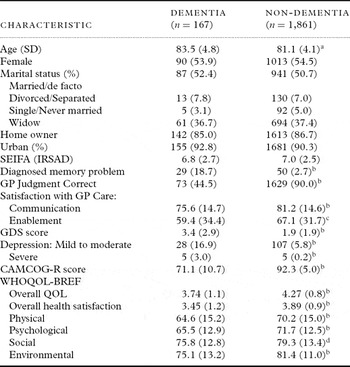
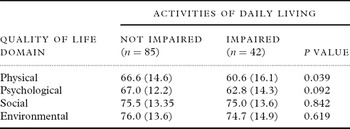
The average age of the 2,028 participants was 81.3 (±4.3) years. Based on performance on the CAMCOG-R (i.e score <80), there were 167 (8.2%) participants with dementia (Table 1). The dementia group was significantly older than other participants (p = 0.01), were more depressed (p < 0.001), and were less satisfied with the care they received from their GP (communication, p < 0.001; enablement, p = 0.006). The dementia group had significantly lower QoL scores in all four domains of the WHOQOL-BREF (Physical, Psychological, Environmental, all p < 0.001; Social, p = 0.002) and in the global ratings of QoL (p < 0.001) and satisfaction with health (p < 0.001). Participants in the dementia group with impaired ADL had significantly lower physical QoL (t test, p = 0.039), but psychological, social, and environmental domains did not differ with ADL status (Table 2). ADL was not included in the multivariate analyses as data were only available for the dementia group.
Participant characteristics and assessment variables (n = 2,028)

a p = 0.01.
b p<0.001.
c p = 0.006.
d p = 0.002.
SEIFA (IRSAD), Socio-Economic Indexes for Areas (Index of Relative Socioeconomic Advantage and Disadvantage; CAMCOG-R, Cognitive Function Measure; WHOQOL-BREF, Quality of Life Outcome Measure; GDS, Geriatric Depression Scale.
Relationship of quality of life with activities of daily living in the dementia group

CAMCOG-R score was modestly but significantly correlated with all four QoL domains in the total study population (all p < 0.001), but only with the social domain (r = 0.178, p = 0.035) in the dementia group and with the physical (r = 0.117, p < 0.001), psychological (r = 0.123, p < 0.001), and environmental (r = 0.177, p < 0.001) domains in the non-dementia group. The individual domain scores of the CAMCOG-R were used for multiple regression analysis to determine which areas of function impacted most on QoL.
Dementia group
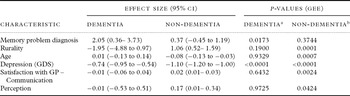
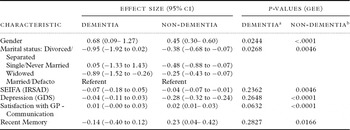
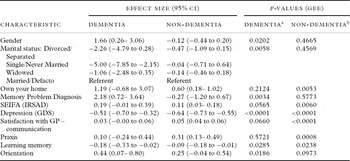
The GDS score was negatively associated with physical (regression co-efficient −0.74, 95% CI −0.96 to −0.54), psychological (−0.55, 95% CI −0.67 to −0.42), and environmental (−0.51, 95% CI −0.70 to −0.32) QoL in the dementia group. Participants in the dementia group who had been given a diagnosis of a memory problem had significantly higher physical (2.05, 95% CI −0.36 to 3.74) and environmental (2.18, 95% CI 0.72–3.64) QoL compared with those in this group who had not received a diagnosis. Social QoL also had a positive, but non-significant association (p = 0.064) with having a diagnosis of a memory problem in this group. Participants who had been given a diagnosis of a memory problem had a significantly lower (p < 0.001) CAMCOG score (64.4 ± 11.3) than those who had not received a diagnosis (72.2 ± 7.9).
Satisfaction with GP care (communication) was positively associated with psychological QoL (0.04, 95% CI 0.01–0.08) and had positive but non-significant association with the social and environmental domains. Other significant positive associations with QoL were being married/defacto for the social (p = 0.0268; Table 5) and environmental domains (p = 0.0058; Table 6) and a higher score in the orientation domain of the CAMCOG-R for the environmental domain (0.44, 95% CI 0.07–0.80) (Table 6).
Non-dementia group
Several of the same factors that were correlated with QoL in the dementia group were also important in the non-dementia group. The GDS score was negatively correlated with all four domains in the non-dementia group (physical −1.10, 95% CI −1.20 to −1.00; psychological −0.92, 95% CI −0.98 to −0.86; social −0.28, 95% CI −0.32 to −0.24; environmental −0.64, 95% CI −0.73 to −0.55) (Tables 3–6). Satisfaction with GP care (communication) was positively associated with all four QoL domains (physical 0.02, 95% CI 0.01–0.03; psychological 0.02, 95% CI 0.01–0.04; social 0.02, 95% CI 0.01– 0.03; environmental 0.05, 95% CI 0.04–0.06).
Predictors of physical QOL presented separately by dementia status

aBetter QOL for dementia group observed with: diagnosis of memory problem, lower depression score.
bBetter QOL for non-dementia group observed with: inner regional residence (cf. urban), younger age, lower depression score, higher satisfaction with GP communication, higher score in perception domain of CAMCOG.
The following factors were not significant in both multivariate models: gender, marital status, home ownership, GP audit correct, IRSAD, and satisfaction with GP care (enablement) and CAMCOG subscales (attention, praxis, abstract thinking, remote memory, recent memory, learning memory, orientation, comprehension, and expression).
QOL, Quality of Life.
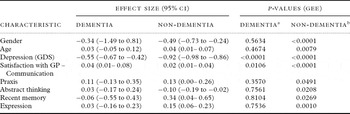
Predictors of psychological QOL presented separately by dementia status

aBetter QOL for dementia group observed with: low depression score, higher satisfaction with GP care (communication).
bBetter QOL for non-dementia group observed with: being male, increasing age, low depression score, higher satisfaction with GP care (communication), higher scores in praxis, recent memory, and expression and lower scores in abstract thinking.
The following factors were not significant in both multivariate models: marital status, home ownership, diagnosed with memory problem, GP judgment correct, IRSAD, rurality, and satisfaction with GP care (enablement) and CAMCOG subscales (attention, remote memory, learning memory, orientation, and comprehension).
QOL, Quality of Life.
Predictors of social QOL presented separately by dementia status

aBetter QOL for dementia group observed with: being female, being married/defacto.
bBetter QOL for non-dementia group observed with: being female, being married/defacto, lower SES, higher satisfaction with GP care (communication), higher scores in recent memory.
The following factors were not significant in both multivariate models: home ownership, diagnosed with memory problem, GP judgment correct, and satisfaction with GP care (enablement) and CAMCOG subscales (attention, praxis, abstract thinking, remote memory, learning memory, orientation, comprehension, and expression).
Predictors of environmental QOL presented separately by dementia status

aBetter QOL for dementia group observed with: being female, being married, being diagnosed with memory problems, low depression score, lower learning memory.
bBetter QOL for non-dementia group observed with: being home owner/occupier, higher SES, low depression score, higher satisfaction with GP communication, higher praxis score and lower learning memory.
The following factors were not significant in both multivariate models: GP judgment correct, satisfaction with GP care (enablement) and CAMCOG subscales (attention, abstract thinking, remote memory, recent memory, comprehension, and expression).
SEIFA (IRSAD), Socio-Economic Indexes for Areas (Index of Relative Socioeconomic Advantage and Disadvantage; GDS, Geriatric Depression Scale.
A number of sociodemographic factors were also correlated with QoL in the non-dementia group: age was negatively associated with physical (−0.08, 95% CI −0.13 to −0.03) and psychological QoL but did not affect the social and environmental domains (Tables 2–5); being married or defacto was beneficial for social QoL (p = 0.005); socioeconomic advantage was positively associated with environmental QoL (0.11, 95% CI 0.03–0.18) but negatively associated with the social domain (−0.04, 95% CI −0.07 to −0.01); and home ownership was associated with increased environmental QoL (0.60, 95% CI 0.18–1.02). Participants living in an inner regional location had significantly higher physical QoL than those living in an urban location (1.06, 95% CI 0.52–1.59).
Higher scores in several CAMCOG-R domains were positively associated with QoL in the non-dementia group: psychological QoL was associated with praxis (0.13, 95% CI 0.00–0.26), recent memory (0.34, 95% CI 0.04–0.65), and expression (0.15, 95% CI 0.06– 0.23); environmental QoL was associated with praxis (0.31, 95% CI 0.13– 0.49); social QoL was associated with recent memory (0.23, 95% CI 0.04–0.42); and physical QoL was associated with perception (0.17, 95% CI 0.01–0.34).
Discussion
People with dementia had significantly lower QoL across all four QoL domains compared to the non-dementia group. The two factors that were associated with both the dementia and non-dementia groups across multiple QoL domains were depression and participant satisfaction with GP communication. Within the dementia group, those who had been given a diagnosis of a memory problem had significantly higher physical and environmental QoL and higher social QoL compared to those not given a diagnosis.
The positive association of having a memory problem diagnosis with QoL for people with dementia is a key finding of this study. The direction of causality is not clear in this cross-sectional study, and people with higher QoL may be more proactive in seeking dementia diagnosis. However, diagnosis may also have a positive impact on QoL in some people. There are numerous benefits associated with a timely diagnosis and disclosure of a memory problem including improved management of exacerbating conditions and symptoms, access to appropriate treatments and social support services, and an opportunity to prepare for the future. The improved access to appropriate services that comes with diagnosis may have a more immediate and significant effect on physical and environmental QoL than the other domains as reflected in the results of this study. However, managing or creating a new sense of self, including the redefinition of goals and expectations is an important coping strategy during early dementia (Pearce et al., Reference Pearce, Clare and Pistrang2002) and may contribute to improved psychological and social QoL in the longer term. This process can only begin effectively with the support of family, friends, and services after a diagnosis has been communicated to the patient. An early dementia diagnosis may also address feelings of uncertainty around self-perceived memory loss and increase the sense of ‘self-determination and freedom’ that has been identified by those having dementia as an important contributor to their QoL (Dröes et al., Reference Dröes2006).
The positive association of having a memory problem diagnosis with QoL (and the lack of a negative association with a false-positive diagnosis in the non-dementia group) found in this study is a further compelling argument for early diagnosis and disclosure of dementia. Although relatives and clinicians may resist discussing a dementia diagnosis on the grounds that it may have a further negative effect on quality of life, it has been reported that both patients and carers prefer full disclosure of diagnosis (Byszewski et al., Reference Byszewski2007) and that insight or awareness of cognitive decline have no impact on health-related QoL in Alzheimer's patients with mild dementia (Hurt et al., Reference Hurt2010). These findings suggest that clinicians should not be deterred from discussing a memory diagnosis and plans for future with patients. Indeed, a broader finding of this study is that effective GP–patient communication in general can have a significant impact on patients’ quality of life. Satisfaction with GP care in terms of communication was positively associated with QoL for both the dementia and non-dementia groups across multiple domains. Similar findings have been reported in cancer patients (Vogel et al., Reference Vogel, Leonhart and Helmes2009), a group that presents similar communication difficulties to those faced by GPs in dementia and geriatric care generally i.e stigma, fear, and uncertainty regarding the course of the disease, and the complexity of managing multisystem disease. These findings have implications for GP practice for communication generally and in relation to their dementia patients. Listening to patients concerns, taking adequate time to provide information and explanation of problems or treatments, and tailoring the involvement in decision making to the patient's desired level may assist patients cope with their situation and potentially improve their quality of life.
Consistent with previous studies, depression scores were negatively associated with all four QoL domains in the non-dementia group and three of the four domains in the dementia group. Depression has previously been found to be a strong predictor of poor QoL in the elderly generally (Webb et al., Reference Webb, Blane, McMunn and Netuveli2010) and in people with dementia (Banerjee et al., Reference Banerjee2009). Impaired ADL and increased dependency are other factors associated with poor health-related QoL (Andersen et al., Reference Andersen, Wittrup-Jensen, Lolk, Andersen and Kragh-Sorensen2004) and lower physical QoL (this study) in community-dwelling patients with dementia. Quality of life, however, does not have a simple relationship with cognitive ability as measured by CAMCOG-R (this study), and other measures of cognition (Banerjee et al., Reference Banerjee2009). A higher score in the attention and orientation domains of the CAMCOG-R were associated with increased environmental QOL in people with dementia, however the physical, psychological, and social domains were not affected. For the person with dementia, a greater understanding of his or her surroundings may result in an improved sense of personal control over their environment. The usefulness of any form of reorientation therapy for dementia patients would require further investigation, as another study has reported that impairment of insight can be protective for the person with dementia in relation to health-related QoL (Hurt et al., Reference Hurt2010). These authors suggest that reality orientation therapy, which requires the patient to repeatedly acknowledge their problems, may actually reduce health-related QoL as a result of increased awareness.
In this study, social QoL was higher in females and those who were married/de facto for both the demented and non-demented groups. Gender differences in QoL have been reported previously in older people generally (Zaninotto et al., Reference Zaninotto, Falaschetti and Sacker2009) as have spousal effects on well-being and quality of life in old age (Hoppmann et al., Reference Hoppmann, Gerstorf and Luszcz2008). Being female and married/defacto was also associated with higher environmental QoL in the demented group. Since home and neighborhood provide social capital and constitute significant resources for maintenance of QoL in the elderly (Mollenkopf and Walker, Reference Mollenkopf, Walker, Mollenkopf and Walker2007), the presence of a partner may help people with dementia retain a sense of security in relation to their environment and to make use of the environmental resources that are available. In the absence of adequate social resources (such as that provided by a partner), negative perceptions of the built environment can increase (Mollenkopf and Walker, Reference Mollenkopf, Walker, Mollenkopf and Walker2007). Marital status did not affect environmental QoL in the non-demented group, suggesting that it might be less dependent on social resources than in those with dementia. The positive association of environmental QoL with higher socioeconomic resources (as measured by IRSAD) in the non-demented group further supports the importance of home, neighborhood, and financial security for some aspects of life quality. Interestingly though, social QoL was negatively associated with higher socioeconomic resources in the non-demented group.
There are limitations associated with the observational cross-sectional nature of this study. We cannot draw any conclusions regarding causality. A longitudinal investigation of QoL in dementia would allow causal relationships to be examined, but this would not distinguish cohort effects. As the baby boomers reach old age, there is likely to be an impact of changing values and expectations on the most significant determinants of QoL, which may be quite different to that of their parents’ generation. Second, although the WHOQOL-BREF has been widely used and specifically validated for use in people with dementia (Lucas-Carrasco et al., Reference Lucas-Carrasco, Skevington, Gomez-Benito, Rejas and March2011), there have been issues raised about the validity of the social domain in older patients (Naumann and Byrne, Reference Naumann and Byrne2004). The social domain consists of just three questions dealing with satisfaction with personal relationships and sex life that older patients find difficult to answer resulting in larger numbers of missing values. Another limitiation of the study is that the recruitment method used may have resulted in selection of community-dwelling people with mild to moderate dementia. Those people with more severe dementia, especially those living alone in the community may not have the capacity to complete and return the consent form required for recruitment into the study. Finally, allocation to the dementia group based on CAMCOG-R score alone, without consideration of functional impairment may have resulted in the inclusion of some participants with mild cognitive impairment in this group.
QoL is a complex and multifaceted construct, especially when examined within the context of a complex set of disorders that comprise dementia. The factors that influence QoL in the elderly population generally are not necessarily those most important in people with dementia, though depression and satisfaction with GP care are associated with QoL in both demented and non-demented elderly people. The positive association of a memory problem diagnosis and QoL for people with dementia provides further confirmation of the benefits of a timely diagnosis of dementia.
Conflict of interest
CDP has been on the advisory boards for Pfizer, Novartis, Janssen, and Lundbeck. All other authors have no competing interests to declare.
Description of authors’ roles
K. Mate assisted with design of the study, supervised the data collection, and wrote the paper. P. McElduff did the statistical analyses. P. Magin, N. Stocks, and S. Goode assisted in study design and writing the paper. C. Pond conceived and developed the study and assisted with writing the paper.
Acknowledgments
This study was supported by the Australian Government's National Health and Medical Research Council (Grant ID #351220).