Introduction
The Douglas-fir beetle (Dendroctonus pseudotsugae Hopkins) (Coleoptera: Curculionidae) is the most important insect pest of Douglas-fir (Pseudotsuga menziesii (Mirb.) Franco) (Pinaceae) in western North America (Furniss and Carolin Reference Furniss and Carolin1977). Following disturbances that create large numbers of recently dead or highly stressed host trees with little or no defences against colonisation, populations can increase to high densities, leading to the successful colonisation and mortality of healthy, live trees for several years until populations again decline to endemic levels (Furniss et al. Reference Furniss, McGregor, Foiles and Partridge1979; Wright et al. Reference Wright, Berryman and Wickman1984; Hood and Bentz Reference Hood and Bentz2007; Furniss Reference Furniss2014a). A consistently effective method for protecting high-value trees and stands during outbreaks using the antiaggregation pheromone 3-methylcyclohex-2-en-1-one (MCH) has been used operationally since 2000 (Ross et al. Reference Ross, Gibson and Daterman2015). Current recommendations are to place individual releasers on a 12 m × 12 m grid throughout the area to be protected. Despite the many publications demonstrating the efficacy of MCH for protecting trees (Ross and Daterman Reference Ross and Daterman1994, Reference Ross and Daterman1995a; Ross et al. Reference Ross, Gibson, Their and Munson1996, Reference Ross, Daterman and Gibson2002; Ross and Wallin Reference Ross and Wallin2008; Brookes et al. Reference Brookes, Ross, Strand, Thistle, Ragenovich and Lowrey2016) and a large number of successful operational treatments over the past 20 years, the specific mechanism of action on bark beetle behaviour or the dispersal characteristics of MCH in forested environments are not fully understood. The objective of the present study was to evaluate Douglas-fir beetle response to individual MCH releasers at varying distances from the source to gain further insight into the spatial dynamics of MCH effects on Douglas-fir beetle behaviour in light of existing recommendations for operational MCH treatments.
Materials and methods
This study was conducted during July 2014 at a location 6.5 km directly north of Stanley, Idaho, on the border of the Sawtooth and Challis National Forests (44° 17′ N, 114° 53′ W), United States of America. Some of the trap lines were located in each of the forests. Elevations across the study area ranged from 2000 to 2100 m. The area was experiencing elevated Douglas-fir mortality, as determined from the United States Department of Agriculture Forest Service Aerial Detection Survey maps, due to high Douglas-fir beetle populations following the Halstead wildfire that had occurred in the area two years earlier.
Six trap lines were established on 10 July 2014. All trap lines were located at least 200 m from each other and from any potential Douglas-fir host trees. All trap lines were either in open meadows or in stands of lodgepole pine (Pinus contorta Dougl. Ex Loud.) (Pinaceae) that were killed by the previous wildfire. Sixteen-unit multiple funnel traps were placed 1, 3, 9, 27, and 81 m from the origin. Traps were placed in a straight line in the direction that was judged to most likely be downwind of the origin in mid to late afternoon when adult beetle flight peaks (Rudinsky Reference Rudinsky1963; Daterman et al. Reference Daterman, Rudinsky and Nagel1965), based on prevailing winds and local topography. Each trap contained a lure of approximately 10 mg of frontalin (1,5-dimethyl-6,8-dioxabicyclo[3.2.1]octane) and 5 mg of seudenol (3-methylcyclohex-2-en-1-ol) impregnated in polyvinyl chloride cord and a plastic pouch containing 15 mL of ethanol (PheroTech Inc., Delta, British Columbia, Canada; Ross and Daterman Reference Ross and Daterman1995b). Release rates at 25 ºC and chemical purities for frontalin, seudenol, and ethanol were 0.5, 0.25, and 88 mg/day and 95, 99.3, and 98%, respectively. A single bubble capsule containing 500 mg of MCH released at ~5 mg/day at 25 °C (Synergy Shield MCH Single Bubble, Product #3311, Synergy Semiochemicals Corp., Burnaby, British Columbia, Canada) was attached to a snag or nonhost tree at the origin (i.e., one metre from the first trap in the trap line) for the even-numbered trap lines. Trap contents were collected on 13, 15, 18, 20, and 25 July 2014. At the time of collecting trap samples, MCH bubble capsules were moved between even- and odd-numbered trap lines to provide spatial as well as temporal replication.
Trap samples were transported on ice to the laboratory and stored in a freezer until processed. All Douglas-fir beetles in each sample were counted. Reduction in Douglas-fir beetle trap catch for each trap of each line was calculated as one minus the mean daily trap catches with the MCH releaser present divided by catches with the releaser absent. To test whether mean catch reduction was significant at each distance, a one-sample t-test was performed with the null hypothesis of no catch reduction (n = 6; α = 0.05) with SigmaPlot 12.3 (Systat Software Inc., San Jose, California, United States of America). The data met the test assumption of normality (Shapiro–Wilk test, α = 0.05), and a Bonferroni correction was applied for the five comparisons. The mean catch reduction at each distance was modelled with the function y = c + ax b by using the Dynamic Fit Wizard (least-squares method) in SigmaPlot 12.3. This particular function was chosen because it describes the typical dose–response of bark beetles to attraction-inhibiting semiochemicals (Miller et al. Reference Miller, Borden and Lindgren1995; Miller and Borden Reference Miller and Borden2000; Lindgren and Miller Reference Lindgren and Miller2002).
Results
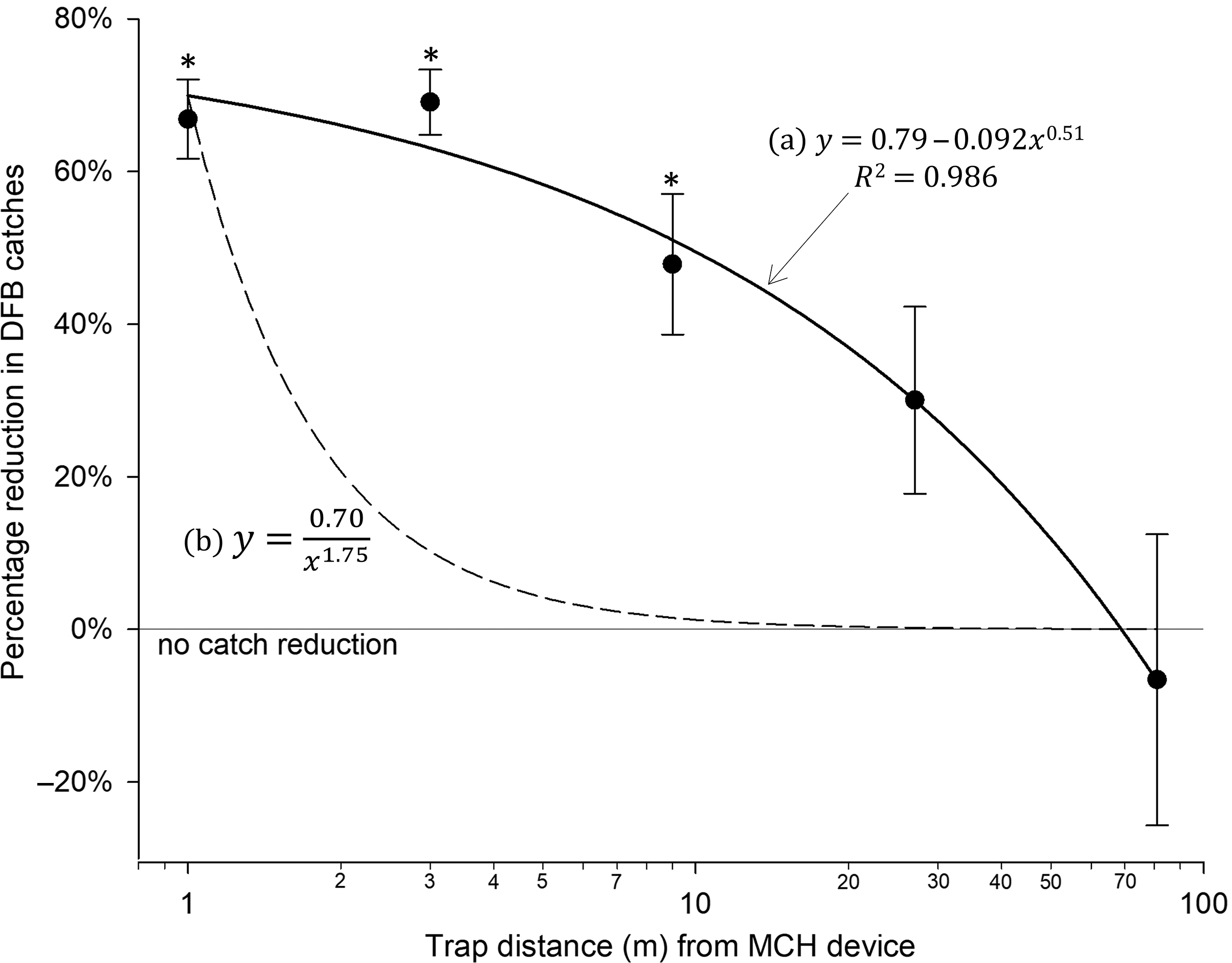
A statistically significant reduction in Douglas-fir beetle trap catches due to the presence of MCH was observed up to nine metres from the release device (Fig. 1). Results of one-sample t-tests were: at one-metre distance, t 5 = 12.9, P < 0.001; at three-metres distance, t 5 = 16.2, P < 0.001; at nine-metres distance, t 5 = 5.19, P = 0.017; at 27-m distance, t 5 = 2.45, P = 0.29; and at 81-m distance, t 5 = 0.35, P = 1. The equation (a) y = 0.79 − 0.092x 0.51 described the reduction in trap catches with distance from the MCH source with R 2 = 0.986 (F 2,4 = 68.7, P = 0.0143). The standard error of the exponent (variable b) was 0.16.
Reduction of catches in attractant-baited traps caused by a displaced point source of 3-methylcyclohex-2-en-1-one (MCH). Reduction in catches (the variable expressed in the y-axis) represents one minus the catches with MCH present divided by catches with MCH absent. Attractant-baited traps were deployed simultaneously at different distances (1, 3, 9, 27, and 81 m) and in the prevailing downwind direction from the MCH source, and the presence and absence of MCH were alternated every few days. Equation (a) is the power function that best relates mean catch reduction to distance from the MCH source and equation (b) represents the function expected if inhibition were related linearly to time-averaged, local airborne concentration of inhibitor (based on the plume dispersion equation in Elkinton et al. Reference Elkinton, Cardé and Mason1984). Equation (b) assumes the same value for x = 1 as equation (a). Asterisks indicate that reduction in catches was statistically different from zero (one-sample t-test, α = 0.05 with Bonferroni correction).

Discussion
Behavioural response to MCH declined with distance from the source much less steeply than the calculated decline in mean airborne concentration of the semiochemical indicated. Under conditions of light wind, level ground, and neutral environmental conditions, the time-averaged concentration of pheromone within a plume (C) produced by a point source is estimated to decline with distance approximately as (b) C = dx −1.75 (Elkinton et al. Reference Elkinton, Cardé and Mason1984; with the value of d governed by wind speed, compound release rate, deviation of measurement point from directly downwind, and additional factors). For illustration, this function is plotted in Fig. 1 (with the same response level at one-metre distance assumed for both this equation (b) and the power equation fitted to our data (a)). Both curves follow in form the basic atmospheric dispersion curves used by atmospheric scientists (e.g., the Gaussian models; Hanna et al. Reference Hanna, Briggs and Hosker1982).
If catch reduction were related linearly to a time-averaged airborne concentration of MCH at each trap, inhibitory effects would have declined approximately 98% between one and nine metres from the release device, whereas observed mean catch reduction declined only about 28% over this distance. Tests with attractant-baited traps have indicated that catch reduction at the release point of an inhibitory semiochemical typically varies as a function of inhibitor-release rate to the power of approximately 0.1–0.4 (Miller et al. Reference Miller, Borden and Lindgren1995; Miller and Borden Reference Miller and Borden2000; Lindgren and Miller Reference Lindgren and Miller2002; no such dose–response data currently exist specifically for MCH and Douglas-fir beetle). If x in equation (a) is substituted with the plume model for relating downwind concentration to distance (i.e., x = dC 0.571), the attraction-inhibiting activity of MCH at a location distant from a releaser is found to be related to the average airborne concentration at that location approximately to the power of 0.291, a value that falls within the aforementioned range for dose–response functions for bark beetle inhibitors. Concentration downwind is proportional to the lure release rate (Elkinton et al. Reference Elkinton, Cardé and Mason1984). Thus, the disparity between the concentration-distance function for the plume dispersion model (Fig. 1, curve b) and the response-distance function for MCH observed in our study (Fig. 1, curve a) is resolved if MCH for Douglas-fir beetle possesses a release rate–response function with an exponent value similar to that reported for other bark beetle inhibitors. Our results illustrate how functions relating MCH concentrations to Douglas-fir beetle behavioural responses will be necessary for using models of local airborne pheromone concentrations (such as Strand et al. Reference Strand, Ross, Thistle, Ragenovich, Matos and Lamb2012) to make inferences regarding the spatial distribution of efficacy of different arrangements of MCH releasers.
Several factors should be considered in interpreting the results of our study. The relationship between inhibition level and distance from an MCH releaser will be affected by elution rate (Teske et al. Reference Teske, Thistle, Strom and Zhu2014) and wind direction and speed, because time-averaged concentrations will be relatively greater in the downwind direction and with lower wind speeds. Because our traps were placed roughly in the downwind direction of the MCH releaser, it is possible that the catch reductions reported in Fig. 1 were greater than the averaged radial effects. Additionally, the precise relationship between the capacity of an MCH device to reduce attractive responses (the variable measured in this study) and protect surrounding trees is unknown.
In order to prevent the confounding effect of spillover infestation of nearby Douglas-fir trees (Knopf and Pitman Reference Knopf and Pitman1972; Pitman Reference Pitman1973; Ringold et al. Reference Ringold, Gravelle, Miller, Furniss and McGregor1975), our trap lines were placed in meadows or recently burned lodgepole pine stands. There was no forest canopy or strong host-tree odours in either setting. Pheromone concentrations have been predicted to be lower at downwind distances in more open stands compared to closed-canopy stands as a result of thermal turbulent mixing from uneven heating of the forest floor (Baldocchi et al. Reference Baldocchi, Law and Anthoni2000; Edburg et al. Reference Edburg, Allwine, Lamb, Thistle, Peterson and Strom2010; Thistle et al. Reference Thistle, Strom, Strand, Lamb, Edburg, Allwine and Peterson2011; Strand et al. Reference Strand, Ross, Thistle, Ragenovich, Matos and Lamb2012). As a consequence, downwind distances where MCH is at a concentration that elicits a behavioural response from Douglas-fir beetles could be even greater in a closed-canopy stand than what was observed in this study in more open settings. The specific effects of host-tree terpenes on beetle response to MCH have not been reported, but the earliest operational tests of MCH that demonstrated a strong repellent effect were conducted with recently downed trees that would likely have been producing strong terpene odours (Furniss et al. Reference Furniss, Clausen, Markin, McGregor and Livingston1981, Reference Furniss, Markin and Hager1982; McGregor et al. Reference McGregor, Furniss, Oaks, Gibson and Meyer1984). Furthermore, host terpenes are known to synergise Douglas-fir beetle response to aggregation pheromones (Furniss and Schmitz Reference Furniss and Schmitz1971), but they are not needed in the presence of ethanol (Pitman et al. Reference Pitman, Hedden and Gara1975). It is unlikely that the present study’s results would have been different if the traps had been in the presence of host-tree odours.
Current operational recommendations for the spacing of MCH releasers that are identical to those used in this study are to place them on a 12 m × 12 m grid (Ross et al. Reference Ross, Gibson and Daterman2015). This recommendation is based on earlier research to identify the optimal spacing (Ross et al. Reference Ross, Gibson, Their and Munson1996; Strand et al. Reference Strand, Ross, Thistle, Ragenovich, Matos and Lamb2012). Data in the present study indicate that trap catches can be reduced by 40–50% at a distance of 12 m from the releaser. Although the model used predicts significant behavioural response beyond 12 m from a releaser, the effect is apparently not strong nor consistent enough to totally prevent dispersing adults from initiating colonisation of suitable host trees. The data reported here may help researchers to understand more precisely the relationships between effective spatial arrangements of release devices (Ross et al. Reference Ross, Daterman and Gibson2002; Ross and Wallin Reference Ross and Wallin2008; Brookes et al. Reference Brookes, Ross, Strand, Thistle, Ragenovich and Lowrey2016) and Douglas-fir beetle behaviour.
Acknowledgements
The authors thank Laura Lowrey for helping to locate the research site and Ty Styhl for collecting trap samples. They also thank Harold Thistle for reviewing and commenting on an earlier draft of the manuscript. This research was supported, in part, by a Cooperative Agreement between the United States Department of Agriculture Forest Service Southern Research Station and Oregon State University (14-CA-11330129-044).
This publication reports research involving pesticides. It does not contain recommendations for their use, nor does it imply that the uses discussed here have been registered. All uses of pesticides in the United States of America must be registered by appropriate state and/or federal agencies before they can be recommended. This article was written and prepared by employees of the Government of the United States of America on official time, and it is, therefore, in the public domain and not subject to copyright.