INTRODUCTION
The deep-sea polychaete worm Neopolynoe acanellae (Verrill, 1881) is reported from Western Greenland, Iceland, the Faroes Islands, Denmark, south to the Canary Islands in Europe, and from the Flemish Cap (46°N, off south-eastern Newfoundland) south to North Carolina (USA) in North America, at depths of 460–1919 m (Pettibone, Reference Pettibone1963; Bock et al., Reference Bock, Fiege and Barnich2010). It has been found in association with various deep-sea corals, including Acanella arbuscula (Ditlevsen, 1917), Acanthogorgia armata (Verrill, 1881) and Anthomastus grandiflorus (Ditlevsen, 1917), and with a sponge of the genus Chondrocladia Thomson, 1873. Pettibone (Reference Pettibone1963) mentioned that it was also found on Pennatula grandis Ehrenberg, 1834 in the north-eastern United States and classified it as a commensal symbiont. Martin & Britayev (Reference Martin and Britayev1998) later indicated that this association was facultative with all known hosts. The present contribution confirms that the species occurs in north-eastern Newfoundland, along the coast of Labrador as well as in the lower Arctic (63°N), thereby bridging with the European geographic range on the western coast of Greenland and supporting a temperate and polar distribution throughout the North Atlantic and lower Arctic. Observations in the present study also provide evidence of the parasitic nature of N. acanellae relative to its host P. grandis.
MATERIALS AND METHODS
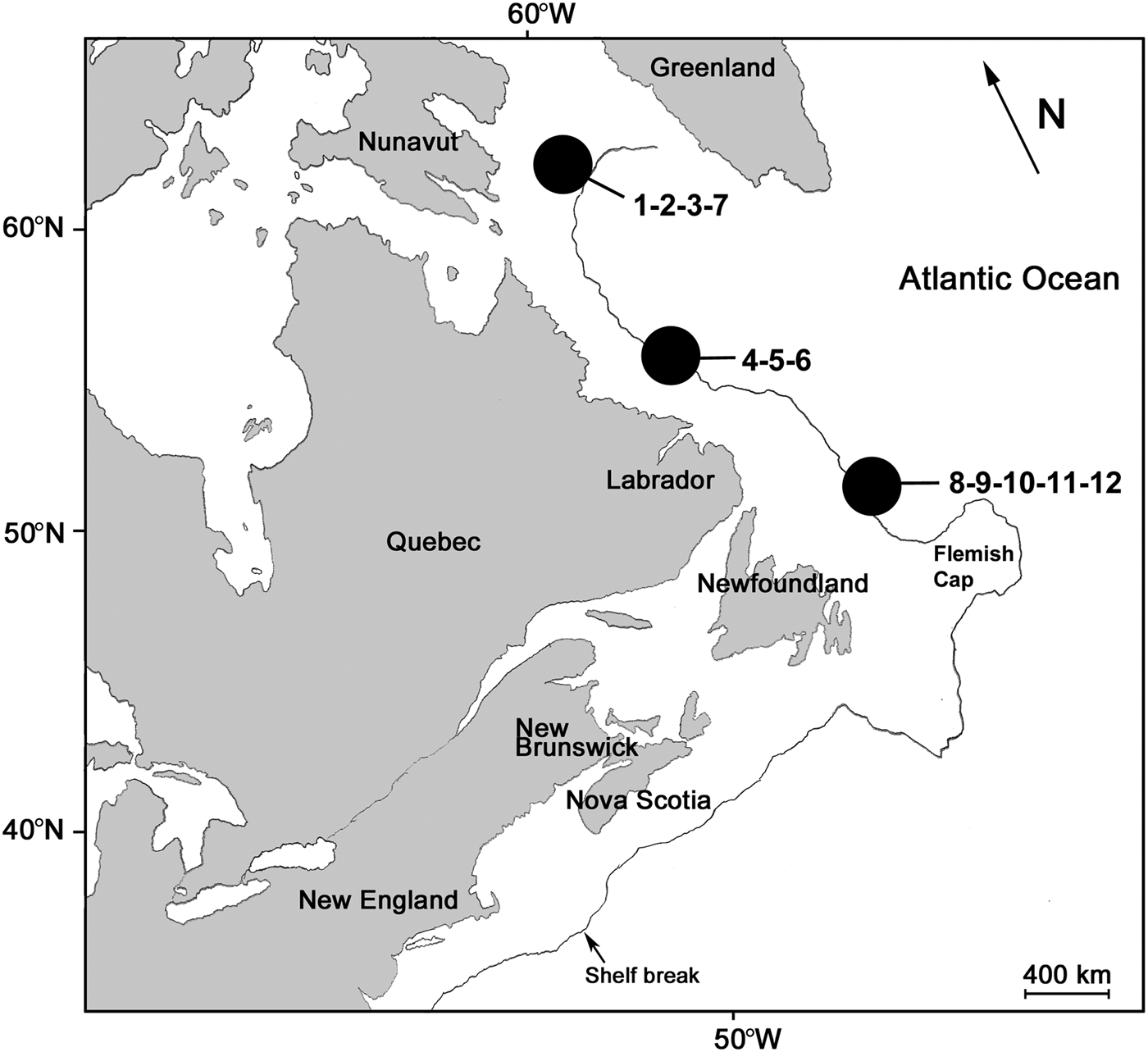
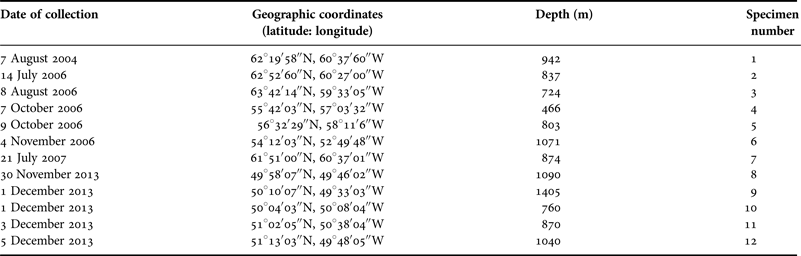
A total of 12 scale worms were found on the pennatulacean coral Pennatula grandis, collected as bycatch during multispecies trawl surveys and also collected by the At-Sea Observer Program conducted by Fisheries and Oceans Canada (DFO). Specimens (23–41 mm in length) were obtained in August 2004, July, August, October and November 2006, July 2007 and November and December 2013 along the north-eastern continental slope of Newfoundland, Labrador and the lower Arctic at depths ranging from 466 to 1405 m (Table 1, Figure 1). Two of the worms were dissected under a stereomicroscope to isolate the content of their digestive tracts. A specimen and its host (P. grandis) were deposited at the Canadian Museum of Nature in March 2014 (catalogue number CMNA 2014-0001).
Map showing the locations where Neopolynoe acanellae and its host Pennatula grandis were collected (always together) along the continental shelf of Newfoundland, Labrador and the Lower Arctic (Canada). The specimen numbers refer to the details on date and depth of collection listed in Table 1.

Sampling coordinates and depth for Neopolynoe acanellae and its host, the sea pen Pennatula grandis, along the continental slope of north-eastern Newfoundland, Labrador and the Lower Arctic (Canada). The specimen numbers correspond to collection sites shown in Figure 1.
RESULTS AND DISCUSSION
The scale worms were identified as Neopolynoe acanellae (Verrill, 1881) based on the presence of the following characters: >50 segments; bilobed prostomium with cephalic peaks; large eyes with anterior pair located dorsolaterally on widest part of prostomium (Figure 2A); lateral antennae inserted ventrally; antennae and cirri smooth; 15 pairs of elytra inserted on segments 2, 4, 5, 7, 9, …, 23, 26, 29 and 32, leaving long tail uncovered; elytral surface covered by numerous conical microtubercles, elytral margin with few, scattered short papillae (Figure 2B); long ventral cirri reaching beyond tip of neuropodia (Figure 2C); neuropodia with slender, digitiform supra-acicular process (Figure 2C); notochaetae stout with blunt tips, neurochaetae unidentate (Bock et al., Reference Bock, Fiege and Barnich2010; Barnich et al., Reference Barnich, Gambi and Fiege2012). Neopolynoe acanellae is easily distinguished from the two other species in the genus – Neopolynoe antarctica (Kinberg, 1858) and Neopolynoe paradoxa (Storm, 1888) – by the shape of its supra-acicular process and the length of its ventral cirri. For detailed descriptions of these two others species, see Bock et al. (Reference Bock, Fiege and Barnich2010) and Barnich et al. (Reference Barnich, Gambi and Fiege2012). Previously used names for Neopolynoe acanellae include Polynoe (Eunoa) acanellae Verrill, 1881 and Harmothoe (Hermadion) acanellae (Verrill, 1881) (Read, Reference Read, Read and Fauchald2014).
(A) Close up on head of Neopolynoe acanellae showing everted proboscis (pr), palps (pa), lateral antennae (la), and eyes (e); (B) elytron from anterior part of body; (C) parapodium, anterior view. Scale bars = 1 mm.
The present collections extend the North American distribution range of Neopolynoe acanellae northward by 17° (~2000 linear km), i.e. to 63°N. Previously, its northernmost distribution in North American waters was the Flemish Cap in south-eastern Newfoundland (~46°N) reported by Bock et al. (Reference Bock, Fiege and Barnich2010). The depth range (Table 1) falls within known values for the species (460–1919 m; Bock et al., Reference Bock, Fiege and Barnich2010).
The infestation rate (number of Pennatula grandis hosting the worm relative to all Pennatula grandis collected) was ~5 ± 3% (± SD). Only one Neopolynoe acanellae was found per infested host. It should be noted that mobile associates may be lost during collection of trawl bycatches and that this might therefore be an underestimation of natural infestation rates. Pettibone (Reference Pettibone1963) mentioned lengths of Neopolynoe acanellae of up to 90 mm, which is more than twice the maximum size of specimens collected here (41 mm). This difference in maximum size, when compared to specimens from other regions, may be related to the state of maturity (younger/immature individuals) or to the influence of the Labrador Current, which maintains year-long seawater temperatures between −1°C and 2°C in the region under study (Lazier, Reference Lazier1982). However, similarly small specimens of Neopolynoe acanellae (25–55 mm) from the Peabody Museum of Natural History (Yale University, USA) are reported to have been collected in warmer oceanic areas of the north-eastern United States.
In the present study, the specimens of Neopolynoe acanellae were mostly found in a groove along the dorsal track of the rachis of Pennatula grandis (N = 9; Figure 3A) and sometimes among the leaves (N = 3). The groove in the host is about the same width as the polychaete worm (~4–5 mm, with chaetae; Figure 3B). Sympatric species of pennatulaceans (sea pens) were shown to shelter other associates, including fish larvae (Baillon et al., Reference Baillon, Hamel, Wareham and Mercier2012) and marine invertebrates (Baillon et al., Reference Baillon, Hamel and Mercier2014). Toxic chemicals produced by soft corals are known to deter potential predators (Changyun et al., Reference Changyun, Haiyan, Changlun, Yanan, Liang and Huashi2008), which may explain why Neopolynoe acanellae find refuge in Pennatula grandis. Moreover, calcified elements (sclerites) probably render the host unpalatable, offering additional protection (Baillon, Reference Baillon2014). The cryptic coloration of Neopolynoe acanellae (Figure 3C) evokes a long coevolution.
(A) General view of the sea pen Pennatula grandis harbouring a polychaete worm Neopolynoe acanellae (arrow) among its leaves (l); (B) lower section of the rachis of the sea pen P. grandis with a specimen of N. acanellae visible along the groove (g) of the dorsal track (dt) just above the peduncle (p); (C) close-up of live N. acanellae (dorsal view) with visible elytron (e) and chaetae (ch). A and B: scale bars = 25 mm; C: scale bar = 5 mm.
Analysis of newly collected worms showed that their intestinal contents had the same colour (reddish orange) as the soft tissues of their host Pennatula grandis. A closer examination revealed the presence of soft tissues mixed with sclerite fragments (as per Baillon, Reference Baillon2014) presumed to belong to the host. This suggests that Neopolynoe acanellae may not be commensal on Pennatula grandis as previously reported for other hosts (Pettibone, Reference Pettibone1963; Martin & Britayev, Reference Martin and Britayev1998), but rather parasitic. However, further investigation will be required to fully elucidate the level of intimacy of this association and the impact of Neopolynoe acanellae on Pennatula grandis.
The range extension presented here confirms that Neopolynoe acanellae occurs at bathyal depths on both sides of the North Atlantic as well as in the Arctic. This work also highlights the link between Neopolynoe acanallae and deep-sea corals, adding to a growing number of faunal associates found in and around cold-water corals in Atlantic Canada (Buhl-Mortensen & Mortensen, Reference Buhl-Mortensen and Mortensen2004, Reference Buhl-Mortensen, Mortensen, Freiwald and Roberts2005; Baillon et al., Reference Baillon, Hamel, Wareham and Mercier2012, Reference Baillon, Hamel and Mercier2014; Mercier et al., Reference Mercier, Baillon and Hamel2014). Cold-water corals are considered to act as ecosystem engineers that can increase the space available to other organisms and thereby enhance the biodiversity relative to their surrounding areas (Boutillier et al., Reference Boutillier, Kenchington and Rice2010). Records of polychaete worms in Canada currently include 1200 species belonging to 68 families, although statistical extrapolations raise the total number of species to 1629 (Carr, Reference Carr2012). These results emphasize the need for more investigations and suggest that the marine diversity in Canadian waters is currently underestimated (Carr, Reference Carr2012). More new species and range extensions are expected to be discovered in years to come, especially given the surge of interest in the conservation of deep-sea corals (Gilkinson & Edinger, Reference Gilkinson and Edinger2009) and the intensification of related research in the region.
ACKNOWLEDGEMENTS
We thank the crews of the CCGS Teleost and the At-Sea Observer Program involved in the collection of the data and specimens, V. Wareham (DFO, St. John's) for access to some preserved specimens and two anonymous reviewers for their comments. This work was partly funded by grants from the Natural Sciences and Engineering Research Council of Canada (NSERC) and the Canada Foundation for Innovation (CFI), received by A. Mercier.