Introduction
The water availability regime can affect the environmental range in which dormant seeds are able to germinate (Benech-Arnold et al., Reference Benech-Arnold, Sánchez, Forcella, Kruk and Ghersa2000; Finch-Savage and Leubner-Metzger, Reference Finch-Savage and Leubner-Metzger2006). The ability to germinate in response to different light signals is one of the features that can be modified in weed seeds exposed to different water regimes (Batlla et al., Reference Batlla, Nicoletta and Benech-Arnold2007). For example, sensitivity to light increases in seeds of the crop weed Lolium rigidum that remain hydrated during dormancy; however, the same seeds do not acquire the ability to germinate in darkness (Steadman, Reference Steadman2004). In contrast, L. rigidum seeds that undergo dry after-ripening are then able to germinate with or without a light stimulus (Steadman, Reference Steadman2004). The above-mentioned responses are well-studied in some weed species from croplands, but similar or distinct responses might be observed in species from other ecosystems. For example, low water potentials induce dark dormancy in seeds of Rumex crispus, Chenopodium bonus-henricus and Origanum vulgare (Duke, Reference Duke1978; Kahn and Karssen, Reference Kahn and Karssen1980; Pons, Reference Pons1991). These species inhabit a wide habitat range that includes rangelands and grasslands. Consequently, the sensitivity to light signals could be affected by different soil water regimes during the time grassland seeds are buried.
Dormancy is broken in seeds of many species when they perceive a certain quality and quantity of light. The wavelengths most efficient in breaking dormancy are the red spectral bands (R, 600–700 nm) (Fenner, Reference Fenner1980; Casal and Sánchez, Reference Casal and Sánchez1998). R light effects on germination can be reversed by far-red light (FR, 700–800 nm) in the low fluence response (LFR) (Borthwick et al., Reference Borthwick, Hendricks, Parker, Toole and Toole1952; Casal and Sánchez, Reference Casal and Sánchez1998). The antagonistic effects of R and FR are caused by the action of phytochromes, which are known to possess two interchangeable forms, Pr and Pfr, with absorption peaks in R and FR, respectively (Rüdiger and Thümmler, Reference Rüdiger, Thümmler, Kendrick and Kronenberg1994). Such absorption peaks coincide with the action spectra for breaking seed dormancy with light (Casal and Sánchez, Reference Casal and Sánchez1998). Light absorption by Pr provokes its transformation to Pfr, thus allowing sensitive seeds to break dormancy and germinate (Bewley and Black, Reference Bewley and Black1994). In turn, a FR pulse, immediately after the R pulse, causes a rapid reversal of the Pfr molecules to Pr, thus preventing seed germination. Therefore, the phytochrome ratio in the Pfr active form depends on the red:far-red (R:FR) ratio of light. The response of these seeds to the different wavelengths have important ecological implications due to the fact that vegetation modifies the R:FR ratio that reaches the soil (Holmes and Smith, Reference Holmes and Smith1977; Fenner, Reference Fenner1980; Casal et al., Reference Casal, Luccioni, Oliverio and Boccalandro2003). In fact, when natural light passes through green plant tissues, it is intercepted by photosynthetic pigments that specifically absorb the R bands of the spectrum and transmit and reflect the FR wavelengths. This is relevant in grasslands in which the amount of R light to reach the soil surface increases, after the canopy is suppressed by a disturbance, such as grazing (Deregibus et al., Reference Deregibus, Casal, Jacobo, Gibson, Kauffman and Rodriguez1994). This allows seeds to germinate in conditions involving low competition with established plants (Casal and Sánchez, Reference Casal and Sánchez1998).
Seed dormancy in the soil seed-bank of several native winter grassland grasses is progressively attenuated during summer (Baskin and Baskin, Reference Baskin, Baskin and Cheplick1998; Rodriguez et al., Reference Rodriguez, Jacobo and Deregibus1998). The decrease in the dormancy level during summer enables the seeds to germinate in the fall, a season in which both temperature and soil water availability are favourable to seedling establishment (Baskin and Baskin, Reference Baskin, Baskin and Cheplick1998; Rodriguez et al., Reference Rodriguez, Jacobo and Deregibus1998). In contrast, in many types of grasslands, summer is an unfavourable period for plants, due to the great variability in precipitation (Borchert, Reference Borchert1950; Ting and Wang, Reference Ting and Wang1997) and in the water content of the soil (James et al., Reference James, Pärtel, Wilson and Peltzer2003). Therefore, the study of the dormancy changes that occur under different water availability regimes might contribute to the understanding of the different capabilities of seeds to germinate in different environmental circumstances.
In the present study we hypothesize that water availability affects the sensitivity to light of Bromus catharticus seeds and thus affects the emergence pattern of seedlings. B. catharticus Vahl. is a biennial or perennial short-lived species that only regenerates by seeds and which is widespread across the Pampa grasslands (South America). In this area, an important characteristic of the summer rainfall pattern is its variability: fairly prolonged droughts or excessive precipitations can occur. Therefore, the soil water availability may modulate both seed dormancy and the emergence pattern of seedlings in grasslands.
Materials and methods
Seed collection and study site
Seeds of B. catharticus and mesocosms were extracted from a Pampa grassland located in San Miguel del Monte (Monte, province of Buenos Aires, Argentina). This grassland resembled the plant community characterized by Melica brasiliana, Borreria dasycephala and Echium plantagineum described by Burkart et al. (Reference Burkart, León and Movia1990). Co-dominant species were Briza subaristata, Bromus catharticus, Ambrosia tenuifolia and perennial summer grasses such as Paspalum dilatatum and Botriochloa laguroides. The climate of the Pampas can be defined as dry sub-humid to sub-humid, with mild winters and warm, slightly dry summers (Burgos and Vidal, Reference Burgos and Vidal1951). The coefficient of variation for annual rainfall in the entire Pampas exceeds the 15% limit which can be taken as an indicator of a stable rainfall pattern (Hall et al., Reference Hall, Rebella, Ghersa, Culot and Pearson1992). Mean annual precipitation in San Miguel del Monte is 911 mm with significant year to year variation; the mean monthly temperature ranges from 23°C in January (summer) to 9.1°C in July (winter) (De Fina, Reference De Fina1992). Seeds were collected at the time of their natural dispersal in December 2004 and December 2006 and were stored at − 10°C until the experiments commenced.
Seed pretreatments
Seeds harvested in December 2006 were incubated in groups of 100 in plastic boxes of 15 × 10 × 6 cm on four layers of Whatman no. 1 filter paper under four different moisture regimes:
(1) Continuously dehydrated seeds: filter paper was kept dry during the entire incubation period (after-ripening conditions).
(2) Continuously hydrated seeds: filter paper was soaked with distilled water during the entire incubation period.
(3) Fluctuating moisture regime: seeds were subjected to one cycle (day 20, FMR1) or three cycles (days 0, 20 and 40, FMR2) of hydration and dehydration (wetting and drying). Hydration–dehydration cycles were achieved by alternate exposure of seeds to dry filter paper until the first day of the hydration phase, when seeds were moved to boxes with water-soaked filter paper. The hydration phases lasted 2 d and seeds were then returned to dry filter paper and allowed to lose water into the atmosphere of the boxes (dehydration phase). Fluctuating moisture pretreatments were an attempt to recreate wetting and drying conditions experienced by seeds in the soil.
All boxes were wrapped in black polyethylene and were kept in an incubator at 25°C for 55 d. The incubation temperature characterized the average soil temperature during summer of undisturbed grasslands of the area (Insausti et al., Reference Insausti, Soriano and Sánchez1995). The moisture content of seeds was determined in three sub-samples of 25 seeds each by weighing them before and after drying for 24 h in an oven at 100°C. Moisture content was expressed on a fresh-weight basis.
Germination tests
Immediately after pretreatment, seeds were placed in continuously hydrated conditions for germination. Seeds were incubated at different temperatures to characterize their dormancy level. As no differences between 15°C and 15/25°C (12/12 h) were found in previous experiments, germination tests were only conducted at 15°C (typical of the autumn) and 20 or 25°C (summer temperatures) in transparent polystyrene boxes (6 × 7 × 1 cm) containing two layers of Whatman no. 1 filter paper soaked with distilled water. Four replicates of the following treatments, with 25 seeds each, were performed: (1) red light pulses for 20 min d− 1, R:FR = 4.09, irradiance = 18.0 μmol m− 2 s− 1 provided by two fluorescent tubes (Philips TL 40W/15) covered with red acetate, λmax = 610 nm; (2) far-red light pulses for 20 min d− 1, R:FR = 0.002, irradiance = 6.3 μmol m− 2 s− 1 provided by an Osram incandescent quartz bulb of 150 W filtered with 10 cm of water and Schott RG9 filters (Schott, Mainz, Germany) of 2 mm width, λmax = 760 nm; (3) darkness.
Seeds were distributed in boxes under very low intensity green light (Burkart and Sánchez, Reference Burkart and Sánchez1969) and boxes were covered with black polyethylene. This is the right procedure for germination studies in seeds that do not respond in the very low fluence response (VLFR) mode (see Results). They were then exposed to the daily light pulses for 5 d. The final germination count was done 5 d after the last irradiation. Germination percentages were transformed to proportions and transformed again according to the arc sine formula √x (Sokal and Rohlf, Reference Sokal and Rohlf1969). To study the effect of the moisture pretreatments and light treatments on the germination of B. catharticus seeds, the transformed data were analysed using two-way analysis of variance. Multiple comparisons were done with Duncan tests (P < 0.05).
Another laboratory experiment was conducted to investigate the role of phytochromes on inducing the differences in germination between seeds subjected to different hydration pretreatments. In this manner, we studied the reversibility of the effect of the R light by a subsequent FR light pulse. In this experiment, seeds harvested in December 2004 were maintained continuously dehydrated or hydrated with distilled water for 1 month at 25°C in groups of 100 in plastic boxes of 15 × 10 × 6 cm on four layers of Whatman no. 1 filter paper. At the end of the pretreatments, seeds were placed for germination at 15°C under the same conditions of the laboratory experiment described previously. The irradiance protocols were also the same; however, in this case, another irradiance treatment was added: each red light pulse (20 min d− 1) was immediately followed by a far-red light pulse applied for another 20 min.
The mesocosms experiment
In December 2005, immediately after the dispersion of B. catharticus seeds, soil blocks measuring 40 × 27 × 20 cm, with intact seed bank and vegetation, were extracted from the grassland. Blocks were placed in containers and taken to a greenhouse at a controlled temperature. Afterwards, they were subjected to the following treatments for 2 months: (1) watered regime: blocks were watered on a daily basis; and (2) drought regime: blocks were watered only on day 30. Drought blocks were also periodically irrigated from below to maintain drought conditions on the soil surface while keeping vegetation alive. Continuous measurements of volumetric water contents were performed with ECHO Probes (Decagon, Pullman, Washington, USA) connected to a Campbell 21-X datalogger (Campbell Scientific Ltd., Logan, Utah, USA). The soil temperature of the grassland blocks was measured with thermistors connected to HOBO H08-006-04 dataloggers (Onset Computer Corp., Bourne, Massachusetts, USA). Sixty days after treatments began, an initial record of the density of B. catharticus seedlings that emerged under the canopy was taken; all blocks were then watered and the greenhouse temperature was lowered to simulate temperature conditions during fall. At that point, vegetation was cut to soil level and half of the blocks were exposed to natural sunlight. The other half were covered with filters that exclude red light, so a low R:FR ratio reached the seeds (blue acrylic sheet Paolini no. 2031, 2.4 mm thick). Blue acrylic filters were used instead of the original canopy to avoid sunflecks and to ensure homogeneous conditions. In the blocks exposed to natural sunlight, photosynthetically active radiation (PAR) at midday under clear-sky conditions presented a value of 1870 μmol m− 2 s− 1 with an R:FR ratio of 1.20. Under the filters, PAR at midday presented a value of 380 μmol m− 2 s− 1 with an R:FR radiation of 0.01. In the afternoon (between 17.00 and 17.30 hours), the R:FR ratio of the uncovered blocks was 1.10, while under the filters the ratio reached 0.08. After 2 weeks under these conditions, the emerged B. catharticus seedlings were counted. Seedling density was analysed by a non-parametrical Kruskal–Wallis test with a posteriori comparisons (α = 0.05) (Sokal and Rohlf, Reference Sokal and Rohlf1969).
Results
The effect of the water regime on seed responses to light
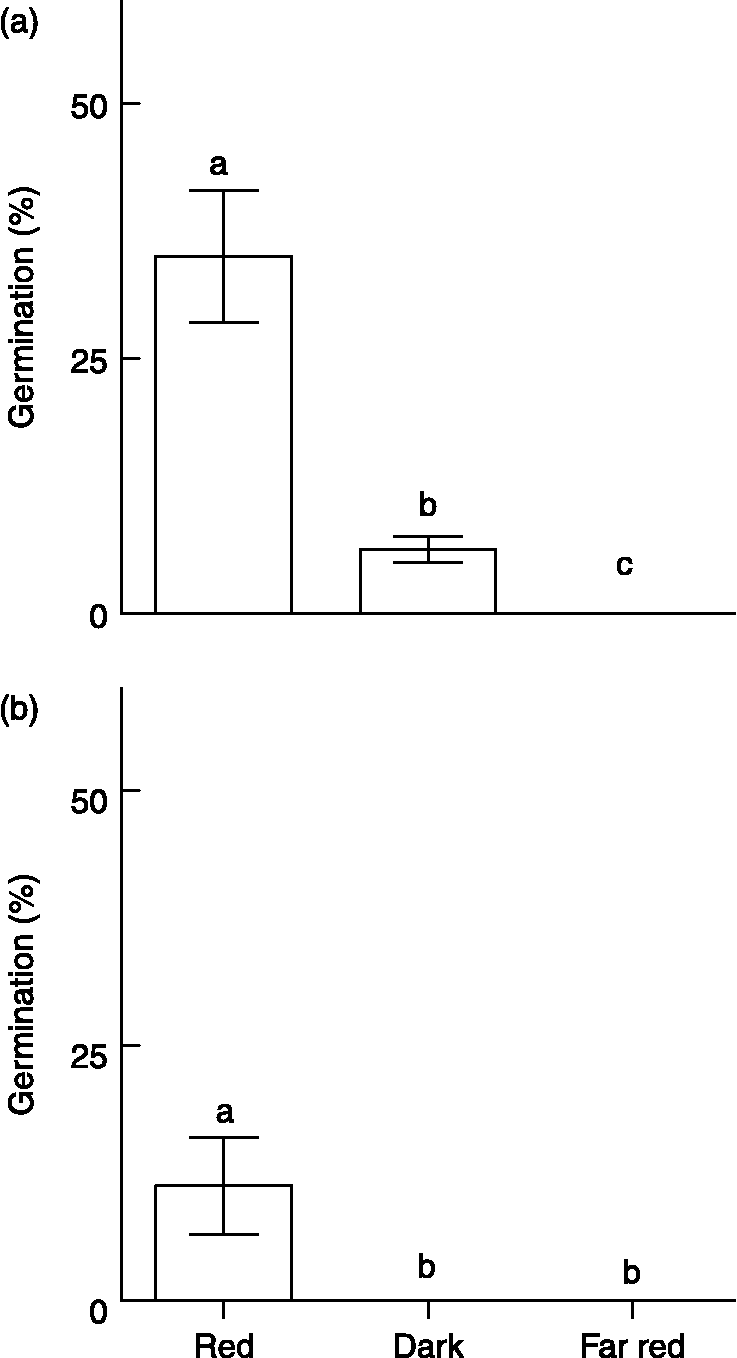
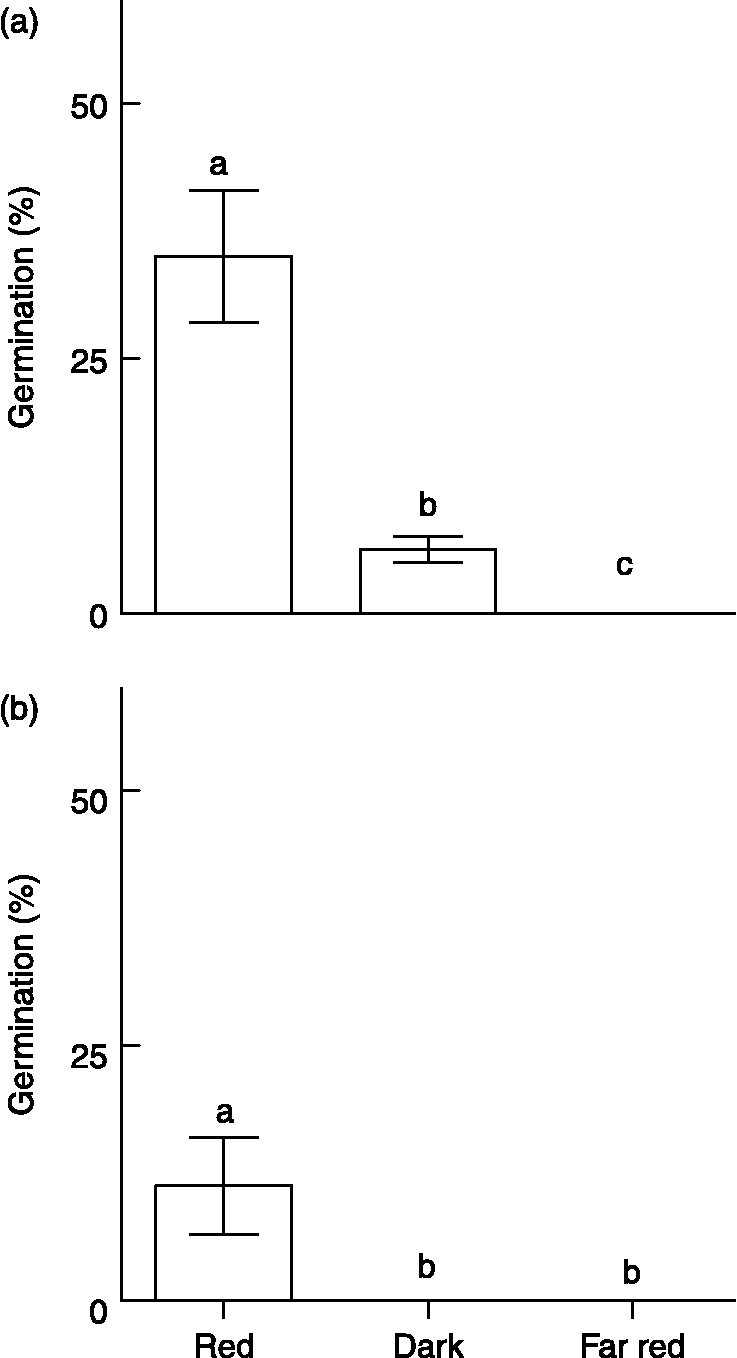
Immediately before starting the pretreatments, B. catharticus seeds harvested in 2006 had low germination percentages when exposed to red light pulses, whereas germination in darkness or after far-red light pulses was significantly lower or negligible (Fig. 1). There were very noticeable differences in the expression of seed dormancy among seeds incubated at different temperatures: there was no germination at 25°C and germination at 15°C was higher than at 20°C (Fig. 1).
Germination (%) under different light treatments of Bromus catharticus seeds immediately before the start of laboratory experiments. Seeds incubated at (a) 15°C; (b) 20°C. There was no germination at 25°C. Red: light pulses with high R:FR; far red: light pulses with low R:FR; dark: darkness. Values are means ± SE. Multiple comparisons were done with the Duncan test (P < 0.05); different lower-case letters within a graph indicate significant differences.
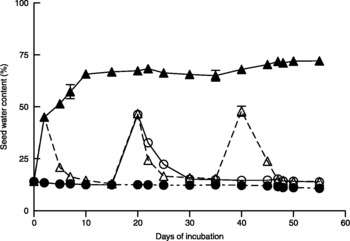
The water content time course for continuously hydrated seeds showed a phase of increased water uptake and a subsequent period in which water contents remained quite constant (Fig. 2). In FMR2, after 2 d in the initial phase of imbibition, the water uptake of seeds was hindered, and fell to the values of the continuously dehydrated seeds in less than 10 d (Fig. 2). This pattern of water hydration and dehydration was repeated twice, on day 20 and day 40. FMR1 seeds experienced imbibition only on day 20 (Fig. 2). The water content remained low for continuously dehydrated seeds during the entire course of the pretreatment period (Fig. 2).
Bromus catharticus seed water content time courses (%, fresh-weight basis). Continuously dehydrated seeds (filled circles), continuously hydrated seeds (filled triangles), fluctuating moisture regime 1 (FMR1; open circles), fluctuating moisture regime 2 (FMR2; open triangles). Bars indicate standard errors if larger than the symbols.

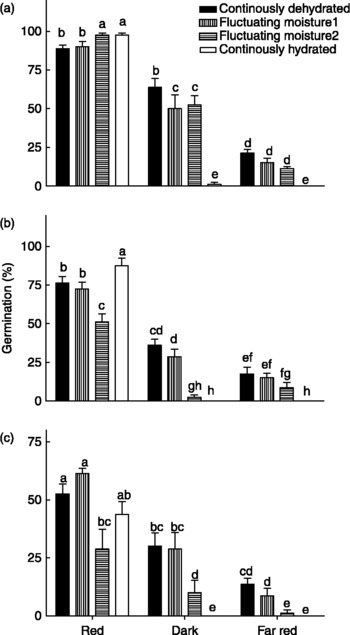
The germination of seeds subjected to all pretreatments (moisture regimes) and temperatures was greater than immediately before the start of the pretreatments (Fig. 3). B. catharticus seeds subjected to all moisture regimes displayed the highest germination percentages after being irradiated with red light pulses (Fig. 3). In spite of the fact that germination percentages varied among the moisture regimes after red light pulses, the most important differences appeared in suboptimal light conditions (Fig. 3). Under all temperature conditions, the germination percentages of seeds that were previously subjected to the continuously hydrated regime were negligible both in darkness and after being irradiated with far-red light pulses (Fig. 3). In contrast, germination was significantly higher in darkness and after far-red light pulses in seeds incubated under both fluctuating moisture regimes at 15°C (Fig. 3a), a temperature at which B. catharticus dormant seeds reached the highest germination percentages (Fig. 1). At all temperatures tested, continuously dehydrated seeds reached, on average, the highest germination percentages after far-red light pulses or in darkness, as compared to the other moisture regimes (Fig. 3). However, at 15 and 20°C, fluctuating moisture regimes reached, after far-red light pulses, germination percentages not significantly different from those obtained with continuously dehydrated seeds (Fig. 3a, b). The importance of the temperature in regulating the expression of seed dormancy after the hydration pretreatments was very noticeable under suboptimal light conditions: while at 15°C both fluctuating moisture regimes reached the same germination percentages in darkness or after far-red light pulses, the germination of FMR1 seeds resembled that of the continuously dehydrated regime at 20°C and 25°C in the same conditions (Fig. 3b, c). On the other hand, the germination of FMR2 seeds resembled that of the continuously hydrated regime seeds at 20°C in darkness and at 25°C after far-red light pulses.
Germination (%) of Bromus catharticus seeds after incubation for 55 d under the different moisture regimes described in Fig. 2. Seeds germinated at (a) 15°C; (b) 20°C; and (c) 25°C. Red: light pulses with high R:FR; far red: light pulses with low R:FR; dark: darkness. Values are means ± SE. Multiple comparisons were done with the Duncan test (P < 0.05); different lower-case letters within a graph indicate significant differences.

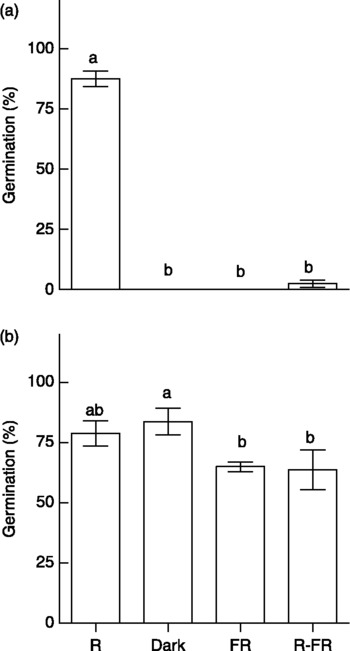
Seed harvested in December 2004 showed contrastable behaviour in terms of germination after being subjected to the hydration pretreatments. In continuously hydrated seeds, the effect of red light pulses was fully reversed by a far-red light pulse applied immediately after each red light pulse (Fig. 4). In contrast, continuously dehydrated seeds germinated at high percentages under all light conditions (Fig. 4).
Reversibility of the effect of a pulse of red light by a subsequent pulse of far-red light at 15°C. (a) Continuously hydrated seeds; (b) continuously dehydrated seeds. R: light pulses with high R:FR; FR: light pulses with low R:FR; R-FR: R pulses immediately followed by FR light pulses; dark: darkness. Values are means ± SE Multiple comparisons were done with the Duncan test (P < 0.05); different lower-case letters within a graph indicate significant differences.

The effect of the moisture regime on seedling emergence
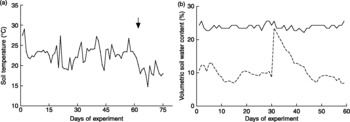
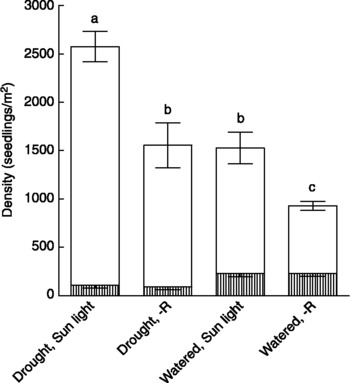
During the application of the soil moisture regimes, summer temperatures were registered in the soil of the grassland blocks (Fig. 5a). Afterwards, when the canopy was opened and the greenhouse temperature was lowered, soil temperatures resembled those of autumn (Fig. 5a). The volumetric water contents of the surface soil of blocks subjected to both moisture regimes were clearly distinct (Fig. 5b). Grassland blocks that had been watered on a daily basis showed continuously high water content, whereas the blocks subjected to drought conditions presented lower water contents, except on day 30 (Fig. 5b). At the first density count, done at the end of the period in which the moisture regimes had been imposed, more seedlings had emerged in the blocks that had been watered than in the blocks in which drought conditions had been simulated (H = 10.32; P = 0.0155). Nevertheless, there were substantial differences among treatments in the second seedling density count (H = 17.98, P < 0.001) (Fig. 6). The second density count showed a high density of B. catharticus seedlings that emerged in bare soil (high R:FR ratio) in the drought regime blocks, while the watered regime significantly reduced the density of emerged seedlings in the same bare-soil blocks (Fig. 6). In the filtered blocks (low R:FR ratio), the drought regime promoted the germination of the fraction of seeds inhibited by the presence of the filters in the watered regime blocks (Fig. 6).
Mesocosms soil temperature (a) and volumetric soil water content (b). Discontinuous line: soil water content of mesocosms subjected to a drought regime. Continuous line: daily watered mesocosms. The arrow indicates the day when the first density of Bromus catharticus seeds was measured, vegetation was removed, all mesocosms were watered and half of them were covered by light filters.

Density of Bromus catharticus seedlings emerged from the mesocosms experiment. Shaded columns: seedlings emerged before the first density count during summer conditions. Open columns: seedlings emerged before the second density count during autumn conditions. Drought: mesocosms subjected to a superficial drought regime. Watered: mesocosms watered daily. Sun light: unfiltered mesocosms (high R:FR ratio). − R: Red light excluded (low R:FR ratio). Values are means ± SE. Different letters indicate significant differences among treatments in the second seedling density (P < 0.05).

Discussion
Our results showed that the water availability during the time B. catharticus seeds were dormant had a subsequent strong regulatory effect upon their dormancy level and germinability at different temperatures. Primary dormancy decreased for B. catharticus seeds that had unlimited water availability, but the seeds maintained their requirements of high R:FR ratios of light for germination. In contrast, seeds that experienced low water availability lost primary dormancy, while their light requirements for germination decreased significantly. In this way, seeds that experienced limited water availability in the soil might be able to germinate under a broader range of light conditions than seeds under higher water availability. These results were consistent with the seed-bank germination dynamics and emergence pattern of seedlings in the mesocosms experiment. Therefore, B. catharticus seedling emergence depends on soil water availability prior to the germination period.
Vegetation can prevent seed germination efficiently through its effect upon transmitted light (Górski et al., Reference Górski, Górska and Nowicki1977; Casal and Sánchez, Reference Casal and Sánchez1998). In this manner, germination of most grassland species is lower under a leaf canopy than in bare soil or in darkness (Silvertown, Reference Silvertown1980). Leaf canopy-induced dormancy has a high irradiance response (HIR) and an LFR component (Casal and Sánchez, Reference Casal and Sánchez1998). As in previous studies performed in the same grassland ecosystems, where seeds perceived far-red light through the LFR mode of phytochrome action (Deregibus et al., Reference Deregibus, Casal, Jacobo, Gibson, Kauffman and Rodriguez1994; Insausti et al., Reference Insausti, Soriano and Sánchez1995), our results indicate the involvement of phytochrome in the LFR mode in B. catharticus seed germination. In effect, many B. catharticus seeds germinated under light conditions resembling that occurring in gaps (high R:FR ratio) but not under conditions related to the presence of an intact canopy (low R:FR ratio) or soil burial (darkness). For these seeds, the promotion of germination by R pulses was reverted by subsequent FR pulses. However, a considerable fraction of seeds that were continuously dehydrated (afterripened seeds), or subject to fluctuating moisture regimes during dormancy, escaped the control of phytochrome and germinated in darkness (Figs 3 and 4). Moreover, seeds irradiated with low R:FR ratios showed lower germination percentages than for seeds in darkness. When analysed together, both results indicate that seeds which germinated in darkness did so in response to sufficient existing Pfr, or because these seeds contained phytochrome intermediates that generated Pfr when seeds were hydrated (Bewley and Black, Reference Bewley and Black1994). In contrast, germination was negligible for continuously hydrated seeds in darkness. This result concurs with that reported by Hsiao and Vidaver (Reference Hsiao and Vidaver1973) in lettuce, where dark reversion to the Pr form of phytochrome only occurred in seeds subjected to high water availabilities.
Seeds of many weed crop species have high sensitivity and a very low fluence response to light (VLFR) (Casal and Sánchez, Reference Casal and Sánchez1998; Batlla et al., Reference Batlla, Nicoletta and Benech-Arnold2007). In these seeds, germination is associated with tillage disturbances (Sauer and Struik, Reference Sauer and Struik1964; Botto et al., Reference Botto, Scopel, Ballaré and Sánchez1998). However, seeds from non-arable natural grasslands would not be exposed to large-scale soil disturbances due to cultivation but to low-scale soil disturbances caused by digging mammals (i.e. armadillos in South America). The role of very low fluences of light in the germination of grassland seeds has only scarcely been explored (Sauer and Struik, Reference Sauer and Struik1964; Pons, Reference Pons1991). In these cases, seeds from some dicotyledonous species germinated after short exposures to light or induced by FR irradiations (Sauer and Struik, Reference Sauer and Struik1964; Pons, Reference Pons1991). The present results show that B. catharticus seeds germinated less when exposed to a saturated FR pulse than in darkness, so seeds did not respond in the VLFR mode (Figs 1, 3 and 4). So far, studies carried in natural grasslands have shown that germination of the seed bank is triggered by defoliation and above-ground plant elimination caused by grazing, flooding or fire (Deregibus et al., Reference Deregibus, Casal, Jacobo, Gibson, Kauffman and Rodriguez1994; Read and Bellairs, Reference Read and Bellairs1999; Jutila and Grace, Reference Jutila and Grace2002; Snyman, Reference Snyman2005; Insausti and Grimoldi, Reference Insausti and Grimoldi2006), conditions mainly related to an LFR mode of phytochrome action. The ecological significance of the VLFR mode of phytochrome action in the germination behaviour of grassland seeds merits further investigation.
The soil water regime caused modifications in the emergence pattern of B. catharticus seedlings. Grassland mesocosms that had been subjected to a drought regime had a higher density of seedlings emerged under light conditions that simulated the presence of established adult plants (low R:FR ratio) than mesocosms watered at field capacity. This indicates that a fraction of B. catharticus seeds acquired the capability to germinate under the established vegetation, especially in the drought regime. In the same grassland ecosystems of our work, Deregibus et al. (Reference Deregibus, Casal, Jacobo, Gibson, Kauffman and Rodriguez1994) observed that a fraction of Lolium multiflorum L. seeds can germinate during fall under a thick canopy of summer grasses remaining from the preceding warm season. Those summer gramineous plants may have a reduced capacity for growth and less ability to compete with the emerged seedlings due to the upcoming cold season (Deregibus et al., Reference Deregibus, Casal, Jacobo, Gibson, Kauffman and Rodriguez1994). In B. catharticus seeds from grasslands in which summer grasses prevail, we also found intrapopulational differences as regards light and temperature requirements to germinate. Differences between fractions within populations can limit germination to a single period, with the subsequent death of all seedlings if the environment turns unfavourable (Bradford, Reference Bradford2005). In this case, apart from the emergence pattern, it is essential to determine the subsequent survival of seedlings to evaluate the importance of germination under the canopy on the population dynamics of B. catharticus in grasslands.
The emergence of B. catharticus seedlings was higher in the grassland mesocosms that experienced an edaphic drought during summer than in those that remained continuously watered. Moreover, a new phenomenon that was not anticipated in the laboratory experiment appeared: seedling emergence was higher in the exposed mesocosms that experienced a drought than in the exposed irrigated mesocosms. This indicates that primary dormancy was not alleviated at all in seeds from the watered mesocosms (Fig. 6). Several studies conducted in ecosystems in which grasses prevail (i.e. steppes) have demonstrated that emergence is higher in, or only restricted to, years in which rainfall is above normal (Lauenroth et al., Reference Lauenroth, Sala, Coffin and Kirchner1994; Defosse et al., Reference Defosse, Bertiller and Robberecht1997; Marone et al., Reference Marone, Horno and González Del Solar2000; Bisigato and Bertiller, Reference Bisigato and Bertiller2004). Nevertheless, in such ecosystems, a lack of recruitment might occur in excessively humid years (Lauenroth et al., Reference Lauenroth, Sala, Coffin and Kirchner1994); in addition, extraordinary emergence may occur when a prolonged drought is interrupted by abundant rainfalls (Marone et al., Reference Marone, Horno and González Del Solar2000). Thus, the intraseasonal distribution of precipitation might be an important factor in seedling recruitment in these ecosystems (Lauenroth et al., Reference Lauenroth, Sala, Coffin and Kirchner1994). The results of our study provide direct experimental evidence of the importance of a drought in grasslands for the recruitment of new individuals during the post-drought period. During a summer drought, primary dormancy can decrease for a considerable fraction of seeds from the soil bank. The drought may be followed by a rainy season in which unlimited water availability promotes the germination of a vast quantity of seeds from the soil seed-bank and subsequent seedling establishment.
Acknowledgements
We especially thank Professor R.A. Sánchez for interesting comments on the results of the mesocosms experiment. This study was supported by a grant from ANPCyT Foncyt–PICT 20–32083.