1. Introduction
Verb-second order is a major syntactic organizing principle of most Germanic languages. Verb-second (V2) order is characterized by the finite verb appearing in the second position of the clause, preceded by exactly one constituent. The classic generative analysis of V2 order is schematized in (1): the finite verb occupies C, the highest head position in the clause, and the initial constituent (XP) occupies the Specifier of C, which is projected to the left:Footnote [2]

Below C, we find TP which, among other things, is responsible for verbal inflection and the realization of subject, object, and other grammatical relations. Well-known word order differences between the Germanic V2 languages, most strikingly OV vs. VO order, are thus independent of V2 syntax, a point also made outside phrase-structural approaches to V2 (see Diderichsen Reference Diderichsen and Diderichsen1966, Heltoft Reference Heltoft1992a). While there have been a number of refinements to the basic analysis sketched in (1), it has proved remarkably robust and I will not challenge it here. My primary concerns are two questions that arise from (1), neither of which have been fully resolved in the literature to date.
The first question is whether there are grammatical restrictions on the choice of XP in declarative V2 clauses. The Danish topological-functional linguistics tradition (as represented by Diderichsen Reference Diderichsen1968; Hansen Reference Hansen1970, Reference Hansen1984; Heltoft Reference Heltoft1986, Reference Heltoft1992b; Thomsen Reference Thomsen1996; Jakobsen Reference Jakobsen1998; Jørgensen Reference Jørgensen2000a) holds that the initial position is multifunctional, hosting unmarked themes (roughly, continuation topics), marked themes (contrastive topics), and rhemes (focus), but defaulting to subject. In the generative tradition there is little explicit discussion of this question, but the implicit consensus seems to be that there are no syntactic restrictions on the initial position in declaratives. If we do find distinctive patterns, they are not a matter of syntax, but of stylistics and text linguistics. In this paper I argue, based on the distribution of an overt Danish VP anaphor, that there are syntactic restrictions on the initial position of declarative V2 clauses, at least in Danish. In particular, I argue that information-structurally undistinguished elements, including expletives, cannot occupy the Specifier of CP, ruling out certain subject-initial V2 clauses. This argument challenges both the topological-functional view and the generative view and paves the way for a new understanding of the relationship between information structure and V2 syntax.
The second question is whether subject-initial V2 clauses also have the structure in (1), or whether such clauses lack the CP layer. This issue was explicitly debated in the 1980s and 1990s (Travis Reference Travis1984, Schwartz & Vikner Reference Schwartz and Vikner1989, Travis Reference Travis and Freidin1991, Zwart Reference Zwart1991, Branigan Reference Branigan1996, Schwartz & Vikner Reference Schwartz, Vikner, Belletti and Rizzi1996, Zwart Reference Zwart1997), but with no clear resolution. Based on the behavior of the Danish VP anaphor, I argue that some subject-initial clauses are just TPs, namely clauses with initial information-structurally undistinguished subjects. In contrast, subject-initial V2 clauses with information-structurally distinguished subjects are CPs. This view is compatible only with the analyses of V2 proposed in Travis (Reference Travis1984, Reference Travis and Freidin1991) and Zwart Reference Zwart1991 and this paper can be seen as developing these analyses further by explicating the information-structural conditions for subject fronting to Spec-CP.
From my examination of these two questions, I draw the larger conclusion that, at least in Danish, V2 syntax is bound up with information structure in a deep and particular way. Whereas some languages have been shown to have distinct positions for topic and focus (e.g. Mayan; Aissen Reference Aissen1992), Danish has a single position, Specifier of CP, which is restricted to information-structurally distinguished elements, but not dedicated to any particular information-structural function. This conclusion relates to Valéria Molnár’s theory of C-linking (Molnár Reference Molnár, Delsing, Falk, Josefsson and Sigurdsson2003, Reference Molnár, Molnár and Winkler2006), though my analytic interpretation is somewhat different. My proposal also relates to recent work by Bjarne Ørsnes on non-finite do-support in Danish (Ørsnes Reference Ørsnes2010). Ørsnes shows that the distribution of non-finite forms of the Danish dummy verb gøre interacts with the position of the VP anaphor examined in the present paper and attributes that in part to Spec-CP having a ‘grammaticalized discourse function (either Topic or Focus)’ in Danish (Ørsnes Reference Ørsnes2010: 12).
This paper also contributes to the understanding of VP anaphors, which are richly attested throughout the Germanic languages, but have been much less studied than VP ellipsis. The major conclusion that emerges on this front is that overt VP anaphors, by virtue of being overt, may interact with clausal syntax very differently from null VP anaphors (VP ellipsis). To my knowledge this observation has not played a role in any work on the typology of anaphora, including Hankamer & Sag (Reference Hankamer and Sag1976), Huang (Reference Huang2000), and Winkler (Reference Winkler2005). The present study suggests that it should.
The paper is organized as follows. Section 2 lays out the relevant aspects of verb-second syntax. Section 3 introduces the Danish VP anaphor det and establishes two generalizations about its position in V2 clauses. Section 4 develops an analysis of these generalizations within the Minimalist framework and extends the analysis to VP anaphora in embedded clauses and to a word order alternation found with certain types of subjects. In Section 5 I articulate the consequences of this analysis for the analytical understanding of V2 and discuss some previous objections to asymmetric analyses of V2. Section 6 summarizes the results and identifies some avenues for further research.
2. Verb-second order and Danish clause structure
The Danish sentences in (2)–(8) are typical instantiations of V2:Footnote [3]

As the right-margin annotations indicate, a wide range of elements can occupy the initial position. As far as I know, the only elements that cannot occupy the initial position in Danish V2 clauses are finite verbs and finite VPs, negation (ikke), and a handful of adverbs (også ‘also’, jo ‘indeed’, skam ‘really’, sgu  ${\approx}$ ‘damned’, da ‘surely’); see Jørgensen (Reference Jørgensen2000a: 83).
It is also worth noting that the finite verb in the second position can be an auxiliary, as in (2), (4), and (8), or a main verb, as in (3), (5), (6), and (7). Under the standard V2 analysis sketched in the Introduction, the example in (2) has the structure in (9).Footnote [4]
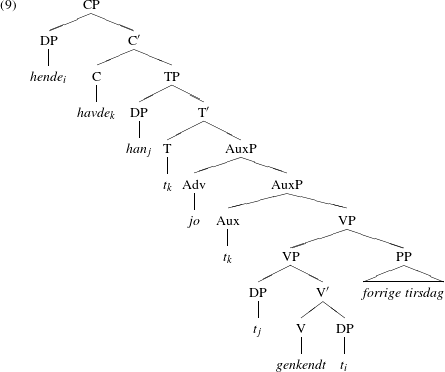
Four aspects of this structure are important for what follows. First, the finite verb (havde) moves to C via T. Second, the direct object (hende) moves to the Specifier of CP from its base position as the sister of the main verb genkendt. Third, the subject (han) surfaces in the third position, immediately after the finite verb, since the Specifier of TP is the canonical subject position in Danish and the Specifier of TP is projected to the left, as are all Specifiers in Danish. This accounts for the position of the subject in all of (2) through (8). Lastly, negation and so-called medial adverbs, like jo (‘indeed’) in (9), left-adjoin to the complement of T. Movement to C is limited to the verb that heads the complement of T, and there is no independent movement of lower verbs. Consequently, non-finite main verbs follow medial adverbs, whereas finite main verbs precede them; compare the order han jo genkendt (= subjadv V) in (2) to kom de sjældent (= V subjadv) in (3).
This much is relatively uncontroversial, though see Diesing (Reference Diesing1990), Reinholtz (Reference Reinholtz and Halpern1990), and Rögnvaldsson & Thráinsson (Reference Rögnvaldsson, Thráinsson, Maling and Zaenen1990) for dissenting views. Issues under active debate include the possible function and causes of V2 order (see e.g. Vikner Reference Vikner1995: 51–64; Brandner Reference Brandner, Lohnstein and Trissler2004; Zwart Reference Zwart, den Dikken and Tortora2005), its origin (see e.g. Eythorsson Reference Eythorsson1995, Dewey Reference Dewey2006), and the loss of V2 order in English (Fischer et al. Reference Fischer, van Kemenade, Koopman and van der Wurff2000: 104–137; Haeberli Reference Haeberli and Lightfoot2002). The open issue of most immediate relevance to present concerns is the structure of subject-initial V2 clauses, like (10).

If we apply the canonical analysis to (10), the result is the structure in (11).
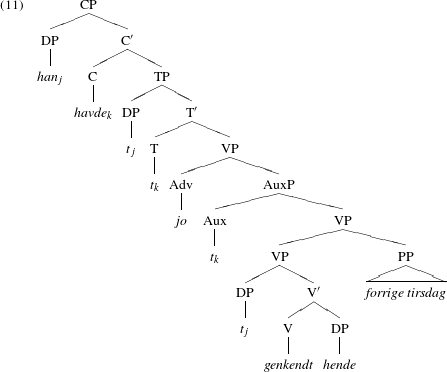
This is the uniform CP analysis advocated, in various guises, by den Besten (Reference den Besten and Abraham1983), Koopman (Reference Koopman1984), Holmberg (Reference Holmberg1986), Platzack (Reference Platzack, Hellan and Christensen1986a, Reference Platzack1986b), Taraldsen (Reference Taraldsen1986), Schwartz & Vikner (Reference Schwartz and Vikner1989), Weerman (Reference Weerman1989), Tomaselli (Reference Tomaselli1990), Holmberg & Platzack (Reference Holmberg and Platzack1995), Vikner (Reference Vikner1995), Schwartz & Vikner (Reference Schwartz, Vikner, Belletti and Rizzi1996), and van Craenenbroeck & Haegeman (Reference van Craenenbroeck and Haegeman2007). Unlike (9) above, movement of han and havde into the CP domain is string vacuous, in the sense that the very same word order results if there is no movement to CP, as in the alternative structure in (12).
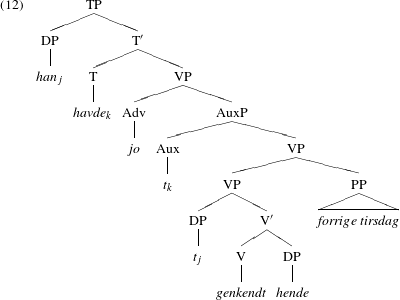
This structure is associated with the asymmetric V2 analyses developed by Travis (Reference Travis1984, Reference Travis and Freidin1991) and Zwart (Reference Zwart1991, Reference Zwart1997);Footnote [5] see also Santelmann (Reference Santelmann and Adger1999) and Sells (Reference Sells2001: 16–22). These analyses are asymmetric, because subject-initial V2 clauses, analyzed as TPs, have a different structure than non-subject-initial V2 clauses, which are CPs.
In this paper, I advocate a third position for Danish: some subject-initial V2 clauses are CPs – the ones with information-structurally distinguished subjects; while some are just TPs – the ones with information-structurally undistinguished subjects.
3. VP anaphor det
This section introduces the Danish VP anaphor det and offers two descriptive generalizations about its surface position in verb-second clauses: det must appear in situ when the illocutionary force of the clause requires the Specifier of CP to be empty or occupied by an interrogative phrase (the vp anaphora in situ generalization) and det cannot appear in situ when an information-structurally undistinguished subject occupies the initial position (the vp anaphora fronting generalization). An analysis of these generalizations and Danish verb-second clauses is developed in Section 4.
3.1 Introducing VP det
The VP-anaphoric construction of interest is exemplified in (13) below.Footnote [6] The VP anaphor is det and is homophonous with the third person singular neuter pronoun. In (13) det is a verbal proform (Houser et al. Reference Houser, Mikkelsen, Toosarvandani, Brainbridge and Agbayani2007), and I gloss it as det throughout. The antecedent is the VP of the main clause (‘emphasizes coaching’) and through this anaphoric dependency the clause containing det (= the target clause) is interpreted as ‘Aalborg doesn’t emphasize coaching’.

Like English VP ellipsis, det is licensed by an auxiliary, including modals, the perfect auxiliaries have (have) and være (be), the passive auxiliary blive (become), and the dummy auxiliary gøre (do).Footnote [7] While overt VP anaphors are attested throughout Germanic languages, they have been studied much less than VP ellipsis. There is important early work on Swedish by Källgren & Prince Reference Källgren and Prince1989 and on Norwegian by Lødrup Reference Lødrup and Gonzalez1994 and, in the last decade, a surge of work on overt VP anaphors and their relation to VP ellipsis in various Germanic languages (López & Winkler Reference López and Winkler2000; van Craenenbroeck Reference van Craenenbroeck2004; Winkler Reference Winkler2005: Chapter 3; Houser et al. Reference Houser, Mikkelsen, Toosarvandani, Brainbridge and Agbayani2007; Andréasson Reference Andréasson, Butt and King2008, Reference Andréasson2009; Herold Reference Herold2009; Ørsnes Reference Ørsnes2010; Platzack Reference Platzack, Ackema, Alcorn, Heycock, Jaspers, van Craenenbroeck and Wyngaerd2012; Ørsnes Reference Ørsnes2013). To my knowledge, the present paper is the first to relate the positioning of a VP anaphor to the syntax of verb-second clauses.
From a language-internal perspective, there are also good reasons to study the Danish VP anaphor det. The anaphor is very commonFootnote [8] and it is found in all clause types and all registers. It is also worth noting that unlike English do it and do so, which require their antecedent VP to be non-stative (Lakoff Reference Lakoff1966, Kehler & Ward Reference Kehler, Ward, Horn and Ward2004, Houser Reference Houser2010), Danish det imposes no semantic restrictions on its antecedent.
In non-V2 clauses, such as the second clause in (13) above, there is only one clause-internal position for det, which is the position occupied by regular non-pronominal VPs in such clauses: immediately following the finite auxiliary, which is itself preceded by the subject, negation, and other medial adverbs. Thus in (13), we have the order subject–negation–auxiliary–det. I call this position for det the regular position. In verb-second clauses, however, there are three potential positions for det: regular position (14), object-shifted position (15), and fronted position (16).

In V2 clauses, the finite auxiliary moves to the second position and therefore need not immediately precede a det in the regular position. In (14), for example, the order is adverb–auxiliary–subject–negation–det. The key to diagnosing the regular position in such clauses is the position of det relative to negation and other medial adverbs. In (14) det follows negation, whereas in (15) det precedes negation. The latter is the object-shifted position. Finally, the fronted position has det immediately preceding the finite auxiliary, as in (16).Footnote [9]
My focus in this paper is on the interaction between VP anaphora and V2 syntax, in particular the conditions on fronting the VP anaphor to the initial position in V2 clauses. I will not be concerned with the difference between the regular and object-shifted positions and will refer to these collectively as the in situ position. (See Andréasson Reference Andréasson, Butt and King2008, Reference Andréasson2009; Bentzen et al. Reference Bentzen, Merchant and Svenonius2013; and Ørsnes Reference Ørsnes2013 for detailed discussion of object-shifted vs. regular position of VP-anaphoric det in the mainland Scandinavian languages.)
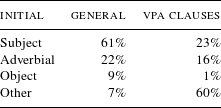
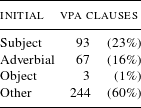
Table 1 offers a first indication that VP-anaphoric det interacts in a significant way with verb-second order. The general column gives the frequency of different constituents in the initial position in Danish V2 clauses generally and the vpa clauses column gives the frequency for these constituents in the initial position in V2 clauses with VP anaphora.Footnote [10]
Distribution of initial elements in Danish V2 clauses in general compared to V2 clauses with VP anaphora.
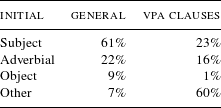
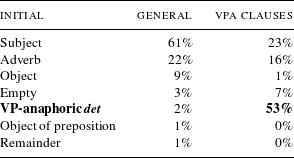
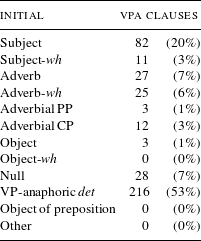
Comparing the two columns, we see that VPA clauses have radically fewer subjects in the initial position (23% vs. 61%), radically fewer objects (1% vs. 9%),Footnote [11] and slightly fewer adverbs (16% vs. 22%). Instead, VPA clauses have a dramatically higher rate of ‘Other’ initial constituents than V2 clauses generally (60% vs. 7%). Table 2 breaks down the ‘Other’ category into Empty, VP-anaphoric det, Object of preposition, and Remainder. The category Empty includes polar questions, imperatives, and verb-initial antecedents of conditionals. In all of these, there is no element in the initial position or, under certain analyses, there is an element, but that element is null.
Distribution of initial elements in Danish V2 clauses in general compared to V2 clauses with VP anaphora.

The important thing to note in Table 2 is that in 53% of VPA clauses, the VP anaphor occupies the initial position. It is thus by far the most frequent initial element in such clauses, far outnumbering subjects (53% to 23%) and adverbials (53% to 16%). A natural interpretation of Table 2 is that VPA clauses have a very different distribution of elements in the initial position, because the VP anaphor itself is very frequent in this position. And yet det obviously does not have to occur in the initial position. In just under half of all VPA clauses it is not fronted. This is important, because one of the few previously published claims about the position of det is that it must front (Vikner Reference Vikner1988: 11, fn 5). The data reported in Table 2 contradict that claim.Footnote [12] The remainder of this section seeks to establish two generalizations about the position of det in V2 clauses. These generalizations, along with the analysis in Section 4, take us a long way toward explaining the quantitative patterns seen in Table 2, specifically the dramatic difference in the number of initial subjects in VPA clauses, as compared to V2 clauses generally.Footnote [13]Footnote [14]
3.2 VP anaphor in situ
Certain clause types require det to appear in situ. As I show below, this is the case for constituent questions, polar questions, imperatives, and antecedents of conditionals. I propose to unify these in terms of the generalization in (17).

The proposal is that these clauses all use the initial position to signal their illocutionary force (question, command, and conditional), and that this eliminates the possibility of det-fronting to that position. In such clauses the VP anaphor appears in situ, which means either the regular (unshifted) position or the object-shifted position.
3.2.1 Constituent questions
In (18), the VP anaphor occurs in a subject question, and the only legitimate order is that in (18a), with the wh-word in the initial position and the anaphor in situ.

The same is true for questions of manner, location, time, and reason. Object questions, which would require extraction out of the pronominal VP, are ungrammatical (see Houser et al. Reference Houser, Mikkelsen, Toosarvandani, Brainbridge and Agbayani2007: 3, 9–11 for data and analysis), so the question of word order in these is moot. The ungrammaticality of (18b) follows from two well-established facts: Danish constituent questions require wh-fronting and in a verb-second clause there is only one fronted position available, namely the Specifier of CP. Hence det cannot front in (18).
3.2.2 Polar interrogatives
Polar interrogatives also disallow fronting of det, as shown in (19).Footnote [15]

The relevant factor here is that Danish polar interrogatives require a (phonologically) empty initial position and hence det cannot front. Some analyses assume that the initial position is empty in polar interrogatives (Diderichsen Reference Diderichsen1968: 162); others assume that the initial position is occupied by a null question operator (Vikner Reference Vikner1995: 49, following Baker’s (Reference Baker1970) original analysis of English). The analysis I develop later in the paper is compatible with either assumption. The important point here is that the syntax of polar interrogatives makes demands on the initial position that preclude det-fronting. Hence det surfaces in situ, as shown in (19a).
3.2.3 Imperatives
Imperatives also disallow det-fronting, as (20) shows.

Like polar questions imperatives are verb-initial and hence require an (phonologically) empty Spec-CP. Consequently, there is no room for det to front, which accounts for the ungrammaticality of (20b). Jensen (Reference Jensen2007) argues that Danish imperatives are just TPs with a null subject and the finite verb in T. This structure also accounts for the observed verb-initial word order, but is incompatible with the analysis of the VP anaphor developed below, which requires det to be licensed by a C-head. The present paper thus provides an indirect argument in favor of the more standard view that imperatives, including Danish ones, are CPs. (See Potsdam Reference Potsdam and van der Wurff2007 and references cited there for details of the CP analysis.)
3.2.4 Conditionals
Finally, det-fronting is prohibited in the antecedents of conditional constructions. Like polar questions and imperatives, the verb must be the first phonologically realized element of the clause, as shown by the contrast in (21).

The syntax of conditionals requires an (phonologically) empty initial position in the antecedent clause. Det-fronting would target that initial position and hence cannot take place.
To summarize, these patterns can all be understood in terms of the established syntax of questions, imperatives, and conditionals. In each case, a hard syntactic requirement (empty/no Spec-CP or a wh-phrase in Spec-CP) precludes fronting of det. All we need to say is that det may surface in situ and the interaction with established syntactic principles will yield the attested restriction. This is as far as other accounts go (Andréasson Reference Andréasson, Butt and King2008: 37–38; Herold Reference Herold2009: 80, 125f, 160f; Ørsnes Reference Ørsnes2010: 16–17). What has not been observed, to my knowledge, is that there are also contexts that require fronting of det. I present several such cases in the next section.
3.3 VP anaphor fronting
The received wisdom about declarative V2 clauses in Germanic languages is that the choice of initial element is syntactically free, but is subject to discourse-pragmatic and textual requirements. This view is consistent with the quantitative data on the initial position in V2 clauses reported in Tables 1 and 2. Setting aside non-declaratives, we find subjects, various kinds of objects, adverbials, and VP-anaphoric det in the initial position. It is entirely possible that this distribution directly reflects discourse pragmatics, text structuring, and other patterns of language use. Superficially, the same is true of VPA clauses: if we set aside the kinds of non-declaratives analyzed above, we find the typical range of elements in the initial position: subjects, objects, and adverbials. However, when we examine individual V2 clauses with VPA, a striking pattern emerges. In VPA clauses with expletive subjects, the expletive cannot take the place of the anaphor in the initial position. In answers to polar questions, in generalizations, and in repetitions, the VP anaphor must likewise take the initial position over the subject, whether the subject is expletive or not. I propose that these patterns fall under the generalization in (22).

In Section 4, I propose an explanation of this generalization in terms of the structure of V2 clauses, the function of Spec-CP in such clauses, and the licensing requirements on VP anaphora. The remainder of the present section lays out the empirical evidence for the VP Anaphor Fronting Generalization (or the Fronting Generalization, for short), and unpacks the notion of an undistinguished subject. I first show that the Fronting Generalization holds for expletive subjects (Section 3.3.1) and that it is the right way to characterize the observed word order restriction in such clauses. Then, in Section 3.3.2, I turn to the other three environments listed above (22) – answers to polar questions, generalizations, and repetitions – which all involve discourse-old subjects of equally discourse-old predicates and show that they too obey the Fronting Generalization in (22). Section 3.4 considers and rejects a stronger version of the Fronting Generalization, before moving on to the analysis in Section 4.
3.3.1 Expletive subjects
Danish makes wide use of the subject expletive der, cognate with English there. While the expletive routinely occupies the initial position, as in the first clause of (23), VPA clauses do not allow an initial expletive (23b, c). Instead the VP anaphor must occur in the initial position (23a):

In (23b) the VP anaphor is object-shifted across the adverbial også (also) and in (23c) it is not, appearing instead in the regular position. Either order is impossible, showing that the source of the ungrammaticality is the initial expletive, not the object shift of det or lack thereof.Footnote [16] The pattern in (23) follows the Fronting Generalization in (22): the undistinguished subject (expletive der) cannot occupy the initial position at the expense of the VP anaphor (as it does in (23b) and (23c)), but the VP anaphor can surface in the initial position, as in (23a), relegating the expletive subject to the third position.
The Fronting Generalization is not dependent on the antecedent VP having an expletive subject, as (24) shows. Here the antecedent clause has the contentful subject ‘many misunderstandings’, whereas the target clause has the expletive subject der. The attested order is (24a) with the VP anaphor in the initial position. It is ungrammatical to have the expletive in the initial position, whether the VP proform is object-shifted or not (24b).

Neither is the Fronting Generalization specific to VP anaphora licensed by the dummy auxiliary gøre. We find the same pattern with all licensing auxiliaries, exemplified for the perfect auxiliary have in (25) and the passive auxiliary blive in (26).

As (27) and (28) show, there is no such restriction on non-expletive subjects. In (27), the initial position can be occupied by the contentful subject en anden (someone else), as in (27b), which is the attested order, or by the VP anaphor (27a). In (28), the attested order has the VP anaphor initially (28a), but the subject-initial order in (28b) is also grammatical.Footnote [17]

In each of these examples, the (a) and (b) versions of the VPA clause are truth-conditionally equivalent, though they differ subtly in their pragmatic relation to the antecedent clause, a point to which I will return briefly in Section 4.4.
A natural question to ask at this point is whether the ban on det in situ in (23)–(26) could be due to an independent property of expletive constructions, in particular the definiteness effect (Milsark Reference Milsark1979), which is operative in Danish (Mikkelsen Reference Mikkelsen2002). The definiteness effect refers to the general infelicity of definite NPs as pivots of expletive constructions. Personal pronouns are definite and generally infelicitous as pivots. VP-anaphoric det is an anaphoric proform, and it is possible that this makes VP det definite (though see Lødrup Reference Lødrup and Gonzalez1994). If so, the ban on det in the pivot (= in situ) position in (23)–(26) could be analyzed as a definiteness effect and as such not in need of independent explanation.
Three considerations speak against this possibility. First, fronting of a definite pivot does not generally ameliorate the definiteness effect. Thus (29c) is as degraded as (29b).Footnote [18]Footnote [19]

In contrast, fronting VP-anaphoric det in expletive clauses restores these to full grammaticality, as shown by examples (a) in (23)–(26).
Second, fronting something other than the pivot does not ameliorate the definiteness effect with NP pivots, as (30) shows. In contrast, fronting something other than the VP anaphor can restore expletive VPA clauses to full grammaticality. An example of this is (31), which is a possible continuation of (25) above.
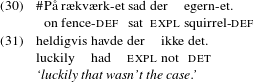
Even if these two differences between expletive clauses with definite NP pivots and expletive VPA clauses could be accounted for, there is a third reason not to analyze the ill-formedness of examples (b) in (23)–(26) as a definiteness effect. Danish has two other expletive constructions – weather clauses and extraposition structures – which are not associated with any definiteness effect and yet these constructions exhibit the exact same ordering restriction with VP anaphora as the expletive construction examined above.Footnote [20] An account of (23b)–(26b) above in terms of the definiteness effect would not extend to these expletive constructions, and would therefore miss a significant generalization.
3.3.2 Discourse-old subjects
The second type of information-structurally undistinguished subjects that are included in the Fronting Generalization are discourse-old subjects of equally discourse-old predicates. Discourse-old entities are those that have been already mentioned in the prior discourse (Prince Reference Prince, Mann and Thompson1992: 11), as opposed to entities that are known to the hearer, and hence hearer-old, but have not been mentioned in the current stretch of discourse.Footnote [21] Prince’s work and subsequent work by Gregory Ward, Betty Birner, and others have demonstrated the relevance of discourse-oldness for a range of word order alternations in English and other languages, and the need to distinguish discourse-old/new from hearer-old/new (Prince Reference Prince and Cole1981, Reference Prince, Mann and Thompson1992; Birner Reference Birner1994; Ward & Birner Reference Ward and Birner1995; Birner Reference Birner1996; Birner & Ward Reference Birner and Ward1996; Prince Reference Prince and Kamio1997; Birner & Ward Reference Birner and Ward1998; Kaiser Reference Kaiser, Okrent and Boyle2000; Miller Reference Miller2001; Kaiser Reference Kaiser, van Koppen, Thrift, van der Torre and Zimmermann2002).
Most of the pragmatic conditions on word order documented in this body of work involve a particular subpart of a clause having a particular information status for the non-canonical word order in question to be felicitous. The information-status condition included in the Fronting Generalization singles out clauses where subject and predicate are both discourse-old, and equally discourse-old. This situation arises when a clause is a repetition or near repetition of a previous utterance. Below I examine three such recurrent contexts: answer to polar questions, generalizations from prior statement of specific instances, and repetitions.
3.3.2.1. Answers to polar questions
In matching (i.e. not over-informative; Kiefer Reference Kiefer, Searle, Kiefer and Bierwish1980, Yadugiri Reference Yadugiri1986) answers to polar questions, a subject cannot take the initial position in place of a VP anaphor:

The subject in (32a&b) is information-structurally undistinguished, because both it and its predicate are rendered equally discourse-old by the question. The Fronting Generalization in (22) thus rules out (32b), in which the undistinguished subject takes the initial position at the expense of the VP anaphor. The grammaticality of (32c) shows that undistinguished subjects can occupy the initial position if the VP is not pronominal. The same is true for expletive subjects (see the first clause of (23) above) and for undistinguished subjects in generalizations and repetitions (discussed below).
The example in (32) involves a direct question–answer exchange and one could imagine that this pragmatic fact could affect word order. In that light, it is relevant to observe that the word order restriction holds beyond direct question–answer exchanges. Thus we find it in direct answers to indirect questions (33), in indirect answers to direct questions (34), and in indirect answers to indirect questions (35).

The persistent infelicity of subject-initial order in (33)–(35) is accounted for by the Fronting Generalization, since in all of these answers, the subject and VP anaphor are made equally discourse-old by the question. Collectively, these data offer good evidence that the initial position is governed by discourse-oldness, not by a specific conversational interaction. This conclusion is further supported by the fact that we find the same pattern (no initial undistinguished subjects in VPA clauses) outside question–answer pairs.
3.3.3 Generalizations
Generalizations from a specific instance can also give rise to undistinguished subjects with VP anaphora, as seen in (36).

By virtue of the antecedent clause, the subject and predicate in (36a,b) are equally discourse-old. The Fronting Generalization thus correctly rules out (36b) where the undistinguished subject takes the initial position in place of the VP anaphor.
3.3.4 Repetitions
Perhaps the most straightforward case of contextually undistinguished subjects comes from repetition. Danish speakers often use VP anaphora in repetitions and here the anaphor must take the initial position over the subject, as the contrast between (37a) and (37b) shows.

I conclude that undistinguished subjects cannot take the initial position in place of VP-anaphoric det, irrespective of whether the undistinguishedness is lexically determined (expletive subjects) or contextually determined (contentful subjects in matching answers to polar questions, generalizations, and repetitions). Putting the In Situ and Fronting Generalizations together, we arrive at (38).

It is the second generalization that helps explain why there are radically fewer initial subjects in VPA clauses than in V2 clauses in general (23% vs. 61%). The Fronting Generalization places no restrictions on subjects in V2 clauses generally, but it bans certain subjects from the initial position in VPA clauses (namely undistinguished subjects), thereby lowering the number of initial subjects in VPA clauses compared to V2 clauses generally.
3.4 A hypothetical Fronting Generalization
An important question to ask at this point is whether we can strengthen the Fronting Generalization to state that in a V2 clause with an undistinguished subject, the VP anaphor must occupy the initial position. Then we would have a nice symmetric account of the position of det: one condition that states when det cannot front (38a) and another that states when it must front. The short answer is no. Whether or not the VP anaphor must occupy the initial position in clauses with undistinguished subjects depends on what other elements are present in the clause. If there is another frontable element, e.g. a PP, a subordinate clause, or an adverb that is not inherently banned from the initial position, then it is possible to front that element instead of the VP anaphor, provided that it fulfills regular contextual, discourse, and text-pragmatic requirements. Returning to the expletive examples in (23)–(26), we can observe the following. In (25), repeated here as (39), there is another frontable element in the target clause, namely, the adverb heldigvis (luckily). The pragmatic relation between antecedent and target clause can be mediated by this adverb in the initial position, and the adverb-initial order in (39c) is possible alongside (39a).

In (39c), the VP anaphor occurs in situ with the undistinguished subject in the third position. The hypothetical generalization that VP det must front in the presence of an undistinguished subject would incorrectly rule out such constructions. They are allowed by the Fronting Generalization in (38b) because that generalization explicitly refers to the position of the undistinguished subject and only bans in situ VP anaphors when the undistinguished subject is in the initial position, as in (39b).
Similarly, the unabbreviated version of (23a) has a temporal subordinate clause following the adverb også (also). Such clauses can generally occur in the initial position and it would be grammatical, and felicitous, to have the temporal clause in place of the VP anaphor in the initial position in (23).
In (24), reproduced as (40) below, there are two candidates for the initial position: the PP mellem denne romans to hovedpersoner (between the two main characters of this novel) and the PP for eksempel (for example).

Neither of these PPs are categorically banned from the initial position, but in the context of (40) it is quite odd to front either of them, as shown in (40c) and (40d). I am not in a position to fully explain why the initial PPs are not pragmatically well-formed in (40c,d), but I believe it is relevant that there is a paragraph break between the antecedent and target clauses in the original passage. I thus interpret (40) as a case where pragmatic considerations conspire to make fronting of the VP anaphor the only option, rather than a point in favor of a hypothetical requirement that a VP anaphor must front in a clause with an undistinguished subject.
Finally, in (26), repeated here as (41), there are no other frontable elements present in the VPA clause.
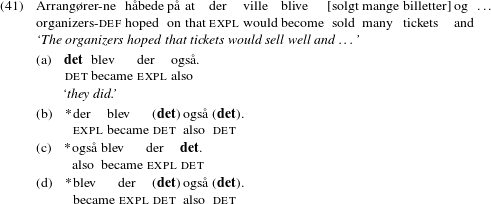
In (41a–d) we have just the finite auxiliary blev (became) and the adverb også (also), in addition to the expletive and VP anaphor. Også is one of the handful of adverbs barred from the initial position (see p. 4), so fronting it results in ungrammaticality (41c). Similarly, a finite verb cannot occupy the initial position outside of the three environments discussed in Section 3.2. Hence (41d) is also ungrammatical on a declarative interpretation. Thus the only elements that are in principle frontable are the expletive and the VP anaphor, and here the Fronting Generalization prohibits the expletive from taking the initial position over the VP anaphor, leaving (41a) as the only possible word order. If viewed in isolation, (41) appears to suggest obligatory fronting of a VP anaphor with an undistinguished subject, but that is untenable given the grammaticality of examples like (39c). In contrast, (39c) is unproblematic for the real Fronting Generalization, and so are (41c) and (41d), since their ungrammaticality has nothing to do with the presence of the VP anaphor; the initial elements are categorically banned from the initial position whether the verb phrase is pronominal or not.
The upshot of this discussion is that obligatory fronting of det is epiphenomenal. This sets VPA clauses apart from constituent questions, polar questions, imperatives, and antecedents of conditionals. In a constituent question, the wh-phrase must occupy the initial position, no matter what other elements happen to be around in the clauseFootnote [22] and in a polar question the initial position must be (phonologically) null or we have no polar question. Similarly, the initial position must be empty in imperatives and antecedents of conditionals. We cannot test to see which of these requirements is stronger, since we cannot combine a constituent question with a polar question nor with an imperative nor with the antecedent of a conditional. Each requirement is absolute and they never interact. The situation is interestingly different with VP-anaphoric det, because det is compatible with all clause types. Consequently, the positioning of VP det opens a new window on the inner workings of V2 syntax.
4. An analytical proposal
My account of the VPA In Situ and VPA Fronting Generalizations involves a particular analysis of verb-second syntax, which I couch in the Minimalist framework. Following Travis (Reference Travis1984, Reference Travis and Freidin1991) and Zwart (Reference Zwart1991), I assume that Danish V2 clauses may be TPs or CPs. Verb-second TPs are necessarily subject-initial, since Spec-TP is reserved for subjects. Verb-second CPs, on the other hand, may be subject-initial or not, and require that the initial element bear a C-related function. C-related functions include expression of illocutionary force (specifically, interrogative, imperative, and conditional force), information-structural categories like topic and focus (of various kinds), and marking of the rhetorical relation to the previous clause (typically by adverbs). In structural terms, this means that all V2 Cs require a Specifier and all place some content requirement on that Specifier (that it be a wh-phrase, that it be a contrastive topic, that it signal a certain rhetorical relation, etc.). Concretely, I propose to implement this as a series of C items that differ in their selectional features, specifically the identity of the feature that triggers the movement of some element to Spec-CP. For example, the C used in constituent questions bears a strong uninterpretable wh-feature ( $u$wh*) that triggers the movement of a phrase bearing a matching interpretable wh-feature to Spec-CP. Analogously, Danish has a V2 C containing a strong uninterpretable focus feature (
 $u$foc*) and that C attracts an element bearing a matching interpretable focus feature to Spec-CP.Footnote [23] If a C is used in a derivation where no element bears a matching interpretable feature, the derivation fails. Crucially, information-structurally undistinguished elements do not bear the kinds of interpretable features that are required by V2 Cs, and can therefore not be attracted to Spec-CP in a V2 clause. Collectively these assumptions about feature distribution encode the idea that, in Danish, Spec-CP is reserved for elements that serve some discourse-relevant function and elements that cannot serve such functions (either by nature or in the given context) are never realized in Spec-CP. In contrast, T places no discourse requirements on its Specifier. It just requires a nominal there to serve as the subject. Hence there are no information-structural requirements on the initial element in a V2 TP. Turning, finally, to the VP anaphor itself, I assume that it is inherently an anaphoric topic (cf. López & Winkler Reference López and Winkler2000), and as such is able to appear in Spec-CP, given the appropriate C, i.e. a C that bears an uninterpretable anaphoric topic feature, which I will annotate as
 $u$atop. In addition, VP det comes with a licensing requirement of its own: it must be licensed by a C. This requirement is independent of movement to Spec-CP. While only a C equipped with
 $u$atop* can attract VP det to the initial position, any C can license VP det. If C bears a selectional feature other than
 $u$atop, the licensing is done remotely, by Agree. If C bears
 $u$atop*, it can license det locally, following the movement of det to Spec-CP. I implement this licensing requirement as an uninterpretable C feature on det (
 $u$C). The feature is weak, which allows it to be checked in situ by Agree. Note that this is an instance of upwards Agree (in the sense of Baker Reference Baker2008: 45ff), since the Goal (C) c-commands the Probe (det). With these assumptions in place we can turn to cases of det in situ and explain why the anaphor must surface in situ in these cases.
4.1 Accounting for det in situ
When a VP anaphor occurs in a constituent question, a polar question, an imperative, or the antecedent of a conditional, the anaphor must surface in situ. In presenting the relevant data (in Section 3.2), I suggested that this is because each of these constructions puts independent demands on the initial position, which conflict with fronting the VP anaphor; as a result the anaphor is prevented from fronting. We are now in a position to make that suggestion more concrete using the featural apparatus introduced above.
Constituent questions involve a C-head that bears  $u$wh*. This feature attracts the wh-phrase to Spec-CP, yielding the schematic structure in (42) for a subject question with a VP anaphor:
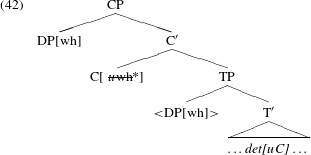
What remains to be checked is the  $u$C feature on the anaphor. The C-head checks this, using its category feature C. Since the
 $u$C on det is weak it is checked in situ by Agree. (Note that C c-commands the anaphor in (42).) Hence, det surfaces in situ. At this point we need to ask what would happen if, instead, we had a C with a
 $u$atop feature. Such a C would attract det to Spec-CP, leaving the subject wh-phrase in Spec-TP. The resulting word order (det Aux wh) is impossible, as demonstrated in Section 3.2. Depending on how we treat wh-phrases, there are two ways to account for this within my analysis. If wh-elements are distinguished only by an interpretable wh-feature and carry no uninterpretable features themselves, such structures are grammatically well-formed but semantically uninterpretable, since we have a question word (the wh-element) in a declarative clause (C[
 $u$atop] is declarative). Alternatively, wh-elements themselves carry an uninterpretable feature that must be checked by an interrogative C (that is, a C that carries the value Q for the clause-type feature). Since the C that carries [
 $u$atop] is declarative, the relevant feature on the wh-element cannot be checked and the derivation fails. To summarize, for semantic or syntactic reasons, the wh-element must be in an interrogative CP. The C that projects an interrogative CP attracts the wh-phrase to Spec-CP and hence the VP anaphor stays in situ.
The anaphor must also stay in situ in polar questions, imperatives, and antecedents of conditionals. In all of these, the initial position must be empty. Previous work has implemented this requirement in one of two ways: Spec-CP is occupied by a null element (an operator that carries the illocutionary force of the utterance) or Spec-CP is absent. I will not take a stand here on which analysis is correct (for which construction), since either is compatible with my account of VPA in situ. If these verb-initial constructions do indeed involve a null operator in Spec-CP, the account of VPA in situ is similar to that given for constituent questions above: the relevant C requires that the operator to occur in Spec-CP (through a specific selectional feature) and hence det cannot be fronted, but must surface in situ. If they do not involve null operators, then obligatory VP det in situ is accounted for as follows: C is present but lacks a selectional feature. The finite auxiliary is attracted to C, by whatever mechanism it normally is in V2 clauses, but since C has no selectional feature nothing is attracted to Spec-CP and these structures surface with an initial verb.Footnote [24]
4.2 Accounting for the VPA Fronting Generalization
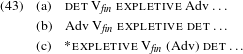
In V2 clauses with an undistinguished subject, the subject cannot occupy the initial position at the expense of a VP anaphor. The VP anaphor itself, or some other frontable element, must take the initial position. This pattern is schematized for V2 clauses with an expletive subject and a frontable adverbial in (43).
The goal of this section is to account for this pattern using the analysis developed above for det in situ. I illustrate the analysis using expletive constructions and then extend it to the other, context-dependent, cases of obligatory fronting with undistinguished subjects.
We will first consider (43a), where the VP anaphor occupies the initial position. Since (43a) is not subject-initial, it is a V2 CP. C is in charge of attracting the VP anaphor to the initial position and it does that by way of a  $u$atop* feature, which matches the discourse function of the VP anaphor (det is an anaphoric topic). The C-head licenses the VP anaphor by checking its
 $u$C feature, resulting in the structure below:

The order in (43b) comes about when a different C is chosen, one that attracts the adverbial to Spec-CP. C licenses the VP anaphor in situ by checking  $u$C on det via Agree. As in (44), the expletive surfaces in Spec-TP.
The crux of the analysis is the explanation it offers for the ungrammaticality of (43c). This is a subject-initial V2 clause and as such could be either a TP or a CP. If it is a CP, the initial element must bear a C-relation function, since all V2 Cs require their Specifier to bear some C-related function. However, the expletive cannot bear any C-relation function: it is not a wh-word, it cannot be a topic or a focus, and it cannot express the rhetorical relation to the previous sentence. Hence, (43c) cannot be a well-formed CP. Expletives can occupy Spec-TP, so we need to consider the possibility that (43c) is a V2 TP. Here it becomes relevant that the clause contains VP-anaphoric det, which must be licensed by a C. If (43c) is a TP, there is no C to license det and the derivation fails due to an unchecked  $u$C feature on det. Hence, (43c) cannot be a well-formed TP either. Consequently, there is no well-formed structure for (43c) and it is therefore ungrammatical.
Importantly, this analysis applies equally well to the other cases of undistinguished subjects presented above (answers to polar questions, generalizations, and repetitions). In each case, a C must be present to license VP-anaphoric det. Every V2 C requires an information-structurally distinguished Specifier; so no matter which C is involved it requires the initial element to bear a C-related function. However, the subject is information-structurally undistinguished and therefore cannot bear any such function and there is consequently no derivation that results in a subject-initial realization.
At this point we have accounted for the two generalizations established in Section 3. First, VP-anaphoric det cannot front in questions, imperatives, and antecedents of conditionals, since the C-head involved in these clause types makes contrary demands on the initial position. Second, an undistinguished subject cannot take the initial position at the expense of the VP anaphor, since VP anaphors only occur in CPs and undistinguished elements cannot occupy Spec-CP. This analysis makes a prediction about VP anaphora in embedded clauses, which I articulate and examine in the next section.
4.3 VPA in embedded clauses
If VP-anaphoric det can be licensed in situ by any and only C, and if expletive-initial V2 clauses are just TPs (because expletives cannot occupy Spec-CP), the possibility of VP-anaphoric det in a clause embedded inside an expletive-initial clause is predicted to depend on whether the embedded clause is a TP or a CP. In particular, we predict the following distribution:

The structure in (45) is predicted to be ungrammatical because there is no C to license det, whereas (46) is predicted to be grammatical because the embedded clause contains a C that can license det. To test these predictions we need to identify constructions that have these structures.
4.3.1 [tp ... [tp ...]] case
A strong candidate for the C-less structure in (45) is a raising construction with a raised expletive subject and VP anaphora in the embedded clause, as in (47a, b).
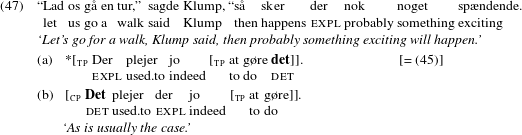
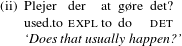
The raising verb plejer has no verbal equivalent in English, but it is one of the most used raising predicates in Danish. The antecedent of the embedded VP anaphor is sker noget spændende (‘happens something exciting’) which takes an expletive subject. (The constituency of the antecedent VP is obscured by verb movement of sker.) In both (47a) and (47b), the expletive subject of the embedded clause has raised to the subject position of the matrix clause, i.e. Spec-TP. In (47b), the VP anaphor has also moved out of the embedded clause and surfaces in the sentence-initial position, preceding the finite raising verb. The result is a non-subject-initial V2 clause: some constituent other than the subject occupies the initial position (i.e. Spec-CP), the finite verb occupies the second position (i.e. C), and the subject appears in the third position (in Spec-TP). The movement of the VP anaphor to matrix Spec-CP is prompted by a  $u$atop feature on matrix C. (The movement of the expletive to the matrix subject position is triggered by the regular EPP feature on matrix T, and will not concern us further here.) The VP anaphor is licensed by the matrix C and the derivation converges. This accounts for the grammaticality of (47b).Footnote [25]
Turning to (47a), first note that it is indeed ungrammatical as predicted if it instantiates the structure in (45). Following the logic of the previous section, we know that the matrix clause in (47a) is just a TP, since the expletive is initial in the matrix clause and expletives cannot occupy Spec-CP. The syntax of raising tells us that the embedded clause is also a TP (Chomsky Reference Chomsky1981: 66 and much subsequent work) and hence (47a) instantiates the structure in (45). It is ungrammatical because the VP anaphor is not licensed. It can only be licensed by C (as encoded in the  $u$C feature on det) but there is no C in this structure, only TPs.
4.3.2 [tp ... [cp ...]] case
The schematic structure in (46) is instantiated by expletive constructions with a CP complement to the N-head of an NP pivot.Footnote [26] As predicted, these are grammatical with VP-anaphoric det inside the complement clause to N, as in (48a):

We know that the matrix clause in (48a) is a TP since it is expletive-initial. The embedded clause, however, is a CP; it is headed by the declarative complementizer at (‘that’).Footnote [27] The embedded clause is not a V2 clause; complement clauses to N never are. The verb stays in situ and nothing moves to Spec-CP; compare (48a) to the ungrammatical versions with det-fronting to embedded Spec-CP in (48c) and (48d). Consequently the leftmost element of the embedded clause is the complementizer at. Since at is a C, it can license VP det. In (48a) it does that by Agree.
Importantly, (48b) is also grammatical. In this structure, the VP anaphor has moved from the embedded clause to matrix Spec-CP. Unlike the fronting in (47b), this involves movement out of a complex NP and one might therefore expect a contrast between (47b) and (48b), in particular that (48b) be ungrammatical. Its grammaticality is consistent with observations by Erteschik-Shir (Reference Erteschik-Shir1973: 32–49) and Jakobsen (Reference Jakobsen, Devriendt, Goossens and van der Auwera1996) that complex NPs are not generally islands in Danish. Thus, from a language-internal perspective there is nothing surprising about (48b) and in terms of my analysis of fronting, it works exactly like (47b): matrix C bears  $u$atop and thereby attracts det to matrix Spec-CP. I include (48b) to rule out an alternative explanation for the grammaticality of (48a), one that would not offer as strong support for the analysis of the VP anaphor and Danish verb-second structures developed in the previous sections. Had (48b) been ungrammatical, one could potentially argue that (48a) is grammatical because there is no other way to express the relevant meaning (recall the ungrammaticality of both (48c) and (48d)). But (48b) is grammatical, ruling out this alternative explanation for the contrast between (48a) and (47a). Instead, I contend, the contrast between (48a) and (47a) follows from an independently motivated structural difference between complement clauses to N (they are CPs) and raising constructions (they involve an embedded TP). Together with the categorical licensing requirement of the VP anaphor (det must be licensed by a C), this structural difference produces the observed contrast.
There is one more alternative explanation that I would like to set aside.Footnote [28] In (47) the VP anaphor originates in a non-finite clause; in (48) it originates in a finite clause. If the VP anaphor could not surface in a non-finite clause, that would account equally well for the key contrast between (47a) and (48a). It would also account for the grammaticality of both (47b) and (48b), since, in both, the anaphor surfaces in a finite matrix clause. Examples like (49) rule out this explanation.
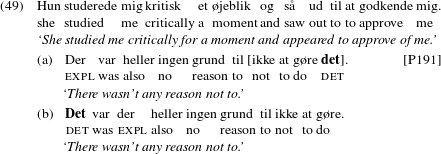
Like (48), (49) is an expletive construction in which the NP pivot contains a complement clause. However, in (49) the CP complement to N is non-finite, as shown by the inflection of the embedded verb (gøre is infinitive) and the lack of an overt subject; the subject is PROarb.Footnote [29] Again we cannot pin the grammaticality of (49a) on the lack of alternative ways of expressing the semantic content, since (49b), with fronting of det to matrix Spec-CP, is perfectly grammatical. If finiteness were the factor governing the surface position of the VP anaphor, we would expect (49) to pattern with (47), but it patterns with (48). This shows that it is syntactic category (C vs. T) that matters for licensing the VP anaphor, not finiteness.
4.4 ‘Optional’ fronting
Recall from Section 3.3.1 that with non-expletive subjects, det-initial and subject-initial versions of a given V2 clause are sometimes both possible:

In (50), the attested order is (50b), with the subject in initial position, but (50a) with anaphor fronting is also possible. In (51), the attested order is (51a) with initial det, but the subject-initial order in (51b) is also possible. I propose to analyze this alternation as follows. In both examples, the subject of the target clause is contentful (‘someone else’ in (50) and ‘you’ in (51)) and may therefore take on an information-structural function. The linguistic context, specifically the antecedent clause, allows each subject to function as contrastive focus (‘someone else’ vs. ‘we’ in (50) and ‘you’ vs. ‘I’ in (51)). As a contrastive focus, the subject can occur in the Specifier of CP (given the appropriate C), as in (50b) and (51b). However, the linguistic context does not require initial focus; speakers have a choice about how to construe the relation between the two clauses. If they construe it contrastively, we get subject fronting. If they construe it anaphorically, we get det-fronting. Notice that under this analysis, (50b) and (51b) are CPs, despite being subject-initial.
For some attested examples, speakers differ in whether they allow the alternative order (see Table 7 in the Appendix). A typical example is given in (52).Footnote [30]
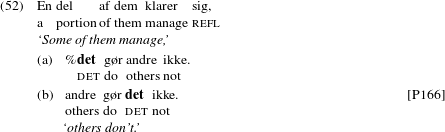
I interpret this variation as follows. Some speakers can only construe the relation between the clauses as one of contrasting two sets of individuals. This construal forces the order in (52b). Other speakers also allow an anaphoric relation between the two clauses and for these speakers both orders are possible. Clearly more work is needed to establish the factors that determine which clausal construals speakers allow. The important point here is that det-fronting is never truly optional; a clause with a fronted det places a different set of restrictions on its use in text and discourse than the same clause with det in situ.
5. Asymmetric verb-second order
My account of the word order generalizations governing the VP anaphor det requires that Danish V2 clauses come in two sizes: TP and CP. This is in line with the asymmetric V2 analyses developed by Travis (Reference Travis1984, Reference Travis and Freidin1991), Zwart (Reference Zwart1991), and Sells (Reference Sells2001), but in direct conflict with the dominant analysis of verb-second order, which holds that all V2 clauses are CPs (den Besten Reference den Besten and Abraham1983; Koopman Reference Koopman1984; Holmberg Reference Holmberg1986; Platzack Reference Platzack, Hellan and Christensen1986a, Reference Platzackb; Taraldsen Reference Taraldsen1986; Schwartz & Vikner Reference Schwartz, Vikner, Belletti and Rizzi1996; Weerman Reference Weerman1989; Tomaselli Reference Tomaselli1990; Holmberg & Platzack Reference Holmberg and Platzack1995; Vikner Reference Vikner1995; Schwartz & Vikner Reference Schwartz, Vikner, Belletti and Rizzi1996; Jouitteau Reference Jouitteau and van Craenenbroeck2008).Footnote [31] It is thus relevant to reexamine the empirical arguments advanced in favor of the uniform CP analysis over an asymmetric TP/CP analysis of V2. As far as I can tell, only four such arguments have been advanced for Mainland Scandinavian languages:Footnote [32]
(1) Distribution of unstressed pronouns (Schwartz & Vikner Reference Schwartz, Vikner, Belletti and Rizzi1996)
(2) Extraction from embedded V2 clauses (Holmberg Reference Holmberg1986: 110ff)
(3) Position of finite V in clauses with mon (Vikner Reference Vikner1995: 45–46)
(4) Adjunction to TP (Schwartz & Vikner Reference Schwartz, Vikner, Belletti and Rizzi1996)
I concentrate on arguments 3 and 4 here.Footnote [33]
5.1 Mon clauses
The argument from mon clauses targets the assumption that the finite verb may surface in T in V2 clauses, as it is claimed to do under the asymmetric analysis in subject-initial V2 clauses that are just TPs. Mon clauses, like (53), are relevant because they would seem to be main clauses with a lexical C. (mon has no direct correlate in English, but translates as ‘I wonder’. Following Vikner Reference Vikner1995 I gloss it that way too.)

If mon occupies C, we can make sense of the fact that in (53) mon sits between the wh-phrase and the subject. If mon is in C, that position is not available as a landing site for verb movement, but presumably T is available so we need to ask whether the finite verb is in V or T in (53). The relative position of the verb and negation in (54) shows that the verb is in V, not in T:

This is unproblematic for the uniform CP analysis, because under that analysis V2 movement is always movement of V to C (via T) and if V cannot move to C (here because mon occupies C), then V cannot move at all. Under the asymmetric V2 analysis, on the other hand, V2 is movement of the finite verb to the highest head position of its clause, which is C in a V2 CP and T in a V2 TP. Moreover, the finite verb must move to this position in both V2 CP and V2 TP (otherwise, the verb would not necessarily surface in the second position). Thus, the asymmetric V2 analysis would seem to predict the starred position for har in (54). However, this argument only succeeds if mon is indeed a complementizer. In an unrelated paper on subject relative clauses (Vikner Reference Vikner1991), Sten Vikner advocates a different view of mon, originally due to Kristian Mikkelsen (Reference Mikkelsen1911: 582), namely that mon is a reduced verb form that introduces an embedded non-V2 clause, but no subject. Vikner (Reference Vikner1991: 118–119) gives some diachronic support for this view, which I will not review here. The important point is that on this analysis of mon, (54) is a biclausal structure with wh-extraction out of the embedded clause. The string børnene ikke har set is an embedded clause of the non-V2 variety and therefore no verb movement is expected under any V2 analysis, including the asymmetric analysis.
5.2 Adjunction to TP
The argument from adjunction to TP starts from the observation that some V2 languages allow adverbs to intervene between C and the subject of a non-subject-initial V2 clause. This is illustrated for Swedish in (55), where the adverb trots allt intervenes between the finite verb in C (vill) and the subject (Johan). (This is example (4c) from Schwartz & Vikner Reference Schwartz, Vikner, Belletti and Rizzi1996.)

Schwartz & Vikner (Reference Schwartz, Vikner, Belletti and Rizzi1996: 12) point out that such examples would seem to require adjunction of adverbs to TP. If subject-initial V2 clauses are TPs, we would expect adverbs to be able to adjoin to these, producing the ungrammatical word order in (56). This example is cited from Schwartz & Vikner (Reference Schwartz, Vikner, Belletti and Rizzi1996: (5)).

This is perhaps the strongest argument against the asymmetric V2 analysis (though see the response in Sells (Reference Sells2001: 19–21)). However, it does not actually apply to Danish. Haeberli (Reference Haeberli1999) shows that Germanic languages differ with respect to the availability of the adverb–subject order in (55). Among the North Germanic languages, Swedish (55) and Norwegian (57) allow adverb–subject order (as do most West Germanic languages), whereas Icelandic (58) and, crucially, Danish (59) do not (nor do West Flemish and Afrikaans).Footnote [34]

In so far as there is no independent evidence that Danish allows adjunction to TP, the ungrammaticality of adjunction to a subject-initial Danish V2 clause, as in (60), is unproblematic under the asymmetric analysis:

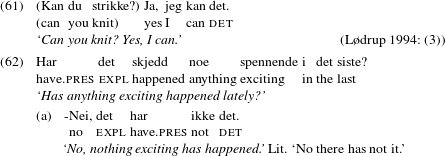
The conclusion that emerges is this: none of the known arguments against the asymmetric V2 analysis holds for Danish. This is interesting for at least two reasons. First, it means that there are no outstanding problems for the analysis of Danish V2 proposed here. Second, while positional restrictions on overt VP anaphors in other Germanic V2 languages have not been systematically examined, there is preliminary evidence that the VPA Fronting Generalization proposed here for Danish does not hold throughout Mainland Scandinavian. Helge Lødrup provides the Norwegian examples in (61) and (62). In (61), the VP anaphor det occurs in a matching answer to a polar question and yet the undistinguished subject takes the first position, leaving det in situ (answer words like ja (yes) and nei (no) do not count for V2). In (62), the VP anaphor is in an expletive clause (62a) and, contrary to the Danish pattern, the VP anaphor may surface in situ (after the negation ikke) with an initial expletive subject.Footnote [35]
This suggests that the exact information-structural restrictions on V2 structure detailed above might be particular to Danish and not shared by all or even any of the other Germanic V2 languages. This might seem like an undesirable result, but it is hardly unique. Much of the research on Germanic V2 in recent years has pointed to the same general conclusion: V2 across the Germanic languages, and across dialects of individual languages, is not as unified a phenomenon as we first thought. There are differences in the distribution of V2 in embedded clauses (Heycock Reference Heycock, Everaert and van Riemsdijk2005, Heycock et al. Reference Heycock, Sorace and Hansen2010), differences in the possibility of V3 in wh-questions (Westergaard & Vangsnes Reference Westergaard and Vangsnes2005, Westergaard Reference Westergaard2009), differences in the movability of complex verbs (Vikner Reference Vikner2005), etc. Moreover, we know from the work of Bohnacker and Rosén that the Germanic languages differ in how the initial position is filled in language use (Bohnacker & Rosén Reference Bohnacker and Rosén2008). The results of the present paper suggest that some of these usage and frequency differences might relate to structural and grammatical differences between the individual V2 languages.
From an analytical standpoint, one might object that the asymmetric V2 analysis splits V2 into two separate phenomena: a CP structure with the finite verb in C and a TP structure with the finite verb in T; this point is elaborated in Williams (Reference Williams1997: 267–268). Within a representational theory of syntax, like the Government and Binding Theory within which the original generative analysis of V2 was couched, that critique carries a certain heft. In a derivational theory like Minimalism, the issue presents itself somewhat differently, a point also made in Zwart (Reference Zwart1997: 254). In both V2 structures the finite verb is in the highest head position of the V2 clause, namely, C if the V2 clause is a CP and T if it is a TP. Once we allow V2 clauses to be either CPs or TPs, the different positions for the finite verb will follow. Simplifying somewhat, a V2 TP is generated when the numeration contains no C; a V2 CP when it contains a C. If it does contain a C, that C will attract the finite verb from T to C. If the numeration contains no C, there is nothing to move V beyond T and the finite verb will surface in T.Footnote [36]
6. Conclusion
I will summarize the paper by highlighting four conclusions. First, while the initial position in Danish V2 clauses is multifunctional, there are more syntactic restrictions on this position than previously acknowledged. In particular, we can add declarative VPA clauses to questions, imperatives, and antecedents of conditionals, as clause types where the choice of initial element is restricted. Second, the analysis proposed to account for restrictions on the initial position in expletive constructions extends straightforwardly to cases of context-governed restrictions on the initial position, found in answers to polar questions, generalizations, and repetitions. I take this to be a real strength of the analysis. Third, Danish subject-initial V2 clauses are not structurally uniform: information-structurally differentiated ones are CPs, undifferentiated ones are TPs. Since TP is necessarily subject-initial, this explains why the initial position ‘defaults to subject’, as noted in the descriptive literature (see references in the Introduction). Fourth, V2 involves a different relationship between information structure and syntax than systems in which there are dedicated positions for topic and/or focus, such as Hungarian (Kiss Reference Kiss1998), Italian (Rizzi Reference Rizzi and Haegeman1997), and Mayan (Aissen Reference Aissen1992). In Danish, Spec-CP must be occupied by an information-structurally distinguished element, but is not dedicated to a particular function.
There remain a number of open questions. Here I will focus on three that I find particularly important. The first question is whether the notion of an ‘undistinguished subject’ that is at the core of my proposal about Danish verb-second syntax has application outside of Danish. This is an especially pressing issue, since the two languages most closely related to Danish – Norwegian and Swedish – appear to differ from Danish with respect to information-structural conditions on the initial position in VPA clauses. As shown in examples (61) and (62) in Section 5, Norwegian allows initial undistinguished subjects in VPA clauses and the corresponding Swedish examples are also felicitous, provided that the auxiliary is stressed (Elisabet Engdahl, personal communication, March 7, 2013). These observations show that the syntax–information structure mapping proposed here for Danish does not hold, at least not in full detail, for Norwegian and Swedish. That of course does not entail that undistinguished subjects have no syntactic effects in Swedish and Norwegian, but I leave the investigation of such possible effects for future research.
Somewhat surprisingly, the most direct evidence for the syntactic relevance of undistinguished subjects in another Germanic language comes from English, which is Germanic, of course, but not V2. First, David Pesetsky points out the paradigm in (63)–(64), which shows an interaction between word order and distinguished (Mary) vs. undistinguished (he) subjects in clauses with the VP anaphor so (personal communication, September 16, 2011).
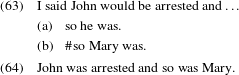
This paradigm cannot be explained in exactly the structural terms developed for Danish, since it does not revolve around undistinguished subjects in the initial position; the VP anaphor is initial in all three variations. Nonetheless, it does provide evidence that English syntax is sensitive to the notion of undistinguished subjects.
Intriguingly, there is evidence from language acquisition for a connection between undistinguished subjects and reduced clause structure in English. In recent work, Ken Wexler argues that the notion of undistinguished subjects developed in the present paper is relevant for understanding the omission of subjects in finite clauses in young children acquiring English (Wexler Reference Wexler, Becker, Grinstead and Rothman2013). Wexler’s argument starts from the observation that young children (up to six years of age) omit undistinguished subjects more frequently than they omit distinguished subjects. To account for this, he brings together the hypothesis developed in the present paper – that initial undistinguished subjects occur in structurally reduced clauses (namely, TPs) whereas initial distinguished subjects occur in CPs – with Rizzi’s (Reference Rizzi, Hoekstra and Schwartz1994) proposal that the root projection is special in child language in that it allows omission of material in its Specifier. Bringing these two ideas together, Wexler argues that children omit undistinguished subjects because subjects occur in the Specifier of TP and when the subject is undistinguished the clause is a TP and, as a root, the TP projection allows its Specifier to be dropped. Distinguished subjects also occur in Spec-TP but clauses with distinguished subjects project a CP above TP and thus the subject is not in the Specifier of the root and, by Rizzi (Reference Rizzi, Hoekstra and Schwartz1994), cannot be omitted. If this explanation is on the right track, Wexler’s observations provide striking confirmation of the syntactic relevance of the notion of information-structurally undistinguished subjects beyond the facts of Danish word order presented here.
Second, I have argued that discourse-oldness restricts the position of the VP anaphor, but I have said nothing about how discourse structure might affect the position of VP det, though I think there are good reasons to suspect that it does play a role. For instance, López (Reference López2009) argues that left dislocation of anaphors in Romance is sensitive to discourse structure in that the clause containing the antecedent must be in a subordinated discourse relation to the clause containing the left-dislocated element (Asher & Vieu Reference Asher and Vieu2005). And Kehler (Reference Kehler2000, Reference Kehler2002) shows that the derivation and interpretation of English VP ellipsis is sensitive to discourse structure, in particular Cause–Effect relations vs. Resemblance relations. Both are obvious directions for future research on Danish VP-anaphoric det.
A final open question is why VP-anaphoric det should require licensing by C.Footnote [37] Danish nominal anaphors do not require such licensing; they can occur in situ with undistinguished subjects. One could hypothesize that VP anaphora affects discourse – and ultimately syntax – differently because event tracking is different from tracking of individuals. However, Danish VP ellipsis also does not require licensing by C – VP ellipsis is possible with expletive clauses with an initial expletive – so it cannot simply be a matter of nominal vs. verbal. The possibility of VP ellipsis in the very environments where the VPA Fronting Generalization prohibits overt VP anaphora further suggests that overtness matters for V2 syntax in a fundamental way.
APPENDIX
The proportions of initial elements reported in Tables 1 and 2 were obtained in the following way.
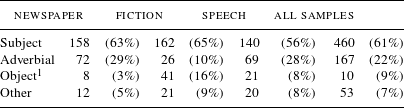
V2 clauses in general. Surprisingly, there appears to be no comprehensive quantitative study of initial position in Danish V2 clauses. I therefore conducted a small pilot study and compared the results to existing comprehensive studies of Swedish and Norwegian, as well as to an existing pilot study of spoken Danish. I extracted samples from Danish newspapers, fiction, and spoken language. Each sample contained 250 V2 clauses. The newspaper sample was drawn from three articles in Weekendavisen (May 24–June 1, 2006), the fiction from Jakob Ejersbo’s novel Nordkraft (published in 2002 by Gyldendal), and the spoken sample from the BySoc corpus, which contains transcriptions of sociolinguistic interviews. Counts of initial elements in those three samples are given in Table 3.Footnote [38]
Distribution of initial elements in Danish V2 clauses by genre.
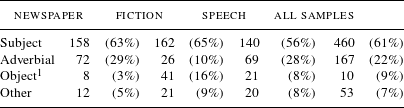
Thomsen (Reference Thomsen1996) reports 57.5% subject-initial V2 clauses for spoken Danish in a corpus of 9002 words, which concurs with 56% initial subjects in my BySoc sample. He does not provide ratios for objects or adverbials. In general, the proportions are comparable to those reported for Swedish and Norwegian based on comprehensive corpus studies: subject (64%–73%, depending on genre), adverbials (23%–30%), and objects (2%–14%) (Bohnacker & Rosén Reference Bohnacker and Rosén2008 and Ute Bohnacker, personal communication, March 30, 2009). These studies only considered declarative V2 clauses.
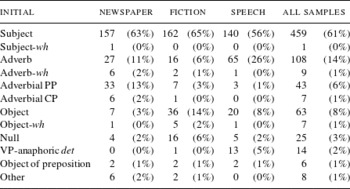
Table 4 represents the same samples, but differentiates the categories further. The category ‘Null’ includes polar questions, imperatives, and verb-initial antecedents of conditionals. In all of these, there is no element in the initial position or, under certain analyses, there is an element, but that element is a null operator.
Distribution of initial elements in Danish V2 clauses by genre.

VPA clauses. The proportions of initial elements reported for VPA clauses represent a database of 414 instances of VP-anaphoric det gathered from corpora, newspapers, magazines, fiction, radio, and conversation. Seven of these were not contained in a V2 clause, but instead occurred in a fragment of some kind. These are not included in the counts below. The 407 tabulated examples include cases where det occurs as the predicate of the V2 clause itself, as well as cases where it is the predicate of a non-V2 clause embedded in a V2 clause. In cases where det occurs as the predicate of a V2 clause embedded in another V2 clause, the constituent in the initial position of the (most deeply) embedded V2 clause is counted. Table 5 shows the counts for the initial position, using just four broad categories.
Distribution of initial elements in Danish V2 clauses with VP anaphora.
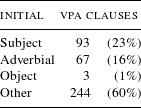
Table 6 gives counts for initial position differentiating the categories further.
Distribution of initial elements in Danish V2 clauses with VP anaphora.

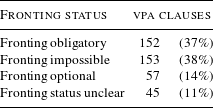
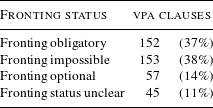
All VPA examples were further annotated as to whether fronting was obligatory, impossible, or optional, based on judgments from native speakers. If speakers disagreed or reported uncertainty, the example was annotated as ‘fronting status unclear’. The result of this annotation is given in Table 7.
Speaker judgments on fronting of VP-anaphoric det in Danish V2 clauses.