Introduction
Research has repeatedly shown that surrogate decision-makers of critically ill patients receiving intensive care are at heightened risk of significant psychological distress, including posttraumatic stress disorder (PTSD) and prolonged grief disorder (PGD) (Anderson et al., Reference Anderson, Arnold and Angus2008; Siegel et al., Reference Siegel, Hayes and Vanderwerker2008; Wright et al., Reference Wright, Keating and Balboni2010; Rodriguez Villar et al., Reference Rodriguez Villar, Sanchez Casado and Prigerson2012; Kentish-Barnes et al., Reference Kentish-Barnes, Chaize and Seegers2015; Lovell et al., Reference Lovell, Smith and Kannis-Dymand2015; Derry et al., Reference Derry, Lief and Schenck2020; Greenberg et al., Reference Greenberg, Basapur and Quinn2021). Involvement in making end-of-life decisions appears to be a particularly significant source of stress (Azoulay et al., Reference Azoulay, Pochard and Kentish-Barnes2005). This is largely due to the intense emotional conflict surrogates frequently experience, as their wish to make decisions that are in accordance with the patient's values may be at odds with their fear of feeling responsible for the patient's well-being and death, their desire to preserve the patient's life, and the need to protect the welfare of their family (Schenker et al., Reference Schenker, Crowley-Matoka and Dohan2012). Often, intensive care unit (ICU) clinical staff approach surrogates to make life-and-death decisions, such as consenting to Do Not Resuscitate (DNR) orders, on short notice and with little mental preparation, exacerbating this internal conflict. Surrogates may be in a state of shock about patients’ deteriorating health, grief-stricken over the prospect of their loved ones’ impending deaths, and coping with trauma-provoking patient suffering and medical realities in the ICU. Being in such a distressed psychological state understandably can have an impact on a surrogate's decision-making capacity. Thus, guilt, regret, and protracted grief following the patient's death are common (Hickman et al., Reference Hickman, Daly and Lee2012; Lovell et al., Reference Lovell, Smith and Kannis-Dymand2015).
There have been several efforts to address the mental health needs of surrogates. However, prior intervention trials have produced mixed results (Lautrette et al., Reference Lautrette, Darmon and Megarbane2007; White et al., Reference White, Cua and Walk2012, Reference White, Angus and Shields2018; Curtis et al., Reference Curtis, Back and Ford2013; Carson et al., Reference Carson, Cox and Wallenstein2016; Cox et al., Reference Cox, White and Hough2019; Dionne-Odom et al., Reference Dionne-Odom, Ejem and Wells2020). A primary limitation of these clinical trials is that they have targeted mental health outcomes without utilizing explicit mental health interventions. The current proof-of-concept study aims to address this limitation. We developed and pilot tested a brief mental health intervention called EMPOWER (Enhancing and Mobilizing the POtential for Wellness and Emotional Resilience), which uses ultra-brief (Sperry and Binensztok, Reference Sperry and Binensztok2019), evidence-based cognitive-behavioral, acceptance-based techniques to reduce experiential avoidance, grief, anxiety, and peritraumatic distress (Prigerson et al., Reference Prigerson, Viola and Brewin2019).
Our conceptual model posits that symptoms of grief, anxiety, traumatic stress, and related maladaptive coping reactions, such as dissociation and avoidance, interfere with engaging in value-concordant and empowered end-of-life decision-making (Glick et al., Reference Glick, Motta and Wiegand2018). We highlight the role in coping of experiential avoidance, which is the natural tendency to avoid unpleasant feelings and consideration of negative outcomes (Plumb et al., Reference Plumb, Orsillo and Luterek2004; Gamez et al., Reference Gamez, Chmielewski and Kotov2011, Reference Gamez, Chmielewski and Kotov2014) and which has been associated with PTSD and PGD (Marx and Sloan, Reference Marx and Sloan2005; Bishop et al., Reference Bishop, Ameral and Palm Reed2018; Williams et al., Reference Williams, Hardt and Henschel2019; Serrano-Ibanez et al., Reference Serrano-Ibanez, Ruiz-Parraga and Gomez-Perez2021). There are many subtle ways avoidance may manifest for surrogates. As the prospect of losing the patient weighs on them, they may push for more aggressive care, attempting to avoid their grief. Faced with the prospect of the patient suffering, they may seek reassurance from clinicians, attempting to avoid feelings of guilt. Fearful of making the “wrong” decision, they may avoid engaging in goals of care discussions and end-of-life decisions. This avoidance is likely to be detrimental, as advance care planning and goals of care discussions have been associated with higher quality, less aggressive, and more value-consistent end-of-life care, as well as better patient quality of life (Mack et al., Reference Mack, Weeks and Wright2010). Both of these predict better bereavement adjustment of the caregiver (Wright et al., Reference Wright, Zhang and Ray2008; Garrido and Prigerson, Reference Garrido and Prigerson2014).
The ability of surrogates to engage in end-of-life decision-making on the patient's behalf relies on them to be emotionally “present” and thinking clearly. EMPOWER aims to reduce surrogates’ experiential avoidance and to empower them in their decision-making role (Tunzi, Reference Tunzi2012), providing them with tools to cope with distress related to the patient's impending death as well as to adjust following the patient's ICU discharge or death.
Guided by the Stage Model of Behavioral Therapies (Rounsaville et al., Reference Rounsaville, Carroll and Onken2001), the present study focused on Stage IA (e.g., intervention development and refinement) and had two objectives: (1) to develop and refine EMPOWER using feedback from bereaved surrogates and from expert critical care and mental health clinicians and (2) to determine preliminary feasibility, acceptability, and effects of EMPOWER on surrogate mental health and patient outcomes.
Methods
Study design and procedures
This Institutional Review Board-approved study (Weill Cornell Medicine IRB #1610017622; Clinicaltrials.gov Registration # NCT03276550) involved refinement of the EMPOWER intervention manual (Part 1) followed by a single-arm pilot trial of EMPOWER (Part 2).
Part 1 used a modified Delphi approach that involved gathering opinions from experts, keeping feedback anonymous, identifying and summarizing feedback themes, and circulating modifications back to experts until consensus is reached (de Meyrick, Reference de Meyrick2003). Key informants were nominated by targeted sampling (de Meyrick, Reference de Meyrick2003) of ICU and mental health clinicians, ensuring representation from different training and specialties and bereaved surrogates of patients who had been admitted to the ICU. Consented surrogates and clinicians were provided with a copy of the EMPOWER intervention manual and a survey primarily conducted by interview, which included prompts to elicit structured feedback on its content, format, and language. Interviews were audio-recorded and transcribed using a professional service. Following analysis of round one feedback, key informants were provided with an updated manual to offer any additional feedback. Key informants received $50 for their participation.
Part 2 was an open trial of EMPOWER implemented in the ICU of an urban academic medical center. Individuals were eligible if they were the healthcare proxy or surrogate of a non-communicative, critically ill patient, as indicated in the patient's medical record or by the ICU medical team. Patients had to be at least age 21 or older, lack of decisional capacity (e.g., on ventilator, unconscious, or cognitively impaired rendering them unable to talk), admitted to an ICU or step-down unit during their current hospitalization, and considered by the ICU attending or fellow to be near the end of life (patients whose ICU physicians or fellows would not be surprised if they did not survive more than 3 months; Haydar et al., Reference Haydar, Strout and Bond2019). Surrogate decision-makers had to be English-speaking, report a very close attachment to the patient (a summed score of at least 8 on two items from the Partner Dependence Scale) (Johnson et al., Reference Johnson, Vanderwerker and Bornstein2006; Reference Johnson, Zhang and Greer2007), and be at least moderately anxious (greater than 5 on either anxiety item of the McGill Quality of Life Scale) (Cohen et al., Reference Cohen, Mount and Strobel1995).Footnote 1 Screening scores were selected based on pilot data, indicating that anxiety and attachment issues are key risks for poor coping among caregivers (Prigerson et al., Reference Prigerson, Horowitz and Jacobs2009; Wright et al., Reference Wright, Keating and Balboni2010; Garrido and Prigerson, Reference Garrido and Prigerson2014; Higgins et al., Reference Higgins, Garrido and Prigerson2015). Exclusion criteria included current suicidal ideation.
Surrogates were identified by reviewing the ICU census with the ICU clinical staff several times a week to identify patients lacking decisional capacity. After obtaining permission from attending physicians, research assistants approached the surrogate in the ICU. If the surrogate was interested and eligible, informed consent was obtained. Access to patients’ charts was permitted through a Health Insurance Portability and Accountability Act (HIPAA) waiver.
Surrogates were assessed with self-report measures pre-intervention/baseline (Time 1 [T1]), post-intervention (within a week of the surrogate's completion of the baseline assessment) (T2), 1-month post-baseline (T3), and 3-months post-baseline (T4). They were also invited to complete a qualitative exit interview to provide feedback on EMPOWER. Patient outcomes included and intensity of care. Participants received $25 per assessment completed for a maximum of $100. The EMPOWER intervention was delivered by the lead intervention developer, WGL, who is a licensed clinical psychologist, for the first four cases. In preparation for a subsequent feasibility pilot randomized controlled trial, additional interventionists were thoroughly trained through didactics and review of recordings of the initial cases. Interventionists included a Master's level advanced clinical psychology doctoral student, an experienced licensed social worker, and a more recently licensed social worker. All four interventionists had prior experience working with family caregivers and bereaved populations.
Intervention and conceptual model description
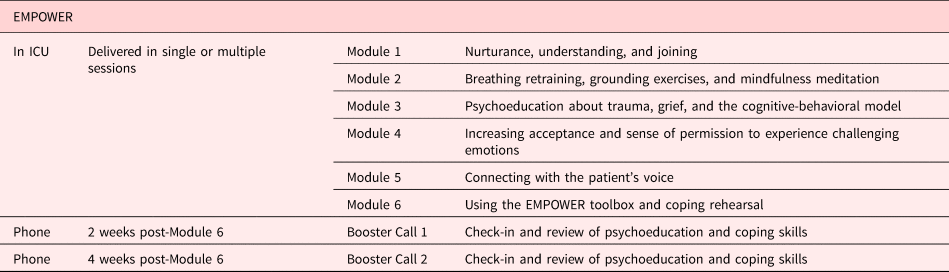
EMPOWER incorporates evidence-based cognitive-behavioral approaches (Bryant et al., Reference Bryant, Moulds and Nixon2003, Reference Bryant, Mastrodomenico and Felmingham2008, Reference Bryant, Kenny and Joscelyne2014; Boelen et al., Reference Boelen, de Keijser and van den Hout2007; Gartlehner et al., Reference Gartlehner, Forneris and Brownley2013; Litz et al., Reference Litz, Schorr and Delaney2014; Birur et al., Reference Birur, Moore and Davis2016), acceptance-based principles to build distress tolerance (Orsillo and Batten, Reference Orsillo and Batten2005; Walser and Westrup, Reference Walser and Westrup2007; Kelly et al., Reference Kelly, Sido and Forsyth2015; McLean and Follette, Reference McLean and Follette2016), and meaning-centered grief therapy techniques (Lichtenthal et al., Reference Lichtenthal, Catarozoli and Masterson2019; Neimeyer, Reference Neimeyer2012, Reference Neimeyer2016) to reduce experiential avoidance and symptoms of anxiety, grief, and traumatic stress. The program targets individuals reporting distress and at risk of poor outcomes in the longer term. It consists of six discrete ~15-min modules delivered flexibly in a setting that is frequently prone to multiple interruptions and crises such as the ICU. The six modules may be done in a single session or in parts over the course of 2–3 days, though this varies and may take longer, depending on the surrogate's preference and availability.
The intervention uses empathic support, psychoeducation, and experiential exercises, and is tailored to the most pressing and distressing challenges that the surrogate reports, be they fears of losing the patient, worries about decision-making, concerns about family, or a combination of stressors. Table 1 provides an overview of the intervention content and structure. EMPOWER begins in Module 1 with an assessment of the surrogate's most significant sources of distress and provision of empathic support. In Module 2, the surrogate engages in breathing retraining, grounding exercises, and mindfulness meditation to address acute emotional and physiological stress responses (e.g., symptoms of hyperarousal and/or dissociation) in order to facilitate processing of the subsequent psychoeducation. The surrogate is taught how to use these tools to manage symptoms and assist with processing information provided by the patient's medical team moving forward.
EMPOWER overview of modules

In Module 3, they are provided with psychoeducation about experiential avoidance and the cognitive-behavioral model to help facilitate emotional processing (Foa et al., Reference Foa, Hembree and Rothbaum2007). They are taught how experiential avoidance can manifest in many ways — through the pursuit of aggressive care of the patient, avoidance of making significant decisions, ruminative worry, and/or reassurance-seeking — and how such behaviors reflect the individual's efforts, whether conscious or not, to “get away”, or flee, from the difficult cognitions and emotions. Surrogates are taught about how such avoidance is negatively reinforcing — bringing short-term respite, but paradoxically maintaining their distress. In Module 4, acceptance-based principles and coping strategies are reviewed. The surrogate's ability to tolerate distress in real time and throughout the EMPOWER encounter are highlighted to help increase acceptance of these aversive states and foster self-compassion (Orsillo and Batten, Reference Orsillo and Batten2005; Walser and Westrup, Reference Walser and Westrup2007).
EMPOWER targets key attachment issues related to grief and any decision-making challenges in Module 5. This module also reviews psychoeducation and discusses strategies for preventing regrets. It invites an imaginal dialogue with the patient to garner the patient's support in the surrogate's struggle to consider the patient's wishes and values, and to facilitate quality decision-making and empowerment (Tunzi, Reference Tunzi2012; Cox et al., Reference Cox, Wysham and Walton2015). The intervention concludes in Module 6 with a review of the key EMPOWER principles and coping rehearsal for anticipated stressful situations. Two booster calls are conducted (two and four weeks later) to review the key principles of EMPOWER, to discuss successes and challenges applying the coping strategies in real-life scenarios, and to engage in coping rehearsal for anticipated stressful situations. Since, in many cases, the patient has died prior to one of the booster calls, this call often provides acute meaning-centered bereavement support and reviews how to apply the EMPOWER principles in coping with post-loss grief and bereavement.
EMPOWER focuses largely on exercises that involve carefully titrated exposure to distress during the intervention. Importantly, however, interventionists must be careful to work within the surrogate's “therapeutic window”; that is, to adequately activate the individual's emotions without exceeding their capacity to tolerate distress (Briere and Lanktree, Reference Briere and Lanktree2013). The interventionist pays careful attention to the surrogate's ability to regulate affect so as to avoid re-traumatizing them. The focus on providing individually tailored tools for higher-risk individuals distinguishes EMPOWER from interventions like critical incident stress debriefing (Mitchell and Everly, Reference Mitchell, Everly, Everly and Lating1995; Gartlehner et al., Reference Gartlehner, Forneris and Brownley2013). Ultimately, EMPOWER aims to help surrogates make difficult decisions by building tolerance for painful feelings and negative intrusive thoughts, and by minimizing future chronic avoidance (e.g., of emotional triggers), so that normative acute stress and grief responses do not escalate into pathological reactions like PTSD and PGD (Marx and Sloan, Reference Marx and Sloan2005; Bishop et al., Reference Bishop, Ameral and Palm Reed2018; Williams et al., Reference Williams, Hardt and Henschel2019; Serrano-Ibanez et al., Reference Serrano-Ibanez, Ruiz-Parraga and Gomez-Perez2021). The intervention manual also notes adaptations for various cultural and ethnic populations and the importance of cultural competence in delivering EMPOWER to diverse surrogate groups.
Assessment of feasibility and acceptability
We assessed the proportion of surrogates approached for the open trial who (a) consented, (b) declined participation, and (c) were ineligible. We also assessed delivery of EMPOWER by recording the number of modules completed and reasons not completed. Feasibility of (a) recruitment, (b) implementation, (c) measurement, and (d) retention were examined. Surrogate satisfaction at T2 and attrition at T4 were used to evaluate acceptability. Part 2 participants were also invited to complete a qualitative exit interview about their experience with EMPOWER and to provide any additional feedback about acceptability and to further refine the intervention.
Self-report measures
Demographic and background information
Surrogates self-reported demographic information during the baseline interview. Demographic information for patients, as well as medical information including DNR order completion, intubation, extubation, and withdrawal of life-sustaining care, were obtained through medical chart abstraction.
Psychological outcomes
Peritraumatic distress, the primary outcome, was measured at T1 and T2 by the Peritraumatic Distress Inventory (PDI), a reliable (α = 0.76) and valid 13-item test that measures the extent to which an individual experienced distress at the time of a critical incident event and in the subsequent minutes or hours (Brunet et al., Reference Brunet, Weiss and Metzler2001; Bunnell et al., Reference Bunnell, Davidson and Ruggiero2018). By inference, the event corresponded to the ICU stay of the patient, and to remove any ambiguity, this was made explicit for the final participant. Due to their lack of relevance in the ICU setting, items 4 and 7 of the PDI were not administered to participants, yielding a modified 11-item version, with scores ranging from 0 to 44, with higher scores representing greater peritraumatic distress. Symptoms of intrusion and avoidance, often used as an indicator of PTSD, were measured at T2, T3, and T4 using the reliable (α = 0.79–0.94) Impact of Event Scale-Revised (Weiss and Marmar, Reference Weiss, Marmar, Wilson and Keane1996). The first item of this measure was not administered to participants, leaving a total of 21 items, with scores ranging from 0 to 88, and higher scores representing greater PTSD symptomology. Instructions were modified to specify that participants were to respond to the items regarding “stressful events in the ICU” rather than “stressful life events” as is detailed in the original instructions (Weiss and Marmar, Reference Weiss, Marmar, Wilson and Keane1996). The first nine participants were asked to specify an index event in the ICU, whereas the final participant was asked to respond based on the ICU stay in general.
Experiential avoidance was measured by the Brief Experiential Avoidance Questionnaire (BEAQ) (Gamez et al., Reference Gamez, Chmielewski and Kotov2014), a 15-item measure assessing six dimensions of experiential avoidance that has demonstrated good internal consistency. Scores range from 15 to 90, with higher scores representing greater experiential avoidance. Anticipatory grief was measured by the 12-item PG-12 (Zhang et al., Reference Zhang, El-Jawahri and Prigerson2006; Prigerson et al., Reference Prigerson, Vanderwerker and Maciejewski2008. Reference Prigerson, Horowitz and Jacobs2009), and post-loss PGD symptom severity was assessed by the widely used, valid, 13-item PG-13 (Zhang et al., Reference Zhang, El-Jawahri and Prigerson2006; Prigerson et al., Reference Prigerson, Vanderwerker and Maciejewski2008, Reference Prigerson, Horowitz and Jacobs2009). Combined scores on these measures were used to index pre- or post-loss grief intensity, with scores ranging from 11 to 55, and higher scores representing greater grief intensity.
For the first three participants enrolled, anxiety and depression were measured by the Hospital Anxiety and Depression Scale (HADS), a valid and reliable 14-item measure of anxiety and depression used in both hospital and community settings (Zigmond and Snaith, Reference Zigmond and Snaith1983). The measure has demonstrated reliability in caregivers (α = 0.85 for anxiety; α = 0.84 for depression) (Gough and Hudson, Reference Gough and Hudson2009). Scores for both anxiety and depression subscales range from 0 to 21, with greater scores representing greater symptoms. For the remaining seven participants, anxiety was measured using the Generalized Anxiety Disorder-7 (GAD-7), a valid and reliable 7-item measure of generalized anxiety symptoms (scores ranging from 0 to 21) (Spitzer et al., Reference Spitzer, Kroenke and Williams2006), and depression was measured with the widely used 9-item Patient Health Questionnaire-9 (PHQ-9), with scores ranging from 0 to 27 (Kroenke et al., Reference Kroenke, Spitzer and Williams2001).
Distress tolerance was indexed by the summed score of items 1, 2, 8, and 9 of the 14-item Distress Tolerance Scale (DTS), which assesses an individual's ability to endure negative emotional states (Simons and Gaher, Reference Simons and Gaher2005). The summed score of these items can range from 0 to 20, with greater scores representing greater ability to tolerate distress. Decision-making self-efficacy was measured by the Family Decision-Making Self-efficacy Scale: Unconscious Patient Scenario (FDMSS), a 13-item valid and reliable assessment of confidence of family members in their ability to make decisions with or for a terminally ill loved one (Nolan et al., Reference Nolan, Hughes and Kub2009). Using a modified response scale of 1–6, scores ranged from 13 to 78, with higher scores representing greater self-efficacy. Satisfaction with and helpfulness of the EMPOWER components was measured by a Post-Intervention Satisfaction Questionnaire (PISQ), an assessment of helpful treatment components and satisfaction with the intervention. All participants received a single categorical item inquiring about treatment length. The final seven participants were asked to rate the helpfulness and effectiveness of the EMPOWER intervention on a Likert-style scale where 0 represented “not at all” and 10 represented “extremely”. These participants also rated how helpful EMPOWER was on four ICU-related domains (i.e., “It helped me to think through what the patient wanted,” “It helped make me less stressed”) on a similar Likert-style 0 to 10 scale, where 0 represented “not at all helpful” and 10 represented “extremely helpful”.
Data analysis
Part 1 key informant interviews were transcribed and content analyzed, a well-established, systematic qualitative analysis approach in health research (Morse, Reference Morse, Denzin and Lincoln1994), to identify themes from participants’ narratives. We followed Morse's (Reference Morse, Denzin and Lincoln1994) guidelines for conducting rigorous qualitative research (e.g., consensus coding and thematic saturation) using Atlas.ti software. Coding of feedback was overseen by KER and WGL, who have extensive experience in qualitative methods for intervention development. A preliminary codebook was developed a priori by KER and WGL that included general feedback categories (e.g., feedback on intervention format, intervention materials, module content, and satisfaction with intervention). Interviews were independently coded by at least two team members using this codebook. Consensus meetings were led by KER, and the codebook was iteratively modified as new themes were identified (Charmaz, Reference Charmaz2004; Hill et al., Reference Hill, Knox and Thompson2005). Themes around feedback and suggested changes to EMPOWER were summarized, and manual modifications were made incorporating feedback. Additional feedback from key informants on the modifications and revised manual, as well as feedback provided in the exit interviews with open trial participants, followed the same procedures used in the first round. Minor modifications were made, resulting in a finalized EMPOWER intervention manual.
For Part 2, we computed descriptive statistics to characterize the feasibility and acceptability of EMPOWER by examining helpfulness/satisfaction ratings, rates of recruitment, attrition, and number of modules and booster calls completed. Targets were completion of 4–6 modules for feasibility and almost all positive feedback for acceptability. To evaluate the preliminary effects of EMPOWER, we used descriptive statistics and Dunlap's d within-subjects effect-size estimates (Dunlap et al., Reference Dunlap, Cortina and Vaslow1996) at each longitudinal timepoint relative to baseline.
Results
Part 1
We enrolled five bereaved surrogates of patients who were uncommunicative and died in the ICU and 10 ICU (n = 7) and mental health (n = 3) clinicians, including nurses, social workers, psychologists, and a critical care physician, to obtain their feedback on EMPOWER. This number of key informants was selected to ensure sufficiently comprehensive feedback about the manual from multiple perspectives (Morse, Reference Morse, Denzin and Lincoln1994). Themes of stakeholder feedback consisted of general feedback on the intervention approach, format and materials, reasons EMPOWER may be helpful to surrogates, elements of each module and booster session that should remain or be modified, and suggested additions to the intervention. Overall, both provider and surrogate stakeholders viewed EMPOWER as having the potential to benefit surrogates, with only one surrogate stakeholder out of five noting a preference for standard psychotherapy. Participants also provided feedback more broadly on important considerations for interventionists delivering EMPOWER, given the unique needs of surrogates and the ICU setting. Stakeholders described the importance of providing surrogates with psychoeducation about the purpose of EMPOWER and intervention techniques used in the modules. Feedback suggested that interventionists delivering EMPOWER should also be familiar with the myriad challenges of the ICU setting and that it would be important for them to be attentive to the patient's case in order to best partner with the surrogate. They noted the critical need for interventionists to be mindful of the surrogate's receptivity and shifting needs due to the ever-changing nature of the ICU setting. To that end, stakeholders shared either observed or personal experiences of surrogates in the ICU, of which interventionists should be aware. Elements of these experiences were woven in throughout the manual to further tailor it to this unique population. Despite stakeholders noting some potential challenges of providing an intervention in the ICU, they emphasized the need for such an intervention and the utility of EMPOWER's flexible, modular nature.
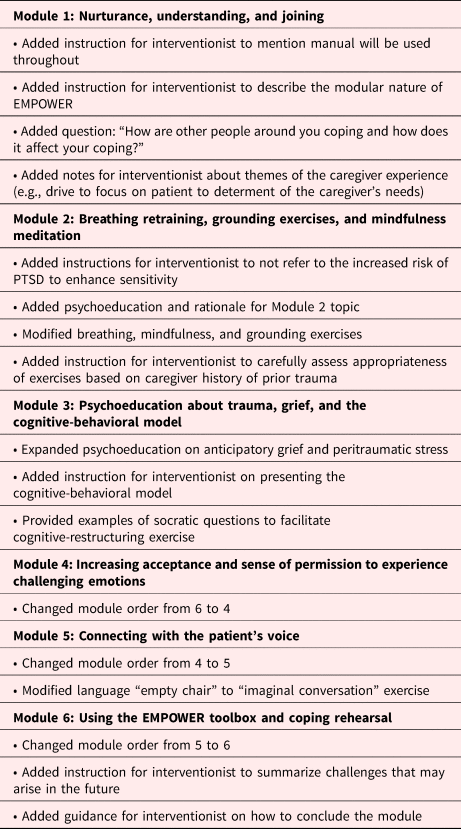
Feedback on the EMPOWER format resulted in several changes, including reducing or further defining clinical jargon (e.g., mindfulness and trauma), improving navigability (e.g., table of contents), changing the use of binary gender terms to non-binary (e.g., they/them/their), making EMPOWER applicable for a broad range of illness scenarios, and changing the order of several modules. Stakeholders provided suggestions for changes to module format and content, with most feedback centering on the provision of more instructions for interventionists and, similarly, more psychoeducation on intervention techniques for surrogates. Detailed content and formatting changes made in each of the six modules are summarized in Table 2. Finally, participants suggested minor modifications to the handouts included in the EMPOWER manual to clarify exercise instructions and increase their relevance.
Module content and format modifications

Round 2 feedback and exit interviews included positive feedback on the manual, with only minor additional changes suggested. These included slight changes to handout language for clarity and several recommendations for interventionists similar to those provided in the first round (e.g., interventionists should be attentive to medical circumstances of the patient and shifting surrogate needs and emotions).
Part 2
Participant characteristics
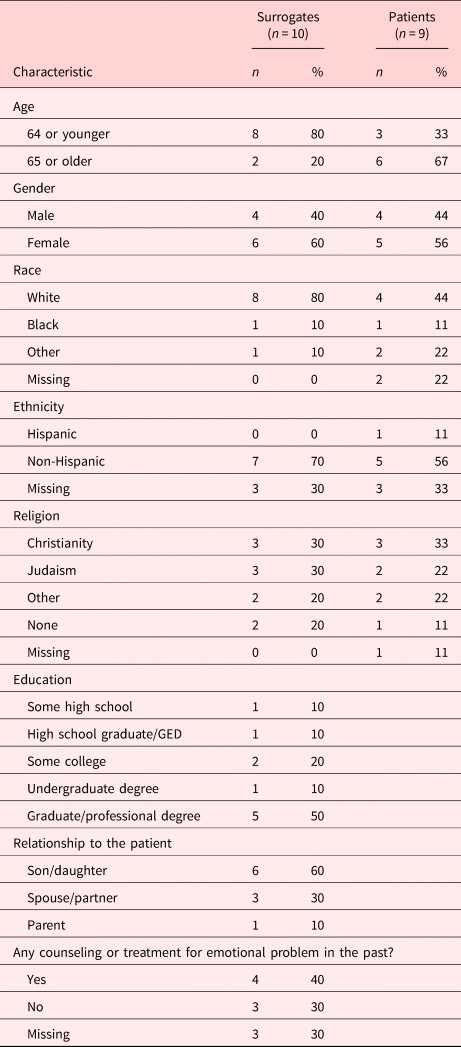
Details about the 10 surrogates who participated in the open trial are presented in Table 3. The majority of participants were under age 65, White, non-Hispanic, high school graduates, and adult children of the patients. Data for nine of the patients whom the surrogates were caring for were available. Four of the nine had active cancer (split evenly between liquid and solid tumor cancers). Two patients died between the T1 and T2 assessments. Three patients died between the T2 assessment and the T3 assessment 1-month post-baseline. One patient died between the T3 assessment and the T4 assessment 3-months post-baseline, leaving four patients who survived the study period.
Part 2 surrogate decision-maker and patient characteristics (N = 10)

Feasibility and acceptability
Recruitment was challenging, as expected with this population. We received consent to approach 87 patient-surrogate dyads. For 23 of these dyads (26%), the patient died, was discharged, or regained decision-making capacity before the surrogate could be approached. Of the 64 surrogates who were approached, 49 (77%) declined participation. Reasons for refusal included reporting a sufficient level of support, feeling too busy to participate and concerns about the time commitment involved in participating, and not wanting to leave the patient's bedside. Fifteen participants (23%) completed the screening process. Of these, one participant did not meet eligibility criteria, and four dropped out before receiving the intervention due to scheduling challenges and/or declining patient status. This yielded a total of 10 participants who completed the baseline assessment and received the EMPOWER intervention. Two surrogate decision-makers withdrew from the study. One surrogate withdrew while completing the T2 assessment, as the indexed patient had died a week prior and they no longer wished to participate. Thus, post-intervention, follow-up, and patient data are missing for this participant. The other was an international participant who was lost to follow-up when they returned to their home country during the study period. In all, six participants completed the T3 assessment, and eight completed the T4 assessment. Surrogates were enrolled a median 22 days after the patient's ICU admission (minimum 3 days, maximum 38 days).
Overall, EMPOWER appeared feasible, with 100% of participants who began the intervention completing all six modules. Completion of the booster calls was less consistent. Of the nine participants eligible for a booster call (excluding the participant who dropped during administration of T2), five completed both booster calls. The remaining four participants did not complete any booster calls.
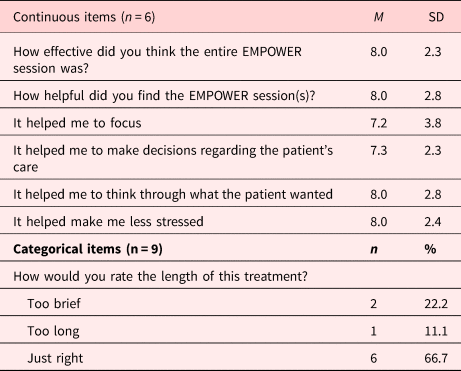
Acceptability of the EMPOWER intervention appeared strong, with post-intervention ratings of effectiveness and helpfulness both averaging an 8 out of 10 (see Table 4 for additional post-intervention ratings from the PISQ). Exit interviews provided more evidence of acceptability. In responding to a question about whether EMPOWER was helpful, a 31-year-old surrogate caring for her mother with metastatic non-small-cell lung cancer stated, “And, you know, when everything was said and done — because my mother did pass the day after — I think it was a huge, huge help.” Another, a 51-year-old surrogate caring for her husband with acute myeloid leukemia commented about the intervention, “I thought it was fabulous.” When asked whether what was discussed in EMPOWER was actually applicable to what was going on in the ICU setting, she responded, “Yeah, because I think I used that⋯ used that and it opened my eyes. Yeah, I definitely do.” In response to a question about whether the intervention was helpful, a 67-year-old caring for her husband with myelodysplastic syndrome replied, “Well I think that it's very helpful. I think it should continue.” When a separate surrogate was asked what helped most, the 57-year-old caring for her mother with chronic obstructive pulmonary disease expressed, “And actually was a professional who I felt safe – I felt like, you know, not only did somebody have my back, there's a lot of people who give you advice and support but this is someone that knew what she was talking about.”
Part 2 PISQ survey responses

Exploration of preliminary efficacy
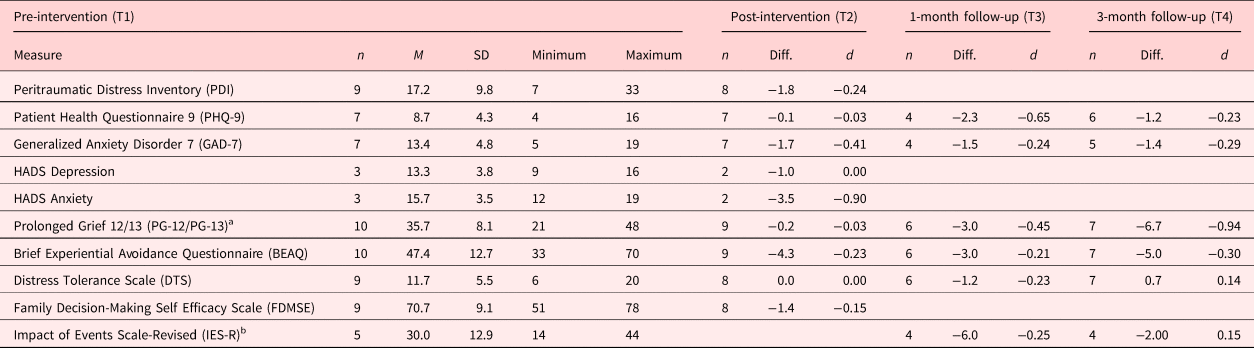
Table 5 shows pooled descriptive statistics and effect-size estimates for outcomes of interest. Examining acute effects immediately after the 6-module, 1.5- to 2-h intervention, a small within-subjects effect at T2 was observed for the primary outcome, peritraumatic distress (Dunlap's d ≥ 0.2). A large within-subjects effect at T2 was observed for anxiety as measured by the HADS Anxiety Subscale among the two participants who received it (Dunlap's d ≥ 0.8), and a small-to-moderate effect was observed for anxiety as measured by the GAD-7 (Dunlap's 0.2 >d < 0.5). There was also a small effect at T2 on experiential avoidance (Dunlap's d ≥ 0.2).
Changes in mental health symptoms over time

a All participants were administered PG-12 at baseline and were administered PG-12 or PG-13 based on patient vital status at following timepoints.
b First administered post-intervention (T2).
At 1-month post-baseline (T3), a moderate within-subjects effect was observed for depression (Dunlap's 0.5 ≤ d < 0.8); a small-to-moderate effect was observed for prolonged grief symptoms (Dunlap's 0.2 ≤ d < 0.5); and small effects were observed for anxiety, experiential avoidance, and posttraumatic stress symptoms (Dunlap's d ≥ 0.2). At 3-months post-baseline (T4), we found a large effect on prolonged grief symptoms (Dunlap's d > 0.8) and small intervention effects for depression, anxiety, and experiential avoidance (Dunlap's d ≥ 0.2).
Patient outcomes were also examined. We found that DNR orders were placed for four out of the nine patients with available data during their indexed ICU stay. For two of these patients, these orders were placed before study enrollment. For the other two patients, these orders were placed 25 and 27 days, respectively, after receiving the EMPOWER intervention. All nine patients were receiving mechanical ventilation. Extubation occurred in four patients. Withdrawal of life-sustaining care did not occur in any of the patients.
Discussion
The overall goal of this study was to develop, refine, and pilot test of a brief manualized psychological intervention, EMPOWER, to determine its preliminary feasibility, acceptability, and promise in improving surrogates’ mental health symptoms and patient outcomes. EMPOWER was designed to be adaptable to the fast-paced, often chaotic, ICU milieu, using ultra-brief, evidence-based interventions (Sperry and Binensztok, Reference Sperry and Binensztok2019) to reduce peritraumatic stress, grief, anxiety, and experiential avoidance. EMPOWER targets surrogates who are anxious and/or closely attached to the patient because these individuals are at greatest risk for developing poor outcomes, such as PTSD and PGD, following the patient's death or discharge from the ICU (Bryant et al., Reference Bryant, Mastrodomenico and Felmingham2008; Andrews et al., Reference Andrews, Brewin and Stewart2009; Prigerson et al., Reference Prigerson, Horowitz and Jacobs2009; Gartlehner et al., Reference Gartlehner, Forneris and Brownley2013). Importantly, unlike many interventions developed for grief and trauma, EMPOWER was developed by incorporating both provider and surrogate feedback, improving its acceptability and utility for the uniquely challenging circumstances of the ICU. In Part 1 of the study, we used participant feedback to improve the comprehensibility of EMPOWER's psychoeducation and exercises by minimizing the use of jargon and reorganizing the order of the content so that it would be more digestible.
We found that recruitment for the Part 2 open trial of EMPOWER was feasible, although there were challenges to enrolling surrogates, with only 23% of those approached consenting. This is understandable given that EMPOWER approaches family surrogates in, perhaps, one of the most stressful times of their lives. We observed that some surrogates expressed interest in the EMPOWER intervention but did not want to complete the assessments and therefore did not consent to the study. Completion of the intervention itself appeared to be highly feasible, with 100% of participants completing all six of the brief modules, exceeding our target. However, only five of the nine participants still participating after T2 completed booster calls. There are many explanations for this, including caregiving demands, patients’ health fluctuations, and coping with acute grief when the patient had died. Completion of the second booster call among all those who were able to complete the first suggests participants may have found the calls helpful. The intervention itself appeared highly acceptable, with surrogates providing high ratings of effectiveness and helpfulness as well as generally positive feedback in the exit interviews.
On average, reductions in psychological symptoms were observed among our small sample of surrogates. Surrogates are often weighed down by anxiety and anticipatory grief over the impending death of the patient while faced with making life-and-death decisions on the patient's behalf in the potentially traumatic conditions of the ICU. The fact that after just 1.5–2 h of intervention over approximately 1 week, participants reported decreases in acute symptoms, including peritraumatic stress, anxiety, and experiential avoidance, has important implications. Such symptom improvements may not only translate into reducing suffering for surrogates themselves, but they may also help surrogates better engage in and process critical communication with the patient's ICU care team.
Over time, the impact of applying the coping tools taught through EMPOWER appeared to have been beneficial, as we observed reductions in symptoms of experiential avoidance, prolonged grief, depression, anxiety, and posttraumatic stress symptoms 1-month after the intervention. At 3-months post-baseline, the effect on prolonged grief symptoms increased and gains appeared maintained for depression, anxiety, and experiential avoidance. For the most part, observed effects were small to moderate. However, given the limited amount of time EMPOWER takes to administer and the fact that 60% of participants also became bereaved during the study time period, these preliminary findings are encouraging.
While the small sample size in the present study precluded mediation analyses, our findings that experiential avoidance decreased in parallel with reductions in other psychological outcomes suggest that it may serve as a mechanism of change. By reducing experiential avoidance, surrogates’ ability to tolerate distress and be emotionally activated (Fernandez-Rodriguez et al., Reference Fernandez-Rodriguez, Paz-Caballero and Gonzalez-Fernandez2018) during the ICU stay may increase. This, in turn, may help them to digest medical information they are given, make decisions that are aligned with their and the patient's values, and allow them to be more present with and emotionally available for the patient, whose time may be limited. Thus, reducing experiential avoidance may assist with improving end-of-life decision-making on behalf of the patient and minimize regrets (Hickman et al., Reference Hickman, Daly and Lee2012). Furthermore, given that experiential avoidance is an important predictor of psychiatric disorders, including depression, anxiety, prolonged grief, and PTSD (Marx and Sloan, Reference Marx and Sloan2005; Spinhoven et al., Reference Spinhoven, Drost and de Rooij2016, Reference Spinhoven, van Hemert and Penninx2017; Williams et al., Reference Williams, Hardt and Henschel2019; Serrano-Ibanez et al., Reference Serrano-Ibanez, Ruiz-Parraga and Gomez-Perez2021), reducing such avoidance may have longer-term psychological benefits.
It should be noted that the goal of EMPOWER is not to eliminate grief, anxiety, and traumatic stress reactions, but rather to help surrogates to respond to these reactions adaptively (e.g., minimizing experiential avoidance) and compassionately, helping to reduce numbing by titrating exposure to difficult feelings whenever possible. It additionally provides a space to do their “due diligence” in reflecting on their and the patient's values and circumstances, so that they may feel empowered in the decision-making process (Tunzi, Reference Tunzi2012).
Study limitations and future directions
This proof-of-concept evaluation has several limitations, including the small sample size, homogeneity with respect to race and ethnicity, and the use of a within-subjects design. The absence of a comparison group, though typical of early pilot work, limits conclusions that can be drawn about observed improvements of symptoms, which may have decreased naturally over time. Further complicating our ability to draw conclusions is the fact that several participants became bereaved, and at varying time points, during the study period; this is a challenge inherent to this type of research but is an important consideration in interpreting the findings. Another weakness of the study was the use of self-report assessments, which can be influenced by differing interpretations of questions and response scales. As we received feedback from participants about unclear assessment items, we removed items and/or selected new measures in preparation for a pilot randomized controlled trial. We thus have partial data in several instances, and our findings should be considered with this limitation in mind.
The next step in developing EMPOWER is conducting a Stage IB feasibility randomized controlled trial to prepare for a larger-scale efficacy trial (Rounsaville et al., Reference Rounsaville, Carroll and Onken2001). We will focus on strengthening recruitment strategies and supporting completion of booster calls, or eliminating them if we find that they are not wanted or impactful. We also plan on exploring the mediating role of experiential avoidance, including any distinctions between the effects of global vs. momentary experiential avoidance (Levin et al., Reference Levin, Krafft and Pierce2018), in future trials. Although we did not find evidence of EMPOWER impacting patient outcomes, including consenting to DNR orders or withdrawal of life support, in the present trial, given our single-arm design, small sample size, and the diversity of patient circumstances we observed, we will continue to investigate whether the intervention impacts patient care. The identification of facilitators and barriers to future dissemination and implementation of EMPOWER should also be a focus, including how the intervention may integrate into bereavement services (McAdam and Erikson, Reference McAdam and Erikson2016). Although obstacles to the delivery of an effective mental health intervention in the ICU loom large, the need for such an intervention could not be greater. Our observation of its preliminary feasibility, acceptability, and promise in reducing a range of psychological symptoms suggests that further evaluation is warranted.
Funding
This research was supported by National Cancer Institute (NCI) grant R21CA218313 (Prigerson/Lichtenthal) and American Cancer Society grant 130534-PEP-17-053-01-PCSM. Research efforts were additionally supported by NCI grants R35CA197730 (Prigerson), K07CA172216 (Lichtenthal), P30CA008748 (Thompson), and T32CA009461 (Ostroff).
Conflict of interest
None declared.