Introduction
During the last decade, lambing percentages in New Zealand have increased from 100% to 129% (Meat and Wool New Zealand Economic Service, 2006) with an increase in twin and triplet litters (Amer et al., Reference Amer, McEwan, Dodds and Davis1999). During mid and late pregnancy, ewes bearing twin or triplet foetuses require more energy to support foetal growth than ewes bearing a single foetus (Nicol and Brookes, Reference Nicol and Brookes2007). In a pastoral-based production system, as is common in New Zealand, pasture growth rates in winter may be insufficient to allow for the provision of high pasture masses for twin- and triplet-bearing ewes in mid and late pregnancy. Knowledge of the impact of different feeding regimes in either mid or late pregnancy on post-partum behaviour is important for lamb survival, as abnormal ewe or lamb behaviour can result in compromised survival (Nowak, Reference Nowak1996).
Morris and Kenyon (Reference Morris and Kenyon2004) recommended that twin- and triplet-bearing ewes should be offered pastures with a minimum sward height of 4 cm during both mid and late pregnancy. Corner et al. (Reference Corner, Kenyon, Stafford, West, Lopez-Villalobos, Morris and Oliver2008) found that offering ewes a 2 cm sward in mid and a 4 cm sward in late pregnancy resulted in heavier lambs at birth than offering ewes 4 cm in mid pregnancy and 2 cm in late pregnancy. This suggests that ewe nutrition in late pregnancy has a greater effect on lamb birth weight than in mid pregnancy. In addition, offering ewes a concentrate supplement in late pregnancy can result in an increase in the birth weight of twin lambs (Banchero et al., Reference Banchero, Quintas, Vasquez, Gigena, La Manna, Lindsay and Milton2007; Kerslake et al., Reference Kerslake, Kenyon, Morris, Stafford and Morel2008), further indicating the importance of late pregnancy nutrition from a birth weight perspective.
The survival rate of triplet lambs has been reported to be lower than both singleton and twin lambs (Scales et al., Reference Scales, Burton and Moss1986; Everett-Hincks and Dobbs, Reference Everett-Hincks and Dobbs2007). In addition, Scales et al. (Reference Scales, Burton and Moss1986) reported an average birth weight of triplet lambs of 3.3 kg compared to 5.2 kg for singleton lambs and 4.1 kg for twins. Triplet lamb birth weights have been reported as 19% to 24% lower than twin birth weights (Hinch et al., Reference Hinch, Crosbie, Kelly, Owens and David1985; Morris and Kenyon, Reference Morris and Kenyon2004; Everett-Hincks et al., Reference Everett-Hincks, Blair, Stafford, Lopez-Villalobos, Kenyon and Morris2005a) and 36% to 40% lower than singleton lambs (Scales et al., Reference Scales, Burton and Moss1986; Hinch et al., Reference Hinch, Lynch, Nolan, Leng, Bindon and Piper1996). Therefore, it might be expected that an increase in triplet lamb birth weight could result in greater survival.
The establishment of a ewe and lamb bond is essential for lamb(s)’ survival (Nowak, Reference Nowak1996), and ensures that a ewe will allow only her own lambs to suck (Poindron et al., Reference Poindron, Lévy and Keller2007). The incidence of separation of the ewe and lamb decreases as the time a ewe and her lambs remain at the birth site increases (Alexander et al., Reference Alexander, Stevens and Mottershead1983; Lindsay et al., Reference Lindsay, Nowak, Putu and McNeill1990). Undernutrition during pregnancy results in ewes exhibiting fewer appropriate maternal behaviours and poorer maternal care than well-fed ewes (Putu et al., Reference Putu, Poindron and Lindsay1988a; Nowak, Reference Nowak1996). The effects of nutrition on maternal behaviour score (MBS) varies between extensive and intensive production systems (Dwyer et al., Reference Dwyer, Lawrence, Bishop and Lewis2003; Everett-Hincks et al., Reference Everett-Hincks, Blair, Stafford, Lopez-Villalobos, Kenyon and Morris2005a). Housed ewes that were underfed were more likely to exhibit low MBSs than well-fed ewes (Dwyer et al., Reference Dwyer, Lawrence, Bishop and Lewis2003). Under pastoral conditions, MBSs were similar for ewes offered 2, 4, 6 and 8 cm swards in mid and late pregnancy (Everett-Hincks et al., Reference Everett-Hincks, Blair, Stafford, Lopez-Villalobos, Kenyon and Morris2005a). Nonetheless, inadequate ewe nutrition, particularly of ewes bearing triplet lambs, can result in impaired lamb udder-seeking behaviour (Everett-Hincks et al., Reference Everett-Hincks, Blair, Stafford, Lopez-Villalobos, Kenyon and Morris2005a).
In the present study, the effect of offering pasture at different sward heights, during mid to late pregnancy, on the behaviour of twin- and triplet-bearing ewes and their lambs 12 to 24 h after birth under pastoral conditions was examined.
Material and methods
Experimental design and animals
The design of the experiment and feeding levels are described in a previous paper (Corner et al., Reference Corner, Kenyon, Stafford, West, Lopez-Villalobos, Morris and Oliver2008). Briefly, mixed-age Romney ewes (80 bearing twin and 56 bearing triplet foetuses) that were bred during a 17-day period (14 April till 1 May 2004) were randomly allocated to one of two feeding levels in mid pregnancy. Ewes were offered pasture with a sward height of less than 2 cm (∼700 kg dry matter (DM)/ha) or greater than 4 cm (∼1300 kg DM/ha) after the midpoint of pregnancy from day P70 to day P107 (Corner et al., Reference Corner, Kenyon, Stafford, West, Lopez-Villalobos, Morris and Oliver2008). On P107, half of the ewes within each feeding treatment were then offered a maximum of 2 cm or a minimum of 4 cm for the remainder of pregnancy. This resulted in four feeding treatments: 2-2, 2-4, 4-2 and 4-4. Ewe feeding levels were balanced for ewe age, pregnancy rank and live weight. Two days after parturition, all ewes and their lambs were moved to paddocks with a sward height of at least 4 cm until weaning (Corner et al., Reference Corner, Kenyon, Stafford, West, Lopez-Villalobos, Morris and Oliver2008).
Ewe and lamb measurements
Ewe live weights and condition scores were recorded on P65, P107 and P130. Within 12 to 24 h of birth, lambs were caught and ear-tagged. This procedure resulted in the separation of the ewe and her lambs for 10 to 15 min. Throughout the lambing period, regular checks were made of lambing paddocks during daylight hours. Lambs that were deemed to be 12 to 24 h of age were tagged and weighed, and the behaviour of both the lambs and their dam was observed and their behaviours recorded. Although the exact time of birth was not known, it is believed that lambs were uniformly spread throughout the age range thus eliminating any age bias between treatment groups.
The ewe’s maternal behaviour was quantified during the tagging procedure using MBS, whereby the response of the ewe to her lambs was assessed while the lambs were being physically restrained by a shepherd. The MBS is a 5-point measure of a ewe’s response to her lambs being restrained, e.g. a ewe that flees and does not return while the shepherd handled her lambs would be scored a 1 and a ewe that stays close to her lambs and makes contact with her lambs or the shepherd during the tagging procedure would be scored a 5.
After 10 to 15 min of separation from the ewe, all lambs within a litter were placed on their sides and released. The behaviour of the ewe and her lambs was assessed for the subsequent 5 min. Behaviours that were recorded included the latency for the lamb to stand, time for the lamb and ewe to make contact (contact was defined as the ewe and lamb being within 0.5 m of each other) and time to successfully suck and follow the dam if she moved more than 5 m from the tagging site (Corner et al., Reference Corner, Kenyon, Stafford, West, Morris and Blair2005; Everett-Hincks et al., Reference Everett-Hincks, Blair, Stafford, Lopez-Villalobos, Kenyon and Morris2005a). The behaviours of 267 lambs born to ewes in the 2-2, 2-4, 4-2 and 4-4 treatments (twin born = 31, 43, 47 and 28 and triplet born = 38, 20, 24 and 36, respectively) were observed. In addition, the frequencies of ewe high- and low-pitched bleats and lamb bleats were recorded during the 5 min observation period. Observations were also made of how the ewe and her lambs came together, e.g. if the ewe made contact with each of her lambs by moving toward the lambs, the lambs moved toward the ewe or both the ewe and lambs moved toward each other. The behaviour of 119 ewes was observed; these ewes included 76 twin-bearing ewes (14 in 4-4 treatment, 24 in 4-2, 22 in 2-4 and 16 in 2-2) and 43 triplet-bearing ewes (13 in the 4-4 treatment, 8 in 4-2, 7 in 2-4 and 15 in 2-2).
Statistical analysis
This experiment involved two birth ranks (twin v. triplet) and a crossover design incorporating four ewe feeding levels (2-2 v. 2-4 v. 4-2 v. 4-4). Ewes were excluded from the study if they died (n = 6), abandoned their lambs before tagging (n = 3), lambs were stillborn (n = 5) or the ewe gave birth to a single lamb (n = 3).
Ewe live weight gain, number of high- and low-pitched bleats, the percentage of low bleats to total bleats and the time taken for the ewe to move 5 m away from the tagging site were analysed using the generalised linear model (GLM) procedure in SAS. The model included the fixed effects of litter size and ewe treatment and their interactions. Interactions were included in the initial model and any non-significant interactions were removed and the model was re-run.
Observations were made of the percentage of lambs that bleated; the frequency of bleats and the time to bleat, stand, contact dam, suck, follow dam was also analysed using the GLM procedure in SAS. The fixed effects included in the model were litter size and ewe treatment. Unadjusted pair-wise comparisons (t-tests) were made using the lsmeans function in PROC GLM.
The distribution of the percentage of ewes that bleated and the frequency of ewe bleats (both high- and low-pitched), lamb bleats and the time for the lamb to bleat, stand, contact dam and suck were not normal, therefore, a square-root transformation (X0.5) was used to normalise the data. Tables containing these variables present least squared means and standard errors of the transformed data plus the means of the untransformed data in parentheses.
The time taken for ewes and lambs to exhibit each of the behaviours recorded was analysed first with those animals not exhibiting the behaviour excluded, and secondly with a default value of the maximum time plus 1 s for those animals that did not exhibit the behaviour. In the first analysis, the Proc GLM function in SAS was used. In the second analysis, a non-parametric test (Proc NPAR1WAY) was performed due to the clustering of observations at the maximum time.
The time taken for lamb behaviours (bleat, stand, contact, suck and follow) was also analysed on a litter basis by utilising the longest time of a lamb within a litter as the litter value for each behaviour. Litter behaviours were analysed using the Proc GLM function in SAS and examining the effect of litter size (twin and triplet) and ewe treatment (2-2, 2-4, 4-2 and 4-4).
Ewe MBS was analysed using the GENMOD procedure in SAS. The model included fixed effects of ewe treatment and litter size. Lamb survival and the presence or absence of behaviours of the ewe (bleating in a low or high pitch, ewe moving toward lamb to make contact and leaving tagging site) and lamb (bleat, stand, contact dam, suck, follow dam and move towards ewe to make contact) were analysed using a binomial distribution and logit transformation in the GENMOD procedure in SAS. Tables containing these variables present least squares means and standard errors of the transformed data and the back-transformed means in parentheses.
Results
Ewe live weight
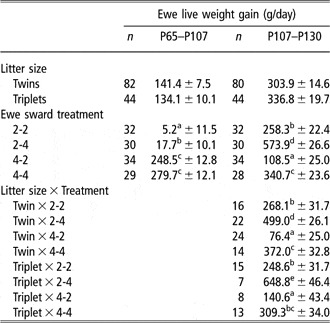
Total ewe live weight gains during pregnancy reflected changes in the sward height offered. From P65 to P107, ewes offered minimum swards of 4 cm gained weight at a faster rate (P < 0.05) than ewes offered a maximum 2 cm (Table 1). After the sward height treatments were changed, there was a significant interaction (P < 0.05) between litter size and treatment. Within twin-bearing ewes, those offered 4-4 had a faster rate of weight gain than ewes offered 2-2 swards (P < 0.05), whereas within triplet-bearing ewes the rate of weight gain between these groups did not differ (P > 0.05). Twin- and triplet-bearing ewes offered 2 to 4 cm swards had the greatest and ewes offered 4-2 had the slowest rate of weight gain between P107 and P130 (P < 0.05). At P130, the mean live weight of ewes in the 2-2, 2-4, 4-2 and 4-4 treatments was 64.9 ± 1.0, 70.3 ± 1.6, 71.2 ± 1.2 and 76.6 ± 1.4 kg, respectively.
The effect of litter size and nutritional treatment on live weight gain (g/day) of ewes in mid (P65–P107) and late pregnancy (P107–P130)

a,b,c,d,eMeans within columns with different superscripts are significantly different (P < 0.05).
Lamb live weight
At birth, twin lambs were heavier (P < 0.05) than triplets (4.5 ± 0.1 v. 3.8 ± 0.1 kg). Lambs born to 4-4 ewes were heavier (P < 0.05) than lambs born to 2-2 and 4-2 ewes (4.4 ± 0.1 v. 3.9 ± 0.1 and 4.0 ± 0.1 kg, respectively). Lambs born to 2-4 ewes had intermediate birth weights (4.2 ± 0.1 kg) which did not differ from lambs born to 4-4, 4-2 and 2-2 ewes (Corner et al., Reference Corner, Kenyon, Stafford, West, Lopez-Villalobos, Morris and Oliver2008). The percentage of lambs surviving to 2 weeks post-tagging did not differ (P > 0.05) between lambs born to ewes in the 2-2, 2-4, 4-2 and 4-4 treatments (89.1%, 91.5%, 93.7%, 94.2%, respectively). A greater percentage of twin lambs (96.0%) survived than triplet lambs (87.2%; P < 0.05).
Ewe vocalisation
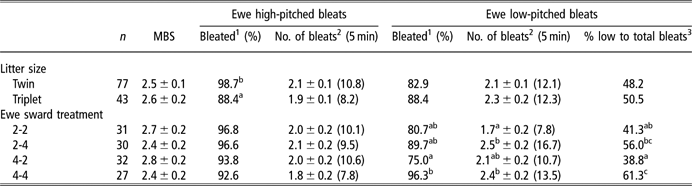
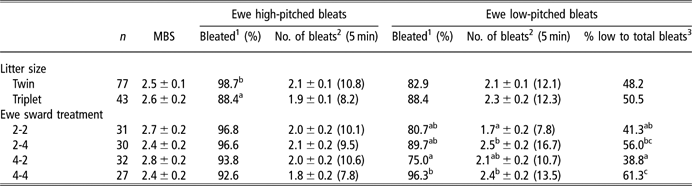
A greater percentage of twin-bearing ewes bleated in a high pitch than triplet-bearing ewes (Table 2; P < 0.05). Of ewes that bleated in a high pitch, the number of bleats did not differ between litter sizes and ewe treatments.
The effect of litter size and nutritional treatment on maternal behaviour score (MBS) and ewe bleating behaviour exhibited during the 5 min observation period (least squares means ± s.e.)
1The percentage of ewes that were observed to bleat in a high or low pitch (ewes that did not bleat were omitted from the analyses).
2The means of the number of low or high bleats observed. Data were X0.5 transformed; untransformed means are presented in parentheses.
3The mean of the percentage of each ewes bleats that were in a low pitch.
a,b,cMeans within columns with different superscripts are significantly different (P < 0.05).
Ewes in the 4-2 treatment were less (P < 0.05) likely to bleat in a low pitch compared to 4-4 ewes. Of the ewes that bleated in a low pitch, 2-2 ewes bleated less (P < 0.05) in the 5 min period than both 2-4 and 4-4 ewes. Twin- and triplet-bearing ewes did not differ in the percentage of ewes that bleated in a low pitch or the number of low bleats. Ewes in the 4-4 treatment had a greater percentage (P < 0.08) of total bleats as low bleats than both 2-2 and 4-2 ewes. Ewes in the 2-4 treatment had a greater percentage of (P < 0.05) low-to-high bleats than 4-2 ewes.
Lamb vocalisation
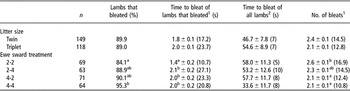
The percentage of lambs that bleated during the 5 min observation period was lower in the 2-2 sward treatment than the 4-4 treatment (P < 0.05; Table 3). However, of lambs that were observed to bleat, those born to 2-2 ewes bleated earlier than lambs born to ewes in all other sward height treatments (P < 0.05). When the analysis included all lambs (including those that did and did not bleat), non-parametric tests showed no significant differences between litter sizes and ewe treatments in the time to bleat. When time to bleat was analysed by litter, triplet litters tended to take longer to bleat (P = 0.07) than twin litters.
The effect of ewe litter size and nutritional treatment on the percentage of lambs that bleated, time taken for lambs to bleat, including all lambs and only those lambs that bleated, during the 5 min observation period (least squares means ± s.e.)

1Data were X0.5 transformed; untransformed means are presented in parentheses.
2Lambs that did not bleat were given the default time of 301 s. Medians are given in parentheses. Non-parametric tests were conducted.
a,bMeans within columns with different superscripts are significantly different (P < 0.05).
The number of bleats emitted by only the lambs that bleated, was lower (P < 0.05) for lambs born to 4-2 and 4-4 than lambs born to 2-2 ewes (Table 3).
Ewe and lamb behaviours
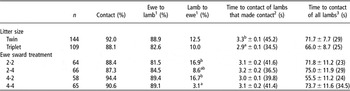
The percentage of lambs that moved toward their dam (in order to reach her), was lower for lambs born to ewes in the 4-4 treatment than lambs born to ewes in the 4-2 and 2-2 treatments (P < 0.05; Table 4). The percentage of ewes that moved towards their lambs did not differ between treatment groups. Triplet lambs and their dam were quicker (P < 0.05) to make contact than twin lambs. The time to contact did not differ between ewe treatments.
The effect of ewe litter size and nutritional treatment on the percentage of lambs that made contact with their dam by moving toward the ewe or the ewe moving toward the lamb, and the time taken for contact to be made including only those lambs that made contact or all lambs (least squares means ± s.e.)

1A ewe and lamb that approached each other were classed as both ‘ewe to lamb’ and ‘lamb to ewe’.
2Data were X0.5 transformed; untransformed means are presented in parentheses.
3Lambs that did not make contact were given the default time of 301 s. Median is given in parentheses. Non-parametric tests were conducted.
a,bMeans within columns with different superscripts are significantly different (P < 0.05).
The percentage of lambs that stood during the observation period did not differ between twin and triplet lambs (87.2% v. 93.2%, respectively), or between lambs born to ewes in the 2-2, 2-4, 4-2 and 4-4 treatments (92.8%, 85.7%, 88.7% and 92.2%, respectively). In addition, the percentage of lambs that successfully sucked during the observation period did not differ between twin and triplet lambs (31.5% v. 35.6%, respectively), or between lambs born to ewes in the 2-2, 2-4, 4-2 and 4-4 treatments (37.5%, 30.2%, 35.2% and 32.8%, respectively). Of those lambs that stood, the time required to stand did not differ between lambs born to ewes in the 2-2, 2-4, 4-2 and 4-4 treatments (42.0, 35.1, 23.8 and 33.4 s, respectively) or between twin and triplet lambs (37.1 v. 30.1 s respectively). No differences in the time to suck were identified between lambs born to ewes in the 2-2, 2-3, 4-2 and 4-4 treatments (155.8, 147.4, 122.6 and 154.0 s, respectively), or between twin and triplet lambs (145.4 v. 144.5 s, respectively). However, when the times for all lambs were included in the analysis, including lambs that failed to exhibit the different behaviours, the time taken to stand differed between both litter sizes (P < 0.05) and ewe treatments (P < 0.05). Twin lambs had a greater (26 s), and triplets a lesser (14.5 s), median time to stand than expected based on the null hypothesis (P < 0.05). In addition, lambs born to ewes in the 2-2 (16 s) and 4-2 (12 s) treatments had faster median time to stand and lambs born to ewes in the 2-4 (30 s) treatment had slower median time to stand than expected. When the time to stand and suck was analysed by litter, no differences were observed between litter sizes or ewe treatments (P > 0.05).
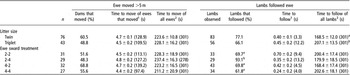
The percentage of ewes that moved further than 5 m from the tagging site during the 5 min observation period and the time taken to move from tagging site did not differ between litter sizes and ewe treatments (Table 5). The percentage of lambs that followed their dam after she moved away from tagging site was greater for lambs born to 2-4 ewes than lambs born to ewes in all other treatments (P < 0.05).
The effect of litter size and nutritional treatment on the percentage of ewes that moved more than 5 m from the tagging site and the time they took to move during the observation period including only ewes that moved or all ewes, and the percentage of lambs that followed their dam and the time taken for lambs to follow their dam including only lambs that followed or all lambs (least squares means ± s.e.)

1Data were X0.5 transformed; untransformed means are presented in parentheses.
2Ewe that did not move away from the tagging site were given the default time of 301 s. Median is given in parentheses. Non-parametric tests were conducted.
3Lambs whose dam move away from the tagging site and that did not follow were given the default time of 301 s. Non-parametric tests were conducted.
a,bMeans within columns with different superscripts are significantly different (P < 0.05).
The time required for a lamb to follow their dam, if she moved more than 5 m from tagging site, did not differ between litter sizes and ewe treatments, when analysed with only lambs that followed their dam (Table 5). However, when time to follow included lambs whose dam left but did not follow, the median time to follow was greater for triplets than twins (Table 5; P < 0.05).
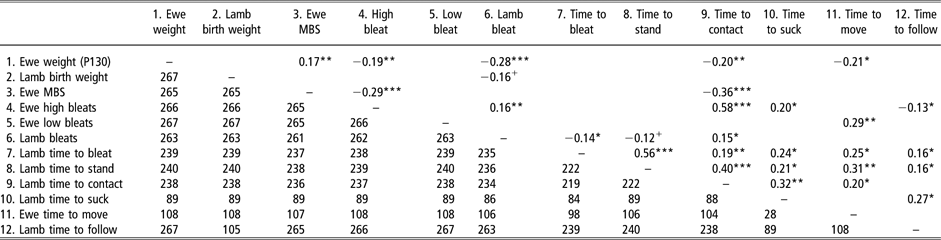
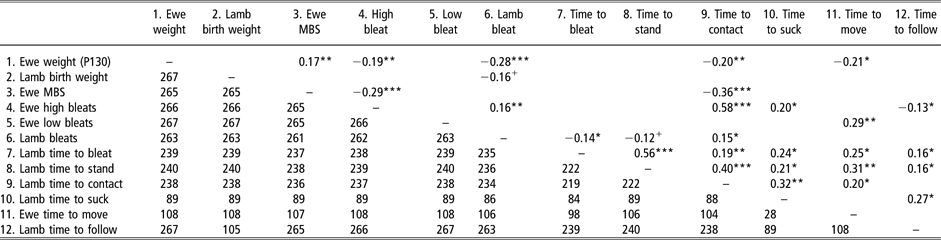
The time for lambs to make contact with the ewe was negatively correlated with ewe live weight and MBS, and positively correlated with number of ewe high bleats and the time taken for ewe to move more than 5 m from the tagging site (P < 0.05; Table 6). Time to make contact was also positively correlated with lamb behaviours including number of lamb bleats and the time taken for lamb to bleat, stand and suck (P < 0.05). The time required for the lamb to stand tended to be negatively correlated with number of lamb bleats (P < 0.1) and was positively correlated with time for lamb to bleat, to make contact with dam, suck and follow dam and with time taken for ewe to leave the tagging site (P < 0.05).
Correlations of post-tagging ewe and lamb behaviours
MBS = maternal behaviour score.
Correlation coefficients and P-values are presented above the diagonal and number of animals included below.
Blank cells indicate non-significant correlations (P > 0.1); +P < 0.1, *P < 0.05, **P < 0.01 and ***P < 0.001.
Discussion
The aim of the current experiment was to determine the effect of ewe nutrition during mid and late pregnancy on the behaviour of twin- and triplet-bearing ewes and their lambs 12 to 24 h after parturition under pastoral conditions.
Ewe bleats, particularly low-pitched bleats, aid in the establishment of the ewe lamb bond (Nowak, Reference Nowak1996; Dwyer and Lawrence, Reference Dwyer and Lawrence2005) and low-pitched bleats are considered ‘care-giver’ bleats made exclusively to the lamb whereas high-pitched bleats are ‘protest’ or distress bleats (Dwyer et al., Reference Dwyer, McLean, Deans, Chirnside, Calvert and Lawrence1998). In the present study, ewes offered 2 cm swards in late pregnancy (2-2; 4-2) were less likely to bleat in a low pitch than ewes in the 4-4 or 2-4 treatments. This suggests that higher levels of nutrition in late pregnancy provide some advantage for maternal bonding.
Lambs born to ewes with high MBS have greater survival rates to weaning than those born to ewes with low scores (O’Connor et al., Reference O’Connor, Jay, Nicol and Beatson1985; Everett-Hincks et al., Reference Everett-Hincks, Lopez-Villalobos, Blair and Stafford2005b). In the current study, MBS did not differ between nutritional treatments or litter sizes. The MBS results of the current study were in agreement with O’Connor (Reference O’Connor1996); however, the majority of other studies reported increases in MBS as litter size increased (O’Connor et al., Reference O’Connor, Jay, Nicol and Beatson1985; Dwyer et al., Reference Dwyer, Lawrence, Bishop and Lewis2003; Everett-Hincks et al., Reference Everett-Hincks, Lopez-Villalobos, Blair and Stafford2005b; Corner et al., Reference Corner, Kenyon, Stafford, West and Oliver2006). In these other studies, it is possible that the increase in MBS due to an increase in litter size is an artefact of the increased number of lambs, which would increase the likelihood of a ewe reuniting with at least one of the lambs. However, as no singleton lambs were present in the current study, this could explain why such an increase in MBS was not observed here.
As in the current study, Everett-Hincks et al. (Reference Everett-Hincks, Lopez-Villalobos, Blair and Stafford2005b) reported that there was no effect of ewe nutrition on MBS. However, Dwyer et al. (Reference Dwyer, Lawrence, Bishop and Lewis2003) reported that well-fed ewes were more likely to receive high scores and less likely to receive low scores than low-intake ewes. There are many differences between the findings of both Everett-Hincks et al. (Reference Everett-Hincks, Lopez-Villalobos, Blair and Stafford2005b) and the current study and that of Dwyer et al. (Reference Dwyer, Lawrence, Bishop and Lewis2003). First, Dwyer et al. (Reference Dwyer, Lawrence, Bishop and Lewis2003) used only primiparous Scottish Blackface ewes whereas both the current study and that of Everett-Hincks et al. (Reference Everett-Hincks, Lopez-Villalobos, Blair and Stafford2005b) used mixed-age Romney ewes. It is possible that there may be a reduction in the variability of maternal behaviour as ewes gain maternal experience. In addition, the environment in which ewe and lamb behaviour was observed was different: in the current study and that of Everett-Hincks et al. (Reference Everett-Hincks, Lopez-Villalobos, Blair and Stafford2005b), the behaviour of the ewes and lambs was observed in the paddock, whereas Dwyer et al. (Reference Dwyer, Lawrence, Bishop and Lewis2003) observed ewes in indoor pens.
Lamb behaviour is the major limiting factor to lamb survival (O’Connor and Lawrence, Reference O’Connor and Lawrence1992). Lambs that stand soon after birth, suck soon after standing and maintain close contact with their dam are more likely to develop an exclusive bond with their dam (Alexander, Reference Alexander1988). Lamb bleating is a stimulus-response behaviour that contributes to the establishment and maintenance of the ewe–lamb bond (Lindsay, Reference Lindsay1996; Nowak, Reference Nowak1996). Vocal behaviour of the neonate has been suggested to be an expression of need (Weary and Fraser, Reference Weary and Fraser1995) and is inversely related to maternal care (Dwyer and Lawrence, Reference Dwyer and Lawrence1998). In the current study, fewer lambs born to ewes in the 2-2 treatment bleated during the observation period than lambs born to 4-4 ewes. A possible explanation for this is that a proportion of lambs born to 2-2 ewes do not have sufficient vigour to bleat. However, the lambs born to 2-2 ewes that bleated, did so earlier than all other lambs and with a greater frequency than lambs born to ewes in the 4-2 and 4-4 treatment. This may indicate that lambs born to 2-2 ewes, which were lighter than lambs born to the 4-4 ewes, had a greater ‘need’ than lambs born to ewes in all other treatments and this is supported by the observation that a greater percentage of 2-2 lambs moved towards the ewe than 4-4 lambs. The frequency of lamb bleats during the observation period tended to be negatively correlated with lamb birth weight in agreement with Dwyer et al. (Reference Dwyer, McLean, Deans, Chirnside, Calvert and Lawrence1998) observations with Blackface, but not Suffolk sheep.
In the current study, the frequency of lamb bleats during the 5 min observation period was positively correlated with the total number of ewe high-pitched bleats and the latency for the ewe and lamb to make contact. The frequency of lamb bleats was also negatively correlated with the latency for the lamb to bleat. These findings suggest that lamb bleating behaviours were a response to the separation from their dam and her vocalisation.
Behavioural progress including time required to stand, move towards udder, attempt to suck and successfully suck, can be used as an indicator of neonatal vigour. Dwyer et al. (Reference Dwyer, Lawrence, Bishop and Lewis2003) noted that the behavioural progress of heavy birth weight lambs was faster than that of light lambs. Interestingly in the present study, lamb birth weight was not positively correlated with any behaviour measure after tagging while positive correlations were observed between the time taken for the ewe and lamb to make contact with the time taken for the lamb to bleat, stand and successfully suck. Therefore in the current study, time to contact appears to provide a better indication of the ‘need’ lambs have for their dam than birth weight.
In the current study, triplet lambs were faster to make contact with their dam than twin lambs when only those lambs that made contact were included in the analysis. This finding is in agreement with Everett-Hincks et al. (Reference Everett-Hincks, Blair, Stafford, Lopez-Villalobos, Kenyon and Morris2005a) who reported that triplets were quicker to make contact with their dam after tagging than twin lambs. However, triplets did not differ from twins when the analysis was conducted with all lambs, including those that did not make contact. This suggests that within sets of triplets there maybe wider variation than within twins.
In the current study, the median time required for lambs to stand after tagging was greater than expected for twins and lower for triplets, however, no differences in time to suck were observed. Dwyer et al. (Reference Dwyer, Lawrence, Bishop and Lewis2003) reported that triplet lambs were slower to stand and suck than twins. The findings may differ from those in the current study due to the age of the lamb, as Dwyer et al. (Reference Dwyer, Lawrence, Bishop and Lewis2003) observed lamb behaviour immediately after birth, whereas, in the present study lambs were 12 to 24 h old.
Conclusion
Nutrition during mid and late pregnancy had no effect on the MBS of ewes 12 to 24 h after birth, but fewer ewes offered 2 cm pasture swards in late pregnancy bleated in a low (care giver) pitch. Lambs, born to ewes offered 2-2 cm pasture swards, were lighter, and if they bleated they bleated more, thus suggesting more ‘need’ for their dam than lambs born to ewes offered 4 cm pastures in mid and late pregnancy (4-4). The 2-2 lambs were less likely to vocalise, possibly due to less vigour, than 4-4 lambs. However, the changes observed in ewe vocalisation and lamb behaviour and vocalisation did not impact on lamb survival.