1. Introduction
The study of olfaction is by nature a multi-disciplinary science, which has been investigated from various perspectives of chemistry, medical neurology, psychology, psycholinguistics, and cultural anthropology. Olfaction, unlike vision (cf. Berlin & Kay, Reference Berlin and Kay1969), has been viewed as linguistically marginal in many previous studies. Most psychological experiments and studies on odor identification and recognition conclude that there is a rather poor linguistic repertoire when it comes to describing a perceived odor (cf. Cain Reference Cain1979, Reference Cain1982; Engen, Reference Engen1987; Plümacher & Holz, 2007, and the references therein). Engen (Reference Engen1987) considers that olfactory perception is categorized differently from visual perception in terms of neurological processing. Whereas the latter is systematically stored in our memory in an organized way, the former is more flexible and adaptable. It is rather open-ended and not controlled linguistically. The storage of olfactory perception in memory remains as an individual and unconnected instance. The memory cannot be activated through verbal descriptions, but by perceptual experiences in the same context.
On the other hand, Burenhult and Majid (Reference Burenhult and Majid2011) report that, along with vision and audition, olfaction is central to Jahai ideology, which “revolves around a complex set of beliefs that structures the human relationship with the supernatural”. Jahai is an Aslian language which belongs to the Austroasiatic family. In Jahai there are approximately a dozen or so abstract descriptive odor verbs which are basic terms in accordance with Berlin and Kay (Reference Berlin and Kay1969), as they are monolexemic, psychologically salient, and used in common parlance.
The Aslian-speaking communities have been termed ‘smell cultures’ by Classen, Howes, and Synnott (Reference Classen, Howes and Synnott1994). Jahai is not the only example among these languages with smells as a prominent cultural feature. Another genetically related language, Semai, uses ‘expressives’,Footnote 1 a distinct category of words in the form of a string of consonants serving as a template for describing sensory phenomena (Tufvesson, Reference Tufvesson2011). Perceptual variations or qualities are encoded by inserting a different vowel into the slot of a template. In terms of olfaction, odors are described by using templates to encode a type of odor, and vowel alterations to capture perceptual gradience, as shown in Table 1.
Expressive templates of odors in Semai (Tufvesson, Reference Tufvesson2011, p. 91)

Based on these findings, Burenhult and Majid (Reference Burenhult and Majid2011) argue that these languages challenge the view of odor identification and categorization being vestigial in humans. Moreover, comparative studies of the other Austroasiatic languages suggest that this olfactory dominance in both culture and language may be traced back to a much earlier stage of the language group.
Similar to the Aslian-speaking communities is the Ongee culture from the Little Andaman Island (Pandya, 1987/1993; also cited in Classen, Reference Classen1993, Reference Classen and Howes2005). As hunters and gatherers, the Ongee people are brought up with an odor-oriented concept in their society, organizing their lives and world with smells as the fundamental cosmic principle. The language itself demonstrates this olfaction-related conceptualization. For example, the form of greeting, KonyuneɁ onorange-tankaɁ, is concerned with one’s nose, which can be translated as ‘how is your nose?’ or literally ‘when/why/where is the nose to be?’ Birth, growth, and death are conceptualized by odors. The word for growth, genekula, is a process of smell. Death is considered as the loss of one’s personal odor. The word for ‘hunter’, gitewabe, is literally ‘to release smell causing a flow of death’. As Classen (2005, p. 156) sums up, “the heart of Ongee cosmology is ordered by an olfactory model: the inhaling and exhaling of breath”.
The implications from these studies suggest that despite the weak neural connections between the limbic system and the language processing areas (i.e., Broca’s area and Wernicke’s area) which result in a lack of olfactory vocabulary for a language user to properly cope with identification of odorants (Chernigovskaya & Arshavsky, Reference Chernigovskaya, Arshavsky, Plümacher and Holz2007; Holz, Reference Holz, Plümacher and Holz2007, p. 189; Zucco & Tressoldi, Reference Zucco and Tressoldi1989), the sensual dominance of vision in Western societies over the other senses may be culturally biased (cf. Classen, Reference Classen1993).
This paper is a response to the issue. Amis, an Austronesian language spoken in Taiwan, exhibits abundant odor terms, in comparison with other Formosan languages investigated so far (cf. Lee, Reference Lee2010a, Reference Lee2010b). Morphologically, the proclitic hala= attaches to a reduplicated noun to form the source-oriented construction as a way for describing odors. This conforms to the schema [prefix-(reduplication) X] (X = a noun indicating the odorant source / a verb indicating the state of smell), as discussed in Lee (Reference Lee2010a, Reference Lee2010b).
The structure of this paper is as follows. Section 2 introduces the Amis language and explains the methodology of data collection. The notion of ‘basic term’ is discussed. Section 3 presents the odor terms in Amis and their lexical categories and semantics. Section 4 provides the analysis and implications of the verbal responses from the scratch-and-sniff task conducted by ten participants. This is followed by a conclusion.
2. The Amis language and its speakers
Amis, an Austronesian language spoken in the eastern part of Taiwan, together with Siraya, Kavalan, and Basay, belong to the branch of East Formosan (Blust, Reference Blust, Zeitoun and Li1999). It also totals the largest population among the Formosan indigenous groups, of around 200,000 speakers, which is about 36.6% of the total indigenous population in Taiwan.Footnote 2
Even though the internal relationship of Amis is pending further research, the language can be roughly divided into five dialects based on Tsuchida (Reference Tsuchida1982): Sakizaya, Northern Amis, Tav-Vata’an Amis, Central Amis, and Southern Amis (cf. Li, Reference Li1999, p. 77). Li (Reference Li1999) considers Sakizaya as the most conservative dialect in Amis as it retains the voiced stops /b/ and /d/, which are spirantized respectively as /v/ and /ð/, or even devoiced into /f/ and /ɬ/ in other dialects. Some consultants alternate between [b] and [β] in their dialects.Footnote 3
Compared with the other Formosan languages, Amis appears to be in a better state with regards to language endangerment, though it can be roughly estimated that over 50% of fluent speakers are middle-aged. The language is also learned or acquired by its neighboring ethnic groups, such as Kavalan, Bunun, and Paiwan.
2.1. methodology of data collection
The Amis data are collected from eleven consultants, covering the dialects from North to South. This pan-dialectal approach is meant to be comprehensive rather than comparative. The consultants who represent different dialects are intentionally selected in this study in order to provide a comprehensive presentation of the available data. Therefore, this paper is focused on the Amis language as a whole rather than on a single Amis dialect, as it is difficult to justify any single dialect as a representative sample for this study.
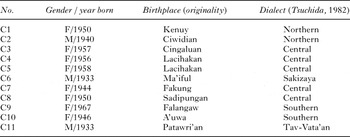
Table 2 lists the general information of the eleven consultants, of which the first ten participated in the scratch-and-sniff task.Footnote 4
The basic information of the Amis consultants

In the first section, each consultant is asked to describe a scenario prompted by the given sentences or phrases about different types of smells. The aim of this session is to elicit and clarify the possible grammatical strategies for describing odors, as well as the commonly used odor terms for certain types of smell. The results of this session provide a considerable number of sentences, which were then carefully selected for presentation in this paper, as shown in examples (1) to (41) in Section 3. These data also bear significant dialectal variations for describing odors, and slight differences in terms of lexical cognition for olfactory perception.
Next, the consultants were asked to conduct a task of elicitation by stimuli with a booklet ‘The Brief Smell Identification Test™, (Doty Reference Doty2001; Majid, Senft, & Levinson, Reference Majid, Senft, Levinson and Majid2007), and ten of them agreed to conduct the task. There were twelve smell patches in a booklet. Each page contained one odor, which was sealed in a brown patch at the bottom of the right-hand corner, along with four choices above each patch. A smell was released by scratching the patch with a sharp pencil provided in the kit. The consultants were asked to sniff each scratched patch and describe the perceived odors in their native languages. The results are presented and discussed in Section 4.
The rationale behind the design of these sessions is to understand how olfactory perception is manifested linguistically in the Amis language, and how it is conceptualized by the Amis people. In the first session, the odor terms and the sentences of the source-oriented construction were elicited by prompted scenarios and conversations. The data collected in this session reveal what types of smell are lexically encoded in the language and the grammatical strategies used to manifest olfactory perception.
The first session served as a warm-up activity for the second session. In the second session the consultants were invited to conduct the scratch-and-sniff task. Their current physical condition is taken into account. If a consultant suffers from smell loss or is having a cold, the interview session is called off or scheduled for another day. Otherwise, it is assumed that once the consultant was assessed as proficient after the first session, he or she was able to successfully conduct the second session. The results of the second session provide a clue as to how the perceived smells are conceptualized by the participants and how consistently the olfactory encoding can be obtained. Therefore, the completion of these two sessions offers a thorough picture for our understanding of the topic.
2.2. the notion of the ‘basic term’ of odors
For ‘basic term’, we follow Berlin and Kay’s (1969, p. 6) definition of ‘basic color term’, in which a basic term should exhibit at least the following four characteristics: (1) It is mono-lexemic: the meaning is not predictable from the meaning of its parts; (2) its signification is not included in that of any other term; (3) its application must not be restricted to a narrow class of objects; and (4) it must be psychologically salient.Footnote 5
However, if we apply strictly the four criteria of ‘basic color term’ to our consideration of ‘basic odor term’, there are probably no or very few ‘basic odor terms’. The problem lies in the third criterion that “its application must not be restricted to a narrow class of objects”. Most odor terms found in Amis are used to refer to a specific class of objects, which are their prototypical odorant sources.
There have been advocates of the idea that odors cannot be classified in the same way as colors (cf. Chrea, Valentin, Sulmont-Rossé, Nguyen, & Abdi, Reference Chrea, Valentin, Sulmont-Rossé, Nguyen and Abdi2005; Dubois, Reference Dubois, Plümacher and Holz2007) and that ‘basic terms’ of odors are absent (Plümacher & Holz, 2007, p. 6), given that odor terms cannot be “abstracted from their reference to particular objects”.Footnote 6 Dubois (2007, p. 172) states that since odor classifications rely mainly on the classification of objects as odorant sources, it is difficult to conceive odors as physical entities. Rather, they should be considered as psychological effects.
On the other hand, if we disregard the third criterion, the odor terms found in Amis meet the other three criteria and thus, like Jahai (Burenhult & Majid, Reference Burenhult and Majid2011), they can probably be considered as basic odor terms.
However, in this paper we are cautious about considering the Amis odor terms as ‘basic’. The odor terms in Amis require selection restrictions towards certain odorant sources with which they can contextually collocate. In this way, they cannot be abstracted from the references. For example, we can talk about something which can be colored as red, yet we cannot say that something can be smelled as anglis or angsit in Amis.
3. Linguistic representations of olfactory cognition in Amis
This section presents linguistic representations of olfaction in Amis, including the abstract odor terms and the morphological components for describing odors. With more than a dozen odor terms, Amis is a language with a rich set of odor descriptors.
3.1. mono-lexemic odor terms and lexical categories
Compared with some Formosan languages investigated previously (cf. Lee, Reference Lee2010a, Reference Lee2010b),Footnote 7 Amis exhibits rather abundant olfactory terms, with more than a dozen of them. The asymmetry of having more unpleasant odor terms than pleasant ones in language is also manifested.
In Amis the lexeme sanek is conceptually equivalent to smell, as it is associated with to smell and smelly. The form mi-sanek denotes ‘to smell’ and ma-sanek ‘be smelly, be stinky’, which are derived from the noun sanek ‘smell, odor’.
The lexeme sanek is conceptually neutral with regards to hedonic judgments. It is neither pleasant nor unpleasant. Related forms such as ma-sanek or the noun sanek are often used in the source-oriented construction when describing an odor (see more details in Section 3.2).
The distinction of human vs. non-human is prevalent in the grammar and lexicon of Amis. There are two nominal odor-related terms in Amis which are designated to [+human] contexts, silet and Ɂluh. Their original meaning is ‘dirt from one’s body’, which is then metaphorically extended to describe one’s body odor, thus they often bear negative connotations (see examples (1) to (3)):Footnote 8
(1) fangsis ku silet-isu.
be.fragrant nom body.odor-2sg.gen
‘You smell nice.’ (Ciwidian)Footnote 9
(2) ira ku silet nu hacul kinaFootnote 10 wawa.
exist nom body.odor gen milk nom.this.lig child
‘This child’s body smells of (rancid) milk.’ (Lacihakan)
(3) ma-sanek saan ku Ɂluh nu ka-kiriɁ-anFootnote 11 ni kacaw.
av-odor quotFootnote 12nom dirt gen loc1-itchy-loc2gen Kacaw
‘Kacaw’s underarm really smells.’ (Cingaluan)
The odor term silet is also used metaphorically to mean ‘charisma’ or ‘popularity’. For example, sentence (4) is literally ‘your body odor exists with people’.
(4) ira ku nu tamdaw-an a silet-isu.
exist nom gen people-genrFootnote 13lig body.odor-2sg.gen
‘You have charisma; you are very popular.’ (Lacihakan)
Cross-dialectically there are more than a dozen odor terms which function as stative verbs. The most generic one is ma-sanek, derived from the noun sanek ‘odor’ as mentioned above. It corresponds to hanek in the southern dialects.
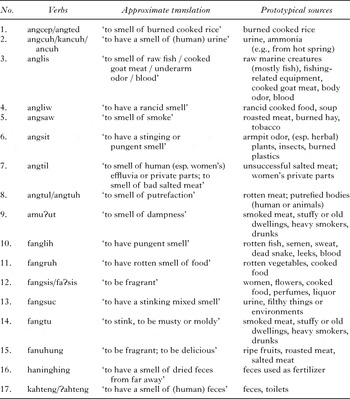
Table 3 lists in an alphabetical order the odor terms functioning as stative verbs in the Amis dialects and their prototypical sources. The table serves to present the odor terms before our discussion.
Abstract odor terms as stative verbs in Amis

An observation from these odor terms reveals that half of the odor terms begin with the phoneme sequence of ang-, and six odor terms begin with that of fang-. This is reminiscent of Austronesian root theory of Blust (Reference Blust1988), who points out that “in a number of Formosan and Western Malayo-Polynesian languages a phoneme sequence that reflects *(C)ang(e)CV(C) is recurrently associated with the meaning of ‘stench, bad odor’. This is termed as ‘Gestalt symbolism’, which ‘consists of the correlation of a meaning … with a larger configuration that must be defined both in terms of phonemes and of syllables” (Blust, Reference Blust1988, p. 59).
Second, dialectal variations of several odor terms are noted. The more frequent one appears first. For example, angcep is found in most dialects, but angted (or angsed) is found in Sadipungan. On the other hand, fangtu is found in Tav-Vata’an Amis, whereas the other dialects use the approximately equivalent odor term amuɁut. The two terms referring to odor are separate due to the variation of lexical cognition that exists among the consultants.
Further information for each odor term is provided alphabetically as follows.
1. angcep/angted: This odor term refers to the smell of burned rice only. Reduplicating the verb indicates attenuation. The verb ma-Ɂadi is used to collocate with other burned food.
(5) angcep∼cep kina hemay.
smell.burned.rice∼iter nom.this.lig cooked.rice
‘The cooked rice smells a bit burned.’ (Cingaluan)
(6) ma-Ɂadi kina tiɁtiɁ nu sili.
av-be.burned nom.this.lig meat gen goat
‘The goat meat is burned.’ (Cingaluan)
2. angcuh/kancuh/ancuh: Most consultants consider this odor term as referring to the smell of human urine, though one or two consultants think that the source of urine can also be that of animals. The alternative term kancuh is also heard. Another equivalent term, ancuh, was obtained from the A’uwa consultant.
(7) ancu∼ncuh-ayFootnote 14 kura cawfan.
smell.urinal∼iter-facFootnote 15 this duvet
‘This duvet smells of urine.’ (A’uwa)
(8) kancuh saan ku isiʡ ni kacaw.
smell.urinal quot nom urine gen Kacaw
‘Kacaw’s urine smells strong.’ (Cingaluan)
3. anglis: Fish is an important diet of the Amis people. This term is used specifically for describing the odor from raw fish or marine creatures in a fish market, or the pungent smell from cooked goat meat. One consultant reports that this odor term is used to describe the smell of blood when a tortoise is being killed. Although this term is used to describe the negative effect of the fishy smell or the cooked meat, the odorant sources are still considered edible (cf. fanglih below).
(9) anglis i ka-la∼li-ɁacaɁ-an.
smell.fishy prep loc1-recp∼get.price-loc2
‘The market smells fishy.’ (Patawri’an)
(10) hala=sanek nu futing, anglis∼lis ku kamay-isu.
HALA=odor gen fish smell.fishy∼iter nom hand-2sg.gen
‘There is smell of fish. Your hands smell fishy.’ (Cingaluan)
4. angliw: This term is used to describe the rancid smell when cooked foods, such as dishes and soups, have gone bad.
(11) angliw=tu ku dateng.
smell.rancid=pfvFootnote 16nom vegetable
‘The dishes have gone rancid.’ (Sadipungan)
(12) ma-tafungaw-ay kura hulu. angli∼ngliw-ay.
av-be.moldy-fac that cooked.rice smell.rancid ∼iter-fac
‘That cooked rice is moldy. It smells bad.’ (A’uwa)
5. angsaw: This term is used to describe the smell from burned food, or the smoky smell attached to one’s hair or clothes, for example, when one is burning hay or having a barbeque.
(13) ha=angsa∼ngsaw-ay kura hulu.
HA= smell.smoky∼iter-fac that cooked.rice
‘That rice smells smoky.’ (A’uwa)
(14) angsaw ku fuduy-isu.
smell.smoky nom clothes-2sg.gen
‘Your clothes smell smoky.’ (Ciwidian)
6. angsit: This odor term is used specifically to describe the pungent or stinging smell emitted from herbal plants, tree sap, insects (especially bedbugs), armpit odor, or burned plastics or rubbish.
(15) angsit saan kina ni-Ɂiruh-an a lakaw/suka.
be.smelly quot nom.this.lig loc1.pat-burn-loc2lig rubbish/plastics
‘The burned rubbish/plastics are very smelly.’ (Cingaluan)
(16) angsit ku ka-kiriɁ-an ninaFootnote 17 tamdaw.
be.smelly nom loc1-itchy-loc2gen.this.lig person
‘That person’s armpit smells.’ (Lakihakan)
7. angtil: This odor term is culturally dependent, as it refers to the bad smell produced by salted meat (silaw) − a traditional Amis food − if it is not properly done. Moreover, it also refers to the smell of women’s private parts, thus it is considered by some consultants as a forbidden word, and the other term angtul is used instead (cf. angtul below). It is an insult if this word is used to describe a person.
(17) caɁay kakapah ku ni-pa-cilah. angtil!
neg good nom pfv-caus-salt be.stinky
‘The salted meat is not good. (It) stinks.’ (Ciwidian)
(18) sa-angtil=sa kisu!
intens-be.stinky=quotFootnote 182sg.nom
‘You stink very much! (an insult)’ (Sadipungan)
8. angtul/angtuh: This odor term refers to the smell produced by rotten meat or fish, bad wounds, and the smell of putrefaction. Since it is used to describe the smell which induces the worst psychological effect, its references are often extended.
(19) angtul∼tul kina tiɁtiɁ a ayam.
smell.rotten∼iter nom.this.lig meat lig chicken
‘The chicken meat is foul.’ (Cingaluan)
(20) angtul saan kina ma-patay-ay ayam.
smell.rotten quot nom.this.lig av-die-fac chicken
‘The dead chicken is very smelly.’ (Cingaluan)
(21) antu∼ntuh-ay!
smell.rotten∼iter-fac
‘It smells disgusting!’ (A’uwa)
9. amuɁut: This odor term refers to the smell of dampness. For some consultants, this term is equivalent to another term, fangtu. Their references of odorant sources are similar.
(22) amuɁut=sa hanek-en kuni sawfan.
smell.damp=quot odor-uv nom.this duvet
‘This duvet is very damp with smell.’ (Farangaw)
(23) amuɁut ku lumaʡ numaku.
semll.damp nom house 1sg.gen
‘My house smells of dampness.’ (Fakung)
10. fanglih: This odor term is semantically overlapped with the odor term anglis, yet for some consultants its effect is worse than anglis: the odorant source is no longer edible if it is fanglih, as it is considered rotten. It is also used to describe the smell of bodily effluvia such as semen, or the smell from a snake being hit dead.
(24) makay ira ku hala=riya∼riyar-ay-isu a fanglih.
why exist nom HALA=pl∼sea-fac-2sg.gen lig smell.rotten
‘Why do you smell of sea? It’s smelly.’ (Sadipungan)
11. fangruh: This odor term is used to describe the stinky smell of rotten vegetables or cooked dishes. It is found in the Sadipungan dialect.
12. fangsis/faɁsis and fanuhung: There are two odor terms, fangsis and fanuhung, for the meaning of ‘be fragrant’. The former describes the odorant sources from women, flowers, cooked foods, perfumes, or liquor, whereas the latter that from ripe fruits, smoked meat, or salted meat. The lexeme fanuhung can also denote the sense of taste, meaning ‘be delicious’.
(25) fangsis=sa kisu.
be.fragrant=quot 2sg.nom
‘You smell nice.’ (Lakihakan)
(26) ma-sanek-aku ku faɁsis-ay a hana.
av-odor-1sg.gen nom be.fragrant-fac lig flower (Japanese loan)
‘I smell the fragrance of flowers.’Footnote 19 (Cingaluan)
13. fangsuc: This odor term is used to describe the mixed and ineffable smell in a filthy environment.
14. fangtu: For the dialects with this term, it refers to the pungent, musty, or moldy smell from old or damp dwellings, smoked meat, tobacco, or the consumed alcohol from the breath of a drunk. It usage is almost equivalent to amuɁut.
15. fanuhung: see fangsis above.
(27) fanuhung-ay ku ni-sa-silaw-an numisu.
be.fragrant-fac nom loc1.pat-make-salted.meat-loc22sg.gen
‘Your salted meat smells nice.’ (Farangaw)
16. haninghing: This odor term refers to the smell of fertilizer, which is made of feces.
17. kahteng/Ɂahteng: This odor term specifically refers to the smell of feces in general. Some consultants consider that this odorant source is designated to [+human], whereas others consider that it is not necessarily so.
(28) kahteng saan kina wawa/*wacu.
be.smelly quot nom.this.lig child/*dog
‘The child smells of feces.’ (Cingaluan)
(29) Ɂahteng nu wacu a tayiʡ.
be.smelly gen dog lig feces
‘the bad smell of dog’s feces’ (Ciwidian)
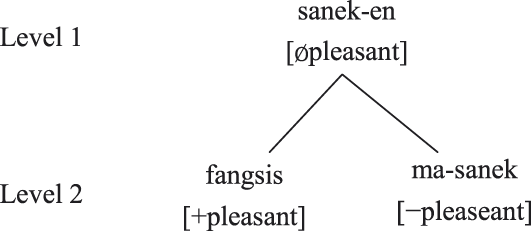
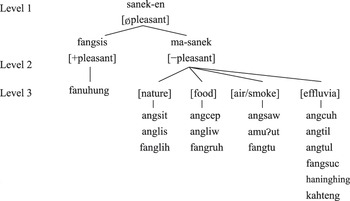
Following these descriptions, it is possible to categorize Amis odor terms by employing semantic features and lexical hierarchies. This categorization is linguistic rather than olfactory per se. This linguistic categorization of odor terms is thus based on two parameters: (1) the psychological effects of odor perception; and (2) the references of odorant sources. Given that odor perception induces psychological effects − basically hedonic judgment such as pleasant or unpleasant (cf. Dubois, Reference Dubois, Plümacher and Holz2007), a binary semantic feature is accordingly used: [+pleasant] and [−pleasant]. With this feature, the term sanek-en ‘odor-uv; (odor) being smelt’ is underspecified, and is positioned as the superordinate of the taxonomic relation. The first two levels are shown in Figure 1.
Taxonomic hierarchy of the Amis generic odor terms.
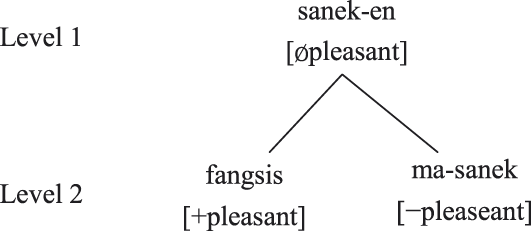
As shown in Figure 1, a perceived odor, sanek-en, usually evokes two generic psychological effects which are translated verbally as either fangsis, or ma-sanek. Although odor types cannot be realized as entities, conceptually it is possible to consider that fangsis is ‘a kind of odor’ which smells pleasant, whereas ma-sanek is ‘a kind of odor’ which smells mostly unpleasant. Both fangsis and ma-sanek are generic terms for the Amis people to describe a perceived odor.
For level 3 of the taxonomic hierarchy, the categorization is based on the types of odorant source rather than the psychological effects. Empirically speaking, to further describe an odor apart from giving hedonic assessment, most people resort to the object which usually emits the ‘kind’ of odor. This empirical experience is also reflected linguistically. As we shall see in Section 4, most verbal responses from the sniff-and-scratch task are source-oriented. This gives us an empirical basis to categorize the Amis odor terms from the types of odorant references.
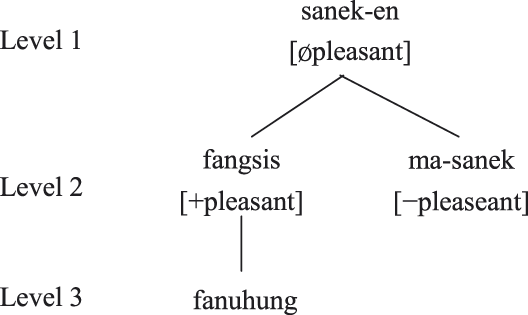
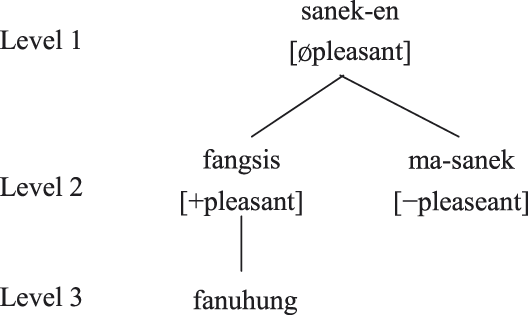
The odor term fanuhung is placed under fangsis as a kind of pleasant odor. An odor which is fanuhung is also fangsis, yet a fangsis object is not necessarily fanuhung, as the latter encompasses the sensory domain of taste. Therefore, level 3 is added as shown in Figure 2.
Taxonomic hierarchy of the Amis [+pleasant] odor terms.
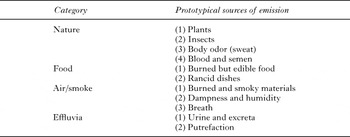
The odor terms which are considered as the hyponyms of ma-sanek are classified with four indices: nature-emitted, food-emitted, air/smoke-emitted, and effluvia-emitted. It is difficult to provide a semantic feature at this level which is able to cover the four indexes conceptually. What makes it more complicated is that some odor terms appear to describe cross-categorical sources. Therefore, it is necessary to further specify each source index and categorize the odor terms based on the most prototypical sources. The specification is summarized in Table 4.
Linguistic categorization of the Amis odor terms

The categorization in Table 4 is explained as follows. First, body odor from humans and animals is considered as natural because it is usually invisible and ubiquitous, and may not be as foul as effluvia. For example, certain animals such as goats have a specific body odor, which is usually perceived as similar to a human’s body odor, especially that from the armpits. Conceptually, body odor is linked with sweat, as the odor is partly due to vaporization of sweat. Similarly, blood (from killing an animal) and semen are grouped in this category, as their odor is not as offensive as that of effluvia.
Second, it is obvious in Amis that some odor terms are designated to a specific type of food, such as angcep for burned cooked rice. This salient feature is culturally dependent and should not be ignored for categorization. Even though it is inevitable to produce burned rice with the traditional way of rice-cooking, burned rice is still considered edible. The odor category of food-emitted sources also coincides with the rancid type, as the odor is usually generated by food.
Third, the odors generated from burning (fire) and humidity (water or unknown liquid) are grouped together, based on their linguistic representations. The smell of dampness results from the humidity created by a large amount of water in the air caught in a stuffy space such as a long-term unoccupied old house. Likewise, the smell of smoke resulting from burning created by slow or intense fire is caught on an object such as one’s hair or clothes during a period of time. This explains the same linguistic encoding of the odor related to the breath from a heavy smoker (linked with fire) and a drunk (linked with liquid).
With this classification, the Amis odor terms are grouped into each category more or less evenly. As shown in Figure 3, the odor terms related to the sources of effluvia are in the majority, suggesting that the most offensive odors tend to be more extensively expressed.Footnote 20
Taxonomic hierarchy of the Amis odor terms.

3.2. the source-oriented construction
Apart from using the odor terms listed in Section 3.1, another way to describe odors in Amis is by attaching the proclitic hala= to the reduplicated form of the noun which is considered as the (possible) odorant source by the speaker.Footnote 21 This is similar to the schema found in the other four Formosan languages, namely, [prefix-(reduplication) X], where X is a noun indicating the odorant source (Lee, Reference Lee2010a). Following Majid et al. (Reference Majid, Senft, Levinson and Majid2007), this type of expressions is termed a ‘source-oriented construction’.
The lexeme hala= is analyzed as a proclitic as it can attach to a noun phrase indicating the odorant source.Footnote 22 The following examples show that when hala= is attached to a noun phrase, the whole component functions as the verbal predicate of a sentence.
(30) hala=[sanek nu futing]NP, anglis∼lis ku kamay-isu.
HALA=odor gen fish smell.fishy∼iter nom hand-2sg.gen
‘(It) smells of fish. Your hands smell fishy!’ (Cingaluan)
(31) hala=[anglis nu futing]NP ku fuduy-isu.
HALA=fishy.smell gen fish nom clothes-2sg.gen
‘Your clothes smell of fish.’ (Cingaluan)
If hala= attaches to a noun instead of a noun phrase, the noun as the odorant source is usually reduplicated. The form of a reduplicant depends on the syllables of the base. In some dialects, reduplication of the odorant source following the proclitic hala= is optional, as shown in (35).
(32) hala=futi∼futing kisu=sa?
HALA=pl∼fish 2sg.nom=quot
‘Why do you smell of fish?’ (Cingaluan)
(33) hala=
isi∼ isi kina kafang.
HALA=pl∼urine nom.this.lig duvet
‘This duvet smells of urine.’ (Cingaluan)
(34) hala=pulahi∼lahik. angtul!
HALA=pl∼chicken.feces stink
‘There’s a smell of chicken feces. (It) stinks.’ (Lacihakan)
(35) hala=dadipis ku kina kaysing.
HALA=cockroach nom nom.this.lig bowl
‘This bowl smells of cockroach.’ (Lacihakan)


Dialectal variations are observed regarding the proclitic hala=. In the northern dialects such as Kenuy and Ciwidian, as well as the Sakizaya dialect, the corresponding form is hali=. In these dialects, reduplication of the odorant sources is obligatory for denoting the meaning of ‘to smell of X’. Otherwise the meaning is different, which becomes ‘to love or like (to eat) X’, as in (36).Footnote 23 Therefore, reduplication in these dialects serves as a device of homophony avoidance.
(36) hali-futing kwuni a wawa.
like-fish this lig child
‘This child likes (eating) fish.’ (Sakizaya)
(37) hali=futi∼futing ku zikuc-isu.
HALI=pl∼fish nom clothes-2sg.gen
‘Your clothes smell of fish.’ (Sakizaya)
(38) hali=Ɂpa∼Ɂpah ku silet numisu.
HALI=pl∼liquor nom body odor 2sg.gen
‘Your whole body smells of alcohol.’ (Ciwidian)
In southern dialects such as Farangaw and A’uwa (our consultant’s mother came from the Heng-chun area in Southern Taiwan), the corresponding form is ha=. Reduplication of the odorant source is the norm, though it is optional.
(39) ha=tama∼tamaku ku pa-seraɁ-an numisu.
HA=pl∼tobacco nom caus-breathe-loc 2sg.gen
‘Your breath smells of cigarettes.’ (Farangaw)
(40) ha=kuku∼kukuʡ=sa ku hanek-isu
HA=pl∼chicken=quot nom odor-2sg.gen
‘You smell of chicken.’ (Farangaw)
(41) ha=dadipi∼dipis kura fulac.
HA=pl∼cockroach that uncooked.rice
‘This uncooked rice smells of cockroach (cockroaches must have contaminated the rice).’ (A’uwa)
The kinds of odorant source that follow the proclitic hala= for olfactory descriptions vary among different dialects. The consultants seem to have slightly different intuitions in terms of lexical collocations. In general, any odorant source manifested as a noun or a noun phrase is possible to be the grammatical host of hala=. Rejection of certain collocations by the consultants is due to semantic anomaly rather than grammatical judgment. For example, most consultants do not accept the form hala=tamdamdaw (< tamdaw) (HALA=people∼pl), which literally means ‘to smell of people’. However, a consultant suggests that the form is possible if used figuratively.
4. Conceptualization of olfactory experiences
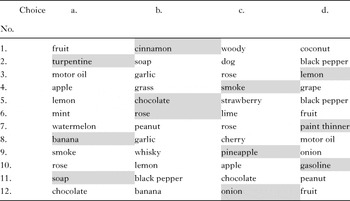
This section presents the result of the scratch-and-sniff task by using the booklet ‘The Brief Smell Identification TestTM’ (Majid et al., Reference Majid, Senft, Levinson and Majid2007) developed and proliferated by Sensonics, Inc.Footnote 24 According to Doty (Reference Doty2001), ‘The Brief Smell Identification TestTM’ (B-SIT), also known as the ‘Cross-Cultural Smell Identification TestTM’ (CC-SIT), contains twelve items of micro-encapsulated odorants, serving as an alternative for its longer version ‘The 40-item University of Pennsylvania Smell Identification Test’ (UPSIT) if less administration time is available. These booklets have been applied to otolaryngology, neurology, and other medical specialties, of which the typical aim is to measure the degrees of olfactory dysfunction or anosmia, i.e., smell loss. On each page there is a micro-encapsulated odorant sealed in a brown patch and above which four choices of source-oriented responses are given, such as, (a) oil, (b) garlic, (c) rose, and (d) lemon, along with the question “This odor smells most like: …”. The participant in a test is forced to make a choice even if no smell sensation is perceived.
Given the present research objective, the 12-item version has proved sufficient and tolerable for the participants. Unlike the typical aim of the test mentioned above, a participant’s correct identification of the odorant on each page is not obligatory in this study. For the references as to what odors are provided in the booklet, the choices of the twelve odorants are listed in Table 5. The correct answer is gray-shaded.
Answer key of the B-SIT

As mentioned in Section 2.1, ten out of the eleven consultants agreed to conduct the task and provided the responses in their own Amis dialects. Following Majid et al. (Reference Majid, Senft, Levinson and Majid2007), the responses (data) are analyzed in terms of two aspects: (1) category of responses, and (2) whether the responses reflect a certain degree of consistency among the participants in terms of odor encoding.
4.1. categories of the responses
The responses are categorized into three parts: (1) evaluative, whether the perceived odor is smelly or fragrant; (2) descriptive, in which the perceived odor is given an odor term or an adjective; and (3) source-oriented, in which the perceived odor is likened to an object which the participant considers as the odorant source.
Before a task began, each participant was emphatically told that this is not an identification task, thus no ‘correct’ answer for each odor was expected. The participants were told to elaborate the olfactory experience in their native language after sniffing a smell. Therefore, they may provide a response which contains source-oriented information with either descriptive or evaluative odor terms. This type of response is counted as having two valid tokens.
Another type of response considered as invalid for our categorization was when the participants were unable to detect the odor, or just simply replied “no idea” or “I don’t know what the smell is”, etc., in Amis. There are eighteen such tokens.
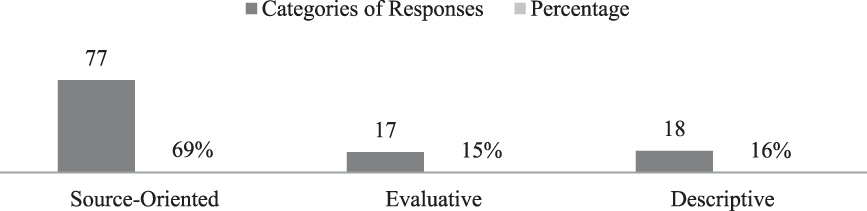
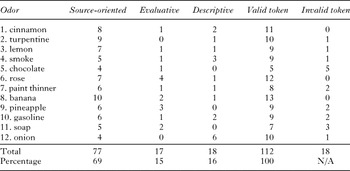
In total, 112 valid and 18 invalid tokens were obtained. Nearly 69% of the responses are source-oriented (77 tokens), 15% are evaluative (17 tokens), and 16% are descriptive (18 tokens). The distribution is illustrated in Figure 4, showing that the category of source-oriented responses is the majority.
Categories of responses for the scratch-and-sniff task.
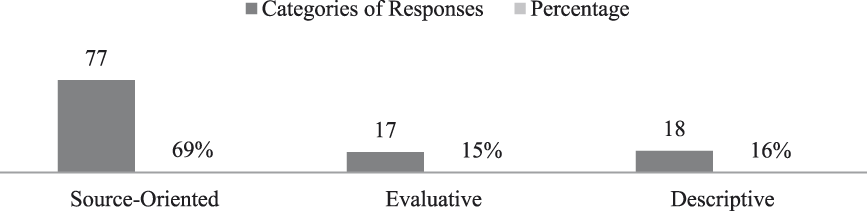
This result is intriguing if compared with that obtained from both English and Jahai speakers in Majid and Burenhult’s (2014, p. 268) study, in which the English participants use predominantly source-based descriptions for odors, presumably due to the fact that English is a language with a limited number of odor terms. Despite having a rich set of odor terms, the Amis participants in this study mostly respond with an object considered as the odorant source.
Table 6 shows the correlation of each odor with each category, from which some observations can be made. First, the odor ‘chocolate’ has the most invalid tokens, suggesting that this odor is more ineffable for the Amis participants. Second, the odors ‘rose’ and ‘banana’ receive twelve and thirteen valid tokens, respectively, yet the latter is mostly described by using source-oriented responses. Finally, the odor ‘onion’ is described largely by descriptive odor terms, probably due to its pungent smell.
Correlation of odors with types of response

4.2. consistency of odor encoding
Since it is assumed that odor perception is subjective and thus the participants’ verbal responses towards a certain odor tend to be idiosyncratic (cf. Herz & Engen, Reference Herz and Engen1996), the semantically related responses for the same odorant patch are investigated in order to shed light on the consistency of odor encoding in an ethnic group.
This section presents the key information of the responses obtained from the task. Key information in this context refers to a noun or a noun phrase taken as an odorant source in the category of source-oriented responses, or an odor term as a stative verb depicting an odor in the category of descriptive responses. In so doing, the lexical relations of the key words are explored. Special attention is also paid to the descriptive odor terms in the responses, whereas the evaluative responses − fangsis ‘be fragrant’ and ma-sanek ‘be smelly’ − are ignored.
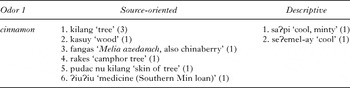
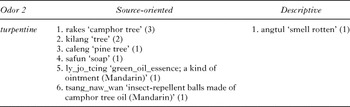
The odors ‘cinnamon’ and ‘turpentine’ are recognized as arborary substances. Most participants comment that the two odors smell similar, and cross-dialectal verbal responses also suggest that the two odors are conceptualized in the same category. In comparison, the odor ‘cinnamon’ has higher encoding consistency, as seven participants provide a tree-related response, and two participants consider the odor as ‘cool’, probably reminding them of ‘mint’. The odor ‘turpentine’ is less preferred by one participant who described it as ‘stinky’ (see Tables 7 and 8).
Responses for the odor ‘cinnamon’

Responses for the odor ‘turpentine’

The participants appear to be more familiar with the odor ‘lemon’. The source-oriented responses are related to citrus fruits such as orange and lemon (see Table 9).
Responses for the odor ‘lemon’

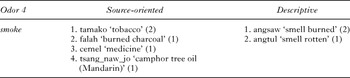
The odor ‘smoke’ is associated with the smell of tobacco or of burned charcoal. Most participants consider this smell as having the quality of being ‘burned’ (see Table 10).
Responses for the odor ‘smoke’

With five invalid tokens, the odor ‘chocolate’ is the most ineffable for half of the participants. Those who detected the smell shared a similar perception and provided verbal responses such as ‘candy’ and ‘coffee’, which are usually conceptually linked with ‘chocolate’ (see Table 11).
Responses for the odor ‘chocolate’

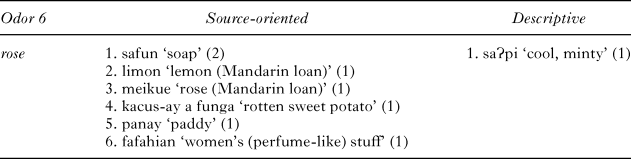
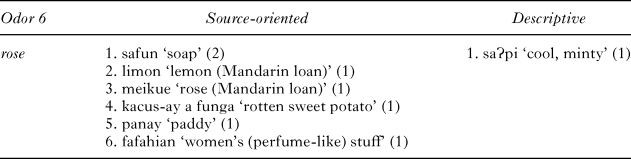
Although it is not as ineffable as the odor ‘chocolate’, the participants vary conceptually for the odor ‘rose’. Three of them resorted to the similar smell from soap or perfume. Only one of them identified the odor (see Table 12).
Responses for the odor ‘rose’
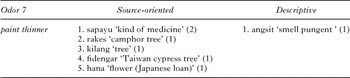
The verbal responses and reactions from the participants suggest that the odor ‘paint thinner’ is conceptualized in the same category as the odors ‘cinnamon’ and ‘turpentine’, as some participants commented that ‘It smells of tree again’. Two participants consider that it was a kind of medicine which they took during their childhood. One participant describes the smell as angsit, the odor term denoting the unpleasant smell of plants and insects (see Table 13).
Responses for the odor ‘paint thinner’

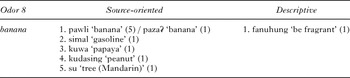
The odor ‘banana’ usually received the shortest reaction time during the task and was also the most identifiable odor as six participants provided the correct label. However, those who failed to identify the odor as ‘banana’ perceived it as different objects which appear to be conceptually unrelated (see Table 14).
Responses for the odor ‘banana’

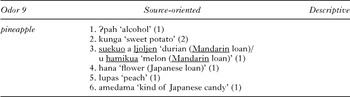
Compared with the odor ‘banana’, the odor ‘pineapple’ was perceived with difficulty. Only some responses were fruit-related (see Table 15).
Responses for the odor ‘pineapple’

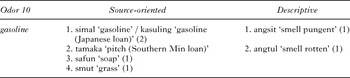
The odor ‘gasoline’ was identified by two participants, while one participant considered the smell as bitumen (or asphalt), a substance used for paving roads. It is perceived as sharing a similar chemical smell with that of gasoline. The descriptors angsit and angtul suggest that this odor was conceptualized as being similar to the smell of plants or that of rotten meat (see Table 16).
Responses for the odor ‘gasoline’

The odor ‘soap’ obtained two more valid tokens than the odor ‘chocolate’. However, having being identified by three participants, this odor was perceived with higher encoding consistency. Interestingly, two of the participants perceive the smell as arborary (see Table 17).
Responses for the odor ‘soap’

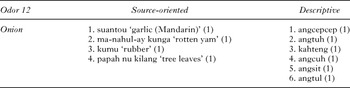
Among the twelve odors, the odor ‘onion’ induced the strongest emotional reaction, which is reflected linguistically. The participants expressed the perceived odor by using different descriptors, which are linked to the prototypical odorant sources of plants, burned rice, rotten food, urine, or feces (see Table 18).
Responses for the odor ‘onion’

4.3. implications
An odor triggers an episode from a participant’s memory and the verbal response is associated with his/her past experiences. When a participant was struggling with identifying or describing a certain smell, he/she resorted to past experiences. The tip-of-the-nose phenomenon was observed. Many participants responded that they had smelled the odor before but were unable to name it. Normally, the participants decided whether the odor was pleasant or unpleasant if they thought that the source could not be identified.
Several implications result from the second session. First, the data show that the odor with high consistency of verbal encoding is not necessarily the odor with a high degree of identification. For example, although ‘banana’ is the most identified odor, it is ‘cinnamon’ which is perceived more similarly among the participants.
Second, a high degree of odor identification is not necessarily linked to familiarity with a certain odor. For example, ‘banana’ and ‘pineapple’ are supposed to be familiar fruits for the participants, yet it is the former which is more easily identified, whereas the verbal responses to the latter vary.
Third, with source-oriented responses, most participants provided the lexical items which belong to the generic level in taxonomies, such as kilang ‘tree’, hana ‘flower’, or suekuo ‘fruit’ (since there are no generic terms for ‘flower’ and ‘fruit’ in Amis, the respective loanwords from Japanese and Mandarin are used).
Take the odors ‘cinnamon’, ‘turpentine’, and ‘paint thinner’, for example. The consistency is based on the lexical relations of taxonomies and meronomies. Under kilang ‘tree’ are its hyponyms rakes ‘camphor tree’, fangas ‘chinaberry’, caleng ‘pine tree’, and fidengar ‘Taiwan cypress’. On the other hand, the meronymic relation between kilang ‘tree’ and pudac ‘surface (of tree, fruit, egg, etc.)’ is considered an optional part−whole relationship. The term pudac is a facultative meronym of kilang since the former not only denotes the bark of a tree, but also fruit skin and eggshells. Linguistically, this relation is manifested by the possessive phrase pudac nu kilang, in which nu is a genitive case marker. The other term kasuy ‘wood’ is also semantically related, as it is ligneous.
Although the verbal responses of an odor differ among the participants, the odorant sources they perceive can still be semantically categorized. For example, the responses for ‘lemon’ are also highly consistent, as a taxonomic relation can be established. With the odor ‘pineapple’, the hypernym suekuo ‘fruit’ is provided, along with several hyponyms, including ‘durian’, ‘melon’, and ‘peach’.
The responses from the task suggest that linguistic expressions for a perceived odor are culturally dependent, even though this is not a cross-cultural study (cf. Chrea, Ferdenzi, Valentin, & Abdi, Reference Chrea, Ferdenzi, Valentin and Abdi2007). For example, the hyponyms of kilang ‘tree’ are commonly seen in the Amis living environment, among which fangas ‘chinaberry tree’ serves to indicate the arrival of spring when it blooms. The banana is the most productive native fruit, and the equivalent odor triggers fast identification.
As Chrea et al. (Reference Chrea, Ferdenzi, Valentin and Abdi2007) suggest, codability of an odor depends on culture both quantitatively and qualitatively. Familiarity comes into play when the link between odor perception and verbal expression is weak. Frequency of exposure to specific odors counts for a participant to fluently describe odorant sources. Memories also help to facilitate the ease of naming a perceived odor, thus a higher degree of consistency among the participants is likely to be obtained for familiar odors.
Finally, responses listed in the various tables also suggest that, though on average most of the participants adopt the source-oriented construction to express their perceived odors, abstract odor terms tend to be used when the smell is strong and repulsive. This is reflected in Table 18, where more than half of the responses are descriptive, including angcepcep, angtuh, kahteng, angcuh, angsit, and angtul. None of the other odors has received so many responses using abstract odor terms rather than the source-oriented construction. This further implies that abstract odor terms are primed by psychological effects triggered by abrupt unpleasant smells.
5. Concluding remarks
Amis, a Formosan language, represents another example with abundant olfactory terms. This paper investigated linguistic representations of olfaction in the Amis dialects. Moreover, the results of the scratch-and-sniff task by ten participants are presented to provide further implications with regard to olfactory conceptualization and consistency of odor encoding. As a conclusion the discussions in this paper are summarized as follows.
In total, seventeen mono-lexemic odor terms were found, though this is not meant to be exhaustive. The references of the odorant sources of these odor terms are described in detail, along with the data presenting their usage and syntactic distribution. The odor terms function as stative verbs, which can be reduplicated at predicate position.
Furthermore, the odor terms are structured, with taxonomic hierarchies based on two parameters: (1) psychological effects and (2) references of odorant sources. The former is based on the semantic feature [±pleasant], which distinguishes fangsis ‘be fragrant’ [+pleasant] from ma-sanek ‘smelly’ [−pleasant], with sanek-en ‘odor-uv, being smelt’ [ø pleasant] as the superordinate.
Based on the references of odorant sources, the odor terms under the node of ma-sanek are divided into four categories: nature-emitted, food-emitted, air/smoke-emitted, and effluvia-emitted. In Figure 3, there are three odor terms for each of the first three categories, and six odor terms for the last category. The odor term under the node of fangsis is fanuhung, whose references also extend to the gustatory domain.
The most common strategy to express odors morphologically is by attaching the proclitic hala= to a noun or a noun phrase denoting ‘to smell of X’, where X is an odorant source. The odor schema of [hala=(reduplication)X] is termed as ‘source-oriented construction’ (Majid et al., Reference Majid, Senft, Levinson and Majid2007), and is similar to the schema [prefix-(reduplication) X] described in Lee (Reference Lee2010a).
Dialectal variations are observed from some of the odor terms and the source-oriented construction. In the central dialects the proclitic is hala=. Its equivalent form in the northern dialects (including Sakizaya) is hali= and in the southern dialects is ha=. In the northern dialects, reduplication of the odorant noun X is obligatory, for there is a homophonous prefix hali- denoting the meaning of ‘to like, fancy X’. Therefore, reduplication serves as a device of homophony avoidance to express olfaction.
A scratch-and-sniff task was conducted to probe conceptualization of olfactory experiences by using the booklet of ‘The Smell Identification Test™’. The verbal responses for each of the twelve odors are divided into three categories: (1) source-oriented, (2) evaluative, and (3) descriptive (Majid et al., Reference Majid, Senft, Levinson and Majid2007). The result shows that 69% of the verbal responses were source-oriented, while 15% were evaluative and 16% descriptive.
Given that the purpose of the task is to elicit spontaneous expressions for describing odors rather than odor identification, a quantitative figure for measuring codability is irrelevant. However, the verbal responses show a high degree of consistency for certain odors such as ‘cinnamon’ and ‘banana’. It is assumed that olfactory perception is connected with past experiences of olfaction-related events. Cultural contexts and social constraints play vital roles in olfactory responses, which tend to trigger mnemonic process while describing a perceived odor.