INTRODUCTION
Children who are born prematurely and with very low birth weight (VLBW; birth weight ⩽1500 g) have a higher risk of speech and language problems at preschool age than children who are born at full term (e.g. Mikkola et al., Reference Mikkola, Ritari, Tommiska, Salokorpi, Lehtonen, Tammela, Pääkkönen, Olsen, Korkman and Fellman2005; Wolke, Samara, Bracewell & Marlow, Reference Wolke, Samara, Bracewell and Marlow2008). However, in clinical work, it is not always easy to identify at an early age those VLBW children who need support for their language development. The main purpose of the present study was to obtain information on the grammatical skills and the emergence of grammar in VLBW children at the end of the second year, when the first basic lexicon has been acquired and grammar begins to emerge. Earlier studies have suggested that VLBW children have developed significantly weaker grammatical skills than full-term controls by 2 ; 0 (corrected age; e.g. Foster-Cohen, Edgin, Champion & Woodward, Reference Foster-Cohen, Edgin, Champion and Woodward2007; Stolt, Lehtonen, Haataja, Lapinleimu & the PIPARI Study Group, Reference Stolt, Lehtonen, Haataja and Lapinleimu2011). The present study offers further analysis of early morphosyntactical development in VLBW children: an analysis of the emergence of grammar in relation to the size of the expressive lexicon. Recent studies have suggested that early grammar emerges in close association with the growth of expressive lexicon size in full-term children (e.g. Bates & Goodman, Reference Bates, Goodman and MacWhinney1999; Conboy & Thal, Reference Conboy and Thal2006). However, no detailed analysis of how early grammar emerges in VLBW children at the end of the second year has been presented previously (see, however, Sansavini, Guarini, Alessandroni, Faldella, Giovanelli & Salvioli, Reference Sansavini, Guarini, Alessandroni, Faldella, Giovanelli and Salvioli2006).
Language development of the VLBW children at the end of the second year
The reported findings are not consistent as to whether the expressive lexicon size of VLBW children differs significantly from that of full-term controls at 2 ; 0 years of corrected age, although the values of prematurely born children tend to be lower than those of full-term control children (Foster-Cohen et al., Reference Foster-Cohen, Edgin, Champion and Woodward2007; Kern, Reference Kern2007; Stolt et al., Reference Stolt, Klippi, Launonen, Munck, Lehtonen, Lapinleimu and Haataja2007). The composition of the expressive lexicon during the second year has been reported to develop at a significantly slower rate in VLBW children than in control children (Stolt, Haataja, Lapinleimu & Lehtonen, Reference Stolt, Haataja, Lapinleimu and Lehtonen2009a). However, if the compositional development of the lexicon is analyzed in relation to lexicon size, it takes place qualitatively in a near-parallel manner for VLBW children as for controls (Stolt et al., Reference Stolt, Klippi, Launonen, Munck, Lehtonen, Lapinleimu and Haataja2007; Stolt et al., Reference Stolt, Haataja, Lapinleimu and Lehtonen2009a; see also Menyuk, Liebergott & Schultz, Reference Menyuk, Liebergott and Schultz1995). At the corrected age of 2 ; 6, the percentage of words in the different lexical word classes in the expressive lexicon of VLBW children (born ⩽33 gestational weeks and weighing ⩽1600 g at birth) has been reported to be comparable to that of full-term children (Sansavini et al., Reference Sansavini, Guarini, Alessandroni, Faldella, Giovanelli and Salvioli2006). Nevertheless, in the same study, the VLBW children's group included significantly more children with a very small lexicon size at 2 ; 6 than the control group.
The overall language performance of VLBW children has been reported to be significantly poorer than the performance of full-term controls at the end of the second year (Jansson-Verkasalo, Valkama, Vainionpää, Pääkkö, Ilkko & Lehtihalmes, Reference Jansson-Verkasalo, Valkama, Vainionpää, Pääkkö, Ilkko and Lehtihalmes2004; Stolt et al., Reference Stolt, Haataja, Lapinleimu and Lehtonen2009a; Jansson-Verkasalo et al. did not use age correction; in Stolt et al. the age was corrected). In addition, it has been demonstrated that morphosyntactical development (i.e. the utterance length) is weaker in VLBW groups than in control groups at 2 ; 0 years of corrected age (e.g. Foster-Cohen et al., Reference Foster-Cohen, Edgin, Champion and Woodward2007; Kern, Reference Kern2007). It is also possible that the early grammatical development of VLBW children does not proceed in a parallel manner to that of full-term children at the end of the second year. We compared the early grammatical development of VLBW children (N = 32) to that of full-term controls (N = 35) at 1 ; 6 and at 2 ; 0 (corrected ages) in a longitudinal study (Stolt et al., Reference Stolt, Lehtonen, Haataja and Lapinleimu2011). The data was analyzed from the language used in videotaped mother–child interactions and gathered using the Finnish version of the Communicative Development Inventory (FinCDI) at both age points. Very few significant differences in early grammatical development were found between the groups at 1 ; 6, but at 2 ; 0 the early grammatical development of the VLBW children was clearly and significantly weaker than that of the controls. Thus, the findings suggested that grammar emerges in a different manner in VLBW children than in full-term children at the end of the second year. In the present study we wanted to analyze the emergence of grammar in VLBW children in a more detailed manner.
Grammatical development at the end of the second years
In most children, grammar begins to emerge in the second half of the second year. At the lexical level, this development is manifested as an increase in the number of different word classes, and especially as an increase in the number of verbs and grammatical function words (e.g. Bates, Dale & Thal, Reference Bates, Dale, Thal, Fletcher and MacWhinney1995; Bates et al., Reference Bates, Marchman, Thal, Fenson, Dale, Reznick, Reilly and Hartung1994; Caselli, Casadio & Bates, Reference Caselli, Casadio and Bates1999; Stolt et al., Reference Stolt, Haataja, Lapinleimu and Lehtonen2009a). The development of lexical word classes is linked to an increase in vocabulary size, and not necessarily to the age of the child (e.g. Bates et al., Reference Bates, Dale, Thal, Fletcher and MacWhinney1995; Stolt, Haataja, Lapinleimu & Lehtonen, Reference Stolt, Haataja, Lapinleimu and Lehtonen2009b; Thordardottir, Weismer & Evans, Reference Thordardottir, Weismer and Evans2002). Since the lexicon size of two-year-olds varies considerably, the number of verbs and grammatical function words in the lexicon of individual children likewise varies considerably at this age.
Children begin to produce morphology and syntax during the second half of the second year. The number of inflectional types increases within a relatively short period (Bittner, Dressler & Kilani-Schoch, Reference Bittner, Dressler and Kilani-Schoch2003). Finnish children need to acquire many different morphological inflections due to the structure of their native language (e.g. Laalo, Reference Laalo, Voeikova and Dressler2002; Reference Laalo, Bittner, Dressler and Kilani-Schoch2003; Toivainen, Reference Toivainen1997). Finnish is an agglutinative language in which grammatical and case relations are expressed primarily by using suffixes (Dasinger, Reference Dasinger and Slobin1997; Toivainen, Reference Toivainen1997). The morphology of Finnish is rich. The nominal words (i.e. nouns, adjectives, pronouns and numerals) are inflected by using fifteen different case forms (e.g. ‘in the house’ – talossa; ‘from the house’ – talosta; ‘to the house’ – taloon) and verbs are inflected using verb inflections. Finnish has a system of subject–verb agreement: finite verbs are inflected with one of six person–number suffixes. In addition, the verbal morphology for finite verbs can express voice (active, passive) and mood (indicative, imperative, conditional, potential) and tense (past, non-past; e.g. Dasinger, Reference Dasinger and Slobin1997; Laalo, Reference Laalo, Voeikova and Dressler2002; Reference Laalo, Bittner, Dressler and Kilani-Schoch2003; Toivainen, Reference Toivainen1997). The majority of children acquiring English use word combinations at 2 ; 0 (Bates et al., Reference Bates, Dale, Thal, Fletcher and MacWhinney1995). The findings related to the emergence of word combinations in Finnish children are parallel to those reported for English children (Stolt et al., Reference Stolt, Haataja, Lapinleimu and Lehtonen2009b).
There has been discussion in the literature as to why and how grammar begins to emerge (e.g. Bates & Goodman, Reference Bates, Goodman and MacWhinney1999). The debate has revolved around whether the grammar develops independently from lexical growth, or in association with it. This question is particularly interesting due to the very high variation in lexicon size between individual children at the end of the second year. Several studies focusing on the grammatical development of children acquiring different target languages have reported that early grammatical development (i.e. the morphological development, the utterance length, the emergence of word combinations) is closely linked to the growth of the expressive lexicon in full-term children (e.g. Anisfeld, Rosenberg, Hoberman & Gasparini, Reference Anisfeld, Rosenberg, Hoberman and Gasparini1998; Bates et al., Reference Bates, Dale, Thal, Fletcher and MacWhinney1995; Caselli et al., Reference Caselli, Casadio and Bates1999; Thordardottir et al., Reference Thordardottir, Weismer and Evans2002; Szagun, Steinbrink, Franik & Stumper, Reference Szagun, Steinbrink, Franik and Stumper2006). In our earlier study (Stolt et al., Reference Stolt, Haataja, Lapinleimu and Lehtonen2009b), the emergence of grammar and its relation to lexicon size was analyzed in a group of two-year-old, full-term Finnish children (N = 181). The results showed that Finnish children acquire their early morphology in relation to lexicon size: case inflections were acquired in relation to nominal lexicon size, and verb inflections in relation to verb lexicon size. In addition, the emergence of word combinations was linked to the growth of vocabulary size. One of the aims of the present study is, therefore, to analyze the emergence of early grammar in relation to lexicon size in VLBW children. To our knowledge, this subject has been analyzed in only one study thus far (Sansavini et al., Reference Sansavini, Guarini, Alessandroni, Faldella, Giovanelli and Salvioli2006), and it was found that in a group of 73 VLBW children at 2 ; 6 (corrected age), the correlation coefficient values between grammatical and lexical variables were high, significant and comparable to those detected in the control group of 22 control children.
The question of whether early grammar develops in relation to lexicon growth or separately from it is linked to the question of modularity (e.g. Bates & Goodman, Reference Bates and Goodman1997; Reference Laalo, Bittner, Dressler and Kilani-Schoch1999). Regarding linguistic skills, grammar can be seen as a separate module from the lexicon and thus developing independently from vocabulary growth. However, recent findings have generated evidence that contradicts this view (e.g. Conboy & Thal, Reference Conboy and Thal2006). Since both lexicon and grammar develop very actively at the end of second year and at the beginning of the third year, it is important to analyze whether grammar emerges in a parallel manner in VLBW children to full-term children when analyzed in relation to lexicon size, or whether very premature birth has any influence on this developmental phenomenon.
Aims of the study
The main aim of the present study was to obtain information on the emergence of grammar in prematurely born VLBW children at two years of age. First, the aim was to compare the grammatical skills of VLBW children to those of full-term controls at a group level at 2 ; 0. Second, the aim was to gain information on how grammar (i.e. verbs and closed-class words in the lexicon, number of morphological inflections, utterance length, use of word combinations) emerges in VLBW children when the possible effect of lexicon size is taken into consideration. We also wanted to analyze the emergence of the two inflectional systems of Finnish (case forms and verb inflections) in relation to the size of that lexicon in which they are used (case forms vs. nominal lexicon size, verb inflections vs. verb lexicon size) in VLBW children, and to compare it to that of full-term control children.
In the present study, we report findings from the sample of VLBW and full-term children that has been described in previously published works. The size and composition of the lexicon of the group of VLBW children who belong to the present sample of VLBW children has been analyzed in detail and reported (Stolt et al., Reference Stolt, Klippi, Launonen, Munck, Lehtonen, Lapinleimu and Haataja2007). The emergence of grammar in relation to lexicon size has been analyzed in a sample of full-term children who belong to the present control group (Stolt et al., Reference Stolt, Haataja, Lapinleimu and Lehtonen2009b). In the present study, the emergence of grammar at two years of age is analyzed in a regional six-year cohort of VLBW children. This data has not been reported in earlier studies.
METHOD
Subjects
The subjects were VLBW children who took part in a longitudinal, six-year regional cohort study (Development and Functioning of Very Low Birth Weight Infants from Infancy to School Age; the PIPARI Study). All VLBW children who were born at the Turku University Hospital and met the inclusion criteria were invited to participate in the PIPARI study during their stay in the neonatal intensive care unit. The inclusion criteria for the prematurely born children were as follows: (1) from the beginning of 2001, the birth weight of the child ⩽1500 g, and from the beginning of 2004, the birth weight of the child ⩽1500 g and/or born ⩽31 + 6 gestational weeks including larger infants if born <32 weeks of gestation,; (2) the parent understands Finnish or Swedish sufficiently to be able to complete the follow-up forms; and (3) the family lives in the Turku University Hospital catchment area. A total of 278 VLBW children met the inclusion criteria between January 2001 and December 2006. Out of the 278 children, 42 died and 9 families declined to participate. At two years of age (the corrected age was used for VLBW children, that is, the age calculated from the expected date of delivery, not from the actual birth date), the parents of the VLBW children (N = 227) were asked to complete the Finnish version of the Communicative Development Inventory (CDI: Fenson, Dale, Reznick, Bates, Thal & Pethick, Reference Fenson, Dale, Reznick, Bates, Thal and Pethick1994; FinCDI: Lyytinen, Reference Lyytinen1999) and to return it by post within two weeks. The inventories of 178 children (78%) were returned. Out of those, 21 inventories were excluded because the family spoke a language or languages other than Finnish at home and 1 was excluded because it had been incompletely filled in. The final study group consisted of 156 VLBW children growing up in monolingual, Finnish-speaking families.
The children in the control group were born at Turku University Hospital between November 2001 and March 2004. The first healthy, full-term (i.e. normal birth weight, no admissions to the neonatal intensive care unit, born at 37 gestational weeks or later) boy and girl of the week were invited to participate in the study during their stay in the maternity ward. A sample of 200 children was collected. When the children reached the age of two years, the FinCDI form was given to the 193 families (98%) to be filled in and returned within two weeks by post. The inventories of 164 (85%) children were returned. Of those, 16 were excluded because the family used a language other than Finnish at home, and 2 were excluded because they had been incompletely filled in. The final sample consisted of 146 inventories of full-term children growing up in monolingual, Finnish-speaking families.
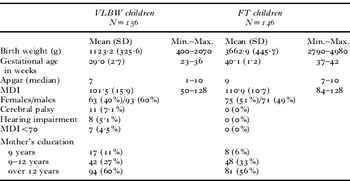
The background characteristics of the children are presented in Table 1. At the time the FinCDI was completed, the mean corrected age of the VLBW children was 2 ; 0·7 (SD 11 days; the chronological mean: 2 ; 2·33, SD 20 days), and the mean age of the full-term children was 2 ; 0·12 (SD 11 days). There were no significant differences between the groups in terms of gender distribution (χ2(1) = 3·67, p = 0·06) or in the basic education of the mother (χ2(2) = 3·73, p = 0·16). The mental developmental index (MDI) as measured by the Bayley Scales of Infant Development (BSID II, Bayley, Reference Bayley1993) at two years of corrected age was significantly lower in the VLBW than in the full-term children (t(298) = 6·01, p < 0·001).
Child and parent characteristics of very-low-birth-weight and full-term children

Notes: VLBW = very-low-birth-weight children, FT = full-term children, N = number of subjects, SD = standard deviation, Min.–Max. = minimum and maximum values of the group, MDI = Bayley Scales mental developmental index.
The mother's education percentages were computed from the information available. Education data was missing for twelve mothers.
The study protocol of the Development and Functioning of Very Low Birth Weight Infants from Infancy to School Age study was approved by the Ethical Committee of the Hospital District of Southwest Finland in December 2000 (VLBW children) and in September 2001 (full-term children).
Materials
The standardized Finnish version of the Communicative Development Inventory (CDI; Fenson et al., Reference Fenson, Dale, Reznick, Bates, Thal and Pethick1994; FinCDI; Lyytinen, Reference Lyytinen1999) was used to collect the data on language development. The CDI is a well-known structured parental rating method, and it has been shown to be reliable and valid in many studies (e.g. Fenson et al., Reference Fenson, Dale, Reznick, Bates, Thal and Pethick1994; Reference Fenson, Marchman, Thal, Dale, Reznick and Bates2007; FinCDI: Lyytinen, Reference Lyytinen1999; Stolt et al., Reference Stolt, Haataja, Lapinleimu and Lehtonen2009a; Reference Stolt, Haataja, Lapinleimu and Lehtonen2009b). The CDI consists of a vocabulary checklist and sections measuring grammatical growth. The vocabulary checklist has been modified to be a representative index of the early lexicon. The vocabulary checklist of the FinCDI consists of 595 items presented in 20 semantic categories. The criteria for a word (1: the word is used spontaneously and not only imitated; 2: the word is connected repeatedly to the same referent) are specified on the FinCDI form. The grammar section of the FinCDI differs slightly from that of the English version (Lyytinen, Reference Lyytinen1999; Lyytinen, Poikkeus, Leiwo, Ahonen & Lyytinen, Reference Lyytinen, Poikkeus, Leiwo, Ahonen and Lyytinen1996; Fenson, Marchman, Thal, Dale, Reznick & Bates, Reference Fenson, Marchman, Thal, Dale, Reznick and Bates2007). It consists of three parts. The first part, The plural ending and case forms, is divided into 9 subsections, each reflecting the single most typical morphological ending of nominal words (plural ending, genitive, partitive, inessive, elative, illative, adessive, ablative and allative). The second part, Verb inflections, is divided into 7 subsections, each asking about the use of a single verbal inflection (the 2nd person singular or S2 imperative, 3S negative present tense, 3S indicative present tense, 1S indicative present tense, 3S indicative preterite, passive and 3S indicative perfect). Each subsection presents one suffix, provides examples of its use and asks the parents to indicate whether their child uses the suffix ‘never’, ‘sometimes’ or ‘often’. The third part of the grammar section of the FinCDI inquires as to whether or not the child combines words (‘yes’ or ‘no’). The parents are also requested to write out the three longest utterances used most recently by their child.
The lexical variables that were used in the present study were adapted from the studies by Bates et al. (Reference Bates, Marchman, Thal, Fenson, Dale, Reznick, Reilly and Hartung1994) and Caselli et al. (Reference Caselli, Casadio and Bates1999) and modified slightly to meet the needs of present study (compare Stolt et al., Reference Stolt, Haataja, Lapinleimu and Lehtonen2009b). The variables used in the present study were: (1) total number of words (i.e. lexicon size); (2) number of nominal words in the lexicon (i.e. nouns, pronouns and adjectives); (3) verbs (i.e. action words); and (4) closed-class words (i.e. prepositions, question words, quantifiers and connectives). The category of nominal words was used, and not the category of nouns, because the objective of the present study was to analyze the emergence of two inflectional systems of Finnish (i.e. case forms, verb inflections) in relation to the size of the lexicon in which these inflections are used in VLBW children. Nominal words (i.e. nouns, adjectives, numerals and pronouns) are inflected in Finnish by using case forms. As numerals are not included in the FinCDI, the category of nominal words included all nouns, adjectives and pronouns marked in the FinCDI form. Furthermore, following the procedure of Bates et al. (Reference Bates, Marchman, Thal, Fenson, Dale, Reznick, Reilly and Hartung1994) and Caselli et al. (Reference Caselli, Casadio and Bates1999), some potential nominals were excluded from the category of nouns, because they may follow a different developmental course from ‘true nominals’ in the early stages of language acquisition. The words that were excluded were the words marked in the following categories of the FinCDI form: ‘games and routines’, ‘sound effects’, ‘names for people’ and ‘places to go’ (Bates et al., Reference Bates, Marchman, Thal, Fenson, Dale, Reznick, Reilly and Hartung1994). The category of closed-class words differed also slightly from that used in earlier studies (e.g. Bates et al., Reference Bates, Marchman, Thal, Fenson, Dale, Reznick, Reilly and Hartung1994; Caselli et al., Reference Caselli, Bates, Casadio, Fenson, Fenson, Sanderl and Weir1995; Caselli et al., Reference Caselli, Casadio and Bates1999). In the present study, pronouns were not included in this category because they were included in the category of nominal words.
The grammatical variables that were used in the present study were as follows. In the grammar section, the parents' responses were coded as ‘no’ (=not yet) and ‘yes’ (=sometimes, often), and the number of case forms and verb inflections marked in the FinCDI form were calculated for each child. Each child got a number of case form types (plural form included) that could vary between 0 and 9, and a number of verb inflectional types that could vary between 0 and 7 in individual children. The mean length of the longest utterances (M3L) was counted in morphemes from the three longest utterances reported by the mother. Frozen phrases (e.g. songs, counting, etc.) were excluded from the analysis. Whether the child combines words (‘yes’/‘no’) was coded.
Analysis
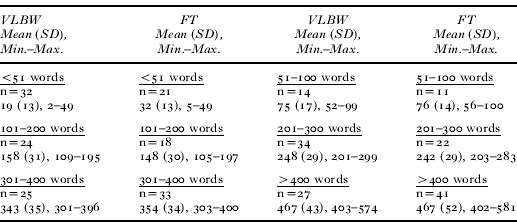
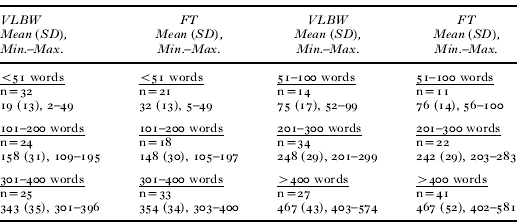
The values of the VLBW children were first compared to the values of the controls at the group level. Then the emergence of grammar in relation to lexicon size was analyzed in the VLBW children and compared to that of the controls. To describe how grammar emerges if analyzed in relation to lexicon size, all the lexicons were divided into subgroups according to lexicon size in the FinCDI, and different grammatical values were presented in lexicon size subgroups for the VLBW and full-term children separately. The subgroups, the descriptive statistics of each group and the numbers of VLBW and full-term children in each group are presented in Table 2. The subgroups that were used were parallel to those used in earlier studies (e.g. Bates et al., Reference Bates, Marchman, Thal, Fenson, Dale, Reznick, Reilly and Hartung1994; Bates et al., Reference Bates, Dale, Thal, Fletcher and MacWhinney1995; Bates & Goodman, Reference Bates, Goodman and MacWhinney1999; Caselli et al., Reference Caselli, Casadio and Bates1999; Conboy & Thal, Reference Conboy and Thal2006; Stolt et al., Reference Stolt, Haataja, Lapinleimu and Lehtonen2009b). After the description, the effect of very premature birth and lexicon size on the emergence of grammar in VLBW children was analyzed and compared to that of the controls.
Lexicon size subgroups and the numbers of very-low-birth-weight (VLBW) and full-term (FT) children in each subgroup. The mean value, standard deviation, and minimum and maximum value of the group are presented
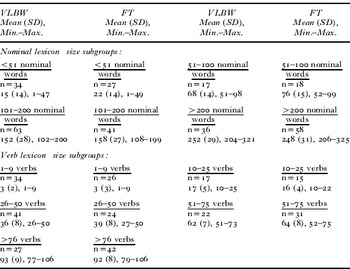
In the third stage of the analyses, the emergence of the two inflectional systems of Finnish was analyzed in relation to the size of the lexicon in which they are primarily used (i.e. nominal inflections vs. nominal lexicon, verb inflections vs. verb lexicon). The emergence of the two inflectional systems of Finnish was first described in relation to the size of the lexicon in which they are primarily used for VLBW and full-term children separately. For the description, the children were divided into subgroups according to the size of their nominal and verb lexicon. The grouping was parallel to that used in earlier studies focusing on the emergence of grammar analyzed in relation to lexicon size (e.g. Bates & Goodman, Reference Bates, Goodman and MacWhinney1999; Thordardottir et al., Reference Thordardottir, Weismer and Evans2002; Stolt et al., Reference Stolt, Haataja, Lapinleimu and Lehtonen2009b) and is presented in Table 3. After the description, the effect of nominal lexicon/verb lexicon size and very premature birth on the emergence of nominal inflections/verb inflections was analyzed. Lastly, the correlations between lexicon size and M3L value, as measured using the FinCDI, and the MDI value, as measured using the Bayley test, were calculated to gain information on what kind of information maternal ratings provide in relation to values measured through formal test.
Nominal and verb lexicon size subgroups and the numbers of very-low-birth-weight (VLBW) and full-term children (FT) in each subgroup. The mean value, standard deviation, and minimum and maximum value of the groups are presented

Note: Six VLBW children and two full-term children had no nominal words, and they are excluded from the analysis of the emergence of the case forms in relation to the growth of nominal lexicon. Fifteen VLBW children and eight full-term children had no verbs, and they were excluded from the analysis of the emergence of verb inflections in relation to the growth of verb lexicon.
RESULTS
Comparison of the values of the VLBW and full-term children at 2 ; 0
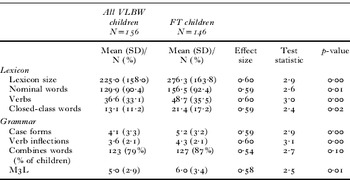
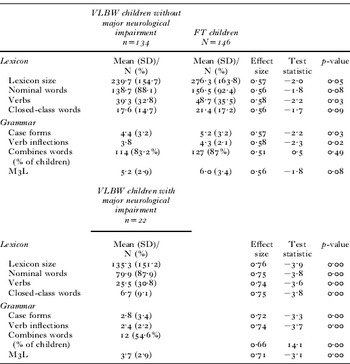
The descriptive statistics and the group comparisons for the entire sample of VLBW children and for the full-term children are presented in Table 4. The descriptive statistics and comparisons to the control group are presented separately for the subgroups of VLBW children (i.e. children without and with major neurological impairment) in Table 5. A major neurological impairment was defined as cerebral palsy, mental retardation (MDI value <70) or bilateral hearing loss (>40 dB) diagnosed during the first two years.
Descriptive statistics and the group comparison for the emergence of grammar in the entire cohort of very-low-birth-weight (VLBW) children and in the full-term (FT) children at two years of age

Notes: M3L = mean length of the three longest utterances counted in morphemes, SD = standard deviation, N = number of subjects.
The following words were included in the group of nominal words: nouns, adjectives and pronouns. The following words were included in the group of closed-class words: prepositions, quantifiers, question words and connectives.
The comparisons between the two continuous variables were made using the Wilcoxon Two-Sample Test, and the comparison between categorical variables (i.e. use of word combinations) using the Chi-Square Test. The effect size provides an estimate for the probability that the value of the variable for an individual in the control group will exceed the value for a randomly selected individual from the VLBW group.
Descriptive statistics for the emergence of grammar in the group of very-low-birth-weight (VLBW) children with and without major neurological impairment at two years of age. Group comparisons are also presented

Notes: M3L = mean length of the three longest utterances counted in morphemes, SD = standard deviation, FT = full-term children.
The following words were included in the group of nominal words: nouns, adjectives and pronouns. The following words were included in the group of closed-class words: prepositions, quantifiers, question words and connectives.
The comparisons between two continuous variables were made using the Wilcoxon Two-Sample Test, and the comparison between categorical variables (i.e. use of word combinations) using the Chi-Square Test. The effect size provides an estimate for the probability that the value of the variable for an individual in the control group will exceed the value for a randomly selected individual from the VLBW group.
A Wilcoxon Two-Sample Test was used to make comparisons between the two continuous variables and a Chi Square Test was used to analyze whether there were any significant differences in the categorical variables between the groups. All other values, except the percentage of children who used word combinations at 2 ; 0, were significantly weaker in the VLBW children than in the control group when the values of the entire cohort of VLBW children were analyzed (Table 4). When the values of VLBW children who had no major neurological impairment were compared to those of the controls, the VLBW children had a significantly smaller lexicon size and their lexicon included fewer verbs. In addition, the number of acquired case forms and verb inflections were lower than in the control group (Table 5). All the values of those VLBW children who had a major neurological impairment were significantly weaker than those of the control children.
The effect of lexicon size and very premature birth on the emergence of grammar
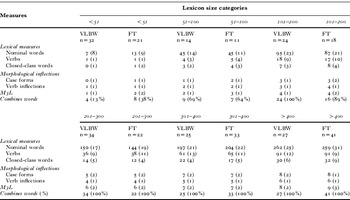
In Table 6, the mean values and standard deviations for the variables used in the present study are presented in relation to lexicon size for the VLBW children and the control children. The values show that, in general, the emergence of grammar took place in a parallel manner for the VLBW children as for the controls when it was described in relation to lexicon size.
The emergence of grammar in very-low-birth-weight (VLBW) children and in full-term (FT) children presented in relation to lexicon size. The mean values and standard deviation, or the number and percentage of children, for the VLBW children and full-term children in each lexicon size subgroup are presented

The emergence of M3L value as a function of vocabulary size is presented in Figure 1a for the VLBW children and in Figure 1b for the controls. The median and 10th, 25th, 75th and 90th percentile values of each lexicon size subgroup are presented for both groups. Generally, the figures show parallel median curves for both groups.
The mean length of the three longest utterances as calculated in morphemes (M3L) presented in relation to vocabulary size in very-low-birth-children (Figure 1a) and full-term children (Figure 1b).

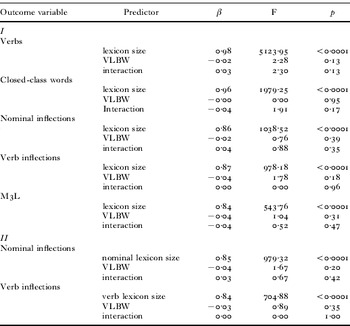
Multiple regression analysis was used to analyze the effect of lexicon size, the effect of very premature birth, and the combined effect of lexicon size and very premature birth on the emergence of grammar. The analyzed grammatical variables (i.e. outcome variables) were: number of verbs and grammatical function words in the lexicon, number of nominal and verb inflections and mean length of the three longest utterances (M3L value). These continuous measures were used as outcome variables in the multiple regression models, and lexicon size, very premature birth and the interaction between lexicon size and very premature birth were used as predictors. Specifically, it was asked whether lexicon size influenced the outcome variables and whether the outcome variables were lower in VLBW children than in the control children when the lexicon size is controlled. The interaction between lexicon size and very premature birth was used to study whether the association between the lexicon size and the outcome variable differs between the VLBW children and the controls.
The results of the multiple regression analysis are presented in Table 7. The effect sizes of multiple regression analysis are presented using the standardized regression coefficients (β). The finding was the same in all five analyses: lexicon size had a significant effect on the emergence of the grammatical variable, the outcome variables did not differ between the groups of VLBW and full-term children when the lexicon size was taken into consideration, and the effect of lexicon size on the outcome variables did not differ in the VLBW children when compared to that of the controls.
Results of multiple regression analysis (I – Effect of lexicon size on the emergence of grammar, II – Effect of nominal/verb lexicon size on the emergence of nominal inflections/verb inflections)

Note: M3L – mean length of the three longest utterances calculated in morphemes.
Logistic regression analysis was used to analyze the effect of premature birth and lexicon size on the emergence of word combinations. The emergence of word combinations was used as an outcome variable, and lexicon size, very premature birth and the interaction between them were used as predictors in this analysis. The effect sizes of the logistic regression analyses are presented using Nagelker's pseudo R square change (ΔR2). The effect of lexicon size on the emergence of word combinations differed between the groups of VLBW and full-term children as the interaction between very premature birth and lexicon size was significant (χ2 = 4·7, ΔR2 = 0·01, p = 0·03). Full-term children with a small lexicon size used word combinations more often than VLBW children, but when a child acquired more words, the VLBW children caught up to the controls. The model estimated that when a child produced 25 words, 11% of the VLBW children and 29% of the full-term children used word combinations. When the lexicon size was 50 words, 41% of the VLBW children and 47% of the controls used words combinations, and when the lexicon size was 75 words, the values were 80% and 65% respectively. When the lexicon size was >200 words, all children used word combinations (see Table 6). Since the effect of lexicon size on the emergence of word combinations differed between the groups of VLBW and full-term children, the analysis was repeated in the groups of VLBW children without major neurological impairment and the controls. In this analysis, the effect of lexicon size on the emergence of word combination did not differ between the groups of VLBW and full-term children (χ2 = 2·7, ΔR2 = 0·01, p = 0·10).
Emergence of morphological inflections analyzed in relation to respective lexicon size
Emergence of case forms analyzed in relation to nominal lexicon size
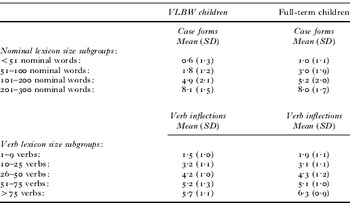
The mean values and standard deviations for the number of acquired case forms in different nominal lexicon size subgroups in VLBW and full-term children are presented in Table 8 and the results of multiple regression analysis are presented in Table 7. The effect of nominal lexicon size on the emergence of nominal inflections did not differ between the groups of VLBW and full-term children.
The emergence of case forms and verb inflections presented in relation to respective lexicon size in very-low-birth-weight (VLBW) and full-term (FT) children

Note: SD = standard deviation.
Emergence of verb inflections analyzed in relation to verb lexicon size
The mean values and standard deviations for the number of verb inflections that the children had acquired in different verb lexicon size subgroups for VLBW children and for full-term controls are presented in Table 8, and the results of the multiple regression analysis are presented in Table 7. The effect of verb lexicon size on the emergence of verb inflections did not differ between the groups of VLBW and full-term children.
Correlations between the values derived from the FinCDI and BSID II
In the group of VLBW children, the Pearson's correlation coefficient value between lexicon size and MDI value was r = 0·71, p < 0·0001, and between M3L value and MDI value r = 0·68, p < 0·001. Respectively, in the control group, the Pearson's correlation coefficient value between lexicon size and MDI value was r = 0·76, p < 0·0001, and between M3L value and MDI value, r = 0·80, p < 0·001.
DISCUSSION
The main aim of the present study was to gain information on the emergence of grammar in a six-year regional cohort of VLBW children. Specifically, we wanted to analyze whether the grammatical skills of the VLBW children differ from those of the full-term children at two years of corrected age. In addition, we wanted to gain information on how grammar emerges in VLBW children when the possible effect of lexicon size is taken into consideration. At the group level, the values of the VLBW children were significantly weaker than those of the controls. This result is in line with previously published findings. Both Foster-Cohen et al. (Reference Foster-Cohen, Edgin, Champion and Woodward2007) and Kern (Reference Kern2007) have reported, in studies based on a parallel method to the one used in the present study, that VLBW children had a significantly smaller lexicon size and weaker grammatical development than full-term children at two years of age. However, the results of the present study differ slightly from our earlier findings (Stolt et al., Reference Stolt, Klippi, Launonen, Munck, Lehtonen, Lapinleimu and Haataja2007), which indicated no significant difference in lexicon size between VLBW and full-term children at 2 ; 0. This difference between findings may be due to fact that the samples of VLBW and full-term children in our earlier study were smaller than those in the present study.
When the VLBW children with a major neurological impairment were excluded, many values of the VLBW children remained significantly weaker than those of the control group. Parallel findings have been presented. For example, Wolke and Meyer (Reference Wolke and Meyer1999) reported that the speech and language skills in a group of VLBW children were significantly weaker than those of the control group, when the children diagnosed with major neurological disability were excluded from the analysis (see also Luoma, Herrgård, Martikainen & Ahonen, Reference Luoma, Herrgård, Martikainen and Ahonen1998; Stolt et al., Reference Stolt, Haataja, Lapinleimu and Lehtonen2009a). Thus, the higher incidence of major neurological impairments does not explain the weaker language skills in this group.
Even though grammar emerged at a slower rate in the VLBW children, it emerged in a manner comparable to that of the controls when effect of lexicon size was taken into consideration. Sansavini et al. (Reference Sansavini, Guarini, Alessandroni, Faldella, Giovanelli and Salvioli2006) analyzed the relationship between lexical and grammatical development in VLBW children slightly older than those in the present study, and reported a high correlation coefficient value between lexical and grammatical measures in VLBW children to those found in the control group. The present findings are in line with those reported by Sansavini et al. (Reference Sansavini, Guarini, Alessandroni, Faldella, Giovanelli and Salvioli2006) . Further, in our earlier studies (Stolt et al., Reference Stolt, Klippi, Launonen, Munck, Lehtonen, Lapinleimu and Haataja2007; Stolt et al., Reference Stolt, Haataja, Lapinleimu and Lehtonen2009a), the composition of the lexicon in relation to lexicon size in VLBW children was analyzed. It was found that, although the VLBW children had significantly fewer verbs, nouns, adjectives and social terms in their expressive vocabularies than the controls at two years of corrected age, most of the differences in the composition of the lexicon between groups were no longer significant when the compositional development was analyzed in relation to the lexicon size. The present study provided information on the emergence of grammar in VLBW children and showed that grammar also emerges in relation to expressive lexicon in a parallel manner in the VLBW children's group as it does in the control group. Thus, it seems that the growth of expressive lexicon size during the second year is an important indicator of early language development in VLBW children, as it is in full-term children. Both the acquisition of different word categories and the acquisition of early grammar are tied to early expressive lexicon growth. The present finding is in accordance with the reported results of the close association between lexical and grammatical growth in full-term children at the end of the second year (e.g. Anisfeld et al., Reference Anisfeld, Rosenberg, Hoberman and Gasparini1998; Bates et al., Reference Bates, Dale, Thal, Fletcher and MacWhinney1995; Bates & Goodman, Reference Bates, Goodman and MacWhinney1999; Caselli et al., Reference Caselli, Casadio and Bates1999; Thordardottir et al., Reference Thordardottir, Weismer and Evans2002; Stolt et al., Reference Stolt, Haataja, Lapinleimu and Lehtonen2009b).
There were more VLBW children than full-term children who did not use word combinations among those with a very small lexicon at the age of two. However, when this comparison was repeated in a sample of healthy VLBW children (i.e. children with major neurological impairment were excluded), no differences emerged between the groups. This finding suggests that there may be qualitative differences in the early grammatical development between those VLBW children who have a major neurological impairment and full-term children with small lexicon sizes at two years of corrected age.
Although the grammatical skills of the VLBW children were studied quite widely in the present study, the analysis did not cover receptive language. It is important to take this into consideration when applying the results in a clinical context, especially since it has been reported that VLBW children have weaker receptive language skills than full-term children at two years of corrected age (e.g. Stolt et al., Reference Stolt, Haataja, Lapinleimu and Lehtonen2009a). Thus, the results of the present study only provide information on the language areas presented (i.e. expressive lexical and grammatical knowledge at 2 ; 0), and they do not provide a comprehensive description of the linguistic skills of VLBW children.
The values obtained by using the parental rating method correlated significantly with the values measured through formal tests. This finding gives further support for the reliability and the use of the structured maternal rating method when evaluating the language skills of very young children (compare also Fenson et al., Reference Fenson, Dale, Reznick, Bates, Thal and Pethick1994; Fenson et al., Reference Fenson, Marchman, Thal, Dale, Reznick and Bates2007). Furthermore, in the present study, the Finnish version of an originally English method, the CDI, was used. Although the Finnish and English instruments are highly parallel, there are also differences between them. Some parts of the grammar section of the FinCDI differ slightly from that of the original English version (Lyytinen, Reference Lyytinen1999; Lyytinen et al., Reference Lyytinen, Poikkeus, Leiwo, Ahonen and Lyytinen1996). This should be taken into consideration if the results of the present study are compared to the results of the studies in which the original English version of the CDI is used.
The present study provided information on the emergence of grammar in VLBW children at two years of corrected age. At the group level, the language skills of the VLBW children were weaker than those of the controls. However, even though grammar emerged at a slower rate in the VLBW children, it emerged in a manner comparable to that of the controls when effect of lexicon size was taken into consideration. The effect of lexicon size on the emergence of grammar differed between the groups only when emergence of word combinations was analyzed. The results suggest that even though the emergence of expressive grammar occurs at a slower speed for VLBW children, in general the emergence of grammar takes place in the majority of VLBW children in a comparable manner to full-term controls, when the effect of lexicon size is taken into consideration. The findings provide further support for the view that grammar grows in close association with lexicon growth at the end of the child's second year.