Research has established that some aspects of the care of children and young people up to the age of 17 years with congenital heart disease, this population subsequently being described as children, and their families require to be improved.1, 2 One of the areas of greatest worry, and least knowledge, for children and their families is that of activity.3–6 Parents and school teachers may be afraid to let children exercise and needlessly restrict their activity, or they may be oblivious to the risk of allowing the child to exercise at levels of intensity that are dangerous.1, 3–7
The benefits of physical activity for long-term cardiac health are well established8, 9 and specific recommendations about the safety of exercise for children with congenital cardiac malformations are in place.7, 10–12 Both the Kennedy Report,13 and the Department of Health of the United Kingdom,14 recommend that a multidisciplinary team should provide support to children with congenital cardiac disease and their families. In the United Kingdom, however, input at outpatient level from physiotherapists to the multidisciplinary team working within paediatric cardiac services is minimal. Ideally, each child and their parent attending clinics would be offered individualised assessment of their needs for activity and exercise, and a physiotherapy service offered which included programmes based both at home and/or in the clinic. The physiotherapist might also need to work with parents and teachers to help them adopt a more accurate appreciation of the capacity of the children for physical activity in relation to their congenital cardiac condition. Unfortunately, existing services are generally only sufficient to cover acute in-patient episodes of care,15 ignoring the fact that the majority of care takes place over many years in the outpatient setting. It seems likely that the current resources available for physiotherapy in the setting of paediatric cardiology would be swamped if they were to review every child recalled to outpatient clinics in a face-to-face consultation.
Danford16 has remarked that, whilst research that identifies the need for education of the patient and the family has been valuable, what is required is some practical action to remedy this problem. The main aim of our study, therefore, was to assess the utility of a simple method for providing that support by screening all patients using a simple questionnaire completed in the waiting area, and providing a telephone-based physiotherapy advice and intervention service for those who requested it, or for those whose answers revealed them to be at high risk of over-exertion.
Methods
Ethical approval for the study was obtained from the Leeds Teaching Hospitals National Health Service Trust, specifically via the Leeds (East) Research Ethics Committee.
Patients
We included all children aged from 7 to 17 years attending the general outpatient clinics at a tertiary paediatric cardiac centre and six peripheral clinics from January to April 2004.
Questionnaires
The clinic nurses gave out the questionnaires (see Appendix), numbered consecutively. The questionnaire was short, with four questions directed at the children, plus one question for their parents or carers. Some parents helped their child complete the questionnaire.
Most questions required a response of yes or no, with the exception of the second question, the self-grading section, where children were asked to tick which of a list of five statements about physical activity was correct for their cardiac condition. These five statements reflected the five categories of the guidelines for recreational activity provided by the American Heart Association,11 specifically
- no restrictions to any physical activity/sport;
- moderate exercise allowed including regular sports but some restrictions to physical activity necessary;
- light exercise allowed, a lot of restrictions to physical activity;
- moderate limitation, may attend school/work but not allowed any regular physical activity;
- extreme limitation, housebound or wheelchair activities only; unable to take part in physical activity.
From reviews of the case notes, each respondent was graded into one of these five categories by two paediatric cardiologists so as to determine whether the self-grading by the patient had been accurate.
Identifying patients for intervention
Respondents were categorised into groups of those requiring more advice, perhaps requiring more advice, or not requiring advice according to the response of the child and the parents to the questions “Would you like more information and/or talk to someone about physical activity and your (or ‘your child's’) heart condition?” These were the fourth and fifth questions in the questionnaire.
Those saying they would like more advice were contacted either by telephone or in the clinic, while those saying they might require advice were sent printed information with a number to call if they wanted more information.
In addition, any respondent identified as having a mismatch between the self grading on the scale established by the American Heart Association and the grading reached by the paediatric cardiologists that indicated a significant risk was contacted and the risks explained.
Results
Questionnaire
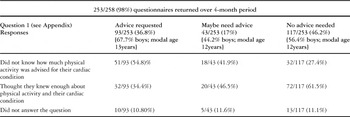
Of the 258 numbered questionnaires given out, 253 (98.0%) were returned. Of those completing questionnaires 148 were boys. The age range was from 7 to 17 years, with a median of 12 years.
Allocation of respondents to the three groups is detailed in Table 1.
Table 1. 253 respondents categorised into 3 groups according to their response to questions 4&5 – was more information needed about physical activity and their cardiac condition.

Table 2 summarizes the responses to the first question, specifically whether or not the children knew how much physical activity was recommended for their cardiac condition.
Table 2. Showing responses to the question asking if children knew, relative to their cardiac condition, how much physical activity or leisure activity they were allowed, or was safe for them to do.

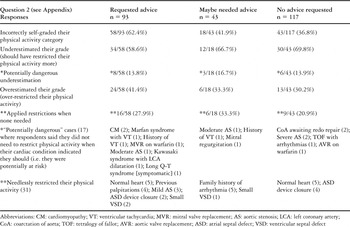
The second question asked respondents to self-grade their levels of activity according to the guidelines established by the American Heart Association.11 The results of comparing these self-gradings with the gradings established by the two paediatric cardiologists are shown in Table 3.
Table 3. The grades 1 through 5 for activity recommended by the American Heart Association, where 1 equals no restriction and 5 equals extreme limitation, as determined by the paediatric cardiologists, were compared with the self-rating for each respondent according to their response to the second question in the questionnaire. The main discrepancies are listed.

All 17 cases with the “potentially dangerous” underestimation of activity were contacted and any risks explained. Of the 17, 3 had misunderstood the question, indicating “no restriction” when they did apply restrictions to contact sports. The remaining 14 were not aware of the level of restriction needed for their cardiac condition.
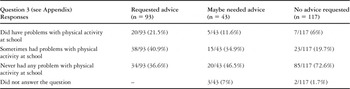
Table 4 details the number of children reporting problems with physical activity at school.
Table 4. Showing responses to the question asking children if they experienced problems at school related to physical activity.

Diagnoses
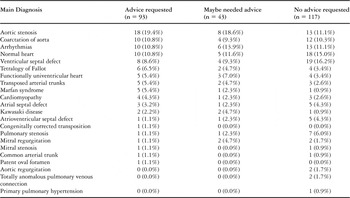
The diagnoses of the 253 respondents covered a diverse range of conditions, in keeping with the typical population seen in clinics dealing with congenital cardiac malformations (see Table 5).
Table 5. Main diagnoses for all 253 patients responding to the questionnaire.

Those requesting advice
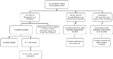
Of the 93 children and/or parents asking for help, 16 were not spoken to directly about physical activity, This was because 4 were not queries related to physical activity, so they were referred to other disciplines, while 12 others could not be contacted by telephone, and were sent general information by post (see Fig. 1). Thus 77 children, and/or their parents, were directly contacted by the cardiac physiotherapist. They were consulted by telephone or in the clinic and, following a discussion to determine their requirements, appropriate information or intervention was provided as follows:

Figure 1. Questionnaire respondents were grouped according to their reply to the offer of more advice about physical activity. The follow-up provided within each group is outlined. Some needed more than one contact to help them achieve planned goals.
Figure 1. Potentially unsafe activity meant the respondents self-assessment of activity levels were beyond that recommended by the clinical guidelines suggested by the American Heart Association.
- 74.0% (57/77) of contacts were with parents only; 22.1% (17/77) with children and their parents; 3.9% (3/77) with children only.
- Of the 77, 56 (72.7%) required a single contact, either by telephone or face-to-face in the clinic, giving specific information and advice about physical activity related to their cardiac condition. Mean contact time for this group was 11 minutes.
- A further 21 (27.3%; 21/77) received more than one contact, with the mean time for each contact being 12 minutes.
- 11 (14.3%; 11/77) required specific intervention/exercise prescription and follow-up over a period of weeks (range 2–12 weeks). The number of contacts received by this group of 11 children ranged from 2 to 13. The total number of contacts was 43, with a mean of 4 contacts per child. The mean time for each contact was 18 minutes, with a range from 10 to 60 minutes.
Main concerns
- The most common concern (65.0%; 50/77) was that parents and children did not know exactly what level of physical activity was appropriate and what, if anything, they should avoid.
- 35.1% (27/77) had concerns about the safety of specific sports or activities.
- Issues around physical education classes at school were also a common problem, the main criti- cism being that teachers did not understand the significance of the cardiac condition of the child. Six schools (7.8%; 6/77) required a letter explaining individual cardiac conditions and their implications for schooling, 3 of which had telephone follow-up and 1 a school visit.
- Other problems included lack of fitness of the child, and/or weight gain due to inactivity.
Inappropriate activity
- 3 (3.9%) of the 77 children directly contacted by the physiotherapist were found to be taking part in activities which put them at risk. All were taking part in competitive sports at a level beyond that to be considered safe relative to their cardiac condition. Two young people thought they knew how much activity was safe, and one was not sure. One thought there were no restrictions to their activity, and two thought some activities were restricted. All agreed to change their programmes of exercise when the risks were explained in depth.
- A further 5 (6.5%) children did not know they should avoid competitive sports.
Discussion
The questionnaires were handed out by clinic nurses at general clinics. This was not disruptive, and there was an excellent uptake and rate of completion of the questionnaires. Nor was supplying the advice required onerous, with almost three-quarters of cases requiring only a single phone call or clinic consultation, in the great majority of cases lasting 10 minutes or less. Only about one-sixth required more active intervention, either an individually tailored programme of activity, or an intervention with schoolteachers or parents. The estimated resources to replicate such a service for a centre of average size might be from 0.4 to 0.7 of a whole-time clinical specialist physiotherapist.
If our experience is typical, it appears that almost two-fifths of children would like to have such information. It is important to note that of those asking for help, one-tenth had normal hearts. Over half of the overall group stated that they did not know the safe level of activity for their condition, and approximately two-thirds were wrong in what they believed to be the correct level for them. A small number were putting themselves at significant risk of death by inappropriately playing contact sports. Some will do this by choice, but none of these children were aware of the danger, and all agreed to change their behaviour.
As the child grows, their clinical state and personal circumstances may change. Children should be prompted to ask their cardiologist about appropriate levels of exercise at clinic consultations. Prompts could be on posters in waiting areas, in information leaflets, on websites and by reminders from clinic staff.
Whilst many children need no restriction to activity, it is important to check they do know this in order to avoid under-participation. It is essential that those needing to restrict exercise understand precisely what this means on an individual basis.
Our study is limited in that the results are from one centre only, and may not be representative of the general situation. In addition, we did not assess the outcome of the intervention provided. Further studies would be needed to investigate whether it was beneficial to the patients, for example, those living a sedentary lifestyle, and whether it had had any long-term effects on the levels of activity achieved.
In conclusion, the depth of information that some children and families need regarding physical activity should not be underestimated. Issues of exercise should be routinely addressed from an early age, with more detailed follow-up provided as required to those in need. The use of the questionnaire and telephone follow-up proved a simple and easily implemented method for screening the large number of patients known to the service. It enabled the specialist cardiac physiotherapist to use her time in the most effective way, and identified those not exercising appropriately, including a small group of children who were potentially putting their lives at risk.
Acknowledgements
This study was supported by a grant from The Children's Heart Surgery Fund. We are grateful to Claire Rose and Dr Claire Irving for their help with collection and analysis of the data, and to Paul Marchant for statistical advice.
Appendix
Questionnaire
Do you know enough about physical activity, lifestyle issues and your heart condition?
1. Thinking about your heart condition – do you know how much physical activity / leisure activity you are allowed, or is safe for you to do?
YES / NO / NOT SURE
2. Thinking about your heart condition, please tick any of the following comments that you agree with:
- I am allowed to do any kind of activities / sports / PE / games if I want to.
- There are some activities /sports / PE / games that I am not allowed to take part in.
- There are a lot of activities /sports / PE / games that I am not allowed to take part in.
- I am not allowed to take part in any activities /sports / PE / games.
- I am unable to take part in any activities / sports / PE / games.
3. Do you ever have any problems or difficulties with physical activity issues at school?
YES / NO / SOMETIMES
4. Would you like more information and/or to talk to someone about physical activity and your heart condition?
YES / NO / MAYBE
5. Parents/carers
Would you like more information and/or to talk to someone about physical activity and your child's heart condition?
YES / NO / MAYBE
[bull ] Patient name:..........................................................................................................................
Date of Birth:.........................................................................................................................
[bull ] Parent/carer name:..........................................................................................................................
Contact Address: ................................................................................................................................
Telephone:...................................................................................................................
E-mail:...........................................................................................................................
Date:........................................................................................................................
Thank you for filling in this form – please leave it on the desk or give it to the clinic clerk or nurse. January 2004