


Seasonal affective disorder (SAD) is now a well-described form of recurrent major depression characterised by a range of typical and atypical depressive symptoms and a distinct seasonal nature (Reference Rosenthal, Sack and GillinRosenthal et al, 1984; Reference Lam and LevittLam & Levitt, 1999). It is thought to be related to reduced levels of daylight during the winter months, and a significant body of research has now accumulated concerning the biological causes and consequences of the condition. Comparatively little research has focused upon psychosocial factors and SAD. In particular, no research has directly examined the relationship between psychosocial factors, such as negative life events and poor social support, and seasonal depression, although these variables have been found to be associated with increased risk of non-seasonal depression (Brown & Harris, Reference Brown and Harris1978, Reference Brown and Harris1989; Reference Henderson and ByrneHenderson & Byrne, 1981).
The present study aimed to assess the association between a range of demographic and psychosocial factors and ‘seasonality’ (determined by a continuous score on a commonly used screening tool for SAD) and ‘caseness’ (likelihood of being diagnosed as a case of SAD) in a community sample in the UK.
METHOD
Background
The research reported here was conducted in conjunction with the Outcomes of Depression International Network (ODIN) project, designed to assess the prevalence of and risk factors for depression in urban and rural areas within the European Union. Full details of the ODIN project have been published elsewhere (Dowrick et al, Reference Dowrick, Casey and Dalgard1998, Reference Dowrick, Vázquez-Barquero and Wilkinson1999).
Sample frame
The sample consisted of adults, aged between 18 and 64 years, registered on the North Wales Health Authority's general practice database and residing within the former Glyndwr council district in North Wales.
Case finding
A two-phase sampling method (Reference Pickles, Dunn and Vázquez-BarqueroPickles et al, 1995) was adopted as a research strategy, using a self-rating postal survey to identify potential cases, followed by structured diagnostic interview and more-detailed questionnaires with those participants scoring above cut-off.
Potential cases of SAD were identified using a sub-scale of the Seasonal Patterns Assessment Questionnaire (SPAQ; Reference Rosenthal, Bradt and WehrRosenthal et al, 1987), a commonly used screening tool for SAD that provides a ‘global seasonality score’ (GSS) for a given individual. This score ranges from 0 to 24; it indicates the degree of change that individuals experience between the seasons in their sleep, mood, weight, appetite, energy and social activity, and requires that they describe whether these changes represent a mild, moderate, marked, severe or disabling problem for them. The traditional cut-off score of 11 or more, with seasonal changes amounting to at least a ‘moderate’ problem, was applied (Reference Kasper, Wehr and BartkoKasper et al, 1989; Reference Rosen, Targum and TermanRosen et al, 1990). The SPAQ shows reasonable psychometric properties but does tend to produce high false-positive rates compared with clinical diagnosis of SAD. Furthermore, the questionnaire has been criticised for relying upon people's subjective evaluation of seasonal problems and upon their retrospective recall of when depressive episodes occurred. Research has indicated that the reliability of recall of depressive episodes and of seasonal patterns is poor (Reference Wicki, Angst and MerikangasWicki et al, 1992; Reference McAllister-Williams, Ferrier and YoungMcAllister-Williams et al, 1998), and that the degree of seasonality is overestimated when recorded retrospectively as opposed to prospectively (Reference Nayyar and CochraneNayyar & Cochrane, 1996).
Recent negative life events were assessed using the List of Threatening Experiences (LTE), a self-report questionnaire that examines the incidence of 12 categories of negative life events over the previous 6 months (Reference Brugha, Bebbington and TennantBrugha et al, 1985). The LTE assesses life stressors involving moderate or long-term threat such as illness or injury, death of a close friend or relative, unemployment, financial loss and loss of important relationships. The questionnaire shows acceptable levels of reliability and validity (Reference Brugha and CraggBrugha & Cragg, 1990) and a high score has been shown to be associated with increased risk of depression (Reference Brugha and ConroyBrugha & Conroy, 1985). Levels of social support were assessed via a three-item questionnaire called the Oslo 3-Item Social Support Scale (Reference Dalgard, Trent and ReedDalgard, 1996; scale available upon request from Professor Odd Dalgard, e-mail: o.s.dalgard@samfunnsmed.uio.no), which contained questions concerning: number of people the participant reports being close to; concern shown by others; and ease of getting practical help from neighbours. It provides an overall ‘social support index’ (SSI) score, where higher scores indicate lower levels of social support. Basic demographic questions also were incorporated into the screening package.
The second diagnostic interview stage of assessment was conducted with all consenting participants who scored above cut-off on the SPAQ. Interviews were performed during the winter of 1997-98 by a psychologist (E.E.M.) according to the revised version of the Structured Interview Guide for the Hamilton Depression Rating Scale — Seasonal Affective Disorder Version (SIGH—SAD; Reference Williams, Link and RosenthalWilliams et al, 1992). Diagnostic criteria utilised were a minimum score of 15 on the Hamilton Rating Scale for Depression (HRSD), with a score of at least 6 on the supplementary atypical item scale, these being equivalent to those applied in another study of SAD conducted in the UK (Reference Wileman, Andrew and HowieWileman et al, 2001). Diagnosed cases of SAD also met DSM-IV criteria for major depressive episodes with a seasonal (winter) pattern (American Psychiatric Association, 1994).
Ethics
Ethical approval for the study was obtained from the South Clwyd Ethics Committee in North Wales and all participants provided written informed consent.
Statistics
Univariate analyses were performed using χ2 for categorical data, Student's t-tests for normally distributed continuous data and Mann—Whitney tests for non-normally distributed continuous data. Separate analyses were conducted, examining: factors associated with continuous GSS score (multiple regression); factors associated with being below/above cut-off on the SPAQ (stepwise logistic regression); and factors associated with being diagnosed as a case of SAD (stepwise logistic regression). Regression analyses examined the relationship between these categories and the following variables:
-
(a) number of negative life events in the past 6 months (mean);
-
(b) level of social support (SSI score on the Oslo 3-Item Social Support Scale);
-
(c) marital status (single, married/cohabiting or separated/divorced/widowed);
-
(d) employment status (in paid employment or other);
-
(e) occupation type (directly/indirectly employed in agriculture or other);
-
(f) place of birth (North Wales, elsewhere in UK/outside of UK);
-
(g) age (as a continuous variable);
-
(h) gender;
-
(i) socio-economic status (coded by occupation according to Office of Population, Censuses and Surveys (now the Office for National Statistics) guidelines into three categories: professional, managerial and lower professional; non-manual skilled and skilled manual; and partially skilled and unskilled).
RESULTS
Response rates
Screening questionnaires were sent to 1999 people, with a 63% (n=1250) response rate being obtained. Younger people were significantly less likely to respond to the screening questionnaire than older people (t=5.7, d.f.=1440, P<0.001), the mean age of non-responders being 40 years and that of responders being 43 years. Men were significantly less likely to respond than women, with a response rate of 58.6% v. 67.4% (χ2=16.5, P<0.001). Sixty-six respondents (5.3%) screened positive for SAD according to SPAQ criteria. Of this sample, 55 (83%) agreed to undergo diagnostic interview and 25 were diagnosed with SAD according to the outlined criteria. The results of the epidemiological arm of this study have been reported in detail elsewhere (Reference Michalak, Wilkinson and DowrickMichalak et al, 2001).
Multivariate analyses
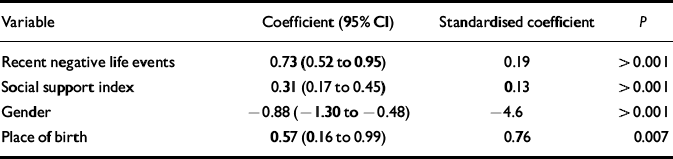
The outlined variables were entered into a stepwise multiple regression model to determine their association with GSS, fitted to 1181 cases with complete data. Having experienced more negative life events in the past 6 months, having a poorer social support network, being a woman and being born outside of North Wales were all predictive of higher seasonality scores (Table 1). These variables, in the same order of significance, were also predictive of scoring above cut-off on the SPAQ using a logistic regression model (results not shown). However, only female gender significantly predicted being diagnosed as a case of SAD (odds ratio=3.8, 95% CI 1.04-13.9).
Stepwise multiple regression analysis predicting ‘global seasonality score’ from demographic and psychosocial variables
| Variable | Coefficient (95% CI) | Standardised coefficient | P |
|---|---|---|---|
| Recent negative life events | 0.73 (0.52 to 0.95) | 0.19 | > 0.001 |
| Social support index | 0.31 (0.17 to 0.45) | 0.13 | > 0.001 |
| Gender | -0.88 (-1.30 to -0.48) | -4.6 | > 0.001 |
| Place of birth | 0.57 (0.16 to 0.99) | 0.76 | 0.007 |
Relationship between negative life events and increased seasonality
The association observed between negative life events and increased reported seasonality was surprising and consequently was made the subject of further analysis. Mean GSS score increased significantly as the number of negative life events experienced increased; participants experiencing 0, 1 or ≥2 negative life events had mean GSS scores of 4.0, 4.9 and 6.4, respectively. Mean number of negative life events experienced by participants scoring above cut-off on the SPAQ were 1.11 (s.d.=1.39), compared with 0.52 (s.d.=0.91) for those below cut-off (Mann—Whitney, P<0.001). In the SPAQ-positive group, a nonsignificant trend towards increased negative life events in men was apparent (mean 1.42 (s.d.=1.87) v. 0.98 (s.d.=1.15)). Number of negative life events experienced was slightly lower for diagnosed cases of SAD (mean 1.0 (s.d.=1.15) for men, 0.85 (s.d.=0.88) for women, NS). In the larger ODIN sample, DSM—IV diagnosed cases of non-seasonal depression reported having experienced a mean number of negative life events of 1.5 (s.d.=1.6) for men and 1.3 (s.d.=1.4) for women (NS).
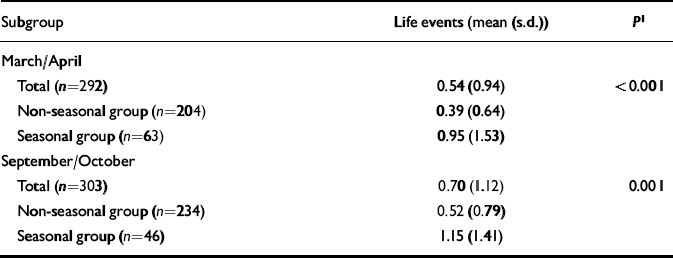
It was also of interest to know whether people with increased reported seasonality experience more negative life events at a particular time of the year. In order to address this question the responses of two subgroups of participants were analysed. Screening questionnaires for this project were sent out between February and November 1997. The first group consisted of participants who responded in March or April 1997 (who were reporting negative life events that had occurred in the previous 6 months, i.e. October/November through to March/April). The second group consisted of participants who responded in September or October 1997 (who were reporting negative life events that had occurred between April/May and September/October). Respondents in each group were then split into two further subgroups: a ‘non-seasonal group’ (those with a GSS score of ≤6) and a ‘seasonal group’ (those with a GSS score of ≥8). A GSS score of ≤6 has been used previously to define non-seasonal controls (Reference Andrew, Wileman and HowieAndrew et al, 2001), whereas a GSS score of ≥ 8 was selected because it represents the bottom cut-off score for inclusion as a case of SAD (Reference Kasper, Wehr and BartkoKasper et al, 1989).
Comparison of the number of negative life events between the two time points was conducted using the Mann—Whitney U-test. No overall significant differences were apparent between the March/April and the September/October subgroups (Table 2). However, the seasonal subgroup experienced significantly more negative life events than the non-seasonal subgroup at both time points. Thus, it appears that people with increased seasonality experience more negative life events throughout the year, and not during one particular season.
Negative life events by time of year
| Subgroup | Life events (mean (s.d.)) | P 1 |
|---|---|---|
| March/April | ||
| Total (n=292) | 0.54 (0.94) | < 0.001 |
| Non-seasonal group (n=204) | 0.39 (0.64) | |
| Seasonal group (n=63) | 0.95 (1.53) | |
| September/October | ||
| Total (n=303) | 0.70 (1.12) | 0.001 |
| Non-seasonal group (n=234) | 0.52 (0.79) | |
| Seasonal group (n=46) | 1.15 (1.41) |
DISCUSSION
We found that four variables (having experienced more negative life events, having low levels of social support, being a woman and being non-native) were predictive of heightened seasonality and SPAQ caseness in this general population sample. However, only gender was predictive of being diagnosed as a case of SAD. The finding that female gender is a risk factor for SAD is not new, and will not be the subject of discussion here. Instead, the following section will focus upon the relationship between negative life events, social support and place of birth, respectively, and seasonality.
Negative life events
The present study found that having experienced more recent negative life events was predictive of higher seasonality scores, as measured by the SPAQ. Although a large body of research has examined the relationship between negative life events and non-seasonal depression (Brown & Harris, Reference Brown and Harris1978, Reference Brown and Harris1989; Reference Henderson and ByrneHenderson & Byrne, 1981), no previous research has directly examined the relationship between seasonality and life events. Some research has been conducted in relation to SAD and negative life events, where it has been reported that the latter can act as a trigger that shifts seasonal depressives from patterns of seasonal depression into patterns of non-seasonal depression (Reference Sakamoto, Nakadaira and KamoSakamoto et al, 1995). Other work has indicated that some episodes of seasonal depression may be triggered by anniversary reactions associated with previous traumatic experiences, but these appear to be relatively rare (Beratis et al, Reference Beratis, Gourzis and Gabriel1994, Reference Beratis, Gourzis and Gabriel1996). However, our study was under-powered to detect an association between negative life events and diagnosed SAD, and further research is required to determine whether such an association exists in clinical populations.
An over-arching question here concerns whether these increased negative life events are a cause or a consequence of increased seasonality. Although the evidence has been controversial (Reference Tennant, Bebbington and HurryTennant et al, 1981), it is generally accepted that stressful or negative life events have a causal relationship with non-seasonal depression (Reference Kendler, Karkowski and PrescottKendler et al, 1999). Although seasonal depression should not be diagnosed in the presence of seasonally recurring life events such as regular winter unemployment, an as yet unidentified causal relationship between negative life events and increased seasonality may exist. Alternatively, heightened seasonality may result in people experiencing more negative life events. For example, a person who is socially impaired as a result of seasonality might be more likely to experience a relationship breakdown. Secondary analysis of the data obtained here indicated that people with increased seasonality in fact experience more negative life events throughout the year. If increased seasonality were to cause life events, we might have expected to see these increased events in the subgroup of people who completed their questionnaires in March/April, but not in the September/October subgroup. The finding that people with seasonality experience more negative life events throughout the year does not provide direct support for either the notion that seasonality causes life events or that life events cause increased seasonality.
Of course, there are other possible explanations for this observed relationship. Personality factors, for example, may have a role to play. Longitudinal research has shown that women with high neuroticism scores report having experienced more negative life events (Reference Fergusson and HorwoodFergusson & Horwood, 1987), and individuals with seasonality have been shown to have heightened levels of neuroticism (Reference Murray, Hay and ArmstrongMurray et al, 1995). Again, however, one must question in which direction causality runs in this putative relationship between personality factors and life events. As has been pointed out (Reference Young and MartinYoung & Martin, 1981), people with certain personality types may be more likely to be involved in (or indeed create) social environments in which the risks of exposure to life events are increased. Alternatively, exposure to life events may modify personality. Finally, individuals who are high in neuroticism could have a tendency to report more negative life events because of their increased sensitivity and responsiveness (Reference Young and MartinYoung & Martin, 1981).
Social support
The observed relationship between impaired social support and increased reported seasonality is also new. Once again, it must be questioned whether poor social support results in increased seasonality, or whether heightened seasonality results in diminished social support. In the former scenario, low levels of social support could increase the likelihood that an individual will experience (or report) greater seasonal variation in their mood and behaviour. In this sense, a good social support network might be said to be having a ‘buffering’ effect against seasonal symptoms. Interestingly, other research has indicated that the buffering effect of social support is particularly pronounced in people with high external loci of control, a personality trait that characterises people who are high in seasonality (Reference Dalgard, Bjork and TambsDalgard et al, 1995). Alternatively, people who are high in seasonality are likely to be relatively unsociable for a proportion of the year, and may develop poorer social support networks. Further research utilising a larger subject sample is required to determine whether this association between social support and seasonality is also present in patients who are diagnosed with SAD.
Place of birth
Finally, being non-native to North Wales significantly predicted higher seasonality. The observation that being native to an area is a protective factor for seasonality is not new. A study of psychiatric nurses in Aberdeen, for example, found that 17% of ‘incomers’ were SPAQ cases compared with 11% of those who had lived in Aberdeen for 5 or more years (Reference Eagles, Mercer and BoshierEagles et al, 1996). Other research examining seasonality in indigenous White, British Asian and Asian women found that the last group were more susceptible to winter depression (Reference Suhail and CochraneSuhail & Cochrane, 1997). Studies in a general population sample in Alaska and an out-patient sample in Canada have observed similar trends (Reference Booker and HelleksonBooker & Hellekson, 1992; Reference Williams and SchmidtWilliams & Schmidt, 1993), although a study of Japanese residents in Stockholm did not find an effect for acclimatisation (Reference Murase, Kitabatake and YamauchiMurase et al, 1995). There are several possible explanations for these findings. People who have lived in one place all their lives may be more acclimatised to that area's weather conditions. Alternatively, natives may have superior social support networks, although in the present study both low social support and being non-native were independent predictors of higher seasonality scores. It remains unclear what mediating variables unpin the observed relationship between place of birth and seasonality. However, the fact that this association has been made in several different countries and populations indicates that it is probably a genuine one.
Conclusions
The present study has served to generate some new evidence concerning psychosocial factors and increased seasonality. In particular, the study has highlighted a new and intriguing relationship between negative life events, poor social support and heightened seasonality. The cross-sectional nature of the research, the small number of diagnosed cases of SAD identified and the fact that the SPAQ is a retrospective, subjectively rated instrument do limit the inferences that can be made on the basis of the data. Nevertheless, the study provides further evidence of the importance of evaluating the role of psychosocial factors in relation to seasonality and SAD in future research.
Clinical Implications and Limitations
CLINICAL IMPLICATIONS
-
▪ Recent negative life events and poor social support networks are associated with increased seasonality of mood disorder.
-
▪ Female gender is a risk factor for diagnosed seasonal affective disorder (SAD) in community populations.
-
▪ Further research should focus upon the psychosocial causes and consequences of seasonality and seasonal depression.
LIMITATIONS
-
▪ The sample of people with diagnosed SAD in this study was relatively small.
-
▪ Detection of seasonality relied upon the Seasonal Patterns Assessment Questionnaire, which is a subjective, retrospective questionnaire.
-
▪ The research was cross-sectional in nature, limiting the inferences that could be made about causality.
Acknowledgements
The North Wales arm of the ODIN project was funded by the European Commission Biomed 2 Programme (contract BMH-4-CT96-1681) and the Wales Office of Research and Development (contract RC092).




eLetters
No eLetters have been published for this article.