1. Introduction
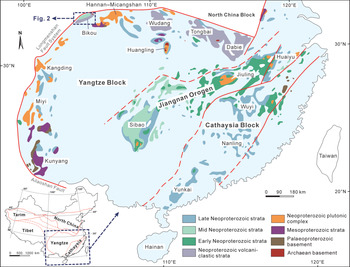
The early Neoproterozoic period is a pivotal time in the evolutionary history of the Earth, witnessing the remodelling of the global tectonic framework caused by assembly and break-up of the Rodinia supercontinent (Hoffman, Reference Hoffman1991; Moores, Reference Moores1991; Torsvik, Reference Torsvik2003; Goodge et al. Reference Goodge, Vervoort, Fanning, Brecke, Farmer, Williams, Myrow and DePaolo2008; Li et al. Reference Li, Li, Li and Liu2008; Zhao et al. Reference Zhao, Li, Liu and Wang2018). The Yangtze Block and the North China Craton constitute the two most ancient Precambrian blocks in the present continental interior of east China (Fig. 1; Zhao & Cawood, Reference Zhao and Cawood2012). Given that a large amount of 860–720 Ma magmatic and sedimentary records is preserved at the peripheries of the landmass, the Yangtze Block is deemed to be involved in this evolution process during the early Neoproterozoic (e.g. XH Li et al. Reference Li, Li, Zhou, Liu and Kinny2002, Reference Li, Li, Li and Liu2008; Zhou et al. Reference Zhou, Kennedy, Sun, Malpas and Lesher2002, Reference Zhou, Yan, Wang, Qi and Kennedy2006a, b; ZX Li et al. Reference Li, Li, Kinny, Wang, Zhang and Zhou2003; Ling et al. Reference Ling, Gao, Zhang, Li, Liu and Cheng2003; Lin et al. Reference Lin, Li and Li2007; Zhao & Zhou, Reference Zhao and Zhou2007, Reference Zhao and Zhou2008, Reference Zhao and Zhou2009; WG Zhu et al. Reference Zhu, Zhong, Li, Deng, He, Wu and Bai2008; Dong et al. Reference Dong, Liu, Santosh, Zhang, Chen, Yang and Yang2011, Reference Dong, Liu, Santosh, Chen, Zhang, Li, He and Zhang2012, Reference Dong, Sun, Yang, Liu, Zhang, Li, Cheng, He and Zhang2017). However, despite a series of studies, considerable controversy exists over the specific geodynamics, and two representative points have been proposed. Some scholars believe that the 860–720 Ma magmatism was a response to intracontinental rifting, which was induced by large-scale super-mantle plume upwelling (ZX Li et al. Reference Li, Zhang and McApowell1995, Reference Li, Li, Kinny and Wang1999, Reference Li, Li, Kinny, Wang, Zhang and Zhou2003; XH Li et al. Reference Li, Li, Zhou, Liu and Kinny2002, Reference Li, Li, Li and Liu2008; Wang et al. Reference Wang, Li, Li, Li, Liu, Yang, Liang and Tu2008). Others consider that the magmatic rocks were generated in a continental arc system, given continuous subduction of oceanic crust beneath the western and northern peripheries (Zhou et al. Reference Zhou, Kennedy, Sun, Malpas and Lesher2002, Reference Zhou, Yan, Wang, Qi and Kennedy2006a, b; Zhao & Zhou, Reference Zhao and Zhou2007, Reference Zhao and Zhou2008, Reference Zhao and Zhou2009; Zhao et al. Reference Zhao, Zhou, Li and Wu2008, Reference Zhao, Zhou, Zheng and Fang2010, Reference Zhao, Li, Liu and Wang2018, Reference Zhao, Zhou, Wu, Zheng and Wang2019; Dong et al. Reference Dong, Liu, Santosh, Zhang, Chen, Yang and Yang2011, Reference Dong, Liu, Santosh, Chen, Zhang, Li, He and Zhang2012, Reference Dong, Sun, Yang, Liu, Zhang, Li, Cheng, He and Zhang2017; Meng et al. Reference Meng, Liu, Du, Liu and Liu2015; Li & Zhao, Reference Li and Zhao2018; Luo et al. Reference Luo, Liu, Zhang, Zhao, Yang, Xu, Guo, Zhang, Tao, Pan, Wand, Gao and Shao2018). Nevertheless, as these studies mainly focused on the igneous rocks, relatively less attention has been paid to the associated sedimentary sequences although these siliciclastic rocks also provide indispensable clues for discriminating the regional tectonic evolution (Bhatia, Reference Bhatia1983, Reference Bhatia1985; Taylor & McLennan, Reference Taylor and McLennan1985; McLennan et al. Reference McLennan, Taylor, McCulloch and Maynard1990, Reference McLennan, Hemming, McDaniel, Hanson, Johnsson and Basu1993; Condie et al. Reference Condie, Belousova, Griffin and Sircombe2009; Cawood et al. Reference Cawood, Hawkesworth and Dhuime2012).
Sketch geological map showing general distributions of Precambrian rocks within South China (after Zhao & Cawood, Reference Zhao and Cawood2012). Insert map at bottom left shows the major tectonic blocks within China.

The Hengdan Group is a succession that is exposed at the western reach of the Bikou Terrane on the NW fringe of the Yangtze Block (Pei, Reference Pei1989; Zhao et al. Reference Zhao, Ma, Zhou and Xiu1990; Li, Reference Li1991). Due to its well-preserved sedimentary records, it has been considered as an ideal carrier for investigating its basin evolution and relevant regional tectonic mechanism (Pei, Reference Pei1989; Zhao et al. Reference Zhao, Ma, Zhou and Xiu1990; Li, Reference Li1991; Yan et al. Reference Yan, Wang, Hanson, Druschke, Wang and Yan2002, Reference Yan, Andrew, Wang, Yan, Druschke, Wang, Liu, Song and Jiang2004; Druschke et al. Reference Druschke, Andrew, Yan, Wang and Wang2006; Sun et al. Reference Sun, Zhou, Yan, Li and Ma2008). However, understanding and tectonic interpretation of the Hengdan Group remain ambiguous due to there being relatively few studies (Pei, Reference Pei1989; Zhao et al. Reference Zhao, Ma, Zhou and Xiu1990; Li, Reference Li1991; Yan et al. Reference Yan, Wang, Hanson, Druschke, Wang and Yan2002; Druschke et al. Reference Druschke, Andrew, Yan, Wang and Wang2006). For instance, based on descriptions and comparisons of sedimentary profiles, some scholars suggest that the Hengdan Group was deposited in a Tonian–Cryogenian oceanic trench basin (Pei, Reference Pei1989) or in an Ediacaran residual oceanic basin (Zhao et al. Reference Zhao, Ma, Zhou and Xiu1990; Li, Reference Li1991). In addition, Yan et al. (Reference Yan, Wang, Hanson, Druschke, Wang and Yan2002) propose that the Hengdan Group might have started sedimentation within a fore-arc basin considerably later during Devonian time on the basis of the seeming stratigraphic correlation between the Hengdan Group and the strata in the South Qinling Belt. In terms of the youngest detrital zircon ages, Druschke et al. (Reference Druschke, Andrew, Yan, Wang and Wang2006) redress this by suggesting that it possibly accumulated during the late Tonian. Therefore, in this case, it follows that further quantitative investigations are necessary to pinpoint the nature of the Hengdan Group.
In this study, we present integrated studies of detrital zircon U–Pb ages and geochemical compositions from the representative strata in the Hengdan Group. These new data not only allow better constraints on the depositional age and provenance characteristic of the sedimentary basin, but also provide insights into regional geodynamic processes.
2. Geological setting
2.1. Precambrian tectonic framework of the Yangtze Block
The Yangtze Block is tectonically bounded by the Qinling–Tongbai–Dabie Orogeny in the north, the Longmenshan Fault System in the west and the Ailaoshan Fault in the southwest (Fig. 1). It was amalgamated with the Cathaysia Block along the Jiangnan Orogen during the early Neoproterozoic and was sutured together with the North China Block along the Qinling–Tongbai–Dabie Orogeny during the Mesozoic (Fig. 1; e.g. Zhao & Cawood, Reference Zhao and Cawood2012; Dong & Santosh, Reference Dong and Santosh2016; Yao et al. Reference Yao, Cawood, Shu and Zhao2019; Cawood et al. Reference Cawood, Wang, Zhao, Xu, Mulder, Pisarevsky, Zhang, Gan, He, Liu, Qi, Wang, Yao, Zhao, Zhou and Zi2020).
The Yangtze Block contains well-documented Precambrian lithologic units, which are dominated by voluminous Neoproterozoic rocks with sparsely distributed Archaean–Palaeoproterozoic basement and Mesoproterozoic sequences (Zhao & Cawood, Reference Zhao and Cawood2012 and references therein). The Archaean–Palaeoproterozoic crystalline basement is sporadically scattered along the block’s perimeter and documents episodic magmatism from c. 3.45 to 1.75 Ga (e.g. Gao et al. Reference Gao, Ling, Qiu, Lian, Hartmann and Simon1999; Zheng et al. Reference Zheng, Griffin, O’Reilly, Zhang, Pearson and Pan2006; Zhao & Cawood, Reference Zhao and Cawood2012; Guo et al. Reference Guo, Gao, Wu, Li, Chen, Hu, Liang, Liu, Zhou, Zong, Zhang and Chen2014; Wang et al. Reference Wang, Cawood, Zhou and Zhao2016; Hui et al. Reference Hui, Dong, Cheng, Long, Liu, Yang, Sun, Zhang and Varga2017). The Mesoproterozoic meta-sedimentary rocks are basically exposed along the southwestern and northern margins (Fig. 1b; Qiu et al. Reference Qiu, Ling, Liu, Kusky, Berkana, Zhang, Gao, Lu, Kuang and Liu2011; LJ Wang et al. Reference Wang, Liu, Feng, Li, Wu, Wang, Wang and Yang2012; Zhao & Cawood, Reference Zhao and Cawood2012; Li et al. Reference Li, Zhang, Yao and Xiang2013; Wang et al. Reference Wang, Zhou, Zhao, Chen and Yan2014a; Wang & Zhou, Reference Wang and Zhou2014).
The Neoproterozoic rocks in the Yangtze Block can be classified into two categories: the Tonian rock assemblages and the Cryogenian–Ediacaran strata (Fig. 1). The Tonian rock units are regularly distributed in the western, northern and southeastern margins of the Yangtze Block. Along the western margin, numerous c. 890–705 Ma plutonic complexes are noted along with a few scattered volcaniclastic sequences (e.g. XH Li et al. Reference Li, Li, Zhou, Liu and Kinny2002; Zhou et al. Reference Zhou, Kennedy, Sun, Malpas and Lesher2002, Reference Zhou, Yan, Wang, Qi and Kennedy2006a, b; ZX Li, 2003; Zhao et al. Reference Zhao, Zhou, Li and Wu2008, Reference Zhao, Zhou, Zheng and Fang2010, Reference Zhao, Li, Liu and Wang2018; Zhao & Zhou, Reference Zhao and Zhou2009; Dong et al. Reference Dong, Liu, Santosh, Zhang, Chen, Yang and Yang2011, Reference Dong, Liu, Santosh, Chen, Zhang, Li, He and Zhang2012; Meng et al. Reference Meng, Liu, Du, Liu and Liu2015; Hui et al. Reference Hui, Dong, Liu, Zhao, Sun, Zhang and Liu2020a and references therein). The northern margin, including the South Qinling Belt, preserves abundant c. 780–720 volcaniclastic sequences and lesser amounts of c. 950–705 Ma plutonic intrusions (Ling et al. Reference Ling, Gao, Cheng, Jiang, Yuan and Hu2006, Reference Ling, Ren, Duan, Liu, Mao, Peng, Liu, Cheng and Yang2008; XY Zhu et al. Reference Zhu, Zhong, Li, Deng, He, Wu and Bai2008, Reference Zhu, Chen, Nie, Siebel, Yang, Xue and Zhai2014; Dong & Santosh, Reference Dong and Santosh2016; Li & Zhao, Reference Li and Zhao2016; Yang et al. Reference Yang, Wang, Li and Li2016; Dong et al. Reference Dong, Sun, Yang, Liu, Zhang, Li, Cheng, He and Zhang2017; Liu et al. Reference Liu, Zhao, Cawood and Wang2018). The northern Yangtze Block is characterized by c. 860–795 Ma granitoids from the Huangling district (Ling et al. Reference Ling, Gao, Cheng, Jiang, Yuan and Hu2006; SB Zhang et al. Reference Zhang, Zheng, Zhao, Wu, Yuan and Wu2008, Reference Zhang, Zheng, Zhao, Wu, Yuan and Wu2009; Zhao et al. Reference Zhao, Zhou and Zheng2013a, b) and the overlying c. 750–720 Ma siliciclastic Liantuo Formation (XM Liu et al. Reference Liu, Hu, Gao, Günther, Xu, Gao and Chen2008; J Wang et al. Reference Wang, Deng, Wang, Qiu, Duan, Jiang and Yang2013; Pi & Jiang, Reference Pi and Jiang2016). The SE margin is predominantly characterized by a large proportion of meta-sedimentary rocks and parts of c. 830–820 Ma granitic plutons (Li et al. Reference Li, Li, Kinny, Wang, Zhang and Zhou2003; XL Wang et al. Reference Wang, Zhou, Qiu and Gao2004, Reference Wang, Deng, Wang, Qiu, Duan, Jiang and Yang2013, Reference Wang, Zhou, Griffin, Zhao, Yu, Qiu, Zhang and Xing2014b; Zheng et al. Reference Zheng, Wu, Wu, Zhang, Yuan and Wu2008; Xue et al. Reference Xue, Ma, Song and Xie2010; Yao et al. Reference Yao, Shu, Santosh and Zhao2014; Wu et al. Reference Wu, Wang, Li, Wilde and Tian2019; Hui et al. Reference Hui, Dong, Neubauer and He2020b). All these units are unconformably overlain by Cryogenian–Ediacaran strata, which are mainly composed of glacial to epicontinental marine deposits (e.g. SH Zhang et al. Reference Zhang, Zheng, Zhao, Wu, Yuan and Wu2008; Bao et al. Reference Bao, Zhang, Jiang, Wu, Li, Wang, An and Yang2018).
2.2. Geological background of the Bikou Terrane
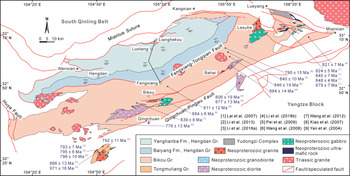
The Bikou Terrane, which covers an area of c. 9000 km2, is located in the far north of the western margin of the Yangtze Block (Fig. 1). It is spatially overlain by or in fault contact with post-Cryogenian strata, and was intruded by some Triassic granites (Fig. 2).
(a) Simplified geological map with investigated profile of the Bikou Terrane (modified after Dong & Santosh, Reference Dong and Santosh2016). Abbreviations: Fm. – Formation; Gr.– Group.

The Neoarchaean Yudongzi Complex represents the oldest basement of the Bikou Terrane (Zhang et al. Reference Zhang, Zhang, Tang and Wang2001; Hui et al. Reference Hui, Dong, Cheng, Long, Liu, Yang, Sun, Zhang and Varga2017). It is exposed in the northeasternmost section (Fig. 2) and consists mainly of c. 2.82–2.45 Ga granitoid gneisses, c. 2.70 Ga amphibolites, and minor meta-sedimentary rocks (Zhang et al. Reference Zhang, Zhang, Tang and Wang2001; Hui et al. Reference Hui, Dong, Cheng, Long, Liu, Yang, Sun, Zhang and Varga2017, Reference Hui, Dong, Zhang, Sun, Liu, Cheng and He2019; Chen et al. Reference Chen, Sun, Zhao, Zhao, Zhu, Long and Wang2019). In addition, potentially regional amphibolite-facies metamorphism is recorded in much of the complex with an age of c. 1.85 Ga (Hui et al. Reference Hui, Dong, Cheng, Long, Liu, Yang, Sun, Zhang and Varga2017; Chen et al. Reference Chen, Sun, Zhao, Zhao, Zhu, Long and Wang2019).
In addition, the Tonian sequences constitute the dominant lithologic component of the terrane, and are classified into two groups, namely, the Bikou Group in the SE, and the Hengdan Group in the NW, which are separated from each other by the Fengxiang–Tongqian Fault (Fig. 2). The Bikou Group is a volcanic succession that is primarily composed of a series of interbedded greenschist-facies meta-basaltic and meta-rhyolitic rocks with some volcano-sedimentary rocks. Available dating results of the meta-volcanic layers suggest that the Bikou Group formed in the c. 845–775 Ma interval (Xu et al. Reference Xu, Xia and Xia2002; Yan et al. Reference Yan, Andrew, Wang, Yan, Druschke, Wang, Liu, Song and Jiang2004; Lai et al. Reference Lai, Li and Qin2007; Wang et al. Reference Wang, Li, Li, Li, Liu, Yang, Liang and Tu2008; Xia et al. Reference Xia, Xia, Xu, Li and Ma2012). In addition, several dioritic plutons are distributed linearly in the central part of the Bikou Group (Fig. 2; Xiao et al. Reference Xiao, Zhang, Ni, Xiang and Liu2007; Ye et al. Reference Ye, Cheng, Lu, Gao and Pan2009; W Wang et al. Reference Wang, Liu, Feng, Li, Wu, Wang, Wang and Yang2012; Ping et al. Reference Ping, Zheng, Xiong, Zhang and Xia2014). Limited investigations on these rocks reveal that the southern plutons were emplaced c. 885–875 Ma, whereas the northern plutons were emplaced c. 850–825 Ma, implying a somewhat northwards-younging trend (Xiao et al. Reference Xiao, Zhang, Ni, Xiang and Liu2007; W Wang et al. Reference Wang, Liu, Feng, Li, Wu, Wang, Wang and Yang2012; Ping et al. Reference Ping, Zheng, Xiong, Zhang and Xia2014). The Hengdan Group is characterized by a thick suite of epi-metamorphic gravity-flow sequences (Pei, Reference Pei1989; Li, Reference Li1991; Yan et al. Reference Yan, Wang, Hanson, Druschke, Wang and Yan2002; Gao et al. Reference Gao, Pei, Li, Li, Pei, Chen, Wang, Zhao, Liu and Li2020). Compared with the Bikou Group, it contains rare volcanic layers but dominantly volcaniclastic materials (Pei, Reference Pei1989; Li, Reference Li1991; Yan et al. Reference Yan, Wang, Hanson, Druschke, Wang and Yan2002). In addition, a set of isolated early Tonian rock units, which is termed the Tongmuliang Group, is exposed to the SE of the Bikou Terrane (Fig. 2). The rock units are also composed of meta-volcanic rocks as well as minor pyroclastic rocks, but with an older formation age c. 970 Ma (Li et al. Reference Li, Wang and Gu2018a). In the eastern domain, it was intruded by some granitic plutons during the late Tonian period c. 795–790 Ma (Pei et al. Reference Pei, Li, Ding, Li, Feng, Sun, Zhang and Liu2009; Li et al. Reference Li, Wang and Gu2018b). All these units are unconformably overlain by or in fault contact with the post-Tonian strata (Fig. 2).
3. Lithology and sampling
3.1. Stratigraphy of the Hengdan Group
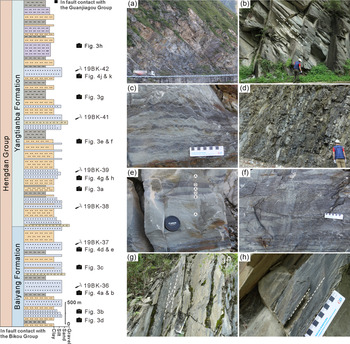
Overall, the investigated Hengdan Group is a typical volcanic–sedimentary flysch turbidite sequence (Pei, Reference Pei1989; Li, Reference Li1991; Yan et al. Reference Yan, Wang, Hanson, Druschke, Wang and Yan2002; Gao et al. Reference Gao, Pei, Li, Li, Pei, Chen, Wang, Zhao, Liu and Li2020). At the bottom and top, it is in fault contact with the early Neoproterozoic Bikou Group and the late Neoproterozoic strata, respectively (Figs 2 and 3). From a macro perspective, the group displays weak deformational features, with the strata dipping steeply to the SE. In some areas of the western basin, spectacular NW-dipping cleavage structures are splendidly observed in the well-stratified siltstone (Fig. 3a). Due to the possibility of strata repetition caused by potential hidden structures, the thickness of the Hengdan Group is considered to be c. 5–7 km (Li, Reference Li1991). The Hengdan Group is divided into two formations: the Baiyang Formation, and the overlying Yangtianba Formation.
Representative field photographs of the Hengdan Group. (a) Northwest-dipping cleavage in the Yangtianba Formation; (b) parallel bedding of sandstones in the Baiyang Formation; (c) graded and cross bedding in the Baiyang Formation; (d) interbedded phyllites and slates in the Baiyang Formation; (e) partial Bouma sequence in the Yangtianba Formation; (f) lenticular and cross bedding between grey siltstone and sandstone in the Yangtianba Formation; (g) oblique bedding of siltstone in the Yangtianba Formation; (h) parallel bedding of siltstone in the Yangtianba Formation. The column on the left shows the generalized stratigraphy of the Hengdan Group (re-illustrated based on investigations by Li, Reference Li1991; Yan et al. Reference Yan, Andrew, Wang, Yan, Druschke, Wang, Liu, Song and Jiang2004; and this study).

The Baiyang Formation is composed predominantly of greyish-green coarse-grained tuffaceous greywacke, feldspar-lithic sandstone, quartz-sericite phyllite, and slate (Fig. 3). In the contact zone near the Fengxiang–Tongqian Fault, some silty slates have experienced proper ductile deformation and are now phyllonites (Li, Reference Li1991). In most sections, thin- to thick-bedded meta-sandstones of different grain sizes are overall interbedded with phyllites and slates (Fig. 3b). Sedimentary structures, such as parallel bedding and graded bedding, can also be observed in some places (Fig. 3c). Meta-sandstones usually have low structural maturity and compositional maturity. The clastic components are mainly characterized by a high amount of lithic detritus which contains a considerable proportion of volcanic materials, plus feldspar and quartz grains (Fig. 4a–f). In the NE basin, the Baiyang Formation also contains some minor tuffs or volcanic lens (Pei, Reference Pei1989; Li, Reference Li1991; Yan et al. Reference Yan, Wang, Hanson, Druschke, Wang and Yan2002).
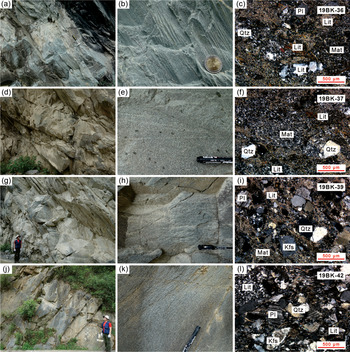
Representative field, hand-specimen and thin-section (cross-polarized light) photos of the investigated samples. Abbreviations: Qtz – quartz; Lit – lithic fragment; Pl – Plagioclase; Kfs – K-feldspar; Mat – Matrix.

The Yangtianba Formation has similar rock associations to the Baiyang Formation. It is marked by conglomerate at its base. In the lower part, it consists mainly of greyish-green fine- to coarse-grained lithic sandstone, phyllite, and silty slate. Thin- to medium-bedded lithic sandstone and thin-bedded siltstone usually form regular repetitions of variable thicknesses (Fig. 3d). Typical structural phenomena including graded bedding, partial Bouma sequences, lenticular and cross bedding, oblique bedding and parallel bedding are well-developed (Fig. 3e–h). The relatively upper part contains more greyish-green or black fine-grained sedimentary rocks, including silty slate, phyllite, and bits of meta-feldspar-lithic sandstone layer. Overall, the Yangtianba Formation displays low maturity, which is consistent with the Baiyang Formation (Fig. 4g–l).
3.2. Sample description
A total of six representative samples of the Hengdan Group were collected along the Lianghekou–Fengxiang section (Fig. 2). Among them, two coarse-grained tuffaceous greywackes (samples 19BK-36 and 37) were collected from bottom and top portions of the Baiyang Formation, separately. Two other samples of coarse-grained tuffaceous greywacke (samples 19BK-38 and 39) and two coarse-grained tuff-bearing sandstones (samples 19BK-41 and 42) were collected in order from the bottom to top portions from the Yangtianba Formation (Fig. 3).
Both greywacke samples (19BK-36, GPS: N32° 54′ 38.01″; E105° 18′ 18.69″; 19BK-37, GPS: N32° 56′ 22.93″; E105° 17′ 01.75″) from the Baiyang Formation show a massive structure and a matrix-supported texture (Fig. 4a–f). They contain lithic fragments (25–30 %), quartz (20–25 %), and plagioclase (20–25 %), as well as a large volume of microcrystalline matrix particles (25 %). Overall, the grains are subangular to angular in shape and appear to ‘float’ on the matrix, indicating a short transportation and a rapid burial under hydrodynamic conditions (e.g. Lu et al. Reference Lu, Qin, Zhang, Han, Wei, Li and Qu2020). Lithic fragment mainly consists of volcanic and clastic rock debris. The volcanic debris in part occurs as chlorite and epidote aggregates but with clearly visible grain outlines, indicating post-depositional recrystallization. The matrix predominantly comprises particles of micro chlorite and epidote which recrystallized from a tuffaceous component, plus tiny quartz grains.
The massive greywacke samples (19BK-38, GPS: N32° 57′ 16.44″; E105° 16′ 08.87″; 19BK-39, GPS: N32° 58′ 50.42″; E105° 14′ 50.22″) from the Yangtianba Formation exhibit a transition-supported texture, which is characterized by subangular lithic fragments (30–35 %), plagioclase (30–35 %), quartz (15–20 %) and K-feldspar (5 %) grains occurring within a microcrystalline tuffaceous matrix (Fig. 4g–i). Lithic fragments are tuff and sedimentary rock debris. The matrix (15 %) is also dominated by a tuffaceous composition, which contains mainly tiny recrystallized chlorite and epidote particles, with accessory quartz grains. The edges of some plagioclase grains are commonly ragged in shape and were partially replaced by chlorite and epidote.
The tuff-bearing sandstone samples (19BK-41, GPS: N33° 00′ 43.05″; E105° 15′ 02.70″; 19BK-42, GPS: N33° 03′ 23.14″; E105° 15′ 52.66″) from the Yangtianba Formation show a grain-supported texture and consist of lithic fragments (30–35 %), plagioclase (30–35 %), quartz (15–20 %) and K-feldspar (15 %) grains (Fig. 4j–l). Most of the grains are angular and poorly sorted. Lithic fragments contain more sedimentary rock debris with lesser tuff clasts. K-feldspar grains commonly have a ‘dirty’ surface where they were partially replaced by some alteration minerals such as sericite, whereas plagioclase grains still retain a very typical twinning structure. The large debris grains are set in a small amount of tuffaceous matrix, which is also presented as needlelike chlorite and epidote particles.
4. Analytical methods
4.1. Zircon U–Pb dating
Zircon U–Pb dating of samples in this study was performed at the State Key Laboratory of Continental Dynamics in the Northwest University, Xi’an, China. Zircon grains were extracted from samples by using heavy-liquid and magnetic separation and then were manually selected under a binocular microscope. Over 500 zircon grains were selected from each sample, and more than 200 grains were randomly fixed on the adhesive tape. The selected grains were then cast in epoxy resin and polished to obtain an even cross-section of the grains. To reveal internal structures and select dating locations, cathodoluminescence (CL) images of zircon grains were obtained via a Gatan MonoCL 3 + Fluorescence Spectrometer (United States) on a scanning electron microscope. The zircon grains were dated in situ using laser ablation – inductively coupled plasma – mass spectrometry (LA-ICP-MS) methodology (see Liu et al. Reference Liu, Gao, Diwu, Yuan and Hu2007). The laser ablation system used is a GeoLas 200M equipped with a 193 nm ArF-excimer laser, and a homogenizing and imaging optical system (MicroLas, Göttingen, Germany). Spots were performed on the ELAN 6100 ICP-MS from Perkin Elmer/SCIEX (Canada) with a dynamic reaction cell (DRC). The laser-ablation spot size was c. 24 μm with a rate of 6 Hz. Harvard zircon 91500 was used as an external standard to correct for both instrumental mass bias and depth-dependent elemental and isotopic fractionation. Here, 207Pb/206Pb, 206Pb/238U and 207Pb/235U ratios were calculated using Glitter 4.0 software (Macquarie University). The compositions of common Pb were corrected according to the method of Andersen (Reference Andersen2002). ISOPLOT 3 was used to calculate and plot the ages (Ludwig, Reference Ludwig2003). In principle, zircon grains with discordances less than 10 % among their 207Pb/206Pb, 207Pb/235U and 206Pb/238U ages are considered for further discussion. Moreover, 207Pb/206Pb age is used for grain >1000 Ma, whereas 206Pb/238U age is adopted for grain <1000 Ma (Griffin et al. Reference Griffin, Belousova, Shee, Pearson and O’Reilly2004).
4.2. Whole-rock geochemical analyses
Whole-rock major and trace element analyses of samples in this study were conducted at the Wuhan Sample Solution Analytical Technology Co., Ltd., Wuhan, China. Details of the analytical techniques follow the report in YS Liu et al. (Reference Liu, Hu, Gao, Günther, Xu, Gao and Chen2008). In the pre-analytical sample processing, fresh sample chips were powdered to 200-mesh using a tungsten carbide ball mill. During sample analysis, major and trace element analyses were generated using the XRF (Rigaku Primus II) and ICP-MS (Agilent 7700e), respectively. For major element analysis, 0.6 g sample powders were mixed with 6.0 g cosolvent and 0.3 g oxidant in platinum crucibles and melted to glass discs in the furnace prior to X-ray fluorescence (XRF) analyses. In addition, each c. 1.0 g dried sample was accurately weighed, placed in the ceramic crucible, heated and weighed again to calculate the loss on ignition (LOI). For trace element analysis, sample powders were dissolved using a HF + HNO3 mixture in Teflon bombs heated to 190 °C for c. 48 hours. An internal standard solution containing single element In was used to monitor signal drift during ion counting. The US Geological Survey (USGS) standards AGV-2, BHVO-2, RGM-2 and BCR-2 were used to calibrate element concentrations of measured samples. Obtained results indicate that the accuracy and precision are better than 5 % for most elements.
5. Results
5.1. Detrital zircon U–Pb ages
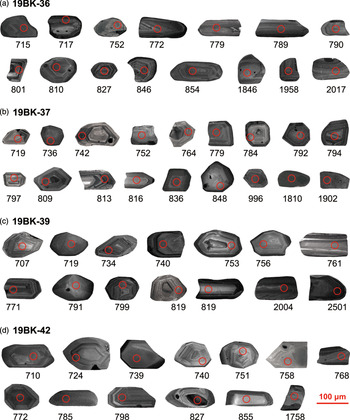
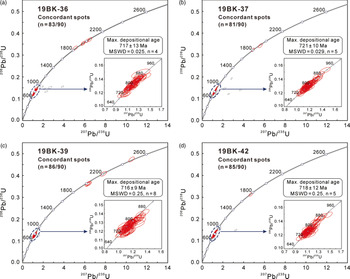
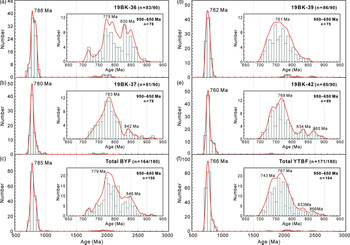
Two samples were selected from each of the Hengdan Group formations for detrital zircon U–Pb dating. In total, 360 measurement spots were obtained on 360 zircon grains from the four samples. CL images of representative zircon grains from each sample are shown in Figure 5. Dating results are listed in Supplementary Table S1 (in the Supplementary Material available online at https://doi.org/10.1017/S0016756820000898) and are plotted in concordia diagrams in Figure 6. In addition, probability density histograms and curves of grains with close to concordant U–Pb ages are displayed in Figure 7.
Cathodoluminescence (CL) images of representative detrital zircon grains from samples 19BK-36 (a), 19BK-37 (b), 19BK-38 (c) and 19BK-39 (d). Solid red circles represent the U–Pb dating spots, while the numbers in black apply to zircon ages.

U–Pb concordia diagrams of investigated samples. Solid red and grey circles refer to concordant and discordant grains, respectively.

Age probability density distributions and curves of concordant zircons. Abbreviations: BYF – Baiyang Formation; YTBF – Yangtianba Formation.

5.1.1. Baiyang Formation
Zircon grains of both the Baiyang Formation bottom and top samples (19BK-36 and 37) exhibit similar characteristics of morphologies and age results. The grains are largely subhedral to euhedral, with sizes ranging from 70 to 250 μm in length and 50–90 μm in width, suggesting that they have experienced a relatively short-distance transportation and weak abrasion. In CL images, these grains predominantly exhibit a well-developed magmatic oscillatory zoning internal structure (Fig. 5a, b; Vavra et al. Reference Vavra, Schmid and Gebauer1999). In total, 180 spots were analysed on 180 grains from the two samples. Among them, 164 analyses are discussed (concordance degree from 95 % to 104 %), while 16 analyses were discarded given their high degree of U–Pb discordance (Supplementary Table S1 (in the Supplementary Material available online at https://doi.org/10.1017/S0016756820000898); Fig. 6a, b).
All these analysed spots display high Th/U ratios ranging from 0.29 to 2.25 (Supplementary Table S1 (in the Supplementary Material available online at https://doi.org/10.1017/S0016756820000898)), confirming their igneous origin (Hoskin & Schaltegger, Reference Hoskin and Schaltegger2003). Overall, 156 spots (constituting c. 95 % of total concordant analyses) are concentrated on a dominant age population from 915 to 715 Ma (Fig. 7a–c). These Neoproterozoic grains show a major peak age c. 779 Ma and a subordinate peak c. 846 Ma (Fig. 7c). In addition, 7 spots show 2055–1795 Ma ages, with another 1 spot showing an isolated age at 1025 Ma (Fig. 7c). Overall, the youngest group of zircons from the two samples exhibit distinctly slightly younger ages, consistently euhedral to subhedral morphology and a typical internal structure with magmatic oscillatory zoning, indicating a rapid erosion of the igneous source and a limited transportation process (Wang et al. Reference Wang, Liu, Feng, Li, Wu, Wang, Wang and Yang2012 a). Such features imply that these zircon grains could be used to constrain the maximum depositional age of samples from the Baiyang Formation. The youngest nine analyses from the two samples yield consistent weighted mean ages of 717 ± 13 Ma (MSWD = 0.025) and 721 ± 10 Ma (MSWD = 0.029) (Fig. 6a, b), constraining the maximum depositional age of the Baiyang Formation.
5.1.2. Yangtianba Formation
Zircon grains of both samples from the Yangtianba Formation (19BK-39 and 41) also show similar features. The grains are largely prismatic in habit and range in size from 70 to 250 μm, with length/width ratios of 1:1 to 2:1 (Fig. 5c, d), indicating that they were derived from local sources by short-distance transportation. CL images (Fig. 5c, d) reveal that most grains are characterized by a clear magmatic oscillatory zoning (Vavra et al. Reference Vavra, Schmid and Gebauer1999). A few grains exhibit a core–rim structure, featuring by a blurry inherited core and a surrounding oscillatory-zoned overgrowth (Fig. 5c, d). A total of 180 spots were selected for assessment on 180 grains, of which 171 analyses show high concordance values from 96 % to 107 % and are considered in the following sections (Supplementary Table S1 (in the Supplementary Material available online at https://doi.org/10.1017/S0016756820000898); Fig. 6c, d).
These concordant spots uniformly exhibit high Th/U ratios greater than 0.12 (Supplementary Table S1 (in the Supplementary Material available online at https://doi.org/10.1017/S0016756820000898)), demonstrating their magmatic attributes (Hoskin & Schaltegger, Reference Hoskin and Schaltegger2003). In the age probability density histograms (Fig. 7d–f), similar to the Baiyang Formation, 164 analyses define a principal age cluster from 896 to 707 Ma, with a peak c. 766 Ma, accounting for c. 96 % of the concordant analyses. Within this age range, these spots exhibit a bimodal age spectrum with prominent peak ages c. 767 and 743 Ma (Fig. 7f). Seven additional analyses yield results varying from 2465 to 1777 Ma (Fig. 7f). In addition, the youngest age group of these two samples from the Yangtianba Formation similarly displays magmatic oscillatory zoning internal structure, and euhedral to subhedral shapes, suggesting their igneous origin. The samples show Th/U ratios >0.80, precluding the metamorphic recrystallization disturbance (Wang & Zhou, Reference Wang and Zhou2013). The 13 youngest analyses from the two samples yield weighted mean ages of 716 ± 9 Ma (MSWD = 0.25) and 718 ± 12 Ma (MSWD = 0.25) (Fig. 6c, d), representing the upper depositional limit age of the Yangtianba Formation.
5.2. Whole-rock geochemical compositions
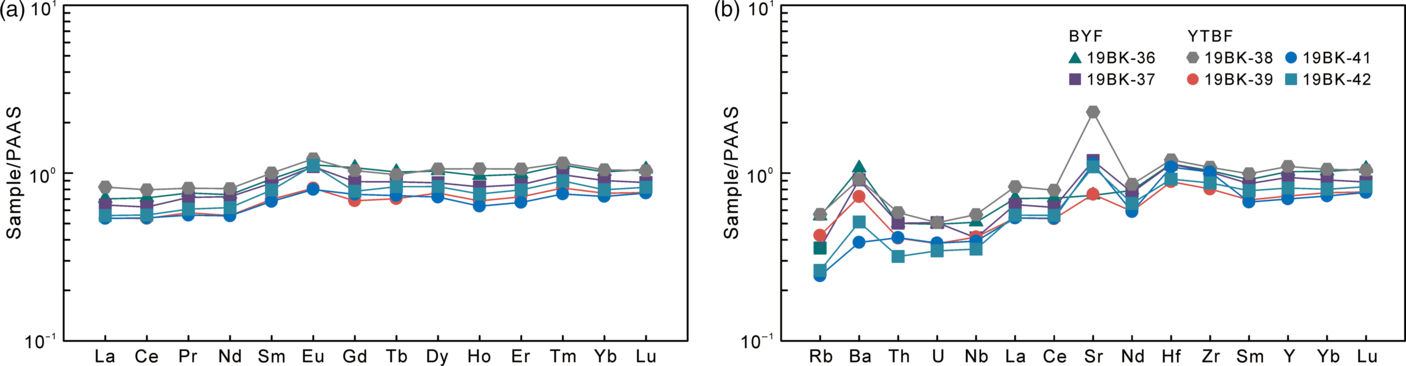
Whole-rock major and trace element compositions of six samples from both the Baiyang and Yangtianba Formations are present in Supplementary Table S2 (in the Supplementary Material available online at https://doi.org/10.1017/S0016756820000898). Overall, these samples from both formations in the Hengdan Group exhibit approximately consistent compositional features. The samples are characterized by narrow ranges of SiO2 (66.80–73.19 wt %), Al2O3 (11.46–15.45 wt %), TiO2 (0.45–0.67 wt %), MgO (1.31–1.91 wt %), FeOTotal (3.75–5.86 wt %) and P2O5 (0.06–0.12 wt %) contents (Supplementary Table S2 (in the Supplementary Material available online at https://doi.org/10.1017/S0016756820000898)). In the post-Archaean Australian shale (PAAS)-normalized rare-earth element (REE) patterns (Fig. 8a), these samples display a slight depletion of light rare-earth elements (LREEs) with (La/Yb)N ratios ranging from 0.69 to 0.79 (Supplementary Table S2 (in the Supplementary Material available online at https://doi.org/10.1017/S0016756820000898)). These samples are characterized by a relatively flat distribution of heavy rare-earth elements (HREEs; (Gd/Yb)N = 0.90–1.06), and generally show similar patterns to PAAS (Taylor & McLennan, Reference Taylor and McLennan1985). In addition, compared to PAAS (Taylor & McLennan, Reference Taylor and McLennan1985), the samples also exhibit highly variable large-ion lithophile elements (LILEs; e.g. Rb, Sr and Ba), less abundant Th, U and Nb contents, and otherwise similar Zr, Hf and Lu values in the PAAS-normalized trace element spider diagrams (Fig. 8b).
(a) PAAS-normalized REE patterns and (b) PAAS-normalized trace element diagrams for investigated samples from the Hengdan Group. Abbreviations: BYF – Baiyang Formation; YTBF – Yangtianba Formation.

6. Discussion
6.1. Maximum depositional age
Since the end of last century, several groundbreaking studies have been conducted in an attempt to uncover the depositional time of the Hengdan Group. According to detailed investigations on sedimentary profiles, Pei (Reference Pei1989) and Li (Reference Li1991) first suggest that the Hengdan Group is likely to have a co-evolving relationship with the Bikou Group, and its deposition time should be in the Neoproterozoic era. Nevertheless, Yan et al. (Reference Yan, Wang, Hanson, Druschke, Wang and Yan2002) consider that the Hengdan Group ought to have an independent evolutionary history compared to the Bikou Group and should belong to a late Palaeozoic sedimentary system.
With the expansion of quantitative geochronological analyses, the deposition time of the Hengdan Group in recent years has once again attracted some scholars’ attention. For instance, Druschke et al. (Reference Druschke, Andrew, Yan, Wang and Wang2006) and Sun et al. (Reference Sun, Zhou, Gao, Yang, Zhao and Zhao2009) report that the sedimentary protoliths might have been deposited during the c. 770–745 Ma interval, based on a limited detrital zircon agepopulation dataset. Such findings give a robust indicator that sedimentation of the Hengdan Group might have started in the late Tonian. In this study, numerous detrital zircon chronological analyses have been performed on the samples from each formation of the Hengdan Group to constrain the precise depositional time. Available dating results for samples 19BK-36 and 37 from bottom and top portions of the Baiyang Formation, respectively, yield consistent age clusters and youngest ages (Figs 6a, b and 7a–c). Zircon grains from the youngest age population of each sample preserve typical magmatic features and have weighted mean ages at 717 ± 13 Ma and 721 ± 10 Ma (Fig. 6a, b), indicating that the maximum depositional age of the Baiyang Formation was probably at 720 ± 8 Ma. In addition, age data for samples 19BK-39 and 42 from bottom and middle portions of the Yangtianba Formation also show similar age spectra, with youngest weighted mean ages at 716 ± 9 Ma and 718 ± 12 Ma (Figs 6c, d and 7d–f). These results demonstrate that the upper sedimentation age limit of the Yangtianba Formation is 717 ± 7 Ma. In this case, such consistent results within error of each other provide the best estimated depositional time of the entire Hengdan Group. The maximum depositional age should be more quantitatively extrapolated to be c. 720 Ma.
Therefore, given the appearance of many Cryogenian ages from the Cryogenian–Ediacaran strata in the Yangtze Block (e.g. J Wang et al. Reference Wang, Deng, Wang, Qiu, Duan, Jiang and Yang2013; Okada et al. Reference Okada, Sawaki, Komiya, Hirata, Takahata, Sano, Han and Maruyama2014), together with the absence of relevant age populations in this study, we propose that the Hengdan Group should start sedimentation at c. 720 Ma. Considering its lithological and petrographical characteristics, these above data suggest that the Hengdan Group belongs to a turbidite sequence that rapidly accumulated in a short period.
6.2. Sedimentary provenance
6.2.1. Chemical properties of the source area
The chemical properties of poorly sorted clastic rocks have been generally considered an effective indicator for investigating the sedimentary provenance (Nesbitt et al. Reference Nesbitt, Markovics and Price1980, Reference Nesbitt, Young, McLennan and Keays1996; Nesbitt & Young, Reference Nesbitt and Young1982; Taylor & McLennan, Reference Taylor and McLennan1985; Bhatia & Crook, Reference Bhatia and Crook1986; McLennan et al. Reference McLennan, Taylor, McCulloch and Maynard1990, Reference McLennan, Hemming, McDaniel, Hanson, Johnsson and Basu1993; Absar et al. Reference Absar, Raza, Roy, Naqvi and Roy2009). Since siliciclastic rocks are prone to alteration during chemical weathering, physical sorting and regional thermal disturbance (Singh, Reference Singh2009), it is necessary to evaluate the possible changes of the relevant immobile elements before evaluation. Chemically immobile elements usually tend to exhibit invariable ratios during alteration and exhibit a linear array with relatively stable elements, whereas these mobile elements generally have a wide scatter (Fralick & Kronberg, Reference Fralick and Kronberg1997; W Wang et al. Reference Wang, Liu, Feng, Li, Wu, Wang, Wang and Yang2012; Wang & Zhou, Reference Wang and Zhou2013). Overall, the samples from both the formations of the Hengdan Group in this study have low values of LOI; (<3.9 wt %) (Supplementary Table S2 (in the Supplementary Material available online at https://doi.org/10.1017/S0016756820000898)). In addition, some of the oxides (i.e. TiO2 and P2O5) display a wide scatter with SiO2 increases, suggesting their chemically mobile properties (Supplementary Table S2 (in the Supplementary Material available online at https://doi.org/10.1017/S0016756820000898)). Al2O3, MgO, FeOTotal, TiO2, Na2O and P2O5 exhibit common linear arrays, indicating that these elements were relatively immobile during chemical weathering and physical sorting (Fralick & Kronberg, Reference Fralick and Kronberg1997; W Wang et al. Reference Wang, Liu, Feng, Li, Wu, Wang, Wang and Yang2012; Wang & Zhou, Reference Wang and Zhou2013).
Chemical Index of Alteration (CIA) values are commonly used as an index to track the weathering trend in the provenance area (Nesbitt et al. Reference Nesbitt, Markovics and Price1980; Nesbitt & Young, Reference Nesbitt and Young1982; Absar et al. Reference Absar, Raza, Roy, Naqvi and Roy2009). Post-depositional K metasomatism is an important factor that could change CIA values (Fedo et al. Reference Fedo, Wayne and Young1995; W Wang et al. Reference Wang, Liu, Feng, Li, Wu, Wang, Wang and Yang2012; Wang & Zhou, Reference Wang and Zhou2013). The samples in this study exhibit a typical linear trend subparallel to the Al2O3–CaO + Na2O axis in the Al2O3–CaO + Na2O–K2O diagram (not shown), indicating insignificant post-depositional K metasomatism (Fedo et al. Reference Fedo, Wayne and Young1995; W Wang et al. Reference Wang, Liu, Feng, Li, Wu, Wang, Wang and Yang2012; Wang & Zhou, Reference Wang and Zhou2013). The CIA values of our samples range from 51.3 to 60.4 (average 56.1; Supplementary Table S2 (in the Supplementary Material available online at https://doi.org/10.1017/S0016756820000898)), suggesting moderate palaeo-weathering history of the sediments. Moreover, certain specific element or oxide ratios (such as SiO2/Al2O3, Th/U, Th/Sc and Zr/Sc) are usually sensitive to sediment recycling and weathering intensity and show a positive correlation (Taylor & McLennan, Reference Taylor and McLennan1985; McLennan, Reference McLennan1989; Cullers, Reference Cullers1994; Zhang et al. Reference Zhang, Li and Wei2012). In this study, the relatively low and narrow variations of SiO2/Al2O3 (4.40–6.04), Th/Sc (0.41–0.74) and Zr/Sc (16.5–26.2) ratios as well as moderate Th/U (4.36–5.40) ratios (Supplementary Table S2 (in the Supplementary Material available online at https://doi.org/10.1017/S0016756820000898)) imply the samples contain a low component of recycled detritus with a long residence time in the provenance. This feature is also consistent with the petrography that shows a very immature material composition of the samples (Figs 4 and 5). This finding demonstrates that the chemical variations of the samples are mostly controlled by the eroded source substance rather than recycling material processes (McLennan, Reference McLennan1989; McLennan et al. Reference McLennan, Hemming, McDaniel, Hanson, Johnsson and Basu1993; Cullers, Reference Cullers1994). Therefore, the Hengdan Group was deposited close to the provenance area, in an environment of rapid erosion and sedimentation.
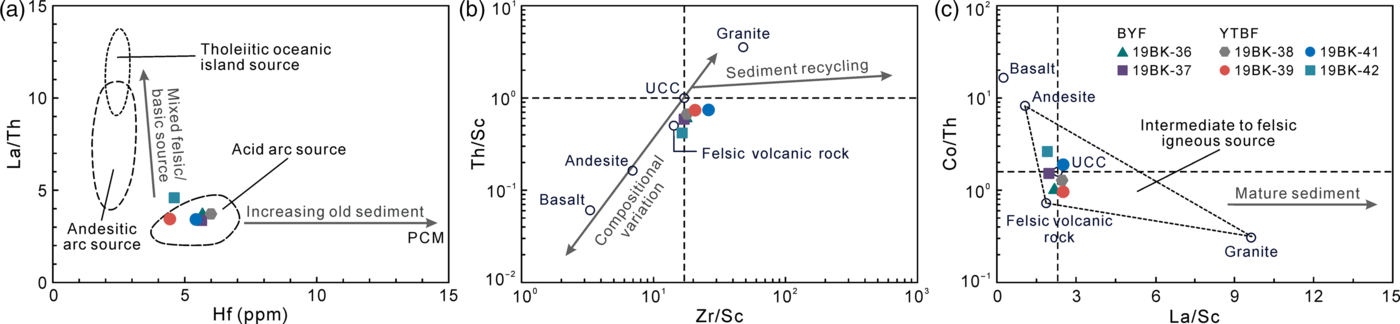
In addition, some trace elements (such as REEs, Th, Sc, Zr and Co) are also provenance indicators, because they are stable and insoluble during weathering and transportation relative to some other elements (Taylor & McLennan, Reference Taylor and McLennan1985; Bhatia & Crook, Reference Bhatia and Crook1986). Due to different abundances of elements in a particular rock type, this fundamental distinction makes them useful for provenance discriminations (Bhatia, Reference Bhatia1985; Taylor & McLennan, Reference Taylor and McLennan1985; Bhatia & Crook, Reference Bhatia and Crook1986; Floyd & Leveridge, Reference Floyd and Leveridge1987; McLennan et al. Reference McLennan, Hemming, McDaniel, Hanson, Johnsson and Basu1993). For instance, the samples exhibit moderate Hf (4.44–5.99 ppm) values, and low La/Th (3.41–4.59) ratios, suggesting the detritus mainly originated from a felsic source with a potential supply of intermediate protolith material (Fig. 9a). Such a conjecture is also supported by the occurrence of abundant magmatic zircons with Neoproterozoic ages as discussed above. Regarding the trends in the Zr/Sc versus Th/Sc diagram, the data indicate a dominant intermediate to felsic igneous provenance and a limited chemical compositional variation of the source (Fig. 9b). This notion is also deduced from the low La/Sc (1.92–2.52), and moderate Co/Th (0.96–2.63) ratios of the samples (Fig. 9c). Derivation of the Hengdan Group from an intermediate to felsic igneous source is consistent with the petrographic observations, namely, the samples contain a large amount of lithic fragment, and tuffaceous material.
Discrimination diagrams for source properties of the investigated samples from the Hengdan Group. (a) Hf versus La/Th diagram (Floyd & Leveridge, Reference Floyd and Leveridge1987); (b) Zr/Sc versus Th/Sc diagram (McLennan et al. Reference McLennan, Hemming, McDaniel, Hanson, Johnsson and Basu1993); (c) La/Sc versus Co/Th diagram (Gu et al. Reference Gu, Liu, Zheng, Tang and Qi2002). Abbreviations: BYF – Baiyang Formation; YTBF – Yangtianba Formation; UCC – Upper continental crust.

6.2.2. Potential provenance of the sedimentary protoliths
Compilation of detrital zircon age distribution patterns is commonly an important means to assess the potential provenance of a specific sedimentary basin (Cawood & Nemchin, Reference Cawood and Nemchin2001; Cawood et al. Reference Cawood, Nemchin and Strachan2007, Reference Cawood, Hawkesworth and Dhuime2012; Condie et al. Reference Condie, Belousova, Griffin and Sircombe2009; Hawkesworth et al. Reference Hawkesworth, Dhuime, Pietranik, Cawood, Kemp and Storey2010). In this study, the samples from the two formations of the Hengdan Group exhibit a coincident detrital zircon age spectrum, which comprises overwhelming Neoproterozoic (c. 915–710 Ma) and minor Palaeoproterozoic (c. 2450–1750 Ma) ages (Fig. 7).
Almost all of the analyses fall into the age population of c. 915–710 Ma and consist of grains showing only minor abrasion, implying that the sediments were likely deposited simultaneously with the magmatism (e.g. Cawood et al. Reference Cawood, Hawkesworth and Dhuime2012). From a regional perspective, this age pulse coincides well with the extensive magmatism along the western margin of the Yangtze Block, mostly including c. 880–775 Ma diorites and bimodal volcanic rocks in the Bikou Terrane (Yan et al. Reference Yan, Andrew, Wang, Yan, Druschke, Wang, Liu, Song and Jiang2004; Lai et al. Reference Lai, Li and Qin2007; Xiao et al. Reference Xiao, Zhang, Ni, Xiang and Liu2007; XC Wang et al. Reference Wang, Li, Li, Li, Liu, Yang, Liang and Tu2008; W Wang et al. Reference Wang, Liu, Feng, Li, Wu, Wang, Wang and Yang2012), c. 890–705 Ma gabbroic to granitic plutons in the proximal Hannan–Micangshan Massif (Zhou et al. Reference Zhou, Kennedy, Sun, Malpas and Lesher2002; Ling et al. Reference Ling, Gao, Zhang, Li, Liu and Cheng2003; Zhao & Zhou Reference Zhao and Zhou2008, Reference Zhao and Zhou2009; Zhao et al. Reference Zhao, Zhou, Zheng and Fang2010; Dong et al. Reference Dong, Liu, Santosh, Zhang, Chen, Yang and Yang2011, Reference Dong, Liu, Santosh, Chen, Zhang, Li, He and Zhang2012; Luo et al. Reference Luo, Liu, Zhang, Zhao, Yang, Xu, Guo, Zhang, Tao, Pan, Wand, Gao and Shao2018; Ao et al. Reference Ao, Zhao, Zhang, Zhai, Zhang, Zhang, Wang and Sun2019; Hui et al. Reference Hui, Dong, Liu, Zhao, Sun, Zhang and Liu2020a), and c. 865–750 Ma gabbroic–granitic intrusions and relevant volcanic rocks in the southerly Xuelongbao–Kangding–Miyi areas (e.g. XH Li et al. Reference Li, Li, Zhou, Liu and Kinny2002; ZX Li et al. Reference Li, Li, Kinny, Wang, Zhang and Zhou2003; Zhou et al. Reference Zhou, Yan, Wang, Qi and Kennedy2006a; Lai et al. Reference Lai, Li and Qin2007; Zhao & Zhou Reference Zhao and Zhou2007; Zhao et al. Reference Zhao, Zhou, Li and Wu2008, Reference Zhao, Li, Liu and Wang2018, Reference Zhao, Zhou, Wu, Zheng and Wang2019; Meng et al. Reference Meng, Liu, Du, Liu and Liu2015). This information indicates that all these rocks might be representative of source detritus to the basin. In detail, a large amount of ages within c. 750–710 Ma, together with the absence of contemporaneous magmatism in other areas, suggests the Hannan–Micangshan Massif might provide the main source. Such attributes suggest that the main substance of the sedimentary basin should be derived from the Bikou Terrane and the adjacent Hannan–Micangshan Massif.
Further, apart from these dominant Neoproterozoic ages, a few older Palaeoproterozoic grains were detected (c. 2450–1750 Ma). Since these ages overlap with the tectono-thermal records in the basement Yudongzi Complex (Zhang et al. Reference Zhang, Zhang, Tang and Wang2001; Hui et al. Reference Hui, Dong, Cheng, Long, Liu, Yang, Sun, Zhang and Varga2017, Reference Hui, Dong, Zhang, Sun, Liu, Cheng and He2019; Chen et al. Reference Chen, Sun, Zhao, Zhao, Zhu, Long and Wang2019), the Bikou Terrane is the strongest candidate to provide the detritus. Moreover, the relatively low number of older Palaeoproterozoic-aged grains implies that supply input from the basement was restricted, which might be ascribed to limited exposure.
In addition, some scholars favour connecting the western margin of the Yangtze Block with eastern Australia and East Antarctica during the supercontinent reconstruction (e.g. ZX Li et al. Reference Li, Zhang and McApowell1995, Reference Li, Li, Kinny, Wang, Zhang and Zhou2003; XH Li et al. Reference Li, Li, Li and Liu2008), and this potential viewpoint implies that these domains might provide detrital material for our samples. However, given that abundant Archaean to Palaeoproterozoic (c. 2700–2300 Ma), and Mesoproterozoic (c. 1700–1000 Ma) detrital zircon ages occur in the Neoproterozoic clastic rocks in Australia and East Antarctica (e.g. Preiss, Reference Preiss2000; Cawood & Nemchin, Reference Cawood and Nemchin2001; Goodge et al. Reference Goodge, Williams and Myrow2004; Veevers et al. Reference Veevers, Saeed, Belousova and Griffin2005; Keeman et al. Reference Keeman, Turner, Haines, Belousova, Ireland, Brouwer, Foden and Wörner2020), together with the scarcity of corresponding age populations in our analyses, the possibility that the detritus in the Hengdan Group was derived from exotic distal sources is excluded.
6.3. Tectonic setting of the sedimentary basin
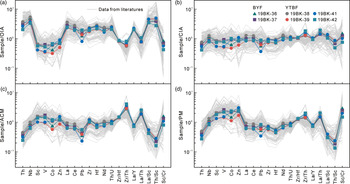
The composition of sedimentary rocks is also useful for discriminating depositional setting, because the deposits from various tectonic settings typically exhibit distinct compositional characteristics, such as those in the oceanic island arc, continental island arc, active continental margin and passive continental margin (Bhatia, Reference Bhatia1983; Bhatia & Crook, Reference Bhatia and Crook1986). This marked feature is especially reflected in some relatively immobile elements, such as REEs, HFSEs and transition elements (Bhatia, Reference Bhatia1983; Bhatia & Crook,Reference Bhatia and Crook1986). For this study, in the multi-element normalized diagram, the samples of the Hengdan Group display concentrations and signatures of most elements resembling those of continental island arc greywackes and representative fore-arc sedimentary sequences, implying they might be accumulated in a basin related to a tectonic setting of the continental arc (Fig. 10). Commonly sedimentary basins in the continental arc include the fore-arc and back-arc basins (e.g. Bhatia, Reference Bhatia1983). Nevertheless, in view of favourable conditions such as good exposure, weak deformation, low-grade metamorphism, preservation of clasts, and presence of rare magmatic layers (Pei, Reference Pei1989; Li, Reference Li1991; Yan et al. Reference Yan, Wang, Hanson, Druschke, Wang and Yan2002; this study), the samples were most likely deposited in a fore-arc basin.
Normalized multi-element patterns for investigated samples from the Hengdan Group. The data collected from literature are shown as grey lines. Normalizing OIA, CIA, ACM and PM data are from Bhatia & Crook (Reference Bhatia and Crook1986). The data of continental island arc fore-arc sedimentary rocks come from the samples from the late Palaeozoic basins in the Central Asian Orogenic Belt (Long et al. Reference Long, Yuan, Sun, Safonova, Xiao and Wang2012; Li et al. Reference Li, Brouwer, Xiao and Zheng2017; Lu et al. Reference Lu, Qin, Zhang, Han, Wei, Li and Qu2020), the Mesozoic basin in the Lhasa Terrane, southern Tibet (Wei et al. Reference Wei, Zhao, Niu, Zhu, DePaolo, Jing, Liu, Guan and Sheikh2020), the Cenozoic Salin Basin in central Myanmar (Lin et al. Reference Lin, Guo, Wai, Tamehe, Wu, Naing and Zhang2019), and the Late Palaeozoic to Early Mesozoic basin in the Sukhothai Arc, northern Thailand (Hara et al. Reference Hara, Kunii, Miyake, Hisada, Kamata, Ueno, Kon, Kurihara, Ueda, Assavapatchara, Treerotchananon, Charoentitirat and Charusiri2017). Abbreviations: OIA – oceanic island arc; CIA – continental island arc; ACM – active continental margin; PM – passive continental margin; BYF – Baiyang Formation; YTBF – Yangtianba Formation.

In addition, the results of detrital zircon age distribution patterns of the samples could also evaluate this inference. The overall zircon ages in the samples from both formations of the Hengdan Group in this study show a dominant proportion of ages (c. 95 %) close to the time of maximum accumulation (Figs 6 and 7), suggesting that the sediments were most likely deposited in an active continental marginal basin (e.g. Cawood et al. Reference Cawood, Hawkesworth and Dhuime2012). Besides, this conjuncture is also supported by the arc nature of the Bikou Terrane during the early Neoproterozoic (see discussions below). Thus, such essential evidences indicate that the Hengdan Group should accumulate in a fore-arc basin, lying within a subduction zone setting.
6.4. Tectonic implications
The tectonic nature of the Bikou Terrane remains a matter of debate, and the ‘plume–rift’ model (e.g. ZX Li et al. Reference Li, Zhang and McApowell1995, Reference Li, Li, Kinny and Wang1999, Reference Li, Li, Kinny, Wang, Zhang and Zhou2003; XH Li et al. Reference Li, Li, Zhou, Liu and Kinny2002, Reference Li, Li, Li and Liu2008) and the ‘slab–arc’ model (e.g. Zhou et al. Reference Zhou, Kennedy, Sun, Malpas and Lesher2002, Reference Zhou, Yan, Wang, Qi and Kennedy2006a, b; Dong et al. Reference Dong, Liu, Santosh, Zhang, Chen, Yang and Yang2011, Reference Dong, Liu, Santosh, Chen, Zhang, Li, He and Zhang2012; Zhao et al. Reference Zhao, Li, Liu and Wang2018) have been proposed. As a consequence, many scholars have disparate interpretations of the Neoproterozoic tectonics of the Bikou Terrane (Pei, Reference Pei1989; Xu et al. Reference Xu, Xia and Xia2002; Yan et al. Reference Yan, Andrew, Wang, Yan, Druschke, Wang, Liu, Song and Jiang2004; Lai et al. Reference Lai, Li and Qin2007; Xiao et al. Reference Xiao, Zhang, Ni, Xiang and Liu2007; XC Wang et al. Reference Wang, Li, Li, Li, Liu, Yang, Liang and Tu2008; Ye et al. Reference Ye, Cheng, Lu, Gao and Pan2009; W Wang et al., Reference Wang, Liu, Feng, Li, Wu, Wang, Wang and Yang2012; Xia et al. Reference Xia, Xia, Xu, Li and Ma2012; Wu et al. Reference Wu, Wang, Li, Wilde and Tian2019).
The main reason for these contradictory interpretations is identification of different types of volcanic rocks in the Bikou Group. For instance, some studies report the occurrence of some oceanic-island and mid-ocean-ridge-featured basalts as well as several bimodal volcanics, and thus suggest that they were formed in a continental rifting setting related to a c. 820–810 Ma mantle plume (Xu et al. Reference Xu, Xia and Xia2002; Lai et al. Reference Lai, Li and Qin2007; Wang et al. Reference Wang, Li, Li, Li, Liu, Yang, Liang and Tu2008; Xia et al. Reference Xia, Xia, Xu, Li and Ma2012; Wu et al. Reference Wu, Wang, Li, Wilde and Tian2019). Alternatively, Pei (Reference Pei1989) and Yan et al. (Reference Yan, Andrew, Wang, Yan, Druschke, Wang, Liu, Song and Jiang2004) suggest that a large amount of c. 845–770 Ma volcanic rocks developed in a subduction-related arc setting, based on their typical arc chemical characteristics. Despite these different arguments, one consensus that can be reached is that the c. 885–825 Ma diorite plutons which appear in the Bikou Group are the products of a subduction process (Xiao et al. Reference Xiao, Zhang, Ni, Xiang and Liu2007; Ye et al. Reference Ye, Cheng, Lu, Gao and Pan2009; W Wang et al. Reference Wang, Liu, Feng, Li, Wu, Wang, Wang and Yang2012; Ping et al. Reference Ping, Zheng, Xiong, Zhang and Xia2014). In this case, despite the former ‘plume–rift’ view that the tectonic environment was probably shifted from subduction (the c. 885–825 Ma diorite plutons) to continental rift, it is not feasible to go through the collision and the collapse processes without any geological and geochronological evidence (e.g. Wilson, Reference Wilson1963; Condie, Reference Condie1997; Kranendonk & Martin, Reference Kranendonk and Martin2011). Therefore, such an assumption suggests that the Bikou Group is more likely to be formed under the constraints of a long-lived subduction-related setting (Fig. 11; Pei, Reference Pei1989; Yan et al. Reference Yan, Andrew, Wang, Yan, Druschke, Wang, Liu, Song and Jiang2004; Wang et al. Reference Wang, Liu, Feng, Li, Wu, Wang, Wang and Yang2012 b).
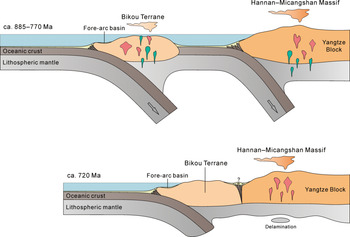
Schematic cartoons showing the early Neoproterozoic tectonic model of NW Yangtze Block.

Moreover, our interpretations on the tectonics of the Hengdan Group also support this conjecture. On the basis of the previous reconnaissance studies (Pei, Reference Pei1989; Zhao et al. Reference Zhao, Ma, Zhou and Xiu1990; Li, Reference Li1991; Yan et al. Reference Yan, Wang, Hanson, Druschke, Wang and Yan2002; Druschke et al. Reference Druschke, Andrew, Yan, Wang and Wang2006), our new results have greatly refined its evolution properties. As discussed above, the Hengdan Group was most likely deposited at c. 720 Ma (Figs 7 and 8). Sedimentation was most likely in a fore-arc basin, which was situated west of a continental arc under the current geographical orientation (Fig. 11). In addition, the massive peak of detritus eroded from the Hannan–Micangshan Massif suggests that the magmatic activities throughout the western margin of the Yangtze Block significantly impacted the Bikou Terrane, which might be attributed to enhanced plate coupling, or even accretion together, between the Bikou arc system and Yangtze continent associated with continuous subduction (Dong & Santosh, Reference Dong and Santosh2016; Zhao et al. Reference Zhao, Li, Liu and Wang2018 and references therein).
Therefore, the Bikou Terrane in the NW margin of the Yangtze Block was mainly controlled by a subduction process during the early Neoproterozoic period. These multi-genetic volcanic rocks, along with corresponding sedimentary sequences in the Bikou Group, may represent the products formed under different tectonic settings that subsequently collaged together in late processes (Pei, Reference Pei1989; Xu et al. Reference Xu, Xia and Xia2002; Yan et al. Reference Yan, Andrew, Wang, Yan, Druschke, Wang, Liu, Song and Jiang2004; Lai et al. Reference Lai, Li and Qin2007; Xiao et al. Reference Xiao, Zhang, Ni, Xiang and Liu2007; XC Wang et al. Reference Wang, Li, Li, Li, Liu, Yang, Liang and Tu2008; Ye et al. Reference Ye, Cheng, Lu, Gao and Pan2009; W Wang et al. Reference Wang, Liu, Feng, Li, Wu, Wang, Wang and Yang2012; Xia et al. Reference Xia, Xia, Xu, Li and Ma2012; Wu et al. Reference Wu, Wang, Li, Wilde and Tian2019). Nevertheless, further detailed studies remain necessary to test this hypothesis. From the perspective of regional tectonics, these integrated assumptions further support the mainstream view in recent years, that a subduction-related system occurred along the western margin of the Yangtze Block during the early Neoproterozoic (e.g. Zhou et al. Reference Zhou, Kennedy, Sun, Malpas and Lesher2002, Reference Zhou, Yan, Wang, Qi and Kennedy2006a, b; Zhao & Zhou, Reference Zhao and Zhou2007, Reference Zhao and Zhou2008, Reference Zhao and Zhou2009; Zhao et al. Reference Zhao, Zhou, Li and Wu2008, Reference Zhao, Li, Liu and Wang2018, Reference Zhao, Zhou, Wu, Zheng and Wang2019; Dong et al. Reference Dong, Liu, Santosh, Zhang, Chen, Yang and Yang2011, Reference Dong, Liu, Santosh, Chen, Zhang, Li, He and Zhang2012, Reference Dong, Sun, Yang, Liu, Zhang, Li, Cheng, He and Zhang2017; Dong & Santosh, Reference Dong and Santosh2016).
7. Conclusion
Integration of the new lithological, detrital zircon U–Pb dating, and whole-rock chemical analyses for the sedimentary rock samples in the Hengdan Group lead us the following conclusions:
-
1. The investigated samples from the Hengdan Group are mainly greywackes and have poor textural and compositional maturity, reflecting rapid accumulation and short-distance transportation of the sediment.
-
2. Concordant detrital zircon grains of samples from the Baiyang and Yangtianba Formations yield weighted average youngest ages of c. 720 Ma, defining the maximum depositional age of the Hengdan Group at c. 720 Ma.
-
3. Detrital zircon age patterns of samples show uniformly dominant Tonian (c. 915–710 Ma) grains, with detritus suitably derived from the Bikou Terrane, and the proximal Hannan–Micangshan Massif in the NW turn of the Yangtze Block.
-
4. Geochemical compositions of the samples reveal that the provenance of the Hengdan Group is predominantly characterized by intermediate to felsic igneous components, suffering rapid erosion and sedimentation.
-
5. Our new data, dialectically in association with previous studies, support that the Hengdan Group was deposited in a fore-arc basin along the Bikou Terrane.
Supplementary material
To view supplementary material for this article, please visit https://doi.org/10.1017/S0016756820000898
Acknowledgements
We would like to thank the Editor Dr Kathryn Goodenough, Dr Wei Wang and an anonymous referee for their perceptive comments and suggestions on an earlier version of the manuscript. Lei Yang, Yuangang Yue and Bin Zhang are also thanked for their invaluable contributions to the field and lab work. Financial support for this study is jointly provided by the National Key Research and Development Program of China (Grants Nos. 2016YFC0600202 and 2016YFC0601003), the National Natural Science Foundation of China (Grants Nos. 41930217, 41421002, and 41772226), the Scientific Research Program Funded by Shaanxi Provincial Education Department (Program No. 15JK1733), and the MOST Special Fund from the State Key Laboratory of Continental Dynamics. Bo Hui acknowledges support from the Northwest University Graduate Innovation and Creativity Funds (Grant No. YZZ17191).
Declaration of interests
We declare that we have no known competing financial interests or personal relationships that could have appeared to influence the work reported in this paper.