Introduction
In recent years, an increasing number of studies have investigated the response to stimuli associated with substances of abuse (drug cues) in patients with addiction disorders. Drug cues elicit an enhanced emotional response in drug-dependent patients, inducing an attentional bias which reflects the salience of these stimuli in drug-dependent populations. Complex multiple factors concur to the individual response to drug cues Reference Field and Cox(1) and different models have been proposed to explain the mechanisms underlying the attentional bias observed in drug-dependent patients and its relationship with clinical addiction and emotional/motivational states. More than one explanation has been given to clarify why drug cues capture the attention of substance abusers. Classical conditioning to stimuli associated with drugs, a state of craving that generates increased arousal and expectations towards drugs, ready availability of substance of abuse, frequency of assumption of drugs are all explanations which have been put forward to account for a drug-cue-induced attentional bias. Most likely, the observed bias might be better accounted for by multiple contributing factors and the observed variability in response to drug cues seems to result from the interplay of different processes (Reference Field and Cox1–Reference Wertz and Sayette3).
Drug cues used in previous experiments include videos with scenes picturing the preparation and consumption of drugs, photos associated with substance abuse (paraphernalia), audio descriptions of drug preparation and consumption during which participants had to imagine the scene, or words associated with various substances of abuse. Individuals with history of drug abuse showed an attentional bias towards drug-related stimuli (Reference Childress, Mozley and McElgin4–Reference Carrigan, Drobes and Randall11). It was observed that drug cues can generate a response very similar to that induced by the drugs themselves, activating memories, sensations, emotions and events connected to them Reference Volkow, Wang and Telang(6,Reference Kelley, Schiltz and Landry12).
The response to drug-related stimuli has been observed using both cognitive tasks and techniques which can detect neurobiological changes. One of the experimental paradigms used to measure the attentional bias caused by drug cues is an emotional variant of the Stroop test. This paradigm is a modified version of the colour-naming Stroop task Reference Stroop(13). The emotional Stroop procedure provides a measure of the attentional bias induced by words with an emotional content. When used in the field of drug addiction, people had to name the colour of the ink of nouns associated with various relevant drugs. In this task response latencies to emotional stimuli are longer than to neutral stimuli Reference Robbins and Ehrman(14). The emotional Stroop test has been used with patients with alcohol Reference Lusher, Chandler and Ball(10), cocaine Reference Childress, Mozley and McElgin(4,Reference Hester, Dixon and Garavan15), heroin Reference Franken, Hendriks, Stam and Van den Brink(16), cannabis Reference Field(17) and tobacco Reference Munafo, Lingford-Hughes, Johnstone and Walton(18) addiction. These studies showed that people with history of drug dependence had an attentional bias towards words associated with the substance of abuse. Stimuli were judged as having a higher emotional salience Reference Bauer and Cox(19), took longer to respond and resulted in lower accuracy than neutral stimuli (Reference Franken, Kroon, Wiers and Jansen9,Reference Lusher, Chandler and Ball10,Reference Hester, Dixon and Garavan15). The attentional bias provides a measure of distraction caused by stimuli associated with drugs. A greater bias has been observed when participants had a current preoccupation with the substance of abuse or when they had been substance deprived by experimental manipulation Reference Cox, Fadardi and Pothos(20). Evidence of this kind supports motivational accounts of the attentional bias.
Evidence from neuroimaging studies of patients with drug dependence showed activation in brain areas associated with reward in response to drug cues, including orbito-frontal and limbic regions (Reference Childress, Mozley and McElgin4,Reference Wexler, Gottschalk and Fulbright5,Reference Garavan, Pankiewicz and Bloom21).
The magnitude of the attentional bias induced by drug cues seems to be associated with the severity of drug dependence and the evolution of the disorder, and a measure of this bias seems to be a valid predictor of the risk for relapse Reference Cox, Hogan, Kristian and Race(22). Drug-related stimuli can elicit memories of events linked to psychoactive substances and can cause emotional arousal in people with history of drug abuse Reference Sell, Morris and Bearn(23). Exposure to drug cues (e.g. environments, individuals or feelings related to drugs) might also be one of the possible causes of relapse in people with history of drug dependence Reference Goldstein and Volkow(24).
A potentially valid treatment approach to lower the risk of relapse would be to modify the cognitive mechanisms that support the motivational and control processes involved in drug-cue response, in an attempt to modify/destroy a well learned and consolidated response to drugs and other conditioned stimuli Reference Lee, Milton and Everitt(25). Effective control and modification of drug-cue response is considered an efficient treatment strategy to prevent maintenance of drug abuse and lower the chance of relapse Reference Volkow, Fowler and Wang(26).
The above findings might have implications in the treatment of addiction. A possible effective treatment strategy for addiction might consist of raising awareness of the risk associated with exposure to drug-related stimuli and consequent cognitive processing of these stimuli in a controlled and monitored environment. To test whether raised awareness of risk in a controlled environment were a more successful strategy for the treatment of addiction, the present study compared the response to drug cues in four different groups of individuals: healthy normal individuals without history of drug abuse (control group); abstinent drug-dependent patients who were treated for drug abuse in a treatment community (a controlled environment free from drugs) or opioid substitution therapy (community therapy group); drug-dependent patients assuming opioid substitution therapy, free from psychoactive drugs (substitution therapy group); active drug-dependent patients, without either pharmacological or community-based treatments (active group). The aim of the study was to verify whether the approach used in the clinical treatment of drug abuse modifies the extent of the attentional bias induced by drug cues.
To our knowledge only one earlier study has looked at the relationship between a drug-cue-induced attentional bias and treatment status in a group of cocaine abusers using an emotional Stroop paradigm Reference Vadhan, Carpenter and Copersino(27). The authors compared treatment-seeking and non-treatment-seeking cocaine abusers. Treatment seekers had greater attentional bias towards drug cues (i.e. increased latency and less accuracy) than to neutral words, while non-treatment seekers showed no such effect. Greater attentional bias when exposed to drug-related cues in treatment seekers was attributed to a subjective status of greater emotional distress associated with cocaine abuse in this group leading them to seek treatment.
The aim of the present study was to further investigate the issue of treatment status in cocaine- and heroin-dependent patients and to compare the effect of different types of treatment (pharmacological and non-pharmacological community-based treatment) on the attentional bias induced by drug cues. It was predicted that there would be an attentional bias towards drug cues in patients with history of drug abuse and that the extent of the attentional bias would change depending on the current clinical conditions of the patients. Although other variables (such as level of craving, ready availability of drugs, severity of addiction) might all have a role in the extent of the attentional bias induced by drug cues, it was predicted that treated patients, whether on opioid substitution therapy or on community-based therapy, would show a smaller attentional bias compared to active drug-dependent patients, since both forms of treatment might reduce the salience of drug-related cues, although through different mechanisms, either by decreasing craving (opioid substitution therapy) or by modifying behaviour and avoiding contacts with drug stimuli (community-based therapy).
Methods
Participants
Four groups of participants took part in this study. The control group included 25 healthy participants without any history of drug abuse (14 males, 11 females; mean age = 30.44, SD = 5.77; mean education = 16.40, SD = 2.55). In the patient group both cocaine- and heroin-dependent patients were recruited (cocaine n = 24; heroin n = 45). The community-treated (CT) group involved 26 drug-dependent patients resident in two centres for the cure of addiction who were recovering with a non-pharmacological approach, all free from drug and substitution therapy and with negative urine toxicology assay (all males; mean age = 30.88, SD = 6.65; mean education = 9.38, SD = 2.92); the opioid substitution therapy group included 20 drug abusers all taking opioid replacement therapy (either methadone or buprenorphine), free from substance of abuse and with negative urine toxicology assay (18 males, 2 females; mean age = 32.80, SD = 7.48; mean education = 9.70, SD = 2.87); the active drug abuse group included 23 drug-dependent individuals assuming psychoactive substances, not on replacement treatment or any type of community-based therapeutic intervention (18 males, 5 females; mean age = 33.13, SD = 9.11; mean education = 10.39, SD = 2.90). The community-treated group was recruited in two therapeutic centres for the treatment of addiction (one from the Parma area and one from the Bologna area); the patients on opioid substitution therapy and active drug abusers were recruited at the Addiction Centre in Parma. The control individuals were an opportunity sample recruited in the areas of Modena and Parma, without any history of systematic or occasional drug use. Drug-dependent patients had a history of prolonged and severe drug abuse of cocaine or heroin, diagnosed with the Structured Clinical Interview for the Diagnostic and Statistical Manual of Mental Disorders (DSM) (SCID I), which ranged from a minimum of 5 to a maximum of 12 years, with a daily consumption of drugs. Community-treated patients had been on treatment in the centres for a period of time ranging from a minimum of 3 months to a maximum of 2 years. The majority in this group were approaching the end of their 2-year treatment programme. The patients on opioid substitution therapy had been taking therapy for at least 3 months. The first and primary substance of abuse (cocaine or heroin) was ascertained during a clinical interview and the main medium of drug administration (intravenous, smoked, inhaled) determined. All had a primary substance of abuse, but some patients had occasionally consumed both drugs and most had consumed alcohol, cannabis and tobacco as well. Establishing the primary substance of abuse was relevant for the selection of drug cues for the emotional version of the Stroop task (this point will be detailed more extensively in the Procedure section). All patients and controls were right-handed.
Materials
Classical and emotional Stroop paradigm. In the classical Stroop task all the word-colour combinations of four colours (yellow, blue, red and black) were used in the congruent/incongruent conditions of the task. The congruent condition included items in which the colour was the same as the written colour–name stimulus; the incongruent condition included items in which the colour and the written colour–name stimulus did not match. In the emotional version of the Stroop task, 141 words associated with cocaine and 178 words associated with heroin were used as stimuli in the emotional condition, while 100 non-drug-related words were used for the neutral trials. All stimuli were presented written in coloured ink using the four colours of the classical task in equal proportions for each condition. The neutral words were taken from a previous study in which nouns of concrete objects were rated as having high scores in frequency and familiarity Reference Gardini, De Beni and Cornoldi(28). The emotional drug-cue words were obtained from a list which had been standardised and validated in a earlier study Reference Gardini, Nocetti and Toraci(29). In this study a population of drug addicted had been asked to generate as many words as possible related to their primary substance of abuse (cocaine and heroin). Subsequently these patients were asked to rate each word for their association with either cocaine or heroin. The drug-cue words were synonymous of drugs, medium of drug administration, environment and people associated with drugs (e.g. drug dealing settings), feelings related to drugs (e.g. the anxiety during searching and finding of drugs), consumption and subsequent effects.
Procedure
The Stroop paradigm was computerised and devised using the E-Prime software. There were four experimental conditions. For the classical version of the task, in the congruent condition, participants had to name the colour of items in which the colour and the colour–name matched (e.g. the word BLACK written in black ink); in the incongruent condition, participants had to name the colour of the ink of colour words in which the colour and the colour name did not match (e.g. the word BLACK written in yellow ink). In the emotional version of the Stroop, in the neutral condition participants had to name the colour of words not having a relation with any substance of abuse written in all combinations of colours (e.g. the word CAT written in red) presented in random order, while in the emotional condition participants were presented with randomly displayed drug-cue words written in all combinations of colours (e.g. the word PUSHER written in blue). In all conditions, the participants had to press one of four keys (each corresponding to a colour, blue, red, yellow or black) on a keyboard to select the colour of the ink a word was written in. Participants made their response with their right hand and were required to press the index finger for blue, the middle finger for red, the ring-finger for yellow and the little finger for black. This finger/colour association was maintained across all conditions to rule out any finger effect on response times. Stimuli remained on screen for 150 ms followed by a maximum three seconds interval during which participants had to provide their response, which was then immediately followed by the presentation of a new stimulus. A fixation cross positioned in the middle of the screen remained present constantly and participants were instructed to fixate the cross.
A few different versions of the emotional Stroop condition were prepared including cues specific for different substances of abuse (cocaine or heroin) and medium of drug administration (intravenous, smoked or inhaled). Each patient was administered with the emotional Stroop version containing drug cues corresponding to their primary drug of abuse and their primary mode of administration, i.e. cocaine-dependent patients were tested with cocaine-related cues and heroin-dependent patients were tested with heroin-related cues. Control participants were administered in rotation one of the different versions of the emotional Stroop with a similar frequency of presentation of each version matching that in the drug abusers.
Three sessions of 6 minutes each were presented to each participant. One hundred-eighty stimuli were presented in each condition. Stimuli were presented in a blocked format. To prevent the use of response strategies Reference Cox, Fadardi and Pothos(20), however, in both versions of the Stroop task each experimental condition (incongruent/emotional) contained a proportion of words of its corresponding control condition (congruent/neutral) and vice versa. Response times were measured. The order of words in each experimental condition and that of the experimental conditions in each session were randomised between and within participants.
Results
An Analysis of Variance was carried out to investigate if the groups differed in age or education. There was no age difference amongst the groups [F(3, 93) = 0.808, p = 0.493], but there was a significant difference in education [F(3, 93) = 34.107, p < 0.0001]. Post-hoc analysis using Fisher's least significant difference (LSD) showed that the control group had a higher level of education than all other groups (p = 0.0001 for all). Gender was not well balanced across groups. A gender difference was present between the control group and the community-treated and opioid substitution therapy groups (χ214.59, p = 0.0001 and χ26.25, p = 0.0124, respectively) but not between the control and active groups (χ22.67, p = 0.10). No significant gender difference was found between the community-treated and the substitution therapy treated groups (χ22.72, p = 0.09) or between the substitution therapy treated and the active groups (χ21.08, p = 0.29), but there was a significant difference in gender between the community-treated and the active groups (χ26.29, p = 0.0121).
Two Analyses of Covariance were computed with group (control, community treated, substitution therapy, active) and drug of abuse (cocaine and heroin) as the independent factors and education and gender as covariate factors (as the groups differed for these variables) and time interference on the classical colour-word and emotional Stroop tasks as dependent variable in turn.
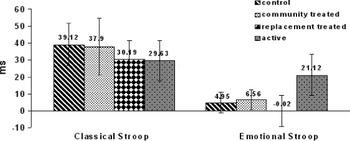
Classical Stroop task. The four groups did not differ in performance [F(3, 85) = 0.378, n.s.] (Fig. 1), nor was there any significant difference between the two drugs of abuse [F(3, 85) = 2.201, n.s.]. There also was no significant interaction between-group and drug of abuse [F(3, 85) = 0.984, n.s.].
Interference effect and attentional bias (in milliseconds) on the classical and emotional versions of the Stroop task, in control and addicted patient groups.

Emotional Stroop task. A significant difference amongst the groups was found [F(3, 85) = 8.600, p < 0.0001]. Fisher's LSD post-hoc test showed that active drug-dependent patients had a greater attentional bias towards drug cues (i.e. a larger difference between the response latency to drug-related words and that to neutral words) (M = 21.12, SD = 25.27) than controls (M = 4.95, SD = 13.56) (p = 0.023), community-treated patients (M = 6.56, SD = 11.74) (p = 0.048), and patients on opioid substitution therapy (M = −0.02, SD = 18.03) (p = 0.003), (see Fig. 1). No significant differences between the other groups were found.
Drug of abuse (cocaine or heroin) was not associated with any significant difference in response times [F(3, 85) = 0.207, n.s.], nor was there any significant interaction between group and drug of abuse [F(3, 85) = 1.735. n.s.].
Discussion
The results of the present study are in line with previous findings that have shown that drug addiction is characterised by an attentional bias in response to drug cues. The reactivity bias towards words related to drugs, however, was differentially influenced by the clinical status and type of treatment of drug-dependent patients.
On the Stroop task, which included a classical and an emotional version, the groups did not differ in performance on the classical condition, but a distinctive difference in attentional bias among the groups was present on the emotional version of the task. Active drug-dependent patients obtained the greatest attentional bias of all groups, manifested as increased latency in response times when they had to process drug cues compared to the processing of neutral words. The increase in latency was significantly higher than those observed in the other groups of healthy controls, patients in community treatment and those on opioid substitution therapy.
The classical colour–name interference obtained with the Stroop task is considered a good measure of cognitive control and inhibitory attentional processes. A decrement of this inhibitory function, controlled by frontal and cingulate regions of the brain has been found in addiction and considered a predisposing factor to relapse Reference Volkow, Fowler and Wang(26,Reference Goldstein, Tomasi and Rajaram30). No abnormal pattern of performance was found on the classical version of the Stroop in any of the patient samples in this study, indicating that the classical version of the Stroop task is not a valid instrument to discriminate drug-dependent patients at risk for treatment dropout Reference Streeter, Terhune and Whitfield(31). It is possible, however, that no effect was found because the groups of drug-dependent patients included patients with dependence from both cocaine and heroin. Some authors have suggested that, although cocaine and heroin abusers show a general impairment in executive functions, distinct cognitive components are affected by dependence from these two drugs, with cocaine abuser patients presenting a more substantial deficits in inhibitory functions as measured by the Stroop task than heroin abusers Reference Verdejo-Garcia and Perez-Garcia(32). The inclusion in the same sample of patients with addiction to different substances might potentially have diluted the effect, failing to detect any statistically meaningful difference. This explanation seems unlikely, however, given that neither on the classical nor on the emotional version of the Stroop task was any drug of abuse effect found nor were there any significant interaction between clinical condition (group) and drug of abuse.
A significant effect was found in the emotional version of the Stroop task, on which active drug-dependent patients showed an attentional bias towards drug cues not present in controls or in patients in treatment (either community-based therapy or opioid substitution therapy). This effect seems to reflect the emotional salience of these stimuli in active drug-dependent patients in whom drug cues might activate memories related to drugs and generate an internal state similar to that of drug consumption, triggering a condition of craving and raising dopamine levels in the dorsal striatum Reference Volkow, Wang and Telang(6).
Although response to drug cues might be influenced by different variables and might reflect the effect of a multiplicity of underlying processes, the point of interest of this study is that the response of drug-dependent patients to drug cues was not uniform across the different groups and changed depending on the clinical condition of the patients. While active abusers had a strong attentional bias, this bias was not detectable in both community-treated patients and in those on replacement treatment. It appears, therefore, that the response to drug-related stimuli varies depending on both external and internal variables, such as the environment, type of treatment, etc. In line with the finding of other studies (e.g. Reference Volkow, Fowler and Wang(26)), opioid substitution therapy with methadone or buprenorphine altered reactivity to stimuli associated with drugs, most likely through a modification of the reward response, as these surrogate opioid substitution therapies reduce craving towards psychoactive substances. A similar reduction in reactivity to drug cues was also present in patients who were on a community-based therapy programme. The mechanism underlying this latter reduction is different in this case and can be only ascribed to a behavioural shift towards other types of reward and through an environmental change that discourages the perpetuation of maladaptive habits.
Both forms of treatment (behavioural and pharmacological) appear able to influence the response to drug cues and a reduction of the attentional bias towards drug cues might be considered as a valid measure of treatment outcome, as it might represent an index of addiction severity and risk for relapse. A decrease in the bias towards drug-related stimuli is considered by some a key factor in the evaluation of different treatment strategies in addiction Reference Lee, Milton and Everitt(25). It is also considered paramount for any therapeutic strategy in the addiction field that treatment should be able to ‘break’ the circuit which induced the inception and prolongation of any drug dependence resulting in a maladaptive response of the reward system (Reference Goldstein and Volkow24,Reference Volkow, Fowler and Wang26,Reference Koob and Le Moal33). Community-based treatment of addiction disorders should achieve this latter objective. Recovery in a treatment community means not having contacts with external drug cues, being surrounded by an environment rich in everyday life and natural rewards. This strategy appears to be an important instrument in the attempt to destroy maladaptive behaviours induced by drug abuse and to increase the gratification response associated with natural rewards, which is lower in drug addicted than healthy individuals Reference Volkow, Fowler and Wang(26). In these circumstances, the saliency of drug-related conditioned stimuli should decrease, while increasing the reward induced by natural rewards, such as food, sex, socialisation, so that a longer-term modification of the impaired salience attribution system can be obtained Reference Volkow, Fowler, Wang and Goldstein(34). In contrast, through replacement pharmacological treatment a decrease in response to drug cues might be achieved by preventing the craving response induced by these stimuli.
The findings of this study fit with the model of addiction and strategies of intervention proposed by Volkow et al. Reference Volkow, Fowler, Wang and Goldstein(34). These scientists suggested that the treatment of drug dependence should focus on decreasing the reward value of drugs while increasing saliency values for natural rewards not related to drugs and should contain strategies to reduce conditioned drug behaviours and increase executive and control functions. It appears, therefore, that to achieve long-lasting results, the strategy of intervention in the field of addiction must be long term to try to re-establish the biological, neurofunctional and behavioural equilibrium destroyed by drug abuse (Reference Koob and Le Moal33–Reference Koob and Le Moal35).
Although less likely, alternative interpretations of the present findings are also possible. The continuative use and availability of drugs in active drug-dependent patients might have determined higher levels of craving and, as a consequence, greater attentional bias towards drug cues, while this would not occur in treated patients who were abstinent for some time and free from expectation of drugs (Reference Field and Cox1–Reference Wertz and Sayette3). Treated drug-dependent patients might have actively made a conscious effort to suppress the attentional bias towards drug cues compared to untreated drug-dependent patients. This latter interpretation, however, does not find support in the present data. Explicit bias suppression in treated patients should have resulted in an overall lengthening of response times in the emotional task (both in response to emotional and neutral stimuli) compared to response times in the classical task, but this lengthening was not observed and the response times of the treated groups were comparable to those of the controls.
The findings of this study indicate that multiple factors may contribute to the reduction of the attentional bias induced by drug cues in drug-dependent patients. In addition to factors, such as conditioning, consumption, availability of drugs, craving and motivation, treatment (whether behavioural or substitution therapy) is also a factor which can significantly change implicit reactivity to drug cues.
Acknowledgements
The authors are grateful to the personnel working at the Therapeutic Communities for the treatment of disorders of abuse ‘Casa Lodesana’ (Fidenza, Parma, Italy) and ‘Casa San Matteo–Il Pettirosso’ (Crevalcore, Bologna, Italy), and the personnel working at the Servizio Tossicodipendenze of Parma and Colorno (PR) for their cooperation and active support during this research. This study was supported by a grant provided by the Presidenza del Consiglio dei Ministri to AV and by the Fondazione Cassa di Risparmio di Parma e Piacenza to PC.