Introduction
The frequency, intensity, and devastation of climate disasters such as hurricanes have been escalating in recent years, especially impacting coastal and island communities. This has led to extensive research on the resilience of public health systems. Yet most studies focus on individual components such as infrastructure, financing, or service delivery without examining the interconnected and interdependent weaknesses in resources, management, and policy or challenges of managing an entire health system under disaster conditions.Reference Kieny, Evans, Schmets and Kadandale 1 –Reference Thomas, Keegan and Barry 4 Addressing these challenges is especially urgent in Puerto Rico, where Hurricane Maria in 2017 exposed profound weaknesses across health services, infrastructure, and governance.
Puerto Rico’s health care system has undergone significant transformations since the mid-20th century. In the 1950s and 1960s, a regionalized public model provided preventive, primary, and hospital services at municipal and community levels. Beginning in the 1990s, reforms privatized much of the system, shifting to managed care delivery financed by state and federal funds. At the time of Hurricane Maria, nearly half the population was enrolled in the government health plan under managed care, while the remainder relied on private insurance, Medicare, or Medicare Advantage. Despite these reforms, Hurricane Maria in 2017 exposed enduring fragilities.Reference Benach, Díaz and Muñoz 5 –Reference Rodríguez-Díaz 7 For instance, prolonged power outages, water shortages, and communication breakdowns directly undermined hospitals and clinics, while workforce migration and limited surge capacity further weakened service delivery.Reference Perreira, Peters and Lallemand 8 –Reference Padilla, Rodríguez-Madera and Varas-Díaz 10
Studies have underscored how Puerto Rico’s political and economic relationships with the mainland United States have driven infrastructure vulnerabilities during climate disasters.Reference Benach, Díaz and Muñoz 5 , Reference Joseph, Voyles and Williams 11 As an unincorporated territory, Puerto Rico lacks full self-determination and Congressional representation, limiting adequate and timely access to federal resources and disaster aid. Historical underinvestment has produced insufficient and fragile infrastructure in health care, electricity, and water systems, leaving facilities unprepared for extreme events.Reference Joseph, Voyles and Williams 11 , Reference Ramos, Garriga-López and Rodríguez-Díaz 12 Federal caps on Medicaid funding and low reimbursement rates for Medicare and Medicaid have further constrained service capacity, compounding inequities in access to care.Reference Rodríguez-Díaz 7 , Reference Perreira, Peters and Lallemand 8 , Reference Perreira, Jones and Oberlander 13 Scholars have argued that these historical and political economic determinants of health intensify disparities in morbidity and mortality during disasters, making Puerto Rico a particularly significant case for examining resilience.Reference Kruk, Myers, Varpilah and Dahn 2 , Reference Kruk, Ling and Bitton 3 , Reference Niles and Contreras 14 , Reference Kishore, Marqués and Mahmud 16
Despite this growing body of work, few studies have provided an integrated analysis of how resource limitations, management practices, and policy constraints intersect to shape health system resilience during and after a major climate disaster in Puerto Rico. Existing literature often isolates dimensions of infrastructure, management, policy. Most do not capture how their interaction affects service delivery on the ground. Without such a comprehensive understanding, efforts to prepare for and address the risk and vulnerabilities remain fragmented.
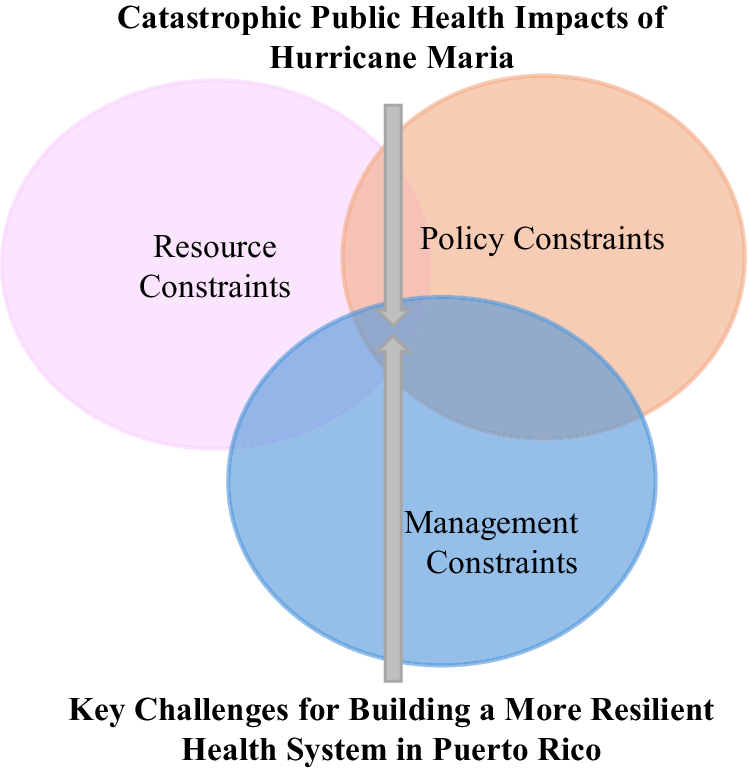
This study addresses this gap by analyzing health system resilience in Puerto Rico following Hurricane Maria. Drawing on qualitative interviews with 62 diverse stakeholders (health care providers, administrators, insurers, emergency managers, and community leaders), we examine resilience across three interrelated domains: (1) resources, (2) management practices, and (3) policy constraints (Figure 1). By synthesizing stakeholder experiences, we offer an integrated account of the barriers and opportunities that shape preparedness, response, and recovery capacity. The findings contribute actionable insights for enhancing disaster preparedness and for informing reforms to strengthen equity and sustainability in Puerto Rico’s health system.
Conceptual diagram of the study.

Methods
Design and Rationale
We employed a qualitative study design using semi-structured interviews to capture diverse perspectives on health system challenges after Hurricane Maria. This approach was chosen to allow participants to narrate experiences and identify systematic barriers in their own words, which is essential for understanding the resilience in context.
Sampling and Recruitment
Participants were recruited using purposive sampling to capture variations across stakeholder groups: (1) direct health service providers (e.g., hospitals, community health centers, nurses, physicians, pharmacists), (2) agency representatives (e.g., Medicaid/Medicare insurers, emergency management officials), and (3) indirect stakeholders (e.g., utility sector representatives, community organizers, patients). Recruitment occurred between January and April 2023 through professional networks, organizational referrals, and snowball sampling. A total of 62 individuals participated (see Figure 2). Table 1 presents the sociodemographic characteristics of the study participants.
Hurricane Maria’s path and the distribution of interview participants in Puerto Rico.

Distribution of sociodemographic characteristics of study participants, Puerto Rico, January-April 2023

Data Collection
Interviews were conducted in Spanish, either in person or via secure virtual platforms, depending on participant preference and availability. The average interview lasted approximately 45 minutes. Interviews followed a guide with structured, semi-structured, and open-ended questions covering 3 domains of resilience: resources, management, and policy. All interviews were audio-recorded with consent, professionally transcribed verbatim, and translated into English for analysis.
Analysis
Data were analyzed thematically. Two researchers independently reviewed transcripts and developed an initial codebook based on both a priori domains (resources, management, policy) and inductive codes emerging from the data. Coding was conducted in NVivo. Themes were refined through iterative team meetings and triangulated across stakeholder groups.
Results
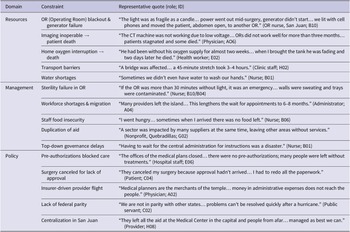
The results highlighted that disaster-related public health management challenges in Puerto Rico following Hurricane Maria were primarily due to resource constraints (e.g., utility infrastructures, services), management constraints (e.g., shortage of health care professionals, inadequate coordination, and poor communication), and policy constraints (e.g., limitations or barriers imposed by regulations governing the delivery of health services, including a lack of planning and regulations). Table 2 provides a summary of major constraints with representative quotations.
Key constraints to health system resilience after Hurricane Maria, Puerto Rico (January-April 2023 interviews, n = 62)

Resource Constraints
Electricity and Clinical Safety
Participants consistently identified the collapse of the island’s electricity grid as the single most disruptive barrier to health care delivery. Power outages lasted on average 62.7 ± 77.8 days, with some facilities reporting up to 300 days without reliable service. Nearly nine in ten participants (85.5%) reported that their workplace or community was directly affected. Electricity failures cascaded into other critical infrastructures, paralyzing water systems, disrupting transportation routes, and crippling communications networks. These breakdowns placed both patients and providers at risk. For clinicians in acute care, even seconds without electricity were life-threatening. A nurse with three decades of operating room experience explained:
“The intermittency in electrical power was also worrisome. Even if it was for seconds, a blackout in the middle of a surgery is desperate. Imagine a neurosurgeon stapling an aneurysm and at that moment there is a power outage, one wrong move and the aneurysm bursts.” (Nurse, San Juan)
Others described full generator failure during complex procedures, forcing improvised and risky patient transfers:
“The light was as fragile as a candle… the power went out in the middle of the surgery and the generator did not come on. We lit with cell phones and moved the patient, abdomen open, to another operating room.” (Nurse, San Juan)
Power instability also disabled imaging and sterilization equipment. A physician recounted the death of a patient on anticoagulants whose head bleed could not be evaluated:
“The CT machine was not working due to low voltage… They couldn’t operate on him because there was no imaging study to justify the emergency. The operating rooms did not work well for more than three months, due to the issue of electricity and air conditioning.” (Physician, San Juan)
Home Oxygen and Life-support Technology
The effects of infrastructure collapse extended far beyond hospitals. Many participants emphasized the risks faced by patients dependent on biomedical equipment at home, such as oxygen concentrators or suction machines. When cylinders ran out or generators failed, lives were placed in immediate danger. “He had been without his oxygen supply for almost two weeks. When I brought him the tank, he was fading and two days later he died,” a health worker from San Juan recalled a case that ended tragically.
Such experiences were not isolated. Providers described multiple households where bedridden patients lacked reliable power or fuel to keep biomedical devices functioning:
“I heard from more than ten people, all bedridden, who needed biomedical equipment in their homes and had problems with the generators. Some did not have generators and others could not get gasoline.” (Hospital Utility Operator, San Juan)
These accounts highlight how fragile home-based care became in the absence of stable electricity and fuel supply chains, underscoring the vulnerability of patients living outside hospital settings.
Communications and Transportation
Breakdowns in transportation and communication were repeatedly described as amplifying harm. With more than 60% of participants reporting blocked roads or collapsed bridges, providers struggled to reach work, and patients often could not access emergency care. “A bridge was affected… a 45-minute stretch took 3–4 hours,” one medical social worker of Ponce described how travel times lengthened dramatically. In more remote communities, the consequences were deadly. A resident and a patient at Salinas recounted the story of a neighbor who died because there was no way to reach an emergency room. “An acquaintance died at home; there was no way to reach the ER… youths carried him to be buried,” he said.
Communication failures compounded these risks. Participants reported internet and phone outages averaging 41.2 ± 62.1 days, which hindered referrals, outreach, and coordination of relief. “The communication problem was the accelerator of so many misfortunes. We couldn’t reach the people who really needed us. Many people were too long incommunicado,” a physician described the human cost of isolation. Together, transportation barriers and communication breakdowns not only slowed response but also converted routine delays into life-threatening situations.
Water Shortages and Infection Control
Water service interruptions were another major constraint, averaging 13.7 ± 33.7 days but lasting over 100 days in some municipalities. Providers described rationing and improvising to sustain hygiene, sterilization, and infection control. “There was instability in the electrical system and in the water system. Sometimes we didn’t even have water to wash our hands,” as one nurse from San Juan recalled. These shortages disproportionately affected nursing homes and congregate care facilities, where frail residents were unable to secure safe water. Several participants linked these conditions to increases in leptospirosis and other infections.
Management Constraints
Service Continuity and Depletion Under Failing Utilities
Beyond infrastructure collapse, participants emphasized management and organizational failures. More than half of providers (53%) reported that their facility was unable to provide services for weeks or months after the hurricane primarily because of prolonged outages and disrupted supply chains. Small reserves that had sustained facilities during routine disruptions were depleted within days. As electricity was inconsistent, refrigeration for medicines and vaccines grew unstable, sterilization processes were interrupted, and operating rooms could no longer follow predictable schedules. With electronic systems down, staff improvised the system by reverting to paper records and depended on colleagues running messages across wards. A nurse described how unstable conditions undermined surgical sterility:
“Maintaining sterility was a constant struggle… If the operating room was more than 30 minutes without light, it was an emergency for any surgery. The walls were sweating and the trays were contaminated.” (Nurse, San Juan)
Resource scarcity extended beyond equipment. Providers themselves were working under extreme strain. Many described long shifts compounded by personal hardships such as hours-long waits for fuel, lack of reliable food, and damaged homes. One nurse recalled:
“A very big challenge was the logistics of how to meet the needs of health providers. I went hungry because although they brought food for the staff, sometimes when I arrived there was no food left. There were no places where I could buy my food.” (Nurse, San Juan)
Workforce Shortages and Service Disruptions
Workforce shortages, which are already a chronic challenge in Puerto Rico, became acute after Hurricane Maria. The exodus of physicians, nurses, and specialists to the mainland, combined with clinic closures and increased demand at facilities that remained open, left patients waiting months for basic and specialized care. A doctor described the scale of the problem:
“Many health service providers left the island and decided not to return… Patients who should normally see primary care providers are showing up in greater numbers. This lengthens the wait for appointments to 6 and 8 months.” (Doctor, San Juan)
Patients themselves echoed these frustrations, emphasizing the daily reality of a system with too few providers and no clear channels for recourse. “There are no paramedics, no ambulances, very few nurses… As a patient I have nowhere to complain,” one patient from Arroyo described the absence of essential emergency personnel.
The hurricane’s impact also extended to critical emergency services. Infrastructure damage and staffing gaps forced temporary closure of specialized facilities, leaving patients to be diverted elsewhere. A Doctor from San Juan recalled how even the Trauma Center in San Juan, one of the island’s most important emergency hubs, was unable to function: “The Trauma Center had to close for several days… All incoming patients were referred to the feds’ Comfort ship.” Together, these accounts highlight how the combined effects of workforce migration, facility closures, and fragile infrastructure undermined both everyday access and acute emergency care, deepening vulnerabilities across the health system.
Coordination Gaps and Unclear Command
Coordination during and after the hurricane was described as fragmented and inconsistent. Several participants noted that while some communities were overwhelmed with overlapping deliveries, others went without basic support. This unevenness reflected a lack of communication between organizations and absence of a coordinated distribution plan. A nonprofit leader from Quebradillas illustrated the problem:
“There was a lot of duplication of interventions. Many times, a sector was impacted by many suppliers at the same time, leaving other areas without services, supplies, and equipment.” (Nonprofit, Quebradillas)
Inside hospitals, the same pattern of weak coordination was evident. Staff were frequently forced to pause critical work while awaiting instructions from senior administrators. This rigid, top-down structure not only delayed care but also left frontline workers feeling powerless. “Having to wait for the central administration for instructions was a disaster, I don’t even want to remember that,” as one nurse from San Juan explained.
Participants across agencies and community organizations repeatedly emphasized the need for clearer command structures and interoperable protocols. They argued that line workers needed authority and guidance to make timely decisions, rather than relying on slow central approvals. A hospital administrator noted: “Have a flow of authority so that line employees will know who to contact and report the sequence of jobs.” Similarly, another hospital administrator highlighted the importance of building connections across services to avoid fragmentation and improve efficiency in emergencies. “If one identifies that a mental health service is needed, then connect directly with the agency that can respond,” he explained. Together, these perspectives underscore how poorly integrated command systems and duplication of effort undermined service delivery, creating both inefficiencies and dangerous gaps in care.
Policy Constraints
Pre-authorizations and Referrals During Emergencies
Participants consistently emphasized rigid insurance requirements. Even in the midst of widespread outages and staffing shortages, insurer requirements for pre-authorizations and referrals remained in force. With medical plan offices closed, patients often went without life-sustaining treatments. A hospital worker described how the system simply froze:
“The offices of the medical plans closed… there were no pre-authorizations, therefore many people were left without receiving their treatments.” (Hospital staff, San Juan)
Patients felt these rules directly in their care. One individual recalled preparing for surgery only to face abrupt cancellation because insurer approval never arrived:
“They canceled my surgery because they had not received approval from the medical plan… no one responded and I had to go do all the paperwork again.” (Patient, Orocovis)
Others emphasized the danger of rigid policies that placed bureaucratic procedure above urgent medical need: “Sometimes referrals and authorizations are required for treatments that put the health and lives of people at risk,” a patient from Ciales said.
Insurer–provider Conflict and Workforce Morale
Providers frequently linked professional dissatisfaction and outmigration to insurance practices they saw as exploitative and profit-driven. Many felt that administrative overhead siphoned funds away from patient care, leaving clinicians underpaid and unsupported. A physician expressed this frustration vividly:
“It is because of the medical plans that there is a flight of professionals… The medical planners are the merchants of the temple; money in administrative expenses does not reach the people.” (Physician, San Juan)
This ongoing tension with insurers not only strained morale but also contributed to the long-term loss of skilled professionals, compounding shortages that were already exacerbated by the disaster.
Financing and Centralization of Aid
Participants also pointed to structural financing inequities rooted in Puerto Rico’s political status. Limited federal funding and lack of Medicaid parity were seen as barriers to preparedness and recovery. As one public servant explained:
“We are not in parity with other states… funds move through agencies and municipalities… problems can’t be resolved quickly after a hurricane.” (Patient, Salinas)
At the same time, aid distribution was perceived as overly centralized in San Juan, leaving rural and mountainous municipalities without timely support. “They left all the aid at the Medical Center in the capital and people from afar… managed as best we can,” one provider described how communities outside the capital were left to manage largely on their own (Hospital Staff, San Juan). Bureaucracy further compounded these inequities by delaying urgent referrals, even for time-sensitive treatments such as dialysis:
“Situations that required quick action were lost in procedures… patients did not receive services on time because dialysis centers did not refer them to the Medical Center.” (Nurse, San Juan)
Taken together, participants emphasized that resource, management, and policy constraints were deeply interconnected rather than isolated challenges. Prolonged power outages disrupted hospital operations, which depleted supplies and strained staff already facing shortages. These resource gaps were magnified by management limitations, including poor coordination, duplicative efforts, and insufficient support for provider well-being. At the same time, rigid policy requirements, such as pre-authorizations and referral mandates, further delayed or blocked access to care, even when providers were willing and able to deliver services. These interlocking barriers created a cascading effect that compounded patient vulnerability and provider strain, underscoring that health system resilience in Puerto Rico cannot be strengthened without addressing all three domains simultaneously.
Limitations
While this study provides important insights into the resilience of Puerto Rico’s health system, several limitations should be noted. First, recruitment did not achieve equal representation across all stakeholder groups (e.g., patients, community representatives, NGOs). Nurses were the most represented group, and findings may therefore disproportionately reflect their perspectives. Second, most interviews were conducted in urban areas due to logistical feasibility, funding availability, and researcher access; as a result, rural-specific challenges may be underrepresented. Third, participation was based on voluntary agreement, and we did not systematically track the denominator of individuals approached versus enrolled. This limits our ability to assess selection bias or generalize findings to the wider population. These limitations partly reflect the resource constraints under which the study was conducted, including limited funding for island-wide travel, translation, and extended recruitment. Future studies with broader resources could expand recruitment to underrepresented stakeholders and rural settings, employ mixed sampling strategies, and integrate longitudinal approaches to strengthen generalizability.
Discussion
This study shows how Puerto Rico’s post-Maria health system resilience was constrained by the interplay of resource, management, and policy factors. Prolonged failures of electricity and communications produced cascading effects that disrupted clinical services (imaging, sterilization, oxygen delivery), while workforce losses and coordination gaps limited organizational adaptability. Simultaneously, routine administrative rules (pre-authorizations, referrals) remained in force during the emergency, delaying time-critical care. These findings not only highlight barriers to resilience in the face of disaster but also underscore the importance of targeted federal policy intervention, infrastructure investment, and more effective coordination of resources and stakeholders. These patterns align with the global literature that conceptualizes resilience as the capacity to absorb, adapt, and transform in the face of shocks.Reference Kruk, Myers, Varpilah and Dahn 2 , Reference Thomas, Keegan and Barry 4 , Reference Fernandez 17 , Reference Blanchet, Nam and Ramalingam 18 , Reference Hanefeld, Mayhew and Legido-Quigley 23
The critical interdependence of infrastructures was evident, as disruptions to the power grid undermined water, transportation, and communication systems. Participants described how blackouts compromised surgical safety, delayed sterilization of instruments, and created shortages of oxygen and medications. Consistent with global resilience research, these findings reflect how infrastructure failures often drive health service collapse during crises.Reference Kruk, Myers, Varpilah and Dahn 2 , Reference Thomas, Keegan and Barry 4 , Reference Chandra, Marsh and Madrigano 19 –Reference Adhikari, Mishra and Marahatta 22 Puerto Rico’s case reinforces the need for robust and redundant systems, including diversified energy sources and facility-level backup power, as central components of health system resilience.
Management constraints, including shortages of health professionals, stress on limited staff, and inadequate coordination among stakeholders, further impaired service delivery. Interviewees emphasized the out-migration of skilled clinicians, long wait times for specialists, and insufficient communication across agencies and insurers. These findings parallel global evidence that disasters exacerbate pre-existing workforce shortages, accelerate migration, and expose governance weaknesses.Reference Blanchet, Nam and Ramalingam 18 , Reference Hanefeld, Mayhew and Legido-Quigley 23 In Puerto Rico, these pressures were compounded by top-down decision-making and insurer priorities that limited frontline flexibility. Such governance constraints have been identified elsewhere as key obstacles to adaptive and learning capacities, which are essential dimensions of resilient health systems.Reference Kieny, Evans, Schmets and Kadandale 1 , Reference Blanchet, Nam and Ramalingam 18 , Reference Hanefeld, Mayhew and Legido-Quigley 23
Policy and financing constraints also hindered the response. Respondents described rigid insurance pre-authorization requirements, low Medicaid reimbursements, and gaps in ACA (Affordable Care Act) coverage, all of which restricted access during and after the emergency. These findings are consistent with prior analyses documenting Puerto Rico’s unique fiscal constraints and their impact on health care delivery.Reference Perreira, Jones and Oberlander 13 , Reference Rodríguez-Madera, Varas-Díaz and Padilla 15 In resilience terms, flexible financing and adaptive governance are recognized as critical enablers, yet participants described an environment of inflexibility and underinvestment.
Based on participants’ accounts, several practical lessons emerge. First, investments in redundant and renewable power systems are critical to safeguarding continuity of care. Second, insurers and regulators should adopt emergency protocols that temporarily relax administrative requirements to protect timely access. Third, policies to retain and support health workers, including fair compensation, training opportunities, and mental health support are essential to sustaining service delivery after shocks. These recommendations are consistent with resilience frameworks that stress absorptive and adaptive capacities, while remaining grounded in the lived experiences documented in this study.
Conclusion
In conclusion, this study analyzed stakeholder perspectives on the challenges of building health system resilience in Puerto Rico following Hurricane Maria. Our findings highlight how resource, management, and policy constraints undermined care delivery and recovery. Participants repeatedly emphasized the cascading effects of prolonged power failures, the stress and migration of health professionals, and the difficulties imposed by pre-authorization and referral processes.
Based on these findings, several recommendations emerge directly from participants’ accounts. Hospitals and providers should strengthen backup energy systems and explore diversification of power sources, as many stakeholders described electricity failure as the most acute barrier to care. Stakeholders also highlighted the need to support and retain health workers through improved compensation, mental health support, and expanded scope of practice for nurses to reduce shortages during crises. Respondents pointed to the importance of more effective coordination mechanisms across hospitals, insurers, and community organizations to avoid duplication and gaps. Finally, participants recommended flexibility in insurance requirements during emergencies, particularly the suspension of pre-authorization and referral mandates that were cited as barriers to timely care. These recommendations are rooted in the lived experiences of those most affected by Hurricane Maria. While broader structural reforms may be necessary to address Puerto Rico’s long-standing vulnerabilities, our findings specifically underscore participant-identified priorities for strengthening health system resilience at the operational and policy levels.
Acknowledgments
We extend our gratitude to all respondents who took the time to participate in the interview despite their busy schedules. We also acknowledge the support from the Population Health Initiative at Florida International University (Population Health Research Catalyst Pilot Fund: Disparity in Disaster Vulnerability, Dynamic Inequality, Population Health, and Climate Resilience). The study was approved by the Social and Behavioral Institutional Review Board of Florida International University (IRB Protocol Approval #: IRB-23-0017).
Author contribution
Pallab Mozumder, Linnette Rodriguez-Figueroa, Sisi Meng, and Nafia Halim were responsible for study conception and design. Mayra Quiles-Miranda contributed to conduct interviews for the study. Barsha Manandhar and Nafisa Halim were responsible for reading the transcripts, coding, and data analysis. Linnette Rodriguez-Figueroa was responsible for analyzing quantitative data. Barsha Manandhar and Pallab Mozumder contributed to the drafting of the Manuscript. Pallab Mozumder, Linnette Rodriguez-Figueroa, Sisi Meng, and Nafia Halim read and edited the manuscript before submission.
Funding statement
We acknowledge the support from the Natural Hazards Center Public Health Disaster Research Award Program on Research in the U.S. Territories, Tribal Areas, and Rural Communities.We also acknowledge the support from the Population Health Initiative at Florida International University (Population Health Research Catalyst Pilot Fund: Disparity in Disaster Vulnerability, Dynamic Inequality, Population Health, and Climate Resilience).
Competing interests
The authors have no conflicts of interest to declare.
Use of artificial intelligence (AI) tools
ChatGPT was used to ensure grammatical accuracy and clarity of English text only.